Unit-III
Abstract
Algorithms
Sub-DAA Class-TE Comp
Greedy Method
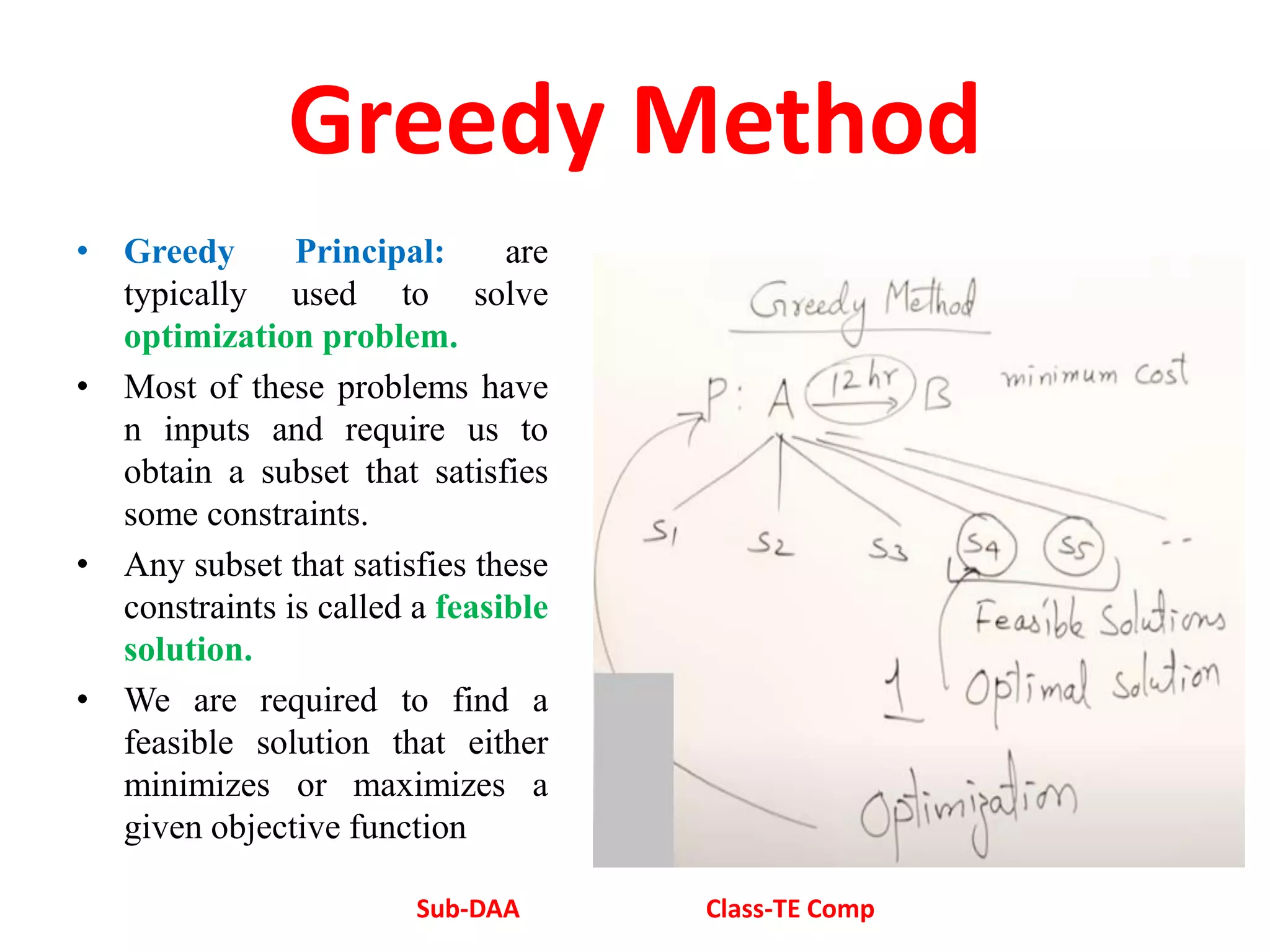
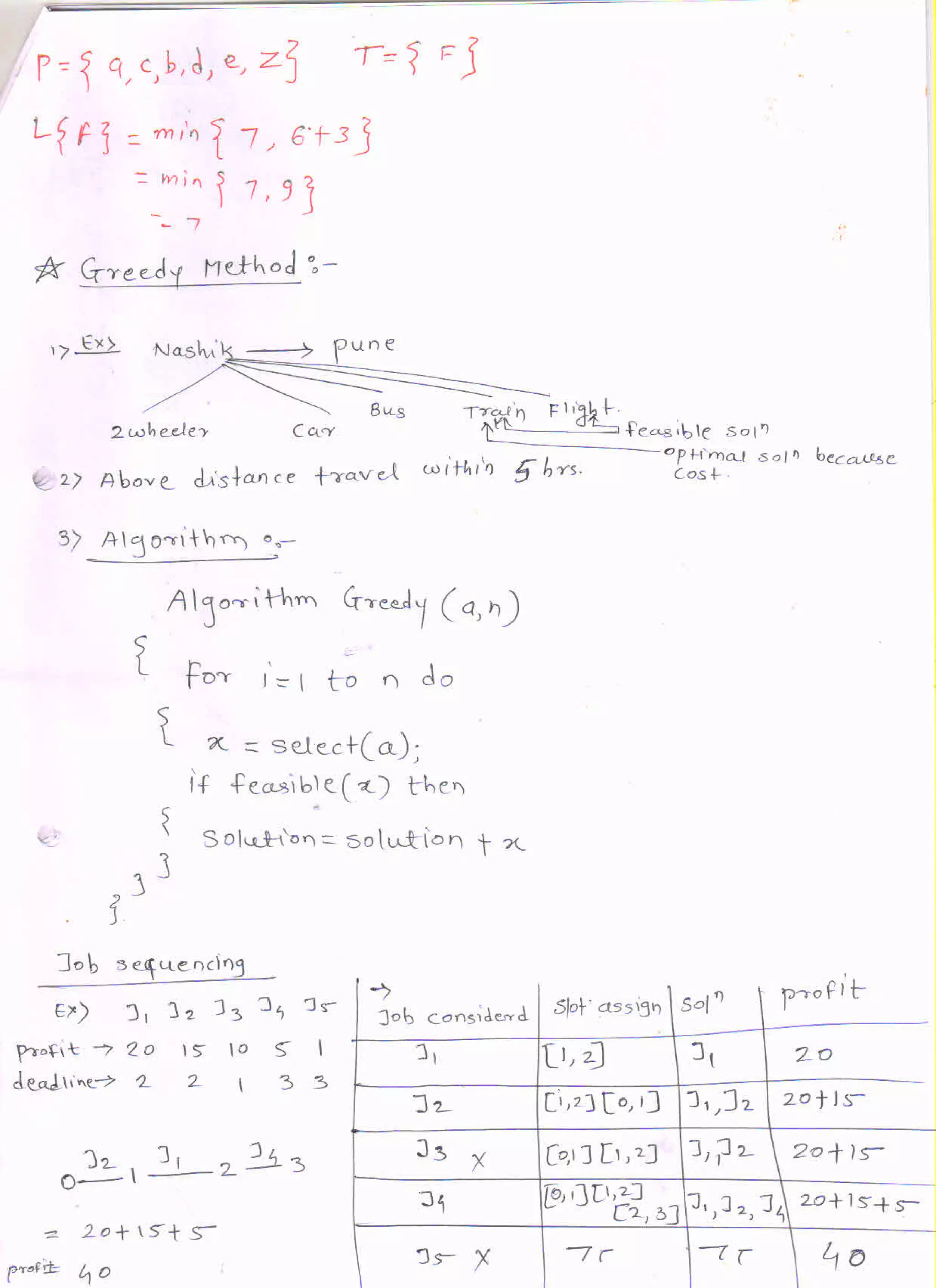
• Greedy Principal: are
typically used to solve
optimization problem.
• Most of these problems have
n inputs and require us to
obtain a subset that satisfies
some constraints.
• Any subset that satisfies these
constraints is called a feasible
solution.
• We are required to find a
feasible solution that either
minimizes or maximizes a
given objective function
Sub-DAA Class-TE Comp
• Subset Paradigm : Devise an algorithm that works in stages
• Consider the inputs in an order based on some selection procedure
• Use some optimization measure for selection procedure
• At every stage, examine an input to see whether it leads to an
optimal solution
• If the inclusion of input into partial solution yields an infeasible
solution, discard the input; otherwise, add it to the partial solution
Applications of Greedy Method:
 Knapsack Problem
 Minimum Spanning Tree
 Job Sequencing Problem
 Huffman Code Generation
 Activity Selection Problem
 Shortest Path
Sub-DAA Class-TE Comp
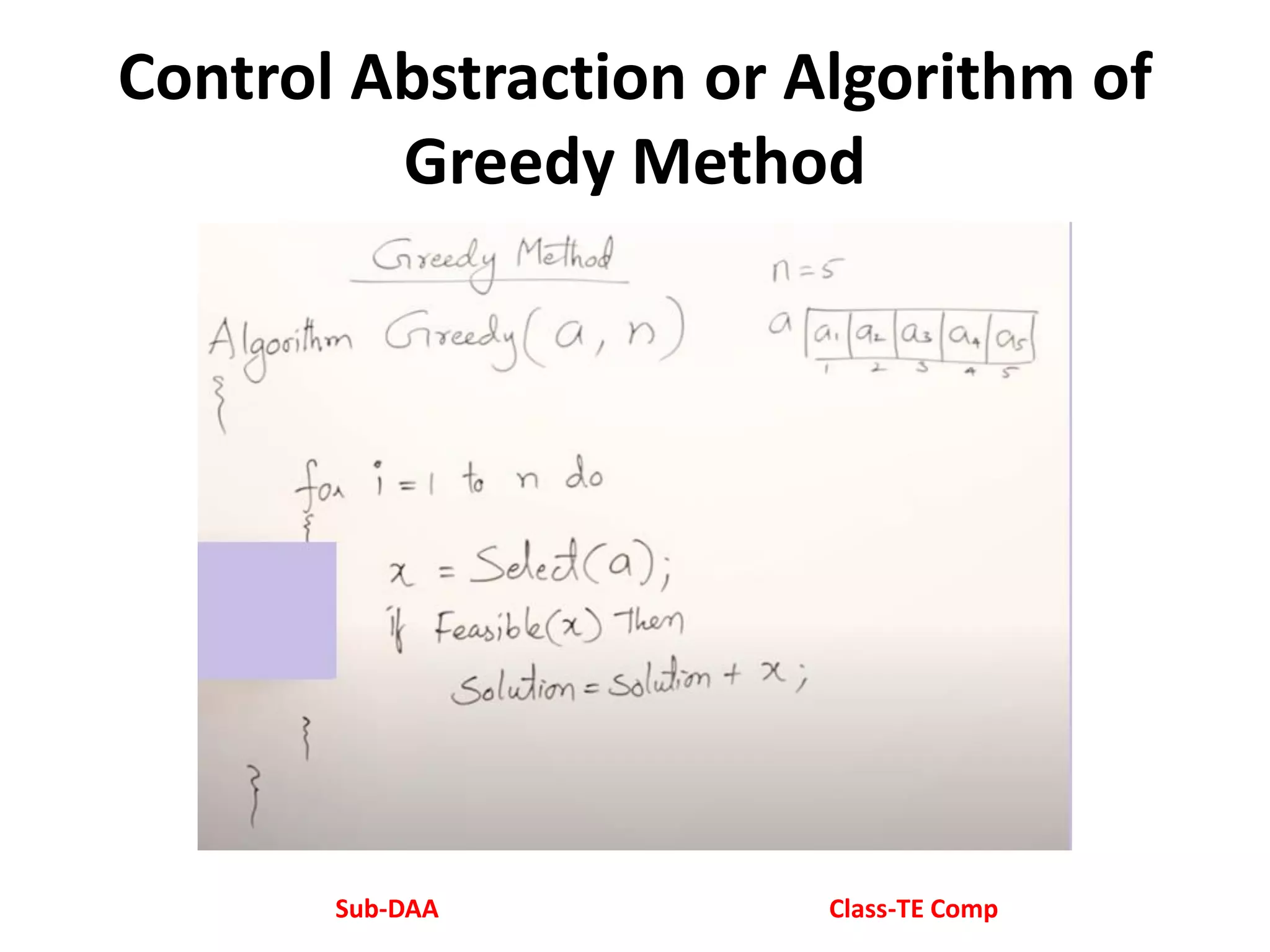
Control Abstraction or Algorithm of
Greedy Method
Sub-DAA Class-TE Comp
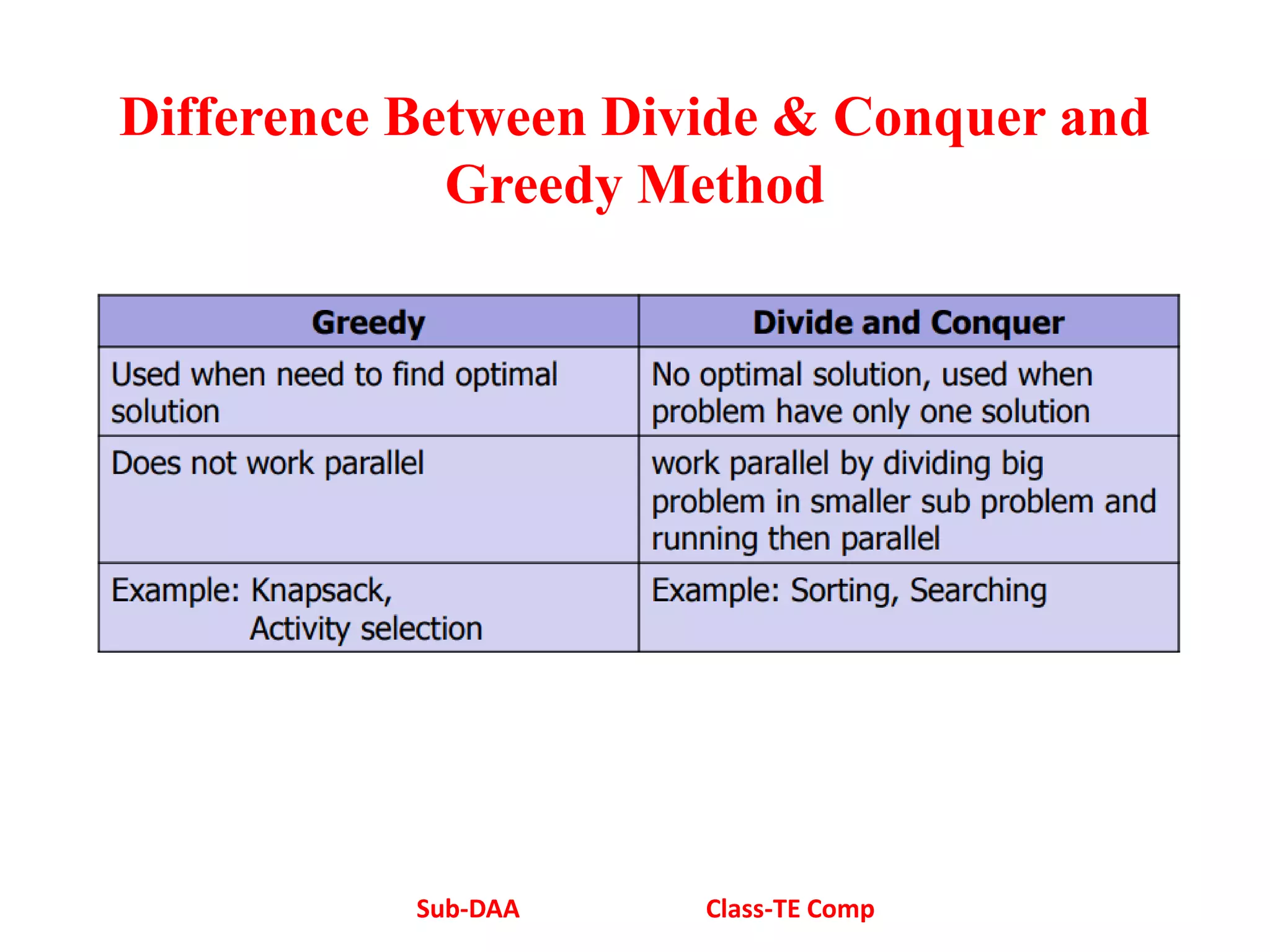
Difference Between Divide & Conquer and
Greedy Method
Sub-DAA Class-TE Comp
Knapsack Problem
Sub-DAA Class-TE Comp
 The knapsack problem is a problem of optimization: Given a set of
items n, each with a weight w and profit p, determine the number of
each item to include in a knapsack such that the total weight is less
than or equal to a given knapsack limit M and the total Profit is
maximum.
 There are two types of Knapsack Problem.
 The 0-1 Knapsack Problem: same as integer knapsack except that
the values of xi 's are restricted to 0 or 1.
 The Fractional Knapsack Problem : same as integer knapsack
except that the values of xi 's are between 0 and 1.
Knapsack Problem Formula
Sub-DAA Class-TE Comp
Knapsack Problem Algorithm and
Time Complexity
Sub-DAA Class-TE Comp
Algorithm GreedyKnapsack (m, n)
// P[1 : n] and w[1 : n] contain the profits and
weights respectively of
// Objects ordered so that p[i] / w[i] > p[i + 1] /
w[i + 1].
// m is the knapsack size and x[1: n] is the
solution vector.
{
for i := 1 to n do x[i] := 0.0 // initialize x U := m;
for i := 1 to n do
{
if (w(i) > U) then break;
x [i] := 1.0; U := U – w[i];
}
if (i < n) then x[i] := U / w[i];
}
Running time:
The objects are to be sorted
into non-increasing order of
pi / wi ratio.
But if we disregard the time to
initially sort the objects, the
algorithm requires only O(n)
time
Sub-DAA Class-TE Comp
Knapsack(0/1) Problem using Greedy
Method
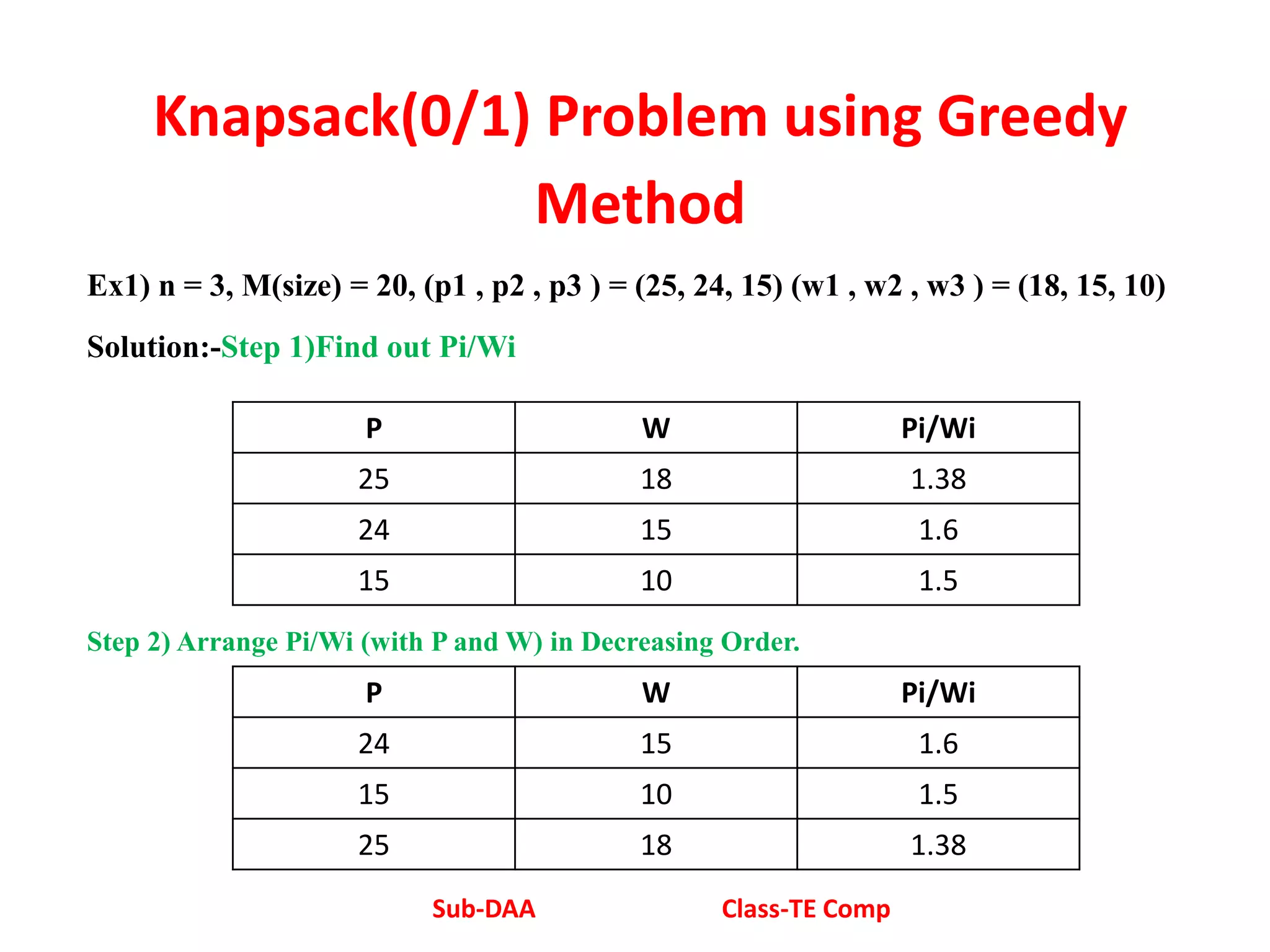
Ex1) n = 3, M(size) = 20, (p1 , p2 , p3 ) = (25, 24, 15) (w1 , w2 , w3 ) = (18, 15, 10)
Solution:-Step 1)Find out Pi/Wi
Step 2) Arrange Pi/Wi (with P and W) in Decreasing Order.
P W Pi/Wi
25 18 1.38
24 15 1.6
15 10 1.5
P W Pi/Wi
24 15 1.6
15 10 1.5
25 18 1.38
Sub-DAA Class-TE Comp
• Step 3) Insert Weight into bucket upto size M
15(w2)
M=20
5(w3)
15(w2)
Step 4) Solution
W1 W2 W3
0 1 ½ (10/2=5)
Step 5) Calculate Total Profit
=P1*0+ P2*1 +P3* ½
=25*0+24*1+15*1/2
=0+24+7.5
Total Profit= 31.5
Sub-DAA Class-TE Comp
Ex 2) n = 3, M(size) = 20, (p1 , p2 , p3 ) = (30, 21, 18) (w1 , w2 , w3 ) = (18, 15, 10)
Solution: Step-1) Arrange Pi/Wi (with P and W) in Decreasing Order.
W1 W2 W3
1/2 1/15 1
P W Pi/Wi
18 10 1.8
30 18 1.66
21 15 1.4
Step 2) Insert Weight into bucket
upto size M M=20
1
9
10
Step 3) Solution
Step 4) Find the total Profit
Total Profit= 18+21*1/15+15
=18+1.4+15=34.4
Sub-DAA Class-TE Comp
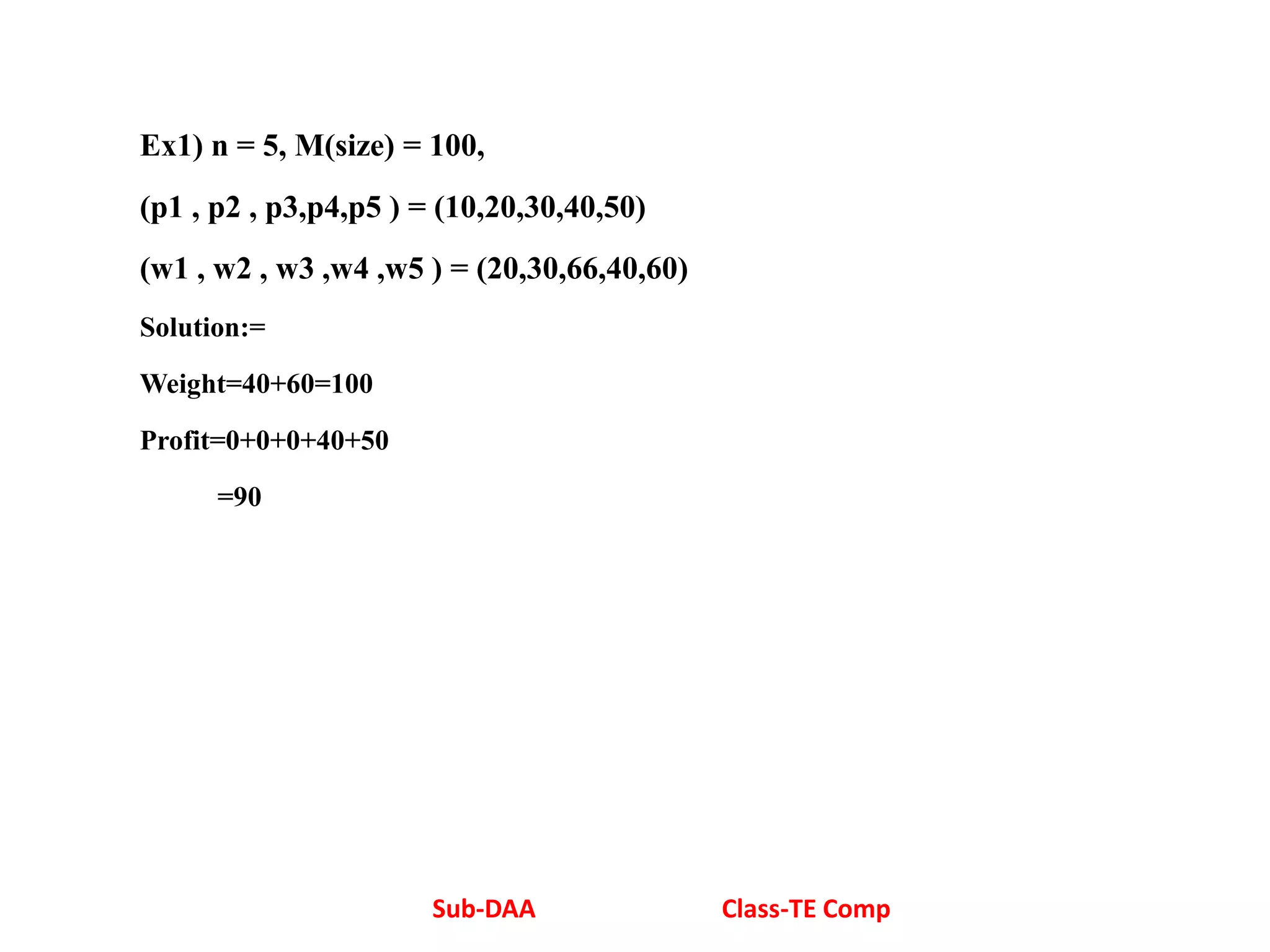
Ex1) n = 5, M(size) = 100,
(p1 , p2 , p3,p4,p5 ) = (10,20,30,40,50)
(w1 , w2 , w3 ,w4 ,w5 ) = (20,30,66,40,60)
Solution:=
Weight=40+60=100
Profit=0+0+0+40+50
=90
Sub-DAA Class-TE Comp
Job sequencing using Greedy Method
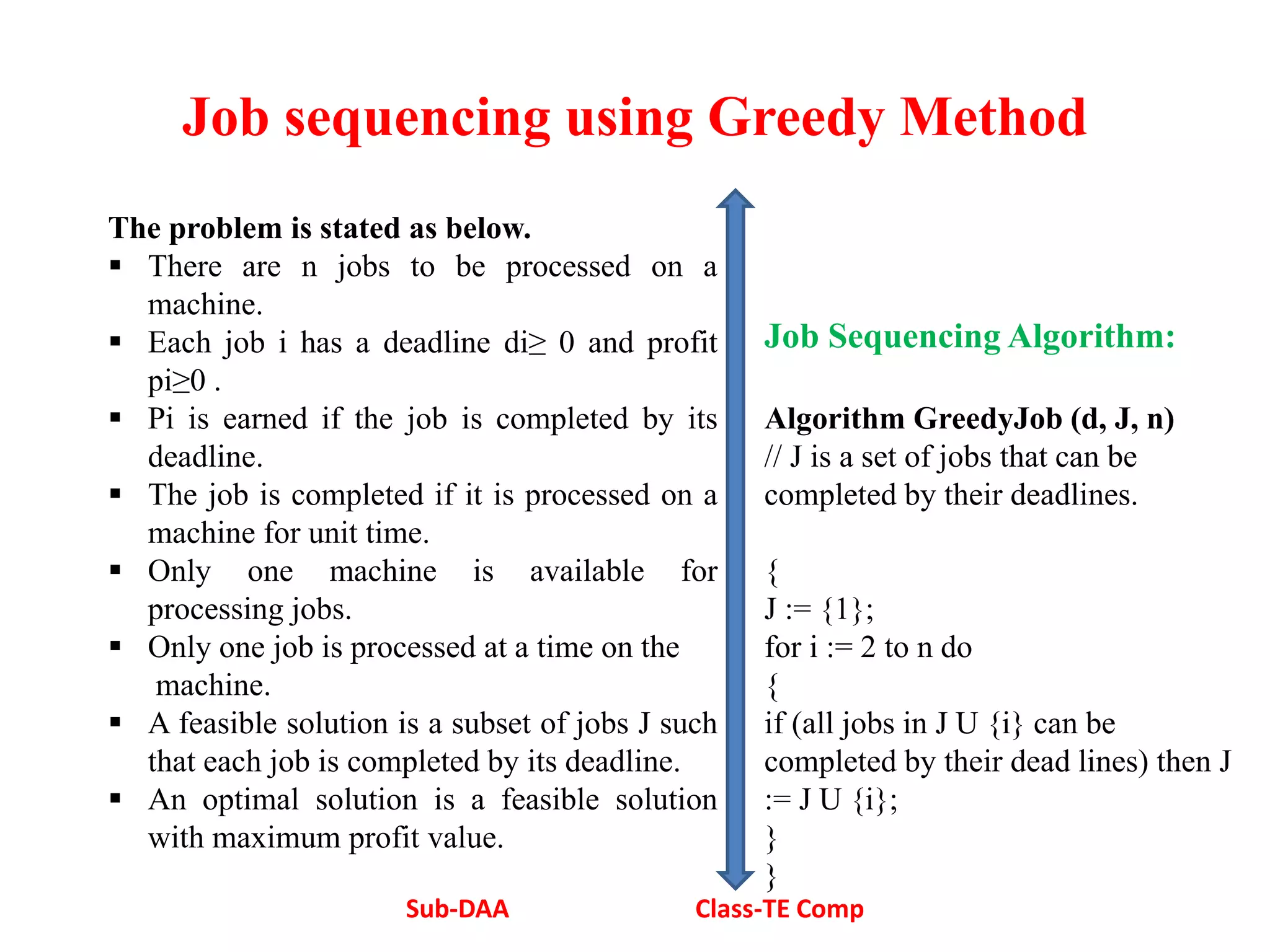
The problem is stated as below.
 There are n jobs to be processed on a
machine.
 Each job i has a deadline di≥ 0 and profit
pi≥0 .
 Pi is earned if the job is completed by its
deadline.
 The job is completed if it is processed on a
machine for unit time.
 Only one machine is available for
processing jobs.
 Only one job is processed at a time on the
machine.
 A feasible solution is a subset of jobs J such
that each job is completed by its deadline.
 An optimal solution is a feasible solution
with maximum profit value.
Job Sequencing Algorithm:
Algorithm GreedyJob (d, J, n)
// J is a set of jobs that can be
completed by their deadlines.
{
J := {1};
for i := 2 to n do
{
if (all jobs in J U {i} can be
completed by their dead lines) then J
:= J U {i};
}
}
Sub-DAA Class-TE Comp
Job sequencing using Greedy Method
Formula:-
For slot assign:-
=[ Alpha(a)-1, Alpha(a)]
Optimal Solution:-
i.e ∑pi 1≤ i≤ n
Job sequencing using Greedy Method Example
Ex 1) Solve following using JSD Method
Where n=5
Sub-DAA Class-TE Comp
JOBs J1 J2 J3 J4 J5
Profit 20 15 10 5 1
Deadline 2 2 1 3 3
Job Consider Slot Assign Solution Profit
J1 [2-1,2]=[1,2] J1 20
J2 [1,2] [0,1] J1,J2 20+15
J3 [1,2] [0,1] J1,J2 20+15
J4 [1,2] [0,1]
[2,3]
J1,J2,J4 20+15+5
J5 [1,2] [0,1]
[2,3]
J1,J2,J4 20+15+5=40
Solution:-Step-1) Arrange all Job in Descending Order
Step-2) Job Sequence Path :- 0…J2…..1…J1….2…J4….3
Profit:- 20+15+5=40
Ex2)N=4 (p1,p2,p3,p4)=(100,10,15,27)
(d1,d2,d3,d4)=(2,1,2,1)
Ex3) N=5 (p1,p2,p3,p4,p5)=(25,15,12,5,1)
(d1,d2,d3,d4,d5)=(3,2,1,3,3)
Sub-DAA Class-TE Comp
Minimum Spanning Tree
Sub-DAA Class-TE Comp
Minimum Spanning Trees (MST):
 A spanning tree for a connected graph is a tree whose vertex set is the same
as the vertex set of the given graph, and whose edge set is a subset of the
edge set of the given graph. i.e., any connected graph will have a spanning
tree.
 Weight of a spanning tree w (T) is the sum of weights of all edges in T. The
Minimum spanning tree (MST) is a spanning tree with the smallest possible
weight.
Sub-DAA Class-TE Comp
Prims Algorithm
How Prim's algorithm works
It falls under a class of algorithms called greedy algorithms that find the local
optimum in the hopes of finding a global optimum.
We start from one vertex and keep adding edges with the lowest weight until we
reach our goal.
The steps for implementing Prim's algorithm are as follows:
1.Initialize the minimum spanning tree with a vertex chosen at random.
2.Find all the edges that connect the tree to new vertices, find the minimum and
add it to the tree
3.Keep repeating step 2 until we get a minimum spanning tree
Sub-DAA Class-TE Comp
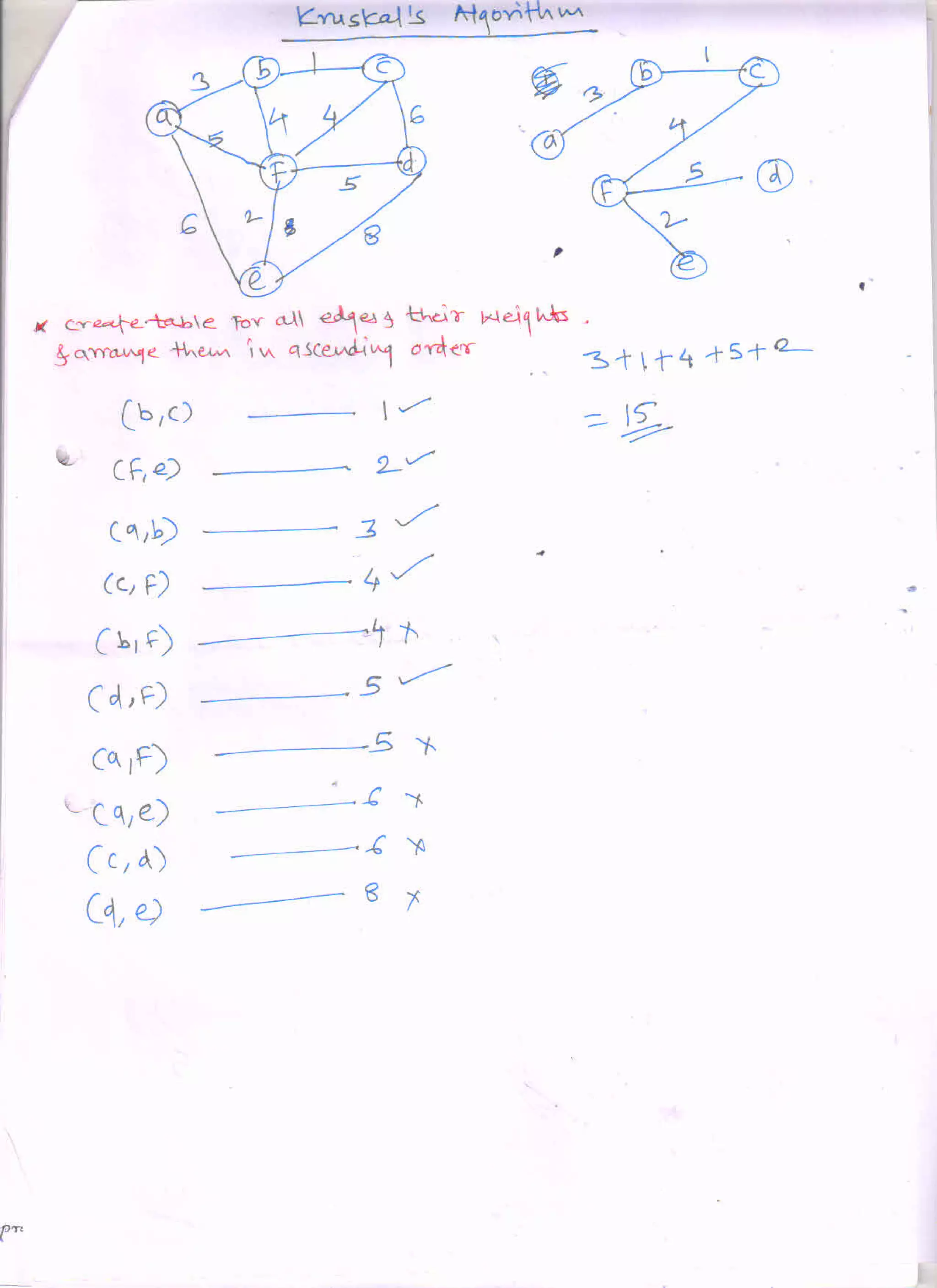
Kruskal's Algorithm
How Kruskal's algorithm works
It falls under a class of algorithms called greedy algorithms that find the local
optimum in the hopes of finding a global optimum.
We start from the edges with the lowest weight and keep adding edges until we
reach our goal.
The steps for implementing Kruskal's algorithm are as follows:
1.Sort all the edges from low weight to high
2.Take the edge with the lowest weight and add it to the spanning tree. If
adding the edge created a cycle, then reject this edge.
3.Keep adding edges until we reach all vertices.
final-ppts-daa-unit-iii-greedy-method.pdf

final-ppts-daa-unit-iii-greedy-method.pdf

  • 1.
  • 2.
    Greedy Method • GreedyPrincipal: are typically used to solve optimization problem. • Most of these problems have n inputs and require us to obtain a subset that satisfies some constraints. • Any subset that satisfies these constraints is called a feasible solution. • We are required to find a feasible solution that either minimizes or maximizes a given objective function Sub-DAA Class-TE Comp
  • 3.
    • Subset Paradigm: Devise an algorithm that works in stages • Consider the inputs in an order based on some selection procedure • Use some optimization measure for selection procedure • At every stage, examine an input to see whether it leads to an optimal solution • If the inclusion of input into partial solution yields an infeasible solution, discard the input; otherwise, add it to the partial solution Applications of Greedy Method:  Knapsack Problem  Minimum Spanning Tree  Job Sequencing Problem  Huffman Code Generation  Activity Selection Problem  Shortest Path Sub-DAA Class-TE Comp
  • 4.
    Control Abstraction orAlgorithm of Greedy Method Sub-DAA Class-TE Comp
  • 5.
    Difference Between Divide& Conquer and Greedy Method Sub-DAA Class-TE Comp
  • 6.
    Knapsack Problem Sub-DAA Class-TEComp  The knapsack problem is a problem of optimization: Given a set of items n, each with a weight w and profit p, determine the number of each item to include in a knapsack such that the total weight is less than or equal to a given knapsack limit M and the total Profit is maximum.  There are two types of Knapsack Problem.  The 0-1 Knapsack Problem: same as integer knapsack except that the values of xi 's are restricted to 0 or 1.  The Fractional Knapsack Problem : same as integer knapsack except that the values of xi 's are between 0 and 1.
  • 7.
  • 8.
    Knapsack Problem Algorithmand Time Complexity Sub-DAA Class-TE Comp Algorithm GreedyKnapsack (m, n) // P[1 : n] and w[1 : n] contain the profits and weights respectively of // Objects ordered so that p[i] / w[i] > p[i + 1] / w[i + 1]. // m is the knapsack size and x[1: n] is the solution vector. { for i := 1 to n do x[i] := 0.0 // initialize x U := m; for i := 1 to n do { if (w(i) > U) then break; x [i] := 1.0; U := U – w[i]; } if (i < n) then x[i] := U / w[i]; } Running time: The objects are to be sorted into non-increasing order of pi / wi ratio. But if we disregard the time to initially sort the objects, the algorithm requires only O(n) time
  • 9.
    Sub-DAA Class-TE Comp Knapsack(0/1)Problem using Greedy Method Ex1) n = 3, M(size) = 20, (p1 , p2 , p3 ) = (25, 24, 15) (w1 , w2 , w3 ) = (18, 15, 10) Solution:-Step 1)Find out Pi/Wi Step 2) Arrange Pi/Wi (with P and W) in Decreasing Order. P W Pi/Wi 25 18 1.38 24 15 1.6 15 10 1.5 P W Pi/Wi 24 15 1.6 15 10 1.5 25 18 1.38
  • 10.
    Sub-DAA Class-TE Comp •Step 3) Insert Weight into bucket upto size M 15(w2) M=20 5(w3) 15(w2) Step 4) Solution W1 W2 W3 0 1 ½ (10/2=5) Step 5) Calculate Total Profit =P1*0+ P2*1 +P3* ½ =25*0+24*1+15*1/2 =0+24+7.5 Total Profit= 31.5
  • 11.
    Sub-DAA Class-TE Comp Ex2) n = 3, M(size) = 20, (p1 , p2 , p3 ) = (30, 21, 18) (w1 , w2 , w3 ) = (18, 15, 10) Solution: Step-1) Arrange Pi/Wi (with P and W) in Decreasing Order. W1 W2 W3 1/2 1/15 1 P W Pi/Wi 18 10 1.8 30 18 1.66 21 15 1.4 Step 2) Insert Weight into bucket upto size M M=20 1 9 10 Step 3) Solution Step 4) Find the total Profit Total Profit= 18+21*1/15+15 =18+1.4+15=34.4
  • 12.
    Sub-DAA Class-TE Comp Ex1)n = 5, M(size) = 100, (p1 , p2 , p3,p4,p5 ) = (10,20,30,40,50) (w1 , w2 , w3 ,w4 ,w5 ) = (20,30,66,40,60) Solution:= Weight=40+60=100 Profit=0+0+0+40+50 =90
  • 13.
    Sub-DAA Class-TE Comp Jobsequencing using Greedy Method The problem is stated as below.  There are n jobs to be processed on a machine.  Each job i has a deadline di≥ 0 and profit pi≥0 .  Pi is earned if the job is completed by its deadline.  The job is completed if it is processed on a machine for unit time.  Only one machine is available for processing jobs.  Only one job is processed at a time on the machine.  A feasible solution is a subset of jobs J such that each job is completed by its deadline.  An optimal solution is a feasible solution with maximum profit value. Job Sequencing Algorithm: Algorithm GreedyJob (d, J, n) // J is a set of jobs that can be completed by their deadlines. { J := {1}; for i := 2 to n do { if (all jobs in J U {i} can be completed by their dead lines) then J := J U {i}; } }
  • 14.
    Sub-DAA Class-TE Comp Jobsequencing using Greedy Method Formula:- For slot assign:- =[ Alpha(a)-1, Alpha(a)] Optimal Solution:- i.e ∑pi 1≤ i≤ n
  • 15.
    Job sequencing usingGreedy Method Example Ex 1) Solve following using JSD Method Where n=5 Sub-DAA Class-TE Comp JOBs J1 J2 J3 J4 J5 Profit 20 15 10 5 1 Deadline 2 2 1 3 3 Job Consider Slot Assign Solution Profit J1 [2-1,2]=[1,2] J1 20 J2 [1,2] [0,1] J1,J2 20+15 J3 [1,2] [0,1] J1,J2 20+15 J4 [1,2] [0,1] [2,3] J1,J2,J4 20+15+5 J5 [1,2] [0,1] [2,3] J1,J2,J4 20+15+5=40 Solution:-Step-1) Arrange all Job in Descending Order Step-2) Job Sequence Path :- 0…J2…..1…J1….2…J4….3 Profit:- 20+15+5=40
  • 16.
    Ex2)N=4 (p1,p2,p3,p4)=(100,10,15,27) (d1,d2,d3,d4)=(2,1,2,1) Ex3) N=5(p1,p2,p3,p4,p5)=(25,15,12,5,1) (d1,d2,d3,d4,d5)=(3,2,1,3,3) Sub-DAA Class-TE Comp
  • 17.
    Minimum Spanning Tree Sub-DAAClass-TE Comp Minimum Spanning Trees (MST):  A spanning tree for a connected graph is a tree whose vertex set is the same as the vertex set of the given graph, and whose edge set is a subset of the edge set of the given graph. i.e., any connected graph will have a spanning tree.  Weight of a spanning tree w (T) is the sum of weights of all edges in T. The Minimum spanning tree (MST) is a spanning tree with the smallest possible weight.
  • 18.
    Sub-DAA Class-TE Comp PrimsAlgorithm How Prim's algorithm works It falls under a class of algorithms called greedy algorithms that find the local optimum in the hopes of finding a global optimum. We start from one vertex and keep adding edges with the lowest weight until we reach our goal. The steps for implementing Prim's algorithm are as follows: 1.Initialize the minimum spanning tree with a vertex chosen at random. 2.Find all the edges that connect the tree to new vertices, find the minimum and add it to the tree 3.Keep repeating step 2 until we get a minimum spanning tree
  • 19.
    Sub-DAA Class-TE Comp Kruskal'sAlgorithm How Kruskal's algorithm works It falls under a class of algorithms called greedy algorithms that find the local optimum in the hopes of finding a global optimum. We start from the edges with the lowest weight and keep adding edges until we reach our goal. The steps for implementing Kruskal's algorithm are as follows: 1.Sort all the edges from low weight to high 2.Take the edge with the lowest weight and add it to the spanning tree. If adding the edge created a cycle, then reject this edge. 3.Keep adding edges until we reach all vertices.