Problem
Statement
● Speaker verificationenables secure and efficient voice-based identity authentication, which is critical for
access control and voice-activated systems. Our project uses machine learning techniques to verify speakers
by analyzing audio samples from different speakers to determine whether they belong to the same individual
or other individuals.
3.
Problem
Statement
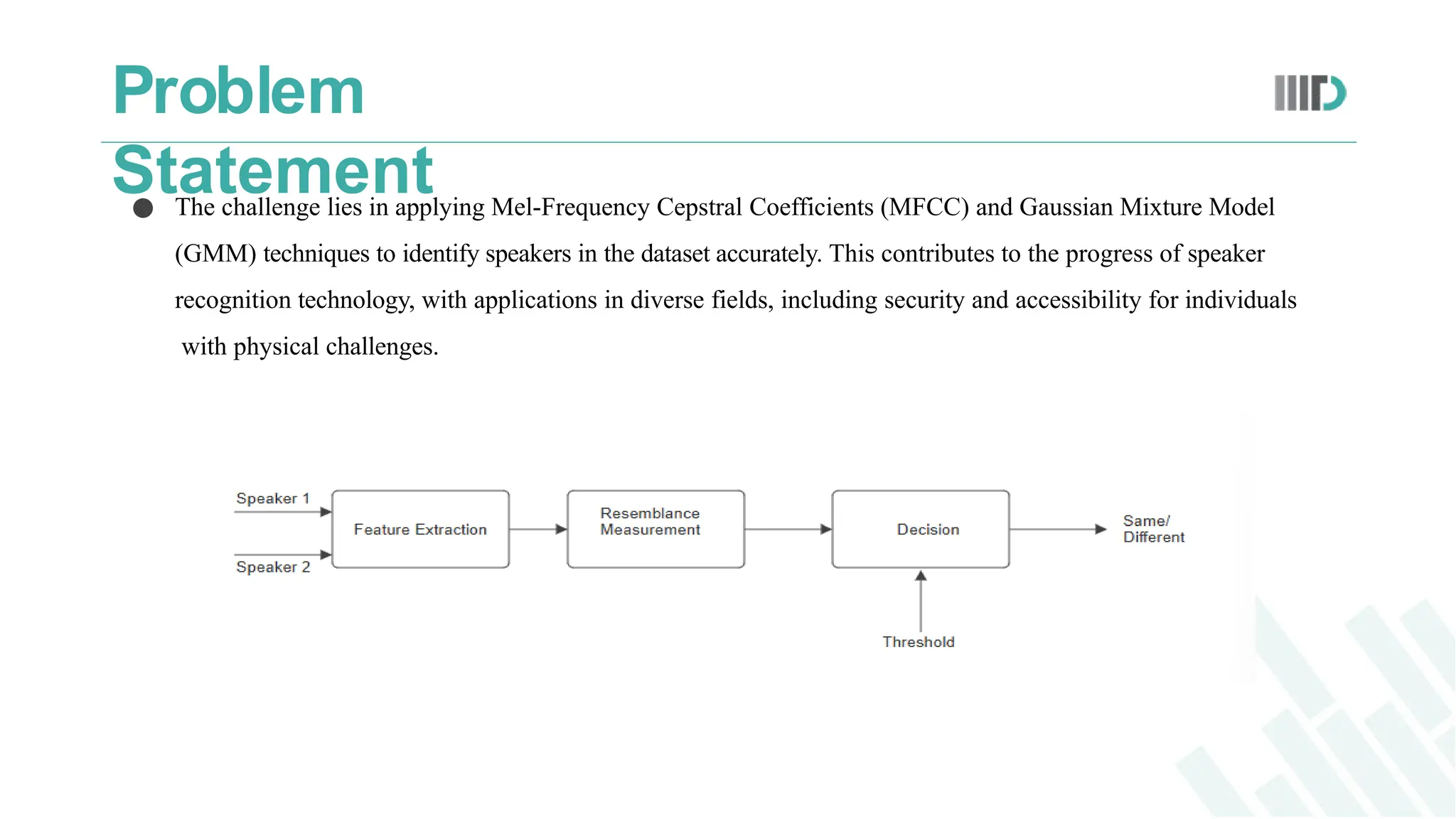
● The challengelies in applying Mel-Frequency Cepstral Coefficients (MFCC) and Gaussian Mixture Model
(GMM) techniques to identify speakers in the dataset accurately. This contributes to the progress of speaker
recognition technology, with applications in diverse fields, including security and accessibility for individuals
with physical challenges.
4.
About the
Dataset
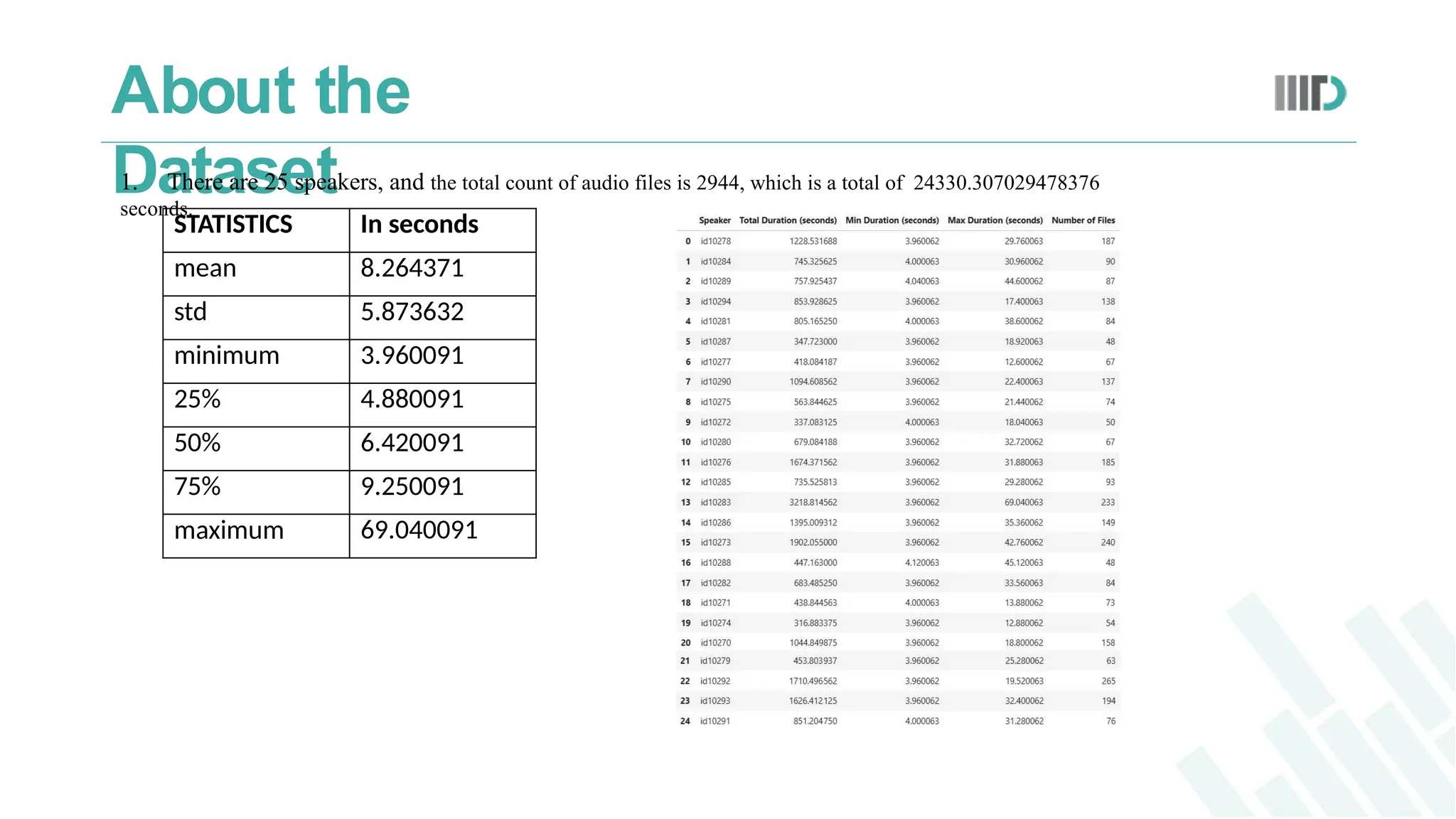
1. Thereare 25 speakers, and the total count of audio files is 2944, which is a total of 24330.307029478376
seconds.
STATISTICS In seconds
mean 8.264371
std 5.873632
minimum 3.960091
25% 4.880091
50% 6.420091
75% 9.250091
maximum 69.040091
5.
Exploratory Data
Analysis
1. Datapreprocessing :
Preprocessing: Audio Normalization: Ensuring all audio files are sampled at a consistent rate (e.g., 16000
Hz) to maintain uniformity.
Segmentation: Audio files are split into smaller, fixed-length segments (3 seconds and 8 sec ). This allows
for handling variable-length audio files while ensuring sufficient data for training.
Padding: Shorter audio segments are padded with zeros to meet the required length. This avoids issues with
variable-length input and ensures consistent feature extraction across all segments.
Noise Reduction: Unwanted noise is minimized using techniques like band-pass filtering, which improves
the quality of the extracted features.
Feature Extraction: Key features like MFCCs (Mel-frequency cepstral coefficients) are extracted from each
audio segment to represent the speaker's voice characteristics.
6.
Methodology and FeatureExtraction
2. Feature Extraction:
• In this speaker verification project, we utilized a comprehensive set of audio features, including MFCC, chroma,
spectral contrast, and spectral centroid, along with their statistical aggregates like mean values (e.g., MFCC_mean,
spectral_centroid_mean). Additionally, advanced features such as MFCC, mel spectrogram, and pitch-related features
like pitches and pitch_mean were extracted to capture the unique characteristics of each speaker's voice. These features
enabled robust representation of audio data for accurate classification, facilitating the verification of whether two audio
samples belong to the same or different speakers.
3. Model Training
• Gaussian Mixture Models (GMMs) for each speaker using their audio data. It processes audio files, extracts
MFCC features, trains a GMM for each unique user Ids, and stores all models in a dictionary. The combined
models are saved as a serialized .pkl file, with progress logged throughout the process.
7.
Result
s
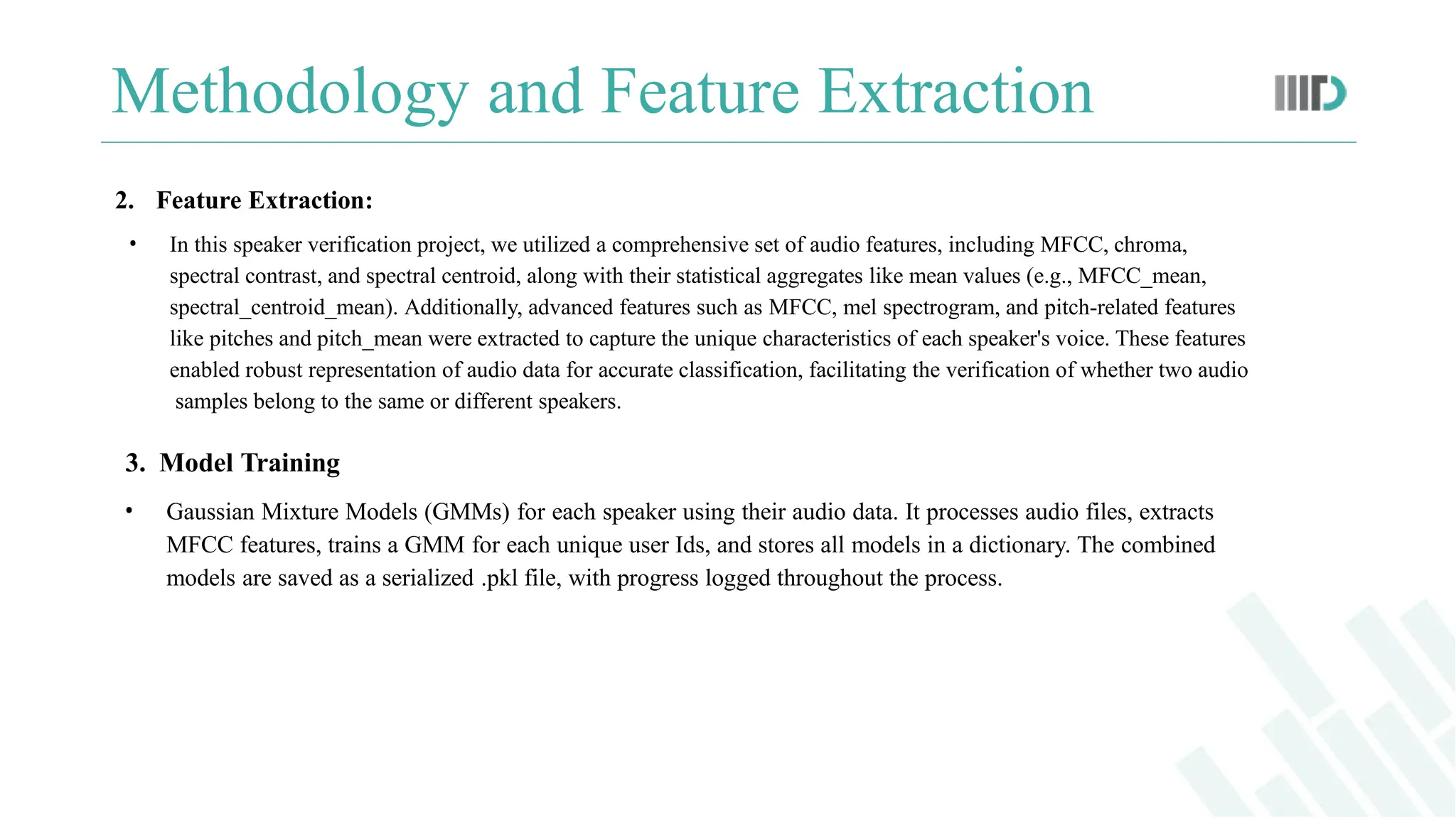
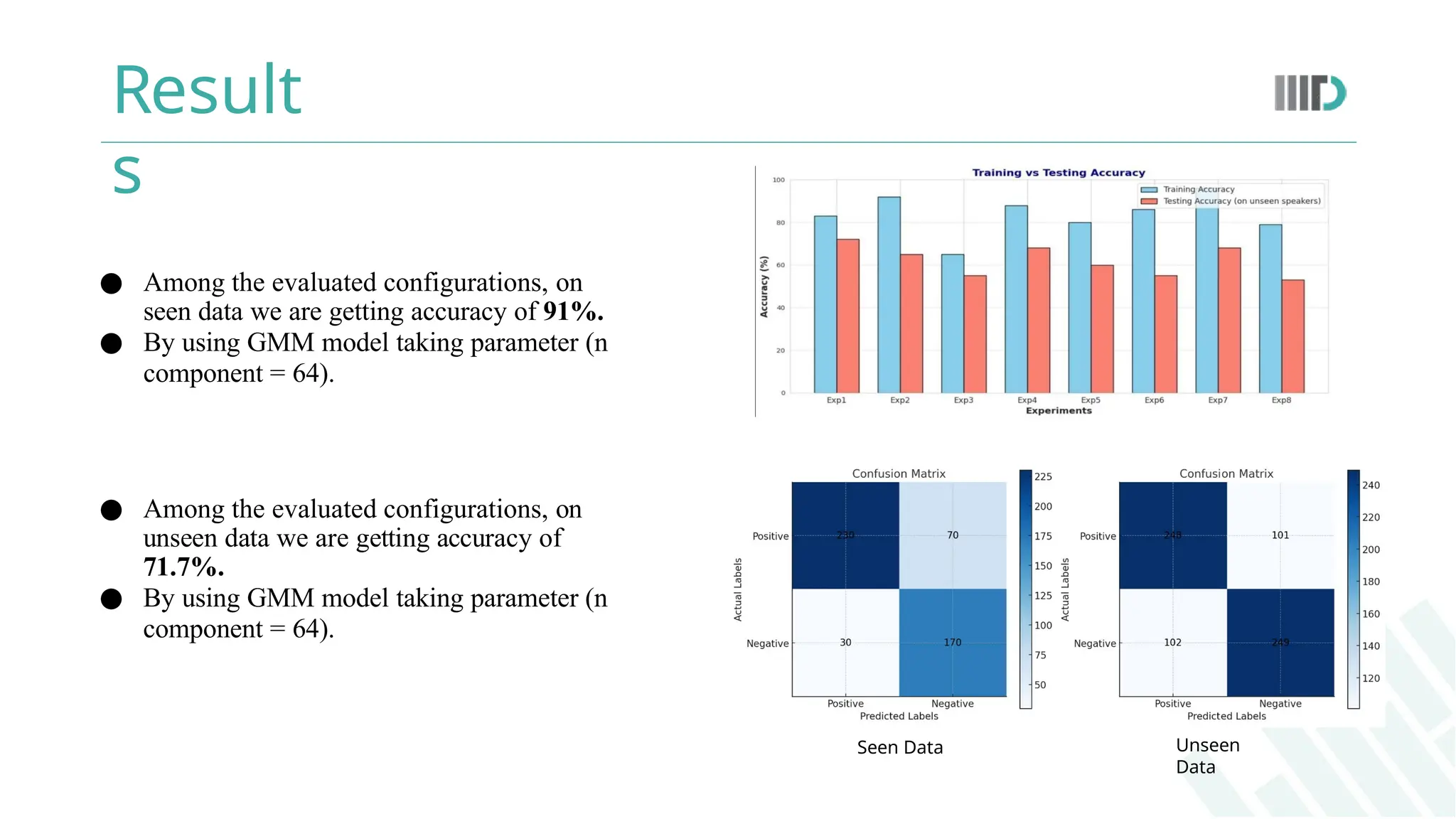
● Among theevaluated configurations, on
seen data we are getting accuracy of 91%.
● By using GMM model taking parameter (n
component = 64).
● Among the evaluated configurations, on
unseen data we are getting accuracy of
71.7%.
● By using GMM model taking parameter (n
component = 64).
Seen Data Unseen
Data
8.
Conclusio
n
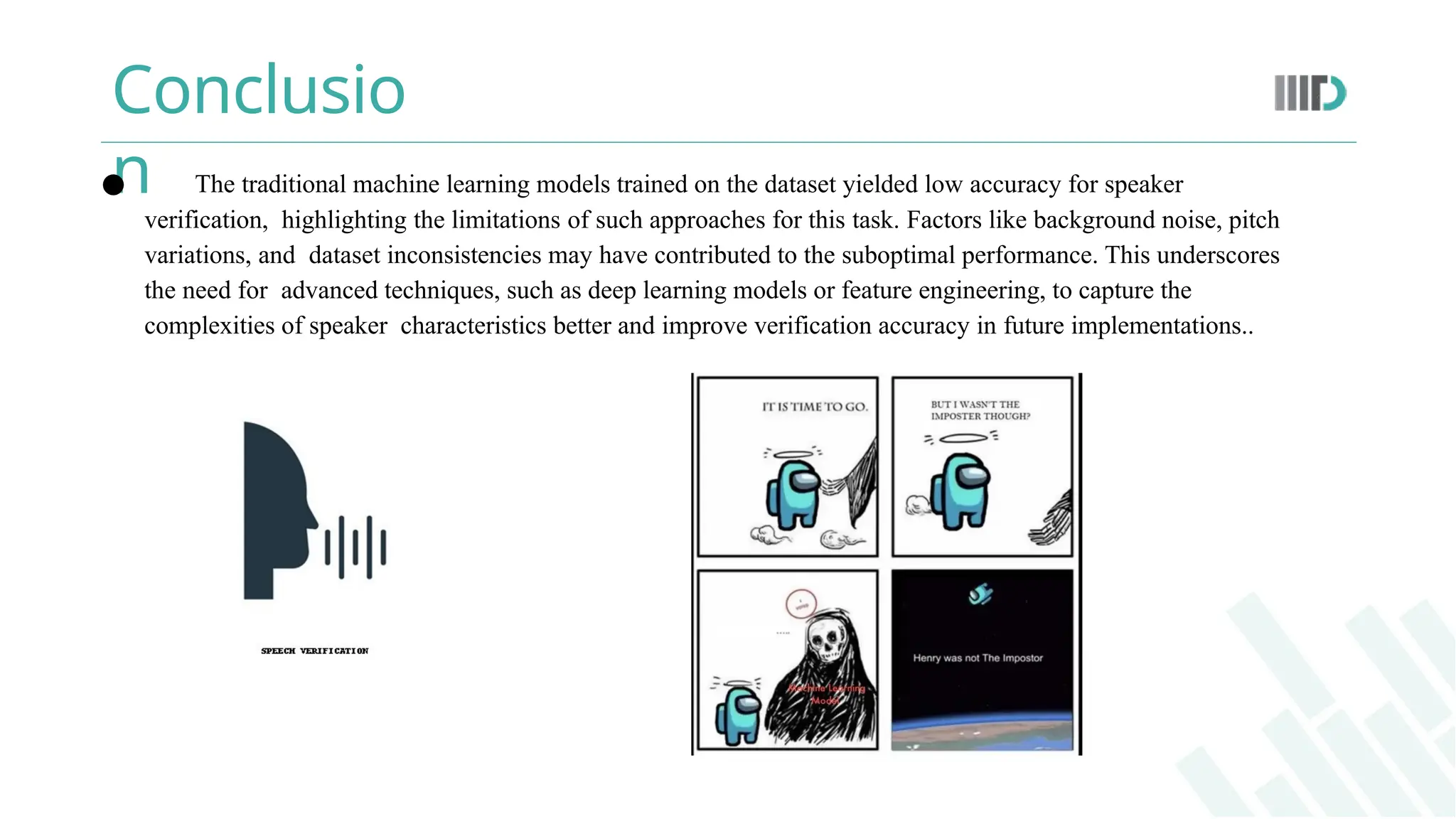
● The traditionalmachine learning models trained on the dataset yielded low accuracy for speaker
verification, highlighting the limitations of such approaches for this task. Factors like background noise, pitch
variations, and dataset inconsistencies may have contributed to the suboptimal performance. This underscores
the need for advanced techniques, such as deep learning models or feature engineering, to capture the
complexities of speaker characteristics better and improve verification accuracy in future implementations..