Charles LaPierre, M.Eng., Technical Lead,
Born Accessible and DIAGRAM; Benetech
George Kerscher, Ph.D., Chief Innovations Officer,
DAISY Consortium; Senior Advisor, Benetech
Finally, Certified Accessible Educational
Materials from Publishers
Rachel Comerford, Director of Content
Standards, Macmillan Learning
Born Accessible EPUB
That Meets the Baseline
for Accessibility
George Kerscher
Page 3
Standards at the Core of
Accessibility
● World Wide Web Consortium (W3C)
– HTML 5, CSS, SVG
● Web Accessibility Initiative (WAI)
● WCAG 2.0
● International Digital Publishing Forum (IDPF)
– http://www.idpf.org/
– EPUB the digital publishing standard
– EPUB Accessibility Conformance and Discovery
1.0 Specification
Page 4
● For the last three years the W3C has run a Digital
Publishing Interest Group
● The merger has placed EPUB under the domain
of W3C
● IDPF members will be given reduced fees for two
years
● 82% of members supported the combination
IDPF and W3C Merger
Page 5
● Adoption of EPUB 3 has been outstanding in most digital
publishing sectors
● EPUB 3.1 is an approved recommendation
– http://www.idpf.org/epub/31/spec/epub-spec.html
● Included is EPUB Accessibility 1.0
– http://www.idpf.org/epub/a11y/accessibility.html
● Conformance and Discovery Requirements for EPUB
Publications
● First ever spec to enable accessibility certification
– This establishes the baseline
● Important: We want to be practical in that publishers should
readily be able to produce accessible EPUB from their normal
production process
EPUB within the World Wide Web
Consortium (W3C)
Page 6
● Requires accessibility conformance in the EPUB
publication
● Builds on WCAG 2.0 with some additional publishing-
specific items
● in the USA WCAG 2.0 “AA” is generally recommended
● “conforms To” metadata pointing to “A,” “AA,” or “AAA”
Accessibility metadata must be included
● Interestingly: publishers have actively participated in the
EPUB Accessibility Spec development and have been
updating their production process to support accessibility.
Baseline Features
Page 7
● The Digital Publishing Interest Group in the W3C has
produced an ARIA 1.1 module to help add some Digital
Publishing semantics to ARIA
● Digital Publishing WAI-ARIA Module 1.0
– https://www.w3.org/TR/dpub-aria-1.0/
● This is currently under review and has not yet been
adopted as a recommendation
● Sample of the proposed new Roles:
– doc-abstract
– doc-appendix
– doc-chapter
– doc-introduction
W3C DPUB’s ARIA 1.1 Module
Page 8
● All headings must be marked in the HTML as headings
(Critical for navigation)
● All textual content must use HTML text markup, e.g.,
paragraphs, block quotes, list items
● All content must be in a logical reading order
● Images are marked as decorative, described in
surrounding text or captions, or have “alt” text
● If you want a fancy heading and use an image, remember
to surround the image with the heading markup and use
alt text (remember you can do very cool things these days
with CSS)
Concrete Examples of Some MUSTS
Page 9
Metadata Requirements to Be Compliant
● EPUBs wishing to be conformant MUST:
– include accessibility discovery metadata
– include the following [schema.org] accessibility
metadata
• accessMode
• accessibilityFeature
• accessibilityHazard
• accessibilitySummary
Page 10
● Specifications are at a high level and techniques are
concrete
● WCAG and EPUB techniques are maintained
independently of specifications
● As support in Reading Systems evolve, the techniques will
improve
● http://www.idpf.org/epub/a11y/techniques/techniques.html
● https://www.w3.org/TR/WCAG20-TECHS/Overview.html
● TTS & Braille: The techniques ensures that Text-to-
Speech can be used to present the information. Also, this
supports text being sent to a refreshable braille display
Supporting Techniques Updated
Frequently
Page 11
● Certify that digital books (and all other publications) meet
the Baseline
● Self-certification
– Sad Story: What happened to Voluntary Product Accessibility
Template (VPAT)?
– Would you have a fox guard the henhouse?
– DAISY is building the EPUB Accessibility Conformance Checker
– Auto checking must be supplemented by human inspection
Accelerating Publisher Adoption:
Certification of EPUB Publications
Page 12
● Excellent accessibility metadata required to be
present in the EPUB package
● Accessibility metadata supports
• Born accessible
• Find accessible
• Buy Accessible
● Questions: Any questions on the Standards side?
Accelerating Publisher Adoption:
Conformance and Certification of EPUB Publications
Benetech Certification
Pilot
Charles LaPierre
Page 14
Born Accessible: Certified by Benetech
● Benetech is piloting the certification process
● A documented process for certification must
be established and followed
● Publisher materials are reviewed and
remediated
● Long term process improvements would be
recommended to publishers
Page 15
Certification Metadata in EPUB
Publications
● How to find certified content in the future:
– certifiedBy: Specifies the name of the party that
certified the content. The certifier of the content could
be the same party that created the EPUB publication,
but can also be a third-party accessibility certifier.
– certifierCredential: Identifies a credential or badge
that establishes the authority of the party identified in
the certifiedBy property to certify content is accessible.
– certifierReport: Provides a link to an accessibility
report created by the party identified in the certifiedBy
property.
– conformsTo: WCAG-A, -AA, or -AAA
Page 16
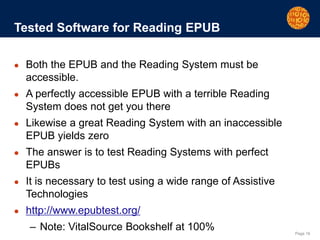
Tested Software for Reading EPUB
● Both the EPUB and the Reading System must be
accessible.
● A perfectly accessible EPUB with a terrible Reading
System does not get you there
● Likewise a great Reading System with an inaccessible
EPUB yields zero
● The answer is to test Reading Systems with perfect
EPUBs
● It is necessary to test using a wide range of Assistive
Technologies
● http://www.epubtest.org/
– Note: VitalSource Bookshelf at 100%
Page 17
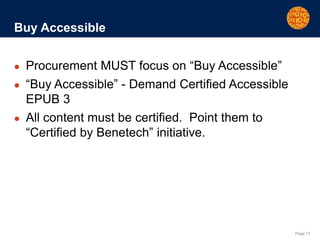
Buy Accessible
● Procurement MUST focus on “Buy Accessible”
● “Buy Accessible” - Demand Certified Accessible
EPUB 3
● All content must be certified. Point them to
“Certified by Benetech” initiative.
Page 18
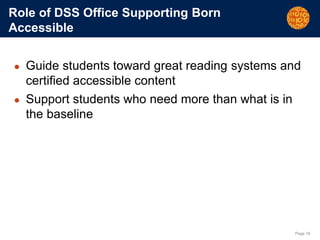
Role of DSS Office Supporting Born
Accessible
● Guide students toward great reading systems and
certified accessible content
● Support students who need more than what is in
the baseline
Page 19
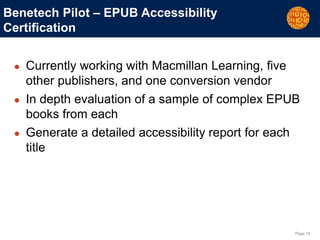
Benetech Pilot – EPUB Accessibility
Certification
● Currently working with Macmillan Learning, five
other publishers, and one conversion vendor
● In depth evaluation of a sample of complex EPUB
books from each
● Generate a detailed accessibility report for each
title
Page 20
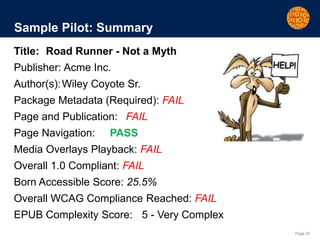
Sample Pilot: Summary
Title: Road Runner - Not a Myth
Publisher: Acme Inc.
Author(s):Wiley Coyote Sr.
Package Metadata (Required): FAIL
Page and Publication: FAIL
Page Navigation: PASS
Media Overlays Playback: FAIL
Overall 1.0 Compliant: FAIL
Born Accessible Score: 25.5%
Overall WCAG Compliance Reached: FAIL
EPUB Complexity Score: 5 - Very Complex
Page 21
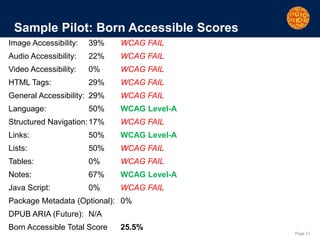
Sample Pilot: Born Accessible Scores
Image Accessibility: 39% WCAG FAIL
Audio Accessibility: 22% WCAG FAIL
Video Accessibility: 0% WCAG FAIL
HTML Tags: 29% WCAG FAIL
General Accessibility: 29% WCAG FAIL
Language: 50% WCAG Level-A
Structured Navigation:17% WCAG FAIL
Links: 50% WCAG Level-A
Lists: 50% WCAG FAIL
Tables: 0% WCAG FAIL
Notes: 67% WCAG Level-A
Java Script: 0% WCAG FAIL
Package Metadata (Optional): 0%
DPUB ARIA (Future): N/A
Born Accessible Total Score 25.5%
Page 22
Accessibility Pilot Results
Page 23
Publishers Perspective
● Rachel Comerford
Page 24
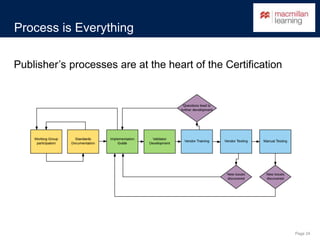
Process is Everything
Publisher’s processes are at the heart of the Certification
Page 25
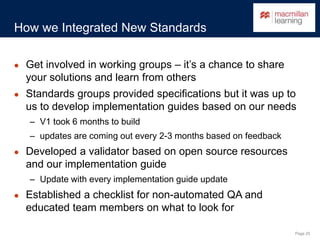
How we Integrated New Standards
● Get involved in working groups – it’s a chance to share
your solutions and learn from others
● Standards groups provided specifications but it was up to
us to develop implementation guides based on our needs
– V1 took 6 months to build
– updates are coming out every 2-3 months based on feedback
● Developed a validator based on open source resources
and our implementation guide
– Update with every implementation guide update
● Established a checklist for non-automated QA and
educated team members on what to look for
Page 26
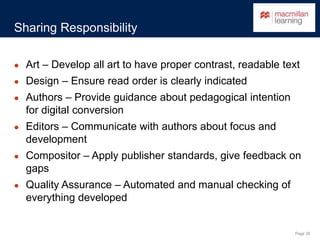
Sharing Responsibility
● Art – Develop all art to have proper contrast, readable text
● Design – Ensure read order is clearly indicated
● Authors – Provide guidance about pedagogical intention
for digital conversion
● Editors – Communicate with authors about focus and
development
● Compositor – Apply publisher standards, give feedback on
gaps
● Quality Assurance – Automated and manual checking of
everything developed
Page 27
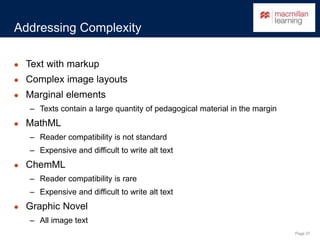
Addressing Complexity
● Text with markup
● Complex image layouts
● Marginal elements
– Texts contain a large quantity of pedagogical material in the margin
● MathML
– Reader compatibility is not standard
– Expensive and difficult to write alt text
● ChemML
– Reader compatibility is rare
– Expensive and difficult to write alt text
● Graphic Novel
– All image text
Page 28
Why Are We Doing This?
● ‘Certified by Benetech’ advantages
– 3rd party confirmation of accessibility standards
– Assurance for students and adopters
– Easy to roll up to administrators
– Gives us feedback to pass on to vendors about the quality of their
work
– Provides internal confidence about the quality of what we’re
delivering
– Helps identify for schools what errors are addressed and what
warnings are relevant
– Most importantly: Shows us what we’re missing and what we
have left to learn
Page 29
EPUB Accessibility 1.0 (Specification)
EPUB Accessibility Techniques 1.0 (Supplemental)
WCAG 2.0 (Specification)
BISG: Quick Start Guide to Accessible Publishing
DIAGRAM Center: Image Description Guidelines
Poet Image Description Training Module
Helpful Resources for Publishers
Page 30
THANK YOU
Questions?
George Kerscher
georgek@benetech.org
Charles LaPierre
charlesl@benetech.org
Rachel Comerford
Rachel.comerford@macmillan.com

Finally, Certified Accessible Educational Materials from Publishers

  • 1.
    Charles LaPierre, M.Eng.,Technical Lead, Born Accessible and DIAGRAM; Benetech George Kerscher, Ph.D., Chief Innovations Officer, DAISY Consortium; Senior Advisor, Benetech Finally, Certified Accessible Educational Materials from Publishers Rachel Comerford, Director of Content Standards, Macmillan Learning
  • 2.
    Born Accessible EPUB ThatMeets the Baseline for Accessibility George Kerscher
  • 3.
    Page 3 Standards atthe Core of Accessibility ● World Wide Web Consortium (W3C) – HTML 5, CSS, SVG ● Web Accessibility Initiative (WAI) ● WCAG 2.0 ● International Digital Publishing Forum (IDPF) – http://www.idpf.org/ – EPUB the digital publishing standard – EPUB Accessibility Conformance and Discovery 1.0 Specification
  • 4.
    Page 4 ● Forthe last three years the W3C has run a Digital Publishing Interest Group ● The merger has placed EPUB under the domain of W3C ● IDPF members will be given reduced fees for two years ● 82% of members supported the combination IDPF and W3C Merger
  • 5.
    Page 5 ● Adoptionof EPUB 3 has been outstanding in most digital publishing sectors ● EPUB 3.1 is an approved recommendation – http://www.idpf.org/epub/31/spec/epub-spec.html ● Included is EPUB Accessibility 1.0 – http://www.idpf.org/epub/a11y/accessibility.html ● Conformance and Discovery Requirements for EPUB Publications ● First ever spec to enable accessibility certification – This establishes the baseline ● Important: We want to be practical in that publishers should readily be able to produce accessible EPUB from their normal production process EPUB within the World Wide Web Consortium (W3C)
  • 6.
    Page 6 ● Requiresaccessibility conformance in the EPUB publication ● Builds on WCAG 2.0 with some additional publishing- specific items ● in the USA WCAG 2.0 “AA” is generally recommended ● “conforms To” metadata pointing to “A,” “AA,” or “AAA” Accessibility metadata must be included ● Interestingly: publishers have actively participated in the EPUB Accessibility Spec development and have been updating their production process to support accessibility. Baseline Features
  • 7.
    Page 7 ● TheDigital Publishing Interest Group in the W3C has produced an ARIA 1.1 module to help add some Digital Publishing semantics to ARIA ● Digital Publishing WAI-ARIA Module 1.0 – https://www.w3.org/TR/dpub-aria-1.0/ ● This is currently under review and has not yet been adopted as a recommendation ● Sample of the proposed new Roles: – doc-abstract – doc-appendix – doc-chapter – doc-introduction W3C DPUB’s ARIA 1.1 Module
  • 8.
    Page 8 ● Allheadings must be marked in the HTML as headings (Critical for navigation) ● All textual content must use HTML text markup, e.g., paragraphs, block quotes, list items ● All content must be in a logical reading order ● Images are marked as decorative, described in surrounding text or captions, or have “alt” text ● If you want a fancy heading and use an image, remember to surround the image with the heading markup and use alt text (remember you can do very cool things these days with CSS) Concrete Examples of Some MUSTS
  • 9.
    Page 9 Metadata Requirementsto Be Compliant ● EPUBs wishing to be conformant MUST: – include accessibility discovery metadata – include the following [schema.org] accessibility metadata • accessMode • accessibilityFeature • accessibilityHazard • accessibilitySummary
  • 10.
    Page 10 ● Specificationsare at a high level and techniques are concrete ● WCAG and EPUB techniques are maintained independently of specifications ● As support in Reading Systems evolve, the techniques will improve ● http://www.idpf.org/epub/a11y/techniques/techniques.html ● https://www.w3.org/TR/WCAG20-TECHS/Overview.html ● TTS & Braille: The techniques ensures that Text-to- Speech can be used to present the information. Also, this supports text being sent to a refreshable braille display Supporting Techniques Updated Frequently
  • 11.
    Page 11 ● Certifythat digital books (and all other publications) meet the Baseline ● Self-certification – Sad Story: What happened to Voluntary Product Accessibility Template (VPAT)? – Would you have a fox guard the henhouse? – DAISY is building the EPUB Accessibility Conformance Checker – Auto checking must be supplemented by human inspection Accelerating Publisher Adoption: Certification of EPUB Publications
  • 12.
    Page 12 ● Excellentaccessibility metadata required to be present in the EPUB package ● Accessibility metadata supports • Born accessible • Find accessible • Buy Accessible ● Questions: Any questions on the Standards side? Accelerating Publisher Adoption: Conformance and Certification of EPUB Publications
  • 13.
  • 14.
    Page 14 Born Accessible:Certified by Benetech ● Benetech is piloting the certification process ● A documented process for certification must be established and followed ● Publisher materials are reviewed and remediated ● Long term process improvements would be recommended to publishers
  • 15.
    Page 15 Certification Metadatain EPUB Publications ● How to find certified content in the future: – certifiedBy: Specifies the name of the party that certified the content. The certifier of the content could be the same party that created the EPUB publication, but can also be a third-party accessibility certifier. – certifierCredential: Identifies a credential or badge that establishes the authority of the party identified in the certifiedBy property to certify content is accessible. – certifierReport: Provides a link to an accessibility report created by the party identified in the certifiedBy property. – conformsTo: WCAG-A, -AA, or -AAA
  • 16.
    Page 16 Tested Softwarefor Reading EPUB ● Both the EPUB and the Reading System must be accessible. ● A perfectly accessible EPUB with a terrible Reading System does not get you there ● Likewise a great Reading System with an inaccessible EPUB yields zero ● The answer is to test Reading Systems with perfect EPUBs ● It is necessary to test using a wide range of Assistive Technologies ● http://www.epubtest.org/ – Note: VitalSource Bookshelf at 100%
  • 17.
    Page 17 Buy Accessible ●Procurement MUST focus on “Buy Accessible” ● “Buy Accessible” - Demand Certified Accessible EPUB 3 ● All content must be certified. Point them to “Certified by Benetech” initiative.
  • 18.
    Page 18 Role ofDSS Office Supporting Born Accessible ● Guide students toward great reading systems and certified accessible content ● Support students who need more than what is in the baseline
  • 19.
    Page 19 Benetech Pilot– EPUB Accessibility Certification ● Currently working with Macmillan Learning, five other publishers, and one conversion vendor ● In depth evaluation of a sample of complex EPUB books from each ● Generate a detailed accessibility report for each title
  • 20.
    Page 20 Sample Pilot:Summary Title: Road Runner - Not a Myth Publisher: Acme Inc. Author(s):Wiley Coyote Sr. Package Metadata (Required): FAIL Page and Publication: FAIL Page Navigation: PASS Media Overlays Playback: FAIL Overall 1.0 Compliant: FAIL Born Accessible Score: 25.5% Overall WCAG Compliance Reached: FAIL EPUB Complexity Score: 5 - Very Complex
  • 21.
    Page 21 Sample Pilot:Born Accessible Scores Image Accessibility: 39% WCAG FAIL Audio Accessibility: 22% WCAG FAIL Video Accessibility: 0% WCAG FAIL HTML Tags: 29% WCAG FAIL General Accessibility: 29% WCAG FAIL Language: 50% WCAG Level-A Structured Navigation:17% WCAG FAIL Links: 50% WCAG Level-A Lists: 50% WCAG FAIL Tables: 0% WCAG FAIL Notes: 67% WCAG Level-A Java Script: 0% WCAG FAIL Package Metadata (Optional): 0% DPUB ARIA (Future): N/A Born Accessible Total Score 25.5%
  • 22.
  • 23.
  • 24.
    Page 24 Process isEverything Publisher’s processes are at the heart of the Certification
  • 25.
    Page 25 How weIntegrated New Standards ● Get involved in working groups – it’s a chance to share your solutions and learn from others ● Standards groups provided specifications but it was up to us to develop implementation guides based on our needs – V1 took 6 months to build – updates are coming out every 2-3 months based on feedback ● Developed a validator based on open source resources and our implementation guide – Update with every implementation guide update ● Established a checklist for non-automated QA and educated team members on what to look for
  • 26.
    Page 26 Sharing Responsibility ●Art – Develop all art to have proper contrast, readable text ● Design – Ensure read order is clearly indicated ● Authors – Provide guidance about pedagogical intention for digital conversion ● Editors – Communicate with authors about focus and development ● Compositor – Apply publisher standards, give feedback on gaps ● Quality Assurance – Automated and manual checking of everything developed
  • 27.
    Page 27 Addressing Complexity ●Text with markup ● Complex image layouts ● Marginal elements – Texts contain a large quantity of pedagogical material in the margin ● MathML – Reader compatibility is not standard – Expensive and difficult to write alt text ● ChemML – Reader compatibility is rare – Expensive and difficult to write alt text ● Graphic Novel – All image text
  • 28.
    Page 28 Why AreWe Doing This? ● ‘Certified by Benetech’ advantages – 3rd party confirmation of accessibility standards – Assurance for students and adopters – Easy to roll up to administrators – Gives us feedback to pass on to vendors about the quality of their work – Provides internal confidence about the quality of what we’re delivering – Helps identify for schools what errors are addressed and what warnings are relevant – Most importantly: Shows us what we’re missing and what we have left to learn
  • 29.
    Page 29 EPUB Accessibility1.0 (Specification) EPUB Accessibility Techniques 1.0 (Supplemental) WCAG 2.0 (Specification) BISG: Quick Start Guide to Accessible Publishing DIAGRAM Center: Image Description Guidelines Poet Image Description Training Module Helpful Resources for Publishers
  • 30.
    Page 30 THANK YOU Questions? GeorgeKerscher georgek@benetech.org Charles LaPierre charlesl@benetech.org Rachel Comerford Rachel.comerford@macmillan.com

Editor's Notes

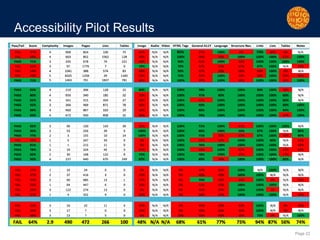
  • #23 This Table shows a snapshot of the accessibility scores for thirty titles evaluated as of February 10, 2017. Most of the EPUBs tested failed certification (requiring to meet WCAG-A compliance) with an average score of 64% and an average complexity level of 2.9 out of 5. Trends showed that Links, and Lists were correctly structured -- above 85% -- with Images, Tables, General Accessibility structured poorly (below 60%).   The table is brightly colored with bolded green text cells having a passing grade for the various titles, and any feature scoring below 70% appearing non-bolded in red.   The publishers and titles of the EPUBs were omitted due to confidentiality restrictions. This clearly shows that two of the six participants (one of which represented multiple publishers) had mostly accessible EPUBs but that all had some issue, especially with image descriptions and accessible table support.