Open Textbooks:
Using, adapting,
reviewing, promoting
• Christina Hendricks
• Sr. Instructor, Philosophy and Arts One, UBC
• 2014-2015 Faculty Fellow with the BCcampus Open Textbook Project
Unless otherwise noted, this work is licensed under a Creative Commons Attribution 4.0 License.
Feel free to use, modify or distribute any or all of this presentation with attribution
Agenda
• What is the Bccampus Open Textbook
Project?
• What are open textbooks?
• How to adopt/adapt open textbooks?
Connect the expertise, programs, and resources
of all BC post-secondary institutions under a
collaborative service delivery framework
1
2
3
Open Education & Professional Learning
Student Services & Data Exchange
Collaborative Programs & Shared Services
bccampus.caSlide from Clint Lalonde, Bccampus, CC-BY
open.bccampus.ca
What are Open Textbooks?
Textbooks that are , of course!
But what does that mean?...
The 5 “R’s” of openness
•The right to make, own and control
copies of the contentRetain
•The right to use the content in a wide
range of waysReuse
•The right to adapt, adjust, or modify
the content itselfRevise
•The right to combine the original or
revised content with other open
content to create something new
Remix
•The right to share copies of the original
content, your revisions, or your remixes
with others
Redistribute
Source: David Wiley, http://opencontent.org/blog/archives/3221 CC-BY
Slide adapted from Mary Burgess, BCcampus, licensed CC-BY
Open Educational Resources
“OER are teaching, learning, and research
resources that reside in the public domain
or have been released under an intellectual
property license that permits their free use
and re-purposing by others.”
-- William and Flora Hewlett Foundation
http://www.hewlett.org/programs/education/open-educational-resources
Open Textbooks
Similar to any other textbook, but with an
open license to allow revision/reuse
• Often a “creative commons” license
http://creativecommons.org/licenses/
Online, PDF, ebook, or printed
• Free of cost online; often small charge for
printed version
Benefits of open textbooks: Cost
Students spend $1200/yr
on textbooks
Source: Fixing the Broken Textbook Market U.S. Student PIRGs, licensed CC BY 4.0
Cover image: Center for Public Interest Research, CC-BY 4.0 license
-- College Board, U.S.
65% of students have not
purchased a textbook for a
course during their academic
career because of price
Nearly half said textbook cost
affected course choice
Slide adapted from Clint Lalonde, BCcampus, CC-BY
Benefits of open textbooks: Own & Retain
Ebooks may not
allow you to
copy and paste,
print or
redistribute
May only have
access for short
period of time
System Lock, Flickr photo shared by Yuri Samoilov, licensed CC
BY 2.0
Benefits of open textbooks: Adaptability
Take out what you don’t need, add in your
own materials or OER from others …
E.g., lecture
notes, videos,
images,
quizzes, & more
CC-A license to remix, flickr photo
shared by fotonen, CC BY 2.0
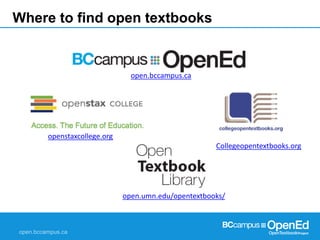
Where to find open textbooks
open.bccampus.ca
openstaxcollege.org
open.umn.edu/opentextbooks/
Collegeopentextbooks.org
Adopting open textbooks
open.bccampus.ca
Adopting open textbooks: options
• Give students a link to the textbook on the BCcampus site
• Download the book and put it on another site for
students to download
• E.g., LMS, Dropbox, own website
• Ask your bookstore or print shop if they can print copies
of the book for students to purchase
• some books are licensed CC BY-NC, and for those the
printers can only charge for cost-recovery, not add a
markup
Adopting open textbooks: tell us!
If you adopt an open textbook from the collection,
please let BCcampus know.
You can do so on the page for each of the books, or
there is a link under “adopt” at open.bccampus.ca
Modifying/revising open textbooks
Click the link for adaptations/modifications on each
textbook page to contact BCcampus
Modifying/revising open textbooks
Or, download the book in one of the available formats
and edit from there (MS Word editable formats coming
this Fall!)
Reviewing open textbooks
http://open.bccampus.ca
Go to “current calls for proposals”, then “review an open
textbook”
Current focus of BCcampus Open Textbook program:
• Encourage adoption of open textbooks by faculty
• Increase awareness of OER and open textbooks
• Encourage reviews of open textbooks by faculty
• Help support faculty in adopting and adapting open
textbooks
Spread the word!
Thank You
Email: c.hendricks@ubc.ca
Twitter: @clhendricksbc
Website: http://blogs.ubc.ca/christinahendricks
open.bccampus.ca

Open Textbooks presentation for Faculty

  • 1.
    Open Textbooks: Using, adapting, reviewing,promoting • Christina Hendricks • Sr. Instructor, Philosophy and Arts One, UBC • 2014-2015 Faculty Fellow with the BCcampus Open Textbook Project Unless otherwise noted, this work is licensed under a Creative Commons Attribution 4.0 License. Feel free to use, modify or distribute any or all of this presentation with attribution
  • 2.
    Agenda • What isthe Bccampus Open Textbook Project? • What are open textbooks? • How to adopt/adapt open textbooks?
  • 3.
    Connect the expertise,programs, and resources of all BC post-secondary institutions under a collaborative service delivery framework 1 2 3 Open Education & Professional Learning Student Services & Data Exchange Collaborative Programs & Shared Services bccampus.caSlide from Clint Lalonde, Bccampus, CC-BY
  • 4.
  • 5.
    What are OpenTextbooks? Textbooks that are , of course! But what does that mean?...
  • 6.
    The 5 “R’s”of openness •The right to make, own and control copies of the contentRetain •The right to use the content in a wide range of waysReuse •The right to adapt, adjust, or modify the content itselfRevise •The right to combine the original or revised content with other open content to create something new Remix •The right to share copies of the original content, your revisions, or your remixes with others Redistribute Source: David Wiley, http://opencontent.org/blog/archives/3221 CC-BY Slide adapted from Mary Burgess, BCcampus, licensed CC-BY
  • 7.
    Open Educational Resources “OERare teaching, learning, and research resources that reside in the public domain or have been released under an intellectual property license that permits their free use and re-purposing by others.” -- William and Flora Hewlett Foundation http://www.hewlett.org/programs/education/open-educational-resources
  • 8.
    Open Textbooks Similar toany other textbook, but with an open license to allow revision/reuse • Often a “creative commons” license http://creativecommons.org/licenses/ Online, PDF, ebook, or printed • Free of cost online; often small charge for printed version
  • 9.
    Benefits of opentextbooks: Cost Students spend $1200/yr on textbooks Source: Fixing the Broken Textbook Market U.S. Student PIRGs, licensed CC BY 4.0 Cover image: Center for Public Interest Research, CC-BY 4.0 license -- College Board, U.S. 65% of students have not purchased a textbook for a course during their academic career because of price Nearly half said textbook cost affected course choice Slide adapted from Clint Lalonde, BCcampus, CC-BY
  • 10.
    Benefits of opentextbooks: Own & Retain Ebooks may not allow you to copy and paste, print or redistribute May only have access for short period of time System Lock, Flickr photo shared by Yuri Samoilov, licensed CC BY 2.0
  • 11.
    Benefits of opentextbooks: Adaptability Take out what you don’t need, add in your own materials or OER from others … E.g., lecture notes, videos, images, quizzes, & more CC-A license to remix, flickr photo shared by fotonen, CC BY 2.0
  • 12.
    Where to findopen textbooks open.bccampus.ca openstaxcollege.org open.umn.edu/opentextbooks/ Collegeopentextbooks.org
  • 13.
  • 14.
    Adopting open textbooks:options • Give students a link to the textbook on the BCcampus site • Download the book and put it on another site for students to download • E.g., LMS, Dropbox, own website • Ask your bookstore or print shop if they can print copies of the book for students to purchase • some books are licensed CC BY-NC, and for those the printers can only charge for cost-recovery, not add a markup
  • 15.
    Adopting open textbooks:tell us! If you adopt an open textbook from the collection, please let BCcampus know. You can do so on the page for each of the books, or there is a link under “adopt” at open.bccampus.ca
  • 16.
    Modifying/revising open textbooks Clickthe link for adaptations/modifications on each textbook page to contact BCcampus
  • 17.
    Modifying/revising open textbooks Or,download the book in one of the available formats and edit from there (MS Word editable formats coming this Fall!)
  • 18.
    Reviewing open textbooks http://open.bccampus.ca Goto “current calls for proposals”, then “review an open textbook”
  • 19.
    Current focus ofBCcampus Open Textbook program: • Encourage adoption of open textbooks by faculty • Increase awareness of OER and open textbooks • Encourage reviews of open textbooks by faculty • Help support faculty in adopting and adapting open textbooks Spread the word!
  • 20.
    Thank You Email: c.hendricks@ubc.ca Twitter:@clhendricksbc Website: http://blogs.ubc.ca/christinahendricks open.bccampus.ca

Editor's Notes

  • #2 Presentation title slide… following the opening slide (containing the large Open Textbook project logo).
  • #5 Opening Slide of presentation – introducing Open Textbook Project
  • #10 Fall 2013 survey, 2039 students, over 150 campuses (all in US?)
  • #11 Fall 2013 survey, 2039 students, over 150 campuses (all in US?)
  • #12 Fall 2013 survey, 2039 students, over 150 campuses (all in US?)