The mobile banking
customer that isn’t:
CÔTE D’IVOIRE
drivers of digital financial services inactivity in
Acknowledgment
This report was written by Susie Lonie, Meritxell Martinez, Christopher Tullis and Rita Oulai, the IFC Digital Financial Services
team for Cote d’Ivoire. The team would like to thank the following World Bank Group peer reviewers and colleagues for their
guidance and support:Anna Koblanck, Cassandra Colbert, David Crush, Tiphaine Crenn, Corinne Riquet, Estelle Lahaye, Greta
Bull, and Joseck Mudiri. We would also like to acknowledge the collaboration of two leading Côte-d’Ivoire mobile money
providers in the development of this market research.
The mobile banking customer that isn’t:
drivers of digital financial services
inactivity in Côte d’Ivoire
Executive Summary	 2
Background	 3
Definition of DFS inactivity	 3
Inactivity in context	 3
Research findings: Reasons for Inactivity	 5
Irregular income	 6
No need to use a mobile money account	 6
Too expensive	 8
Access to agents	 9
Service is too complicated	 10
What predicts inactivity?	 11
POTENTIAL WAYS TO INCREASE ACTIVITY	 12
CONCLUSIONS & RECOMMENDATIONS	 13
2
Côte d’Ivoire is the largest Digital Financial Services market
in the West African Economic and Monetary Union. In
2014, Côte d’Ivoire accounted for over 50 percent of the
value deposited into mobile money accounts in the region.
However, in common with many markets across the globe,
Côte d’Ivoire has a high level of inactive DFS accounts that
have not been used for over 90 days. While there are wide
differences between providers, data indicates that even
under the best case scenario almost 50 percent of the total
number of registered DFS clients are inactive. In order to
sharpen the DFS business case and to further financial
inclusion, it is important to understand why the services
on offer are not being widely used by registered customers.
Is it a matter of pricing? Could it be product design? Does it
have to do with concerns around security? Or is it an issue of
customer care?
To investigate the causes of inactivity and learn how they
can be addressed, The Partnership for Financial Inclusion,
a joint initiative of IFC and The MasterCard Foundation to
advance mobile financial services in Sub-Saharan Africa,
carried out market research in cooperation with two of the
largest DFS providers in Côte d’Ivoire. The study found three
main barriers to usage:
1.	 Not a relevant service: nearly half of the customers
interviewed have irregular incomes and therefore do not
need to use their mobile money accounts on a consistent
or regular basis.
2.	 Lack of understanding of the benefits of the service/
product: over one quarter of customers are unaware of
any compelling reason to use a mobile money account
instead of using cash or more traditional forms of
financial services.
3.	 Too expensive: over 15 percent of customers cite cost as
a reason for not using mobile money accounts instead
of cash. Mobile money tariffs are much higher in Côte
d’Ivoire than other African countries, and this certainly
seems to be restricting usage.
Some secondary reasons were also raised by up to 10 percent
of the research respondents, such as a lack of conveniently
located agents, difficulty using the services, and lost PIN
codes. In addition, the high incidence of “direct deposits”
(into a recipient’s mobile money account) means that
available data undercounts customers who use the service
to send money.
A number of recommendations can be drawn from the
research in order to improve activity levels. Firstly, the cost
of DFS transactions should be reviewed and reduced. This
had strong support from inactive customers. Secondly, the
services and products of DFS providers should be made more
relevant for customers, for example by offering access to
savings and loans. There is also a strong demand for a better
distribution of agents across the country to service more
locations, particularly in rural areas. Finally, there is a need to
help customers understand the benefits of the services and
how to use them with confidence.
Executive Summary
The mobile banking customer that isn’t: drivers of digital financial services inactivity in Côte d’Ivoire 3
and quality constraints could unlock significant additional
market activity in Côte d’Ivoire.
Inactivity in context
As the largest mobile money market in WAEMU, Côte
d’Ivoire accounts for just over half of the region’s registered
customers and number of transactions performed.4
By
the end of 2014, the country’s five digital financial services
providers5
had together registered over 9 million mobile
money accounts. In the same year, Ivorians deposited over
FCFA 1.15 trillion, equivalent to $2.4 billion, into mobile
money accounts, which was over 70 percent of the value
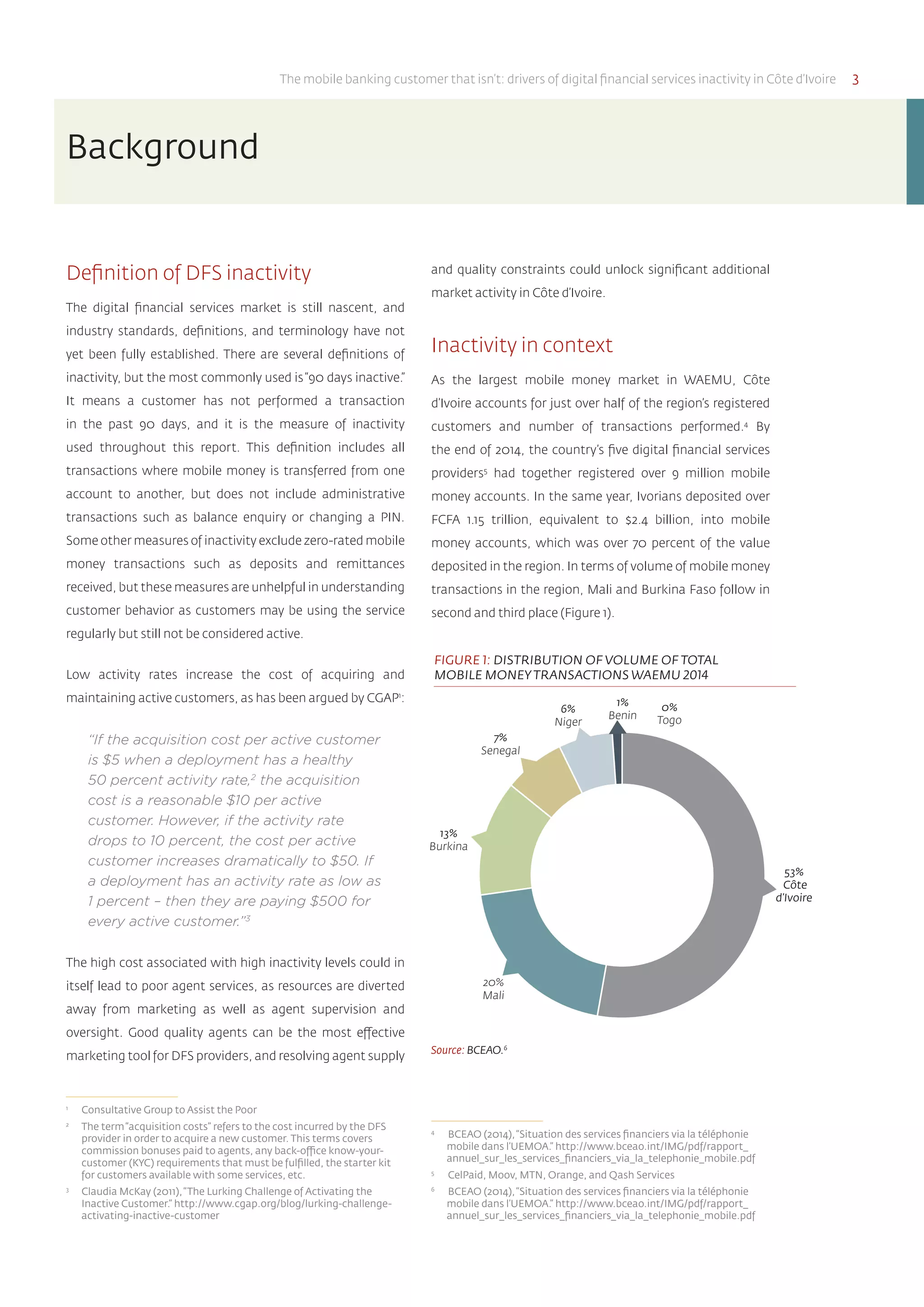
deposited in the region. In terms of volume of mobile money
transactions in the region, Mali and Burkina Faso follow in
second and third place (Figure 1).
Source: BCEAO.6
4	
BCEAO (2014),“Situation des services financiers via la téléphonie
mobile dans l’UEMOA.” http://www.bceao.int/IMG/pdf/rapport_
annuel_sur_les_services_financiers_via_la_telephonie_mobile.pdf
5	
CelPaid, Moov, MTN, Orange, and Qash Services
6	
BCEAO (2014),“Situation des services financiers via la téléphonie
mobile dans l’UEMOA.” http://www.bceao.int/IMG/pdf/rapport_
annuel_sur_les_services_financiers_via_la_telephonie_mobile.pdf
Definition of DFS inactivity
The digital financial services market is still nascent, and
industry standards, definitions, and terminology have not
yet been fully established. There are several definitions of
inactivity, but the most commonly used is“90 days inactive.”
It means a customer has not performed a transaction
in the past 90 days, and it is the measure of inactivity
used throughout this report. This definition includes all
transactions where mobile money is transferred from one
account to another, but does not include administrative
transactions such as balance enquiry or changing a PIN.
Some other measures of inactivity exclude zero-rated mobile
money transactions such as deposits and remittances
received, but these measures are unhelpful in understanding
customer behavior as customers may be using the service
regularly but still not be considered active.
Low activity rates increase the cost of acquiring and
maintaining active customers, as has been argued by CGAP1
:
“If the acquisition cost per active customer
is $5 when a deployment has a healthy
50 percent activity rate,2
the acquisition
cost is a reasonable $10 per active
customer. However, if the activity rate
drops to 10 percent, the cost per active
customer increases dramatically to $50. If
a deployment has an activity rate as low as
1 percent – then they are paying $500 for
every active customer.”3
The high cost associated with high inactivity levels could in
itself lead to poor agent services, as resources are diverted
away from marketing as well as agent supervision and
oversight. Good quality agents can be the most effective
marketing tool for DFS providers, and resolving agent supply
1	
Consultative Group to Assist the Poor
2	
The term“acquisition costs” refers to the cost incurred by the DFS
provider in order to acquire a new customer. This terms covers
commission bonuses paid to agents, any back-office know-your-
customer (KYC) requirements that must be fulfilled, the starter kit
for customers available with some services, etc.
3	
Claudia McKay (2011),“The Lurking Challenge of Activating the
Inactive Customer.” http://www.cgap.org/blog/lurking-challenge-
activating-inactive-customer
Background
FIGURE 1: DISTRIBUTION OF VOLUME OF TOTAL
MOBILE MONEYTRANSACTIONS WAEMU 2014
7%
Senegal
6%
Niger
53%
Côte
d’Ivoire
13%
Burkina
20%
Mali
1%
Benin
0%
Togo
4
Despite these promising developments, almost 50 percent
of all mobile money accounts in Côte d’Ivoire are inactive.
This is not unique to the Ivorian market. According to the
GSMA7
, only 34 percent of the 299 million registered mobile
money accounts worldwide in 2014 were 90 day active,
although activity levels had increased from the previous
year.8
The GSMA also estimates that across Sub-Saharan
Africa, activity levels are higher than in other regions, with
61.9 million of the 146 million registered DFS customers
being active, or 42 percent. Various sources of activity data
as a percentage of the adult population rather than as a
percentage of registered customers show big variations
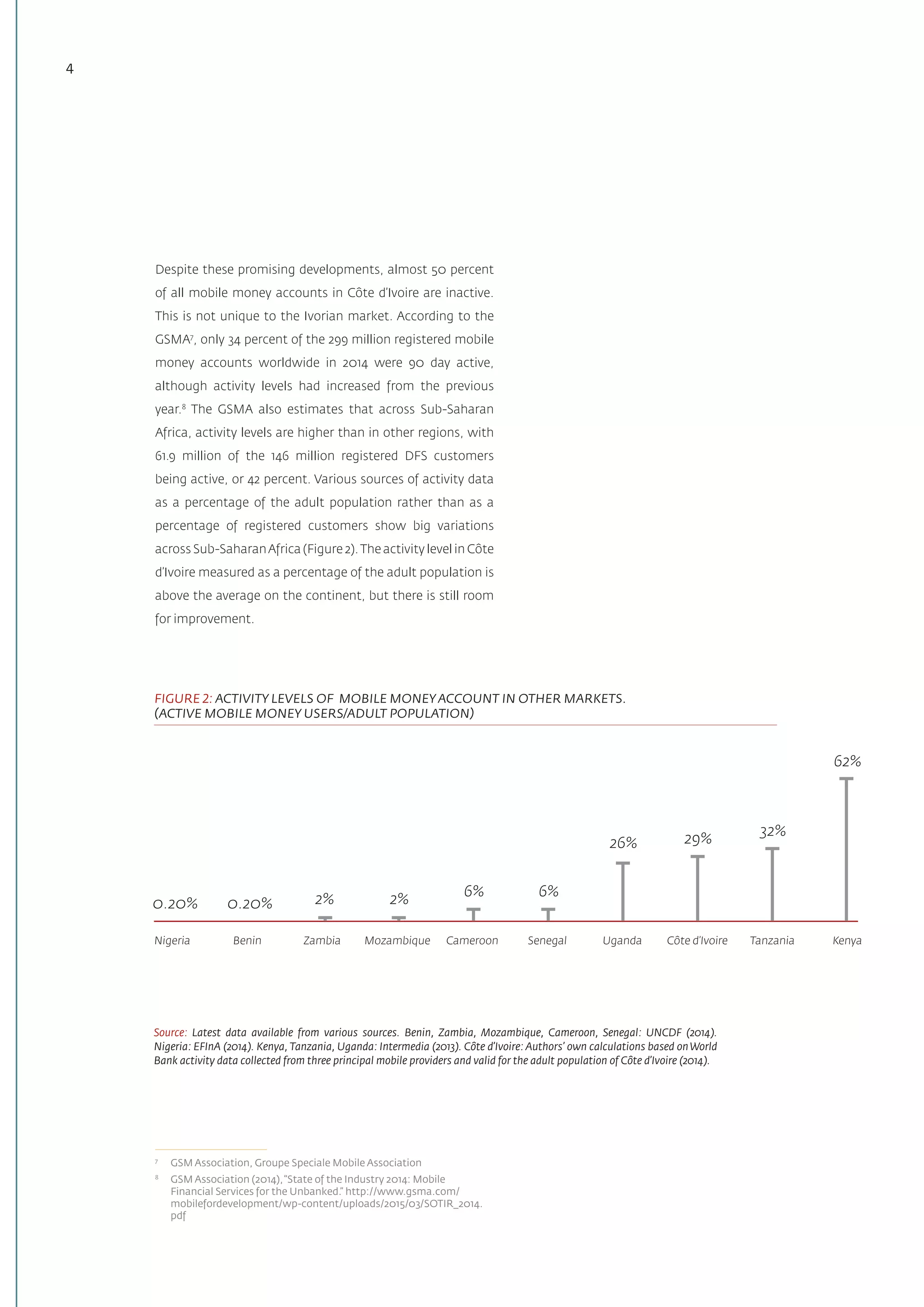
across Sub-SaharanAfrica (Figure 2).The activity level in Côte
d’Ivoire measured as a percentage of the adult population is
above the average on the continent, but there is still room
for improvement.
7	
GSM Association, Groupe Speciale Mobile Association
8	
GSM Association (2014),“State of the Industry 2014: Mobile
Financial Services for the Unbanked.” http://www.gsma.com/
mobilefordevelopment/wp-content/uploads/2015/03/SOTIR_2014.
pdf
Nigeria Benin Zambia Mozambique Cameroon Senegal Uganda Côte d’Ivoire Tanzania Kenya
FIGURE 2: ACTIVITY LEVELS OF MOBILE MONEYACCOUNT IN OTHER MARKETS.
(ACTIVE MOBILE MONEY USERS/ADULT POPULATION)
62%
32%29%26%
6%6%2%2%0.20%0.20%
Source: Latest data available from various sources. Benin, Zambia, Mozambique, Cameroon, Senegal: UNCDF (2014).
Nigeria: EFInA (2014). Kenya, Tanzania, Uganda: Intermedia (2013). Côte d’Ivoire: Authors’ own calculations based on World
Bank activity data collected from three principal mobile providers and valid for the adult population of Côte d’Ivoire (2014).
The mobile banking customer that isn’t: drivers of digital financial services inactivity in Côte d’Ivoire 5
The study asked a sample of one thousand mobile money
customers from two leading service providers in Côte
d’Ivoire why they did not regularly use their registered mobile
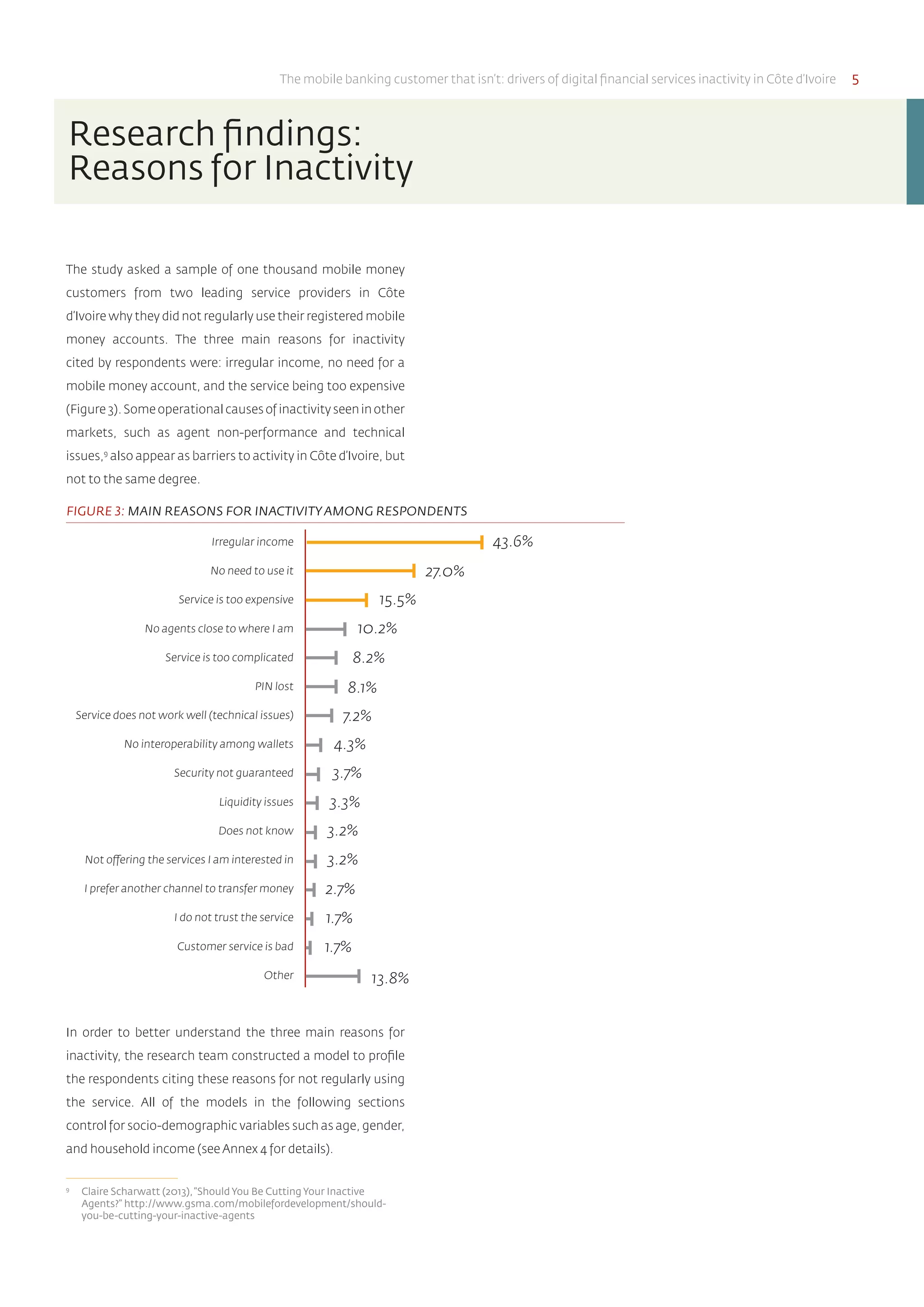
money accounts. The three main reasons for inactivity
cited by respondents were: irregular income, no need for a
mobile money account, and the service being too expensive
(Figure3).Someoperationalcausesofinactivityseeninother
markets, such as agent non-performance and technical
issues,9
also appear as barriers to activity in Côte d’Ivoire, but
not to the same degree.
In order to better understand the three main reasons for
inactivity, the research team constructed a model to profile
the respondents citing these reasons for not regularly using
the service. All of the models in the following sections
control for socio-demographic variables such as age, gender,
and household income (see Annex 4 for details).
9	
Claire Scharwatt (2013),“Should You Be Cutting Your Inactive
Agents?” http://www.gsma.com/mobilefordevelopment/should-
you-be-cutting-your-inactive-agents
Research findings:
Reasons for Inactivity
FIGURE 3: MAIN REASONS FOR INACTIVITYAMONG RESPONDENTS
Irregular income
No need to use it
Service is too expensive
No agents close to where I am
Service is too complicated
PIN lost
Service does not work well (technical issues)
No interoperability among wallets
Security not guaranteed
Liquidity issues
Does not know
Not offering the services I am interested in
I prefer another channel to transfer money
I do not trust the service
Customer service is bad
Other
43.6%
27.0%
15.5%
8.1%
10.2%
8.2%
7.2%
4.3%
3.7%
3.3%
3.2%
3.2%
2.7%
1.7%
1.7%
13.8%
6
Irregular income
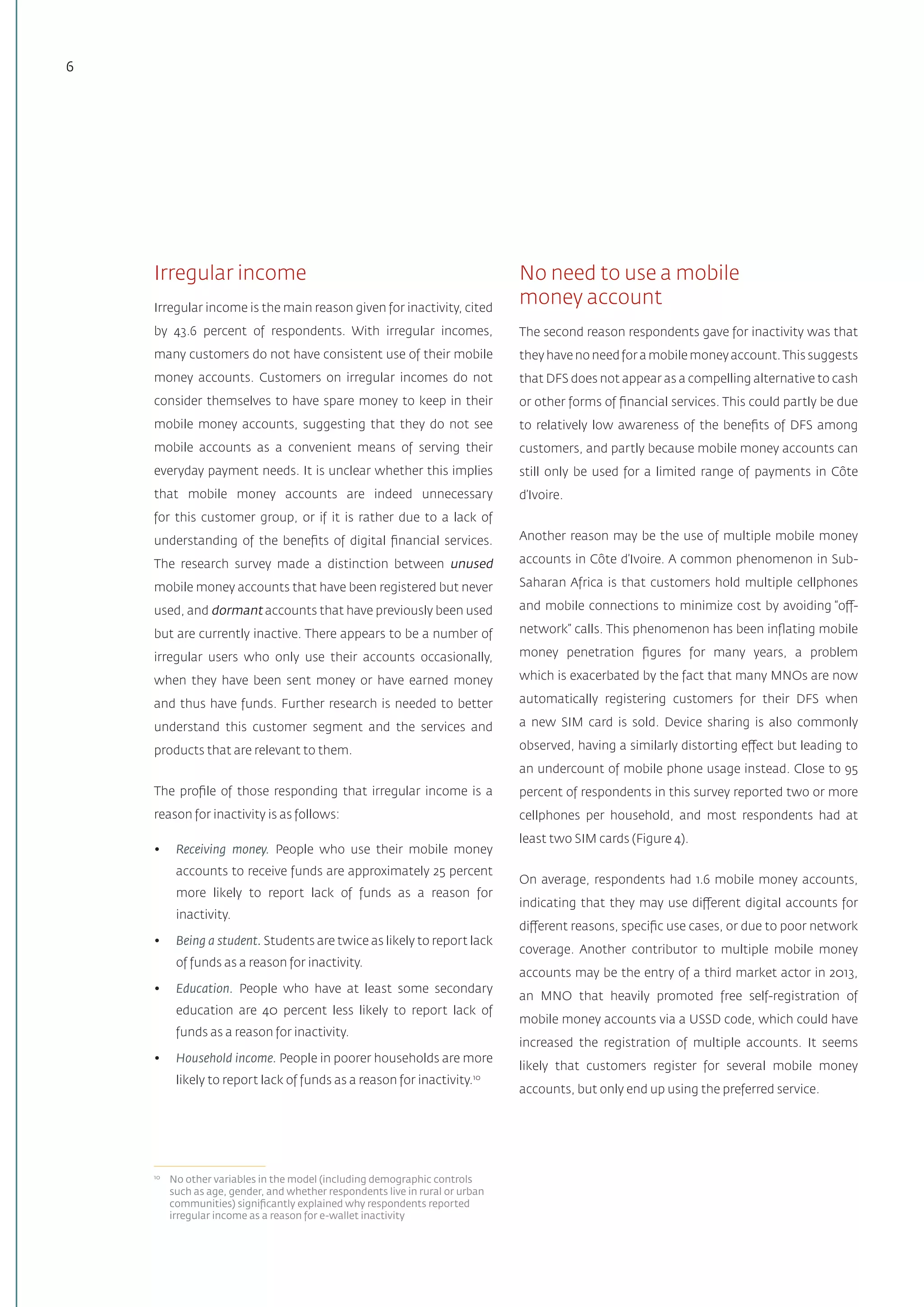
Irregular income is the main reason given for inactivity, cited
by 43.6 percent of respondents. With irregular incomes,
many customers do not have consistent use of their mobile
money accounts. Customers on irregular incomes do not
consider themselves to have spare money to keep in their
mobile money accounts, suggesting that they do not see
mobile accounts as a convenient means of serving their
everyday payment needs. It is unclear whether this implies
that mobile money accounts are indeed unnecessary
for this customer group, or if it is rather due to a lack of
understanding of the benefits of digital financial services.
The research survey made a distinction between unused
mobile money accounts that have been registered but never
used, and dormant accounts that have previously been used
but are currently inactive. There appears to be a number of
irregular users who only use their accounts occasionally,
when they have been sent money or have earned money
and thus have funds. Further research is needed to better
understand this customer segment and the services and
products that are relevant to them.
The profile of those responding that irregular income is a
reason for inactivity is as follows:
•	 Receiving money. People who use their mobile money
accounts to receive funds are approximately 25 percent
more likely to report lack of funds as a reason for
inactivity.
•	 Being a student. Students are twice as likely to report lack
of funds as a reason for inactivity.
•	 Education. People who have at least some secondary
education are 40 percent less likely to report lack of
funds as a reason for inactivity.
•	 Household income. People in poorer households are more
likely to report lack of funds as a reason for inactivity.10
10	
No other variables in the model (including demographic controls
such as age, gender, and whether respondents live in rural or urban
communities) significantly explained why respondents reported
irregular income as a reason for e-wallet inactivity
No need to use a mobile
money account
The second reason respondents gave for inactivity was that
they have no need for a mobile money account.This suggests
that DFS does not appear as a compelling alternative to cash
or other forms of financial services. This could partly be due
to relatively low awareness of the benefits of DFS among
customers, and partly because mobile money accounts can
still only be used for a limited range of payments in Côte
d’Ivoire.
Another reason may be the use of multiple mobile money
accounts in Côte d’Ivoire. A common phenomenon in Sub-
Saharan Africa is that customers hold multiple cellphones
and mobile connections to minimize cost by avoiding “off-
network” calls. This phenomenon has been inflating mobile
money penetration figures for many years, a problem
which is exacerbated by the fact that many MNOs are now
automatically registering customers for their DFS when
a new SIM card is sold. Device sharing is also commonly
observed, having a similarly distorting effect but leading to
an undercount of mobile phone usage instead. Close to 95
percent of respondents in this survey reported two or more
cellphones per household, and most respondents had at
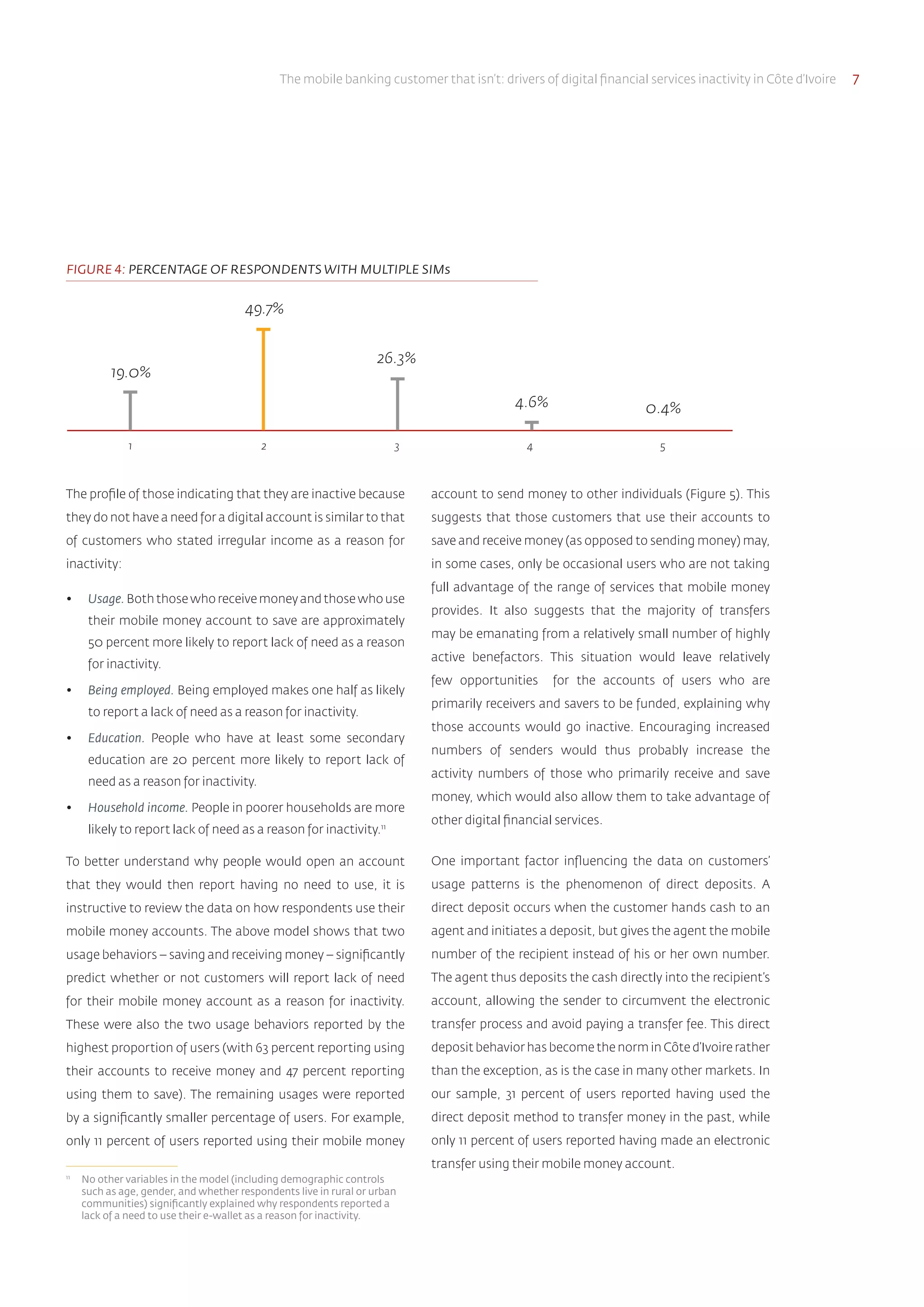
least two SIM cards (Figure 4).
On average, respondents had 1.6 mobile money accounts,
indicating that they may use different digital accounts for
different reasons, specific use cases, or due to poor network
coverage. Another contributor to multiple mobile money
accounts may be the entry of a third market actor in 2013,
an MNO that heavily promoted free self-registration of
mobile money accounts via a USSD code, which could have
increased the registration of multiple accounts. It seems
likely that customers register for several mobile money
accounts, but only end up using the preferred service.
The mobile banking customer that isn’t: drivers of digital financial services inactivity in Côte d’Ivoire 7
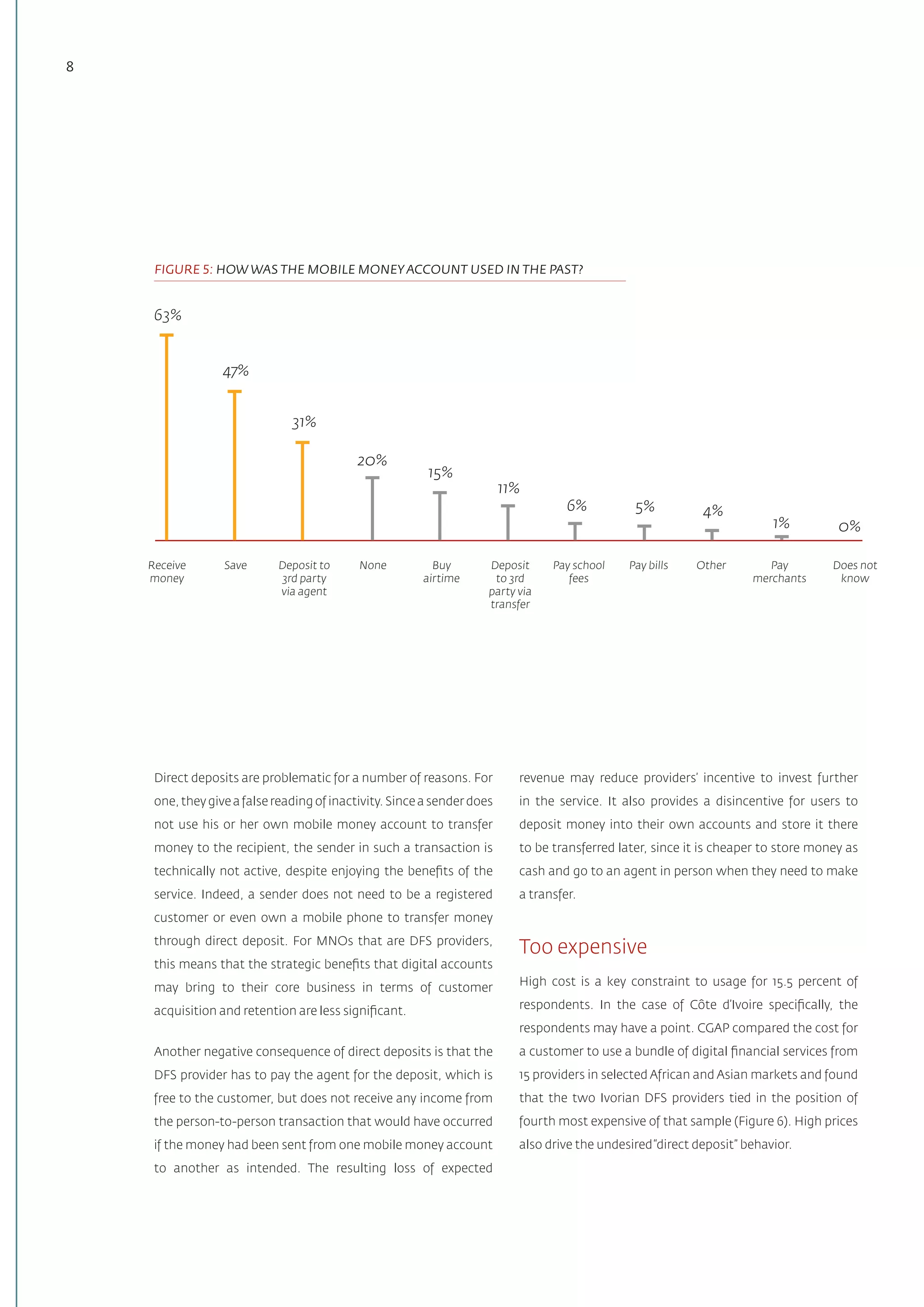
account to send money to other individuals (Figure 5). This
suggests that those customers that use their accounts to
save and receive money (as opposed to sending money) may,
in some cases, only be occasional users who are not taking
full advantage of the range of services that mobile money
provides. It also suggests that the majority of transfers
may be emanating from a relatively small number of highly
active benefactors. This situation would leave relatively
few opportunities for the accounts of users who are
primarily receivers and savers to be funded, explaining why
those accounts would go inactive. Encouraging increased
numbers of senders would thus probably increase the
activity numbers of those who primarily receive and save
money, which would also allow them to take advantage of
other digital financial services.
One important factor influencing the data on customers’
usage patterns is the phenomenon of direct deposits. A
direct deposit occurs when the customer hands cash to an
agent and initiates a deposit, but gives the agent the mobile
number of the recipient instead of his or her own number.
The agent thus deposits the cash directly into the recipient’s
account, allowing the sender to circumvent the electronic
transfer process and avoid paying a transfer fee. This direct
deposit behavior has become the norm in Côte d’Ivoire rather
than the exception, as is the case in many other markets. In
our sample, 31 percent of users reported having used the
direct deposit method to transfer money in the past, while
only 11 percent of users reported having made an electronic
transfer using their mobile money account.
The profile of those indicating that they are inactive because
they do not have a need for a digital account is similar to that
of customers who stated irregular income as a reason for
inactivity:
•	 Usage. Boththosewhoreceivemoneyandthosewhouse
their mobile money account to save are approximately
50 percent more likely to report lack of need as a reason
for inactivity.
•	 Being employed. Being employed makes one half as likely
to report a lack of need as a reason for inactivity.
•	 Education. People who have at least some secondary
education are 20 percent more likely to report lack of
need as a reason for inactivity.
•	 Household income. People in poorer households are more
likely to report lack of need as a reason for inactivity.11
To better understand why people would open an account
that they would then report having no need to use, it is
instructive to review the data on how respondents use their
mobile money accounts. The above model shows that two
usage behaviors – saving and receiving money – significantly
predict whether or not customers will report lack of need
for their mobile money account as a reason for inactivity.
These were also the two usage behaviors reported by the
highest proportion of users (with 63 percent reporting using
their accounts to receive money and 47 percent reporting
using them to save). The remaining usages were reported
by a significantly smaller percentage of users. For example,
only 11 percent of users reported using their mobile money
11	
No other variables in the model (including demographic controls
such as age, gender, and whether respondents live in rural or urban
communities) significantly explained why respondents reported a
lack of a need to use their e-wallet as a reason for inactivity.
1 2 3 4 5
FIGURE 4: PERCENTAGE OF RESPONDENTS WITH MULTIPLE SIMs
19.0%
49.7%
26.3%
4.6% 0.4%
8
Direct deposits are problematic for a number of reasons. For
one, they give a false reading of inactivity. Since a sender does
not use his or her own mobile money account to transfer
money to the recipient, the sender in such a transaction is
technically not active, despite enjoying the benefits of the
service. Indeed, a sender does not need to be a registered
customer or even own a mobile phone to transfer money
through direct deposit. For MNOs that are DFS providers,
this means that the strategic benefits that digital accounts
may bring to their core business in terms of customer
acquisition and retention are less significant.
Another negative consequence of direct deposits is that the
DFS provider has to pay the agent for the deposit, which is
free to the customer, but does not receive any income from
the person-to-person transaction that would have occurred
if the money had been sent from one mobile money account
to another as intended. The resulting loss of expected
revenue may reduce providers’ incentive to invest further
in the service. It also provides a disincentive for users to
deposit money into their own accounts and store it there
to be transferred later, since it is cheaper to store money as
cash and go to an agent in person when they need to make
a transfer.
Too expensive
High cost is a key constraint to usage for 15.5 percent of
respondents. In the case of Côte d’Ivoire specifically, the
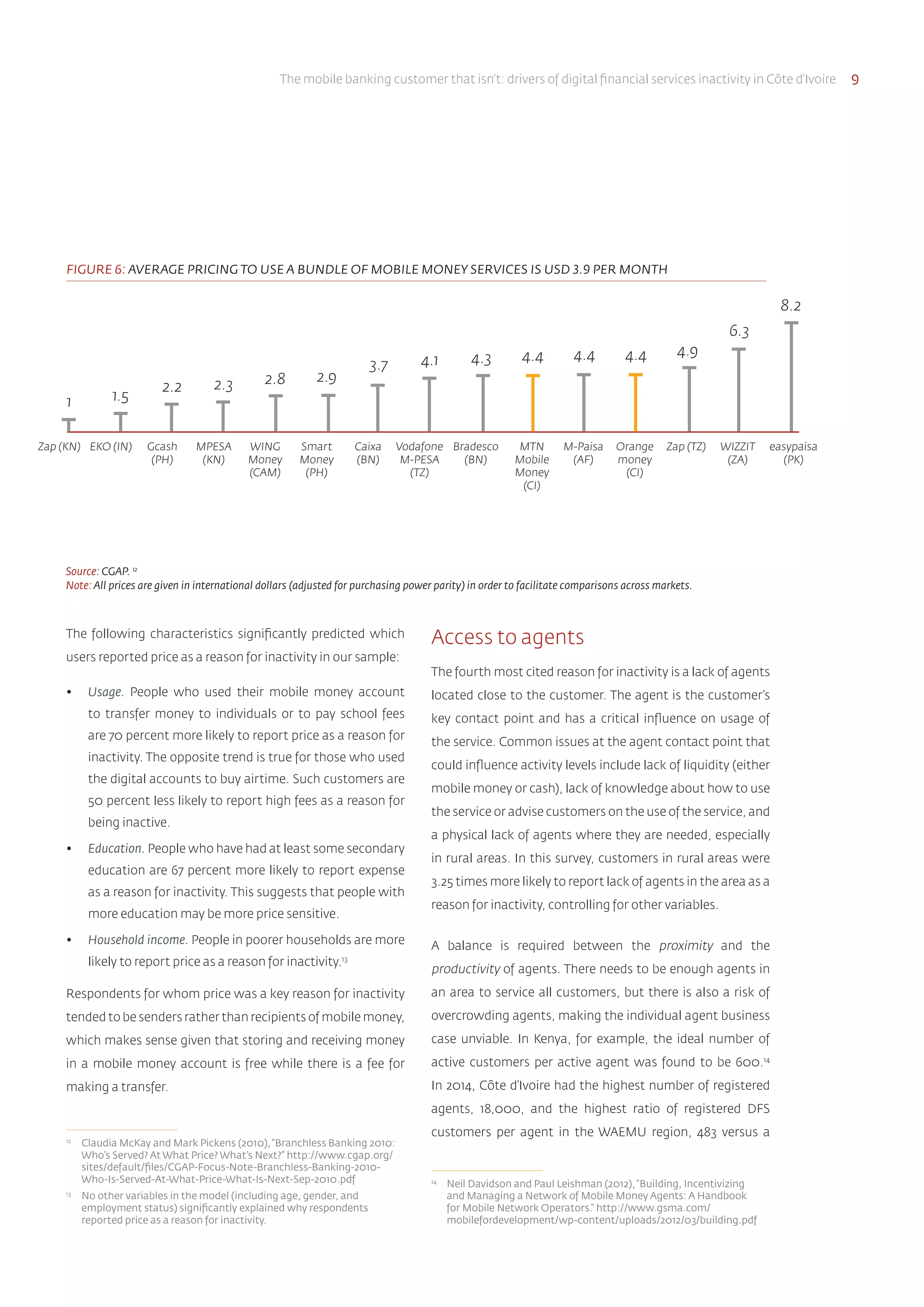
respondents may have a point. CGAP compared the cost for
a customer to use a bundle of digital financial services from
15 providers in selected African and Asian markets and found
that the two Ivorian DFS providers tied in the position of
fourth most expensive of that sample (Figure 6). High prices
also drive the undesired“direct deposit” behavior.
Receive
money
Save Deposit to
3rd party
via agent
None Buy
airtime
Deposit
to 3rd
party via
transfer
Pay school
fees
Pay bills Other Pay
merchants
Does not
know
FIGURE 5: HOW WAS THE MOBILE MONEYACCOUNT USED IN THE PAST?
63%
5%
31%
20%
4%
47%
15%
11%
6%
1% 0%
The mobile banking customer that isn’t: drivers of digital financial services inactivity in Côte d’Ivoire 9
The following characteristics significantly predicted which
users reported price as a reason for inactivity in our sample:12
•	 Usage. People who used their mobile money account
to transfer money to individuals or to pay school fees
are 70 percent more likely to report price as a reason for
inactivity. The opposite trend is true for those who used
the digital accounts to buy airtime. Such customers are
50 percent less likely to report high fees as a reason for
being inactive.
•	 Education. People who have had at least some secondary
education are 67 percent more likely to report expense
as a reason for inactivity. This suggests that people with
more education may be more price sensitive.
•	 Household income. People in poorer households are more
likely to report price as a reason for inactivity.13
Respondents for whom price was a key reason for inactivity
tended to be senders rather than recipients of mobile money,
which makes sense given that storing and receiving money
in a mobile money account is free while there is a fee for
making a transfer.
12	
Claudia McKay and Mark Pickens (2010),“Branchless Banking 2010:
Who’s Served? At What Price? What’s Next?” http://www.cgap.org/
sites/default/files/CGAP-Focus-Note-Branchless-Banking-2010-
Who-Is-Served-At-What-Price-What-Is-Next-Sep-2010.pdf
13	
No other variables in the model (including age, gender, and
employment status) significantly explained why respondents
reported price as a reason for inactivity.
Access to agents
The fourth most cited reason for inactivity is a lack of agents
located close to the customer. The agent is the customer’s
key contact point and has a critical influence on usage of
the service. Common issues at the agent contact point that
could influence activity levels include lack of liquidity (either
mobile money or cash), lack of knowledge about how to use
the service or advise customers on the use of the service, and
a physical lack of agents where they are needed, especially
in rural areas. In this survey, customers in rural areas were
3.25 times more likely to report lack of agents in the area as a
reason for inactivity, controlling for other variables.
A balance is required between the proximity and the
productivity of agents. There needs to be enough agents in
an area to service all customers, but there is also a risk of
overcrowding agents, making the individual agent business
case unviable. In Kenya, for example, the ideal number of
active customers per active agent was found to be 600.14
In 2014, Côte d’Ivoire had the highest number of registered
agents, 18,000, and the highest ratio of registered DFS
customers per agent in the WAEMU region, 483 versus a
14	
Neil Davidson and Paul Leishman (2012),“Building, Incentivizing
and Managing a Network of Mobile Money Agents: A Handbook
for Mobile Network Operators.” http://www.gsma.com/
mobilefordevelopment/wp-content/uploads/2012/03/building.pdf
Zap (KN) EKO (IN) Gcash
(PH)
MPESA
(KN)
WING
Money
(CAM)
Smart
Money
(PH)
Caixa
(BN)
Vodafone
M-PESA
(TZ)
Bradesco
(BN)
MTN
Mobile
Money
(CI)
M-Paisa
(AF)
Orange
money
(CI)
Zap (TZ) WIZZIT
(ZA)
easypaisa
(PK)
FIGURE 6: AVERAGE PRICING TO USE A BUNDLE OF MOBILE MONEY SERVICES IS USD 3.9 PER MONTH
1
4.4 4.44.4
1.5
2.2 2.3 2.8 2.9
3.7 4.1 4.3 4.9
6.3
8.2
Source: CGAP. 12
Note: All prices are given in international dollars (adjusted for purchasing power parity) in order to facilitate comparisons across markets.
10
regional average of 220.15
It would appear that the supply of
agents is currently sufficient as a lower ratio of customers
to agent may reduce agent productivity, assuming that
all agents are currently efficiently run. However, as lack of
access to agents has been cited as one of the key causes
of inactivity, it would appear that some current agents are
not situated where they are needed, are not active, or both.
More research on the location of agents and their level of
activity is needed to determine whether the existing mobile
money agent network is sufficient to meet existing and
future demand.
To better understand some of the aspects of agent network
management which can be improved to increase activity
levels, the research survey was complemented by 40 mystery
shopping visits to existing agents. Six key dimensions of the
customer experience at the agent were assessed:
1.	 External environment at agent location
2.	 Internal environment at agent location
3.	 Waiting and dispatch time
4.	 Customer service
5.	 Agent’s knowledge of products
6.	 Overall agent behavior
From the mystery shopping scorecards it is evident that
one area that needs further improvement is the internal
environment at agent location. Issues like security within
the agent location and lack of flyers and communication
materials were mentioned as very problematic. In general,
the mystery shopping exercise indicated that the guidance
given or help offered by staff at agent locations is very poor
for the sample analyzed.
Service is too complicated
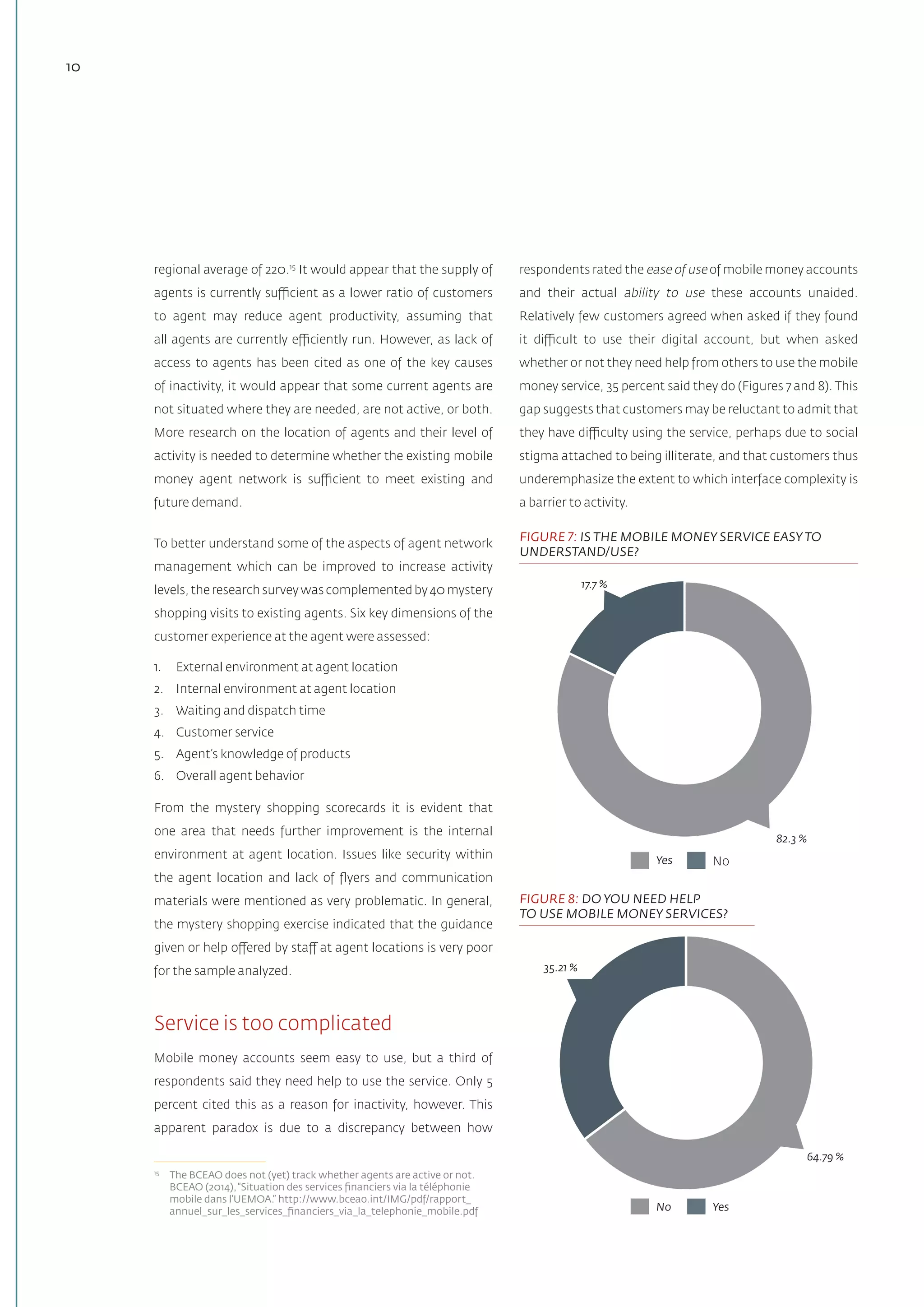
Mobile money accounts seem easy to use, but a third of
respondents said they need help to use the service. Only 5
percent cited this as a reason for inactivity, however. This
apparent paradox is due to a discrepancy between how
15	
The BCEAO does not (yet) track whether agents are active or not.
BCEAO (2014),“Situation des services financiers via la téléphonie
mobile dans l’UEMOA.” http://www.bceao.int/IMG/pdf/rapport_
annuel_sur_les_services_financiers_via_la_telephonie_mobile.pdf
respondents rated the ease of use of mobile money accounts
and their actual ability to use these accounts unaided.
Relatively few customers agreed when asked if they found
it difficult to use their digital account, but when asked
whether or not they need help from others to use the mobile
money service, 35 percent said they do (Figures 7 and 8). This
gap suggests that customers may be reluctant to admit that
they have difficulty using the service, perhaps due to social
stigma attached to being illiterate, and that customers thus
underemphasize the extent to which interface complexity is
a barrier to activity.
FIGURE 7: IS THE MOBILE MONEY SERVICE EASYTO
UNDERSTAND/USE?
17.7 %
82.3 %
35.21 %
64.79 %
FIGURE 8: DO YOU NEED HELP
TO USE MOBILE MONEY SERVICES?
No Yes
Yes No
The mobile banking customer that isn’t: drivers of digital financial services inactivity in Côte d’Ivoire 11
This suggests that there are hurdles to the use of mobile
money accounts that customers are either not aware of or
do not want to admit to. It is also possible that registered
customers understand in theory what they need to do, but
that in practice the user experience is not as easy as Figure 8
seems to indicate. Practical barriers may include issues such
as ensuring that the correct destination number is entered
or USSD time-out.
What predicts inactivity?
A key objective of this research study is to help DFS providers
understand how to activate customers. For that reason, the
team created a simple model to identify and examine the
socio-economic characteristics of inactive customers (see
annex 4 for details). Four of the variables included in the
model were found to be significant predictors of inactivity.16
1.	 Being employed. Customers that are employed are 75
percent less likely to be inactive than students and the
unemployed.
2.	 Usage. Those buying airtime via a mobile money account
are approximately 50 percent less likely to be inactive,
and people depositing money directly into a third party’s
account at an agent are 35 percent less likely to be
inactive.
3.	 Being unbanked. People who have no traditional bank
account are 50 percent less likely to be inactive than
those that are banked.
4.	 Low service satisfaction. Customers that are unhappy
with the mobile money service are highly likely to be
inactive.
The fact that clients who are not otherwise banked were
less likely to be inactive than banked clients suggests that
some people may use mobile money accounts as substitutes
for bank accounts. Indeed, 47 percent of respondents had
used their digital account for saving at some point, and 70
percent planned to do so in the future. Further research is
needed to better understand if, how, and why customers
16	
No other variables in the model (including demographic variables
such as age and gender) significantly explained inactivity.
sometimes appear to use their mobile money accounts as
bank accounts.
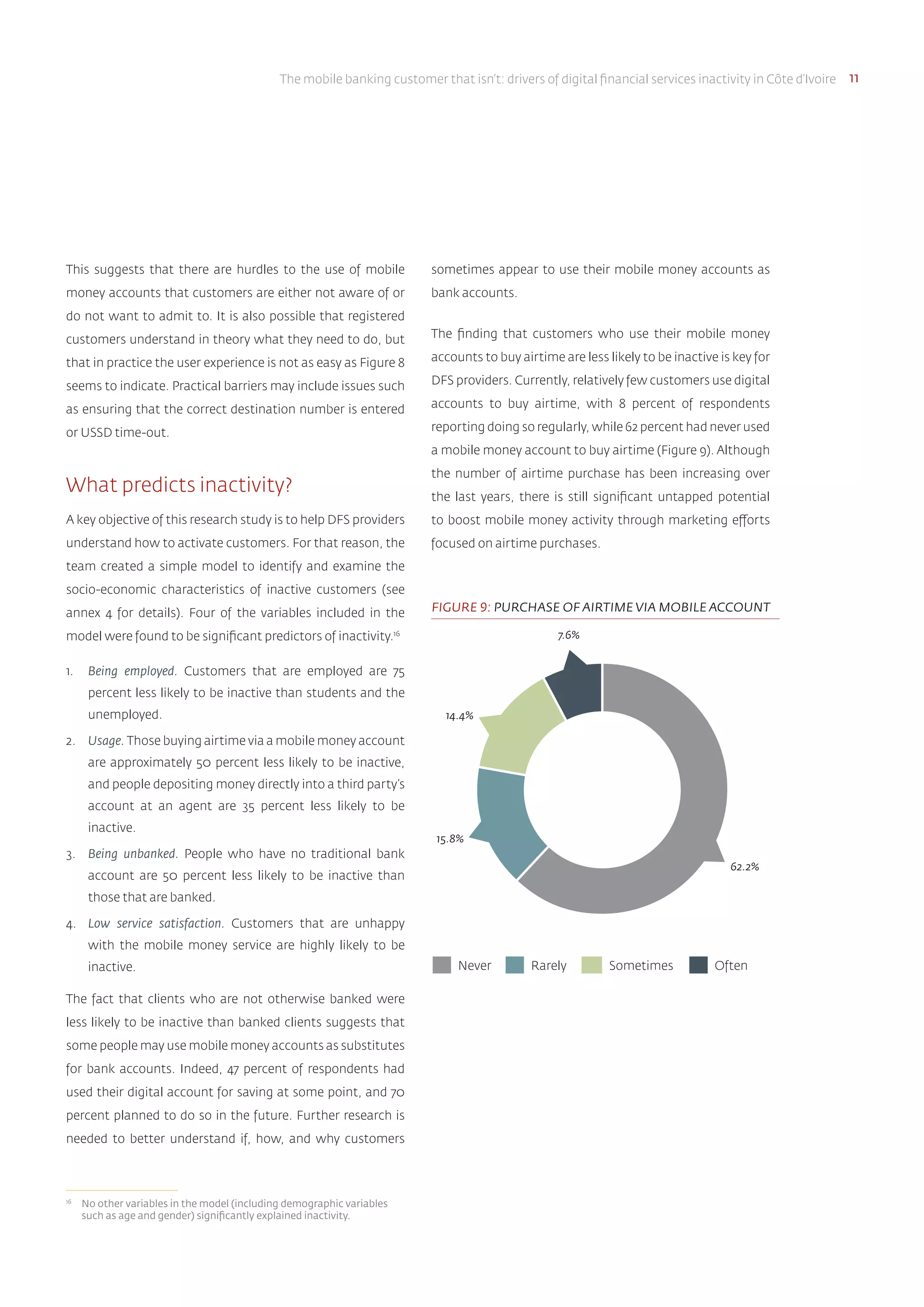
The finding that customers who use their mobile money
accounts to buy airtime are less likely to be inactive is key for
DFS providers. Currently, relatively few customers use digital
accounts to buy airtime, with 8 percent of respondents
reporting doing so regularly, while 62 percent had never used
a mobile money account to buy airtime (Figure 9). Although
the number of airtime purchase has been increasing over
the last years, there is still significant untapped potential
to boost mobile money activity through marketing efforts
focused on airtime purchases.
Never Rarely Sometimes Often
FIGURE 9: PURCHASE OF AIRTIME VIA MOBILE ACCOUNT
62.2%
7.6%
14.4%
15.8%
12
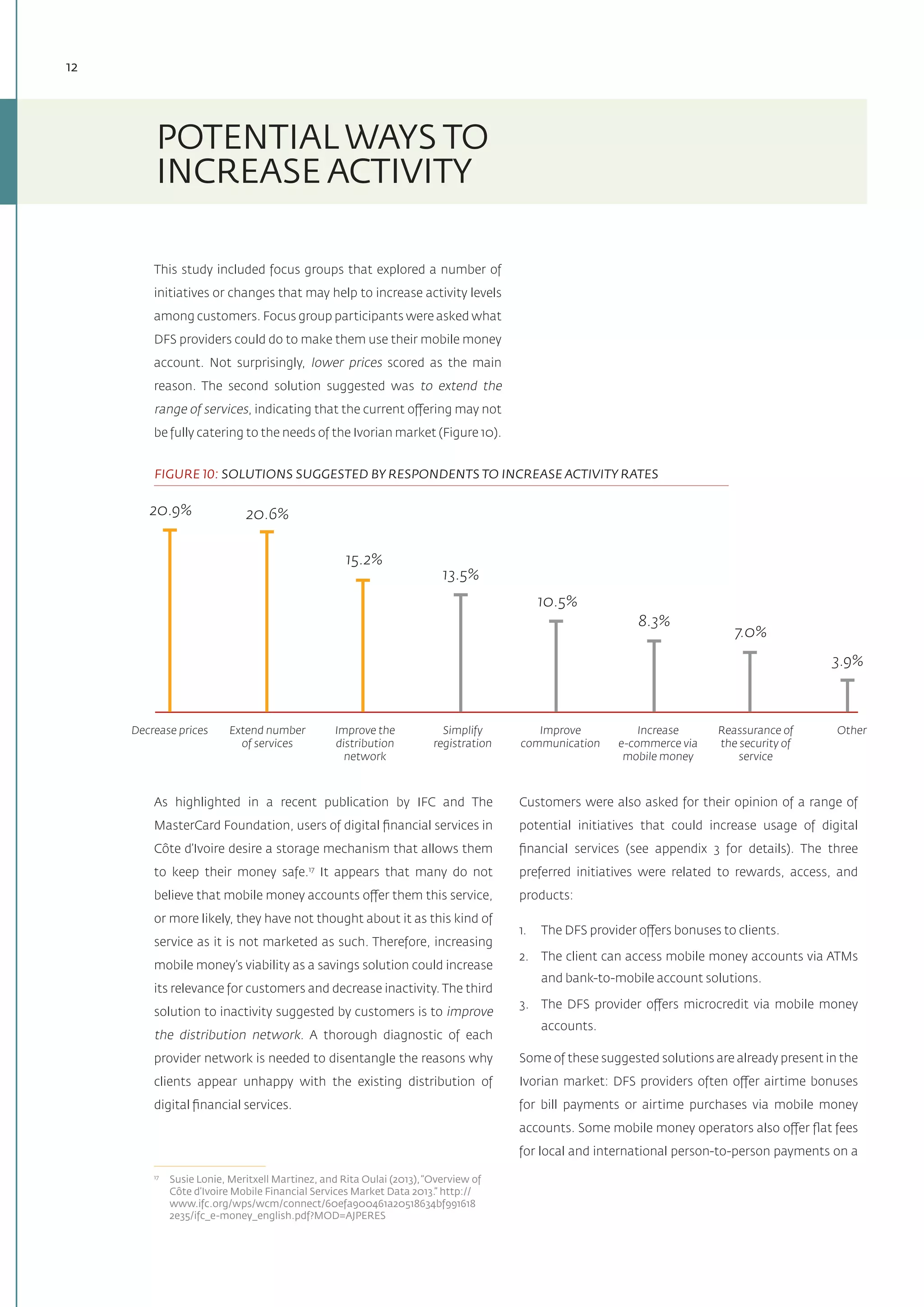
This study included focus groups that explored a number of
initiatives or changes that may help to increase activity levels
among customers. Focus group participants were asked what
DFS providers could do to make them use their mobile money
account. Not surprisingly, lower prices scored as the main
reason. The second solution suggested was to extend the
range of services, indicating that the current offering may not
be fully catering to the needs of the Ivorian market (Figure 10).
POTENTIAL WAYS TO
INCREASE ACTIVITY
Decrease prices Extend number
of services
Improve the
distribution
network
Simplify
registration
Improve
communication
Increase
e-commerce via
mobile money
Reassurance of
the security of
service
Other
FIGURE 10: SOLUTIONS SUGGESTED BY RESPONDENTS TO INCREASE ACTIVITY RATES
20.9%
8.3%
15.2%
7.0%
20.6%
13.5%
10.5%
3.9%
As highlighted in a recent publication by IFC and The
MasterCard Foundation, users of digital financial services in
Côte d’Ivoire desire a storage mechanism that allows them
to keep their money safe.17
It appears that many do not
believe that mobile money accounts offer them this service,
or more likely, they have not thought about it as this kind of
service as it is not marketed as such. Therefore, increasing
mobile money’s viability as a savings solution could increase
its relevance for customers and decrease inactivity. The third
solution to inactivity suggested by customers is to improve
the distribution network. A thorough diagnostic of each
provider network is needed to disentangle the reasons why
clients appear unhappy with the existing distribution of
digital financial services.
17	
Susie Lonie, Meritxell Martinez, and Rita Oulai (2013),“Overview of
Côte d’Ivoire Mobile Financial Services Market Data 2013.” http://
www.ifc.org/wps/wcm/connect/60efa900461a20518634bf991618
2e35/ifc_e-money_english.pdf?MOD=AJPERES
Customers were also asked for their opinion of a range of
potential initiatives that could increase usage of digital
financial services (see appendix 3 for details). The three
preferred initiatives were related to rewards, access, and
products:
1.	 The DFS provider offers bonuses to clients.
2.	 The client can access mobile money accounts via ATMs
and bank-to-mobile account solutions.
3.	 The DFS provider offers microcredit via mobile money
accounts.
Some of these suggested solutions are already present in the
Ivorian market: DFS providers often offer airtime bonuses
for bill payments or airtime purchases via mobile money
accounts. Some mobile money operators also offer flat fees
for local and international person-to-person payments on a
The mobile banking customer that isn’t: drivers of digital financial services inactivity in Côte d’Ivoire 13
temporary basis to encourage repeated usage. Two of the
DFS providers have been experimenting with ATMs: one by
leveraging the large existing ATM network of a state-owned
bank, and the other by investing in and deploying its own
ATM network. The integration of bank accounts with mobile
money accounts already exists in Côte d’Ivoire, allowing
for the transfer of money from digital accounts to bank
accounts and vice versa. However, this service is fairly recent,
quite expensive, marketed only on a limited scale and targets
existing bank customers. This service, if competitively priced
and promoted, could also be used by agents to manage their
liquidity.
The demand for more DFS-enabled microcredit products
highlighted in focus groups is not yet being fully explored
by Ivorian providers. Product innovation is led by markets in
East Africa, with M-Shwari in Kenya, M-Pawa in Tanzania,
and Igurize Amafaranga, an Airtel microcredit product
recently launched in Rwanda. There is an opportunity to
provide similar services in Côte d’Ivoire, where recent data
from BCEAO confirm that the DFS ecosystem in the WAEMU
region is already being used for safe, non-remunerated
storage of funds. In partnership, financial institutions and
DFS providers could leverage mobile money’s high market
penetration to bring interest-bearing savings products and
credit services to the unbanked in Côte d’Ivoire.
There is no single solution to increasing customer activity
in the digital financial services market. However, there are
a range of actions that can be taken to help overcome the
issues that contribute to an inactive clientele. This study
has highlighted some important new areas for research and
lessons learned for the industry as a whole:
1.	 Products and services could be developed that better cater to
customers with irregular incomes. Irregular income is the
main reason for inactivity cited by registered customers.
The Ivorian economy is strongly dependent on the
primary sector and the informal sector, with 68 percent
of the workforce employed in agricultural activities with
seasonal incomes.18
Mobile money account activity,
however, is measured over a period of 30 days, or,
more commonly, 90 days. Research is needed to better
understand the reasons, prevalence, and impact of
irregular usage of digital financial services, and possible
measures to take account of this in order to serve
customers with irregular or cyclical cash flow, such as
farmers and other seasonal workers.
2.	 DFS prices should be revised and reduced. The pricing of
mobile money services appears to be a major issue in
Côte d’Ivoire. It is unclear why the Ivorian providers
charge higher rates than in many other markets, but this
iscertainlylimitingthegrowthpotentialoftheirservices.
Lower prices might encourage more active usage, and
promotional or pilot initiatives by the providers are
recommended to determine the cost versus benefit of
price reduction over an extended period.
3.	 Customer education could be improved. Lack of customer
information and education is an issue both at agent
locations and as demonstrated by how many clients
need help using the service. There is a clear need to give
customers a better understanding of the uses of mobile
money accounts, and to disentangle what the barriers to
ease of use are and how these are linked to behavioral,
contextual, or even personality-related factors.
18	
IFC (2013),“Scan du secteur agro-business Côte d’Ivoire.”
CONCLUSIONS &
RECOMMENDATIONS
14
4.	 A solution to direct deposits is needed. Direct deposits are
very common in Côte d’Ivoire, negatively impacting the
DFS provider business case and creating a false measure
of inactivity. Eliminating revenue leakages due to direct
deposits could also provide a means of financing fee
decreases.
5.	 Agent availability and management can be improved.
Agent access and performance have a strong impact
on customers’ usage of digital financial services. Good
quality agents are a major asset, whilst poor agents can
put off customers from using the service. In Côte d’Ivoire,
the number of agents is reported to BCEAO but it is not
known what proportion is active.19
GSMA estimates
that, on average, 60 percent of agents were active
worldwide, and 43 percent in West Africa, at the end
of 2014.20
Further research on agent networks in Côte
d’Ivoire is needed to understand where the gaps and
issues lie, both in terms of proximity and productivity.
19	
The Alliance for Financial Inclusion suggests the following definition
of“active MFS agent”:“MFS cash points that have performed at least
one transaction in the last 90 days.” AFI Mobile Financial Services
Working Group (2013),“Mobile Financial Services Indicators for
Measuring Access and Usage.” http://www.afi-global.org/sites/
default/files/publications/mfswg_guideline_note_no.11_lo.pdf
20	
GSM Association (2014),“State of the Industry 2014: Mobile
Financial Services for the Unbanked.” http://www.gsma.com/
mobilefordevelopment/wp-content/uploads/2015/03/SOTIR_2014.
pdf
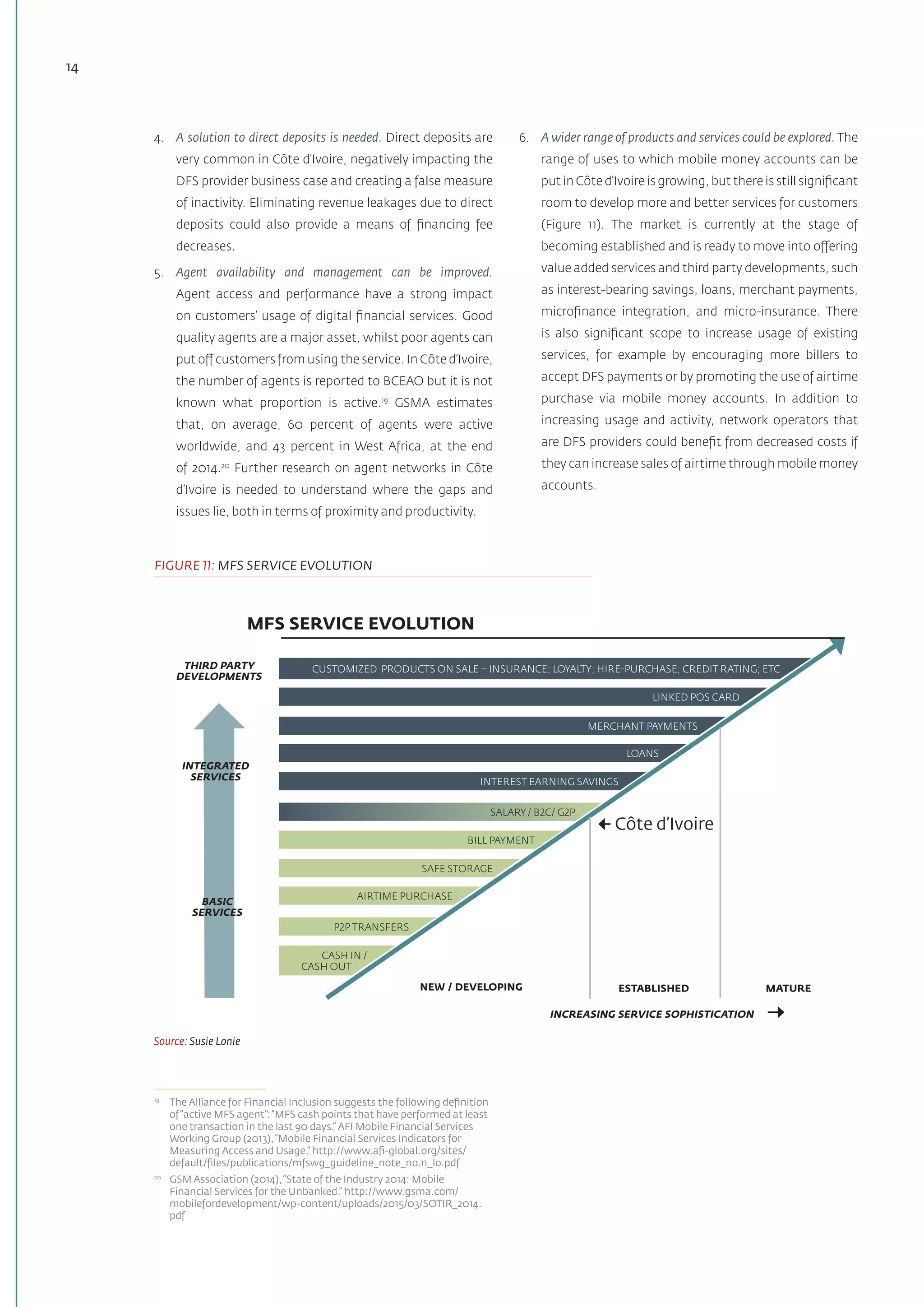
6.	 A wider range of products and services could be explored. The
range of uses to which mobile money accounts can be
put in Côte d’Ivoire is growing, but there is still significant
room to develop more and better services for customers
(Figure 11). The market is currently at the stage of
becoming established and is ready to move into offering
value added services and third party developments, such
as interest-bearing savings, loans, merchant payments,
microfinance integration, and micro-insurance. There
is also significant scope to increase usage of existing
services, for example by encouraging more billers to
accept DFS payments or by promoting the use of airtime
purchase via mobile money accounts. In addition to
increasing usage and activity, network operators that
are DFS providers could benefit from decreased costs if
they can increase sales of airtime through mobile money
accounts.
CUSTOMIZED PRODUCTS ON SALE – INSURANCE; LOYALTY; HIRE-PURCHASE; CREDIT RATING; ETC
LINKED POS CARD
MERCHANT PAYMENTS
LOANS
INTEREST EARNING SAVINGS
SALARY / B2C/ G2P
BILL PAYMENT
SAFE STORAGE
AIRTIME PURCHASE
P2P TRANSFERS
CASH IN /
CASH OUT
NEW / DEVELOPING ESTABLISHED MATURE
THIRD PARTY
DEVELOPMENTS
INTEGRATED
SERVICES
BASIC
SERVICES
INCREASING SERVICE SOPHISTICATION
Côte d’Ivoire
MFS SERVICE EVOLUTION
FIGURE 11: MFS SERVICE EVOLUTION
Source: Susie Lonie
The mobile banking customer that isn’t: drivers of digital financial services inactivity in Côte d’Ivoire 15
Annex 2:
Mystery Shopping Methodology
METHODOLOGY
Mystery shopping with
structured questionnaire (PAPI
method) and at least two visits
per distribution point.
TARGET
POPULATION
Branches and point of sales
managers, agents of the two
participating MNOs
TOTAL SAMPLE
40 distribution points
representing all distributor types
for each MNO.
DATES October 2 to 23, 2014.
Number of visits per locality
LOCATION* NUMBER OF VISITS
Abidjan 44
San Pédro 18
Bouaké 20
Total 82
*Mystery shopping conducted in main city and surrounding
areas representing a mix of urban, semi-urban and rural
areas.
Annex 1:
Research approach
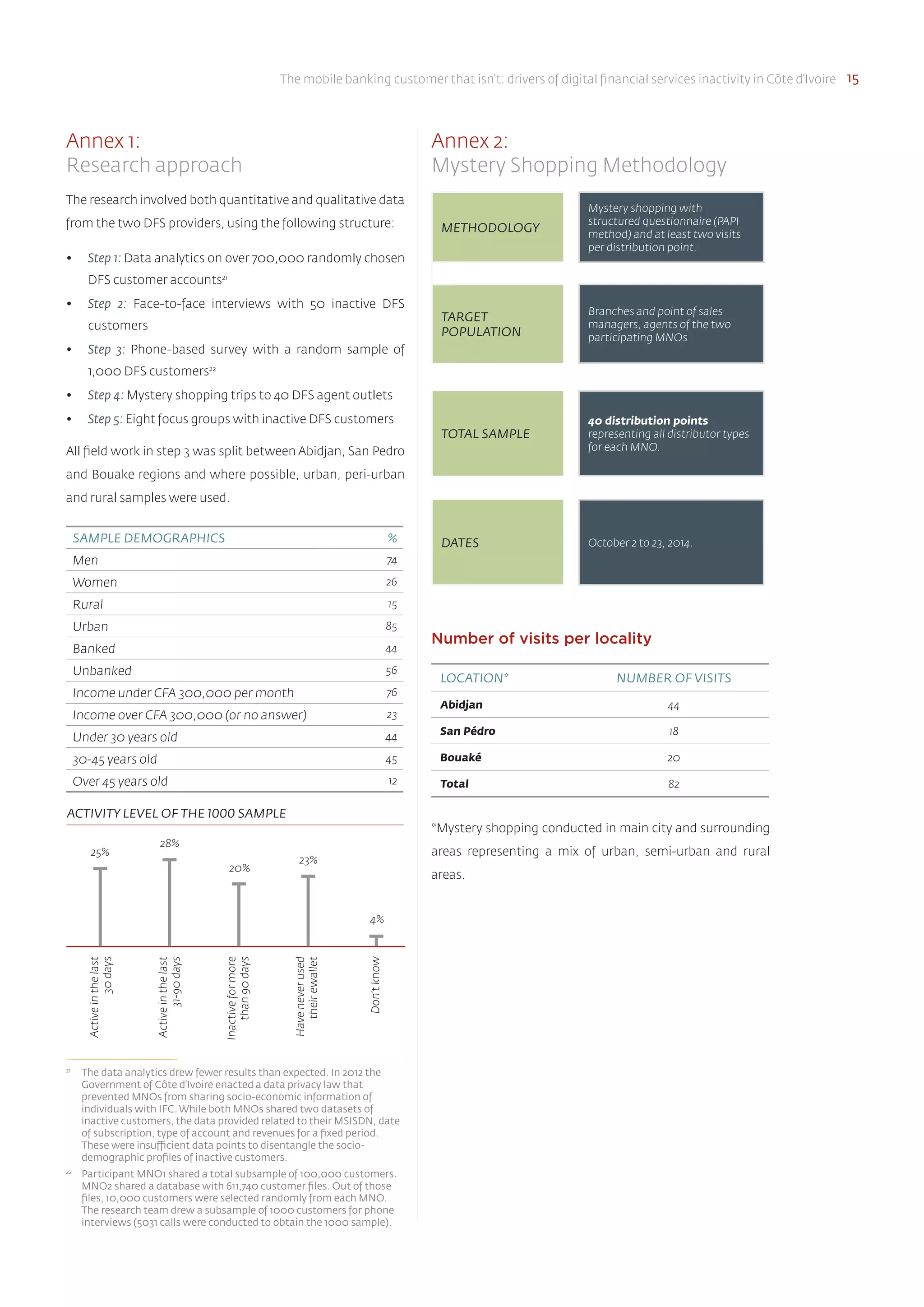
The research involved both quantitative and qualitative data
from the two DFS providers, using the following structure:
•	 Step 1: Data analytics on over 700,000 randomly chosen
DFS customer accounts21
•	 Step 2: Face-to-face interviews with 50 inactive DFS
customers
•	 Step 3: Phone-based survey with a random sample of
1,000 DFS customers22
•	 Step 4: Mystery shopping trips to 40 DFS agent outlets
•	 Step 5: Eight focus groups with inactive DFS customers
All field work in step 3 was split between Abidjan, San Pedro
and Bouake regions and where possible, urban, peri-urban
and rural samples were used.
SAMPLE DEMOGRAPHICS %
Men 74
Women 26
Rural 15
Urban 85
Banked 44
Unbanked 56
Income under CFA 300,000 per month 76
Income over CFA 300,000 (or no answer) 23
Under 30 years old 44
30-45 years old 45
Over 45 years old 12
21	
The data analytics drew fewer results than expected. In 2012 the
Government of Côte d’Ivoire enacted a data privacy law that
prevented MNOs from sharing socio-economic information of
individuals with IFC. While both MNOs shared two datasets of
inactive customers, the data provided related to their MSISDN, date
of subscription, type of account and revenues for a fixed period.
These were insufficient data points to disentangle the socio-
demographic profiles of inactive customers.
22	
Participant MNO1 shared a total subsample of 100,000 customers.
MNO2 shared a database with 611,740 customer files. Out of those
files, 10,000 customers were selected randomly from each MNO.
The research team drew a subsample of 1000 customers for phone
interviews (5031 calls were conducted to obtain the 1000 sample).
Activeinthelast
30days
Activeinthelast
31-90days
Inactiveformore
than90days
Haveneverused
theirewallet
Don’tknow
ACTIVITY LEVEL OF THE 1000 SAMPLE
25%
28%
20%
23%
4%
16
Annex 3:
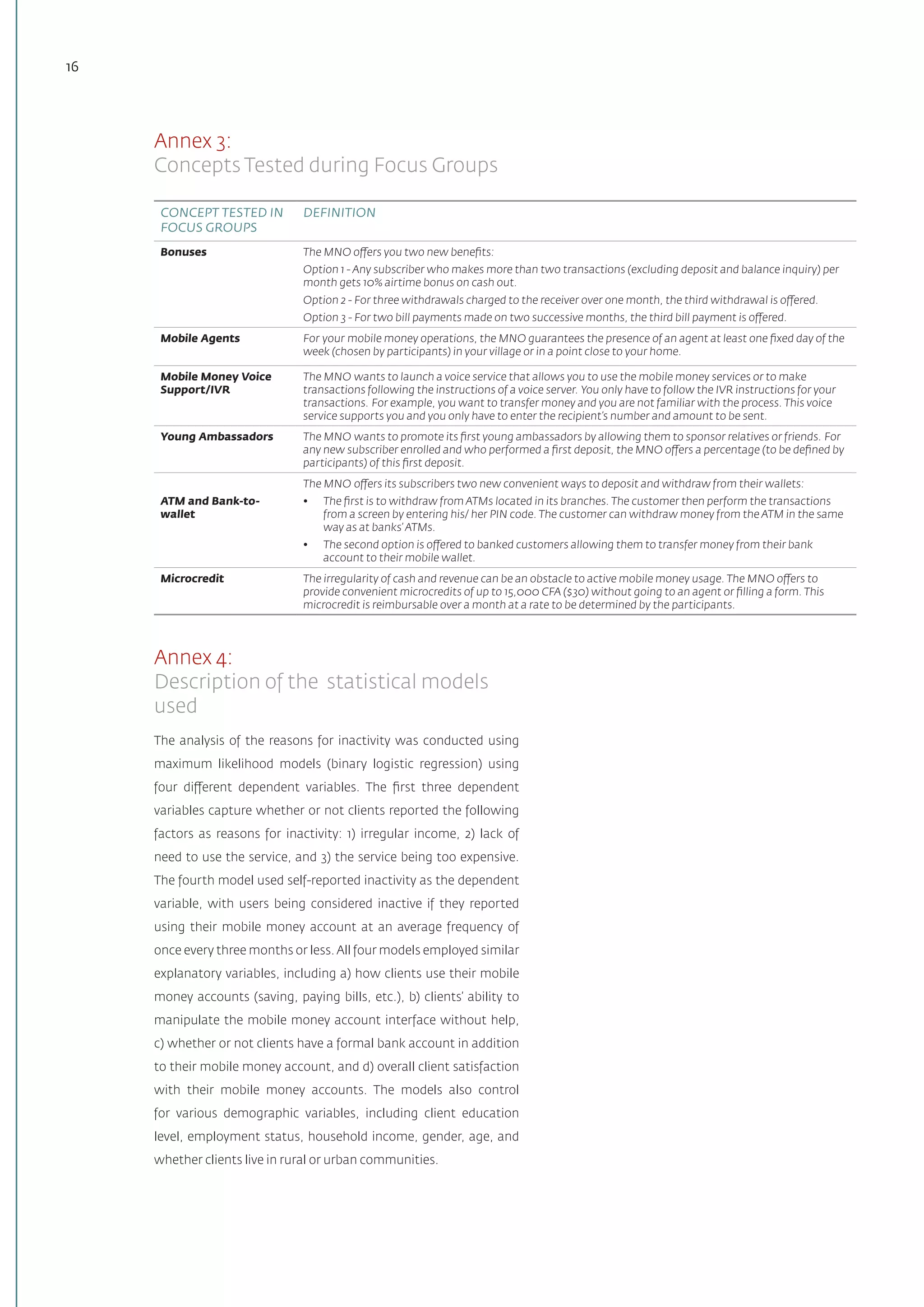
Concepts Tested during Focus Groups
CONCEPT TESTED IN
FOCUS GROUPS
DEFINITION
Bonuses
 
The MNO offers you two new benefits:
Option 1 - Any subscriber who makes more than two transactions (excluding deposit and balance inquiry) per
month gets 10% airtime bonus on cash out.
Option 2 - For three withdrawals charged to the receiver over one month, the third withdrawal is offered.
Option 3 - For two bill payments made ​​on two successive months, the third bill payment is offered.
Mobile Agents
 
For your mobile money operations, the MNO guarantees the presence of an agent at least one fixed day of the
week (chosen by participants) in your village or in a point close to your home.
Mobile Money Voice
Support/IVR
 
The MNO wants to launch a voice service that allows you to use the mobile money services or to make
transactions following the instructions of a voice server. You only have to follow the IVR instructions for your
transactions. For example, you want to transfer money and you are not familiar with the process. This voice
service supports you and you only have to enter the recipient’s number and amount to be sent.
Young Ambassadors The MNO wants to promote its first young ambassadors by allowing them to sponsor relatives or friends. For
any new subscriber enrolled and who performed a first deposit, the MNO offers a percentage (to be defined by
participants) of this first deposit.
 
ATM and Bank-to-
wallet
The MNO offers its subscribers two new convenient ways to deposit and withdraw from their wallets:
•	 The first is to withdraw from ATMs located in its branches. The customer then perform the transactions
from a screen by entering his/ her PIN code. The customer can withdraw money from the ATM in the same
way as at banks’ ATMs.
•	 The second option is offered to banked customers allowing them to transfer money from their bank
account to their mobile wallet.
Microcredit The irregularity of cash and revenue can be an obstacle to active mobile money usage. The MNO offers to
provide convenient microcredits of up to 15,000 CFA ($30) without going to an agent or filling a form. This
microcredit is reimbursable over a month at a rate to be determined by the participants.
Annex 4:
Description of the statistical models
used
The analysis of the reasons for inactivity was conducted using
maximum likelihood models (binary logistic regression) using
four different dependent variables. The first three dependent
variables capture whether or not clients reported the following
factors as reasons for inactivity: 1) irregular income, 2) lack of
need to use the service, and 3) the service being too expensive.
The fourth model used self-reported inactivity as the dependent
variable, with users being considered inactive if they reported
using their mobile money account at an average frequency of
once every three months or less.All four models employed similar
explanatory variables, including a) how clients use their mobile
money accounts (saving, paying bills, etc.), b) clients’ ability to
manipulate the mobile money account interface without help,
c) whether or not clients have a formal bank account in addition
to their mobile money account, and d) overall client satisfaction
with their mobile money accounts. The models also control
for various demographic variables, including client education
level, employment status, household income, gender, age, and
whether clients live in rural or urban communities.
Authors
SUSIE LONIE is a Digital Finance Specialist working with IFC. Susie is one of the creators of the M-PESA money transfer service.
In 2010 Susie was the co-winner of “The Economist Innovation Award for Social and Economic Innovation” for her work on
M-PESA.
MERITXELL MARTINEZ is an IFC Operations Officer and has been with IFC for 3 years. She leads a program that seeks to
increase digital financial services’ uptake in Côte d’Ivoire . Meritxell is based in Dakar and works on microfinance and digital
finance advisory services and portfolio management in West Africa.
RITA OULAI is an IFC Operations Analyst consultant based in Abidjan. She works in microfinance and digital finance. Rita
worked previously for GIZ in Côte d’Ivoire and holds a Business Administration degree from the State University of New York
at Buffalo.
CHRISTOPHER TULLIS is a research consultant with both the IFC Digital Financial Services team and the World Bank’s Africa
Region Gender Innovation Lab. Christopher is based in Abidjan and works on the barriers to and the effects of expanding
access to savings products for the poor.
CONTACT
Anna Koblanck
Communications Officer
14 Fricker Road, Illovo 2196
Johannesburg, South Africa
akoblanck@ifc.org
The PARTNERSHIP FOR FINANCIAL INCLUSION is a joint initiative
of IFC and The MasterCard Foundation to expand microfinance
and advance digital financial services in Sub-Saharan Africa.
The Partnership is also supported by the Bill & Melinda Gates
Foundation and the Development Bank of Austria (OeEB,
Oesterreichische Entwicklungsbank AG), and collaborates with
knowledge partners such as the World Bank and the Consultative
Group to Assist the Poor (CGAP). An important objective of the
Partnership is to build and share industry knowledge for the
public good. This publication is part of a series of research reports
published by the program.
www.ifc.org/financialinclusionafrica

Final+CDI+Inactivity+Report+ENGLISH

  • 1.
    The mobile banking customerthat isn’t: CÔTE D’IVOIRE drivers of digital financial services inactivity in
  • 2.
    Acknowledgment This report waswritten by Susie Lonie, Meritxell Martinez, Christopher Tullis and Rita Oulai, the IFC Digital Financial Services team for Cote d’Ivoire. The team would like to thank the following World Bank Group peer reviewers and colleagues for their guidance and support:Anna Koblanck, Cassandra Colbert, David Crush, Tiphaine Crenn, Corinne Riquet, Estelle Lahaye, Greta Bull, and Joseck Mudiri. We would also like to acknowledge the collaboration of two leading Côte-d’Ivoire mobile money providers in the development of this market research.
  • 3.
    The mobile bankingcustomer that isn’t: drivers of digital financial services inactivity in Côte d’Ivoire Executive Summary 2 Background 3 Definition of DFS inactivity 3 Inactivity in context 3 Research findings: Reasons for Inactivity 5 Irregular income 6 No need to use a mobile money account 6 Too expensive 8 Access to agents 9 Service is too complicated 10 What predicts inactivity? 11 POTENTIAL WAYS TO INCREASE ACTIVITY 12 CONCLUSIONS & RECOMMENDATIONS 13
  • 4.
    2 Côte d’Ivoire isthe largest Digital Financial Services market in the West African Economic and Monetary Union. In 2014, Côte d’Ivoire accounted for over 50 percent of the value deposited into mobile money accounts in the region. However, in common with many markets across the globe, Côte d’Ivoire has a high level of inactive DFS accounts that have not been used for over 90 days. While there are wide differences between providers, data indicates that even under the best case scenario almost 50 percent of the total number of registered DFS clients are inactive. In order to sharpen the DFS business case and to further financial inclusion, it is important to understand why the services on offer are not being widely used by registered customers. Is it a matter of pricing? Could it be product design? Does it have to do with concerns around security? Or is it an issue of customer care? To investigate the causes of inactivity and learn how they can be addressed, The Partnership for Financial Inclusion, a joint initiative of IFC and The MasterCard Foundation to advance mobile financial services in Sub-Saharan Africa, carried out market research in cooperation with two of the largest DFS providers in Côte d’Ivoire. The study found three main barriers to usage: 1. Not a relevant service: nearly half of the customers interviewed have irregular incomes and therefore do not need to use their mobile money accounts on a consistent or regular basis. 2. Lack of understanding of the benefits of the service/ product: over one quarter of customers are unaware of any compelling reason to use a mobile money account instead of using cash or more traditional forms of financial services. 3. Too expensive: over 15 percent of customers cite cost as a reason for not using mobile money accounts instead of cash. Mobile money tariffs are much higher in Côte d’Ivoire than other African countries, and this certainly seems to be restricting usage. Some secondary reasons were also raised by up to 10 percent of the research respondents, such as a lack of conveniently located agents, difficulty using the services, and lost PIN codes. In addition, the high incidence of “direct deposits” (into a recipient’s mobile money account) means that available data undercounts customers who use the service to send money. A number of recommendations can be drawn from the research in order to improve activity levels. Firstly, the cost of DFS transactions should be reviewed and reduced. This had strong support from inactive customers. Secondly, the services and products of DFS providers should be made more relevant for customers, for example by offering access to savings and loans. There is also a strong demand for a better distribution of agents across the country to service more locations, particularly in rural areas. Finally, there is a need to help customers understand the benefits of the services and how to use them with confidence. Executive Summary
  • 5.
    The mobile bankingcustomer that isn’t: drivers of digital financial services inactivity in Côte d’Ivoire 3 and quality constraints could unlock significant additional market activity in Côte d’Ivoire. Inactivity in context As the largest mobile money market in WAEMU, Côte d’Ivoire accounts for just over half of the region’s registered customers and number of transactions performed.4 By the end of 2014, the country’s five digital financial services providers5 had together registered over 9 million mobile money accounts. In the same year, Ivorians deposited over FCFA 1.15 trillion, equivalent to $2.4 billion, into mobile money accounts, which was over 70 percent of the value deposited in the region. In terms of volume of mobile money transactions in the region, Mali and Burkina Faso follow in second and third place (Figure 1). Source: BCEAO.6 4 BCEAO (2014),“Situation des services financiers via la téléphonie mobile dans l’UEMOA.” http://www.bceao.int/IMG/pdf/rapport_ annuel_sur_les_services_financiers_via_la_telephonie_mobile.pdf 5 CelPaid, Moov, MTN, Orange, and Qash Services 6 BCEAO (2014),“Situation des services financiers via la téléphonie mobile dans l’UEMOA.” http://www.bceao.int/IMG/pdf/rapport_ annuel_sur_les_services_financiers_via_la_telephonie_mobile.pdf Definition of DFS inactivity The digital financial services market is still nascent, and industry standards, definitions, and terminology have not yet been fully established. There are several definitions of inactivity, but the most commonly used is“90 days inactive.” It means a customer has not performed a transaction in the past 90 days, and it is the measure of inactivity used throughout this report. This definition includes all transactions where mobile money is transferred from one account to another, but does not include administrative transactions such as balance enquiry or changing a PIN. Some other measures of inactivity exclude zero-rated mobile money transactions such as deposits and remittances received, but these measures are unhelpful in understanding customer behavior as customers may be using the service regularly but still not be considered active. Low activity rates increase the cost of acquiring and maintaining active customers, as has been argued by CGAP1 : “If the acquisition cost per active customer is $5 when a deployment has a healthy 50 percent activity rate,2 the acquisition cost is a reasonable $10 per active customer. However, if the activity rate drops to 10 percent, the cost per active customer increases dramatically to $50. If a deployment has an activity rate as low as 1 percent – then they are paying $500 for every active customer.”3 The high cost associated with high inactivity levels could in itself lead to poor agent services, as resources are diverted away from marketing as well as agent supervision and oversight. Good quality agents can be the most effective marketing tool for DFS providers, and resolving agent supply 1 Consultative Group to Assist the Poor 2 The term“acquisition costs” refers to the cost incurred by the DFS provider in order to acquire a new customer. This terms covers commission bonuses paid to agents, any back-office know-your- customer (KYC) requirements that must be fulfilled, the starter kit for customers available with some services, etc. 3 Claudia McKay (2011),“The Lurking Challenge of Activating the Inactive Customer.” http://www.cgap.org/blog/lurking-challenge- activating-inactive-customer Background FIGURE 1: DISTRIBUTION OF VOLUME OF TOTAL MOBILE MONEYTRANSACTIONS WAEMU 2014 7% Senegal 6% Niger 53% Côte d’Ivoire 13% Burkina 20% Mali 1% Benin 0% Togo
  • 6.
    4 Despite these promisingdevelopments, almost 50 percent of all mobile money accounts in Côte d’Ivoire are inactive. This is not unique to the Ivorian market. According to the GSMA7 , only 34 percent of the 299 million registered mobile money accounts worldwide in 2014 were 90 day active, although activity levels had increased from the previous year.8 The GSMA also estimates that across Sub-Saharan Africa, activity levels are higher than in other regions, with 61.9 million of the 146 million registered DFS customers being active, or 42 percent. Various sources of activity data as a percentage of the adult population rather than as a percentage of registered customers show big variations across Sub-SaharanAfrica (Figure 2).The activity level in Côte d’Ivoire measured as a percentage of the adult population is above the average on the continent, but there is still room for improvement. 7 GSM Association, Groupe Speciale Mobile Association 8 GSM Association (2014),“State of the Industry 2014: Mobile Financial Services for the Unbanked.” http://www.gsma.com/ mobilefordevelopment/wp-content/uploads/2015/03/SOTIR_2014. pdf Nigeria Benin Zambia Mozambique Cameroon Senegal Uganda Côte d’Ivoire Tanzania Kenya FIGURE 2: ACTIVITY LEVELS OF MOBILE MONEYACCOUNT IN OTHER MARKETS. (ACTIVE MOBILE MONEY USERS/ADULT POPULATION) 62% 32%29%26% 6%6%2%2%0.20%0.20% Source: Latest data available from various sources. Benin, Zambia, Mozambique, Cameroon, Senegal: UNCDF (2014). Nigeria: EFInA (2014). Kenya, Tanzania, Uganda: Intermedia (2013). Côte d’Ivoire: Authors’ own calculations based on World Bank activity data collected from three principal mobile providers and valid for the adult population of Côte d’Ivoire (2014).
  • 7.
    The mobile bankingcustomer that isn’t: drivers of digital financial services inactivity in Côte d’Ivoire 5 The study asked a sample of one thousand mobile money customers from two leading service providers in Côte d’Ivoire why they did not regularly use their registered mobile money accounts. The three main reasons for inactivity cited by respondents were: irregular income, no need for a mobile money account, and the service being too expensive (Figure3).Someoperationalcausesofinactivityseeninother markets, such as agent non-performance and technical issues,9 also appear as barriers to activity in Côte d’Ivoire, but not to the same degree. In order to better understand the three main reasons for inactivity, the research team constructed a model to profile the respondents citing these reasons for not regularly using the service. All of the models in the following sections control for socio-demographic variables such as age, gender, and household income (see Annex 4 for details). 9 Claire Scharwatt (2013),“Should You Be Cutting Your Inactive Agents?” http://www.gsma.com/mobilefordevelopment/should- you-be-cutting-your-inactive-agents Research findings: Reasons for Inactivity FIGURE 3: MAIN REASONS FOR INACTIVITYAMONG RESPONDENTS Irregular income No need to use it Service is too expensive No agents close to where I am Service is too complicated PIN lost Service does not work well (technical issues) No interoperability among wallets Security not guaranteed Liquidity issues Does not know Not offering the services I am interested in I prefer another channel to transfer money I do not trust the service Customer service is bad Other 43.6% 27.0% 15.5% 8.1% 10.2% 8.2% 7.2% 4.3% 3.7% 3.3% 3.2% 3.2% 2.7% 1.7% 1.7% 13.8%
  • 8.
    6 Irregular income Irregular incomeis the main reason given for inactivity, cited by 43.6 percent of respondents. With irregular incomes, many customers do not have consistent use of their mobile money accounts. Customers on irregular incomes do not consider themselves to have spare money to keep in their mobile money accounts, suggesting that they do not see mobile accounts as a convenient means of serving their everyday payment needs. It is unclear whether this implies that mobile money accounts are indeed unnecessary for this customer group, or if it is rather due to a lack of understanding of the benefits of digital financial services. The research survey made a distinction between unused mobile money accounts that have been registered but never used, and dormant accounts that have previously been used but are currently inactive. There appears to be a number of irregular users who only use their accounts occasionally, when they have been sent money or have earned money and thus have funds. Further research is needed to better understand this customer segment and the services and products that are relevant to them. The profile of those responding that irregular income is a reason for inactivity is as follows: • Receiving money. People who use their mobile money accounts to receive funds are approximately 25 percent more likely to report lack of funds as a reason for inactivity. • Being a student. Students are twice as likely to report lack of funds as a reason for inactivity. • Education. People who have at least some secondary education are 40 percent less likely to report lack of funds as a reason for inactivity. • Household income. People in poorer households are more likely to report lack of funds as a reason for inactivity.10 10 No other variables in the model (including demographic controls such as age, gender, and whether respondents live in rural or urban communities) significantly explained why respondents reported irregular income as a reason for e-wallet inactivity No need to use a mobile money account The second reason respondents gave for inactivity was that they have no need for a mobile money account.This suggests that DFS does not appear as a compelling alternative to cash or other forms of financial services. This could partly be due to relatively low awareness of the benefits of DFS among customers, and partly because mobile money accounts can still only be used for a limited range of payments in Côte d’Ivoire. Another reason may be the use of multiple mobile money accounts in Côte d’Ivoire. A common phenomenon in Sub- Saharan Africa is that customers hold multiple cellphones and mobile connections to minimize cost by avoiding “off- network” calls. This phenomenon has been inflating mobile money penetration figures for many years, a problem which is exacerbated by the fact that many MNOs are now automatically registering customers for their DFS when a new SIM card is sold. Device sharing is also commonly observed, having a similarly distorting effect but leading to an undercount of mobile phone usage instead. Close to 95 percent of respondents in this survey reported two or more cellphones per household, and most respondents had at least two SIM cards (Figure 4). On average, respondents had 1.6 mobile money accounts, indicating that they may use different digital accounts for different reasons, specific use cases, or due to poor network coverage. Another contributor to multiple mobile money accounts may be the entry of a third market actor in 2013, an MNO that heavily promoted free self-registration of mobile money accounts via a USSD code, which could have increased the registration of multiple accounts. It seems likely that customers register for several mobile money accounts, but only end up using the preferred service.
  • 9.
    The mobile bankingcustomer that isn’t: drivers of digital financial services inactivity in Côte d’Ivoire 7 account to send money to other individuals (Figure 5). This suggests that those customers that use their accounts to save and receive money (as opposed to sending money) may, in some cases, only be occasional users who are not taking full advantage of the range of services that mobile money provides. It also suggests that the majority of transfers may be emanating from a relatively small number of highly active benefactors. This situation would leave relatively few opportunities for the accounts of users who are primarily receivers and savers to be funded, explaining why those accounts would go inactive. Encouraging increased numbers of senders would thus probably increase the activity numbers of those who primarily receive and save money, which would also allow them to take advantage of other digital financial services. One important factor influencing the data on customers’ usage patterns is the phenomenon of direct deposits. A direct deposit occurs when the customer hands cash to an agent and initiates a deposit, but gives the agent the mobile number of the recipient instead of his or her own number. The agent thus deposits the cash directly into the recipient’s account, allowing the sender to circumvent the electronic transfer process and avoid paying a transfer fee. This direct deposit behavior has become the norm in Côte d’Ivoire rather than the exception, as is the case in many other markets. In our sample, 31 percent of users reported having used the direct deposit method to transfer money in the past, while only 11 percent of users reported having made an electronic transfer using their mobile money account. The profile of those indicating that they are inactive because they do not have a need for a digital account is similar to that of customers who stated irregular income as a reason for inactivity: • Usage. Boththosewhoreceivemoneyandthosewhouse their mobile money account to save are approximately 50 percent more likely to report lack of need as a reason for inactivity. • Being employed. Being employed makes one half as likely to report a lack of need as a reason for inactivity. • Education. People who have at least some secondary education are 20 percent more likely to report lack of need as a reason for inactivity. • Household income. People in poorer households are more likely to report lack of need as a reason for inactivity.11 To better understand why people would open an account that they would then report having no need to use, it is instructive to review the data on how respondents use their mobile money accounts. The above model shows that two usage behaviors – saving and receiving money – significantly predict whether or not customers will report lack of need for their mobile money account as a reason for inactivity. These were also the two usage behaviors reported by the highest proportion of users (with 63 percent reporting using their accounts to receive money and 47 percent reporting using them to save). The remaining usages were reported by a significantly smaller percentage of users. For example, only 11 percent of users reported using their mobile money 11 No other variables in the model (including demographic controls such as age, gender, and whether respondents live in rural or urban communities) significantly explained why respondents reported a lack of a need to use their e-wallet as a reason for inactivity. 1 2 3 4 5 FIGURE 4: PERCENTAGE OF RESPONDENTS WITH MULTIPLE SIMs 19.0% 49.7% 26.3% 4.6% 0.4%
  • 10.
    8 Direct deposits areproblematic for a number of reasons. For one, they give a false reading of inactivity. Since a sender does not use his or her own mobile money account to transfer money to the recipient, the sender in such a transaction is technically not active, despite enjoying the benefits of the service. Indeed, a sender does not need to be a registered customer or even own a mobile phone to transfer money through direct deposit. For MNOs that are DFS providers, this means that the strategic benefits that digital accounts may bring to their core business in terms of customer acquisition and retention are less significant. Another negative consequence of direct deposits is that the DFS provider has to pay the agent for the deposit, which is free to the customer, but does not receive any income from the person-to-person transaction that would have occurred if the money had been sent from one mobile money account to another as intended. The resulting loss of expected revenue may reduce providers’ incentive to invest further in the service. It also provides a disincentive for users to deposit money into their own accounts and store it there to be transferred later, since it is cheaper to store money as cash and go to an agent in person when they need to make a transfer. Too expensive High cost is a key constraint to usage for 15.5 percent of respondents. In the case of Côte d’Ivoire specifically, the respondents may have a point. CGAP compared the cost for a customer to use a bundle of digital financial services from 15 providers in selected African and Asian markets and found that the two Ivorian DFS providers tied in the position of fourth most expensive of that sample (Figure 6). High prices also drive the undesired“direct deposit” behavior. Receive money Save Deposit to 3rd party via agent None Buy airtime Deposit to 3rd party via transfer Pay school fees Pay bills Other Pay merchants Does not know FIGURE 5: HOW WAS THE MOBILE MONEYACCOUNT USED IN THE PAST? 63% 5% 31% 20% 4% 47% 15% 11% 6% 1% 0%
  • 11.
    The mobile bankingcustomer that isn’t: drivers of digital financial services inactivity in Côte d’Ivoire 9 The following characteristics significantly predicted which users reported price as a reason for inactivity in our sample:12 • Usage. People who used their mobile money account to transfer money to individuals or to pay school fees are 70 percent more likely to report price as a reason for inactivity. The opposite trend is true for those who used the digital accounts to buy airtime. Such customers are 50 percent less likely to report high fees as a reason for being inactive. • Education. People who have had at least some secondary education are 67 percent more likely to report expense as a reason for inactivity. This suggests that people with more education may be more price sensitive. • Household income. People in poorer households are more likely to report price as a reason for inactivity.13 Respondents for whom price was a key reason for inactivity tended to be senders rather than recipients of mobile money, which makes sense given that storing and receiving money in a mobile money account is free while there is a fee for making a transfer. 12 Claudia McKay and Mark Pickens (2010),“Branchless Banking 2010: Who’s Served? At What Price? What’s Next?” http://www.cgap.org/ sites/default/files/CGAP-Focus-Note-Branchless-Banking-2010- Who-Is-Served-At-What-Price-What-Is-Next-Sep-2010.pdf 13 No other variables in the model (including age, gender, and employment status) significantly explained why respondents reported price as a reason for inactivity. Access to agents The fourth most cited reason for inactivity is a lack of agents located close to the customer. The agent is the customer’s key contact point and has a critical influence on usage of the service. Common issues at the agent contact point that could influence activity levels include lack of liquidity (either mobile money or cash), lack of knowledge about how to use the service or advise customers on the use of the service, and a physical lack of agents where they are needed, especially in rural areas. In this survey, customers in rural areas were 3.25 times more likely to report lack of agents in the area as a reason for inactivity, controlling for other variables. A balance is required between the proximity and the productivity of agents. There needs to be enough agents in an area to service all customers, but there is also a risk of overcrowding agents, making the individual agent business case unviable. In Kenya, for example, the ideal number of active customers per active agent was found to be 600.14 In 2014, Côte d’Ivoire had the highest number of registered agents, 18,000, and the highest ratio of registered DFS customers per agent in the WAEMU region, 483 versus a 14 Neil Davidson and Paul Leishman (2012),“Building, Incentivizing and Managing a Network of Mobile Money Agents: A Handbook for Mobile Network Operators.” http://www.gsma.com/ mobilefordevelopment/wp-content/uploads/2012/03/building.pdf Zap (KN) EKO (IN) Gcash (PH) MPESA (KN) WING Money (CAM) Smart Money (PH) Caixa (BN) Vodafone M-PESA (TZ) Bradesco (BN) MTN Mobile Money (CI) M-Paisa (AF) Orange money (CI) Zap (TZ) WIZZIT (ZA) easypaisa (PK) FIGURE 6: AVERAGE PRICING TO USE A BUNDLE OF MOBILE MONEY SERVICES IS USD 3.9 PER MONTH 1 4.4 4.44.4 1.5 2.2 2.3 2.8 2.9 3.7 4.1 4.3 4.9 6.3 8.2 Source: CGAP. 12 Note: All prices are given in international dollars (adjusted for purchasing power parity) in order to facilitate comparisons across markets.
  • 12.
    10 regional average of220.15 It would appear that the supply of agents is currently sufficient as a lower ratio of customers to agent may reduce agent productivity, assuming that all agents are currently efficiently run. However, as lack of access to agents has been cited as one of the key causes of inactivity, it would appear that some current agents are not situated where they are needed, are not active, or both. More research on the location of agents and their level of activity is needed to determine whether the existing mobile money agent network is sufficient to meet existing and future demand. To better understand some of the aspects of agent network management which can be improved to increase activity levels, the research survey was complemented by 40 mystery shopping visits to existing agents. Six key dimensions of the customer experience at the agent were assessed: 1. External environment at agent location 2. Internal environment at agent location 3. Waiting and dispatch time 4. Customer service 5. Agent’s knowledge of products 6. Overall agent behavior From the mystery shopping scorecards it is evident that one area that needs further improvement is the internal environment at agent location. Issues like security within the agent location and lack of flyers and communication materials were mentioned as very problematic. In general, the mystery shopping exercise indicated that the guidance given or help offered by staff at agent locations is very poor for the sample analyzed. Service is too complicated Mobile money accounts seem easy to use, but a third of respondents said they need help to use the service. Only 5 percent cited this as a reason for inactivity, however. This apparent paradox is due to a discrepancy between how 15 The BCEAO does not (yet) track whether agents are active or not. BCEAO (2014),“Situation des services financiers via la téléphonie mobile dans l’UEMOA.” http://www.bceao.int/IMG/pdf/rapport_ annuel_sur_les_services_financiers_via_la_telephonie_mobile.pdf respondents rated the ease of use of mobile money accounts and their actual ability to use these accounts unaided. Relatively few customers agreed when asked if they found it difficult to use their digital account, but when asked whether or not they need help from others to use the mobile money service, 35 percent said they do (Figures 7 and 8). This gap suggests that customers may be reluctant to admit that they have difficulty using the service, perhaps due to social stigma attached to being illiterate, and that customers thus underemphasize the extent to which interface complexity is a barrier to activity. FIGURE 7: IS THE MOBILE MONEY SERVICE EASYTO UNDERSTAND/USE? 17.7 % 82.3 % 35.21 % 64.79 % FIGURE 8: DO YOU NEED HELP TO USE MOBILE MONEY SERVICES? No Yes Yes No
  • 13.
    The mobile bankingcustomer that isn’t: drivers of digital financial services inactivity in Côte d’Ivoire 11 This suggests that there are hurdles to the use of mobile money accounts that customers are either not aware of or do not want to admit to. It is also possible that registered customers understand in theory what they need to do, but that in practice the user experience is not as easy as Figure 8 seems to indicate. Practical barriers may include issues such as ensuring that the correct destination number is entered or USSD time-out. What predicts inactivity? A key objective of this research study is to help DFS providers understand how to activate customers. For that reason, the team created a simple model to identify and examine the socio-economic characteristics of inactive customers (see annex 4 for details). Four of the variables included in the model were found to be significant predictors of inactivity.16 1. Being employed. Customers that are employed are 75 percent less likely to be inactive than students and the unemployed. 2. Usage. Those buying airtime via a mobile money account are approximately 50 percent less likely to be inactive, and people depositing money directly into a third party’s account at an agent are 35 percent less likely to be inactive. 3. Being unbanked. People who have no traditional bank account are 50 percent less likely to be inactive than those that are banked. 4. Low service satisfaction. Customers that are unhappy with the mobile money service are highly likely to be inactive. The fact that clients who are not otherwise banked were less likely to be inactive than banked clients suggests that some people may use mobile money accounts as substitutes for bank accounts. Indeed, 47 percent of respondents had used their digital account for saving at some point, and 70 percent planned to do so in the future. Further research is needed to better understand if, how, and why customers 16 No other variables in the model (including demographic variables such as age and gender) significantly explained inactivity. sometimes appear to use their mobile money accounts as bank accounts. The finding that customers who use their mobile money accounts to buy airtime are less likely to be inactive is key for DFS providers. Currently, relatively few customers use digital accounts to buy airtime, with 8 percent of respondents reporting doing so regularly, while 62 percent had never used a mobile money account to buy airtime (Figure 9). Although the number of airtime purchase has been increasing over the last years, there is still significant untapped potential to boost mobile money activity through marketing efforts focused on airtime purchases. Never Rarely Sometimes Often FIGURE 9: PURCHASE OF AIRTIME VIA MOBILE ACCOUNT 62.2% 7.6% 14.4% 15.8%
  • 14.
    12 This study includedfocus groups that explored a number of initiatives or changes that may help to increase activity levels among customers. Focus group participants were asked what DFS providers could do to make them use their mobile money account. Not surprisingly, lower prices scored as the main reason. The second solution suggested was to extend the range of services, indicating that the current offering may not be fully catering to the needs of the Ivorian market (Figure 10). POTENTIAL WAYS TO INCREASE ACTIVITY Decrease prices Extend number of services Improve the distribution network Simplify registration Improve communication Increase e-commerce via mobile money Reassurance of the security of service Other FIGURE 10: SOLUTIONS SUGGESTED BY RESPONDENTS TO INCREASE ACTIVITY RATES 20.9% 8.3% 15.2% 7.0% 20.6% 13.5% 10.5% 3.9% As highlighted in a recent publication by IFC and The MasterCard Foundation, users of digital financial services in Côte d’Ivoire desire a storage mechanism that allows them to keep their money safe.17 It appears that many do not believe that mobile money accounts offer them this service, or more likely, they have not thought about it as this kind of service as it is not marketed as such. Therefore, increasing mobile money’s viability as a savings solution could increase its relevance for customers and decrease inactivity. The third solution to inactivity suggested by customers is to improve the distribution network. A thorough diagnostic of each provider network is needed to disentangle the reasons why clients appear unhappy with the existing distribution of digital financial services. 17 Susie Lonie, Meritxell Martinez, and Rita Oulai (2013),“Overview of Côte d’Ivoire Mobile Financial Services Market Data 2013.” http:// www.ifc.org/wps/wcm/connect/60efa900461a20518634bf991618 2e35/ifc_e-money_english.pdf?MOD=AJPERES Customers were also asked for their opinion of a range of potential initiatives that could increase usage of digital financial services (see appendix 3 for details). The three preferred initiatives were related to rewards, access, and products: 1. The DFS provider offers bonuses to clients. 2. The client can access mobile money accounts via ATMs and bank-to-mobile account solutions. 3. The DFS provider offers microcredit via mobile money accounts. Some of these suggested solutions are already present in the Ivorian market: DFS providers often offer airtime bonuses for bill payments or airtime purchases via mobile money accounts. Some mobile money operators also offer flat fees for local and international person-to-person payments on a
  • 15.
    The mobile bankingcustomer that isn’t: drivers of digital financial services inactivity in Côte d’Ivoire 13 temporary basis to encourage repeated usage. Two of the DFS providers have been experimenting with ATMs: one by leveraging the large existing ATM network of a state-owned bank, and the other by investing in and deploying its own ATM network. The integration of bank accounts with mobile money accounts already exists in Côte d’Ivoire, allowing for the transfer of money from digital accounts to bank accounts and vice versa. However, this service is fairly recent, quite expensive, marketed only on a limited scale and targets existing bank customers. This service, if competitively priced and promoted, could also be used by agents to manage their liquidity. The demand for more DFS-enabled microcredit products highlighted in focus groups is not yet being fully explored by Ivorian providers. Product innovation is led by markets in East Africa, with M-Shwari in Kenya, M-Pawa in Tanzania, and Igurize Amafaranga, an Airtel microcredit product recently launched in Rwanda. There is an opportunity to provide similar services in Côte d’Ivoire, where recent data from BCEAO confirm that the DFS ecosystem in the WAEMU region is already being used for safe, non-remunerated storage of funds. In partnership, financial institutions and DFS providers could leverage mobile money’s high market penetration to bring interest-bearing savings products and credit services to the unbanked in Côte d’Ivoire. There is no single solution to increasing customer activity in the digital financial services market. However, there are a range of actions that can be taken to help overcome the issues that contribute to an inactive clientele. This study has highlighted some important new areas for research and lessons learned for the industry as a whole: 1. Products and services could be developed that better cater to customers with irregular incomes. Irregular income is the main reason for inactivity cited by registered customers. The Ivorian economy is strongly dependent on the primary sector and the informal sector, with 68 percent of the workforce employed in agricultural activities with seasonal incomes.18 Mobile money account activity, however, is measured over a period of 30 days, or, more commonly, 90 days. Research is needed to better understand the reasons, prevalence, and impact of irregular usage of digital financial services, and possible measures to take account of this in order to serve customers with irregular or cyclical cash flow, such as farmers and other seasonal workers. 2. DFS prices should be revised and reduced. The pricing of mobile money services appears to be a major issue in Côte d’Ivoire. It is unclear why the Ivorian providers charge higher rates than in many other markets, but this iscertainlylimitingthegrowthpotentialoftheirservices. Lower prices might encourage more active usage, and promotional or pilot initiatives by the providers are recommended to determine the cost versus benefit of price reduction over an extended period. 3. Customer education could be improved. Lack of customer information and education is an issue both at agent locations and as demonstrated by how many clients need help using the service. There is a clear need to give customers a better understanding of the uses of mobile money accounts, and to disentangle what the barriers to ease of use are and how these are linked to behavioral, contextual, or even personality-related factors. 18 IFC (2013),“Scan du secteur agro-business Côte d’Ivoire.” CONCLUSIONS & RECOMMENDATIONS
  • 16.
    14 4. A solutionto direct deposits is needed. Direct deposits are very common in Côte d’Ivoire, negatively impacting the DFS provider business case and creating a false measure of inactivity. Eliminating revenue leakages due to direct deposits could also provide a means of financing fee decreases. 5. Agent availability and management can be improved. Agent access and performance have a strong impact on customers’ usage of digital financial services. Good quality agents are a major asset, whilst poor agents can put off customers from using the service. In Côte d’Ivoire, the number of agents is reported to BCEAO but it is not known what proportion is active.19 GSMA estimates that, on average, 60 percent of agents were active worldwide, and 43 percent in West Africa, at the end of 2014.20 Further research on agent networks in Côte d’Ivoire is needed to understand where the gaps and issues lie, both in terms of proximity and productivity. 19 The Alliance for Financial Inclusion suggests the following definition of“active MFS agent”:“MFS cash points that have performed at least one transaction in the last 90 days.” AFI Mobile Financial Services Working Group (2013),“Mobile Financial Services Indicators for Measuring Access and Usage.” http://www.afi-global.org/sites/ default/files/publications/mfswg_guideline_note_no.11_lo.pdf 20 GSM Association (2014),“State of the Industry 2014: Mobile Financial Services for the Unbanked.” http://www.gsma.com/ mobilefordevelopment/wp-content/uploads/2015/03/SOTIR_2014. pdf 6. A wider range of products and services could be explored. The range of uses to which mobile money accounts can be put in Côte d’Ivoire is growing, but there is still significant room to develop more and better services for customers (Figure 11). The market is currently at the stage of becoming established and is ready to move into offering value added services and third party developments, such as interest-bearing savings, loans, merchant payments, microfinance integration, and micro-insurance. There is also significant scope to increase usage of existing services, for example by encouraging more billers to accept DFS payments or by promoting the use of airtime purchase via mobile money accounts. In addition to increasing usage and activity, network operators that are DFS providers could benefit from decreased costs if they can increase sales of airtime through mobile money accounts. CUSTOMIZED PRODUCTS ON SALE – INSURANCE; LOYALTY; HIRE-PURCHASE; CREDIT RATING; ETC LINKED POS CARD MERCHANT PAYMENTS LOANS INTEREST EARNING SAVINGS SALARY / B2C/ G2P BILL PAYMENT SAFE STORAGE AIRTIME PURCHASE P2P TRANSFERS CASH IN / CASH OUT NEW / DEVELOPING ESTABLISHED MATURE THIRD PARTY DEVELOPMENTS INTEGRATED SERVICES BASIC SERVICES INCREASING SERVICE SOPHISTICATION Côte d’Ivoire MFS SERVICE EVOLUTION FIGURE 11: MFS SERVICE EVOLUTION Source: Susie Lonie
  • 17.
    The mobile bankingcustomer that isn’t: drivers of digital financial services inactivity in Côte d’Ivoire 15 Annex 2: Mystery Shopping Methodology METHODOLOGY Mystery shopping with structured questionnaire (PAPI method) and at least two visits per distribution point. TARGET POPULATION Branches and point of sales managers, agents of the two participating MNOs TOTAL SAMPLE 40 distribution points representing all distributor types for each MNO. DATES October 2 to 23, 2014. Number of visits per locality LOCATION* NUMBER OF VISITS Abidjan 44 San Pédro 18 Bouaké 20 Total 82 *Mystery shopping conducted in main city and surrounding areas representing a mix of urban, semi-urban and rural areas. Annex 1: Research approach The research involved both quantitative and qualitative data from the two DFS providers, using the following structure: • Step 1: Data analytics on over 700,000 randomly chosen DFS customer accounts21 • Step 2: Face-to-face interviews with 50 inactive DFS customers • Step 3: Phone-based survey with a random sample of 1,000 DFS customers22 • Step 4: Mystery shopping trips to 40 DFS agent outlets • Step 5: Eight focus groups with inactive DFS customers All field work in step 3 was split between Abidjan, San Pedro and Bouake regions and where possible, urban, peri-urban and rural samples were used. SAMPLE DEMOGRAPHICS % Men 74 Women 26 Rural 15 Urban 85 Banked 44 Unbanked 56 Income under CFA 300,000 per month 76 Income over CFA 300,000 (or no answer) 23 Under 30 years old 44 30-45 years old 45 Over 45 years old 12 21 The data analytics drew fewer results than expected. In 2012 the Government of Côte d’Ivoire enacted a data privacy law that prevented MNOs from sharing socio-economic information of individuals with IFC. While both MNOs shared two datasets of inactive customers, the data provided related to their MSISDN, date of subscription, type of account and revenues for a fixed period. These were insufficient data points to disentangle the socio- demographic profiles of inactive customers. 22 Participant MNO1 shared a total subsample of 100,000 customers. MNO2 shared a database with 611,740 customer files. Out of those files, 10,000 customers were selected randomly from each MNO. The research team drew a subsample of 1000 customers for phone interviews (5031 calls were conducted to obtain the 1000 sample). Activeinthelast 30days Activeinthelast 31-90days Inactiveformore than90days Haveneverused theirewallet Don’tknow ACTIVITY LEVEL OF THE 1000 SAMPLE 25% 28% 20% 23% 4%
  • 18.
    16 Annex 3: Concepts Testedduring Focus Groups CONCEPT TESTED IN FOCUS GROUPS DEFINITION Bonuses   The MNO offers you two new benefits: Option 1 - Any subscriber who makes more than two transactions (excluding deposit and balance inquiry) per month gets 10% airtime bonus on cash out. Option 2 - For three withdrawals charged to the receiver over one month, the third withdrawal is offered. Option 3 - For two bill payments made ​​on two successive months, the third bill payment is offered. Mobile Agents   For your mobile money operations, the MNO guarantees the presence of an agent at least one fixed day of the week (chosen by participants) in your village or in a point close to your home. Mobile Money Voice Support/IVR   The MNO wants to launch a voice service that allows you to use the mobile money services or to make transactions following the instructions of a voice server. You only have to follow the IVR instructions for your transactions. For example, you want to transfer money and you are not familiar with the process. This voice service supports you and you only have to enter the recipient’s number and amount to be sent. Young Ambassadors The MNO wants to promote its first young ambassadors by allowing them to sponsor relatives or friends. For any new subscriber enrolled and who performed a first deposit, the MNO offers a percentage (to be defined by participants) of this first deposit.   ATM and Bank-to- wallet The MNO offers its subscribers two new convenient ways to deposit and withdraw from their wallets: • The first is to withdraw from ATMs located in its branches. The customer then perform the transactions from a screen by entering his/ her PIN code. The customer can withdraw money from the ATM in the same way as at banks’ ATMs. • The second option is offered to banked customers allowing them to transfer money from their bank account to their mobile wallet. Microcredit The irregularity of cash and revenue can be an obstacle to active mobile money usage. The MNO offers to provide convenient microcredits of up to 15,000 CFA ($30) without going to an agent or filling a form. This microcredit is reimbursable over a month at a rate to be determined by the participants. Annex 4: Description of the statistical models used The analysis of the reasons for inactivity was conducted using maximum likelihood models (binary logistic regression) using four different dependent variables. The first three dependent variables capture whether or not clients reported the following factors as reasons for inactivity: 1) irregular income, 2) lack of need to use the service, and 3) the service being too expensive. The fourth model used self-reported inactivity as the dependent variable, with users being considered inactive if they reported using their mobile money account at an average frequency of once every three months or less.All four models employed similar explanatory variables, including a) how clients use their mobile money accounts (saving, paying bills, etc.), b) clients’ ability to manipulate the mobile money account interface without help, c) whether or not clients have a formal bank account in addition to their mobile money account, and d) overall client satisfaction with their mobile money accounts. The models also control for various demographic variables, including client education level, employment status, household income, gender, age, and whether clients live in rural or urban communities.
  • 19.
    Authors SUSIE LONIE isa Digital Finance Specialist working with IFC. Susie is one of the creators of the M-PESA money transfer service. In 2010 Susie was the co-winner of “The Economist Innovation Award for Social and Economic Innovation” for her work on M-PESA. MERITXELL MARTINEZ is an IFC Operations Officer and has been with IFC for 3 years. She leads a program that seeks to increase digital financial services’ uptake in Côte d’Ivoire . Meritxell is based in Dakar and works on microfinance and digital finance advisory services and portfolio management in West Africa. RITA OULAI is an IFC Operations Analyst consultant based in Abidjan. She works in microfinance and digital finance. Rita worked previously for GIZ in Côte d’Ivoire and holds a Business Administration degree from the State University of New York at Buffalo. CHRISTOPHER TULLIS is a research consultant with both the IFC Digital Financial Services team and the World Bank’s Africa Region Gender Innovation Lab. Christopher is based in Abidjan and works on the barriers to and the effects of expanding access to savings products for the poor.
  • 20.
    CONTACT Anna Koblanck Communications Officer 14Fricker Road, Illovo 2196 Johannesburg, South Africa akoblanck@ifc.org The PARTNERSHIP FOR FINANCIAL INCLUSION is a joint initiative of IFC and The MasterCard Foundation to expand microfinance and advance digital financial services in Sub-Saharan Africa. The Partnership is also supported by the Bill & Melinda Gates Foundation and the Development Bank of Austria (OeEB, Oesterreichische Entwicklungsbank AG), and collaborates with knowledge partners such as the World Bank and the Consultative Group to Assist the Poor (CGAP). An important objective of the Partnership is to build and share industry knowledge for the public good. This publication is part of a series of research reports published by the program. www.ifc.org/financialinclusionafrica