Leaving the Dollhouse:  The Constancy of Gender Roles Through the Socialization of Toys By Veronica Gomes
Manufacturers use deliberate gendering to market toys Naming & categorization (Freeman, 2007) Bicycle names: Top Gun, Bullet, Troublemaker, Rage; Miss Daisy, Wildflower, Dreamweaver Tickled Pink Gendered models are better bestsellers than the more unisex  Online shopping websites divide children’s catalogues into links: “for boys” and “for girls” Same-sex modeling in commercials impacts child’s perception of what is appropriate for their gender (Ruble, Balaban, & Cooper, 1981) Infinite messages about age & gender appropriate behavior, images of expected gender-typed appearance and bodily/behavioral expectations
Ge nder constancy and sex-role development (Ruble, Balaban, & Cooper, 1981) Social learning theory: combination of media absorption and social interaction at home develops concept of appropriate sex-roles by preschool Cognitive-developmental theory: by age 5 or 6, children reach gender constancy and perceive gender to be an unchangeable quality “ Their [children’s] most important relationships are not with people but with products, contributing to a culture characterized by addiction to consumption” (Jackson, 2001, 143) Solidification of gender constancy impacts the interactive direction of children and their imaginative play The purpose of play is to mimic adult functions  Gender roles typically the basis for child’s concept of adult interaction
This study expected to find that even into young adulthood, individuals perceive traditional male and female archetypes in childhood toys. Individuals who were raised to invest more significance in these sex typed products as children are more likely to construct their gender identities based on stereotypes and traditional feminine and masculine roles than their peers and less likely to subvert their genders in interests, fields of study, and careers.
Procedure Questionnaire  Age, gender Two sections surveying the popular generic and brand name toys of each participants’ childhood Six open-answer questions about favorite toys, memorable commercials, opinions on toy design, and determining most important factors in toy selection Qualified 25 statements on a Likert scale (1 to 5, level of agreement) Asked to ascribe gender to all aforementioned toys Sample 45 students (14 copies returned) 8 female, 6 male Aged 15-19 (mean age: 18.1) Investigating effects of childhood socialization at stage of liminality between childhood/adulthood
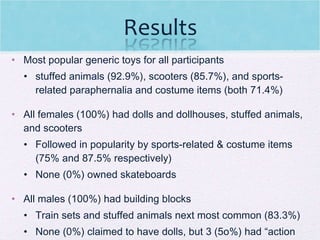
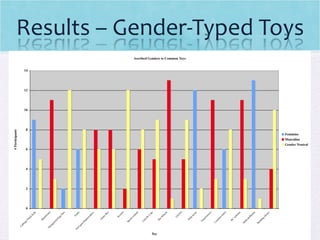
Most popular generic toys for all participants stuffed animals (92.9%), scooters (85.7%), and sports-related paraphernalia and costume items (both 71.4%) All females (100%) had dolls and dollhouses, stuffed animals, and scooters  Followed in popularity by sports-related & costume items (75% and 87.5% respectively) None (0%) owned skateboards All males (100%) had building blocks Train sets and stuffed animals next most common (83.3%) None (0%) claimed to have dolls, but 3 (5o%) had “action figures”
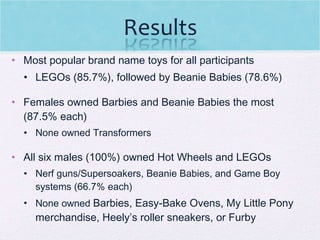
Most popular brand name toys for all participants LEGOs (85.7%), followed by Beanie Babies (78.6%)  Females owned Barbies and Beanie Babies the most (87.5% each) None owned Transformers All six males (100%) owned Hot Wheels and LEGOs Nerf guns/Supersoakers, Beanie Babies, and Game Boy systems (66.7% each) None owned  Barbies, Easy-Bake Ovens, My Little Pony merchandise, Heely’s roller sneakers, or Furby
All Participants Males Females Parents bought toys often 3.6 3.2 3.9 Watched television instead of being supervised 3.0 3.0 3.0 ‘ Dangerous’ toys denied 1.8 1.7 2.0 Encouraged to play competitive sports 3.2 4.2 2.3 Males make good babysitters 3.2 2.8 3.4 Dress-up was a playtime standard 3.3 2.0 4.9 Toys had sentimental value 4.5 4.5 4.5 Shared toys with children of the other sex 3.3 2.7 3.8 Parents preferred ‘educational’ toys 3.0 3.5 2.3 Play standards stricter than other sex siblings 1.5 2.2 1.9 Assertiveness should be encouraged in girls 3.7 3.7 4.3
All Participants Males Females Discouraged from ‘feminine’ toys 2.0 2.8 1.3 More likely to play outside than inside 3.1 3.0 3.3 Parents disagreed on toys 1.5 1.8 1.3 Role-playing gender-typical 3.5 4.0 3.5 Favorite toys reflect current interests 3.5 3.7 3.3 Toys brands should care about unisex advertising 3.3 2.8 3.6 Wanted toys that resembled TV/movie role models 3.1 3.2 3.0 Strong female characters are well represented 2.9 3.3 2.6 Superhero storylines promote aggression, especially in boys 2.9 3.5 2.4 Toys are integral to childhood socialization 3.9 4.0 3.8 Needed toys in order to play 2.1 1.8 2.4
 
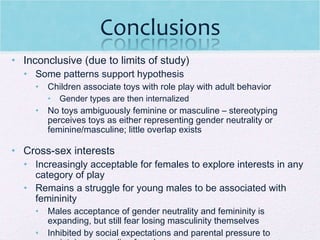
Inconclusive (due to limits of study) Some patterns support hypothesis Children associate toys with role play with adult behavior  Gender types are then internalized No toys ambiguously feminine or masculine – stereotyping perceives toys as either representing gender neutrality or feminine/masculine; little overlap exists Cross-sex interests Increasingly acceptable for females to explore interests in any category of play Remains a struggle for young males to be associated with femininity Males acceptance of gender neutrality and femininity is expanding, but still fear losing masculinity themselves Inhibited by social expectations and parental pressure to maintain a masculine façade
Research sample requires many more subjects from varied backgrounds  More focused questioning in order to determine the degree to which stereotypes permeate social consciousness  Specify questions to more clearly determine what is most perpetuated by commercial advertising vs. the toys themselves Revised version of the questionnaire combined with interviews, experiments with role-play and commercial advertising, and a much larger sample size would yield more definitive results

Toys and Gender Socialization

  • 1.
    Leaving the Dollhouse: The Constancy of Gender Roles Through the Socialization of Toys By Veronica Gomes
  • 2.
    Manufacturers use deliberategendering to market toys Naming & categorization (Freeman, 2007) Bicycle names: Top Gun, Bullet, Troublemaker, Rage; Miss Daisy, Wildflower, Dreamweaver Tickled Pink Gendered models are better bestsellers than the more unisex Online shopping websites divide children’s catalogues into links: “for boys” and “for girls” Same-sex modeling in commercials impacts child’s perception of what is appropriate for their gender (Ruble, Balaban, & Cooper, 1981) Infinite messages about age & gender appropriate behavior, images of expected gender-typed appearance and bodily/behavioral expectations
  • 3.
    Ge nder constancyand sex-role development (Ruble, Balaban, & Cooper, 1981) Social learning theory: combination of media absorption and social interaction at home develops concept of appropriate sex-roles by preschool Cognitive-developmental theory: by age 5 or 6, children reach gender constancy and perceive gender to be an unchangeable quality “ Their [children’s] most important relationships are not with people but with products, contributing to a culture characterized by addiction to consumption” (Jackson, 2001, 143) Solidification of gender constancy impacts the interactive direction of children and their imaginative play The purpose of play is to mimic adult functions Gender roles typically the basis for child’s concept of adult interaction
  • 4.
    This study expectedto find that even into young adulthood, individuals perceive traditional male and female archetypes in childhood toys. Individuals who were raised to invest more significance in these sex typed products as children are more likely to construct their gender identities based on stereotypes and traditional feminine and masculine roles than their peers and less likely to subvert their genders in interests, fields of study, and careers.
  • 5.
    Procedure Questionnaire Age, gender Two sections surveying the popular generic and brand name toys of each participants’ childhood Six open-answer questions about favorite toys, memorable commercials, opinions on toy design, and determining most important factors in toy selection Qualified 25 statements on a Likert scale (1 to 5, level of agreement) Asked to ascribe gender to all aforementioned toys Sample 45 students (14 copies returned) 8 female, 6 male Aged 15-19 (mean age: 18.1) Investigating effects of childhood socialization at stage of liminality between childhood/adulthood
  • 6.
    Most popular generictoys for all participants stuffed animals (92.9%), scooters (85.7%), and sports-related paraphernalia and costume items (both 71.4%) All females (100%) had dolls and dollhouses, stuffed animals, and scooters Followed in popularity by sports-related & costume items (75% and 87.5% respectively) None (0%) owned skateboards All males (100%) had building blocks Train sets and stuffed animals next most common (83.3%) None (0%) claimed to have dolls, but 3 (5o%) had “action figures”
  • 7.
    Most popular brandname toys for all participants LEGOs (85.7%), followed by Beanie Babies (78.6%) Females owned Barbies and Beanie Babies the most (87.5% each) None owned Transformers All six males (100%) owned Hot Wheels and LEGOs Nerf guns/Supersoakers, Beanie Babies, and Game Boy systems (66.7% each) None owned Barbies, Easy-Bake Ovens, My Little Pony merchandise, Heely’s roller sneakers, or Furby
  • 8.
    All Participants MalesFemales Parents bought toys often 3.6 3.2 3.9 Watched television instead of being supervised 3.0 3.0 3.0 ‘ Dangerous’ toys denied 1.8 1.7 2.0 Encouraged to play competitive sports 3.2 4.2 2.3 Males make good babysitters 3.2 2.8 3.4 Dress-up was a playtime standard 3.3 2.0 4.9 Toys had sentimental value 4.5 4.5 4.5 Shared toys with children of the other sex 3.3 2.7 3.8 Parents preferred ‘educational’ toys 3.0 3.5 2.3 Play standards stricter than other sex siblings 1.5 2.2 1.9 Assertiveness should be encouraged in girls 3.7 3.7 4.3
  • 9.
    All Participants MalesFemales Discouraged from ‘feminine’ toys 2.0 2.8 1.3 More likely to play outside than inside 3.1 3.0 3.3 Parents disagreed on toys 1.5 1.8 1.3 Role-playing gender-typical 3.5 4.0 3.5 Favorite toys reflect current interests 3.5 3.7 3.3 Toys brands should care about unisex advertising 3.3 2.8 3.6 Wanted toys that resembled TV/movie role models 3.1 3.2 3.0 Strong female characters are well represented 2.9 3.3 2.6 Superhero storylines promote aggression, especially in boys 2.9 3.5 2.4 Toys are integral to childhood socialization 3.9 4.0 3.8 Needed toys in order to play 2.1 1.8 2.4
  • 10.
  • 11.
    Inconclusive (due tolimits of study) Some patterns support hypothesis Children associate toys with role play with adult behavior Gender types are then internalized No toys ambiguously feminine or masculine – stereotyping perceives toys as either representing gender neutrality or feminine/masculine; little overlap exists Cross-sex interests Increasingly acceptable for females to explore interests in any category of play Remains a struggle for young males to be associated with femininity Males acceptance of gender neutrality and femininity is expanding, but still fear losing masculinity themselves Inhibited by social expectations and parental pressure to maintain a masculine façade
  • 12.
    Research sample requiresmany more subjects from varied backgrounds More focused questioning in order to determine the degree to which stereotypes permeate social consciousness Specify questions to more clearly determine what is most perpetuated by commercial advertising vs. the toys themselves Revised version of the questionnaire combined with interviews, experiments with role-play and commercial advertising, and a much larger sample size would yield more definitive results