+
The Influence of a Model's Gender on
Children's Toy Choice
Caitlyn Farris, Victoria Miller, Tiana Babb,
Chelsey Russell
Franklin College
+
Statement of Problem
 How the gender of the model affects a child’s choice
of toy
 Predict a child’s personality and identity through
gender stereotypes
 Future social norms
 Breaking gender stereotypes
 Prevent discrimination
+
Review of Literature
 Children played with masculine toys more than
feminine or gender-neutral (Green, Bigler, &
Catherwood, 2004)
 Girls more flexible in crossing the gender line
(Green, Bigler, & Catherwood, 2004) and (Wood,
Desmarais, & Gugula, 2002)
 Children tended to play with gender-appropriate toys
(Wood, Desmarais, & Gugula, 2002)
 Limitations
+ Hypothesis
The gender of the
model in the room
will influence the
child’s selection of
toy.
+
Methods: Sample
Participants
 17 children
 Ages 3-5 years old
 53% boys, 47% girls
 Mostly Caucasian
+
Methods: Procedure
Instruments
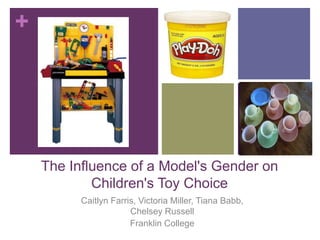
 One of three toys:
white Play-Doh, dish
set, tool set
 Child-Rearing Sex-
Role Attitude Scale
+
Methods: Procedure
Procedure
 Multiple-group design
 IV: gender of the model in the room
 DV: children’s choice of toy
+
Results
 The sample included 17 pre-school students, 8 girls and 9 boys.
There was no significant difference between the children’s toy
choice and the gender of the model present in the room. X2 (4,
N=17) = 4.10, p = .39.
 There was also no significant difference between the boy
participants and their choice of toy. X2 (4, N=9) = 4.00, p = .41.
 There was also no significant difference between the girl
participants and their choice of toy. X2 (2, N=8) = .67 p = .72.
+
Results
 Hypothesis refuted
 No significance/inconclusive
*p<0.05,** p<0.01.
Correlations Between Demographics and Toy Choice
+
Results
Measure M SD Q2 Q3 Q4 Q6 Q8 Q9 Q11 Gender
Q2 1.12 .33 -
Q3 1.53 .80 .22 -
Q4 4.41 1.18 -.13 .22 -
Q6 4.00 1.12 -.34 -.14 -.10 -
Q8 1.94 .97 .41 .61** .08 -.70** -
Q9 1.29 .59 .77** .18 -.28 -.29 .36 -
Q11 1.24 .75 .13 -.12 .10 -.59* .45 -.03 -
Gender 1.47 .51 -.34 -.04 .49* .33 -.19 -.49* .18 -
Correlation Between Questionnaire and Gender
*p<0.05,** p<0.01.
+
ResultsChildren’s Toy Choice
0
1
2
3
4
5
6
Male Model Female
Model
No Model
Dish Set
Tool Set
Playdoh
+
Results
Girl’s Toy Choice
Girls’ Toy Choice
0
0.5
1
1.5
2
2.5
Male Model Female
Model
No Model
Dish Set
Tool Set
Playdoh
+
Results
Boys’ Toy Choice
0
0.5
1
1.5
2
2.5
3
3.5
Male Model Female
Model
No Model
Dish Set
Tool Set
Playdoh
+
Discussion
 Limitations
 Small sample size
 Order of the toys/Shape of the table
 Modern toys
 Future Research
 Implications
+
References
 Green, V. A., Bigler, R., & Catherwood, D. (2004). The variability and
flexibility of gender-typed toy play: A close look at children's
behavioral responses to counterstereotypic models. Sex
Roles, 51(7-8), 371-386. doi:10.1023/B:SERS.
0000049227.05170.aa
 Wood, E., Desmarais, S., & Gugula, S. (2002). The impact of
parenting experience on gender stereotyped toy play of
children. Sex Roles, 47(1-2), 39-49. doi:10.1023/A: 1020679619728

PSY 420 Presentation

  • 1.
    + The Influence ofa Model's Gender on Children's Toy Choice Caitlyn Farris, Victoria Miller, Tiana Babb, Chelsey Russell Franklin College
  • 2.
    + Statement of Problem How the gender of the model affects a child’s choice of toy  Predict a child’s personality and identity through gender stereotypes  Future social norms  Breaking gender stereotypes  Prevent discrimination
  • 3.
    + Review of Literature Children played with masculine toys more than feminine or gender-neutral (Green, Bigler, & Catherwood, 2004)  Girls more flexible in crossing the gender line (Green, Bigler, & Catherwood, 2004) and (Wood, Desmarais, & Gugula, 2002)  Children tended to play with gender-appropriate toys (Wood, Desmarais, & Gugula, 2002)  Limitations
  • 4.
    + Hypothesis The genderof the model in the room will influence the child’s selection of toy.
  • 5.
    + Methods: Sample Participants  17children  Ages 3-5 years old  53% boys, 47% girls  Mostly Caucasian
  • 6.
    + Methods: Procedure Instruments  Oneof three toys: white Play-Doh, dish set, tool set  Child-Rearing Sex- Role Attitude Scale
  • 7.
    + Methods: Procedure Procedure  Multiple-groupdesign  IV: gender of the model in the room  DV: children’s choice of toy
  • 8.
    + Results  The sampleincluded 17 pre-school students, 8 girls and 9 boys. There was no significant difference between the children’s toy choice and the gender of the model present in the room. X2 (4, N=17) = 4.10, p = .39.  There was also no significant difference between the boy participants and their choice of toy. X2 (4, N=9) = 4.00, p = .41.  There was also no significant difference between the girl participants and their choice of toy. X2 (2, N=8) = .67 p = .72.
  • 9.
    + Results  Hypothesis refuted No significance/inconclusive *p<0.05,** p<0.01. Correlations Between Demographics and Toy Choice
  • 10.
    + Results Measure M SDQ2 Q3 Q4 Q6 Q8 Q9 Q11 Gender Q2 1.12 .33 - Q3 1.53 .80 .22 - Q4 4.41 1.18 -.13 .22 - Q6 4.00 1.12 -.34 -.14 -.10 - Q8 1.94 .97 .41 .61** .08 -.70** - Q9 1.29 .59 .77** .18 -.28 -.29 .36 - Q11 1.24 .75 .13 -.12 .10 -.59* .45 -.03 - Gender 1.47 .51 -.34 -.04 .49* .33 -.19 -.49* .18 - Correlation Between Questionnaire and Gender *p<0.05,** p<0.01.
  • 11.
    + ResultsChildren’s Toy Choice 0 1 2 3 4 5 6 MaleModel Female Model No Model Dish Set Tool Set Playdoh
  • 12.
    + Results Girl’s Toy Choice Girls’Toy Choice 0 0.5 1 1.5 2 2.5 Male Model Female Model No Model Dish Set Tool Set Playdoh
  • 13.
    + Results Boys’ Toy Choice 0 0.5 1 1.5 2 2.5 3 3.5 MaleModel Female Model No Model Dish Set Tool Set Playdoh
  • 14.
    + Discussion  Limitations  Smallsample size  Order of the toys/Shape of the table  Modern toys  Future Research  Implications
  • 15.
    + References  Green, V.A., Bigler, R., & Catherwood, D. (2004). The variability and flexibility of gender-typed toy play: A close look at children's behavioral responses to counterstereotypic models. Sex Roles, 51(7-8), 371-386. doi:10.1023/B:SERS. 0000049227.05170.aa  Wood, E., Desmarais, S., & Gugula, S. (2002). The impact of parenting experience on gender stereotyped toy play of children. Sex Roles, 47(1-2), 39-49. doi:10.1023/A: 1020679619728