FINAL RESEARCH
WRITE UP
SITI NUR BAIZURA BINTI AB. RAZAK
2msbaizura/lincoln/2017
• Previous lectures have focused mostly on the
research proposal. Little attention is given to
carrying out the research.
• This final lecture focuses on reporting the
research, after the research plan has been
implemented and the research conducted.
• Reporting entails describing and explaining
how the research results were obtained (ie.
the research process) and explaining the
results.
3msbaizura/lincoln/2017
• Graduate theses and dissertations tend to be
on the other extreme of length and
completeness
• This is the report of the student’s work to
his/her graduate committee
• These tend to be long and sometimes more
wordy than necessary. But completeness is
considered more important
than efficiency in this writing.
4msbaizura/lincoln/2017
Components of a Research
Research
• The components of a research report often
include: Title, Acknowledgements, Abstract,
Table of Contents, Introduction, Literature
Review, Conceptual Framework, Methods and
Procedures, Results, Summary and Conclusions
• Note the similarities to the project proposal –
sometimes sections of the proposal can be used
directly in the report.
5msbaizura/lincoln/2017
6
Research papers usually have five chapters with
well-established sections in each chapter.
• Chapter I - Introduction
• Chapter II - Background
• Chapter III - Methodology
• Chapter IV - Results
• Chapter V - Conclusions and
Recommendations
msbaizura/lincoln/2017
A. Title
– Same advice as for writing Proposal Titles
– Authors, affiliations, keyword and similar information often on
title page
B. Acknowledgements
– Recognize the assistance and support of individuals and
organizations, especially funding
C. Abstract
– A compact summary of the research report
– Extremely important – it is the only thing most people will read
(in deciding to read your paper)
D. Table of Contents
– A listing or outline of the organization of the report. It shows
headings, subheadings and other divisions. Sometimes
includes lists of Tables and Figures (esp. in thesis or
dissertation 7msbaizura/lincoln/2017
CHAPTER I
Introduction
Introductory paragraphs
• few short introductory paragraphs (a couple of pages at most).
• primary goal is to catch the attention of the readers
• contains dramatic and general statements about the need for the study.
• put yourself in your reader's position - would you continue reading?
Statement of the problem
• The statement of the problem is the focal point of your research.
• It should focus on only one problem.
• It should be one or two sentences long.
• It should not suggest a solution.
• Be clear and use all past-tense language without first-person references.
• For example, if the problem states that there is a shortage of volunteers in
the HIV unit, describe why these volunteers are needed by the hospital,
unit or staff.
• Present persuasive arguments why the problem is important enough to
study.
• Include the opinions of others
9msbaizura/lincoln/2017
Purpose/ Research Objectives
• The purpose is a single statement or paragraph that explains what
the study intends to accomplish. “The purpose of this study was to
assess knowledge of nurses about anti-TB treatment”.
Research questions and/or hypotheses
• No elaboration is included in this section
• The research questions for this study was / This study was addressed
by the following research questions/ This study aimed to answer the
following research questions:
1. What is the level of ...
2. Is there a significant relationship between...
Significance of the study
• The significance of the study answers the questions:
• Why is your study important?
• To whom is it important?
• What benefit(s) will occur if your study is done? 10msbaizura/lincoln/2017
Operational Definitions
• Conceptual: general meaning based on the theory: “Dictionary”
definition
• Operational: specific direction of how concept is measured: follows
the phrase “as measured by …”
• An essential component of an operational definition is measurement.
• State the operations for a term by pointing to how it is measured.
(Ordinal/ Nominal/ Interval Scale)
EXAMPLE:
Student nurse
• A nurse undertaking the degree programme in adult nursing
approved by An Bord Altranais (2000). For the purpose of this study
the student nurse will be in their fourth year of the undergraduate
general nursing programme currently working on clinical placement.
11msbaizura/lincoln/2017
Pressure ulcer
• a lesion of skin or underlying tissues by direct unrelieved
pressure for more than 3 hours on the skin.
Good knowledge
• Nurses, who scored above the mean score of the knowledge
questions, were considered as having good knowledge on
pressure ulcer prevention.
Poor knowledge
• Nurses, who scored below the mean value considered as
having poor knowledge towards prevention of pressure ulcer.
State-anxiety
• “ a transitional emotional state aroused in a situation that
presents a perceived threat to self-integrity (Mullooly et al.,
1988, p. 5)
• as measured by the Spielberger State-Trait Anxiety Inventory
(Spielberger et al., 1970) 12msbaizura/lincoln/2017
CHAPTER II
Background
• Chapter II is a review of the literature.
• It is important because it shows what previous
researchers have discovered.
• usually quite long and primarily depends upon how
much research has previously been done in the area
you are planning to investigate.
• should cite similar areas of study or studies that
lead up to the current research.
• Should contain conceptual & theoretical
framework
14msbaizura/lincoln/2017
2.1 Introduction
2.2 Literature Review
• Previous studies focusing on your intended study.
2.2.1 Nurses’s Knowledge on Prevention Pressure Ulcer
2.2.1 Nurses’s Practice on Prevention Pressure Ulcer
• Cite. According to Andrew (2015), ....... However Mullen (2016)
reported that....... . This finding shows that ...
• Majority of .......
• It was also reported that.....
• Mullen(2016) also reported similar finding in his ......
• Only few studies reported that .......
2.3 Conceptual Framework
• Describes the relationship between specific variables identified in the
study.
• Act like map
15msbaizura/lincoln/2017
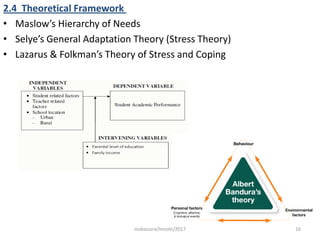
2.4 Theoretical Framework
• Maslow’s Hierarchy of Needs
• Selye’s General Adaptation Theory (Stress Theory)
• Lazarus & Folkman’s Theory of Stress and Coping
16msbaizura/lincoln/2017
CHAPTER III
Methodology
3.1 Introduction
3.2 Study Design
• Quantitative / Qualitative/ Mixed Method
• Specifies what design method of research will be used –
descriptive, correlational, experimental, or documentary
analysis.
• State why and cite reason use the design
3.3 Study setting/ population
• The study was conducted in two public universities in North of
Jordan. These universities are the Jordan University of Science and
Technology (JUST) and Al al-Bayt university (AABU). JordanUniversity
of Science and Technology is the largest nursing school in the region
having a student body of 1350 graduate and undergraduate
nursing students. Al al-Bayt university ………………..
• academic year consists of ….. / how many lecturer & CI 18msbaizura/lincoln/2017
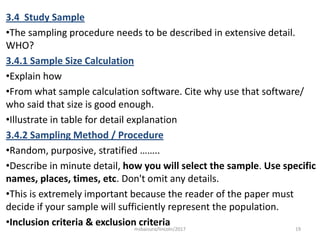
3.4 Study Sample
•The sampling procedure needs to be described in extensive detail.
WHO?
3.4.1 Sample Size Calculation
•Explain how
•From what sample calculation software. Cite why use that software/
who said that size is good enough.
•Illustrate in table for detail explanation
3.4.2 Sampling Method / Procedure
•Random, purposive, stratified ……..
•Describe in minute detail, how you will select the sample. Use specific
names, places, times, etc. Don't omit any details.
•This is extremely important because the reader of the paper must
decide if your sample will sufficiently represent the population.
•Inclusion criteria & exclusion criteria 19msbaizura/lincoln/2017
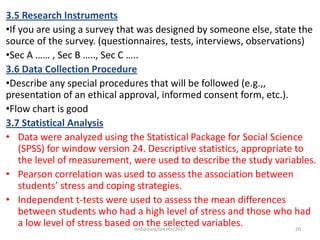
3.5 Research Instruments
•If you are using a survey that was designed by someone else, state the
source of the survey. (questionnaires, tests, interviews, observations)
•Sec A …… , Sec B ….., Sec C …..
3.6 Data Collection Procedure
•Describe any special procedures that will be followed (e.g.,,
presentation of an ethical approval, informed consent form, etc.).
•Flow chart is good
3.7 Statistical Analysis
• Data were analyzed using the Statistical Package for Social Science
(SPSS) for window version 24. Descriptive statistics, appropriate to
the level of measurement, were used to describe the study variables.
• Pearson correlation was used to assess the association between
students’ stress and coping strategies.
• Independent t-tests were used to assess the mean differences
between students who had a high level of stress and those who had
a low level of stress based on the selected variables. 20msbaizura/lincoln/2017
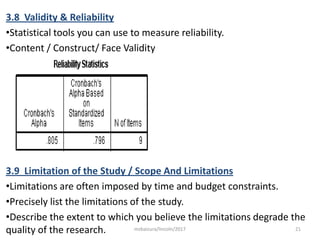
3.8 Validity & Reliability
•Statistical tools you can use to measure reliability.
•Content / Construct/ Face Validity
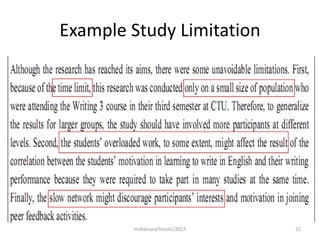
3.9 Limitation of the Study / Scope And Limitations
•Limitations are often imposed by time and budget constraints.
•Precisely list the limitations of the study.
•Describe the extent to which you believe the limitations degrade the
quality of the research. 21msbaizura/lincoln/2017
Example Study Limitation
22msbaizura/lincoln/2017
CHAPTER IV
DATA ANALYSIS AND FINDING /
RESULTS / FINDINGS
4.1 Introduction
Presents and explains the results of the analysis. This is the end product
of all the analyses from which objectives were either achieved or not.
Hypotheses have been tested and the results reported here.
4.2 Demographic Background Of Respondent
• Numbers and tables are not self-evident.
• If you use tables or graphs, refer to them in the text and explain
what they say. An example is: "Table 4 shows a ……….
4.3 Analysis of Data
Each research question addressed individually. For each research
question:
1) Restate the research question
2) State the type of statistical test(s) performed
• Simply present the results. Do not attempt to explain the results in
this chapter.
• Remember this chapter is a presentation of the data.
• No conclusions or implications should appear in this chapter. 24msbaizura/lincoln/2017
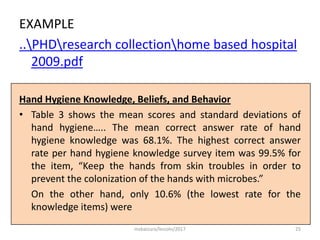
EXAMPLE
..PHDresearch collectionhome based hospital
2009.pdf
Hand Hygiene Knowledge, Beliefs, and Behavior
• Table 3 shows the mean scores and standard deviations of
hand hygiene….. The mean correct answer rate of hand
hygiene knowledge was 68.1%. The highest correct answer
rate per hand hygiene knowledge survey item was 99.5% for
the item, “Keep the hands from skin troubles in order to
prevent the colonization of the hands with microbes.”
On the other hand, only 10.6% (the lowest rate for the
knowledge items) were
25msbaizura/lincoln/2017
CHAPTER V
DISCUSSION AND
RECOMMENDATIONS
Discussion
• Discuss the major findings.
• Summarize the Chapter 4: Results.
• Discuss according to the research questions from
Chapter 1 and answer them with the results you got.
• Cite several studies from Chapter 2 for comparison
and contrast with the results.
• Point out unexpected/negative results
• Explain why you think you found what you did.
• Use references to support what is being said!
• Feel free to disagree with what was found in the
literature
• As the researcher, you may draws upon life
experiences to support your thoughts, views, and
ideas. Tie everything together.
27msbaizura/lincoln/2017
28
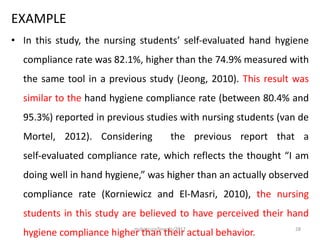
EXAMPLE
• In this study, the nursing students’ self‐evaluated hand hygiene
compliance rate was 82.1%, higher than the 74.9% measured with
the same tool in a previous study (Jeong, 2010). This result was
similar to the hand hygiene compliance rate (between 80.4% and
95.3%) reported in previous studies with nursing students (van de
Mortel, 2012). Considering the previous report that a
self‐evaluated compliance rate, which reflects the thought “I am
doing well in hand hygiene,” was higher than an actually observed
compliance rate (Korniewicz and El-Masri, 2010), the nursing
students in this study are believed to have perceived their hand
hygiene compliance higher than their actual behavior.msbaizura/lincoln/2017
Conclusions
• The conclusions relate directly to the research
questions or objectives.
• They represent the contribution to the
knowledge.
• They also relate directly to the significance of
the study,
• As the researcher, you may draws upon life
experiences to support your thoughts, views,
and ideas.
• Tie everything together.
• Analyze, synthesize, and evaluate what was
found in the research with what you think.
29msbaizura/lincoln/2017
Recommendations
• These can take two forms: recommendations
for further study, or recommendations for
change, or both.
• Each recommendation should trace directly
to a conclusion.
30msbaizura/lincoln/2017
List of References
– A listing of all references used in every part of
the report.
– APA 6 edition
Appendices
– They can be used to present material that might
disrupt the flow of thoughts in the report (eg.
too much detail) or include information of
interest to only some readers.
– eg. a letter of permission to conduct the study,
questionnaire set
31msbaizura/lincoln/2017
Writing Tips
Linking words: CONTRAST
• However
• Nevertheless
• Although/ even though
• Despite/ in spite of
• In contrast / in comparison
• whereas
msbaizura/lincoln/2017 32
Writing Tips
Cause and Effect
• Because of
• To/for
• Owing to
• Thus, hence, therefore
• Consequently
msbaizura/lincoln/2017 33
Avoid using “SINCE” and “AS” to
indicate a cause-effect relationship
Writing Tips
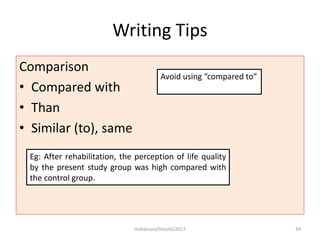
Comparison
• Compared with
• Than
• Similar (to), same
msbaizura/lincoln/2017 34
Avoid using “compared to”
Eg: After rehabilitation, the perception of life quality
by the present study group was high compared with
the control group.
35msbaizura/lincoln/2017
THANK YOU
36msbaizura/lincoln/2017

Final research write up

  • 1.
    FINAL RESEARCH WRITE UP SITINUR BAIZURA BINTI AB. RAZAK
  • 2.
  • 3.
    • Previous lectureshave focused mostly on the research proposal. Little attention is given to carrying out the research. • This final lecture focuses on reporting the research, after the research plan has been implemented and the research conducted. • Reporting entails describing and explaining how the research results were obtained (ie. the research process) and explaining the results. 3msbaizura/lincoln/2017
  • 4.
    • Graduate thesesand dissertations tend to be on the other extreme of length and completeness • This is the report of the student’s work to his/her graduate committee • These tend to be long and sometimes more wordy than necessary. But completeness is considered more important than efficiency in this writing. 4msbaizura/lincoln/2017
  • 5.
    Components of aResearch Research • The components of a research report often include: Title, Acknowledgements, Abstract, Table of Contents, Introduction, Literature Review, Conceptual Framework, Methods and Procedures, Results, Summary and Conclusions • Note the similarities to the project proposal – sometimes sections of the proposal can be used directly in the report. 5msbaizura/lincoln/2017
  • 6.
    6 Research papers usuallyhave five chapters with well-established sections in each chapter. • Chapter I - Introduction • Chapter II - Background • Chapter III - Methodology • Chapter IV - Results • Chapter V - Conclusions and Recommendations msbaizura/lincoln/2017
  • 7.
    A. Title – Sameadvice as for writing Proposal Titles – Authors, affiliations, keyword and similar information often on title page B. Acknowledgements – Recognize the assistance and support of individuals and organizations, especially funding C. Abstract – A compact summary of the research report – Extremely important – it is the only thing most people will read (in deciding to read your paper) D. Table of Contents – A listing or outline of the organization of the report. It shows headings, subheadings and other divisions. Sometimes includes lists of Tables and Figures (esp. in thesis or dissertation 7msbaizura/lincoln/2017
  • 8.
  • 9.
    Introductory paragraphs • fewshort introductory paragraphs (a couple of pages at most). • primary goal is to catch the attention of the readers • contains dramatic and general statements about the need for the study. • put yourself in your reader's position - would you continue reading? Statement of the problem • The statement of the problem is the focal point of your research. • It should focus on only one problem. • It should be one or two sentences long. • It should not suggest a solution. • Be clear and use all past-tense language without first-person references. • For example, if the problem states that there is a shortage of volunteers in the HIV unit, describe why these volunteers are needed by the hospital, unit or staff. • Present persuasive arguments why the problem is important enough to study. • Include the opinions of others 9msbaizura/lincoln/2017
  • 10.
    Purpose/ Research Objectives •The purpose is a single statement or paragraph that explains what the study intends to accomplish. “The purpose of this study was to assess knowledge of nurses about anti-TB treatment”. Research questions and/or hypotheses • No elaboration is included in this section • The research questions for this study was / This study was addressed by the following research questions/ This study aimed to answer the following research questions: 1. What is the level of ... 2. Is there a significant relationship between... Significance of the study • The significance of the study answers the questions: • Why is your study important? • To whom is it important? • What benefit(s) will occur if your study is done? 10msbaizura/lincoln/2017
  • 11.
    Operational Definitions • Conceptual:general meaning based on the theory: “Dictionary” definition • Operational: specific direction of how concept is measured: follows the phrase “as measured by …” • An essential component of an operational definition is measurement. • State the operations for a term by pointing to how it is measured. (Ordinal/ Nominal/ Interval Scale) EXAMPLE: Student nurse • A nurse undertaking the degree programme in adult nursing approved by An Bord Altranais (2000). For the purpose of this study the student nurse will be in their fourth year of the undergraduate general nursing programme currently working on clinical placement. 11msbaizura/lincoln/2017
  • 12.
    Pressure ulcer • alesion of skin or underlying tissues by direct unrelieved pressure for more than 3 hours on the skin. Good knowledge • Nurses, who scored above the mean score of the knowledge questions, were considered as having good knowledge on pressure ulcer prevention. Poor knowledge • Nurses, who scored below the mean value considered as having poor knowledge towards prevention of pressure ulcer. State-anxiety • “ a transitional emotional state aroused in a situation that presents a perceived threat to self-integrity (Mullooly et al., 1988, p. 5) • as measured by the Spielberger State-Trait Anxiety Inventory (Spielberger et al., 1970) 12msbaizura/lincoln/2017
  • 13.
  • 14.
    • Chapter IIis a review of the literature. • It is important because it shows what previous researchers have discovered. • usually quite long and primarily depends upon how much research has previously been done in the area you are planning to investigate. • should cite similar areas of study or studies that lead up to the current research. • Should contain conceptual & theoretical framework 14msbaizura/lincoln/2017
  • 15.
    2.1 Introduction 2.2 LiteratureReview • Previous studies focusing on your intended study. 2.2.1 Nurses’s Knowledge on Prevention Pressure Ulcer 2.2.1 Nurses’s Practice on Prevention Pressure Ulcer • Cite. According to Andrew (2015), ....... However Mullen (2016) reported that....... . This finding shows that ... • Majority of ....... • It was also reported that..... • Mullen(2016) also reported similar finding in his ...... • Only few studies reported that ....... 2.3 Conceptual Framework • Describes the relationship between specific variables identified in the study. • Act like map 15msbaizura/lincoln/2017
  • 16.
    2.4 Theoretical Framework •Maslow’s Hierarchy of Needs • Selye’s General Adaptation Theory (Stress Theory) • Lazarus & Folkman’s Theory of Stress and Coping 16msbaizura/lincoln/2017
  • 17.
  • 18.
    3.1 Introduction 3.2 StudyDesign • Quantitative / Qualitative/ Mixed Method • Specifies what design method of research will be used – descriptive, correlational, experimental, or documentary analysis. • State why and cite reason use the design 3.3 Study setting/ population • The study was conducted in two public universities in North of Jordan. These universities are the Jordan University of Science and Technology (JUST) and Al al-Bayt university (AABU). JordanUniversity of Science and Technology is the largest nursing school in the region having a student body of 1350 graduate and undergraduate nursing students. Al al-Bayt university ……………….. • academic year consists of ….. / how many lecturer & CI 18msbaizura/lincoln/2017
  • 19.
    3.4 Study Sample •Thesampling procedure needs to be described in extensive detail. WHO? 3.4.1 Sample Size Calculation •Explain how •From what sample calculation software. Cite why use that software/ who said that size is good enough. •Illustrate in table for detail explanation 3.4.2 Sampling Method / Procedure •Random, purposive, stratified …….. •Describe in minute detail, how you will select the sample. Use specific names, places, times, etc. Don't omit any details. •This is extremely important because the reader of the paper must decide if your sample will sufficiently represent the population. •Inclusion criteria & exclusion criteria 19msbaizura/lincoln/2017
  • 20.
    3.5 Research Instruments •Ifyou are using a survey that was designed by someone else, state the source of the survey. (questionnaires, tests, interviews, observations) •Sec A …… , Sec B ….., Sec C ….. 3.6 Data Collection Procedure •Describe any special procedures that will be followed (e.g.,, presentation of an ethical approval, informed consent form, etc.). •Flow chart is good 3.7 Statistical Analysis • Data were analyzed using the Statistical Package for Social Science (SPSS) for window version 24. Descriptive statistics, appropriate to the level of measurement, were used to describe the study variables. • Pearson correlation was used to assess the association between students’ stress and coping strategies. • Independent t-tests were used to assess the mean differences between students who had a high level of stress and those who had a low level of stress based on the selected variables. 20msbaizura/lincoln/2017
  • 21.
    3.8 Validity &Reliability •Statistical tools you can use to measure reliability. •Content / Construct/ Face Validity 3.9 Limitation of the Study / Scope And Limitations •Limitations are often imposed by time and budget constraints. •Precisely list the limitations of the study. •Describe the extent to which you believe the limitations degrade the quality of the research. 21msbaizura/lincoln/2017
  • 22.
  • 23.
    CHAPTER IV DATA ANALYSISAND FINDING / RESULTS / FINDINGS
  • 24.
    4.1 Introduction Presents andexplains the results of the analysis. This is the end product of all the analyses from which objectives were either achieved or not. Hypotheses have been tested and the results reported here. 4.2 Demographic Background Of Respondent • Numbers and tables are not self-evident. • If you use tables or graphs, refer to them in the text and explain what they say. An example is: "Table 4 shows a ………. 4.3 Analysis of Data Each research question addressed individually. For each research question: 1) Restate the research question 2) State the type of statistical test(s) performed • Simply present the results. Do not attempt to explain the results in this chapter. • Remember this chapter is a presentation of the data. • No conclusions or implications should appear in this chapter. 24msbaizura/lincoln/2017
  • 25.
    EXAMPLE ..PHDresearch collectionhome basedhospital 2009.pdf Hand Hygiene Knowledge, Beliefs, and Behavior • Table 3 shows the mean scores and standard deviations of hand hygiene….. The mean correct answer rate of hand hygiene knowledge was 68.1%. The highest correct answer rate per hand hygiene knowledge survey item was 99.5% for the item, “Keep the hands from skin troubles in order to prevent the colonization of the hands with microbes.” On the other hand, only 10.6% (the lowest rate for the knowledge items) were 25msbaizura/lincoln/2017
  • 26.
  • 27.
    Discussion • Discuss themajor findings. • Summarize the Chapter 4: Results. • Discuss according to the research questions from Chapter 1 and answer them with the results you got. • Cite several studies from Chapter 2 for comparison and contrast with the results. • Point out unexpected/negative results • Explain why you think you found what you did. • Use references to support what is being said! • Feel free to disagree with what was found in the literature • As the researcher, you may draws upon life experiences to support your thoughts, views, and ideas. Tie everything together. 27msbaizura/lincoln/2017
  • 28.
    28 EXAMPLE • In thisstudy, the nursing students’ self‐evaluated hand hygiene compliance rate was 82.1%, higher than the 74.9% measured with the same tool in a previous study (Jeong, 2010). This result was similar to the hand hygiene compliance rate (between 80.4% and 95.3%) reported in previous studies with nursing students (van de Mortel, 2012). Considering the previous report that a self‐evaluated compliance rate, which reflects the thought “I am doing well in hand hygiene,” was higher than an actually observed compliance rate (Korniewicz and El-Masri, 2010), the nursing students in this study are believed to have perceived their hand hygiene compliance higher than their actual behavior.msbaizura/lincoln/2017
  • 29.
    Conclusions • The conclusionsrelate directly to the research questions or objectives. • They represent the contribution to the knowledge. • They also relate directly to the significance of the study, • As the researcher, you may draws upon life experiences to support your thoughts, views, and ideas. • Tie everything together. • Analyze, synthesize, and evaluate what was found in the research with what you think. 29msbaizura/lincoln/2017
  • 30.
    Recommendations • These cantake two forms: recommendations for further study, or recommendations for change, or both. • Each recommendation should trace directly to a conclusion. 30msbaizura/lincoln/2017
  • 31.
    List of References –A listing of all references used in every part of the report. – APA 6 edition Appendices – They can be used to present material that might disrupt the flow of thoughts in the report (eg. too much detail) or include information of interest to only some readers. – eg. a letter of permission to conduct the study, questionnaire set 31msbaizura/lincoln/2017
  • 32.
    Writing Tips Linking words:CONTRAST • However • Nevertheless • Although/ even though • Despite/ in spite of • In contrast / in comparison • whereas msbaizura/lincoln/2017 32
  • 33.
    Writing Tips Cause andEffect • Because of • To/for • Owing to • Thus, hence, therefore • Consequently msbaizura/lincoln/2017 33 Avoid using “SINCE” and “AS” to indicate a cause-effect relationship
  • 34.
    Writing Tips Comparison • Comparedwith • Than • Similar (to), same msbaizura/lincoln/2017 34 Avoid using “compared to” Eg: After rehabilitation, the perception of life quality by the present study group was high compared with the control group.
  • 35.
  • 36.