Zach Bevens
                                                                                     Donnych Diaz
                                                                                  Jacob Macdonald
                                                                                     Brian Seaman
                                                                                      Jen Shempert


 Using GIS to map Purple Martin Nesting Sites in the Ridgefield National Wildlife Refuge


Introduction:
       The Purple Martin is the largest member of the swallow family which migrates annually
from Brazil to North America to breed. There are three subspecies, one nesting on the southern
east coast of the US and Eastern Mexico, one in the deserts of Arizona and Western Mexico, and
one in the Rocky Mountains and the Pacific Northwest. Nesting pairs are monogamous and will
return every year to previously established nesting sites so long as they are adequate for use
(PMCA website).
       Purple Martins nest in small nesting boxes, or in abandoned woodpecker holes, generally
high up off the ground and away from trees, buildings, or other tall objects. As such, pier pilings
in waterways make ideal locations for martin nest boxes. The backwaters of the Ridgefield
National Wildlife Refuge in southwest Washington have played host to nesting Purple Martins
for many years. These slowly flowing channels are rife with flying insects, which are the sole
food source of the martins.
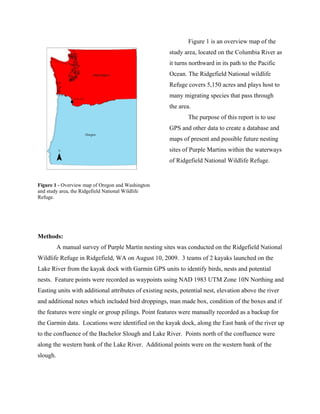
Figure 1 is an overview map of the
                                                       study area, located on the Columbia River as
                                                       it turns northward in its path to the Pacific
                                                       Ocean. The Ridgefield National wildlife
                                                       Refuge covers 5,150 acres and plays host to
                                                       many migrating species that pass through
                                                       the area.
                                                               The purpose of this report is to use
                                                       GPS and other data to create a database and
                                                       maps of present and possible future nesting
                                                       sites of Purple Martins within the waterways
                                                       of Ridgefield National Wildlife Refuge.


Figure 1 - Overview map of Oregon and Washington
and study area, the Ridgefield National Wildlife
Refuge.


Methods:
          A manual survey of Purple Martin nesting sites was conducted on the Ridgefield National
Wildlife Refuge in Ridgefield, WA on August 10, 2009. 3 teams of 2 kayaks launched on the
Lake River from the kayak dock with Garmin GPS units to identify birds, nests and potential
nests. Feature points were recorded as waypoints using NAD 1983 UTM Zone 10N Northing and
Easting units with additional attributes of existing nests, potential nest, elevation above the river
and additional notes which included bird droppings, man made box, condition of the boxes and if
the features were single or group pilings. Point features were manually recorded as a backup for
the Garmin data. Locations were identified on the kayak dock, along the East bank of the river up
to the confluence of the Bachelor Slough and Lake River. Points north of the confluence were
along the western bank of the Lake River. Additional points were on the western bank of the
slough.
The data was downloaded into Garmin DNR software then saved as an ArcMap shapefile.
Data was imported into ArcMap with additional attribute fields added and edited from field notes.
Points were then divided between favorable potential nesting sites and unfavorable based on
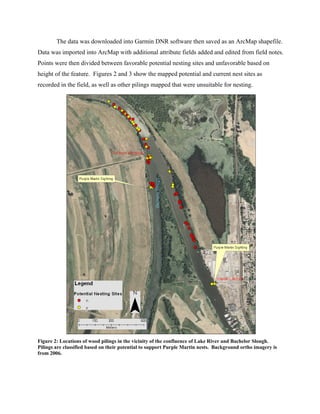
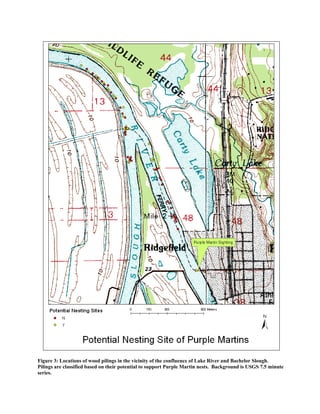
height of the feature. Figures 2 and 3 show the mapped potential and current nest sites as
recorded in the field, as well as other pilings mapped that were unsuitable for nesting.


Figure 2: Locations of wood pilings in the vicinity of the confluence of Lake River and Bachelor Slough.
Pilings are classified based on their potential to support Purple Martin nests. Background ortho imagery is
from 2006.
Figure 3: Locations of wood pilings in the vicinity of the confluence of Lake River and Bachelor Slough.
Pilings are classified based on their potential to support Purple Martin nests. Background is USGS 7.5 minute
series.
Results:
          There were two confirmed sightings of Purple Martins on August 10, 2009. Several birds
were observed at the Ridgefield kayak dock and a single bird was observed in Bachelor Slough
immediately South of the confluence with Lake River. Many of the pilings that were observed
were outfitted with bird boxes in varying states of disrepair; many of them were hanging upside
down or had no floor. All pilings with bird boxes were classified as “potential” nesting sites
regardless of their condition. In addition, any piling with a height greater than 5 meters and some
sort of cavity (woodpecker hole, rotten section, etc.) was classified as “potential” nesting habitat.
Out of 63 collected GPS points, 29 were considered to be potential nesting sites. Only two
currently active nests were observed, both in the immediate vicinity of the kayak launch point.


Discussion:
          The low presence of Purple Martins may be due to several factors. The arrival of Purple
Martins in the Pacific Northwest occurs as early as the middle of April. The total amount of time
spent from the laying of eggs through fledging is roughly a month and a half. Assuming that the
majority of birds arrive within the first month (between April 15 and May 15), the majority of the
nests will then be vacant by the end of July. This study was done in mid-August.
          The current nest boxes may be unsuitable for nesting at this time, which will cause the
Martins to seek new nesting sites. Many of the nest boxes were dilapidated and in need of repair
or replacement. Once a nesting pair has left a site, they are unlikely to return to that site in the
future. Predation and nest competition may also affect the Purple Martin population in this area.
A large number of Osprey and even a Bald Eagle were sighted during this exercise. Barn
swallows were also sighted in the vicinity of the active Purple Martin nesting site near the kayak
launch.


References:
Purple Martin Conservation Association
Wikipedia
Oregon Geospatial Enterprise Office
Lower Columbia Estuary Partnership
USGS Seamless

Purple Martins Nesting Sites

  • 1.
    Zach Bevens Donnych Diaz Jacob Macdonald Brian Seaman Jen Shempert Using GIS to map Purple Martin Nesting Sites in the Ridgefield National Wildlife Refuge Introduction: The Purple Martin is the largest member of the swallow family which migrates annually from Brazil to North America to breed. There are three subspecies, one nesting on the southern east coast of the US and Eastern Mexico, one in the deserts of Arizona and Western Mexico, and one in the Rocky Mountains and the Pacific Northwest. Nesting pairs are monogamous and will return every year to previously established nesting sites so long as they are adequate for use (PMCA website). Purple Martins nest in small nesting boxes, or in abandoned woodpecker holes, generally high up off the ground and away from trees, buildings, or other tall objects. As such, pier pilings in waterways make ideal locations for martin nest boxes. The backwaters of the Ridgefield National Wildlife Refuge in southwest Washington have played host to nesting Purple Martins for many years. These slowly flowing channels are rife with flying insects, which are the sole food source of the martins.
  • 2.
    Figure 1 isan overview map of the study area, located on the Columbia River as it turns northward in its path to the Pacific Ocean. The Ridgefield National wildlife Refuge covers 5,150 acres and plays host to many migrating species that pass through the area. The purpose of this report is to use GPS and other data to create a database and maps of present and possible future nesting sites of Purple Martins within the waterways of Ridgefield National Wildlife Refuge. Figure 1 - Overview map of Oregon and Washington and study area, the Ridgefield National Wildlife Refuge. Methods: A manual survey of Purple Martin nesting sites was conducted on the Ridgefield National Wildlife Refuge in Ridgefield, WA on August 10, 2009. 3 teams of 2 kayaks launched on the Lake River from the kayak dock with Garmin GPS units to identify birds, nests and potential nests. Feature points were recorded as waypoints using NAD 1983 UTM Zone 10N Northing and Easting units with additional attributes of existing nests, potential nest, elevation above the river and additional notes which included bird droppings, man made box, condition of the boxes and if the features were single or group pilings. Point features were manually recorded as a backup for the Garmin data. Locations were identified on the kayak dock, along the East bank of the river up to the confluence of the Bachelor Slough and Lake River. Points north of the confluence were along the western bank of the Lake River. Additional points were on the western bank of the slough.
  • 3.
    The data wasdownloaded into Garmin DNR software then saved as an ArcMap shapefile. Data was imported into ArcMap with additional attribute fields added and edited from field notes. Points were then divided between favorable potential nesting sites and unfavorable based on height of the feature. Figures 2 and 3 show the mapped potential and current nest sites as recorded in the field, as well as other pilings mapped that were unsuitable for nesting. Figure 2: Locations of wood pilings in the vicinity of the confluence of Lake River and Bachelor Slough. Pilings are classified based on their potential to support Purple Martin nests. Background ortho imagery is from 2006.
  • 4.
    Figure 3: Locationsof wood pilings in the vicinity of the confluence of Lake River and Bachelor Slough. Pilings are classified based on their potential to support Purple Martin nests. Background is USGS 7.5 minute series.
  • 5.
    Results: There were two confirmed sightings of Purple Martins on August 10, 2009. Several birds were observed at the Ridgefield kayak dock and a single bird was observed in Bachelor Slough immediately South of the confluence with Lake River. Many of the pilings that were observed were outfitted with bird boxes in varying states of disrepair; many of them were hanging upside down or had no floor. All pilings with bird boxes were classified as “potential” nesting sites regardless of their condition. In addition, any piling with a height greater than 5 meters and some sort of cavity (woodpecker hole, rotten section, etc.) was classified as “potential” nesting habitat. Out of 63 collected GPS points, 29 were considered to be potential nesting sites. Only two currently active nests were observed, both in the immediate vicinity of the kayak launch point. Discussion: The low presence of Purple Martins may be due to several factors. The arrival of Purple Martins in the Pacific Northwest occurs as early as the middle of April. The total amount of time spent from the laying of eggs through fledging is roughly a month and a half. Assuming that the majority of birds arrive within the first month (between April 15 and May 15), the majority of the nests will then be vacant by the end of July. This study was done in mid-August. The current nest boxes may be unsuitable for nesting at this time, which will cause the Martins to seek new nesting sites. Many of the nest boxes were dilapidated and in need of repair or replacement. Once a nesting pair has left a site, they are unlikely to return to that site in the future. Predation and nest competition may also affect the Purple Martin population in this area. A large number of Osprey and even a Bald Eagle were sighted during this exercise. Barn swallows were also sighted in the vicinity of the active Purple Martin nesting site near the kayak launch. References: Purple Martin Conservation Association Wikipedia Oregon Geospatial Enterprise Office Lower Columbia Estuary Partnership USGS Seamless