INVESTING IN THE INFRASTRUCTURE OF
AFGHANISTAN
Nataliya Bondar
“Financing for Development:
Unlocking Investment Opportunities”
BACKGROUND
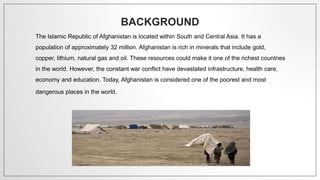
The Islamic Republic of Afghanistan is located within South and Central Asia. It has a
population of approximately 32 million. Afghanistan is rich in minerals that include gold,
copper, lithium, natural gas and oil. These resources could make it one of the richest countries
in the world. However, the constant war conflict have devastated infrastructure, health care,
economy and education. Today, Afghanistan is considered one of the poorest and most
dangerous places in the world.
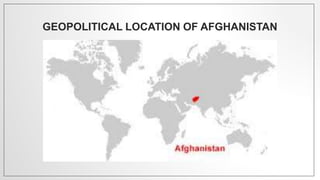
GEOPOLITICAL LOCATION OF AFGHANISTAN
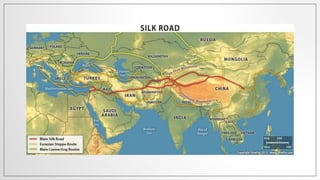
THE NEW SILK ROAD
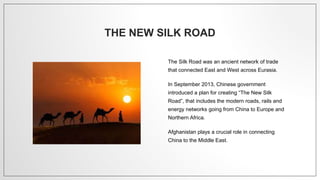
The Silk Road was an ancient network of trade
that connected East and West across Eurasia.
In September 2013, Chinese government
introduced a plan for creating “The New Silk
Road”, that includes the modern roads, rails and
energy networks going from China to Europe and
Northern Africa.
Afghanistan plays a crucial role in connecting
China to the Middle East.
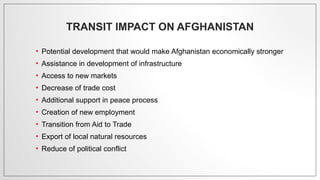
TRANSIT IMPACT ON AFGHANISTAN
• Potential development that would make Afghanistan economically stronger
• Assistance in development of infrastructure
• Access to new markets
• Decrease of trade cost
• Additional support in peace process
• Creation of new employment
• Transition from Aid to Trade
• Export of local natural resources
• Reduce of political conflict
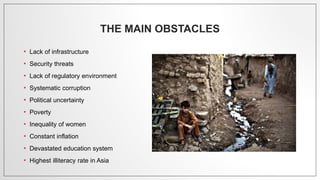
THE MAIN OBSTACLES
• Lack of infrastructure
• Security threats
• Lack of regulatory environment
• Systematic corruption
• Political uncertainty
• Poverty
• Inequality of women
• Constant inflation
• Devastated education system
• Highest illiteracy rate in Asia
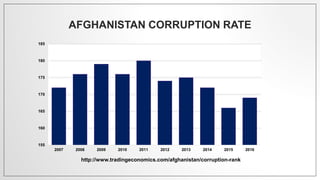
AFGHANISTAN CORRUPTION RATE
http://www.tradingeconomics.com/afghanistan/corruption-rank
155
160
165
170
175
180
185
2007 2008 2009 2010 2011 2012 2013 2014 2015 2016
SOLUTIONS FOR MOBILIZING FINANCE
Usually Domestic Resource Mobilization is the biggest resource to fund
country’s national development plan. The government could increase its
revenue through tax reforms.
Proposed tax reforms:
• Eliminate exemptions that decrease country’s revenue
• Facilitate tax registration process
• Implement self-assessment system (VATs)
• Simplify tax regimes for small enterprises
• Adequately compensate tax officials in order to reduce corruption
ROLE OF MULTILATERAL DEVELOPMENT
BANKS
MDB (Multilateral Development Banks) would play an important role in
developing an effective partnership between public and private
sectors.
They could:
• Decrease risk of the project
• Co-invest
• Help to prepare project to the level of bankability
ROLE OF INTERNATIONAL DEVELOPMENT
ASSOCIATION
IDA (International Development Association) could play a central role by
providing concessional loans and technical assistance.
Infrastructure projects can be complex and risky, especially in conflict-
affected states.
IDA guarantee instruments would decrease risks and attract private
resources.
ROLE OF INTERNATIONAL DEVELOPMENT
ASSOCIATION
Previous Experience:
IDA has successful restored a barely functioning telecom sector in
Afghanistan. Provided guarantees supported the private mobile operator
against noncommercial risks. As a result, in 2015 around 20 million people
had access to a phone compared with only 57,000 functioning phone lines in
2002.
PRIVATE SECTOR INVOLVEMENT
Private Sector could guarantee the financing and efficiency of the project.
Private Sector investment means:
• Access to knowledge
• Innovations
• Expertise
• Tested business models
PRIVATE SECTOR BENEFITS
• The New Silk Road is one of the most significant global economic initiative in the
world
• The volume of Chinese trade with the Middle East compose US $257 billion
• Future investment in the project of almost $1 trillion
• Interaction with economies representing more than 40% of the world’s GDP
• China has become the world’s largest energy consumer. Its dependence on the
Middle Eastern oil continue to rise. Afghanistan is seen as potential energy
supplier
RESOURCES
• http://www.europeanfinancialreview.com/?p=355
• https://en.wikipedia.org/wiki/Afghanistan
• http://foreignpolicy.com/2015/09/02/the-silk-road-through-afghanistan/
• http://www.afghanistans.com/Information/People/SocialProblems.htm
• http://www.worldbank.org/en/topic/governance/brief/domestic-resource-mobilization
• https://www.oecd.org/site/devaeo10/44272298.pdf
• https://storify.com/selinac/role-of-mdb-s-in-oda
RESOURCES
• http://ida.worldbank.org/about/what-ida
• http://www.worldbank.org/en/about/annual-report/roles-resources
• http://ida.worldbank.org/results/country/afghanistan
• http://projects.worldbank.org/procurement/noticeoverview?id=OP00031215&lang=en&print=Y
• https://www.forbes.com/sites/wadeshepard/2017/03/12/8-new-silk-road-companies-that-you-can-invest-
in/#14ea473d4db9
• http://yaleglobal.yale.edu/content/china-and-us-two-visions-one-collaboration
• http://europe.chinadaily.com.cn/epaper/2017-01/20/content_28006221.htm

Final project

  • 1.
    INVESTING IN THEINFRASTRUCTURE OF AFGHANISTAN Nataliya Bondar “Financing for Development: Unlocking Investment Opportunities”
  • 2.
    BACKGROUND The Islamic Republicof Afghanistan is located within South and Central Asia. It has a population of approximately 32 million. Afghanistan is rich in minerals that include gold, copper, lithium, natural gas and oil. These resources could make it one of the richest countries in the world. However, the constant war conflict have devastated infrastructure, health care, economy and education. Today, Afghanistan is considered one of the poorest and most dangerous places in the world.
  • 3.
  • 4.
    THE NEW SILKROAD The Silk Road was an ancient network of trade that connected East and West across Eurasia. In September 2013, Chinese government introduced a plan for creating “The New Silk Road”, that includes the modern roads, rails and energy networks going from China to Europe and Northern Africa. Afghanistan plays a crucial role in connecting China to the Middle East.
  • 6.
    TRANSIT IMPACT ONAFGHANISTAN • Potential development that would make Afghanistan economically stronger • Assistance in development of infrastructure • Access to new markets • Decrease of trade cost • Additional support in peace process • Creation of new employment • Transition from Aid to Trade • Export of local natural resources • Reduce of political conflict
  • 7.
    THE MAIN OBSTACLES •Lack of infrastructure • Security threats • Lack of regulatory environment • Systematic corruption • Political uncertainty • Poverty • Inequality of women • Constant inflation • Devastated education system • Highest illiteracy rate in Asia
  • 8.
  • 9.
    SOLUTIONS FOR MOBILIZINGFINANCE Usually Domestic Resource Mobilization is the biggest resource to fund country’s national development plan. The government could increase its revenue through tax reforms. Proposed tax reforms: • Eliminate exemptions that decrease country’s revenue • Facilitate tax registration process • Implement self-assessment system (VATs) • Simplify tax regimes for small enterprises • Adequately compensate tax officials in order to reduce corruption
  • 10.
    ROLE OF MULTILATERALDEVELOPMENT BANKS MDB (Multilateral Development Banks) would play an important role in developing an effective partnership between public and private sectors. They could: • Decrease risk of the project • Co-invest • Help to prepare project to the level of bankability
  • 11.
    ROLE OF INTERNATIONALDEVELOPMENT ASSOCIATION IDA (International Development Association) could play a central role by providing concessional loans and technical assistance. Infrastructure projects can be complex and risky, especially in conflict- affected states. IDA guarantee instruments would decrease risks and attract private resources.
  • 12.
    ROLE OF INTERNATIONALDEVELOPMENT ASSOCIATION Previous Experience: IDA has successful restored a barely functioning telecom sector in Afghanistan. Provided guarantees supported the private mobile operator against noncommercial risks. As a result, in 2015 around 20 million people had access to a phone compared with only 57,000 functioning phone lines in 2002.
  • 13.
    PRIVATE SECTOR INVOLVEMENT PrivateSector could guarantee the financing and efficiency of the project. Private Sector investment means: • Access to knowledge • Innovations • Expertise • Tested business models
  • 14.
    PRIVATE SECTOR BENEFITS •The New Silk Road is one of the most significant global economic initiative in the world • The volume of Chinese trade with the Middle East compose US $257 billion • Future investment in the project of almost $1 trillion • Interaction with economies representing more than 40% of the world’s GDP • China has become the world’s largest energy consumer. Its dependence on the Middle Eastern oil continue to rise. Afghanistan is seen as potential energy supplier
  • 15.
    RESOURCES • http://www.europeanfinancialreview.com/?p=355 • https://en.wikipedia.org/wiki/Afghanistan •http://foreignpolicy.com/2015/09/02/the-silk-road-through-afghanistan/ • http://www.afghanistans.com/Information/People/SocialProblems.htm • http://www.worldbank.org/en/topic/governance/brief/domestic-resource-mobilization • https://www.oecd.org/site/devaeo10/44272298.pdf • https://storify.com/selinac/role-of-mdb-s-in-oda
  • 16.
    RESOURCES • http://ida.worldbank.org/about/what-ida • http://www.worldbank.org/en/about/annual-report/roles-resources •http://ida.worldbank.org/results/country/afghanistan • http://projects.worldbank.org/procurement/noticeoverview?id=OP00031215&lang=en&print=Y • https://www.forbes.com/sites/wadeshepard/2017/03/12/8-new-silk-road-companies-that-you-can-invest- in/#14ea473d4db9 • http://yaleglobal.yale.edu/content/china-and-us-two-visions-one-collaboration • http://europe.chinadaily.com.cn/epaper/2017-01/20/content_28006221.htm