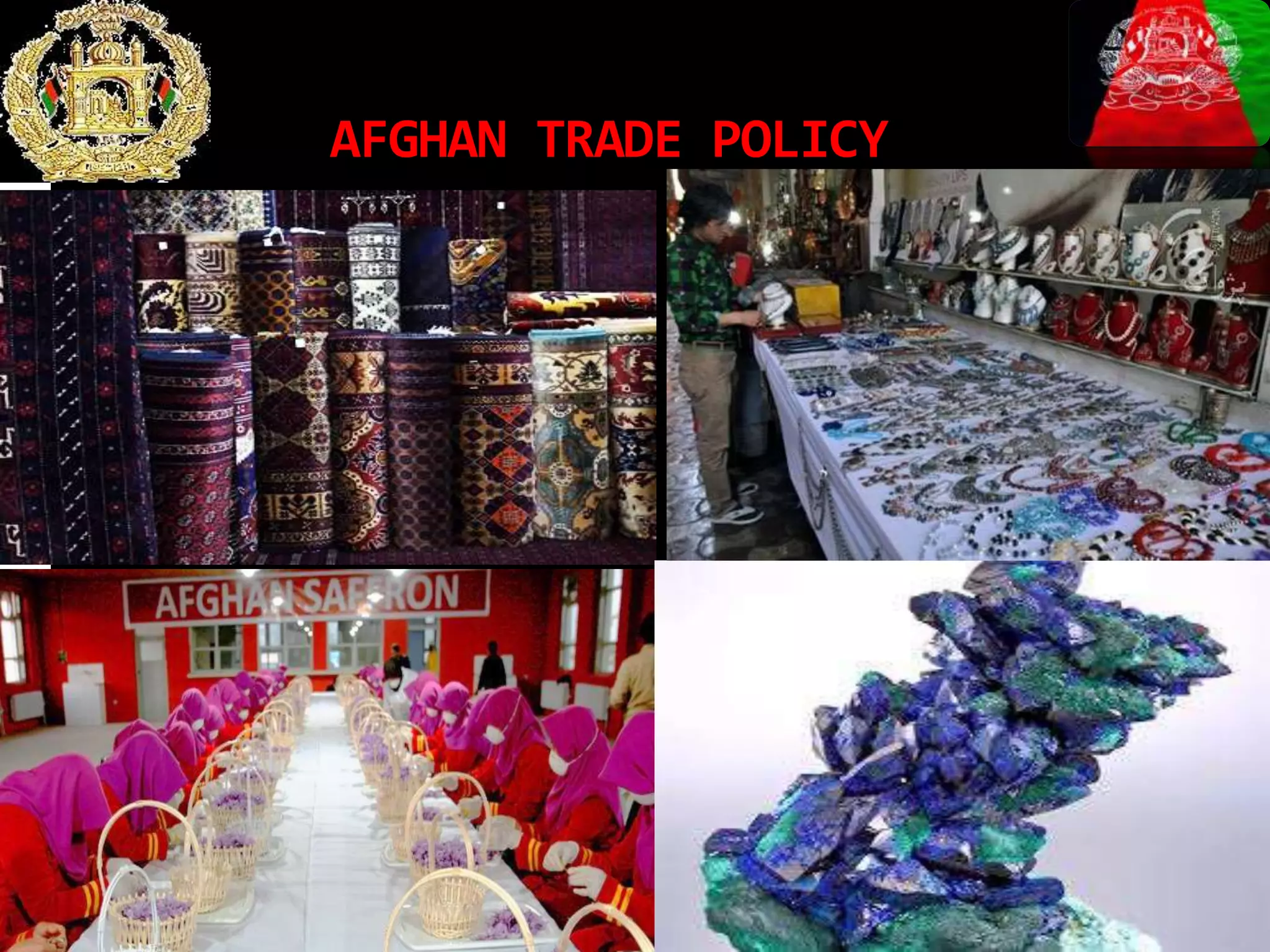
AFGHAN TRADE POLICY
ECONOMIC-OVERVIEW: The economy has improved significantly since the
fall of the Taliban regime in 2001 largely because of the infusion of
international assistance, the recovery of the agricultural sector, and
service sector growth. Despite the progress of the past few years,
Afghanistan is extremely poor, landlocked, and highly dependent on
foreign aid. Much of the population continues to suffer from shortages of
housing, clean water, electricity, medical care, and jobs. Criminality,
insecurity, weak governance, lack of infrastructure, and the Afghan
Government's difficulty in extending rule of law to all parts of the
country pose challenges to future economic growth. Afghanistan's living
standards are among the lowest in the world.
The international community remains committed to Afghanistan's
development, pledging over $67 billion at nine donors' conferences
between 2003 and 2010. In July 2012, the donors at the Tokyo conference
pledged an additional $16 billion in civilian aid through 2015. Despite
this help, the Government of Afghanistan will need to overcome a number
of challenges, including low revenue collection, high levels of
corruption, weak government capacity, and poor public infrastructure.
Afghan President Ashraf GHANI Ahmadzai is dedicated to instituting
economic reforms to include improving revenue collection and fighting
corruption. However, the reforms will take time to implement and
Afghanistan will remain dependent on international donor support over the
next several years.
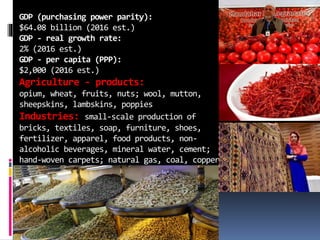
GDP (purchasing power parity):
$64.08 billion (2016 est.)
GDP - real growth rate:
2% (2016 est.)
GDP - per capita (PPP):
$2,000 (2016 est.)
Agriculture - products:
opium, wheat, fruits, nuts; wool, mutton,
sheepskins, lambskins, poppies
Industries: small-scale production of
bricks, textiles, soap, furniture, shoes,
fertilizer, apparel, food products, non-
alcoholic beverages, mineral water, cement;
hand-woven carpets; natural gas, coal, copper
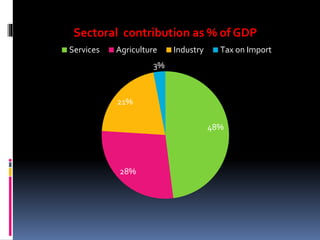
48%
28%
21%
3%
Sectoral contribution as % of GDP
Services Agriculture Industry Tax on Import
Afghanistan Trade policy:
Afghanistan occupies a key strategic location
linking Central Asia with South Asia,
providing China and the Far East with a
direct trade route with the Middle East and
Europe. At the moment, Afghanistan also faces
a security threat that has region-wide
implications and that can only be addressed
effectively by region-wide cooperation
Foreign Trade & Contribution
Trade increased more than 10%.
The total exports of goods was about US$
658 million and total imports was US$ 7.004
billion during 2014-2015.
Despite increasing exports, the Afghanistan
trade balance is generally in deficit and
relying on foreign aid heavily.
Customs Department:
Afghanistan Customs Department (ACD) is a key
department dealing with international trade and
transit, therefore, Customs reforms was high on
the agenda of the government.
In 2004 Afghanistan became a member of World
Customs organization (WCO).
it has two objectives
1. providing protection to society.
2. raising revenue to fund government’s
operating expenses and as a means of achieving
fiscal
What is a Tariff?
A tariff is a duty or tax applied by the Afghan
Customs Department to collect the revenue due
and payable on imported goods and some exported
goods from Afghanistan.
Import Tariffs
Afghanistan Tariffs (percent ad valorem) for
Textiles, Apparel, Footwear and Travel Goods
Yarn =2.5%
Silk =2.5-10
Wool =0-5
Cotton =5%
Knit fabric 5%
Carpet 10-30%
Footwear =2.5-10%
Travel goods 3.5-10%
Home furnishing 2.5-10%
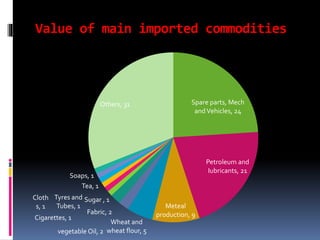
Value of main imported commodities
Spare parts, Mech
andVehicles, 24
Petroleum and
Iubricants, 21
Meteal
production, 9
Wheat and
wheat flour, 5vegetable Oil, 2
Fabric, 2
Sugar , 1
Cigarettes, 1
Tyres and
Tubes, 1
Tea, 1
Cloth
s, 1
Soaps, 1
Others, 31
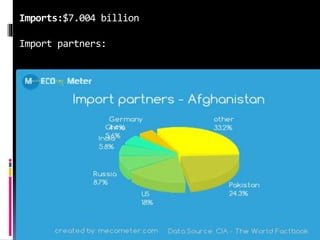
Imports:$7.004 billion
Import partners:
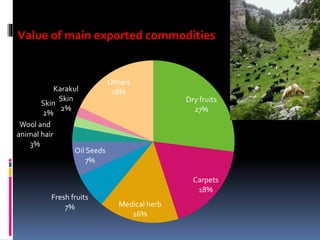
Dry fruits
27%
Carpets
18%
Medical herb
16%
Fresh fruits
7%
Oil Seeds
7%
Wool and
animal hair
3%
Skin
2%
Karakul
Skin
2%
Others
18%
Value of main exported commodities
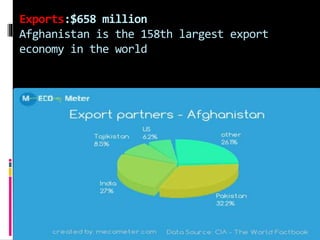
Exports:$658 million
Afghanistan is the 158th largest export
economy in the world
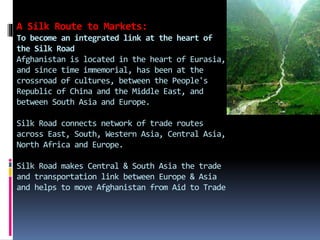
A Silk Route to Markets:
To become an integrated link at the heart of
the Silk Road
Afghanistan is located in the heart of Eurasia,
and since time immemorial, has been at the
crossroad of cultures, between the People's
Republic of China and the Middle East, and
between South Asia and Europe.
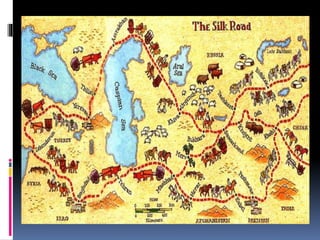
Silk Road connects network of trade routes
across East, South, Western Asia, Central Asia,
North Africa and Europe.
Silk Road makes Central & South Asia the trade
and transportation link between Europe & Asia
and helps to move Afghanistan from Aid to Trade
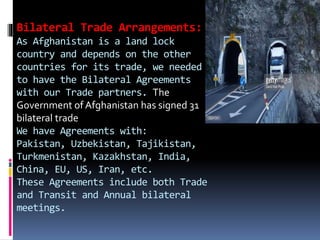
Bilateral Trade Arrangements:
As Afghanistan is a land lock
country and depends on the other
countries for its trade, we needed
to have the Bilateral Agreements
with our Trade partners. The
Government of Afghanistan has signed 31
bilateral trade
We have Agreements with:
Pakistan, Uzbekistan, Tajikistan,
Turkmenistan, Kazakhstan, India,
China, EU, US, Iran, etc.
These Agreements include both Trade
and Transit and Annual bilateral
meetings.
Bilateral Trade Arrangements causes:
1. Increased Trade
2.Technological Spill over
3.Better Socio-economic & political
4.Business to Business Contact
5.Market Access-closer
6.Competitive Advantage
Regional Economic Integration
* To play its central role as a land bridge between Central
Asia and South Asia, and the Middle East and the Far East.
* To connect land locked energy rich Central Asia with warm
water ports and energy deficient South Asia.
* Afghanistan is a member of International organizations
that work on strengthening cooperation on trade, transit
and transportation, such as ECO, CAREC and SAARC.
* Afghanistan plays a key role of land link within the
Region, as such it can help overcome bilateral problems
including border trade.
CAREC: Central Asia Regional Economic Cooperation
Trade Infrastructure and Facilities
* Afghanistan is connecting the region's key economic hubs
to each other, and connecting the landlocked CAREC
countries to other global markets to increase trade
openness in the region and to stimulate growth and
development.
* Hairatan-Mazar-e-Sharif train route connects Central Asia
with Europe and Asia.
* CAREC Corridor 5 connects East Asia to the Arabian Sea
through Central Asia. The route covers the People's
Republic of China, the Kyrgyz Republic, Tajikistan, and
Afghanistan. The corridor has 3,700 km of roads and 2,000
km of railways.
* CAREC Corridor 6 includes three routes linking Europe and
the Russia Federation to the Arabian Sea port of Karachi
and Gwadar or Bandar Abbas in the Persian Gulf. The route
has 10,600 km of roads and 7,200 km of railways.
SAARC South Asian Association for Regional Cooperation
To increase economic cooperation with aim
of generating economic growth and
increase the standards of living.
*Benefit to Afghanistan from tariff
reductions of SAARC members under the
framework of SAFTA(agree S.) (e.g.
India).
Chabahar port:
It is located in south eastern of Iran in
Oman sea. Minimum transit distances to
Afghanistan, Pakistan & middle Asia &
most economical port in commercial trade
for these countries.
The agreement had signed in the presence
of Narendra Modi, Hassan Rohani and
Ashraf Ghani in Iran on May 23, 2016.
The government of Iran has designated
Chabahar as Free Trade and Industrial
Zone.
Advantages of Chabahar Port
1. It will provide an access route to land-
locked Afghanistan, that would be free of
Pakistan’s control.
2. It would give India access to markets and
mineral resources in Afghanistan and central
Asia
3. Provide access to Hajigak iron ore mine
developed by Steel Authority of India.
4. It will provide boost to the development of
International North South Transport Corridor
(INSTC)
5. It will provide Market for farm products from
Afghanistan
6. It will help in combating drug trafficking.
Conclusion:
Afghanistan has pursued a liberal trade
policy and will reform its trade policy
regime in line with the WTO requirements.
In the context of regional integration
and implementation of bilateral and
transit agreements, Afghanistan will
promote harmonization with international
conventions, agreements and standards in
order to move towards Multilateral
trading system.
References:
1.Afghanistan Ministry of Commerce & Industries.
2.The world fact book.
PRESENTED BY:
HABIBULLAH NOORZAD
Afghanistan Trade Policy ppt

Afghanistan Trade Policy ppt

  • 1.
  • 2.
    ECONOMIC-OVERVIEW: The economyhas improved significantly since the fall of the Taliban regime in 2001 largely because of the infusion of international assistance, the recovery of the agricultural sector, and service sector growth. Despite the progress of the past few years, Afghanistan is extremely poor, landlocked, and highly dependent on foreign aid. Much of the population continues to suffer from shortages of housing, clean water, electricity, medical care, and jobs. Criminality, insecurity, weak governance, lack of infrastructure, and the Afghan Government's difficulty in extending rule of law to all parts of the country pose challenges to future economic growth. Afghanistan's living standards are among the lowest in the world. The international community remains committed to Afghanistan's development, pledging over $67 billion at nine donors' conferences between 2003 and 2010. In July 2012, the donors at the Tokyo conference pledged an additional $16 billion in civilian aid through 2015. Despite this help, the Government of Afghanistan will need to overcome a number of challenges, including low revenue collection, high levels of corruption, weak government capacity, and poor public infrastructure. Afghan President Ashraf GHANI Ahmadzai is dedicated to instituting economic reforms to include improving revenue collection and fighting corruption. However, the reforms will take time to implement and Afghanistan will remain dependent on international donor support over the next several years.
  • 3.
    GDP (purchasing powerparity): $64.08 billion (2016 est.) GDP - real growth rate: 2% (2016 est.) GDP - per capita (PPP): $2,000 (2016 est.) Agriculture - products: opium, wheat, fruits, nuts; wool, mutton, sheepskins, lambskins, poppies Industries: small-scale production of bricks, textiles, soap, furniture, shoes, fertilizer, apparel, food products, non- alcoholic beverages, mineral water, cement; hand-woven carpets; natural gas, coal, copper
  • 4.
    48% 28% 21% 3% Sectoral contribution as% of GDP Services Agriculture Industry Tax on Import
  • 5.
    Afghanistan Trade policy: Afghanistanoccupies a key strategic location linking Central Asia with South Asia, providing China and the Far East with a direct trade route with the Middle East and Europe. At the moment, Afghanistan also faces a security threat that has region-wide implications and that can only be addressed effectively by region-wide cooperation
  • 6.
    Foreign Trade &Contribution Trade increased more than 10%. The total exports of goods was about US$ 658 million and total imports was US$ 7.004 billion during 2014-2015. Despite increasing exports, the Afghanistan trade balance is generally in deficit and relying on foreign aid heavily.
  • 7.
    Customs Department: Afghanistan CustomsDepartment (ACD) is a key department dealing with international trade and transit, therefore, Customs reforms was high on the agenda of the government. In 2004 Afghanistan became a member of World Customs organization (WCO). it has two objectives 1. providing protection to society. 2. raising revenue to fund government’s operating expenses and as a means of achieving fiscal
  • 8.
    What is aTariff? A tariff is a duty or tax applied by the Afghan Customs Department to collect the revenue due and payable on imported goods and some exported goods from Afghanistan. Import Tariffs Afghanistan Tariffs (percent ad valorem) for Textiles, Apparel, Footwear and Travel Goods Yarn =2.5% Silk =2.5-10 Wool =0-5 Cotton =5% Knit fabric 5% Carpet 10-30% Footwear =2.5-10% Travel goods 3.5-10% Home furnishing 2.5-10%
  • 9.
    Value of mainimported commodities Spare parts, Mech andVehicles, 24 Petroleum and Iubricants, 21 Meteal production, 9 Wheat and wheat flour, 5vegetable Oil, 2 Fabric, 2 Sugar , 1 Cigarettes, 1 Tyres and Tubes, 1 Tea, 1 Cloth s, 1 Soaps, 1 Others, 31
  • 10.
  • 11.
    Dry fruits 27% Carpets 18% Medical herb 16% Freshfruits 7% Oil Seeds 7% Wool and animal hair 3% Skin 2% Karakul Skin 2% Others 18% Value of main exported commodities
  • 12.
    Exports:$658 million Afghanistan isthe 158th largest export economy in the world
  • 13.
    A Silk Routeto Markets: To become an integrated link at the heart of the Silk Road Afghanistan is located in the heart of Eurasia, and since time immemorial, has been at the crossroad of cultures, between the People's Republic of China and the Middle East, and between South Asia and Europe. Silk Road connects network of trade routes across East, South, Western Asia, Central Asia, North Africa and Europe. Silk Road makes Central & South Asia the trade and transportation link between Europe & Asia and helps to move Afghanistan from Aid to Trade
  • 15.
    Bilateral Trade Arrangements: AsAfghanistan is a land lock country and depends on the other countries for its trade, we needed to have the Bilateral Agreements with our Trade partners. The Government of Afghanistan has signed 31 bilateral trade We have Agreements with: Pakistan, Uzbekistan, Tajikistan, Turkmenistan, Kazakhstan, India, China, EU, US, Iran, etc. These Agreements include both Trade and Transit and Annual bilateral meetings.
  • 16.
    Bilateral Trade Arrangementscauses: 1. Increased Trade 2.Technological Spill over 3.Better Socio-economic & political 4.Business to Business Contact 5.Market Access-closer 6.Competitive Advantage
  • 17.
    Regional Economic Integration *To play its central role as a land bridge between Central Asia and South Asia, and the Middle East and the Far East. * To connect land locked energy rich Central Asia with warm water ports and energy deficient South Asia. * Afghanistan is a member of International organizations that work on strengthening cooperation on trade, transit and transportation, such as ECO, CAREC and SAARC. * Afghanistan plays a key role of land link within the Region, as such it can help overcome bilateral problems including border trade.
  • 18.
    CAREC: Central AsiaRegional Economic Cooperation Trade Infrastructure and Facilities * Afghanistan is connecting the region's key economic hubs to each other, and connecting the landlocked CAREC countries to other global markets to increase trade openness in the region and to stimulate growth and development. * Hairatan-Mazar-e-Sharif train route connects Central Asia with Europe and Asia. * CAREC Corridor 5 connects East Asia to the Arabian Sea through Central Asia. The route covers the People's Republic of China, the Kyrgyz Republic, Tajikistan, and Afghanistan. The corridor has 3,700 km of roads and 2,000 km of railways. * CAREC Corridor 6 includes three routes linking Europe and the Russia Federation to the Arabian Sea port of Karachi and Gwadar or Bandar Abbas in the Persian Gulf. The route has 10,600 km of roads and 7,200 km of railways.
  • 19.
    SAARC South AsianAssociation for Regional Cooperation To increase economic cooperation with aim of generating economic growth and increase the standards of living. *Benefit to Afghanistan from tariff reductions of SAARC members under the framework of SAFTA(agree S.) (e.g. India).
  • 20.
    Chabahar port: It islocated in south eastern of Iran in Oman sea. Minimum transit distances to Afghanistan, Pakistan & middle Asia & most economical port in commercial trade for these countries. The agreement had signed in the presence of Narendra Modi, Hassan Rohani and Ashraf Ghani in Iran on May 23, 2016. The government of Iran has designated Chabahar as Free Trade and Industrial Zone.
  • 21.
    Advantages of ChabaharPort 1. It will provide an access route to land- locked Afghanistan, that would be free of Pakistan’s control. 2. It would give India access to markets and mineral resources in Afghanistan and central Asia 3. Provide access to Hajigak iron ore mine developed by Steel Authority of India. 4. It will provide boost to the development of International North South Transport Corridor (INSTC) 5. It will provide Market for farm products from Afghanistan 6. It will help in combating drug trafficking.
  • 22.
    Conclusion: Afghanistan has pursueda liberal trade policy and will reform its trade policy regime in line with the WTO requirements. In the context of regional integration and implementation of bilateral and transit agreements, Afghanistan will promote harmonization with international conventions, agreements and standards in order to move towards Multilateral trading system.
  • 23.
    References: 1.Afghanistan Ministry ofCommerce & Industries. 2.The world fact book.
  • 24.