AFGHANISTAN
INFRASTRUCTURE
GROUP MEMBERS
SAID ABDUL BASIT
ABIDULLAH
ISMAIL
AFGHANISTAN
AFGHANISTAN OFFICIALLY THE ISLAMIC REPUBLIC OF AFGHANISTAN, IS A
LANDLOCKED COUNTRY LOCATED AT THE CROSSROADS
OF CENTRAL AND SOUTH ASIA. REFERRED TO AS THE HEART OF ASIA, IT IS
BORDERED BY PAKISTAN TO THE EAST AND SOUTH, IRAN TO
THE WEST, TURKMENISTAN TO THE NORTHWEST, UZBEKISTAN TO
THE NORTH, TAJIKISTAN TO THE NORTHEAST, AND CHINA TO
THE NORTHEAST AND EAST. OCCUPYING 652,864 SQUARE KILOMETERS
(252,072 SQ MI) OF LAND, THE COUNTRY IS PREDOMINANTLY MOUNTAINOUS
WITH PLAINS IN THE NORTH AND THE SOUTHWEST, WHICH ARE SEPARATED
BY THE HINDU KUSH MOUNTAIN RANGE. AS OF 2021, ITS POPULATION IS 40.2
MILLION, COMPOSED MOSTLY OF ETHNIC PASHTUNS, TAJIKS, HAZARAS,
AND UZBEKS. KABUL IS THE COUNTRY'S LARGEST CITY AND SERVES AS ITS
CAPITAL.
INFRASTRUCTURE
Infrastructure is the set of facilities and systems that serve a country,
city, or other area, and encompasses the services and facilities
necessary for its economy, households and firms to function.
Roads, Railways, Water system, Hospitals, Schools, Universities, Dams
ETC
IMPORTANCE OF
INFRASTRUCTURE
• Infrastructure development is a vital component in encouraging a
country's economic growth. Developing infrastructure enhances a
country's productivity, consequently making firms more
competitive and boosting a region's economy.
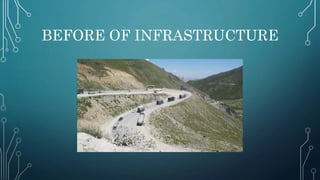
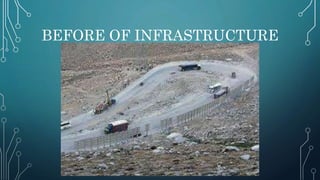
BEFORE OF INFRASTRUCTURE
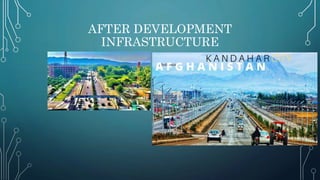
AFTER DEVELOPMENT
INFRASTRUCTURE
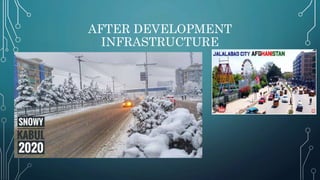
AFTER DEVELOPMENT
INFRASTRUCTURE
TRANSPORT IN AFGHANISTAN
• Transport in Afghanistan has steadily improved in the last decade. Much of the nationals road network
was built during the 1960s but left to ruin during the decades of war and political turmoil. The
current Taliban government has continued to improve the national highways, roads, and bridges.
Landlocked Afghanistan has no seaports, but the Amu Darya river, which forms part of the nation's
border with Turkmenistan, Uzbekistan, and Tajikistan does have substantial traffic. Rebuilding of
airports, roads, and rail services has led to rapid economic growth in recent years. The nation has
about 46 airports as of 2020
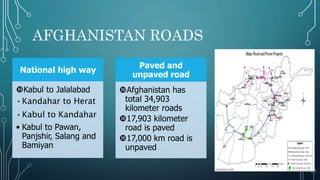
AFGHANISTAN ROADS
National high way
Kabul to Jalalabad
•Kandahar to Herat
•Kabul to Kandahar
• Kabul to Pawan,
Panjshir, Salang and
Bamiyan
Paved and
unpaved road
Afghanistan has
total 34,903
kilometer roads
17,903 kilometer
road is paved
17,000 km road is
unpaved
AFGHANISTAN CIVIL AVIATION
AUTHORITY (ACAA)
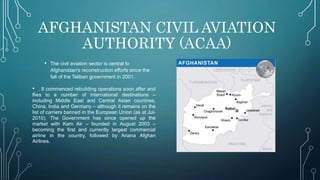
• The civil aviation sector is central to
Afghanistan's reconstruction efforts since the
fall of the Taliban government in 2001.
• . It commenced rebuilding operations soon after and
flies to a number of international destinations –
including Middle East and Central Asian countries,
China, India and Germany – although it remains on the
list of carriers banned in the European Union (as at Jul-
2010). The Government has since opened up the
market with Kam Air – founded in August 2003 –
becoming the first and currently largest commercial
airline in the country, followed by Ariana Afghan
Airlines.
DEMOGRAPHICS
• Population 38.93 million in 2020 (world bank)
• Un estimated that:
• 23.9% urbanite
• 71.4% live in rural areas
• 4.7% are nomadic
• 3 million Afghans are temporarily housed in
neighboring Pakistan and Iran
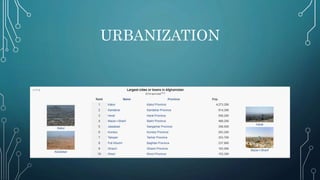
URBANIZATION
ECONOMY
• Afghanistan's nominal GDP was $21.7 billion in 2018, or $72.9 billion by purchasing
power parity (PPP). Its GDP per capita is $2,024 (PPP). Despite having $1 trillion or
more in mineral deposits.
• The country imports over $7 billion worth of goods but exports only $784 million,
mainly fruits and nuts.
• a majority of imports come from either Iran, China, Pakistan and Kazakhstan, while
84% of exports are to Pakistan and India.
• Since the Taliban's takeover of the country in August 2021, the United States
has frozen about $9 billion in assets belonging to the Afghan central bank, blocking
the Taliban from accessing billions of dollars held in U.S. bank accounts.
CHALLENGES IN
TRANSIT/TRANSPORT THE CASE IN
AFGHANISTAN
• There are so various transit/transport challenges faced by many less‐developed countries,
especially in those of landlocked ones with limited trade, but higher costs and many delays.
• Afghanistan is located in central/southern Asia and landlocked among Iran, Pakistan, Tajikistan,
Uzbekistan, Turkmenistan & China. While Afghanistan shares the major features of LDCs such as
poor physical infrastructure, weak institutional capacities, remoteness from world markets, and a
high vulnerability to external shocks
MAJOR CHALLENGES IN
TRANSIT
• Thirty years of war, continuous terrorist attacks since 9/11, non‐ stop intimidation by some
neighbors, drug trafficking, continuous drought, very low level of literacy and higher rate of
unemployment and mortality have accelerated the already negative impacts on economic &
commercial activities of Afghanistan
• Security/Politics
• Infrastructural Facilities
• Trade/Transit Facilities (TF)
• • Less than 70% of TF(task force) standards applied
• • Lack of Bonded warehousing services
• • Lack of coordination within the country
• • Aging trucking fleet with lack of TIR(transport international routers) implementation;
• • Shortage of coordination in BCPs – single window operation
• • No insurance coverage and lack of required security
MAJOR CHALLENGES IN
TRANSIT
• Lack of Border Coordination & Harmonization
• Lower Capacity & Insufficient Technical Assistance
SUGGESTIONS
• Improving security throughout the country both for persons and property;
• Completing the main road rehabilitation connecting
• Constructing a modern ICT system and ensuring that after reconstruction maintenance is
undertaken for sustainability
• Streamlining of border crossing procedures for speedy clearance and anti‐corruption measures
• Reestablishing formal financial and insurance systems including an effective clearance and
settlement system;
• Designing and implementing major capacity‐building programs to develop skills and
professionalism in transit activities while adopting an integrated approach to trade facilitation
and public‐private partnerships
SUGGESTIONS
• Publishing and placing on government webs border‐crossing rules and customs procedures for
transparency
• Developing capacity to monitor trade logistics performance and report findings;
• Reducing discriminatory measures against foreign transport operators to bring about the reciprocity
principle;
• Designing, developing & expanding other transport means such as railway, ferry & air transport while
making maximum usage of North‐South & East‐West corridors;
• Making a continuous effort to achieve consensus on the formal mechanisms needed to carry the regional
cooperation dialogue forward;
• Moving toward single window operation while expanding ASYCUDA implementation;
CONCLUSION
As one of the least developed lands‐locked countries but with very strategic location in Central Asia,
in coordination of donor assistance, the Afghan Government must draft, implement, monitor and
evaluate a Master Plan for transit/trade facilitation to expand its trade & capitalize on its
transport/transit modern corridors. The Government must support each border by ICD (Inland
Clearance Depot) with ICT interfaces. It has no choice but to further improve secondary legislation
in consultation with other agencies. While expanding the use best international practices, including
international standards and conventions, it should develop performance indicators. Although it has
participated in the various regional organizations on economic and commercial cooperation such as
ECO, CAREC, SPECA, & SAARC, the Government must reform and make effective use of trade &
transit agreements (bilateral, multilateral & regional).
DISASTER
• Disasters are serious disruptions to the functioning of a community that exceed its capacity to
cope using its own resources. Disasters can be caused by natural, man-made and technological
hazards, as well as various factors that influence the exposure and vulnerability of a community
DISASTER IN AFGHANISTAN
• Afghanistan is highly prone to intense and recurring natural hazards such as flooding, earthquakes,
snow avalanches, landslides and droughts due to its geographical location and years of
environmental degradation.
• Climate change also poses a threat to Afghanistan’s natural resources, of which the majority of
Afghans depend for their livelihoods. Afghanistan faces significant impacts of climate change and
disasters which impact growth prospects
CLIMATE AND NATURAL DISASTER RISK MANAGEMENT FOR THE ENERGY SYSTEM IN
AFGHANISTAN
• Climate and natural hazards can potentially have catastrophic impacts on the energy system of
Afghanistan. The energy production in Afghanistan is dominated by hydro power generation,
which is vulnerable to climate change because of the future competition for water resources
between sectors and the risk of recurrent droughts.
• natural hazards such as drought, flooding, landslides, avalanches, and earthquakes.
ACTION PLAN
• The actions to be implemented can be defined according to a multi-phased approach. Specific
actions at the first stage of the plan include:
• supporting enhanced policy making and investment planning;
• The plan then provides an operational set of actions targeted to the final implementation of the
project:
EARTHQUAKE
• An earthquake is the sudden movement of the Earth's tectonic plates, resulting in shaking of the
ground. This shaking can result in the damage of various structures such as buildings and further
breakdown of the Earth's surface. The study of earthquakes is called seismology
EARTHQUAKE
• we build buildings to protect from rain, cold and heat so that we can have a peaceful and safe
life. In the same way, in earthquake-prone areas, structural engineers who are responsible for the
design and construction of buildings should also consider earthquake loads in the design of
buildings. Series and others, central areas such as some parts of Kabul and the southeastern
areas such as Paktika and Paktika are located on the active earthquake belt based on seismology,
such as Kashmir, India, Japan, etc.
CAUSES OF EARTHQUAKE
• Tectonic earthquakes: The release of energy of a sudden change in the shape of rocks on the
edge of the plate, that is, on the surface of the fault, is the primary cause of seismic activity in
the world.
• About 90% of all earthquakes are caused by tectonic events.
• Volcanic Earthquakes: Surface volcanic earthquakes are caused by a sudden shift or movement of
magma.
CAUSES OF EARTHQUAKE
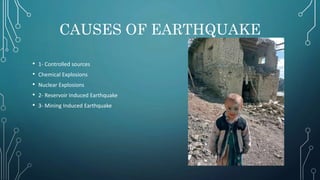
• 1- Controlled sources
• Chemical Explosions
• Nuclear Explosions
• 2- Reservoir Induced Earthquake
• 3- Mining Induced Earthquake
SUGGESTIONS
CONCLUSION AND RECOMMENDATION
• Climate change adaptation and DRR should be should incorporated in national development strategy (ANDS)
and should be included in educational curricula at schools and universities.
• the government should implement awareness programs on natural hazards, climate change, community-
based adaption and DRR across the country.
• The impact of climate change has already felt in Afghanistan considering that natural resources are the
mean of livelihood for most of Afghan and implication of climate change directly affected the water resource
availability, food production decline, livestock decline, migration, drinking water access, health and education,
for example drought in 2008 caused wheat production to decline by 40 to 55 percent countrywide.
• During a flood you should move to higher ground and avoid standing, flowing, or rising water. Keep children
away from dirty water. Keep children and pets away from hazardous sites and floodwater as it's likely to be
dirty, carry bacteria, and vulnerable to electric shock. Keep children clean.
Afghanistan infrastructure.pptx

Afghanistan infrastructure.pptx

  • 2.
  • 3.
    AFGHANISTAN AFGHANISTAN OFFICIALLY THEISLAMIC REPUBLIC OF AFGHANISTAN, IS A LANDLOCKED COUNTRY LOCATED AT THE CROSSROADS OF CENTRAL AND SOUTH ASIA. REFERRED TO AS THE HEART OF ASIA, IT IS BORDERED BY PAKISTAN TO THE EAST AND SOUTH, IRAN TO THE WEST, TURKMENISTAN TO THE NORTHWEST, UZBEKISTAN TO THE NORTH, TAJIKISTAN TO THE NORTHEAST, AND CHINA TO THE NORTHEAST AND EAST. OCCUPYING 652,864 SQUARE KILOMETERS (252,072 SQ MI) OF LAND, THE COUNTRY IS PREDOMINANTLY MOUNTAINOUS WITH PLAINS IN THE NORTH AND THE SOUTHWEST, WHICH ARE SEPARATED BY THE HINDU KUSH MOUNTAIN RANGE. AS OF 2021, ITS POPULATION IS 40.2 MILLION, COMPOSED MOSTLY OF ETHNIC PASHTUNS, TAJIKS, HAZARAS, AND UZBEKS. KABUL IS THE COUNTRY'S LARGEST CITY AND SERVES AS ITS CAPITAL.
  • 4.
    INFRASTRUCTURE Infrastructure is theset of facilities and systems that serve a country, city, or other area, and encompasses the services and facilities necessary for its economy, households and firms to function. Roads, Railways, Water system, Hospitals, Schools, Universities, Dams ETC
  • 5.
    IMPORTANCE OF INFRASTRUCTURE • Infrastructuredevelopment is a vital component in encouraging a country's economic growth. Developing infrastructure enhances a country's productivity, consequently making firms more competitive and boosting a region's economy.
  • 6.
  • 7.
  • 8.
  • 9.
  • 10.
    TRANSPORT IN AFGHANISTAN •Transport in Afghanistan has steadily improved in the last decade. Much of the nationals road network was built during the 1960s but left to ruin during the decades of war and political turmoil. The current Taliban government has continued to improve the national highways, roads, and bridges. Landlocked Afghanistan has no seaports, but the Amu Darya river, which forms part of the nation's border with Turkmenistan, Uzbekistan, and Tajikistan does have substantial traffic. Rebuilding of airports, roads, and rail services has led to rapid economic growth in recent years. The nation has about 46 airports as of 2020
  • 11.
    AFGHANISTAN ROADS National highway Kabul to Jalalabad •Kandahar to Herat •Kabul to Kandahar • Kabul to Pawan, Panjshir, Salang and Bamiyan Paved and unpaved road Afghanistan has total 34,903 kilometer roads 17,903 kilometer road is paved 17,000 km road is unpaved
  • 12.
    AFGHANISTAN CIVIL AVIATION AUTHORITY(ACAA) • The civil aviation sector is central to Afghanistan's reconstruction efforts since the fall of the Taliban government in 2001. • . It commenced rebuilding operations soon after and flies to a number of international destinations – including Middle East and Central Asian countries, China, India and Germany – although it remains on the list of carriers banned in the European Union (as at Jul- 2010). The Government has since opened up the market with Kam Air – founded in August 2003 – becoming the first and currently largest commercial airline in the country, followed by Ariana Afghan Airlines.
  • 13.
    DEMOGRAPHICS • Population 38.93million in 2020 (world bank) • Un estimated that: • 23.9% urbanite • 71.4% live in rural areas • 4.7% are nomadic • 3 million Afghans are temporarily housed in neighboring Pakistan and Iran
  • 14.
  • 15.
    ECONOMY • Afghanistan's nominalGDP was $21.7 billion in 2018, or $72.9 billion by purchasing power parity (PPP). Its GDP per capita is $2,024 (PPP). Despite having $1 trillion or more in mineral deposits. • The country imports over $7 billion worth of goods but exports only $784 million, mainly fruits and nuts. • a majority of imports come from either Iran, China, Pakistan and Kazakhstan, while 84% of exports are to Pakistan and India. • Since the Taliban's takeover of the country in August 2021, the United States has frozen about $9 billion in assets belonging to the Afghan central bank, blocking the Taliban from accessing billions of dollars held in U.S. bank accounts.
  • 16.
    CHALLENGES IN TRANSIT/TRANSPORT THECASE IN AFGHANISTAN • There are so various transit/transport challenges faced by many less‐developed countries, especially in those of landlocked ones with limited trade, but higher costs and many delays. • Afghanistan is located in central/southern Asia and landlocked among Iran, Pakistan, Tajikistan, Uzbekistan, Turkmenistan & China. While Afghanistan shares the major features of LDCs such as poor physical infrastructure, weak institutional capacities, remoteness from world markets, and a high vulnerability to external shocks
  • 17.
    MAJOR CHALLENGES IN TRANSIT •Thirty years of war, continuous terrorist attacks since 9/11, non‐ stop intimidation by some neighbors, drug trafficking, continuous drought, very low level of literacy and higher rate of unemployment and mortality have accelerated the already negative impacts on economic & commercial activities of Afghanistan • Security/Politics • Infrastructural Facilities • Trade/Transit Facilities (TF)
  • 18.
    • • Lessthan 70% of TF(task force) standards applied • • Lack of Bonded warehousing services • • Lack of coordination within the country • • Aging trucking fleet with lack of TIR(transport international routers) implementation; • • Shortage of coordination in BCPs – single window operation • • No insurance coverage and lack of required security
  • 19.
    MAJOR CHALLENGES IN TRANSIT •Lack of Border Coordination & Harmonization • Lower Capacity & Insufficient Technical Assistance
  • 20.
    SUGGESTIONS • Improving securitythroughout the country both for persons and property; • Completing the main road rehabilitation connecting • Constructing a modern ICT system and ensuring that after reconstruction maintenance is undertaken for sustainability • Streamlining of border crossing procedures for speedy clearance and anti‐corruption measures • Reestablishing formal financial and insurance systems including an effective clearance and settlement system; • Designing and implementing major capacity‐building programs to develop skills and professionalism in transit activities while adopting an integrated approach to trade facilitation and public‐private partnerships
  • 21.
    SUGGESTIONS • Publishing andplacing on government webs border‐crossing rules and customs procedures for transparency • Developing capacity to monitor trade logistics performance and report findings; • Reducing discriminatory measures against foreign transport operators to bring about the reciprocity principle; • Designing, developing & expanding other transport means such as railway, ferry & air transport while making maximum usage of North‐South & East‐West corridors; • Making a continuous effort to achieve consensus on the formal mechanisms needed to carry the regional cooperation dialogue forward; • Moving toward single window operation while expanding ASYCUDA implementation;
  • 22.
    CONCLUSION As one ofthe least developed lands‐locked countries but with very strategic location in Central Asia, in coordination of donor assistance, the Afghan Government must draft, implement, monitor and evaluate a Master Plan for transit/trade facilitation to expand its trade & capitalize on its transport/transit modern corridors. The Government must support each border by ICD (Inland Clearance Depot) with ICT interfaces. It has no choice but to further improve secondary legislation in consultation with other agencies. While expanding the use best international practices, including international standards and conventions, it should develop performance indicators. Although it has participated in the various regional organizations on economic and commercial cooperation such as ECO, CAREC, SPECA, & SAARC, the Government must reform and make effective use of trade & transit agreements (bilateral, multilateral & regional).
  • 23.
    DISASTER • Disasters areserious disruptions to the functioning of a community that exceed its capacity to cope using its own resources. Disasters can be caused by natural, man-made and technological hazards, as well as various factors that influence the exposure and vulnerability of a community
  • 24.
    DISASTER IN AFGHANISTAN •Afghanistan is highly prone to intense and recurring natural hazards such as flooding, earthquakes, snow avalanches, landslides and droughts due to its geographical location and years of environmental degradation. • Climate change also poses a threat to Afghanistan’s natural resources, of which the majority of Afghans depend for their livelihoods. Afghanistan faces significant impacts of climate change and disasters which impact growth prospects
  • 25.
    CLIMATE AND NATURALDISASTER RISK MANAGEMENT FOR THE ENERGY SYSTEM IN AFGHANISTAN • Climate and natural hazards can potentially have catastrophic impacts on the energy system of Afghanistan. The energy production in Afghanistan is dominated by hydro power generation, which is vulnerable to climate change because of the future competition for water resources between sectors and the risk of recurrent droughts. • natural hazards such as drought, flooding, landslides, avalanches, and earthquakes.
  • 26.
    ACTION PLAN • Theactions to be implemented can be defined according to a multi-phased approach. Specific actions at the first stage of the plan include: • supporting enhanced policy making and investment planning; • The plan then provides an operational set of actions targeted to the final implementation of the project:
  • 27.
    EARTHQUAKE • An earthquakeis the sudden movement of the Earth's tectonic plates, resulting in shaking of the ground. This shaking can result in the damage of various structures such as buildings and further breakdown of the Earth's surface. The study of earthquakes is called seismology
  • 28.
    EARTHQUAKE • we buildbuildings to protect from rain, cold and heat so that we can have a peaceful and safe life. In the same way, in earthquake-prone areas, structural engineers who are responsible for the design and construction of buildings should also consider earthquake loads in the design of buildings. Series and others, central areas such as some parts of Kabul and the southeastern areas such as Paktika and Paktika are located on the active earthquake belt based on seismology, such as Kashmir, India, Japan, etc.
  • 29.
    CAUSES OF EARTHQUAKE •Tectonic earthquakes: The release of energy of a sudden change in the shape of rocks on the edge of the plate, that is, on the surface of the fault, is the primary cause of seismic activity in the world. • About 90% of all earthquakes are caused by tectonic events. • Volcanic Earthquakes: Surface volcanic earthquakes are caused by a sudden shift or movement of magma.
  • 30.
    CAUSES OF EARTHQUAKE •1- Controlled sources • Chemical Explosions • Nuclear Explosions • 2- Reservoir Induced Earthquake • 3- Mining Induced Earthquake
  • 31.
  • 32.
    CONCLUSION AND RECOMMENDATION •Climate change adaptation and DRR should be should incorporated in national development strategy (ANDS) and should be included in educational curricula at schools and universities. • the government should implement awareness programs on natural hazards, climate change, community- based adaption and DRR across the country. • The impact of climate change has already felt in Afghanistan considering that natural resources are the mean of livelihood for most of Afghan and implication of climate change directly affected the water resource availability, food production decline, livestock decline, migration, drinking water access, health and education, for example drought in 2008 caused wheat production to decline by 40 to 55 percent countrywide. • During a flood you should move to higher ground and avoid standing, flowing, or rising water. Keep children away from dirty water. Keep children and pets away from hazardous sites and floodwater as it's likely to be dirty, carry bacteria, and vulnerable to electric shock. Keep children clean.