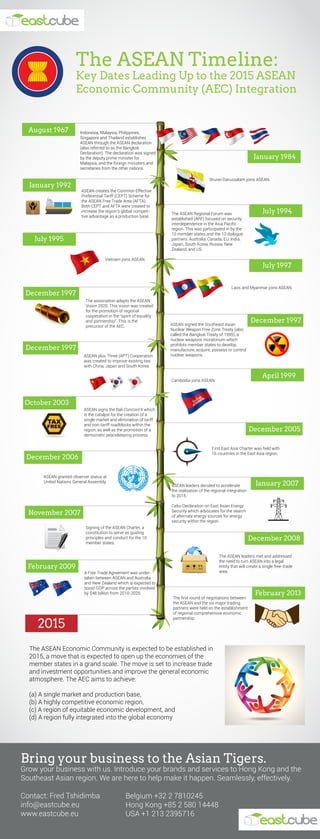
The ASEAN Timeline: 
Key Dates Leading Up to the 2015 ASEAN 
Economic Community (AEC) Integration 
August 1967 Indonesia, Malaysia, Philippines, 
Singapore and Thailand establishes 
ASEAN through the ASEAN declaration 
(also referred to as the Bangkok 
Declaration). The declaration was signed 
by the deputy prime minister for 
Malaysia, and the foreign ministers and 
secretaries from the other nations. 
January 1984 
Brunei Darussalam joins ASEAN. 
January 1992 
ASEAN creates the Common Effective 
Preferential Tariff (CEPT) Scheme for 
the ASEAN Free Trade Area (AFTA). 
Both CEPT and AFTA were created to 
increase the region’s global competi-tive 
advantage as a production base. 
The ASEAN Regional Forum was July 1994 
established (ARF) focused on security 
interdependence in the Asia Pacific 
region. This was participated in by the 
10 member states and the 10 dialogue 
partners: Australia, Canada, EU, India, 
Japan, South Korea, Russia, New 
Zealand, and US. 
July 1995 
Vietnam joins ASEAN. 
July 1997 
Laos and Myanmar joins ASEAN. 
December 1997 
December 1997 
The association adapts the ASEAN 
Vision 2020. This vision was created 
for the promotion of regional 
cooperation in the “spirit of equality 
and partnership”. This is the 
precursor of the AEC. ASEAN signed the Southeast Asian 
Nuclear Weapon Free Zone Treaty (also 
called the Bangkok Treaty of 1995), a 
nuclear weapons moratorium which 
prohibits member states to develop, 
manufacture, acquire, possess or control 
nuclear weapons. 
December 1997 
April 1999 
Cambodia joins ASEAN. 
October 2003 
December 2005 
December 2006 
January 2007 
November 2007 
ASEAN plus Three (APT) Cooperation 
was created to improve existing ties 
with China, Japan and South Korea. 
ASEAN signs the Bali Concord II which 
is the catalyst for the creation of a 
single market and elimination of tariff 
and non-tariff roadblocks within the 
region, as well as the promotion of a 
democratic peacekeeping process. 
First East Asia Charter was held with 
16 countries in the East Asia region. 
ASEAN granted observer status at 
United Nations General Assembly. 
ASEAN leaders decided to accelerate 
the realisation of the regional integration 
to 2015. 
Cebu Declaration on East Asian Energy 
Security which advocates for the search 
of alternate energy sources for energy 
security within the region. 
Signing of the ASEAN Charter, a 
constitution to serve as guiding 
principles and conduct for the 10 
member states. 
December 2008 
February 2013 
February 2009 
The ASEAN leaders met and addressed 
the need to turn ASEAN into a legal 
entity that will create a single free-trade 
A Free Trade Agreement was under- area. 
taken between ASEAN and Australia 
and New Zealand which is expected to 
boost GDP across the parties involved 
by $48 billion from 2010-2020. 
The first round of negotiations between 
the ASEAN and the six major trading 
partners were held on the establishment 
of regional comprehensive economic 
partnership. 2015 
The ASEAN Economic Community is expected to be established in 
2015, a move that is expected to open up the economies of the 
member states in a grand scale. The move is set to increase trade 
and investment opportunities and improve the general economic 
atmosphere. The AEC aims to achieve: 
(a) A single market and production base, 
(b) A highly competitive economic region, 
(c) A region of equitable economic development, and 
(d) A region fully integrated into the global economy 
Bring your business to the Asian Tigers. 
Grow your business with us. Introduce your brands and services to Hong Kong and the 
Southeast Asian region. We are here to help make it happen. Seamlessly, effectively. 
Contact: Fred Tshidimba 
info@eastcube.eu 
www.eastcube.eu 
Belgium +32 2 7810245 
Hong Kong +85 2 580 14448 
USA +1 213 2395716

ASEAN timeline

  • 1.
    The ASEAN Timeline: Key Dates Leading Up to the 2015 ASEAN Economic Community (AEC) Integration August 1967 Indonesia, Malaysia, Philippines, Singapore and Thailand establishes ASEAN through the ASEAN declaration (also referred to as the Bangkok Declaration). The declaration was signed by the deputy prime minister for Malaysia, and the foreign ministers and secretaries from the other nations. January 1984 Brunei Darussalam joins ASEAN. January 1992 ASEAN creates the Common Effective Preferential Tariff (CEPT) Scheme for the ASEAN Free Trade Area (AFTA). Both CEPT and AFTA were created to increase the region’s global competi-tive advantage as a production base. The ASEAN Regional Forum was July 1994 established (ARF) focused on security interdependence in the Asia Pacific region. This was participated in by the 10 member states and the 10 dialogue partners: Australia, Canada, EU, India, Japan, South Korea, Russia, New Zealand, and US. July 1995 Vietnam joins ASEAN. July 1997 Laos and Myanmar joins ASEAN. December 1997 December 1997 The association adapts the ASEAN Vision 2020. This vision was created for the promotion of regional cooperation in the “spirit of equality and partnership”. This is the precursor of the AEC. ASEAN signed the Southeast Asian Nuclear Weapon Free Zone Treaty (also called the Bangkok Treaty of 1995), a nuclear weapons moratorium which prohibits member states to develop, manufacture, acquire, possess or control nuclear weapons. December 1997 April 1999 Cambodia joins ASEAN. October 2003 December 2005 December 2006 January 2007 November 2007 ASEAN plus Three (APT) Cooperation was created to improve existing ties with China, Japan and South Korea. ASEAN signs the Bali Concord II which is the catalyst for the creation of a single market and elimination of tariff and non-tariff roadblocks within the region, as well as the promotion of a democratic peacekeeping process. First East Asia Charter was held with 16 countries in the East Asia region. ASEAN granted observer status at United Nations General Assembly. ASEAN leaders decided to accelerate the realisation of the regional integration to 2015. Cebu Declaration on East Asian Energy Security which advocates for the search of alternate energy sources for energy security within the region. Signing of the ASEAN Charter, a constitution to serve as guiding principles and conduct for the 10 member states. December 2008 February 2013 February 2009 The ASEAN leaders met and addressed the need to turn ASEAN into a legal entity that will create a single free-trade A Free Trade Agreement was under- area. taken between ASEAN and Australia and New Zealand which is expected to boost GDP across the parties involved by $48 billion from 2010-2020. The first round of negotiations between the ASEAN and the six major trading partners were held on the establishment of regional comprehensive economic partnership. 2015 The ASEAN Economic Community is expected to be established in 2015, a move that is expected to open up the economies of the member states in a grand scale. The move is set to increase trade and investment opportunities and improve the general economic atmosphere. The AEC aims to achieve: (a) A single market and production base, (b) A highly competitive economic region, (c) A region of equitable economic development, and (d) A region fully integrated into the global economy Bring your business to the Asian Tigers. Grow your business with us. Introduce your brands and services to Hong Kong and the Southeast Asian region. We are here to help make it happen. Seamlessly, effectively. Contact: Fred Tshidimba info@eastcube.eu www.eastcube.eu Belgium +32 2 7810245 Hong Kong +85 2 580 14448 USA +1 213 2395716