POTENTIAL FOR STORMS AND HAZARDS IN KENTUCKY Sara Ferguson and Kevin Armstrong
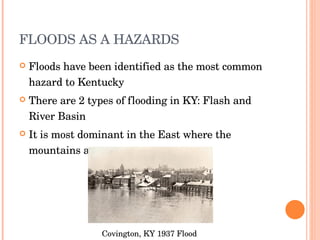
FLOODS AS A HAZARDS Floods have been identified as the most common hazard to Kentucky There are 2 types of flooding in KY: Flash and River Basin It is most dominant in the East where the mountains are Covington, KY 1937 Flood
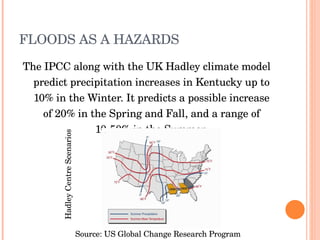
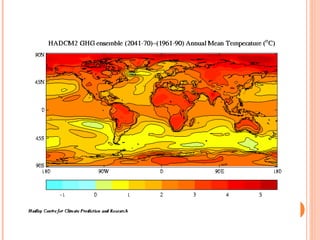
FLOODS AS A HAZARDS The IPCC along with the UK Hadley climate model predict precipitation increases in Kentucky up to 10% in the Winter. It predicts a possible increase of 20% in the Spring and Fall, and a range of 10-50% in the Summer. Source: US Global Change Research Program Hadley Centre Scenarios
 
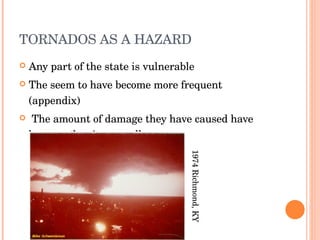
TORNADOS AS A HAZARD Any part of the state is vulnerable The seem to have become more frequent (appendix) The amount of damage they have caused have been on the rise as well 1974 Richmond, KY
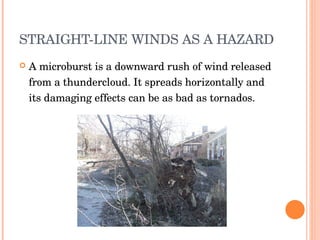
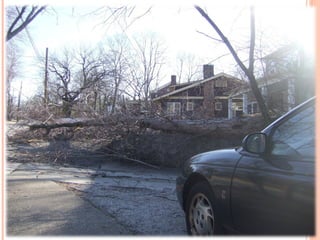
STRAIGHT-LINE WINDS AS A HAZARD A microburst is a downward rush of wind released from a thundercloud. It spreads horizontally and its damaging effects can be as bad as tornados.
 
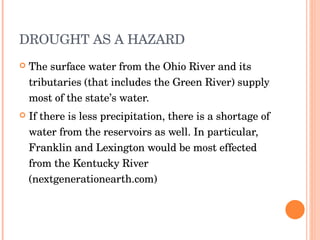
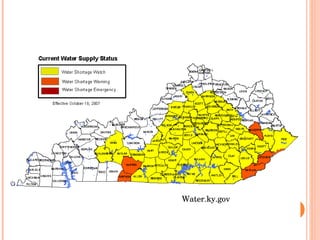
DROUGHT AS A HAZARD The surface water from the Ohio River and its tributaries (that includes the Green River) supply most of the state’s water. If there is less precipitation, there is a shortage of water from the reservoirs as well. In particular, Franklin and Lexington would be most effected from the Kentucky River (nextgenerationearth.com)
Water.ky.gov
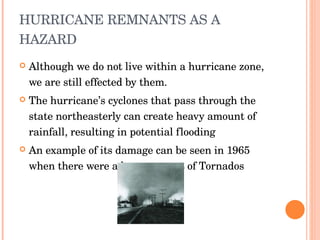
HURRICANE REMNANTS AS A HAZARD Although we do not live within a hurricane zone, we are still effected by them. The hurricane’s cyclones that pass through the state northeasterly can create heavy amount of rainfall, resulting in potential flooding An example of its damage can be seen in 1965 when there were a huge amount of Tornados
WINTER STORMS AS A HAZARD Kentucky rarely is effected by snow storms due to our mild, temperate climate. If our climate was to change, the amount of snow storms could also change
FOREST FIRES AND WILD FIRES  The densely wooded eastern part of the state can burn in dry hot times. Prime times for fires are the spring and fall. There has been no major fires (greater than 5,000 acres) in the past decade.
SUBSIDENCE AND KARSTS TOPOGRAPHY  55% of Kentucky is underlain by some type of karsts geology. Even in good times the ground under our feet in Bowling Green is melting away. Sinkhole collapse is initiated by heavy rain events.  This causes transportation hazards and damage to property.
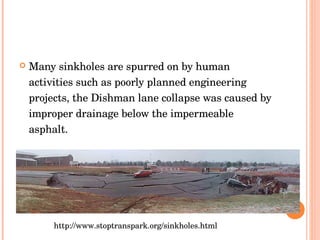
Many sinkholes are spurred on by human activities such as poorly planned engineering projects, the Dishman lane collapse was caused by improper drainage below the impermeable asphalt.  http://www.stoptranspark.org/sinkholes.html
As flood events increase so does erosion and mudslides! With warming comes less frequent but more intense storm events, resulting in worse floods and dryer droughts. Between 1985 and 1999 4,421 mountain tops were removed and valleys filled in eastern KY.  This practice has been shown to increase peak flow by 36%
DROUGHTS AND HEAT WAVES  Every summer heat intensifies and rainfall decreases, severely impacting agriculture. Urban heat islands exacerbate the effects on the elderly and weaker.  Many major metropolitan cities such as Cincinatti experienced a five fold increase in heat related deaths from the 80’s to the 90’s
References www.nextgenerationearth.com www.climateconnection.org   www.ipcc.ch

Final Project

  • 1.
    POTENTIAL FOR STORMSAND HAZARDS IN KENTUCKY Sara Ferguson and Kevin Armstrong
  • 2.
    FLOODS AS AHAZARDS Floods have been identified as the most common hazard to Kentucky There are 2 types of flooding in KY: Flash and River Basin It is most dominant in the East where the mountains are Covington, KY 1937 Flood
  • 3.
    FLOODS AS AHAZARDS The IPCC along with the UK Hadley climate model predict precipitation increases in Kentucky up to 10% in the Winter. It predicts a possible increase of 20% in the Spring and Fall, and a range of 10-50% in the Summer. Source: US Global Change Research Program Hadley Centre Scenarios
  • 4.
  • 5.
    TORNADOS AS AHAZARD Any part of the state is vulnerable The seem to have become more frequent (appendix) The amount of damage they have caused have been on the rise as well 1974 Richmond, KY
  • 6.
    STRAIGHT-LINE WINDS ASA HAZARD A microburst is a downward rush of wind released from a thundercloud. It spreads horizontally and its damaging effects can be as bad as tornados.
  • 7.
  • 8.
    DROUGHT AS AHAZARD The surface water from the Ohio River and its tributaries (that includes the Green River) supply most of the state’s water. If there is less precipitation, there is a shortage of water from the reservoirs as well. In particular, Franklin and Lexington would be most effected from the Kentucky River (nextgenerationearth.com)
  • 9.
  • 10.
    HURRICANE REMNANTS ASA HAZARD Although we do not live within a hurricane zone, we are still effected by them. The hurricane’s cyclones that pass through the state northeasterly can create heavy amount of rainfall, resulting in potential flooding An example of its damage can be seen in 1965 when there were a huge amount of Tornados
  • 11.
    WINTER STORMS ASA HAZARD Kentucky rarely is effected by snow storms due to our mild, temperate climate. If our climate was to change, the amount of snow storms could also change
  • 12.
    FOREST FIRES ANDWILD FIRES The densely wooded eastern part of the state can burn in dry hot times. Prime times for fires are the spring and fall. There has been no major fires (greater than 5,000 acres) in the past decade.
  • 13.
    SUBSIDENCE AND KARSTSTOPOGRAPHY 55% of Kentucky is underlain by some type of karsts geology. Even in good times the ground under our feet in Bowling Green is melting away. Sinkhole collapse is initiated by heavy rain events. This causes transportation hazards and damage to property.
  • 14.
    Many sinkholes arespurred on by human activities such as poorly planned engineering projects, the Dishman lane collapse was caused by improper drainage below the impermeable asphalt. http://www.stoptranspark.org/sinkholes.html
  • 15.
    As flood eventsincrease so does erosion and mudslides! With warming comes less frequent but more intense storm events, resulting in worse floods and dryer droughts. Between 1985 and 1999 4,421 mountain tops were removed and valleys filled in eastern KY. This practice has been shown to increase peak flow by 36%
  • 16.
    DROUGHTS AND HEATWAVES Every summer heat intensifies and rainfall decreases, severely impacting agriculture. Urban heat islands exacerbate the effects on the elderly and weaker. Many major metropolitan cities such as Cincinatti experienced a five fold increase in heat related deaths from the 80’s to the 90’s
  • 17.