IS EARTH capable of
sustaining
The University of Oklahoma
Department of Biology
QUESTION
Can Earth sustain enough
resources to keep up with
the demands of humanity?
More specifically: The demands of a U.S. Lifestyle
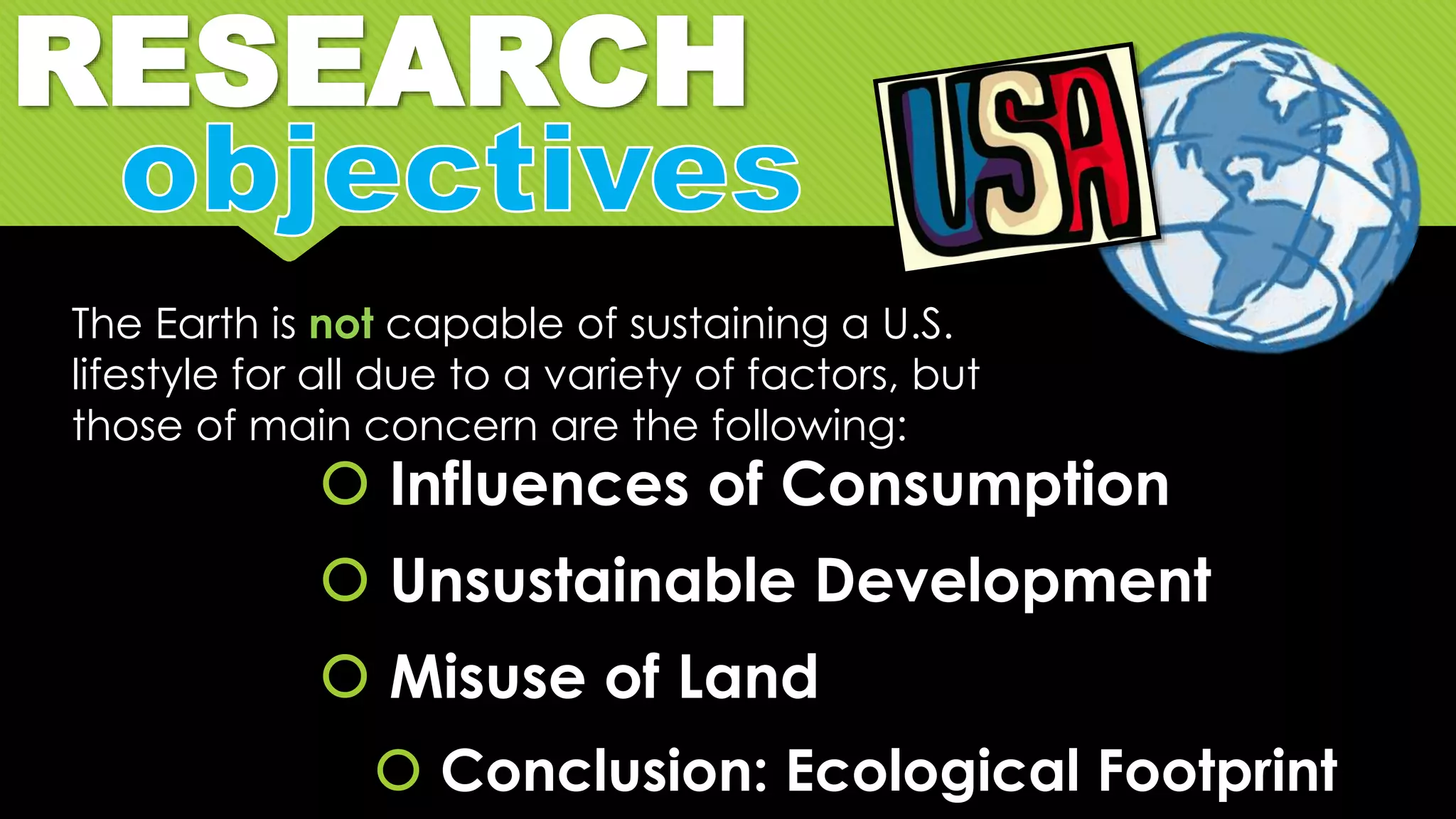
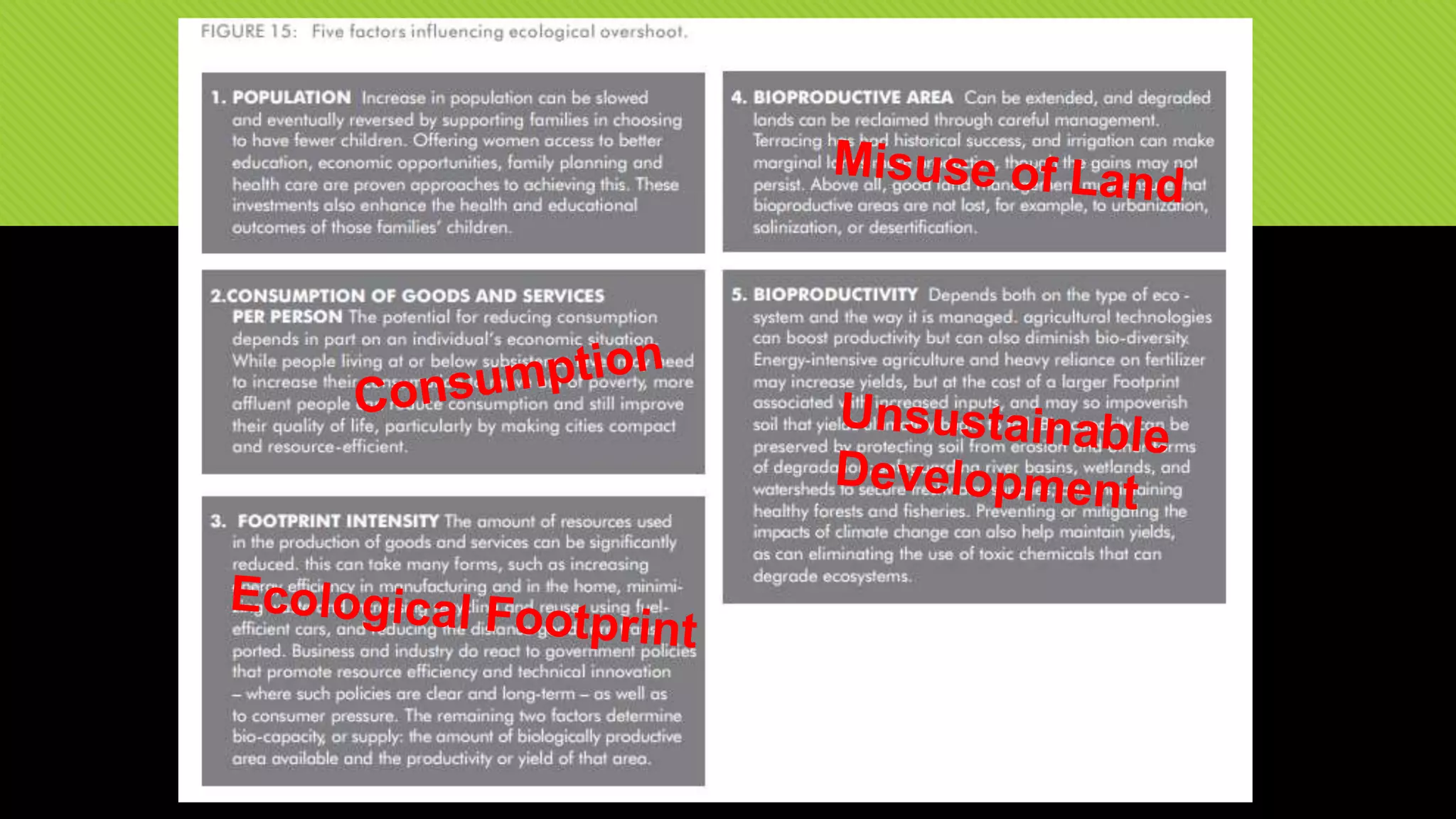
 Influences of Consumption
 Unsustainable Development
 Misuse of Land
 Conclusion: Ecological Footprint
The Earth is not capable of sustaining a U.S.
lifestyle for all due to a variety of factors, but
those of main concern are the following:
RESEARCH
method&venue
 Presentation
 Polls & Significance
 Putnam City North HS:
AP Environmental Science
 Taylor Upchurch
 Amanda Pierce
METHOD&VENUE
 Goods & Services
 Food
 Mobility
 Shelter
 Waste
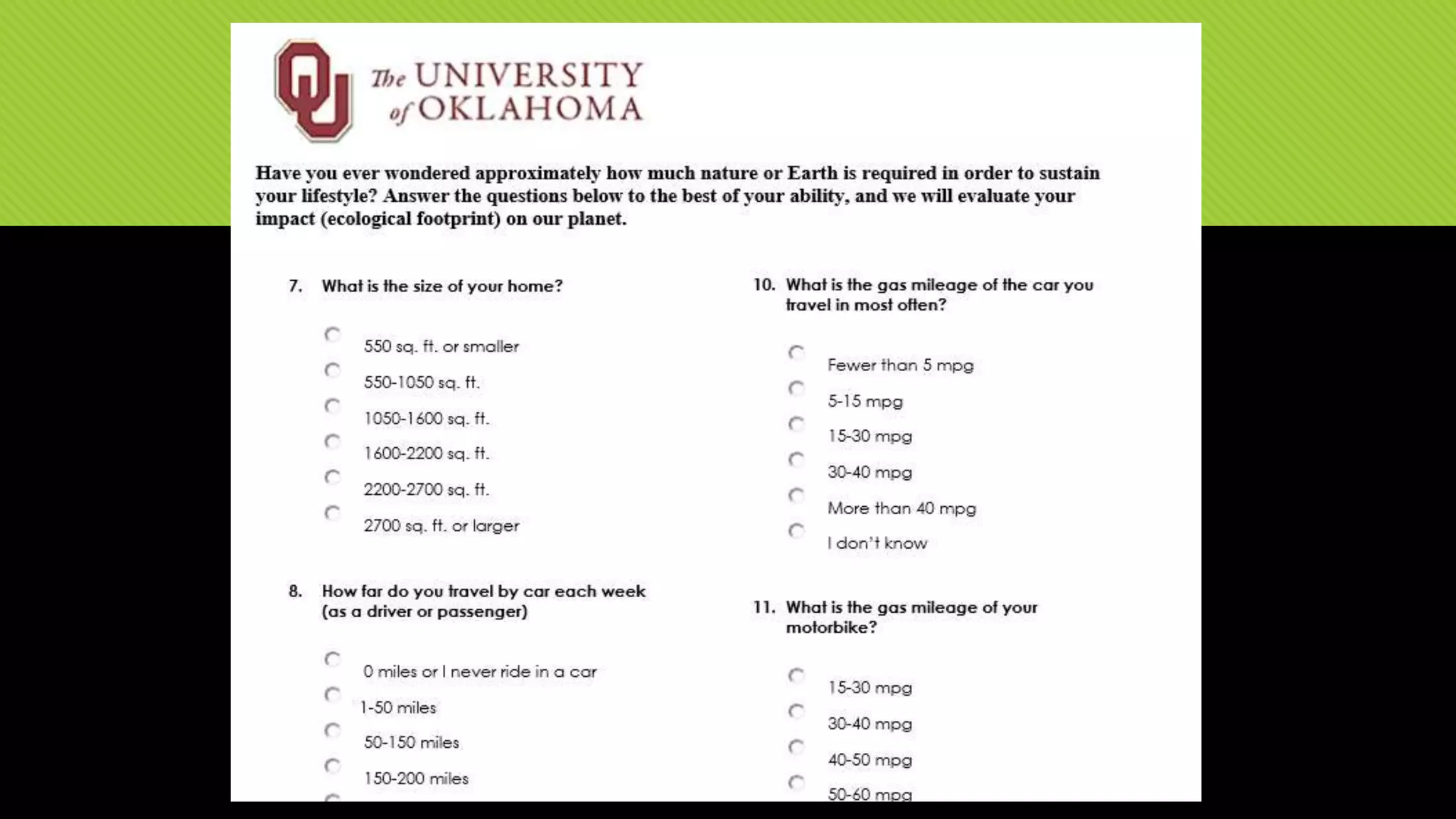
A 14-question quiz covering:
POTENTIAL
 Poll questions answered untruthfully
 Data might be as recent as we might
want in order to make a convincing
argument
 Sources containing skewed data that
favors major companies
Fossil Fuel Reliance
U.S. Lifestyle choices
Housing
Meat and poultry
 Paper waste
 Individual Choices: Global influence
 U.S. uses 25% of total, global fossil fuel
resources. Including coal, oil and natural gas.
 US is only 5% of the global population.
 Since 1975, the average US household size
has increased 38%. With increased size
comes increased reliance on energy.
 In the 60s, Americans consumed an average
of 145 lbs. of meat and poultry per year. By
1999 this number reached 190 lbs. per person.
A 31% increase!
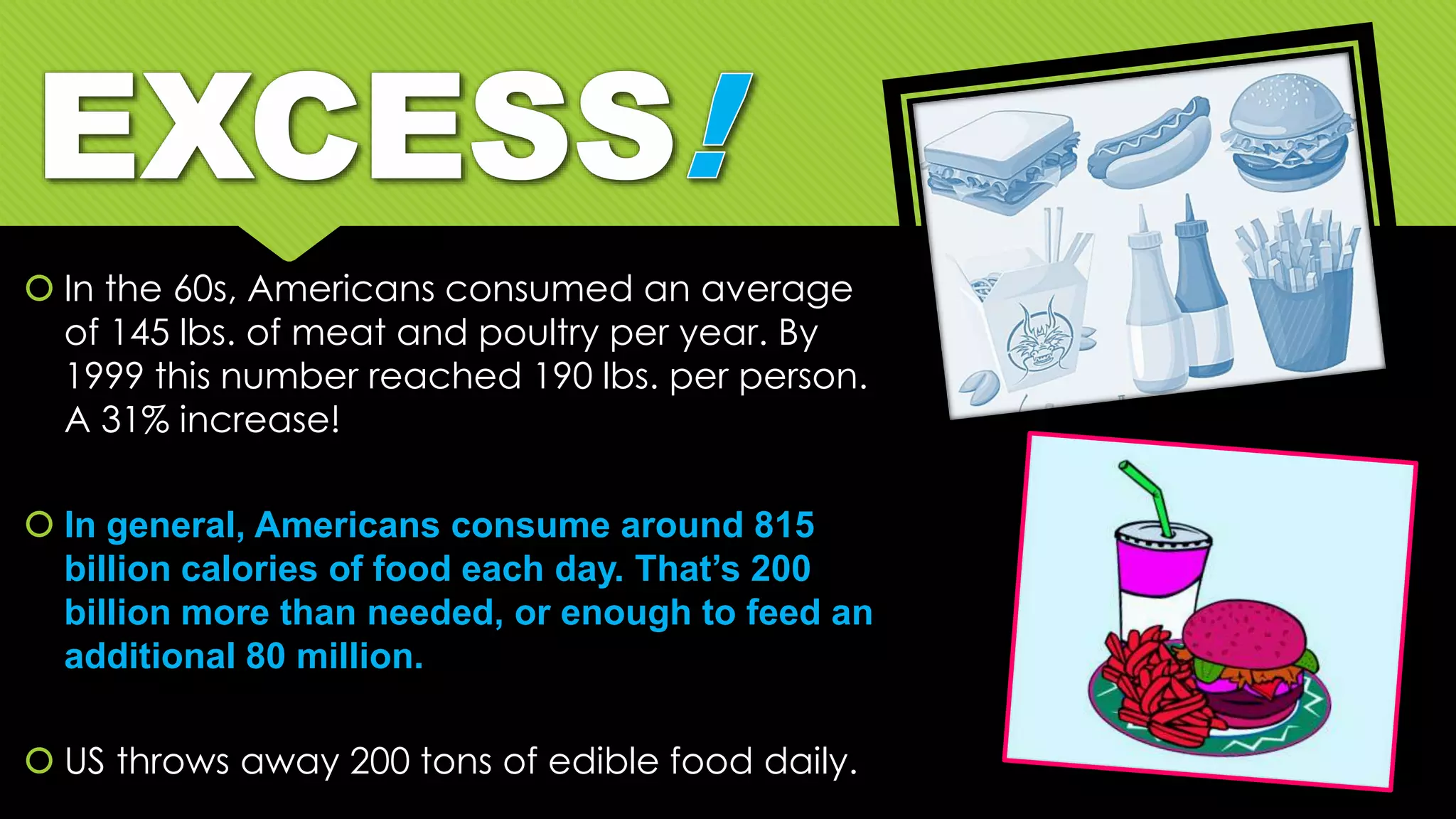
 In general, Americans consume around 815
billion calories of food each day. That’s 200
billion more than needed, or enough to feed an
additional 80 million.
 US throws away 200 tons of edible food daily.
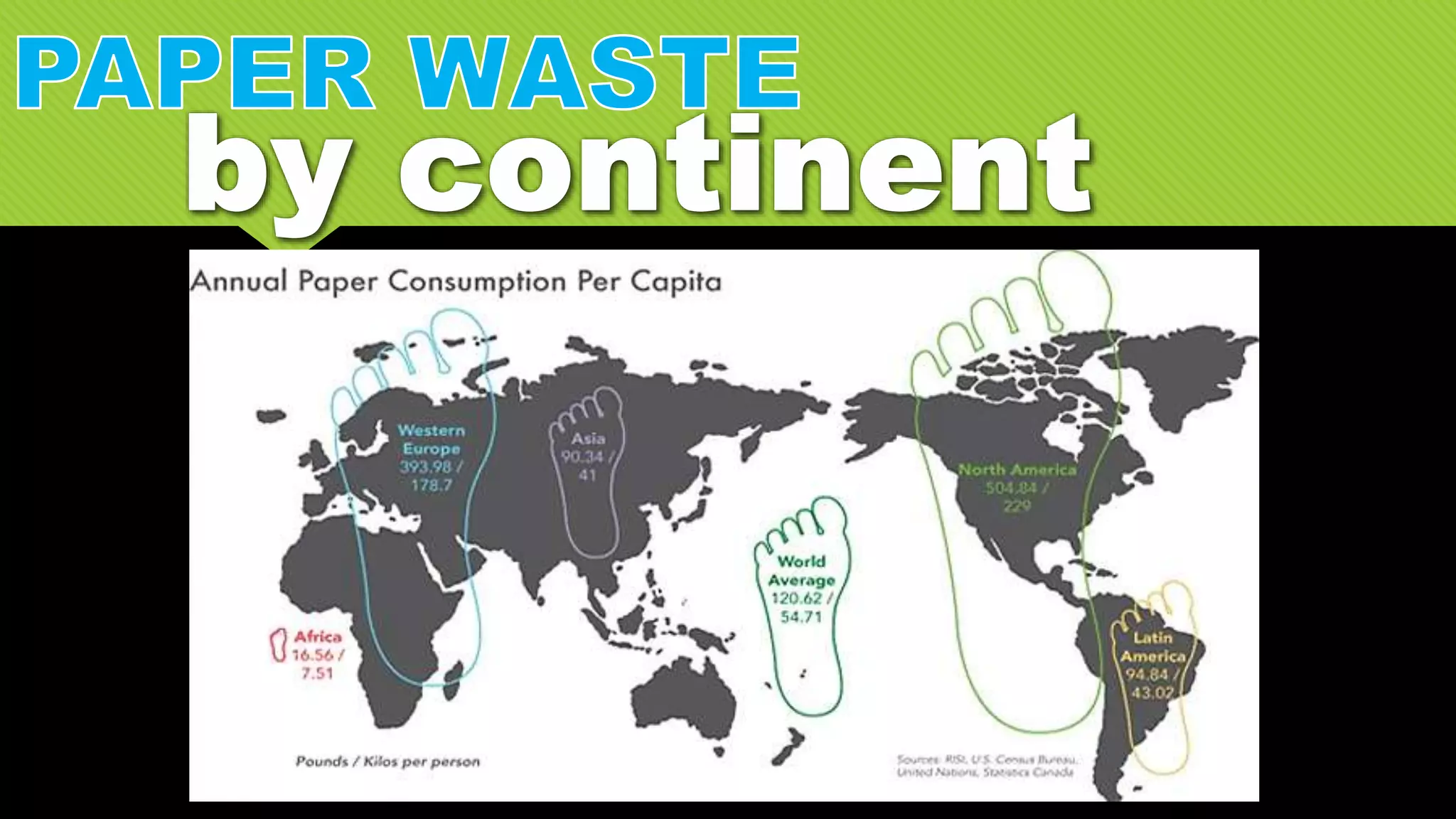
 The US consumes nearly a third of all global
paper resources. (5% of global population)
 North Americans consume an average of
more than 500 lbs of paper annually.
 Paper production requires high amount of
energy. 12% of energy cost in industrial sector
for paper alone.
 Production creates large amount of
greenhouse gases.
 Drives forest destruction.
o ELECTRIC TOOTHBRUSH: batteries
from Japan, plastics from
central Europe, circuit board
from China.
o Individual choices can have
global impacts.
 Municipal Solid Waste
 Forest Removal
 Meat Breeding
 Nuclear Waste
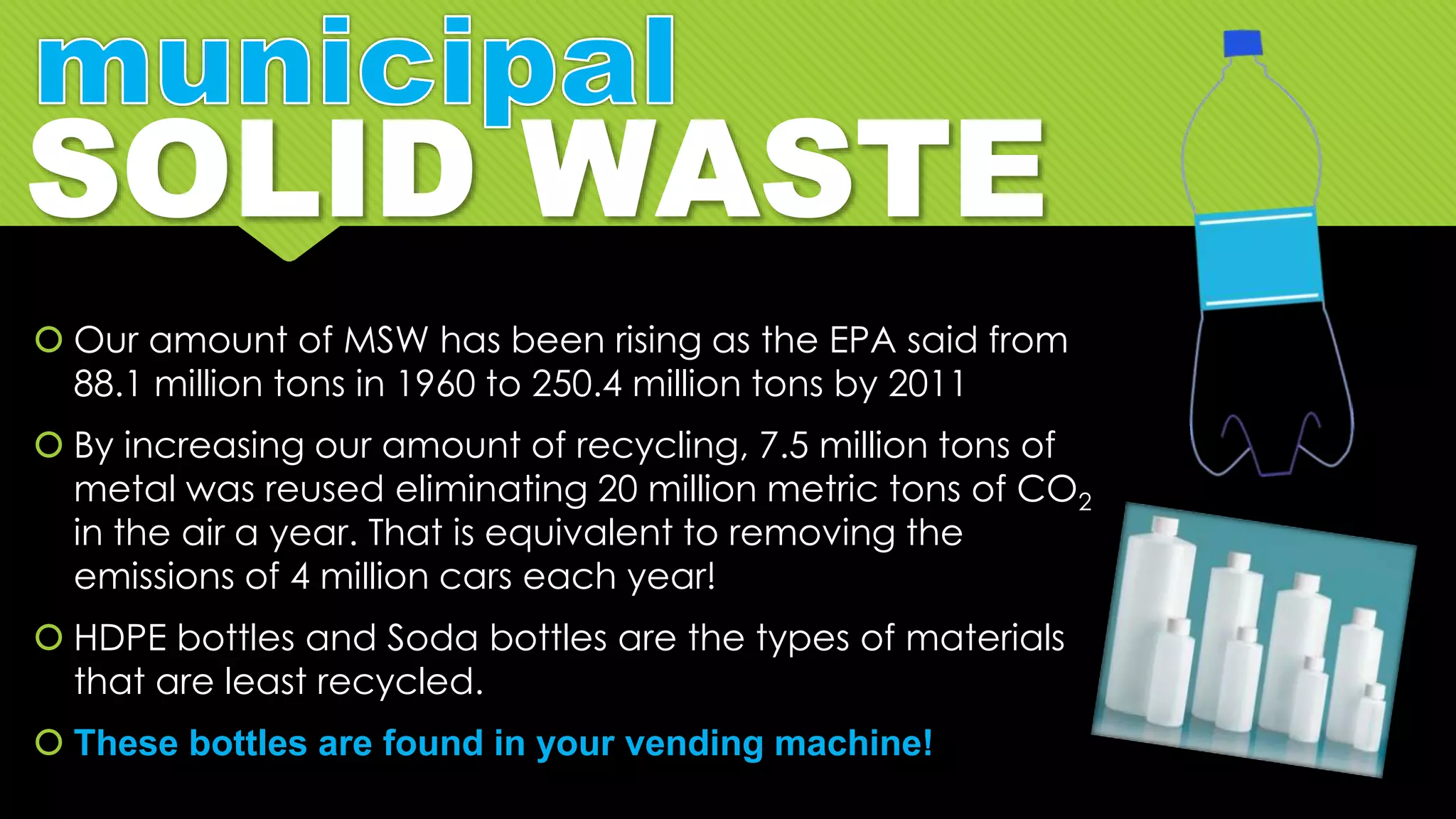
 Our amount of MSW has been rising as the EPA said from
88.1 million tons in 1960 to 250.4 million tons by 2011
 By increasing our amount of recycling, 7.5 million tons of
metal was reused eliminating 20 million metric tons of CO2
in the air a year. That is equivalent to removing the
emissions of 4 million cars each year!
 HDPE bottles and Soda bottles are the types of materials
that are least recycled.
 These bottles are found in your vending machine!
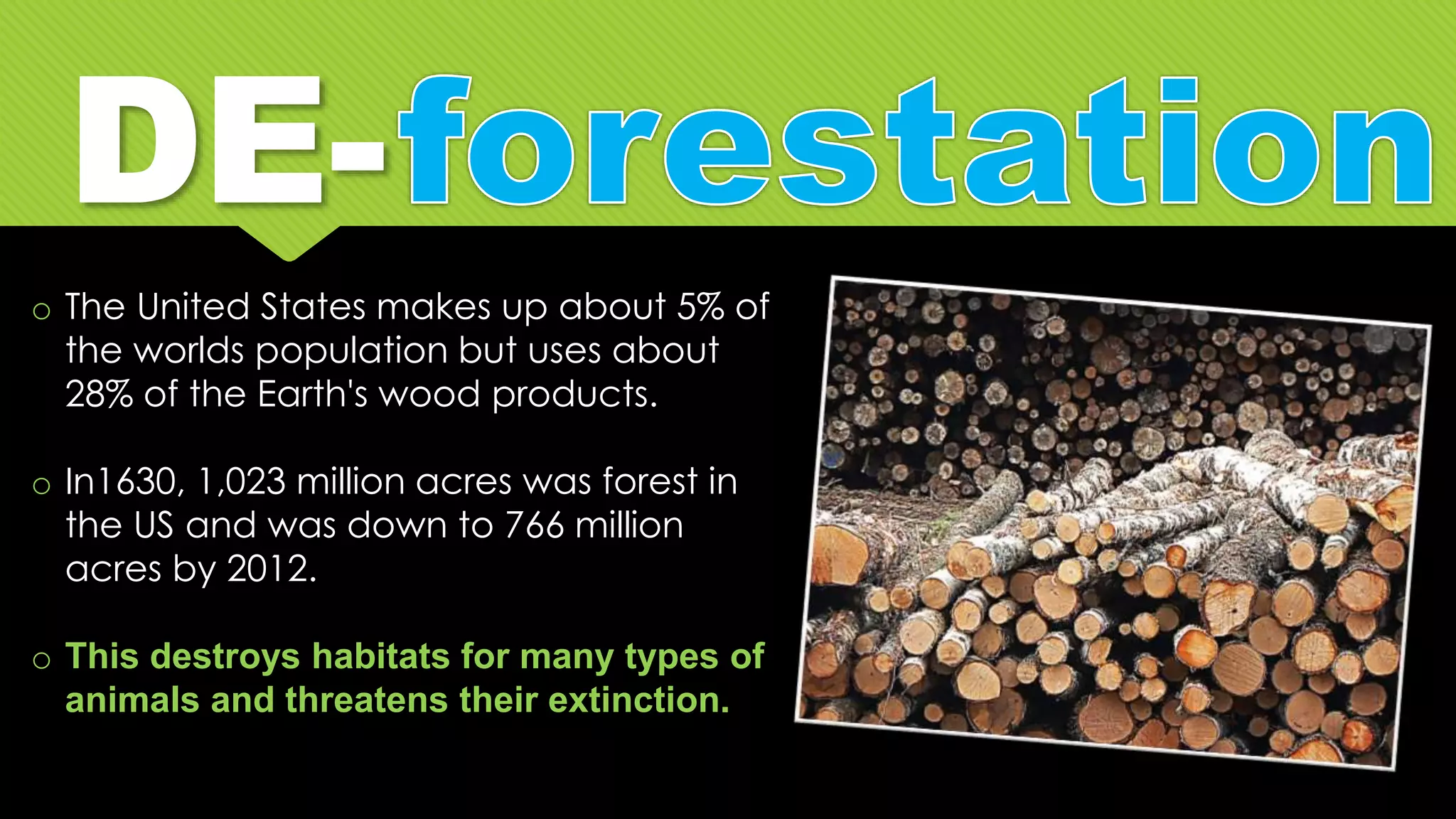
o The United States makes up about 5% of
the worlds population but uses about
28% of the Earth's wood products.
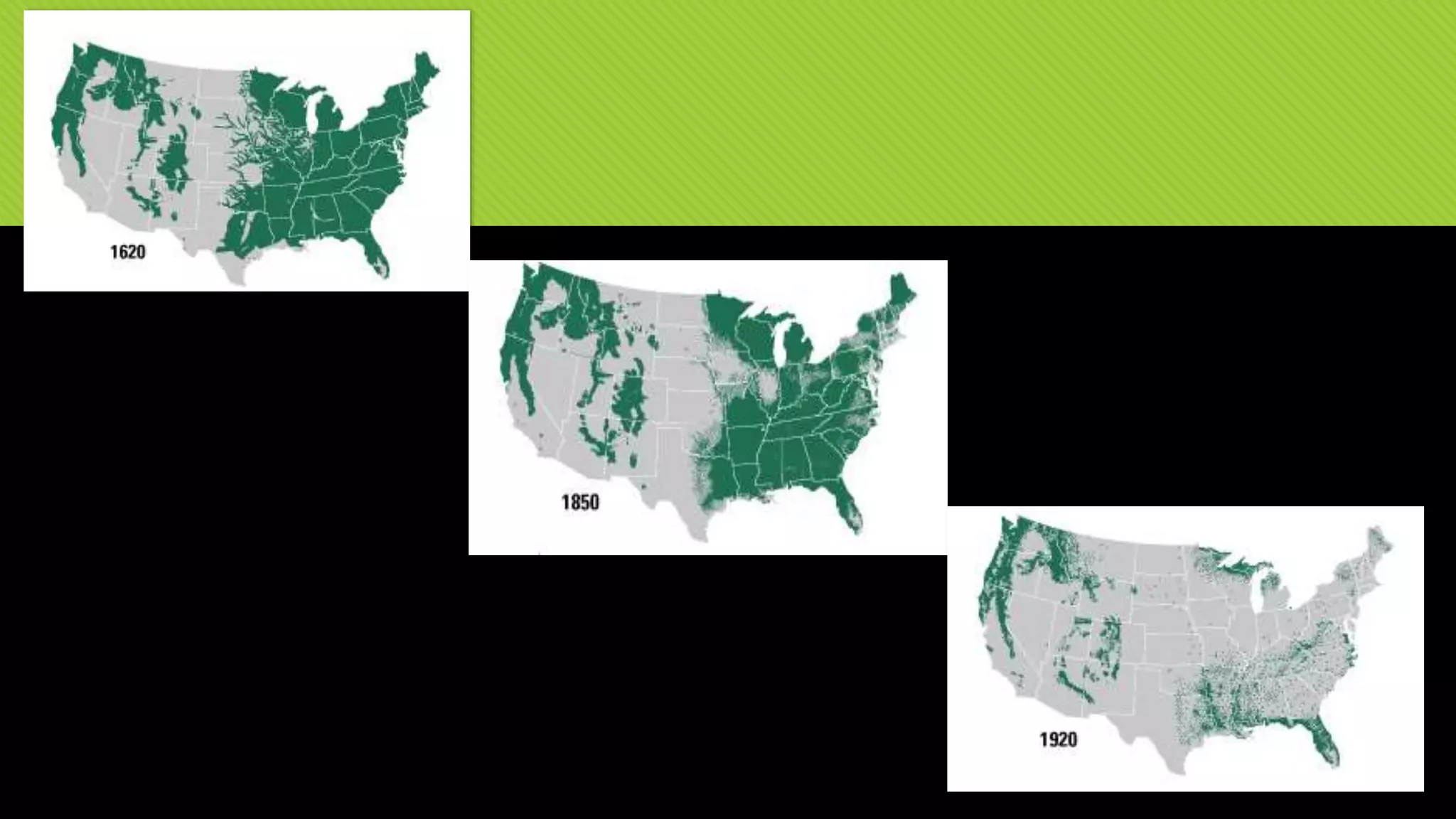
o In1630, 1,023 million acres was forest in
the US and was down to 766 million
acres by 2012.
o This destroys habitats for many types of
animals and threatens their extinction.
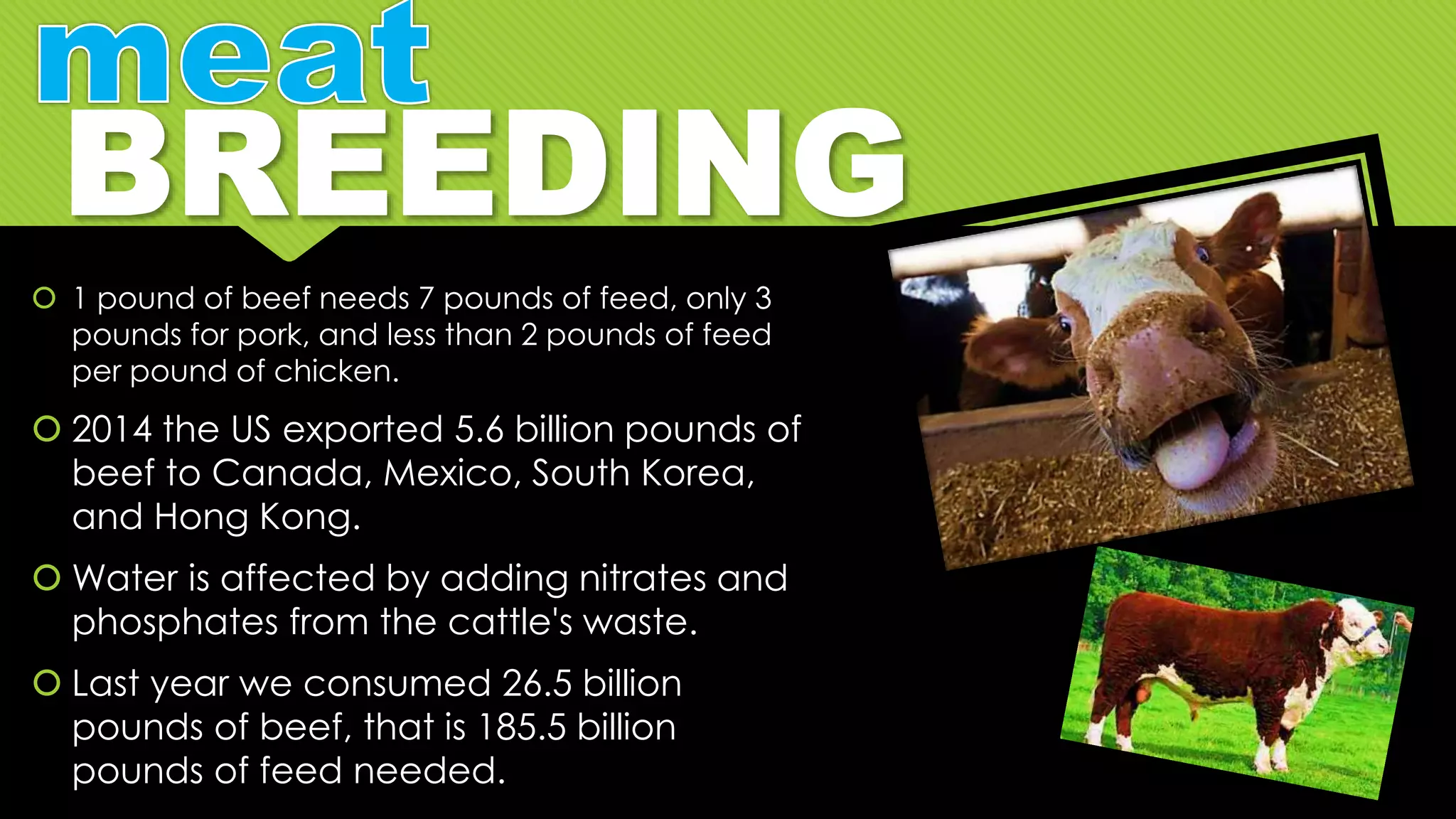
 1 pound of beef needs 7 pounds of feed, only 3
pounds for pork, and less than 2 pounds of feed
per pound of chicken.
 2014 the US exported 5.6 billion pounds of
beef to Canada, Mexico, South Korea,
and Hong Kong.
 Water is affected by adding nitrates and
phosphates from the cattle's waste.
 Last year we consumed 26.5 billion
pounds of beef, that is 185.5 billion
pounds of feed needed.
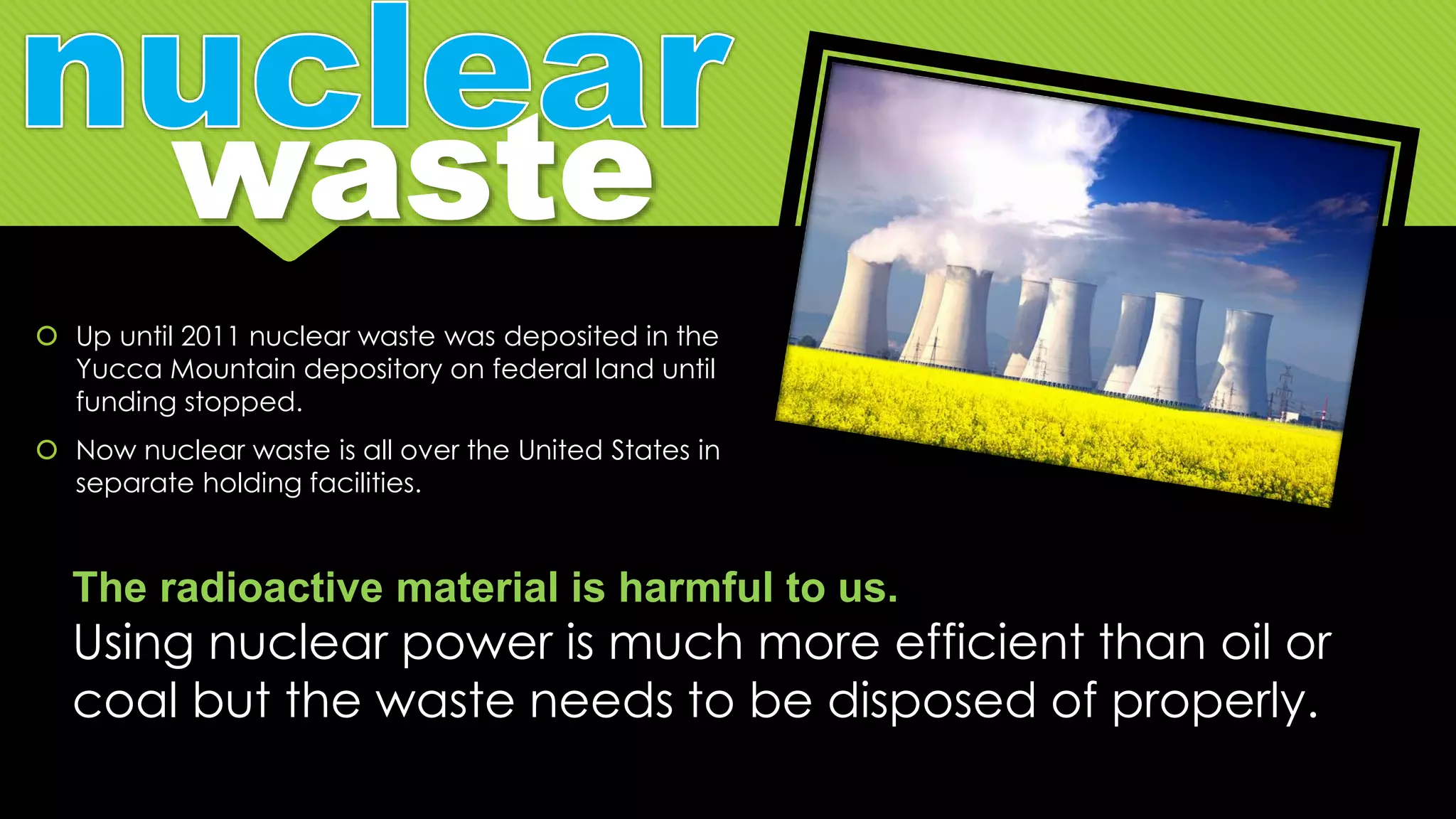
 Up until 2011 nuclear waste was deposited in the
Yucca Mountain depository on federal land until
funding stopped.
 Now nuclear waste is all over the United States in
separate holding facilities.
The radioactive material is harmful to us.
Using nuclear power is much more efficient than oil or
coal but the waste needs to be disposed of properly.
UNSUSTAINABLE
URBAN SPRAWL
o Transportation
o A commuter living an hour's drive from work
annually spends 500 hours in a vehicle.
o Deforestation
WASTE MANAGEMENT
o In 2010 Americans generated over 250 million
tons of trash, about 4.6 pounds per person, per
day.
o Almost 70% of trash in landfills is made of
recyclable material i.e. plastic, paper, metals.
One Man's Trash: Dumps and Landfills." Nat Geo TV Blogs. N.p., 27 July 2012. Web. Accessed 19 Feb. 2015.
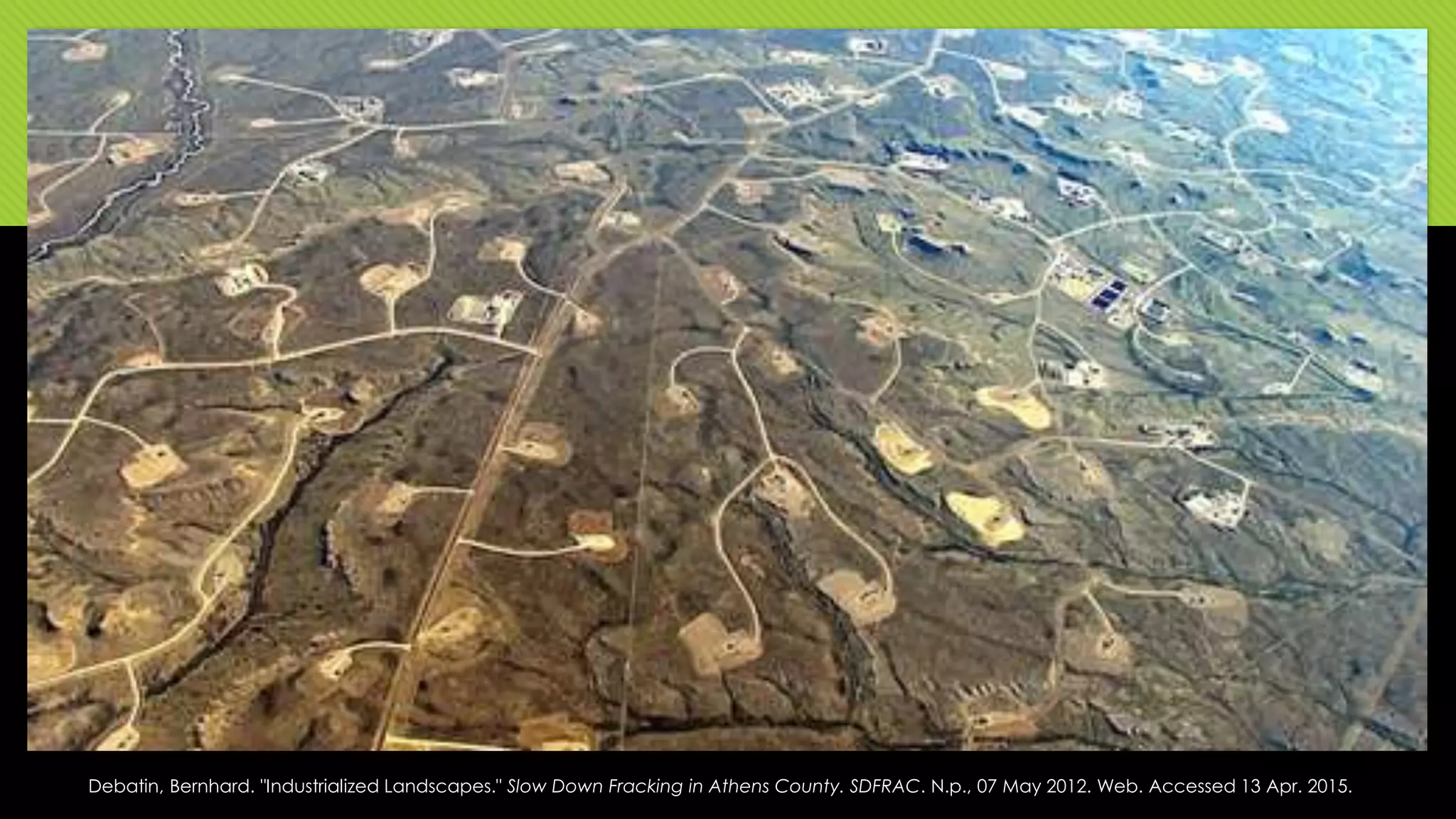
Debatin, Bernhard. "Industrialized Landscapes." Slow Down Fracking in Athens County. SDFRAC. N.p., 07 May 2012. Web. Accessed 13 Apr. 2015.
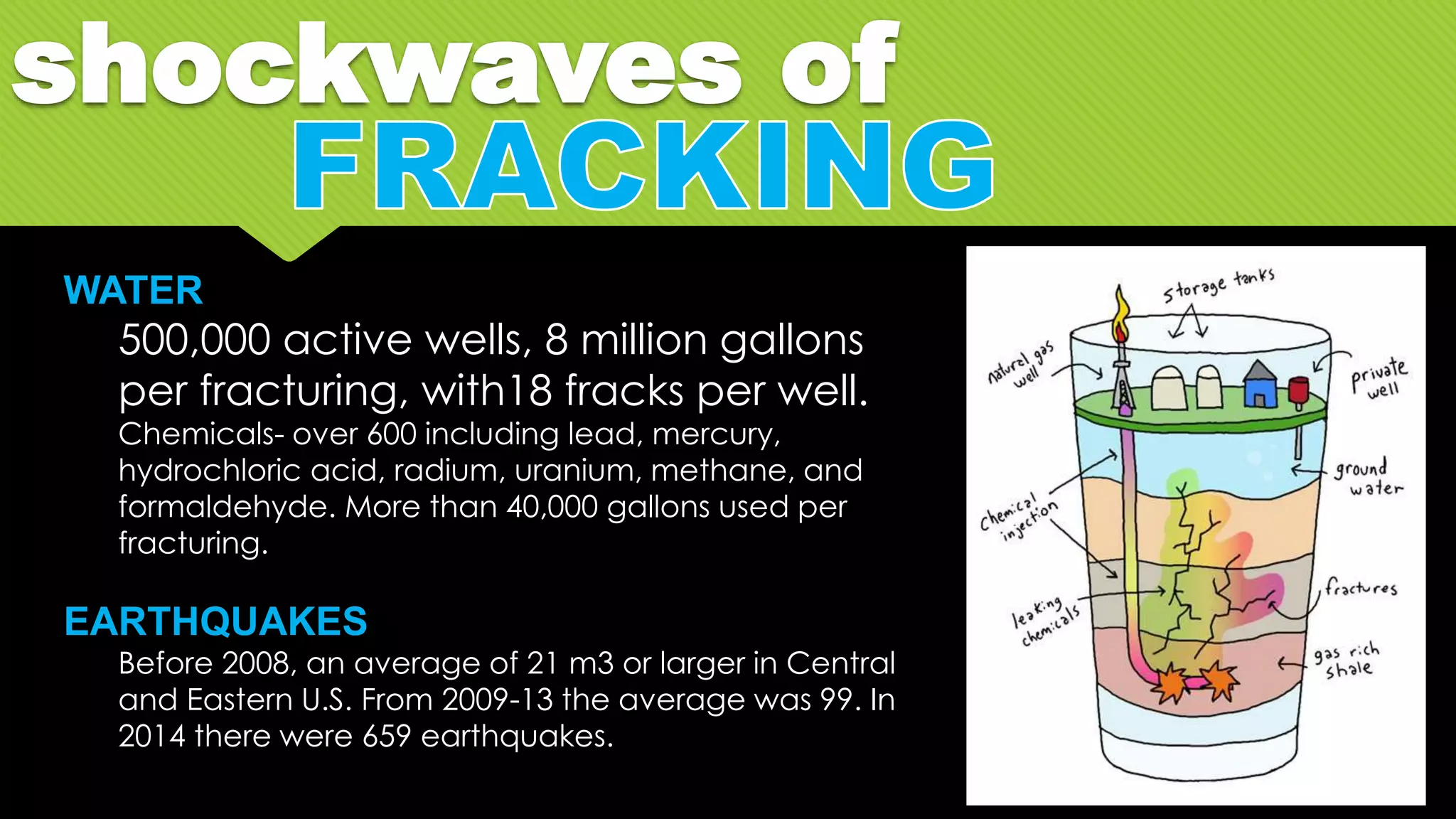
shockwaves of
WATER
500,000 active wells, 8 million gallons
per fracturing, with18 fracks per well.
Chemicals- over 600 including lead, mercury,
hydrochloric acid, radium, uranium, methane, and
formaldehyde. More than 40,000 gallons used per
fracturing.
EARTHQUAKES
Before 2008, an average of 21 m3 or larger in Central
and Eastern U.S. From 2009-13 the average was 99. In
2014 there were 659 earthquakes.
ECOLOGICAL
 How Nations Differ: US vs. INDIA
 Calculating our footprints:
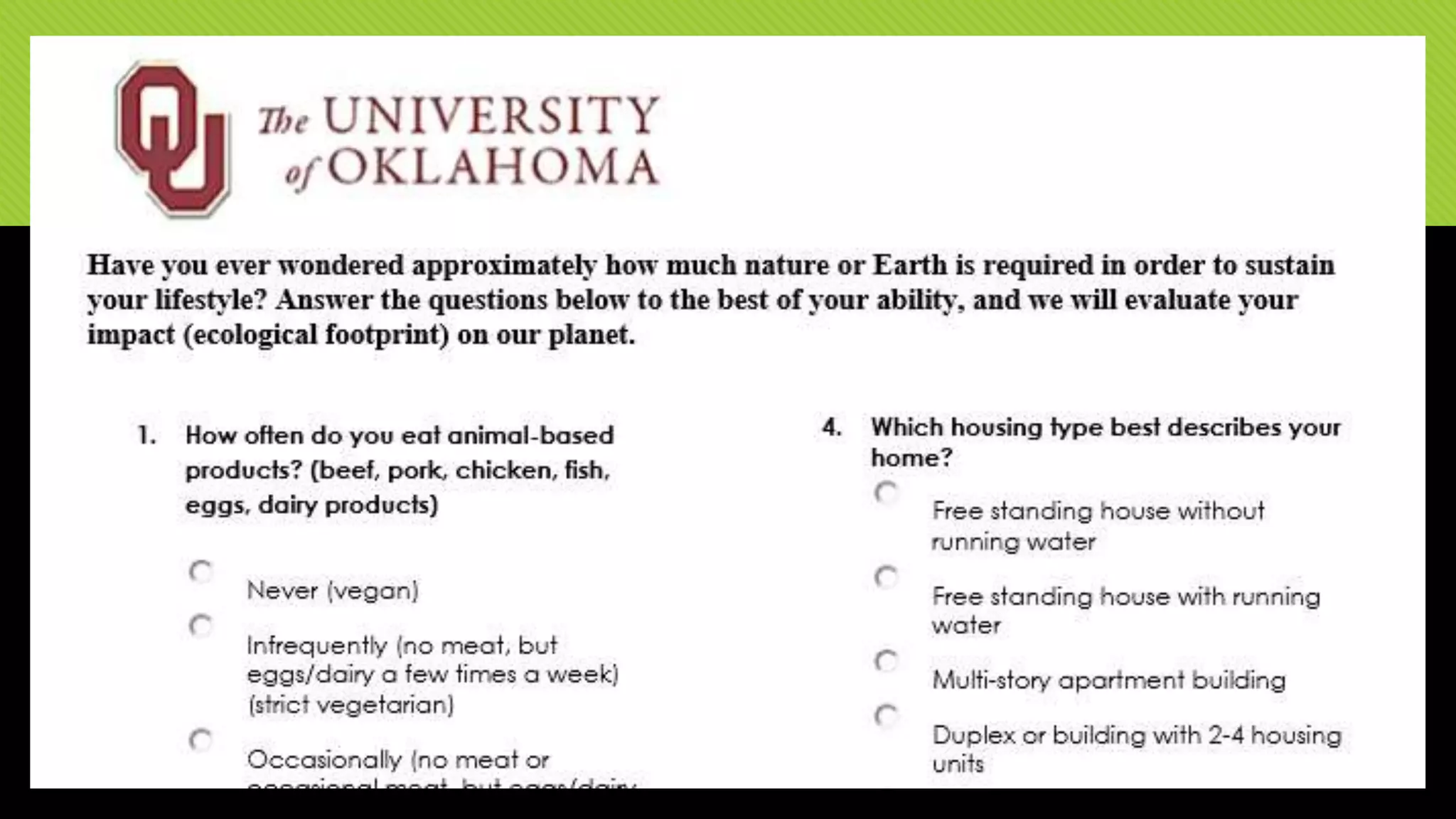
The Global Footprint Network’s Quiz
 PCN “PANTHER TRACKS”
“The measure of humanity’s demands on
nature – everything has consequences
that the planet must endure.”
ECOLOGICAL
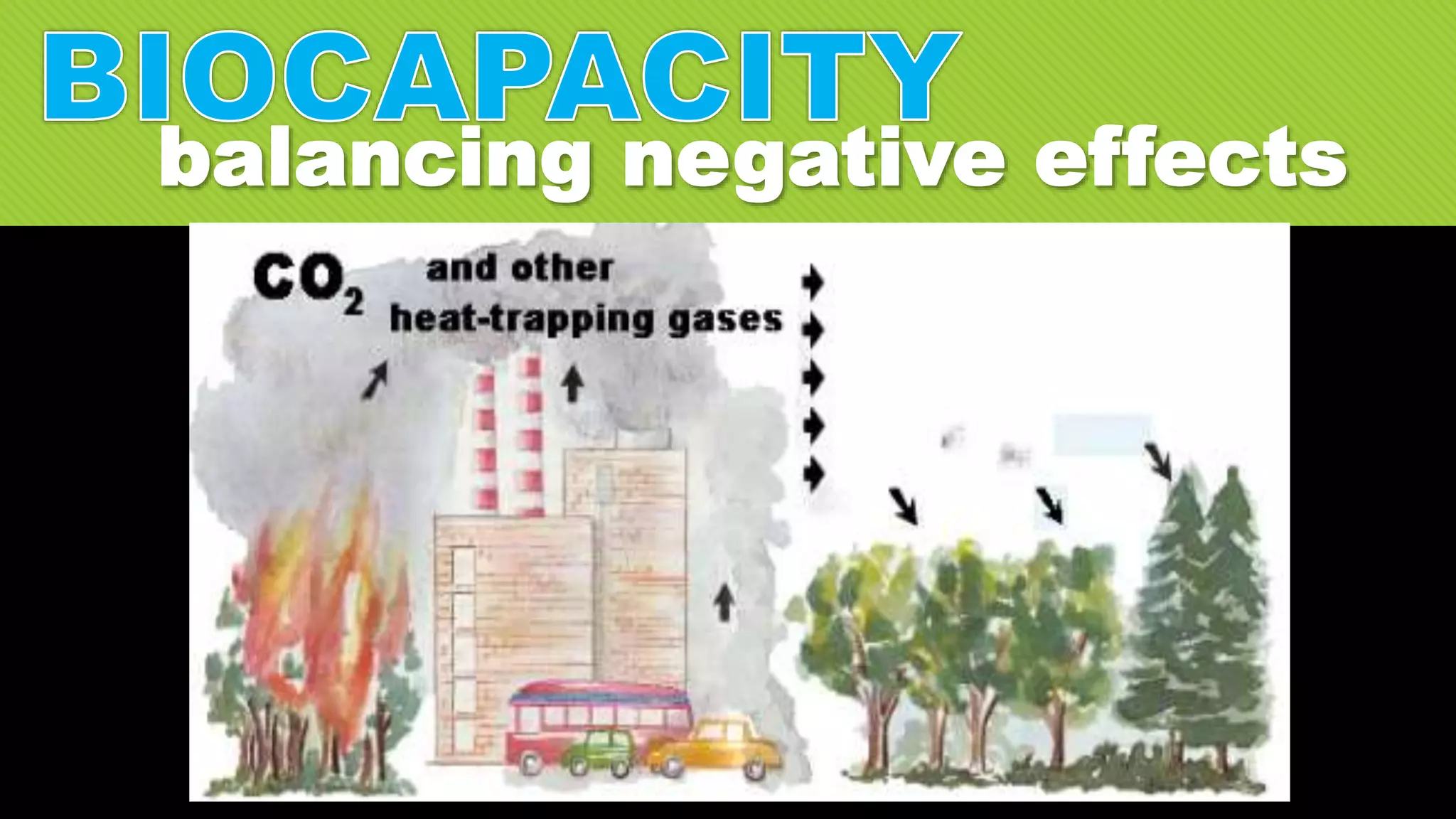
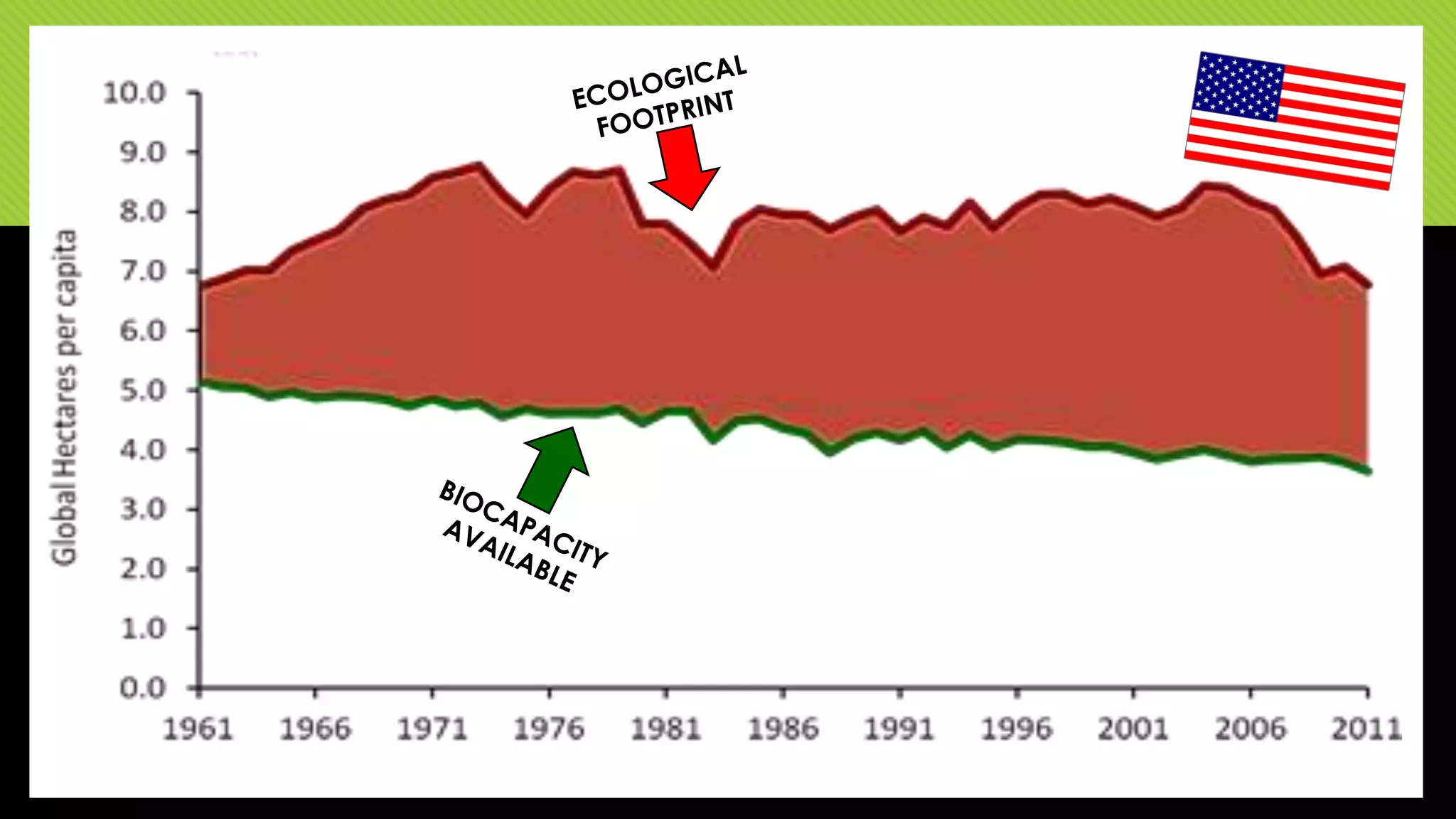
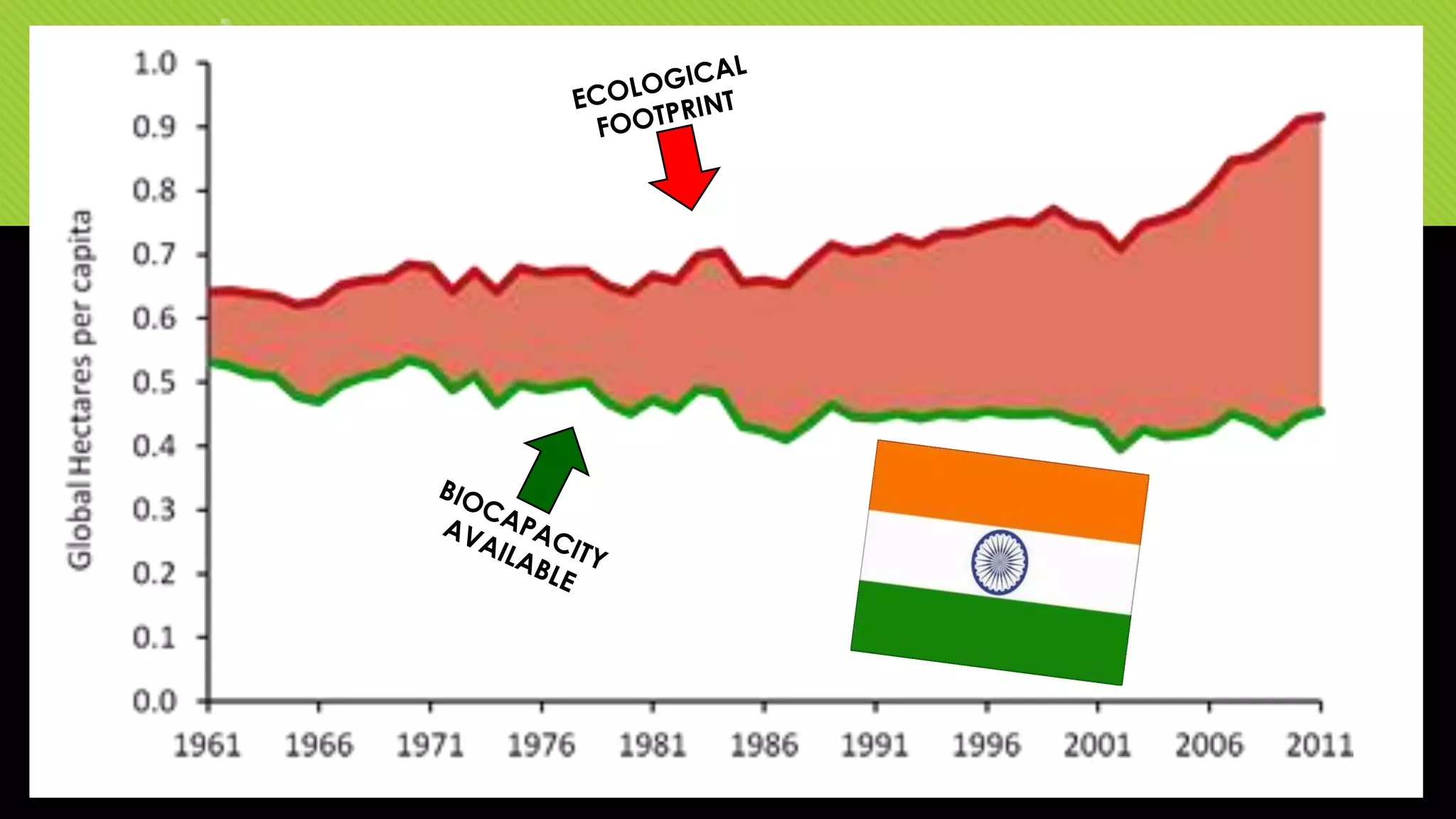
Ecological Footprint: The measure
of humanity’s demands on nature
(biocapacity).
Biocapacity: The planet’s
biologically productive land areas.
F
F
F
F
F
F
F
F
F
F
F
F
F
F
F
F
F
F
F
Vdv
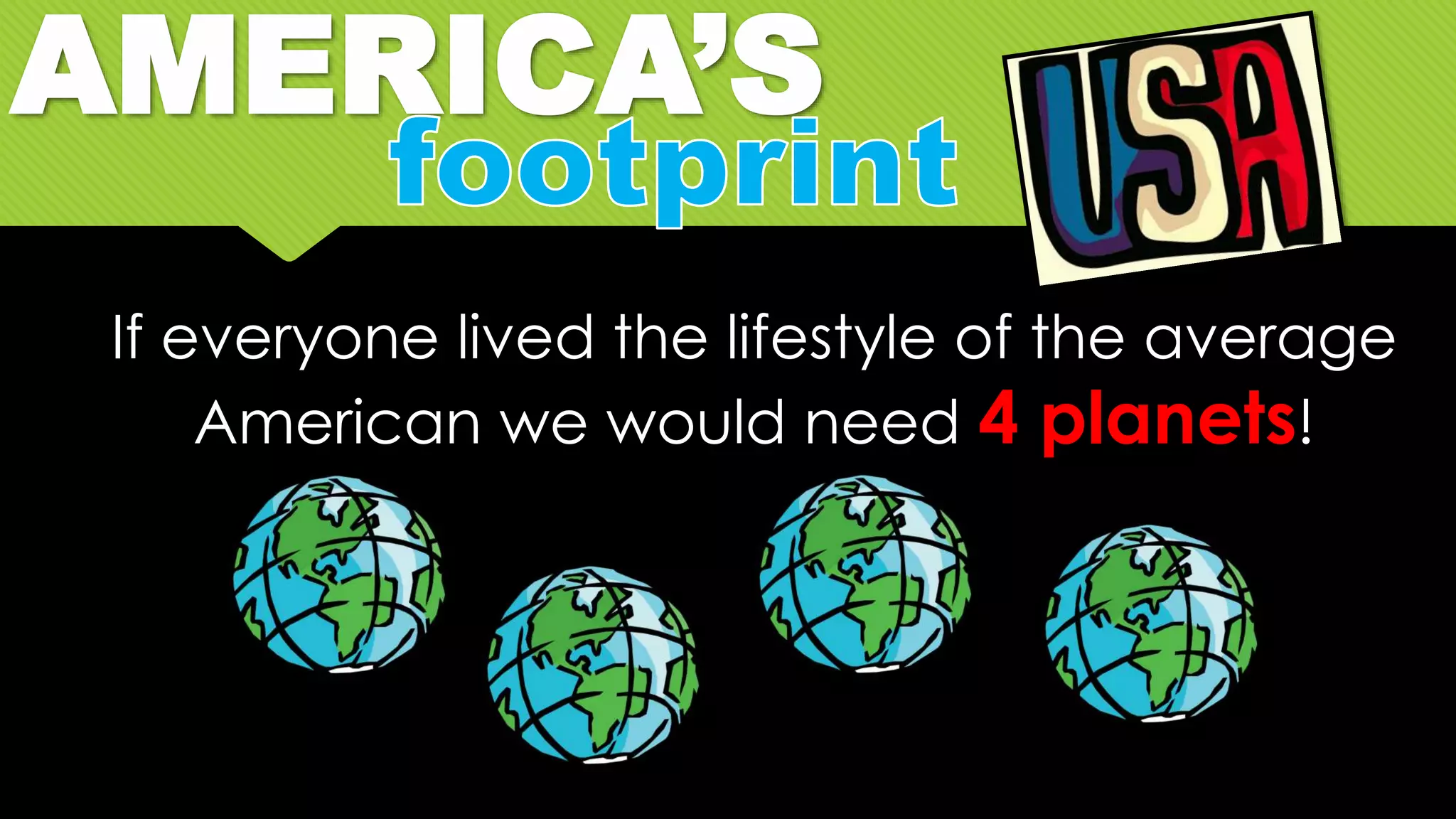
If everyone lived the lifestyle of the average
American we would need 4 planets!
AMERICA’S
F
F
F
F
F
F
F
F
F
F
F
F
F
F
F
F
F
F
F
Vdv
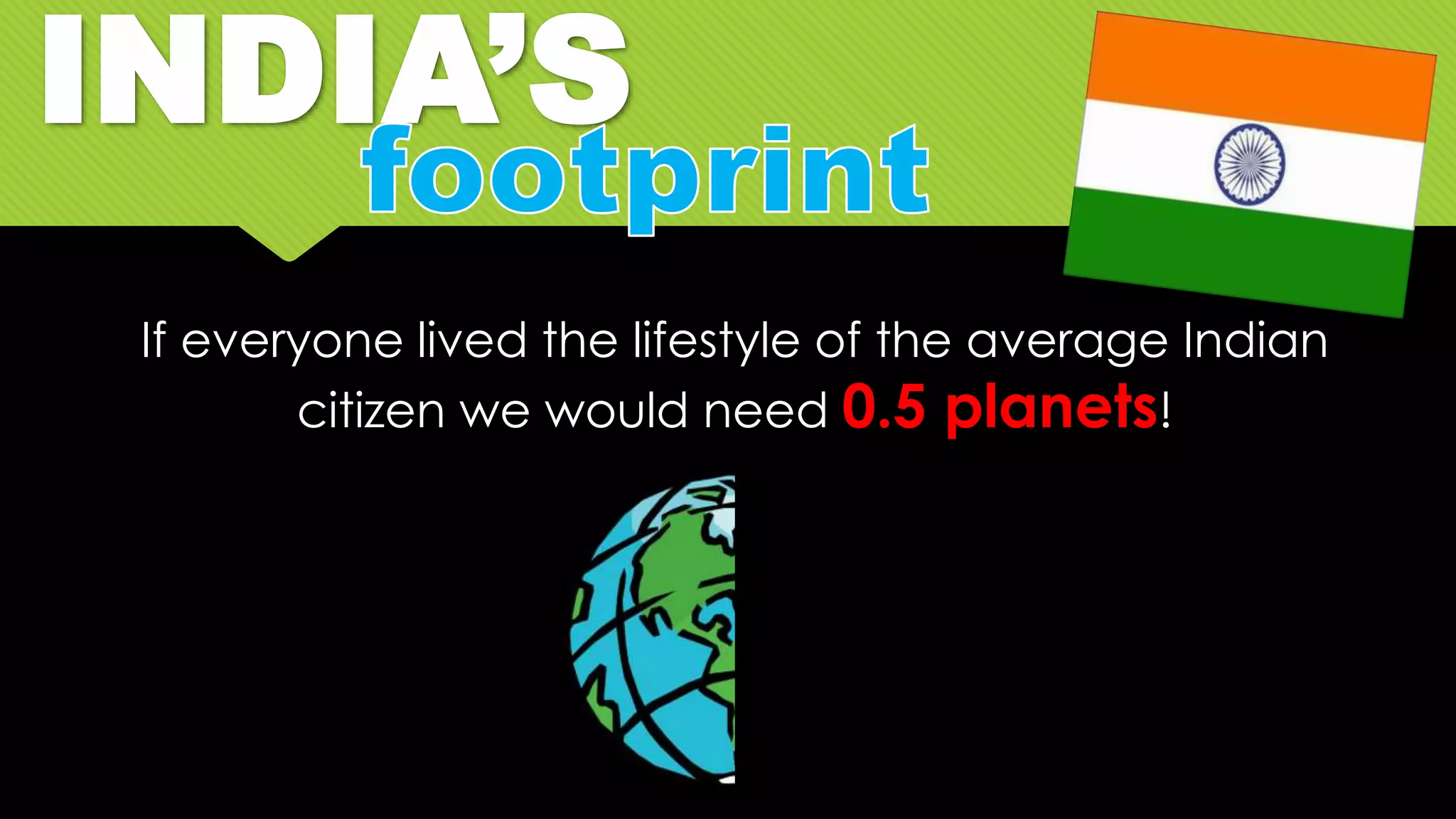
INDIA’S
If everyone lived the lifestyle of the average Indian
citizen we would need 0.5 planets!
FOR YOU
WORLD
(If everyone lived this lifestyle)
NATION AVERAGES
USA INDIA
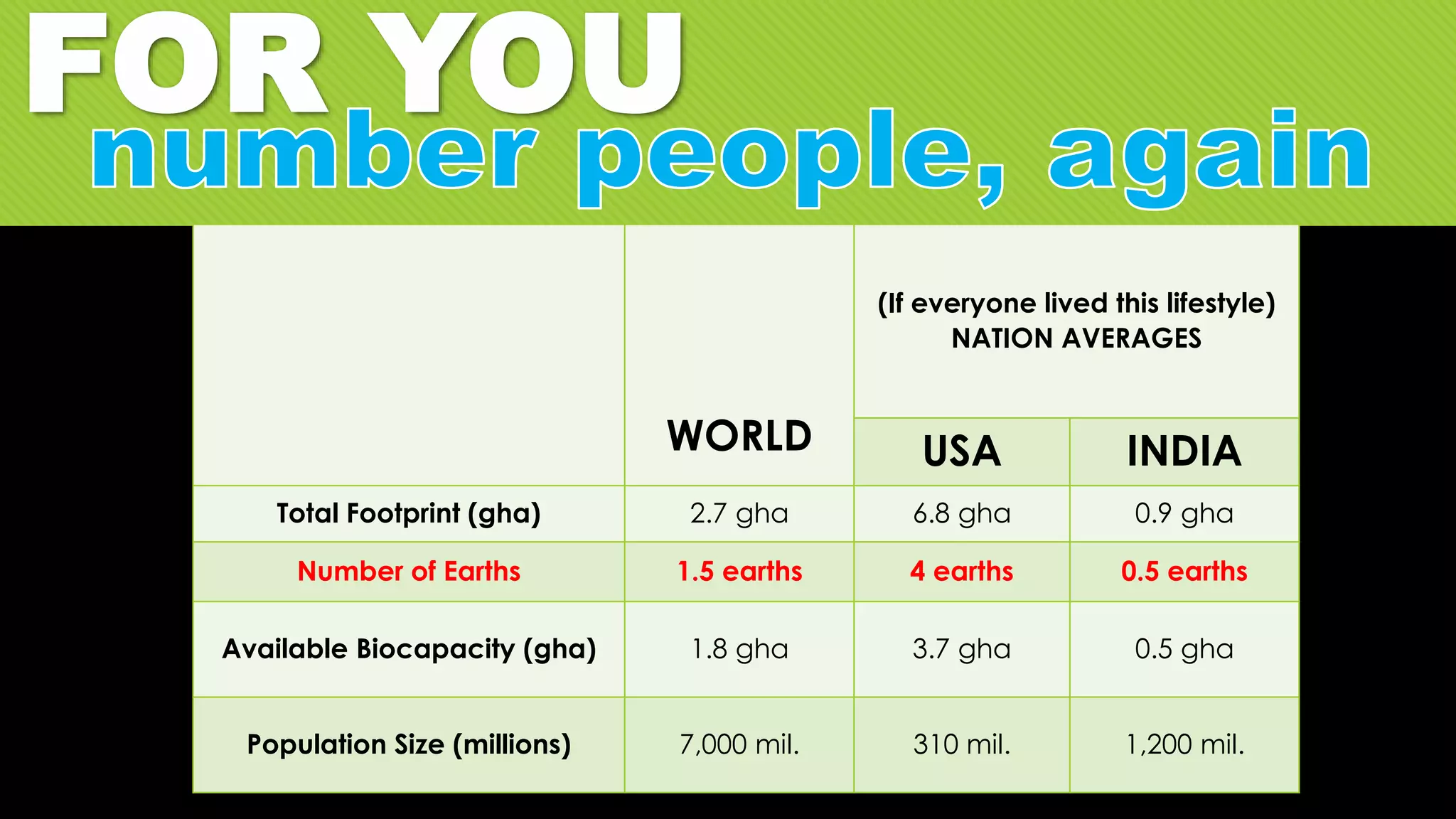
Total Footprint (gha) 2.7 gha 6.8 gha 0.9 gha
Number of Earths 1.5 earths 4 earths 0.5 earths
Available Biocapacity (gha) 1.8 gha 3.7 gha 0.5 gha
Population Size (millions) 7,000 mil. 310 mil. 1,200 mil.
AMERICA’S
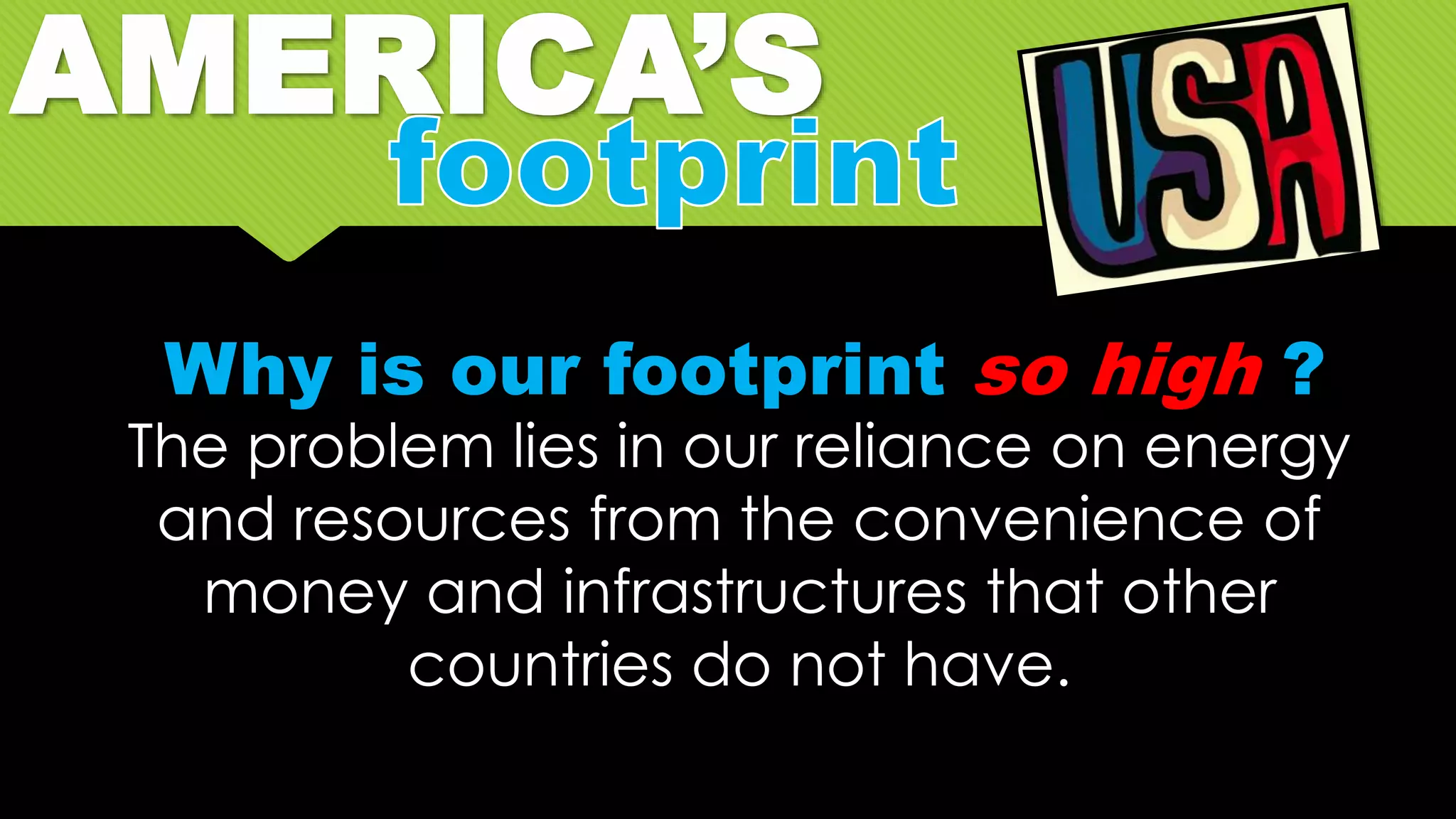
Why is our footprint so high ?
The problem lies in our reliance on energy
and resources from the convenience of
money and infrastructures that other
countries do not have.
INDIA’S
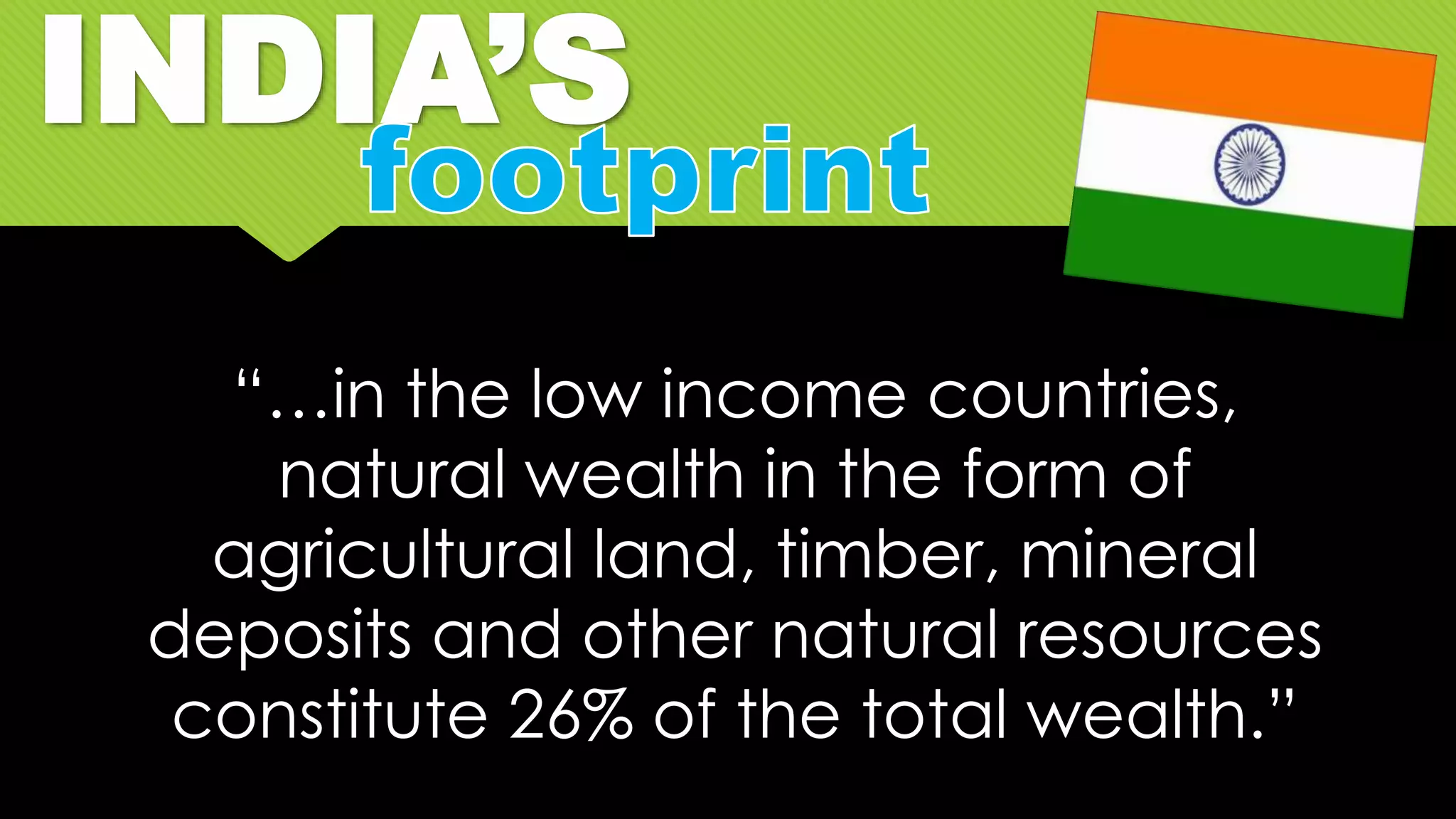
“…in the low income countries,
natural wealth in the form of
agricultural land, timber, mineral
deposits and other natural resources
constitute 26% of the total wealth.”
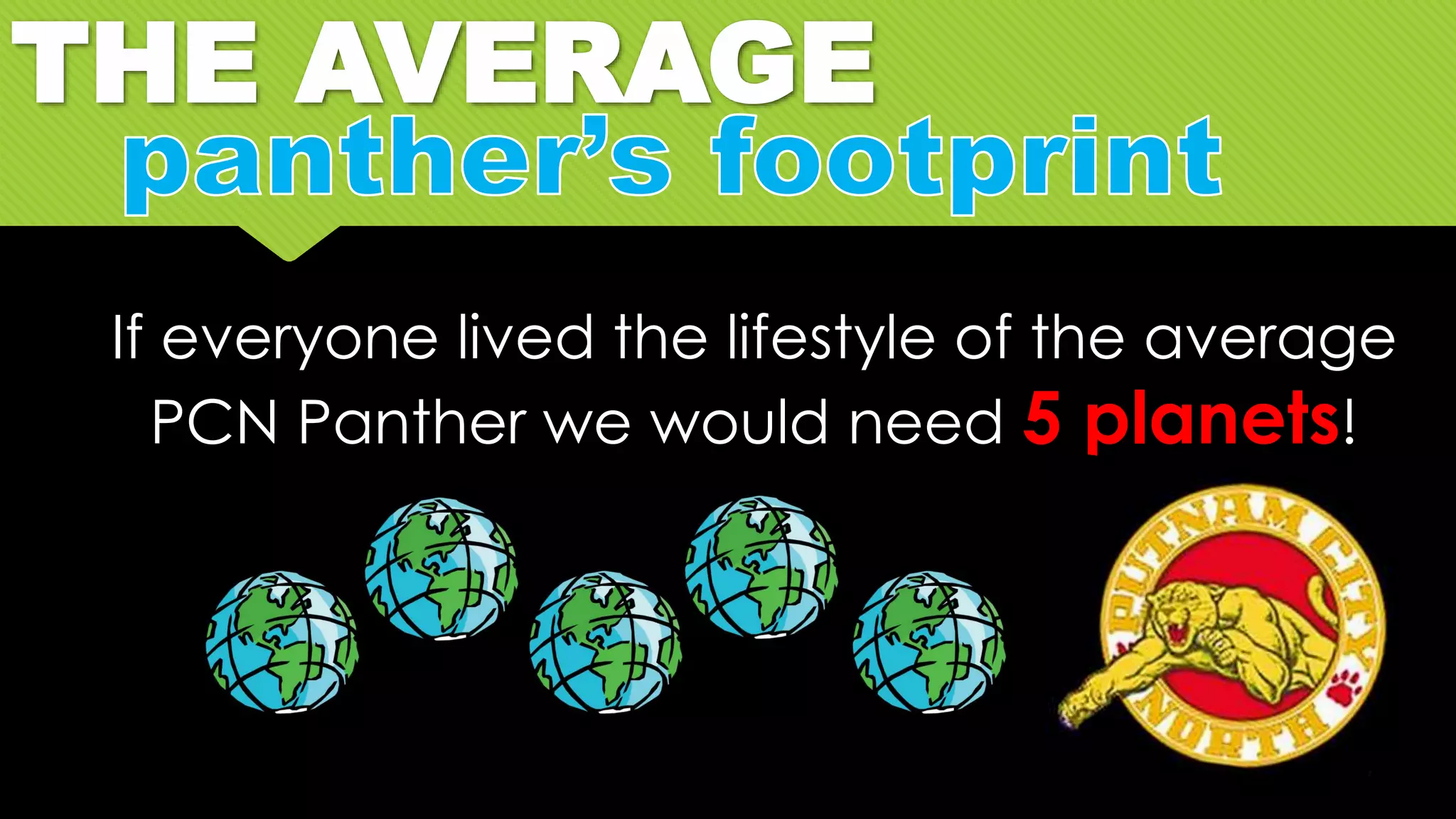
THE AVERAGE
If everyone lived the lifestyle of the average
PCN Panther we would need 5 planets!
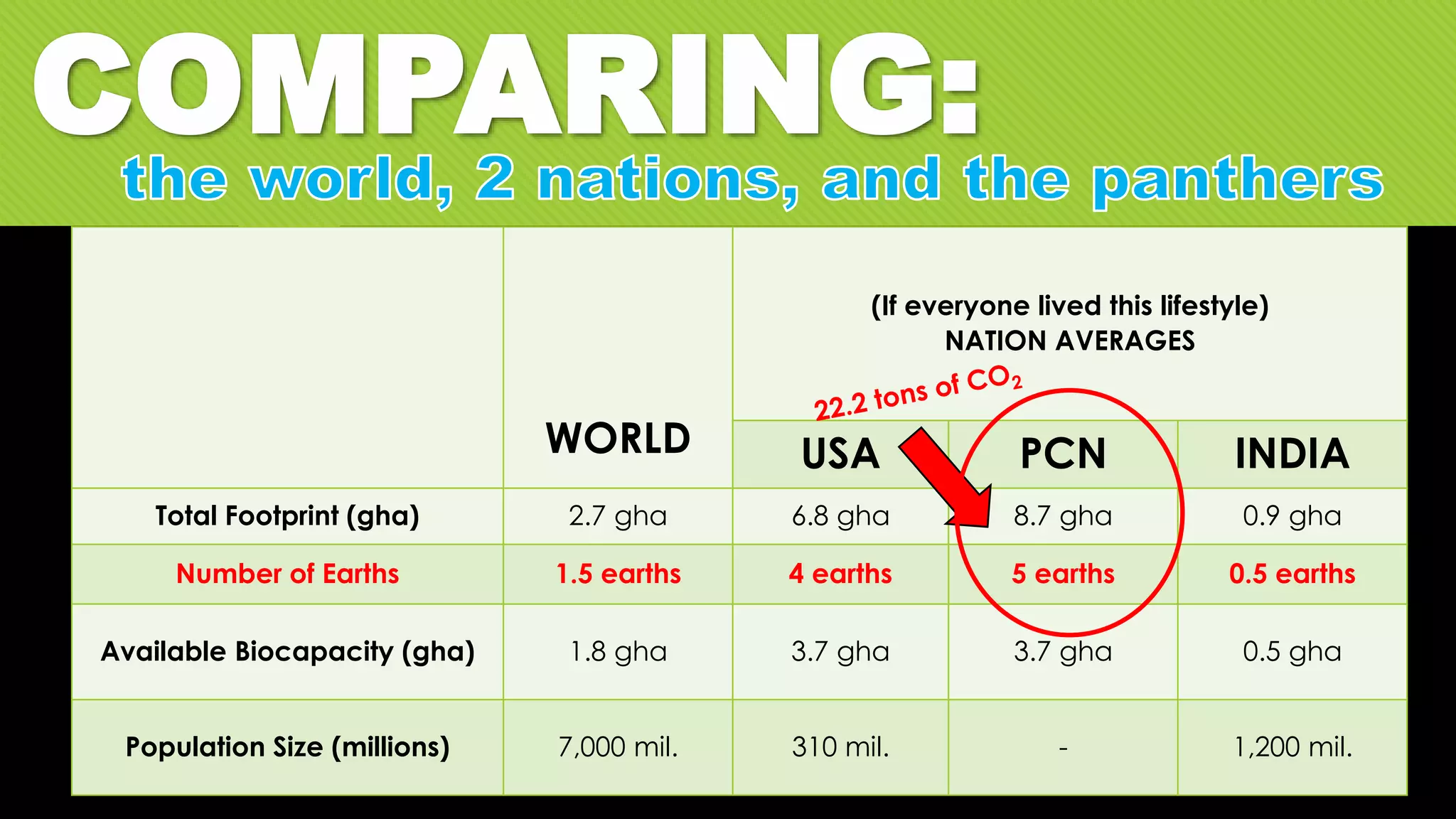
COMPARING:
WORLD
(If everyone lived this lifestyle)
NATION AVERAGES
USA PCN INDIA
Total Footprint (gha) 2.7 gha 6.8 gha 8.7 gha 0.9 gha
Number of Earths 1.5 earths 4 earths 5 earths 0.5 earths
Available Biocapacity (gha) 1.8 gha 3.7 gha 3.7 gha 0.5 gha
Population Size (millions) 7,000 mil. 310 mil. - 1,200 mil.
answering
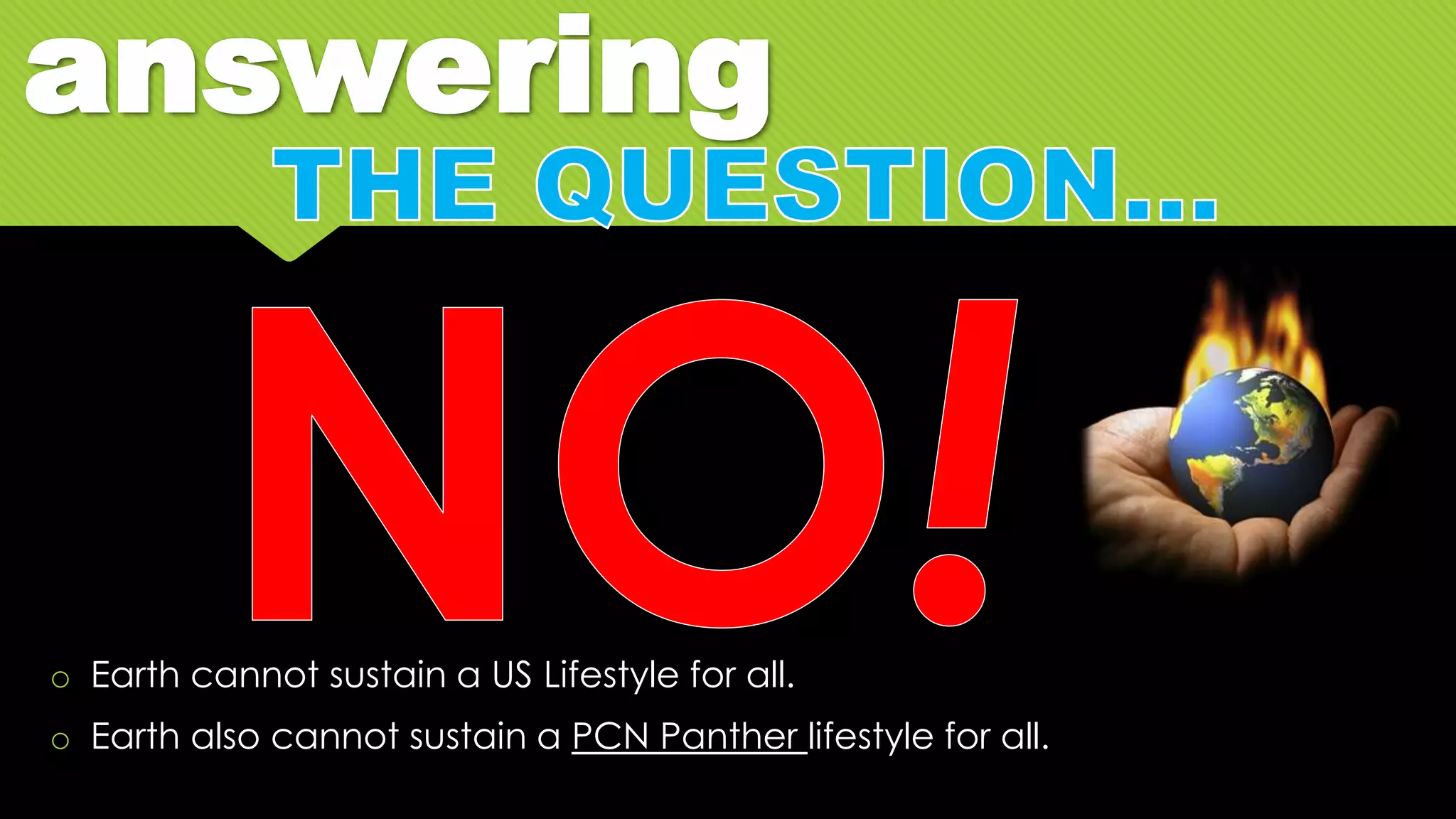
o Earth cannot sustain a US Lifestyle for all.
o Earth also cannot sustain a PCN Panther lifestyle for all.
intellectual
“… Non-sustainable production
and consumption levels are
primarily a result of our desire to do
more, experience more, see more,
and to put it briefly, consume
more,” (Holden 2004).
CAN WE HELP
 AWARENESS
 Campus and community action
 “Young people make up 40-50% of
our global population.”
 SOLUTIONS
 Eco-system clean-up projects
 Lifestyle choices
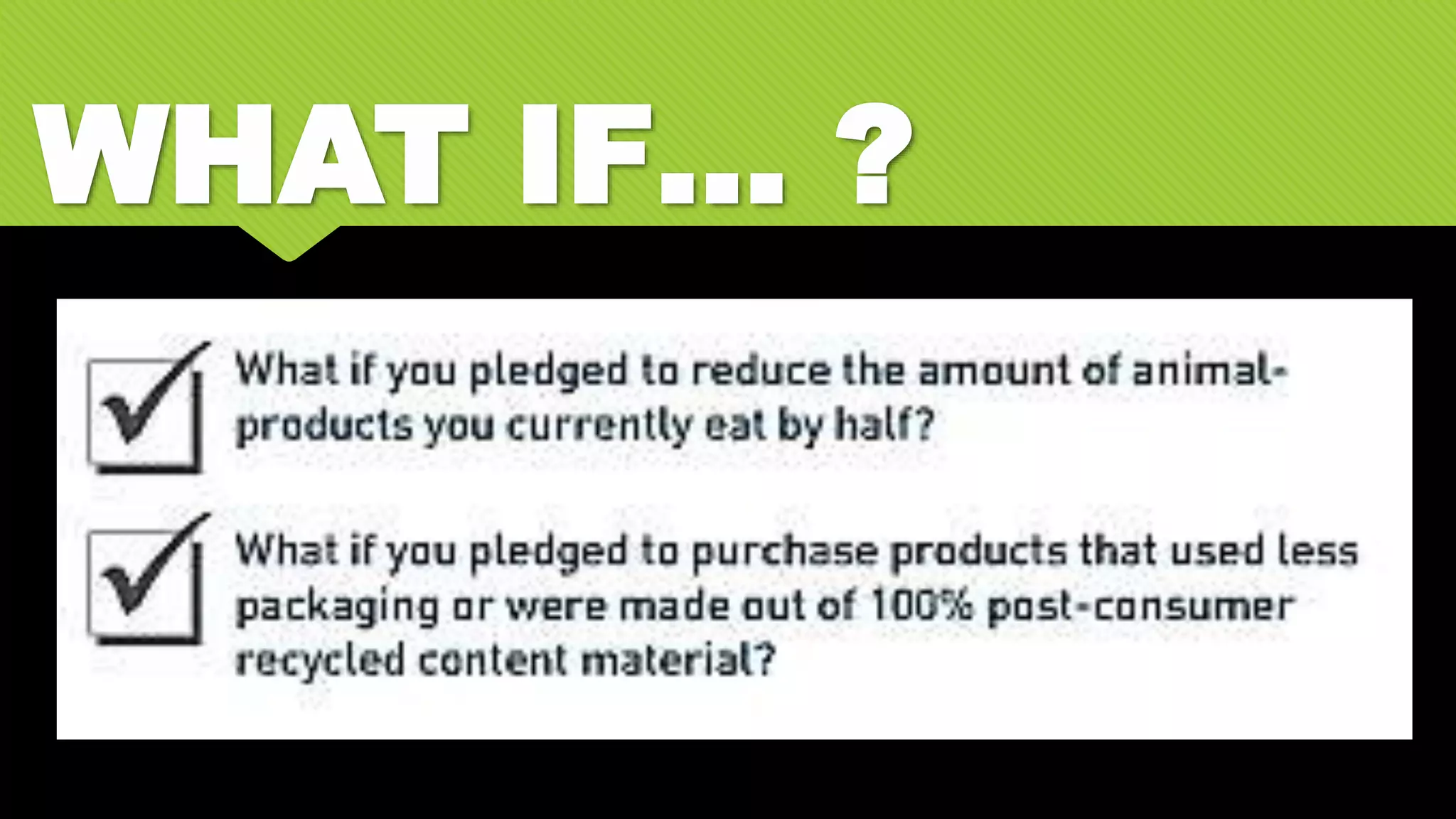
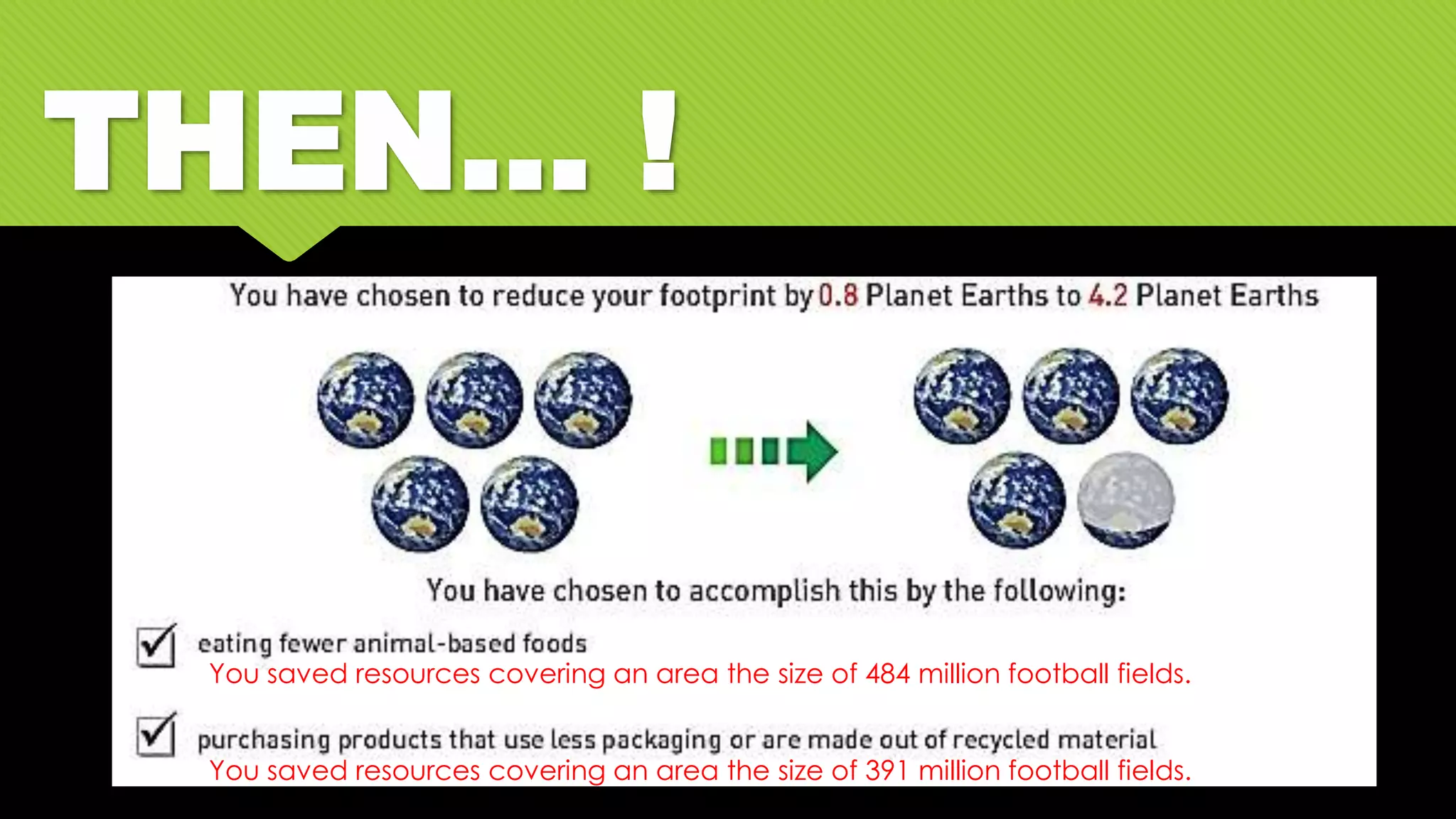
WHAT IF… ?
THEN… !
You saved resources covering an area the size of 484 million football fields.
You saved resources covering an area the size of 391 million football fields.
Thanks for Listening!
Bryce Armstrong
Kevin Brandon
Leah Parker
Spencer Rice

Final Presentation - CAPSTONE

  • 1.
    IS EARTH capableof sustaining The University of Oklahoma Department of Biology
  • 2.
    QUESTION Can Earth sustainenough resources to keep up with the demands of humanity? More specifically: The demands of a U.S. Lifestyle
  • 3.
     Influences ofConsumption  Unsustainable Development  Misuse of Land  Conclusion: Ecological Footprint The Earth is not capable of sustaining a U.S. lifestyle for all due to a variety of factors, but those of main concern are the following: RESEARCH
  • 5.
    method&venue  Presentation  Polls& Significance  Putnam City North HS: AP Environmental Science  Taylor Upchurch  Amanda Pierce
  • 7.
    METHOD&VENUE  Goods &Services  Food  Mobility  Shelter  Waste A 14-question quiz covering:
  • 9.
    POTENTIAL  Poll questionsanswered untruthfully  Data might be as recent as we might want in order to make a convincing argument  Sources containing skewed data that favors major companies
  • 10.
    Fossil Fuel Reliance U.S.Lifestyle choices Housing Meat and poultry  Paper waste  Individual Choices: Global influence
  • 11.
     U.S. uses25% of total, global fossil fuel resources. Including coal, oil and natural gas.  US is only 5% of the global population.  Since 1975, the average US household size has increased 38%. With increased size comes increased reliance on energy.
  • 12.
     In the60s, Americans consumed an average of 145 lbs. of meat and poultry per year. By 1999 this number reached 190 lbs. per person. A 31% increase!  In general, Americans consume around 815 billion calories of food each day. That’s 200 billion more than needed, or enough to feed an additional 80 million.  US throws away 200 tons of edible food daily.
  • 13.
     The USconsumes nearly a third of all global paper resources. (5% of global population)  North Americans consume an average of more than 500 lbs of paper annually.  Paper production requires high amount of energy. 12% of energy cost in industrial sector for paper alone.  Production creates large amount of greenhouse gases.  Drives forest destruction.
  • 15.
    o ELECTRIC TOOTHBRUSH:batteries from Japan, plastics from central Europe, circuit board from China. o Individual choices can have global impacts.
  • 16.
     Municipal SolidWaste  Forest Removal  Meat Breeding  Nuclear Waste
  • 17.
     Our amountof MSW has been rising as the EPA said from 88.1 million tons in 1960 to 250.4 million tons by 2011  By increasing our amount of recycling, 7.5 million tons of metal was reused eliminating 20 million metric tons of CO2 in the air a year. That is equivalent to removing the emissions of 4 million cars each year!  HDPE bottles and Soda bottles are the types of materials that are least recycled.  These bottles are found in your vending machine!
  • 18.
    o The UnitedStates makes up about 5% of the worlds population but uses about 28% of the Earth's wood products. o In1630, 1,023 million acres was forest in the US and was down to 766 million acres by 2012. o This destroys habitats for many types of animals and threatens their extinction.
  • 21.
     1 poundof beef needs 7 pounds of feed, only 3 pounds for pork, and less than 2 pounds of feed per pound of chicken.  2014 the US exported 5.6 billion pounds of beef to Canada, Mexico, South Korea, and Hong Kong.  Water is affected by adding nitrates and phosphates from the cattle's waste.  Last year we consumed 26.5 billion pounds of beef, that is 185.5 billion pounds of feed needed.
  • 22.
     Up until2011 nuclear waste was deposited in the Yucca Mountain depository on federal land until funding stopped.  Now nuclear waste is all over the United States in separate holding facilities. The radioactive material is harmful to us. Using nuclear power is much more efficient than oil or coal but the waste needs to be disposed of properly.
  • 23.
    UNSUSTAINABLE URBAN SPRAWL o Transportation oA commuter living an hour's drive from work annually spends 500 hours in a vehicle. o Deforestation WASTE MANAGEMENT o In 2010 Americans generated over 250 million tons of trash, about 4.6 pounds per person, per day. o Almost 70% of trash in landfills is made of recyclable material i.e. plastic, paper, metals.
  • 24.
    One Man's Trash:Dumps and Landfills." Nat Geo TV Blogs. N.p., 27 July 2012. Web. Accessed 19 Feb. 2015.
  • 25.
    Debatin, Bernhard. "IndustrializedLandscapes." Slow Down Fracking in Athens County. SDFRAC. N.p., 07 May 2012. Web. Accessed 13 Apr. 2015.
  • 26.
    shockwaves of WATER 500,000 activewells, 8 million gallons per fracturing, with18 fracks per well. Chemicals- over 600 including lead, mercury, hydrochloric acid, radium, uranium, methane, and formaldehyde. More than 40,000 gallons used per fracturing. EARTHQUAKES Before 2008, an average of 21 m3 or larger in Central and Eastern U.S. From 2009-13 the average was 99. In 2014 there were 659 earthquakes.
  • 27.
    ECOLOGICAL  How NationsDiffer: US vs. INDIA  Calculating our footprints: The Global Footprint Network’s Quiz  PCN “PANTHER TRACKS” “The measure of humanity’s demands on nature – everything has consequences that the planet must endure.”
  • 28.
    ECOLOGICAL Ecological Footprint: Themeasure of humanity’s demands on nature (biocapacity). Biocapacity: The planet’s biologically productive land areas.
  • 29.
  • 30.
    If everyone livedthe lifestyle of the average American we would need 4 planets! AMERICA’S
  • 31.
  • 32.
    INDIA’S If everyone livedthe lifestyle of the average Indian citizen we would need 0.5 planets!
  • 34.
    FOR YOU WORLD (If everyonelived this lifestyle) NATION AVERAGES USA INDIA Total Footprint (gha) 2.7 gha 6.8 gha 0.9 gha Number of Earths 1.5 earths 4 earths 0.5 earths Available Biocapacity (gha) 1.8 gha 3.7 gha 0.5 gha Population Size (millions) 7,000 mil. 310 mil. 1,200 mil.
  • 35.
    AMERICA’S Why is ourfootprint so high ? The problem lies in our reliance on energy and resources from the convenience of money and infrastructures that other countries do not have.
  • 36.
    INDIA’S “…in the lowincome countries, natural wealth in the form of agricultural land, timber, mineral deposits and other natural resources constitute 26% of the total wealth.”
  • 40.
    THE AVERAGE If everyonelived the lifestyle of the average PCN Panther we would need 5 planets!
  • 41.
    COMPARING: WORLD (If everyone livedthis lifestyle) NATION AVERAGES USA PCN INDIA Total Footprint (gha) 2.7 gha 6.8 gha 8.7 gha 0.9 gha Number of Earths 1.5 earths 4 earths 5 earths 0.5 earths Available Biocapacity (gha) 1.8 gha 3.7 gha 3.7 gha 0.5 gha Population Size (millions) 7,000 mil. 310 mil. - 1,200 mil.
  • 44.
    answering o Earth cannotsustain a US Lifestyle for all. o Earth also cannot sustain a PCN Panther lifestyle for all.
  • 45.
    intellectual “… Non-sustainable production andconsumption levels are primarily a result of our desire to do more, experience more, see more, and to put it briefly, consume more,” (Holden 2004).
  • 46.
    CAN WE HELP AWARENESS  Campus and community action  “Young people make up 40-50% of our global population.”  SOLUTIONS  Eco-system clean-up projects  Lifestyle choices
  • 47.
  • 48.
    THEN… ! You savedresources covering an area the size of 484 million football fields. You saved resources covering an area the size of 391 million football fields.
  • 50.
    Thanks for Listening! BryceArmstrong Kevin Brandon Leah Parker Spencer Rice

Editor's Notes

  • #11 -Since 1975, the average US house size has increased by 38% (2002 Estimate) -In the 60s, Americans consumed an average of 145 lbs of meat and poultry per person. By 1999 this average reached 190lbs per person. Ties in with misuse of land -U.S. uses 25% of total, global fossil fuel resources. Including coal, oil, and natural gas. -A third of the global paper resources are used by the U.S. -(Hoppe) Electric toothbrush: batteries from Japan, plastics from central Europe, circuit board from China.
  • #12 -Since 1975, the average US house size has increased by 38% (2002 Estimate) -In the 60s, Americans consumed an average of 145 lbs of meat and poultry per person. By 1999 this average reached 190lbs per person. Ties in with misuse of land -U.S. uses 25% of total, global fossil fuel resources. Including coal, oil, and natural gas. -A third of the global paper resources are used by the U.S. -(Hoppe) Electric toothbrush: batteries from Japan, plastics from central Europe, circuit board from China.
  • #13 -Since 1975, the average US house size has increased by 38% (2002 Estimate) -In the 60s, Americans consumed an average of 145 lbs of meat and poultry per person. By 1999 this average reached 190lbs per person. Ties in with misuse of land -U.S. uses 25% of total, global fossil fuel resources. Including coal, oil, and natural gas. -A third of the global paper resources are used by the U.S. -(Hoppe) Electric toothbrush: batteries from Japan, plastics from central Europe, circuit board from China.
  • #14 -Since 1975, the average US house size has increased by 38% (2002 Estimate) -In the 60s, Americans consumed an average of 145 lbs of meat and poultry per person. By 1999 this average reached 190lbs per person. Ties in with misuse of land -U.S. uses 25% of total, global fossil fuel resources. Including coal, oil, and natural gas. -A third of the global paper resources are used by the U.S. -(Hoppe) Electric toothbrush: batteries from Japan, plastics from central Europe, circuit board from China.
  • #15 -Since 1975, the average US house size has increased by 38% (2002 Estimate) -In the 60s, Americans consumed an average of 145 lbs of meat and poultry per person. By 1999 this average reached 190lbs per person. Ties in with misuse of land -U.S. uses 25% of total, global fossil fuel resources. Including coal, oil, and natural gas. -A third of the global paper resources are used by the U.S. -(Hoppe) Electric toothbrush: batteries from Japan, plastics from central Europe, circuit board from China.
  • #16 -Since 1975, the average US house size has increased by 38% (2002 Estimate) -In the 60s, Americans consumed an average of 145 lbs of meat and poultry per person. By 1999 this average reached 190lbs per person. Ties in with misuse of land -U.S. uses 25% of total, global fossil fuel resources. Including coal, oil, and natural gas. -A third of the global paper resources are used by the U.S. -(Hoppe) Electric toothbrush: batteries from Japan, plastics from central Europe, circuit board from China.
  • #17 - Main reason why there is misuse of the land is for major food production and meat breeding. - This is using up about 5 pounds of topsoil for every pound of meat produced for large fast food industries such as KFC or Pizza Hut. - It is the wealth of our country and demand for resources that leads to the intense tilling of the land and leaves only a small amount of land left over for subsidized farming.
  • #18 - Main reason why there is misuse of the land is for major food production and meat breeding. - This is using up about 5 pounds of topsoil for every pound of meat produced for large fast food industries such as KFC or Pizza Hut. - It is the wealth of our country and demand for resources that leads to the intense tilling of the land and leaves only a small amount of land left over for subsidized farming.
  • #19 - Main reason why there is misuse of the land is for major food production and meat breeding. - This is using up about 5 pounds of topsoil for every pound of meat produced for large fast food industries such as KFC or Pizza Hut. - It is the wealth of our country and demand for resources that leads to the intense tilling of the land and leaves only a small amount of land left over for subsidized farming.
  • #20 - Main reason why there is misuse of the land is for major food production and meat breeding. - This is using up about 5 pounds of topsoil for every pound of meat produced for large fast food industries such as KFC or Pizza Hut. - It is the wealth of our country and demand for resources that leads to the intense tilling of the land and leaves only a small amount of land left over for subsidized farming.
  • #22 - Main reason why there is misuse of the land is for major food production and meat breeding. - This is using up about 5 pounds of topsoil for every pound of meat produced for large fast food industries such as KFC or Pizza Hut. - It is the wealth of our country and demand for resources that leads to the intense tilling of the land and leaves only a small amount of land left over for subsidized farming.
  • #23 - Main reason why there is misuse of the land is for major food production and meat breeding. - This is using up about 5 pounds of topsoil for every pound of meat produced for large fast food industries such as KFC or Pizza Hut. - It is the wealth of our country and demand for resources that leads to the intense tilling of the land and leaves only a small amount of land left over for subsidized farming.
  • #24 Fracking Water usage- 500,000 active wells, 8 million gallons per fracturing, 18 fracks per well. Chemicals- over 600 including lead, mercury, hydrochloric acid, radium, uranium, methane, and formaldehyde. More than 40,000 gallons used per fracturing. 72 trillion gallons of water and 360 billion gallons of chemicals to run our current wells (1). Waste In 2010 Americans generated over 250 million tons of trash, about 4.6 pounds per person, per day. Less than ¼ of that is recycled. The rest is burned or buried Almost 70% of trash in landfills is made of recyclable material i.e. plastic, paper, metals (2). Urban sprawl Seventy million Americans lived in the nation's urbanized areas in 1950; these regions covered some 13,000 square miles (33,700 square kilometers). By 1990 the urban-suburban population had more than doubled, yet the area occupied by that population almost quintupled—to more than 60,000 square miles (155,000 square kilometers). Sprawl keeps a person in the driver's seat. The suburban family, on average, makes ten car trips a day (keeping in mind that most families have two vehicles). A commuter living an hour's drive from work annually spends the equivalent of 12 workweeks, or 500 hours, in a car (3).
  • #27 Fracking Water usage- 500,000 active wells, 8 million gallons per fracturing, 18 fracks per well. Chemicals- over 600 including lead, mercury, hydrochloric acid, radium, uranium, methane, and formaldehyde. More than 40,000 gallons used per fracturing. 72 trillion gallons of water and 360 billion gallons of chemicals to run our current wells (1). Waste In 2010 Americans generated over 250 million tons of trash, about 4.6 pounds per person, per day. Less than ¼ of that is recycled. The rest is burned or buried Almost 70% of trash in landfills is made of recyclable material i.e. plastic, paper, metals (2). Urban sprawl Seventy million Americans lived in the nation's urbanized areas in 1950; these regions covered some 13,000 square miles (33,700 square kilometers). By 1990 the urban-suburban population had more than doubled, yet the area occupied by that population almost quintupled—to more than 60,000 square miles (155,000 square kilometers). Sprawl keeps a person in the driver's seat. The suburban family, on average, makes ten car trips a day (keeping in mind that most families have two vehicles). A commuter living an hour's drive from work annually spends the equivalent of 12 workweeks, or 500 hours, in a car (3).