“Multiple Disease prediction Using ML”
Department of Computer and Science Engineering
Bengaluru-560074
Vivekananda Institute of technology
Project Presentation on
Presented By:
Pavan N (1VK20CS053)
Rohith HM (1VK20CS068)
Pranav Kumar TUY (1VK20CS054)
Sanjay Kumar J (1VK20CS071)
Guided By:
Ghouse Pasha
Assistant Professor of CSE
Table Of
Contents
• Abstract
• Introduction
• Objective
• Literature Survey
• Existing System
• Drawbacks of Existing System
• Advantages of using ML
• Proposed System
• Block Diagram
• Software Requirements
• Conclusion
• Hardware Requirements
ABSTRACT
Multi-disease prediction leveraging machine learning (ML) is poised to revolutionize
healthcare by enabling proactive care and early intervention.
The abundance of medical data, fuelled by health records, and genomics, provides
fertile ground for training and refining ML models.
Cutting-edge algorithms, particularly Machine learning approaches, excel at extracting
hidden patterns from complex medical data, paving the way for accurate multi-disease
predictions.
Personalized prediction models, tailored to individual patient profiles, offer a deeper
understanding of disease risks and inform targeted preventive measures.
Challenges like data quality, model explainability, and clinical workflow integration
necessitate careful consideration for ethical and effective implementation.
Overcoming these hurdles holds the key to unlocking the immense potential of multi-
disease prediction, empowering individuals and transforming healthcare for the better.
Introduction to
the Project
Multiple Disease prediction using ML
Machine learning (ML) is rapidly transforming healthcare, and one exciting application is the
ability to predict multiple diseases simultaneously. This holds immense potential for early
detection, personalized treatment, and improved patient outcomes.
Diseases like heart disease, diabetes, and Parkinson's pose significant burdens on individuals
and healthcare systems worldwide. Early diagnosis and intervention are crucial for managing
these conditions effectively.
ML algorithms can analyze vast amounts of medical data, including demographics, clinical
information, and biomarkers. This allows them to identify complex patterns and relationships that
might be missed by traditional diagnostic methods.
A Powerful Classification Tool Support Vector Machines (SVMs) are a type of ML algorithm well-
suited for multi-disease prediction.
By training SVM models on comprehensive datasets, researchers can develop accurate prediction
frameworks for multiple diseases. This opens doors for early interventions, personalized treatment
plans, and better resource allocation within healthcare systems.
OBJECTIVE
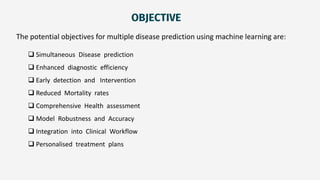
The potential objectives for multiple disease prediction using machine learning are:
 Simultaneous Disease prediction
 Enhanced diagnostic efficiency
 Early detection and Intervention
 Reduced Mortality rates
 Comprehensive Health assessment
 Model Robustness and Accuracy
 Integration into Clinical Workflow
 Personalised treatment plans
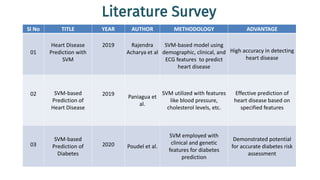
Literature Survey
Sl No TITLE YEAR AUTHOR METHODOLOGY ADVANTAGE
01
Heart Disease
Prediction with
SVM
2019 Rajendra
Acharya et al
SVM-based model using
demographic, clinical, and
ECG features to predict
heart disease
High accuracy in detecting
heart disease
02 SVM-based
Prediction of
Heart Disease
2019 Paniagua et
al.
SVM utilized with features
like blood pressure,
cholesterol levels, etc.
Effective prediction of
heart disease based on
specified features
03
SVM-based
Prediction of
Diabetes
2020 Poudel et al.
SVM employed with
clinical and genetic
features for diabetes
prediction
Demonstrated potential
for accurate diabetes risk
assessment
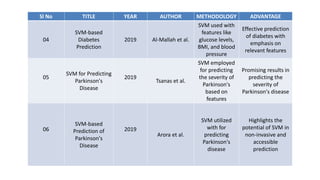
Sl No TITLE YEAR AUTHOR METHODOLOGY ADVANTAGE
04
SVM-based
Diabetes
Prediction
2019 Al-Mallah et al.
SVM used with
features like
glucose levels,
BMI, and blood
pressure
Effective prediction
of diabetes with
emphasis on
relevant features
05
SVM for Predicting
Parkinson's
Disease
2019
Tsanas et al.
SVM employed
for predicting
the severity of
Parkinson's
based on
features
Promising results in
predicting the
severity of
Parkinson's disease
06
SVM-based
Prediction of
Parkinson's
Disease
2019
Arora et al.
SVM utilized
with for
predicting
Parkinson's
disease
Highlights the
potential of SVM in
non-invasive and
accessible
prediction
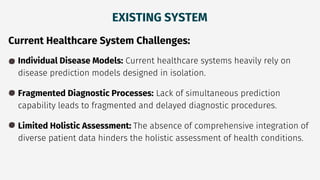
EXISTING SYSTEM
Current Healthcare System Challenges:
Individual Disease Models: Current healthcare systems heavily rely on
disease prediction models designed in isolation.
Fragmented Diagnostic Processes: Lack of simultaneous prediction
capability leads to fragmented and delayed diagnostic procedures.
Limited Holistic Assessment: The absence of comprehensive integration of
diverse patient data hinders the holistic assessment of health conditions.
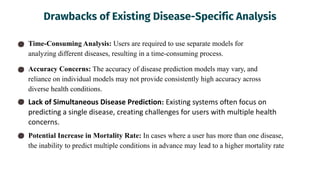
Drawbacks of Existing Disease-Specific Analysis
Time-Consuming Analysis: Users are required to use separate models for
analyzing different diseases, resulting in a time-consuming process.
Accuracy Concerns: The accuracy of disease prediction models may vary, and
reliance on individual models may not provide consistently high accuracy across
diverse health conditions.
Lack of Simultaneous Disease Prediction: Existing systems often focus on
predicting a single disease, creating challenges for users with multiple health
concerns.
Potential Increase in Mortality Rate: In cases where a user has more than one disease,
the inability to predict multiple conditions in advance may lead to a higher mortality rate
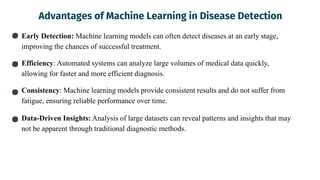
Advantages of Machine Learning in Disease Detection
Early Detection: Machine learning models can often detect diseases at an early stage,
improving the chances of successful treatment.
Efficiency: Automated systems can analyze large volumes of medical data quickly,
allowing for faster and more efficient diagnosis.
Consistency: Machine learning models provide consistent results and do not suffer from
fatigue, ensuring reliable performance over time.
Data-Driven Insights: Analysis of large datasets can reveal patterns and insights that may
not be apparent through traditional diagnostic methods.
PROPOSED SYSTEM
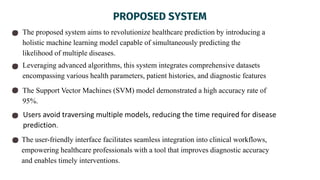
The proposed system aims to revolutionize healthcare prediction by introducing a
holistic machine learning model capable of simultaneously predicting the
likelihood of multiple diseases.
Leveraging advanced algorithms, this system integrates comprehensive datasets
encompassing various health parameters, patient histories, and diagnostic features
The Support Vector Machines (SVM) model demonstrated a high accuracy rate of
95%.
The user-friendly interface facilitates seamless integration into clinical workflows,
empowering healthcare professionals with a tool that improves diagnostic accuracy
and enables timely interventions.
Users avoid traversing multiple models, reducing the time required for disease
prediction.
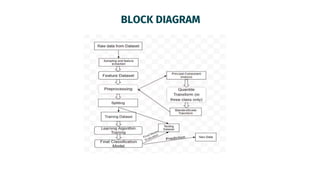
BLOCK DIAGRAM
HARDWARE AND SOFTWARE REQUIREMENTS
HARDWARE REQUIREMENTS
1. CPU: Multi-core processor
2. GPU: High-performance, CUDA-enabled (NVIDIA recommended)
3. RAM: Minimum 16 GB
4. Storage: SSD preferred
5. NIC: High-speed network connectivity
6. Motherboard and Power Supply: Compatible and reliable
SOFTWARE REQUIREMENTS
1. Operating System: Windows, MacOS, Linux (e.g., Ubuntu)
2. Development Environment: Jupyter, VSCode, or PyCharm
3. Programming Language: Python 3.6+
4. Machine Learning Libraries: Scikit-learn, Numpy, Pandas
5. GPU Drivers: NVIDIA CUDA drivers
6. Containerization Tools: Docker/Singularity
7. Version Control: Git
8. Virtual Environment: virtualenv/conda
9. Database Management System: Optional (MySQL, PostgreSQL, MongoDB)
10. Cloud Services: Optional (AWS, Google Cloud, Microsoft Azure)
11. Miscellaneous Tools: Text editors, Data visualization tools (e.g., Matplotlib)
CONCLUSION
In this research paper, we explored the application of machine learning techniques for the
prediction of multiple diseases, with a specific focus on heart disease, diabetes, and
Parkinson's disease.
We utilized the Support Vector Machines (SVM) model to develop a multi-disease prediction
framework and achieved a high accuracy of 98.3%. The findings of this study demonstrate the
potential of machine learning in revolutionizing disease prediction and improving patient
outcomes.
The integration of the trained model into an application enables disease prediction in
real-world scenarios, empowering healthcare professionals, researchers, and individuals to make
informed decisions regarding disease risk assessment and management.
In conclusion, this research contributes to the advancement of disease prediction using
machine learning and emphasizes the potential of SVM models in multi-disease prediction.
The model ensures early detection and proactive healthcare management, enhancing the
precision of disease predictions.
THANK YOU

Final ppt.pptx

  • 1.
    “Multiple Disease predictionUsing ML” Department of Computer and Science Engineering Bengaluru-560074 Vivekananda Institute of technology Project Presentation on Presented By: Pavan N (1VK20CS053) Rohith HM (1VK20CS068) Pranav Kumar TUY (1VK20CS054) Sanjay Kumar J (1VK20CS071) Guided By: Ghouse Pasha Assistant Professor of CSE
  • 2.
    Table Of Contents • Abstract •Introduction • Objective • Literature Survey • Existing System • Drawbacks of Existing System • Advantages of using ML • Proposed System • Block Diagram • Software Requirements • Conclusion • Hardware Requirements
  • 3.
    ABSTRACT Multi-disease prediction leveragingmachine learning (ML) is poised to revolutionize healthcare by enabling proactive care and early intervention. The abundance of medical data, fuelled by health records, and genomics, provides fertile ground for training and refining ML models. Cutting-edge algorithms, particularly Machine learning approaches, excel at extracting hidden patterns from complex medical data, paving the way for accurate multi-disease predictions. Personalized prediction models, tailored to individual patient profiles, offer a deeper understanding of disease risks and inform targeted preventive measures. Challenges like data quality, model explainability, and clinical workflow integration necessitate careful consideration for ethical and effective implementation. Overcoming these hurdles holds the key to unlocking the immense potential of multi- disease prediction, empowering individuals and transforming healthcare for the better.
  • 4.
    Introduction to the Project MultipleDisease prediction using ML
  • 5.
    Machine learning (ML)is rapidly transforming healthcare, and one exciting application is the ability to predict multiple diseases simultaneously. This holds immense potential for early detection, personalized treatment, and improved patient outcomes. Diseases like heart disease, diabetes, and Parkinson's pose significant burdens on individuals and healthcare systems worldwide. Early diagnosis and intervention are crucial for managing these conditions effectively. ML algorithms can analyze vast amounts of medical data, including demographics, clinical information, and biomarkers. This allows them to identify complex patterns and relationships that might be missed by traditional diagnostic methods. A Powerful Classification Tool Support Vector Machines (SVMs) are a type of ML algorithm well- suited for multi-disease prediction. By training SVM models on comprehensive datasets, researchers can develop accurate prediction frameworks for multiple diseases. This opens doors for early interventions, personalized treatment plans, and better resource allocation within healthcare systems.
  • 6.
    OBJECTIVE The potential objectivesfor multiple disease prediction using machine learning are:  Simultaneous Disease prediction  Enhanced diagnostic efficiency  Early detection and Intervention  Reduced Mortality rates  Comprehensive Health assessment  Model Robustness and Accuracy  Integration into Clinical Workflow  Personalised treatment plans
  • 7.
    Literature Survey Sl NoTITLE YEAR AUTHOR METHODOLOGY ADVANTAGE 01 Heart Disease Prediction with SVM 2019 Rajendra Acharya et al SVM-based model using demographic, clinical, and ECG features to predict heart disease High accuracy in detecting heart disease 02 SVM-based Prediction of Heart Disease 2019 Paniagua et al. SVM utilized with features like blood pressure, cholesterol levels, etc. Effective prediction of heart disease based on specified features 03 SVM-based Prediction of Diabetes 2020 Poudel et al. SVM employed with clinical and genetic features for diabetes prediction Demonstrated potential for accurate diabetes risk assessment
  • 8.
    Sl No TITLEYEAR AUTHOR METHODOLOGY ADVANTAGE 04 SVM-based Diabetes Prediction 2019 Al-Mallah et al. SVM used with features like glucose levels, BMI, and blood pressure Effective prediction of diabetes with emphasis on relevant features 05 SVM for Predicting Parkinson's Disease 2019 Tsanas et al. SVM employed for predicting the severity of Parkinson's based on features Promising results in predicting the severity of Parkinson's disease 06 SVM-based Prediction of Parkinson's Disease 2019 Arora et al. SVM utilized with for predicting Parkinson's disease Highlights the potential of SVM in non-invasive and accessible prediction
  • 9.
    EXISTING SYSTEM Current HealthcareSystem Challenges: Individual Disease Models: Current healthcare systems heavily rely on disease prediction models designed in isolation. Fragmented Diagnostic Processes: Lack of simultaneous prediction capability leads to fragmented and delayed diagnostic procedures. Limited Holistic Assessment: The absence of comprehensive integration of diverse patient data hinders the holistic assessment of health conditions.
  • 10.
    Drawbacks of ExistingDisease-Specific Analysis Time-Consuming Analysis: Users are required to use separate models for analyzing different diseases, resulting in a time-consuming process. Accuracy Concerns: The accuracy of disease prediction models may vary, and reliance on individual models may not provide consistently high accuracy across diverse health conditions. Lack of Simultaneous Disease Prediction: Existing systems often focus on predicting a single disease, creating challenges for users with multiple health concerns. Potential Increase in Mortality Rate: In cases where a user has more than one disease, the inability to predict multiple conditions in advance may lead to a higher mortality rate
  • 11.
    Advantages of MachineLearning in Disease Detection Early Detection: Machine learning models can often detect diseases at an early stage, improving the chances of successful treatment. Efficiency: Automated systems can analyze large volumes of medical data quickly, allowing for faster and more efficient diagnosis. Consistency: Machine learning models provide consistent results and do not suffer from fatigue, ensuring reliable performance over time. Data-Driven Insights: Analysis of large datasets can reveal patterns and insights that may not be apparent through traditional diagnostic methods.
  • 12.
    PROPOSED SYSTEM The proposedsystem aims to revolutionize healthcare prediction by introducing a holistic machine learning model capable of simultaneously predicting the likelihood of multiple diseases. Leveraging advanced algorithms, this system integrates comprehensive datasets encompassing various health parameters, patient histories, and diagnostic features The Support Vector Machines (SVM) model demonstrated a high accuracy rate of 95%. The user-friendly interface facilitates seamless integration into clinical workflows, empowering healthcare professionals with a tool that improves diagnostic accuracy and enables timely interventions. Users avoid traversing multiple models, reducing the time required for disease prediction.
  • 13.
  • 14.
    HARDWARE AND SOFTWAREREQUIREMENTS HARDWARE REQUIREMENTS 1. CPU: Multi-core processor 2. GPU: High-performance, CUDA-enabled (NVIDIA recommended) 3. RAM: Minimum 16 GB 4. Storage: SSD preferred 5. NIC: High-speed network connectivity 6. Motherboard and Power Supply: Compatible and reliable
  • 15.
    SOFTWARE REQUIREMENTS 1. OperatingSystem: Windows, MacOS, Linux (e.g., Ubuntu) 2. Development Environment: Jupyter, VSCode, or PyCharm 3. Programming Language: Python 3.6+ 4. Machine Learning Libraries: Scikit-learn, Numpy, Pandas 5. GPU Drivers: NVIDIA CUDA drivers 6. Containerization Tools: Docker/Singularity 7. Version Control: Git 8. Virtual Environment: virtualenv/conda 9. Database Management System: Optional (MySQL, PostgreSQL, MongoDB) 10. Cloud Services: Optional (AWS, Google Cloud, Microsoft Azure) 11. Miscellaneous Tools: Text editors, Data visualization tools (e.g., Matplotlib)
  • 16.
    CONCLUSION In this researchpaper, we explored the application of machine learning techniques for the prediction of multiple diseases, with a specific focus on heart disease, diabetes, and Parkinson's disease. We utilized the Support Vector Machines (SVM) model to develop a multi-disease prediction framework and achieved a high accuracy of 98.3%. The findings of this study demonstrate the potential of machine learning in revolutionizing disease prediction and improving patient outcomes. The integration of the trained model into an application enables disease prediction in real-world scenarios, empowering healthcare professionals, researchers, and individuals to make informed decisions regarding disease risk assessment and management. In conclusion, this research contributes to the advancement of disease prediction using machine learning and emphasizes the potential of SVM models in multi-disease prediction. The model ensures early detection and proactive healthcare management, enhancing the precision of disease predictions.
  • 17.