IAES International Journal of Artificial Intelligence (IJ-AI)
Vol. 14, No. 3, June 2025, pp. 2072~2082
ISSN: 2252-8938, DOI: 10.11591/ijai.v14.i3.pp2072-2082  2072
Journal homepage: http://ijai.iaescore.com
A symptom-driven medical diagnosis support model based on
machine learning techniques
Adil Laabidi, Mohammed Aissaoui
National School of Applied Sciences, Mohammed Premier University, Oujda, Morocco
Article Info ABSTRACT
Article history:
Received Apr 18, 2024
Revised Feb 27, 2025
Accepted Mar 15, 2025
Medicine is a human science that is constantly evolving, and this evolution
generates a large mass of data that needs to be exploited with the multitude
of IT resources available to guarantee and maintain this scientific progress.
Some diseases share most symptoms, whereas others could have a low
probability of being identified in an early stage. Thus, when facing a such
situation, an inexperienced doctor may have difficulty making the right
diagnosis or may test different cases, which will be a big waste of time. In
this paper, we are going to make this embarrassing situation less complex by
giving practitioners every probable disease, and even the least probable ones
according to the given symptoms. Indeed, this work will push the diagnosis
deeper to reveal hidden symptoms and pathogenesis, to help practitioners
make the right decisions. To develop such a solution, the data is organized
by matching each disease with its known symptoms, then we used naive
Bayes as a classification model, and different metrics to evaluate the
performance of this experiment. This work proves that machine learning has
become very effective in the medical sector, especially when we notice that
the accuracy exceeds 90% in the detection of diseases.
Keywords:
Disease prediction
F-score
Machine learning
Medical diagnosis
Naive Bayes
Symptoms
This is an open access article under the CC BY-SA license.
Corresponding Author:
Adil Laabidi
National School of Applied Sciences, Mohammed Premier University
Boulevard Mohamed VI, Oujda, Morocco
Email: laabidi.adil@ump.ac.ma
1. INTRODUCTION
The massive technological advancement has greatly accelerated disease diagnosis and treatment
plans. Various hospitals have adopted the technological approach due to cost reduction, time saving and
accurate results [1], [2]. Moreover, health information technologies could reduce drug events and produce a
better relationship between doctor and patient [3]. We also notice that the dynamic community of
bioinformatics researchers, who have elevated data science to a foundational competency, have consistently
created highly reproducible approaches that work in different settings and with different patients. This group
of researchers employed computers as their laboratories in one of the basic sciences, and which has been one
of the early domains where big data was sequestered as medical science [4].
Furthermore, big data and machine learning have the power to guide practitioners toward the most
effective medical decision and treatments, as they could improve care quality without having any need to test
unnecessary diagnostic and therapies [5]. The collection of massive data has formed large-scale datasets from
different medical sectors such as biological science, radiological, bioinformatics, and even medical
prescriptions written in human natural language. Therefore, this big quantity of data needs an intelligent
treatment to produce relevant results in the aim of helping clinical decisions [6]. To produce these results,
different technics are applied while converging to the same objective; we notice machine learning,
Int J Artif Intell ISSN: 2252-8938 
A symptom-driven medical diagnosis support model based on machine learning techniques (Adil Laabidi)
2073
deep learning, reinforcement learning, and also natural language processing. These artificial intelligence
technologies, combined with human intelligence, have the power to accomplish difficult tasks with ease.
They can help with accurate diagnosis, making efficient treatment and follow-up plans, risk prediction,
productivity improvement, and even reducing medical errors [7], [8].
Using these machine learning techniques, we could work on situations with different levels of
complexity, such as the analysis of radiological images while revealing relevant results that could lead to
interpreting some of the images in priority. Another case could be the situation of patients, some of them may
need to be redirected to a specialist where others will simply receive psychological support. These data
science techniques will not be able to replace human intervention, but will be used as a complement and help
practitioners to better manage their interventions and to devote themselves much more to the most complex
situations. It is a practical way to create collaboration between medicine and artificial intelligence.
In this paper, we study the power of machine learning classifiers to identify diseases according to
some given symptoms. This work won’t be just a simple classification that have to determine concerned
disease, but also to be able to predict even low probability diseases. In some cases, an unexperienced doctor
or even an experienced one could be confused when a patient has symptoms for a common disease, but at the
same time these symptoms can reveal a serious disease in an early stage. Therefore, the doctor must
experiment with different clinical plans for a more accurate diagnosis to define the different possible cases.
However, by following this method, we may waste too much time that could be important in the healing
phase, a time where a disease in an early stage may become in an advanced one. So, this work provides a
solution to overcome this situation and give to practitioners enough time and possibilities to deeply analyses
every case encountered. This study represents the results obtained by applying naive Bayes as a model
learning on a dataset formed from data collected on the web portal of the U.S. National Library of Medicine
(NLM) [9]. The main objective is to give the possibility to determine a hidden disease behind the symptoms
of other ones.
This work is described as follows. Section 2 describes a literature review on machine learning for
healthcare, medical research, and some preliminary comparisons of different models. Section 3 presents the
research methodology which explains the overall structure of our study as well as the techniques and methods
we used in this work. Then in section 4, we will present and discuss the results of this experiment. Finally, in
conclusion, we evaluate the model in terms of achieving the objectives and we will talk about some future
work.
2. RELATED WORKS
Taking advantage of the great technological advances in hardware and software, as well as the
power of various ma- chine learning algorithms, many studies have deeply exploited big data in order to
prove the benefits of artificial intelligence in the medical sector. Laabidi and Aissaoui [10] comparing the
performance of different machine learning algorithms in order to determine the best performing model for
predicting diabetes and prostate cancer. This study proved that algorithms can be very accurate when it
comes to predicting diseases. In the same context, Shah et al. [11] conducted a study with the objective of
determining whether or not a patient could develop heart disease. They worked on four different models
while comparing their performance. The main objective was to work with lesser attributes and tests [11].
This study also demonstrated that classification models are very effective when it comes to producing
medical outcomes with good accuracy. Kosarkar et al. [12] implemented a system using three algorithms,
decision tree, random forest, and naive Bayes. Their work consists in comparing the performances of the
three classifiers using K fold cross validation, which showed that these algorithms gave very good accuracy
with a small advantage of naive Bayes. However, looking at the result of the example given by the author, we
find that naive Bayes and decision tree classifiers give the same result, while random forest gives a different
result. At this level and in general we will choose the favorite result of the most of the classifiers, but with a
precision as close as the one on the example this could put the practitioner in doubt if he has to decide which
disease is the most probable. Therefore, a complementary diagnosis will be necessary.
Chen et al. [13] developed a heart disease predict system by using a combination of 14 attributes to
determine the presence of heart disease. The attributes were a mixture of personal information’s and others
about the presence of symptoms. The use of artificial neural network (ANN) as an algorithm generated good
results, including an accuracy of over 80%. This experiment leads to talk about the efficiency of machine
learning technics even in some of the most advanced and critical medical fields such as cardiology. With this
development of big data analysis, disease prediction and its analysis methods are receiving more attention in
scientific research. Indeed, different researches have been conducted to improve the classification of diseases
and even the risk to develop future diseases [14]. Chen et al. [15] worked on structured and unstructured data
from real life hospital datasets in order to be able to give predictions with an effective accuracy. Their work
aims in another sense to find a solution to the problem of missing data that could impact the quality of the
 ISSN: 2252-8938
Int J Artif Intell, Vol. 14, No. 3, June 2025: 2072-2082
2074
results, they finally proposed a new convolutional neural network based multimodal disease risk prediction
(CNN-MDRP) that gave an accuracy of 94.8% [15]. In the same context, many studies conducted on
computer-aided diagnosis (CADx) demonstrated the great utility of medical diagnostic tools in improving
clinical decisions and reducing unnecessary interventions [16], [17].
Still in the same context but this time with a prediction of diseases using symptoms expressed by the
user himself, gadekar et al. [18] worked on a prediction system based on a set of symptoms provided by the
patient. Such a system can be useful to inform the patient on the possible disease he may have, but remains
insufficient or even risky if the patient is not precise in his diagnosis or if he takes the initiative to consume
drugs without medical opinion. Indeed, the majority of models that aim at predicting diseases are based on a
symptom/disease approach, such an approach can reach a good accuracy but remains unable to reveal if there
is a disease hidden behind the symptoms of another or if a disease is present at an early stage.
3. METHOD
3.1. Proposed experimental process
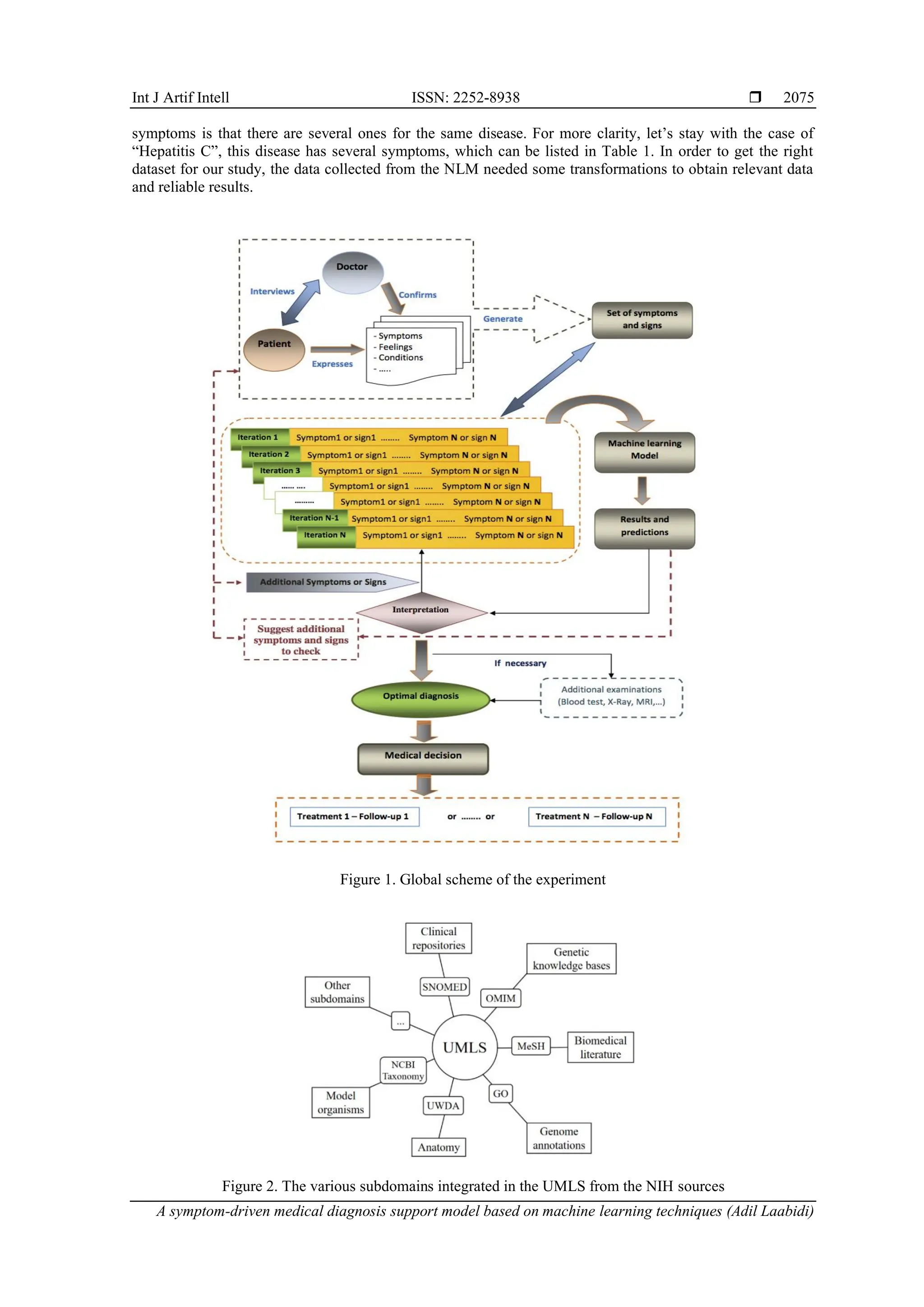
Our disease prediction model is based on an iterative approach, in which the model is fed with the
necessary parameters through several iterations until the optimum result is obtained, as shown in the diagram
in Figure 1. Indeed, when a patient visits a doctor, their primary objective is to accurately convey their
symptoms to receive appropriate treatment. For the doctor, the main goal is to elicit clear and precise
information about the patient's health to make an accurate diagnosis. Our experiment, illustrated in Figure 1,
follows a structured process consisting of the following steps:
‒ Step 1: the doctor inquiries about the patient's health status, guiding the patient to describe their
symptoms and feelings. The doctor's task at this stage is to verify the patient's statements and generate an
initial set of symptoms and signs.
‒ Step 2: the initial set of symptoms and signs identified by the doctor is input into the machine learning
model for the first iteration. The model outputs predictions of likely diseases, ranked in descending order
according to their probability scores. Additionally, the model suggests further symptoms and signs to
check for each listed disease, aiding the practitioner in refining the diagnosis.
‒ Step 3: upon receiving the model's predictions, the doctor interprets the results in the context of the
patient's condition. If the assessment is sufficient to make a decision, the diagnosis is considered optimal.
The practitioner may request additional tests, if necessary, to confirm the diagnosis. If further
investigation is required, the doctor verifies the additional symptoms suggested by the model with the
patient. This process can be repeated iteratively until the doctor is confident in the diagnosis. The number
of iterations is unlimited and depends on the results obtained and the practitioner's judgment. This
iterative approach helps eliminate doubtful cases and identify dangerous conditions accurately.
‒ Step 4: once the doctor finalizes the diagnosis and determines the patient's illness, a treatment protocol
can be planned and implemented for the patient's care and follow-up.
In conclusion, Figure 1 summarizes the process adopted in our study. It is a medical diagnosis support
process designed to help the doctor, whether beginner or experienced, to better master the diagnosis phase in
terms of «Time management» and «Case management».
3.2. Data
The data used in this study come from the NLM, located on the campus of the National Institutes of
Health in Bethesda, Maryland, a center of information innovation since its founding in 1836 [19]. This
library is considered the largest biomedical library in the world, with data collected through a network of
over 8000 collaborators providing access to information across the United States. The NLM has developed a
repository called Unified Medical Language System (UMLS) which is a set of files and software that brings
together many health and biomedical vocabularies and standards to enable interoperability between IT
systems [20]. It integrates more than 2 million names for approximately 900,000 concepts from more than 60
families of biomedical vocabularies. It also integrates 12 million relationships between these concepts [21].
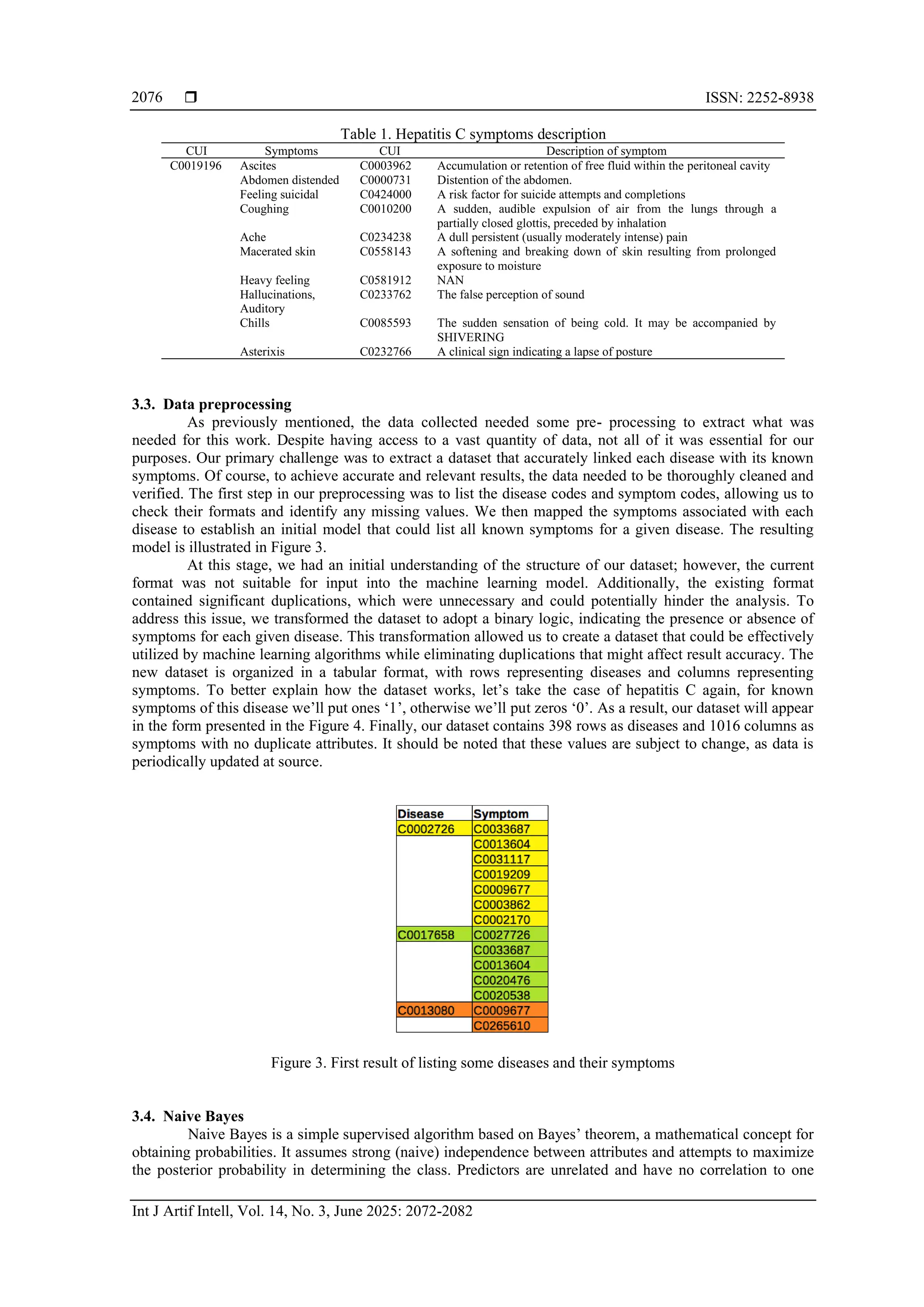
Vocabularies integrated into the UMLS metathesaurus include the NCBI taxonomy, gene ontology, medical
subject headings (MeSH), online mendelian inheritance in man (OMIM), and the digital anatomist symbolic
knowledge base as illustrated in Figure 2 [20], [21].
For our study, the main objective is to extract data from UMLS database in order to associate
diseases with their symptoms. Each disease is identified by a code “CUI” made up of an alphabetical
character, which in our case is the letter “C”, followed by a number of seven digits, giving a code in the
following format “Cxxxxxxx”. for example, if we take “Hepatitis C” as the disease, we’ll find the following
code “C0019196” associated with it. For symptoms, we use the same code format, i.e. the letter “C” followed
by seven digits, e.g. for “Headache” we have the following code “C0018681”, but the particularity of
Int J Artif Intell ISSN: 2252-8938 
A symptom-driven medical diagnosis support model based on machine learning techniques (Adil Laabidi)
2075
symptoms is that there are several ones for the same disease. For more clarity, let’s stay with the case of
“Hepatitis C”, this disease has several symptoms, which can be listed in Table 1. In order to get the right
dataset for our study, the data collected from the NLM needed some transformations to obtain relevant data
and reliable results.
Figure 1. Global scheme of the experiment
Figure 2. The various subdomains integrated in the UMLS from the NIH sources
 ISSN: 2252-8938
Int J Artif Intell, Vol. 14, No. 3, June 2025: 2072-2082
2076
Table 1. Hepatitis C symptoms description
CUI Symptoms CUI Description of symptom
C0019196 Ascites C0003962 Accumulation or retention of free fluid within the peritoneal cavity
Abdomen distended C0000731 Distention of the abdomen.
Feeling suicidal C0424000 A risk factor for suicide attempts and completions
Coughing C0010200 A sudden, audible expulsion of air from the lungs through a
partially closed glottis, preceded by inhalation
Ache C0234238 A dull persistent (usually moderately intense) pain
Macerated skin C0558143 A softening and breaking down of skin resulting from prolonged
exposure to moisture
Heavy feeling C0581912 NAN
Hallucinations,
Auditory
C0233762 The false perception of sound
Chills C0085593 The sudden sensation of being cold. It may be accompanied by
SHIVERING
Asterixis C0232766 A clinical sign indicating a lapse of posture
3.3. Data preprocessing
As previously mentioned, the data collected needed some pre- processing to extract what was
needed for this work. Despite having access to a vast quantity of data, not all of it was essential for our
purposes. Our primary challenge was to extract a dataset that accurately linked each disease with its known
symptoms. Of course, to achieve accurate and relevant results, the data needed to be thoroughly cleaned and
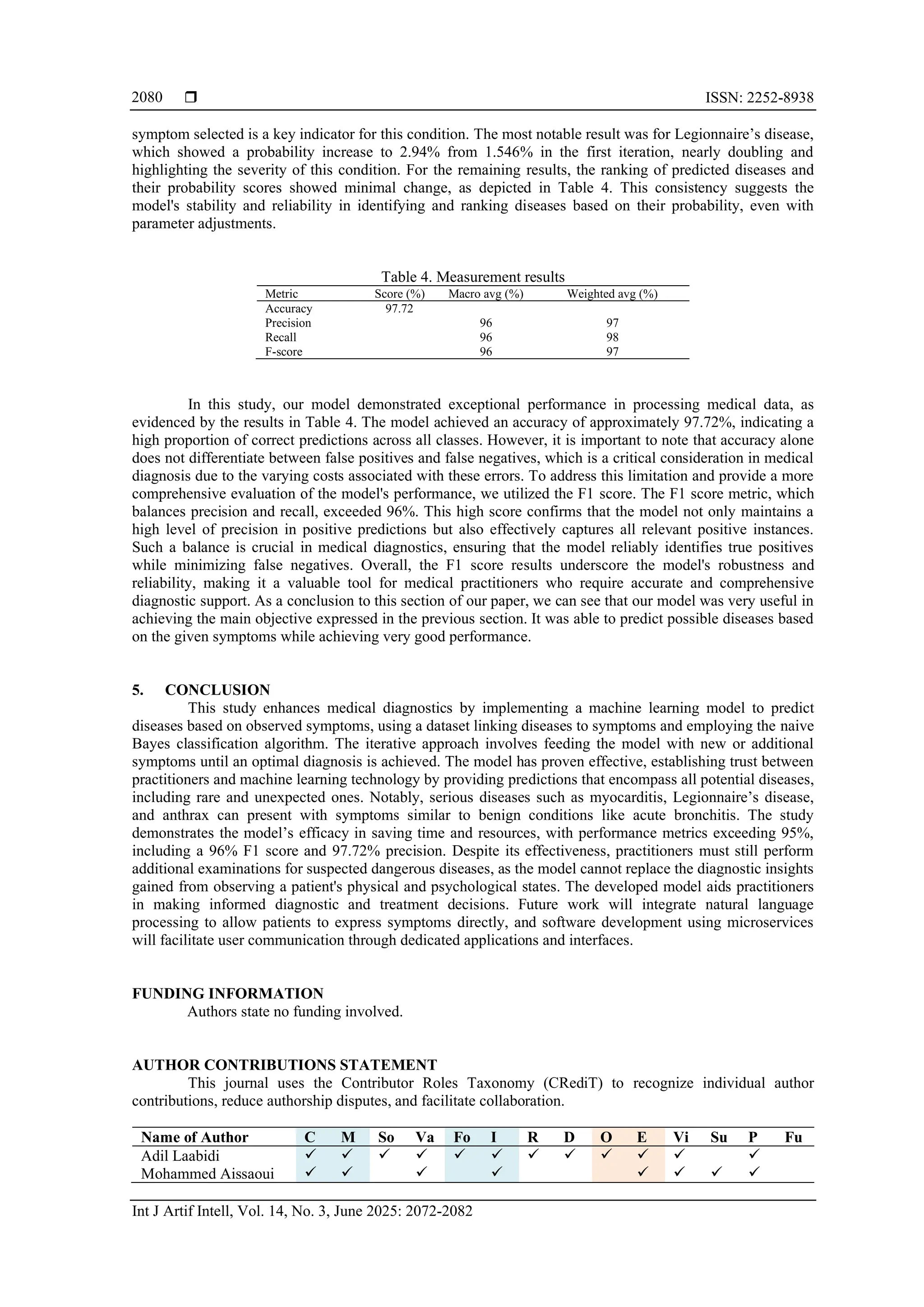
verified. The first step in our preprocessing was to list the disease codes and symptom codes, allowing us to
check their formats and identify any missing values. We then mapped the symptoms associated with each
disease to establish an initial model that could list all known symptoms for a given disease. The resulting
model is illustrated in Figure 3.
At this stage, we had an initial understanding of the structure of our dataset; however, the current
format was not suitable for input into the machine learning model. Additionally, the existing format
contained significant duplications, which were unnecessary and could potentially hinder the analysis. To
address this issue, we transformed the dataset to adopt a binary logic, indicating the presence or absence of
symptoms for each given disease. This transformation allowed us to create a dataset that could be effectively
utilized by machine learning algorithms while eliminating duplications that might affect result accuracy. The
new dataset is organized in a tabular format, with rows representing diseases and columns representing
symptoms. To better explain how the dataset works, let’s take the case of hepatitis C again, for known
symptoms of this disease we’ll put ones ‘1’, otherwise we’ll put zeros ‘0’. As a result, our dataset will appear
in the form presented in the Figure 4. Finally, our dataset contains 398 rows as diseases and 1016 columns as
symptoms with no duplicate attributes. It should be noted that these values are subject to change, as data is
periodically updated at source.
Figure 3. First result of listing some diseases and their symptoms
3.4. Naive Bayes
Naive Bayes is a simple supervised algorithm based on Bayes’ theorem, a mathematical concept for
obtaining probabilities. It assumes strong (naive) independence between attributes and attempts to maximize
the posterior probability in determining the class. Predictors are unrelated and have no correlation to one
Int J Artif Intell ISSN: 2252-8938 
A symptom-driven medical diagnosis support model based on machine learning techniques (Adil Laabidi)
2077
another, but all attributes contribute independently to maximize the probability [11]. We can use the naive
Bayes model without using any Bayesian methods. However, naive Bayes still one of the best classifiers for
dealing with medical real-world datasets and even complex ones [22].
𝑃(𝑋/𝑌) =
𝑃(𝑌 𝑋
⁄ )×𝑃(𝑋)
𝑃(𝑌)
(1)
Where P(X/Y) is the posterior probability, P(X) is the class prior probability, P(Y) is the predictor prior
probability, and P(Y/X) is the likelihood probability of predictor. Naive Bayes remains a simple,
easy-to-implement and efficient algorithm that can handle non-linear and complicated data. However,
according to some studies, there is a loss of accuracy due to the fact that this algorithm is based on the
assumption and class conditional independence [11].
Figure 4. Disease/symptoms dataset final form
3.5. Methodology
The following section presents the main objectives, data structure, and application of our disease
detection model within the context of enhanced diagnosis.
‒ Main objective: Our primary objective is not only to detect diseases associated with observed symptoms
but also to identify diseases that may be present at an early stage or those that are serious but share
symptoms with benign conditions. To achieve this, we employed an input/output model where symptoms
are used as input to generate an output representing the detected diseases. Our approach is unique in that
we do not solely identify the most probable disease; instead, we produce an output that includes various
potential diseases ranked in descending order of their probability scores.
‒ Data and strategy: To implement this work, our dataset is structured in a diseases/symptoms format, with
rows representing diseases and columns representing symptoms. Each disease is associated with its
known symptoms using binary logic: '1' indicates the presence of a symptom, while '0' indicates its
absence, as shown in Table 2. The dataset is then divided into training and testing subsets, with
approximately 70% of the data allocated for training and 30% for testing (test-size =0.3). This strategy
ensures that our model can be effectively trained and validated for accurate disease detection and
diagnosis.
‒ Application and diagnostic enhancement: Consider a patient presenting with various symptoms of
differing severity. We first catalog these symptoms and convert them into coded form for input into our
model. The model then generates an output list of potential diseases, each accompanied by its probability
of being present in the patient. An essential aspect of our approach is that for each detected disease, the
model suggests additional symptoms for the practitioner to verify. This provides the practitioner with
comprehensive information, facilitating a more thorough and accurate diagnosis and enabling the most
appropriate clinical decision-making.
3.6. Performance evaluation criteria
To evaluate the performance of a classifier, it is necessary to introduce two important parameters:
sensitivity and specificity. When sensitivity represents the classifier’s effectiveness in identifying positive
samples to the total actual positive instances, specificity defines the ratio of incorrectly predicted positive
instances to the total actual negative instances. On the other hand, the accuracy measures the overall
correctness of the model’s predictions. It considers both true positive and true negative instances. It can
therefore be calculated as follows:
 ISSN: 2252-8938
Int J Artif Intell, Vol. 14, No. 3, June 2025: 2072-2082
2078
Sensitivity =
𝑇𝑃
𝑇𝑃+𝐹𝑁
× 100 (2)
Specificity =
𝑇𝑁
𝑇𝑁+𝐹𝑃
× 100 (3)
𝐴𝑐𝑐𝑢𝑟𝑎𝑐𝑦 =
𝑇𝑃+𝑇𝑁
𝑇𝑃+𝑇𝑁+𝐹𝑃+𝐹𝑁
(4)
In addition, the F-score or F1 score is used to measure the performance of our model. It is a metric
commonly used in machine learning and statistics to evaluate the performance of a classification model, and
looks for potential imbalance problems. It combines and provides a balance between precision and recall, and
is particularly useful when there is an uneven class distribution. F1 score is obtained as follows:
Precision =
𝑇𝑃
𝑇𝑃+𝐹𝑃
(5)
Recall =
𝑇𝑃
𝑇𝑃+𝐹𝑁
(6)
F-score is the harmonic mean of precision and recall.
F − score = 2 ×
𝑝𝑟𝑒𝑐𝑖𝑠𝑖𝑜𝑛 × 𝑟𝑒𝑐𝑎𝑙𝑙
𝑝𝑟𝑒𝑐𝑖𝑠𝑖𝑜𝑛+𝑟𝑒𝑐𝑎𝑙𝑙
(7)
Table 2. Predicted diseases sorted by descending probability score (Iteration 1)
Symptoms Predicted diseases Probability score Additional signs or symptoms to check
- Fever
- Cough
- Headache
- Fatigue
Acute bronchitise 3.165 'Rhinitis', 'Laryngitis', 'Pharyngitis', 'Myalgia'
Myocarditis 1.588 'Diarrhea', 'Exanthema', 'Chest Pain', 'Palpitations'
Pontiac Fever 1.576 'Common cold', 'Sore throat', 'Confusion', 'Diziness', 'Photophobia',
'Myalgia'
Scarlet Fever 1.552 'Deglutition disorders', 'Vomiting', 'Pharyngitis', 'Peritonsillar
abscess', 'Mucous membrane eruption', 'Strawberry tongue',
'Exanthema', 'Pallor', 'Nausea', 'Tonsillitis'
Legionnaires’
Disease
1.546 'Pleurisy', 'Rhinitis', 'Laryngitis', 'Confusion', 'Lethargy', 'Diarrhea',
'Dry cough', 'Chills', 'Myalgia', 'Chest pain', 'Pneumonia'
Bronchopneu-
monia
1.493 ‘Chest pain’, ‘Chills’, ‘Muscle aches’, ‘Myalgia’, ‘Dyspnea’,
‘Sweating’, ‘Tachypnea’
Chikenpox 0.803 'Exanthema', 'Pruritus'
Sarcoidosis 0.803 'Arthritis', 'Erythema nodosum'
Antrax disease 0.800 'Bronchopneumonia', 'Chills', 'Hypoxia'
4. RESULTS AND DISCUSSION
Our study was designed to facilitate iterative deep diagnosis for practitioners. Initially, we utilized
only four symptoms for our classification, as depicted in Table 3, and subsequently used our model to predict
the diseases. As illustrated in Table 3, the output is a list of diseases ranked in descending order based on
their probability scores, starting with the disease having the highest probability score, followed by the next
highest.
At this initial stage, each predicted disease is not evaluated for its severity but rather for its
probability of being present. The practitioner can then choose to deepen the diagnosis by examining the
probability scores and analyzing each disease from a severity perspective. Table 3 indicates that the first
iteration revealed diseases of varying severity, and the model suggests additional signs and symptoms to
verify, thereby guiding the practitioner towards a more comprehensive diagnosis.
First, let's have a look to the results generated by our machine learning model in terms of probability
of occurrence and severity. In our first iteration, the most probable disease is ‘Acute bronchitis’ with a
probability of 3.165%. Acute bronchitis is not in itself a dangerous disease, but rather a self-limiting
condition that will disappear after a few days or week [23]. But this does not prevent the disease from having
complications in certain cases [23], and it is why the practitioner must ensure that it is indeed the disease in
question in order to anticipate complications. In second place, we find myocarditis with a probability of
1.588%, but the score is nowhere near that of acute bronchitis, since there is a difference of more than half,
which is enormous, especially when it concerns the medical field. In fact, the probability of developing
myocarditis is small, but still alarming, given that the disease is dangerous, especially if you know that it
remains asymptomatic in most cases, or unnoticeable since the symptoms are eclipsed by those of the
Int J Artif Intell ISSN: 2252-8938 
A symptom-driven medical diagnosis support model based on machine learning techniques (Adil Laabidi)
2079
inflammation that triggered the disease [24]. The presence of such a disease in an advanced stage
(Rank 2 in our case) will certainly lead the doctor to diagnose it more thoroughly, in order to prevent
complications such as heart failure and, in rare cases, cardiogenic shock [24]. For the next three ranks, the
probability of disease is relatively close to that of myocarditis, except that the severity of the three diseases
varies widely. Pontiac fever is ranked third with a score of 1.576%, this disease is considered benign and also
self-limiting and can be mistaken for simple flu [25]. In forth position scarlet fever is present with a score of
1.552%, it is a childhood illness currently considered as mild disease if correctly treated [26]. Like
myocarditis, Legionnaires’ disease (Legionella pneumonia) is present with a probability of 1.546%. This is
not a very high score, but it’s important for the doctor not to overlook this result, as the disease is very
dangerous, and as the prognosis of patients depends above all on two factors: “when the disease was
diagnosed” and “when treatment was instituted” [27]. It should be mentioned that the mortality rate among
senior citizens varies between 10 and 50% [28], which is very alarming, hence the need for early diagnosis.
The rest of our list includes bronchopneumonia with a score of 1.493%, a disease that is very common in
children and requires special attention to prevent complications. It’s a potentially fatal disease, as statistics
show that more than 920,000 children under the age of 5 died of pneumonia, mainly bronchopneumonia, in
2015 [29]. Then we have Chickenpox (varicella) and sarcoidosis with 0.803%, the two diseases have the
same probability but not severity. Chickenpox is usually considered as a childhood mild disease [30],
whereas sarcoidosis is a chronic disease that is often asymptomatic at a certain level but requires follow-up
and treatment by drug therapy if symptoms appear [31]. For patients in an advanced stage of the disease who
are untreated, themortality rate is about 5% [31]. The last case in our ranking is anthrax with 0.8%, it is a
notifiable infectious disease because it is very dangerous and requires a specific protocol [32]. Statistics
report a mortality rate of 50% even with treatment [32].
The initial results from our model indicate that while the symptoms observed in the patient are
familiar and common across all age groups, it is crucial to remain vigilant for serious pathologies that may be
concealed behind these seemingly benign symptoms. For the purposes of our analysis, we focused on the first
eight predicted results, which provided sufficient data to evaluate the model's performance. However,
practitioners have the option to review all results in descending order to gain a comprehensive understanding
of the case. Our findings reveal that among the eight predicted results, approximately four were fatal and
dangerous diseases, underscoring the importance of early diagnosis and urgent treatment. This demonstrates
that our model is an effective tool for practitioners to enhance their diagnostic process and identify potential
hidden pathologies promptly, thereby saving valuable time. For instance, early detection of anthrax can save
many lives, including the patients. Similarly, timely identification of Legionnaire’s disease can significantly
improve patient outcomes.
Table 3. Predicted diseases sorted by descending probability score (Iteration 2)
Symptoms Predicted diseases Probability score Additional signs or symptoms to check
- Fever
- Cough
- Headache
- Fatigue
- Rhinitis
Acute bronchitis 6.064 'Laryngitis', 'Pharyngitis', 'Myalgia'
Legionnaires’
Disease
2.940 'Pleurisy', 'Laryngitis', 'Confusion', 'Lethargy', 'Diarrhea', 'Dry
cough', 'Chills', 'Myalgia', 'Chest pain', 'Pneumonia'
Myocarditis 1.523 'Diarrhea', 'Exanthema', 'Chest pain', 'Palpitations'
Pontiac Fever 1.508 'Common cold', 'Sore throat', 'Confusion', 'Diziness',
'Photophobia', 'Myalgia',
Scarlet Fever 1.479 'Deglutition disorders', 'Vomiting', 'Pharyngitis', 'Peritonsillar
abscess', 'Mucous membrane eruption', 'Strawberry tongue',
'Exanthema', 'Pallor', 'Nausea', 'Tonsillitis'
Bronchopneu-
monia
0.780 ‘Chest pain’, ‘chills’, ‘Muscle aches’, ‘Myalgia’, ‘Dyspnea’,
‘Sweating’, ‘Tachypnea’
Chikenpox 0.772 'Exanthema', 'Pruritus'
Sarcoidosis 0.772 'Arthritis', 'Erythema nodosum',
Antrax disease 0.769 'Bronchopneumonia', 'Chills', 'hypoxia'
During our experiment, we conducted multiple iterations of our model to observe its behavior under
varying parameters. The model demonstrated high sensitivity to modifications in symptoms, as evidenced by
the results of the second iteration presented in Table 4. It is important to note that the symptoms selected for
this iteration were chosen based on the disease with the highest initial probability, aiming to refine its
diagnosis further. For practitioners, parameter selection will be more precise, informed by patient observation
and case-specific interviews. Practitioners can iteratively adjust parameters and continue the diagnostic
process until the most optimal result is achieved. This iterative approach can be supplemented with additional
diagnostic methods, such as blood tests or medical imaging. In the second iteration, we observed that the
probability of acute bronchitis increased significantly to 6.064%, which is expected given that the additional
 ISSN: 2252-8938
Int J Artif Intell, Vol. 14, No. 3, June 2025: 2072-2082
2080
symptom selected is a key indicator for this condition. The most notable result was for Legionnaire’s disease,
which showed a probability increase to 2.94% from 1.546% in the first iteration, nearly doubling and
highlighting the severity of this condition. For the remaining results, the ranking of predicted diseases and
their probability scores showed minimal change, as depicted in Table 4. This consistency suggests the
model's stability and reliability in identifying and ranking diseases based on their probability, even with
parameter adjustments.
Table 4. Measurement results
Metric Score (%) Macro avg (%) Weighted avg (%)
Accuracy 97.72
Precision 96 97
Recall 96 98
F-score 96 97
In this study, our model demonstrated exceptional performance in processing medical data, as
evidenced by the results in Table 4. The model achieved an accuracy of approximately 97.72%, indicating a
high proportion of correct predictions across all classes. However, it is important to note that accuracy alone
does not differentiate between false positives and false negatives, which is a critical consideration in medical
diagnosis due to the varying costs associated with these errors. To address this limitation and provide a more
comprehensive evaluation of the model's performance, we utilized the F1 score. The F1 score metric, which
balances precision and recall, exceeded 96%. This high score confirms that the model not only maintains a
high level of precision in positive predictions but also effectively captures all relevant positive instances.
Such a balance is crucial in medical diagnostics, ensuring that the model reliably identifies true positives
while minimizing false negatives. Overall, the F1 score results underscore the model's robustness and
reliability, making it a valuable tool for medical practitioners who require accurate and comprehensive
diagnostic support. As a conclusion to this section of our paper, we can see that our model was very useful in
achieving the main objective expressed in the previous section. It was able to predict possible diseases based
on the given symptoms while achieving very good performance.
5. CONCLUSION
This study enhances medical diagnostics by implementing a machine learning model to predict
diseases based on observed symptoms, using a dataset linking diseases to symptoms and employing the naive
Bayes classification algorithm. The iterative approach involves feeding the model with new or additional
symptoms until an optimal diagnosis is achieved. The model has proven effective, establishing trust between
practitioners and machine learning technology by providing predictions that encompass all potential diseases,
including rare and unexpected ones. Notably, serious diseases such as myocarditis, Legionnaire’s disease,
and anthrax can present with symptoms similar to benign conditions like acute bronchitis. The study
demonstrates the model’s efficacy in saving time and resources, with performance metrics exceeding 95%,
including a 96% F1 score and 97.72% precision. Despite its effectiveness, practitioners must still perform
additional examinations for suspected dangerous diseases, as the model cannot replace the diagnostic insights
gained from observing a patient's physical and psychological states. The developed model aids practitioners
in making informed diagnostic and treatment decisions. Future work will integrate natural language
processing to allow patients to express symptoms directly, and software development using microservices
will facilitate user communication through dedicated applications and interfaces.
FUNDING INFORMATION
Authors state no funding involved.
AUTHOR CONTRIBUTIONS STATEMENT
This journal uses the Contributor Roles Taxonomy (CRediT) to recognize individual author
contributions, reduce authorship disputes, and facilitate collaboration.
Name of Author C M So Va Fo I R D O E Vi Su P Fu
Adil Laabidi ✓ ✓ ✓ ✓ ✓ ✓ ✓ ✓ ✓ ✓ ✓ ✓
Mohammed Aissaoui ✓ ✓ ✓ ✓ ✓ ✓ ✓ ✓
Int J Artif Intell ISSN: 2252-8938 
A symptom-driven medical diagnosis support model based on machine learning techniques (Adil Laabidi)
2081
C : Conceptualization
M : Methodology
So : Software
Va : Validation
Fo : Formal analysis
I : Investigation
R : Resources
D : Data Curation
O : Writing - Original Draft
E : Writing - Review & Editing
Vi : Visualization
Su : Supervision
P : Project administration
Fu : Funding acquisition
CONFLICT OF INTEREST STATEMENT
Authors state no conflict of interest.
DATA AVAILABILITY
The data supporting the results of this study are available from the U.S. National Library of
Medicine. Their access is subject to restrictions as they were used under license for this study. Data can be
obtained from the authors with permission from the National Institutes of Health (NIH) or directly from the
NIH after obtaining a license.
REFERENCES
[1] A. Probandari, L. Lindholm, H. Stenlund, A. Utarini, and A. K. Hurtig, “Missed opportunity for standardized diagnosis and
treatment among adult tuberculosis patients in hospitals involved in public-private mix for directly observed treatment short-
course strategy in indonesia: A cross-sectional study,” BMC Health Services Research, vol. 10, May. 2010, doi: 10.1186/1472-
6963-10-113.
[2] M. Puppala et al., “METEOR: An enterprise health informatics environment to support evidence-based medicine,” IEEE
Transactions on Biomedical Engineering, vol. 62, no. 12, pp. 2776–2786, 2015, doi: 10.1109/TBME.2015.2450181.
[3] M. N. Alolayyan, M. S. Alyahya, A. H. Alalawin, A. Shoukat, and F. T. Nusairat, “Health information technology and hospital
performance the role of health information quality in teaching hospitals,” Heliyon, vol. 6, no. 10, 2020,
doi: 10.1016/j.heliyon.2020.e05040.
[4] H. M. Krumholz, “Big data and new knowledge in medicine: The thinking, training, and tools needed for a learning health
system,” Health Affairs, vol. 33, no. 7, pp. 1163–1170, 2014, doi: 10.1377/hlthaff.2014.0053.
[5] G. S. Ginsburg and K. A. Phillips, “Precision medicine: from science to value,” Health Affairs, vol. 37, no. 5, pp. 694–701, 2018,
doi: 10.1377/hlthaff.2017.1624.
[6] T. B. Murdoch and A. S. Detsky, “The inevitable application of big data to health care,” JAMA: The Journal of the American
Medical Association, vol. 309, no. 13, pp. 1351–1352, 2013.
[7] J. He, S. L. Baxter, J. Xu, J. Xu, X. Zhou, and K. Zhang, “The practical implementation of artificial intelligence technologies in
medicine,” Nature Medicine, vol. 25, no. 1, pp. 30–36, 2019, doi: 10.1038/s41591-018-0307-0.
[8] F. Jiang et al., “Artificial intelligence in healthcare: Past, present and future,” Stroke and Vascular Neurology, vol. 2, no. 4,
pp. 230–243, 2017, doi: 10.1136/svn-2017-000101.
[9] NLM, “UMLS metathesaurus browser,” U.S. National Library of Medicine. 2022. [Online]. Available:
https://uts.nlm.nih.gov/uts/umls
[10] A. Laabidi and M. Aissaoui, “Performance analysis of machine learning classifiers for predicting diabetes and prostate cancer,” in
2020 1st International Conference on Innovative Research in Applied Science, Engineering and Technology (IRASET), 2020,
pp. 1–6. doi: 10.1109/IRASET48871.2020.9092255.
[11] D. Shah, S. Patel, and S. K. Bharti, “Heart disease prediction using machine learning techniques,” SN Computer Science, vol. 1,
2020, doi: 10.1007/s42979-020-00365-y.
[12] N. Kosarkar, P. Basuri, P. Karamore, P. Gawali, P. Badole, and P. Jumle, “Disease prediction using machine learning,” in 2022
10th International Conference on Emerging Trends in Engineering and Technology - Signal and Information Processing
(ICETET-SIP-22, pp. 1–4), 2022, doi: 10.1109/ICETET-SIP-2254415.2022.9791739.
[13] A. H. Chen, S. Y. Huang, P. S. Hong, C. H. Cheng, and E. J. Lin, “HDPS: Heart disease prediction system,” Computing in
Cardiology, vol. 38, pp. 557–560, 2011.
[14] B. Qian, X. Wang, N. Cao, H. Li, and Y. G. Jiang, “A relative similarity based method for interactive patient risk prediction,”
Data Mining and Knowledge Discovery, vol. 29, no. 4, pp. 1070–1093, 2015, doi: 10.1007/s10618-014-0379-5.
[15] M. Chen, Y. Hao, K. Hwang, L. Wang, and L. Wang, “Disease prediction by machine learning over big data from healthcare
communities,” IEEE Access, vol. 5, pp. 8869–8879, 2017, doi: 10.1109/ACCESS.2017.2694446.
[16] B. V. Ginneken, C. M. S. -Prokop, and M. Prokop, “Computer-aided diagnosis: How to move from the laboratory to the clinic,”
Radiology, vol. 261, no. 3, pp. 719–732, 2011, doi: 10.1148/radiol.11091710.
[17] J. Z. Cheng et al., “Computer-aided US diagnosis of breast lesions by using cell-based contour grouping,” Radiology, vol. 255,
no. 3, pp. 746–754, 2010, doi: 10.1148/radiol.09090001.
[18] M. Gadekar, S. Jamadar, P. Pachpute, S. Shinde, and S. Bhosale, “Symptoms based disease prediction,” International Research
Journal of Modernization in Engineering Technology and Science, vol. 4, no. 5, pp. 3557–3563, 2022.
[19] NLM, “About the national library of medicine,” U.S. National Library of Medicine. 2023. [Online]. Available:
https://www.nlm.nih.gov/about/index.html
[20] UMLS, “Unified medical language system (UMLS),” U.S. National Library of Medicine. 2024. [Online]. Available:
https://www.nlm.nih.gov/research/umls/index.html
[21] O. Bodenreider, “The unified medical language system (UMLS): integrating biomedical terminology,” Nucleic Acids Research,
vol. 32, pp. D267–D270, 2004.
[22] M. Fatima and M. Pasha, “Survey of machine learning algorithms for disease diagnostic,” Journal of Intelligent Learning Systems
and Applications, vol. 9, no. 1, pp. 1–16, 2017, doi: 10.4236/jilsa.2017.91001.
[23] A. Singh, A. Avula, and E. Zahn, Acute bronchitis, Florida, United States: StatPearls, 2024.
 ISSN: 2252-8938
Int J Artif Intell, Vol. 14, No. 3, June 2025: 2072-2082
2082
[24] NHLBI, “Heart inflammation: Myocarditis,” The National Heart, Lung, and Blood Institute. 2023. [Online]. Available:
https://www.nhlbi.nih.gov/health/heart-inflammation/myocarditis
[25] T. J. Marrie and P. S. Hoffman, “Legionellosis,” in Tropical Infectious Diseases: Principles, Pathogens and Practice,
Amsterdam, Netherlands: Elsevier, pp. 215–218, 2011, doi: 10.1016/B978-0-7020-3935-5.00032-X.
[26] S. Pardo and T. B. Perera, Scarlet fever. Florida, United States: StatPearls, 2023.
[27] M. F. Brady, A. O. Awosika, A. D. Nguyen, and V. Sundareshan, Legionnaires disease. Florida, United States: StatPearls, 2023.
[28] N. Miyashita et al., “Clinical presentation of legionella pneumonia: Evaluation of clinical scoring systems and therapeutic
efficacy,” Journal of Infection and Chemotherapy, vol. 23, no. 11, pp. 727–732, 2017, doi: 10.1016/j.jiac.2017.09.001.
[29] S. L. Zec, K. Selmanovic, N. L. Andrijic, A. Kadic, L. Zecevic, and L. Zunic, “Evaluation of drug treatment of
bronchopneumonia at the pediatric clinic in sarajevo,” Medical Archives, vol. 70, no. 3, pp. 177–181, 2016,
doi: 10.5455/medarh.2016.70.177-181.
[30] Canadian Paediatric Society, “Facts about chickenpox,” Paediatrics & Child Health, vol. 10, no. 7, pp. 413–414, 2005,
doi: 10.1093/pch/10.7.413.
[31] S. R. A. Bokhari, H. Zulfiqar, and A. Mansur, Sarcoidosis. Florida, United States: StatPearls, 2023.
[32] K. A. Simonsen and K. Chatterjee, Anthrax. Florida, United States: StatPearls, 2023.
BIOGRAPHIES OF AUTHORS
Adil Laabidi graduated in software engineering from the National School of
Applied Sciences, Oujda, Morocco in 2005. He holds a "State doctorate in sciences" from
Mohammed Premier University, Oujda, Morocco in 2024. He works as an engineer at the
Ministry of Health in Morocco. His main area of research includes cloud computing and
machine learning for medical predictions. In general, his areas of interest are cloud computing,
big data, and machine learning. He can be contacted at email: adil.laabidi@gmail.com.
Mohammed Aissaoui holds a "State doctorate in sciences" from Mohammed
Premier University, Oujda, Morocco in 2001. Currently he is a Professor at the National
School of Applied Sciences of Oujda. He also serves as the coordinator of the data science and
cloud computing engineering degree. His main area of research includes cloud computing and
machine learning for medical predictions, hospital data management involving connected
object systems coupled with a cloud computing technological environment, and finally
hospital information systems based on cloud computing technologies. He can be contacted at
email: m.aissaoui@ump.ac.ma.

A symptom-driven medical diagnosis support model based on machine learning techniques

  • 1.
    IAES International Journalof Artificial Intelligence (IJ-AI) Vol. 14, No. 3, June 2025, pp. 2072~2082 ISSN: 2252-8938, DOI: 10.11591/ijai.v14.i3.pp2072-2082  2072 Journal homepage: http://ijai.iaescore.com A symptom-driven medical diagnosis support model based on machine learning techniques Adil Laabidi, Mohammed Aissaoui National School of Applied Sciences, Mohammed Premier University, Oujda, Morocco Article Info ABSTRACT Article history: Received Apr 18, 2024 Revised Feb 27, 2025 Accepted Mar 15, 2025 Medicine is a human science that is constantly evolving, and this evolution generates a large mass of data that needs to be exploited with the multitude of IT resources available to guarantee and maintain this scientific progress. Some diseases share most symptoms, whereas others could have a low probability of being identified in an early stage. Thus, when facing a such situation, an inexperienced doctor may have difficulty making the right diagnosis or may test different cases, which will be a big waste of time. In this paper, we are going to make this embarrassing situation less complex by giving practitioners every probable disease, and even the least probable ones according to the given symptoms. Indeed, this work will push the diagnosis deeper to reveal hidden symptoms and pathogenesis, to help practitioners make the right decisions. To develop such a solution, the data is organized by matching each disease with its known symptoms, then we used naive Bayes as a classification model, and different metrics to evaluate the performance of this experiment. This work proves that machine learning has become very effective in the medical sector, especially when we notice that the accuracy exceeds 90% in the detection of diseases. Keywords: Disease prediction F-score Machine learning Medical diagnosis Naive Bayes Symptoms This is an open access article under the CC BY-SA license. Corresponding Author: Adil Laabidi National School of Applied Sciences, Mohammed Premier University Boulevard Mohamed VI, Oujda, Morocco Email: laabidi.adil@ump.ac.ma 1. INTRODUCTION The massive technological advancement has greatly accelerated disease diagnosis and treatment plans. Various hospitals have adopted the technological approach due to cost reduction, time saving and accurate results [1], [2]. Moreover, health information technologies could reduce drug events and produce a better relationship between doctor and patient [3]. We also notice that the dynamic community of bioinformatics researchers, who have elevated data science to a foundational competency, have consistently created highly reproducible approaches that work in different settings and with different patients. This group of researchers employed computers as their laboratories in one of the basic sciences, and which has been one of the early domains where big data was sequestered as medical science [4]. Furthermore, big data and machine learning have the power to guide practitioners toward the most effective medical decision and treatments, as they could improve care quality without having any need to test unnecessary diagnostic and therapies [5]. The collection of massive data has formed large-scale datasets from different medical sectors such as biological science, radiological, bioinformatics, and even medical prescriptions written in human natural language. Therefore, this big quantity of data needs an intelligent treatment to produce relevant results in the aim of helping clinical decisions [6]. To produce these results, different technics are applied while converging to the same objective; we notice machine learning,
  • 2.
    Int J ArtifIntell ISSN: 2252-8938  A symptom-driven medical diagnosis support model based on machine learning techniques (Adil Laabidi) 2073 deep learning, reinforcement learning, and also natural language processing. These artificial intelligence technologies, combined with human intelligence, have the power to accomplish difficult tasks with ease. They can help with accurate diagnosis, making efficient treatment and follow-up plans, risk prediction, productivity improvement, and even reducing medical errors [7], [8]. Using these machine learning techniques, we could work on situations with different levels of complexity, such as the analysis of radiological images while revealing relevant results that could lead to interpreting some of the images in priority. Another case could be the situation of patients, some of them may need to be redirected to a specialist where others will simply receive psychological support. These data science techniques will not be able to replace human intervention, but will be used as a complement and help practitioners to better manage their interventions and to devote themselves much more to the most complex situations. It is a practical way to create collaboration between medicine and artificial intelligence. In this paper, we study the power of machine learning classifiers to identify diseases according to some given symptoms. This work won’t be just a simple classification that have to determine concerned disease, but also to be able to predict even low probability diseases. In some cases, an unexperienced doctor or even an experienced one could be confused when a patient has symptoms for a common disease, but at the same time these symptoms can reveal a serious disease in an early stage. Therefore, the doctor must experiment with different clinical plans for a more accurate diagnosis to define the different possible cases. However, by following this method, we may waste too much time that could be important in the healing phase, a time where a disease in an early stage may become in an advanced one. So, this work provides a solution to overcome this situation and give to practitioners enough time and possibilities to deeply analyses every case encountered. This study represents the results obtained by applying naive Bayes as a model learning on a dataset formed from data collected on the web portal of the U.S. National Library of Medicine (NLM) [9]. The main objective is to give the possibility to determine a hidden disease behind the symptoms of other ones. This work is described as follows. Section 2 describes a literature review on machine learning for healthcare, medical research, and some preliminary comparisons of different models. Section 3 presents the research methodology which explains the overall structure of our study as well as the techniques and methods we used in this work. Then in section 4, we will present and discuss the results of this experiment. Finally, in conclusion, we evaluate the model in terms of achieving the objectives and we will talk about some future work. 2. RELATED WORKS Taking advantage of the great technological advances in hardware and software, as well as the power of various ma- chine learning algorithms, many studies have deeply exploited big data in order to prove the benefits of artificial intelligence in the medical sector. Laabidi and Aissaoui [10] comparing the performance of different machine learning algorithms in order to determine the best performing model for predicting diabetes and prostate cancer. This study proved that algorithms can be very accurate when it comes to predicting diseases. In the same context, Shah et al. [11] conducted a study with the objective of determining whether or not a patient could develop heart disease. They worked on four different models while comparing their performance. The main objective was to work with lesser attributes and tests [11]. This study also demonstrated that classification models are very effective when it comes to producing medical outcomes with good accuracy. Kosarkar et al. [12] implemented a system using three algorithms, decision tree, random forest, and naive Bayes. Their work consists in comparing the performances of the three classifiers using K fold cross validation, which showed that these algorithms gave very good accuracy with a small advantage of naive Bayes. However, looking at the result of the example given by the author, we find that naive Bayes and decision tree classifiers give the same result, while random forest gives a different result. At this level and in general we will choose the favorite result of the most of the classifiers, but with a precision as close as the one on the example this could put the practitioner in doubt if he has to decide which disease is the most probable. Therefore, a complementary diagnosis will be necessary. Chen et al. [13] developed a heart disease predict system by using a combination of 14 attributes to determine the presence of heart disease. The attributes were a mixture of personal information’s and others about the presence of symptoms. The use of artificial neural network (ANN) as an algorithm generated good results, including an accuracy of over 80%. This experiment leads to talk about the efficiency of machine learning technics even in some of the most advanced and critical medical fields such as cardiology. With this development of big data analysis, disease prediction and its analysis methods are receiving more attention in scientific research. Indeed, different researches have been conducted to improve the classification of diseases and even the risk to develop future diseases [14]. Chen et al. [15] worked on structured and unstructured data from real life hospital datasets in order to be able to give predictions with an effective accuracy. Their work aims in another sense to find a solution to the problem of missing data that could impact the quality of the
  • 3.
     ISSN: 2252-8938 IntJ Artif Intell, Vol. 14, No. 3, June 2025: 2072-2082 2074 results, they finally proposed a new convolutional neural network based multimodal disease risk prediction (CNN-MDRP) that gave an accuracy of 94.8% [15]. In the same context, many studies conducted on computer-aided diagnosis (CADx) demonstrated the great utility of medical diagnostic tools in improving clinical decisions and reducing unnecessary interventions [16], [17]. Still in the same context but this time with a prediction of diseases using symptoms expressed by the user himself, gadekar et al. [18] worked on a prediction system based on a set of symptoms provided by the patient. Such a system can be useful to inform the patient on the possible disease he may have, but remains insufficient or even risky if the patient is not precise in his diagnosis or if he takes the initiative to consume drugs without medical opinion. Indeed, the majority of models that aim at predicting diseases are based on a symptom/disease approach, such an approach can reach a good accuracy but remains unable to reveal if there is a disease hidden behind the symptoms of another or if a disease is present at an early stage. 3. METHOD 3.1. Proposed experimental process Our disease prediction model is based on an iterative approach, in which the model is fed with the necessary parameters through several iterations until the optimum result is obtained, as shown in the diagram in Figure 1. Indeed, when a patient visits a doctor, their primary objective is to accurately convey their symptoms to receive appropriate treatment. For the doctor, the main goal is to elicit clear and precise information about the patient's health to make an accurate diagnosis. Our experiment, illustrated in Figure 1, follows a structured process consisting of the following steps: ‒ Step 1: the doctor inquiries about the patient's health status, guiding the patient to describe their symptoms and feelings. The doctor's task at this stage is to verify the patient's statements and generate an initial set of symptoms and signs. ‒ Step 2: the initial set of symptoms and signs identified by the doctor is input into the machine learning model for the first iteration. The model outputs predictions of likely diseases, ranked in descending order according to their probability scores. Additionally, the model suggests further symptoms and signs to check for each listed disease, aiding the practitioner in refining the diagnosis. ‒ Step 3: upon receiving the model's predictions, the doctor interprets the results in the context of the patient's condition. If the assessment is sufficient to make a decision, the diagnosis is considered optimal. The practitioner may request additional tests, if necessary, to confirm the diagnosis. If further investigation is required, the doctor verifies the additional symptoms suggested by the model with the patient. This process can be repeated iteratively until the doctor is confident in the diagnosis. The number of iterations is unlimited and depends on the results obtained and the practitioner's judgment. This iterative approach helps eliminate doubtful cases and identify dangerous conditions accurately. ‒ Step 4: once the doctor finalizes the diagnosis and determines the patient's illness, a treatment protocol can be planned and implemented for the patient's care and follow-up. In conclusion, Figure 1 summarizes the process adopted in our study. It is a medical diagnosis support process designed to help the doctor, whether beginner or experienced, to better master the diagnosis phase in terms of «Time management» and «Case management». 3.2. Data The data used in this study come from the NLM, located on the campus of the National Institutes of Health in Bethesda, Maryland, a center of information innovation since its founding in 1836 [19]. This library is considered the largest biomedical library in the world, with data collected through a network of over 8000 collaborators providing access to information across the United States. The NLM has developed a repository called Unified Medical Language System (UMLS) which is a set of files and software that brings together many health and biomedical vocabularies and standards to enable interoperability between IT systems [20]. It integrates more than 2 million names for approximately 900,000 concepts from more than 60 families of biomedical vocabularies. It also integrates 12 million relationships between these concepts [21]. Vocabularies integrated into the UMLS metathesaurus include the NCBI taxonomy, gene ontology, medical subject headings (MeSH), online mendelian inheritance in man (OMIM), and the digital anatomist symbolic knowledge base as illustrated in Figure 2 [20], [21]. For our study, the main objective is to extract data from UMLS database in order to associate diseases with their symptoms. Each disease is identified by a code “CUI” made up of an alphabetical character, which in our case is the letter “C”, followed by a number of seven digits, giving a code in the following format “Cxxxxxxx”. for example, if we take “Hepatitis C” as the disease, we’ll find the following code “C0019196” associated with it. For symptoms, we use the same code format, i.e. the letter “C” followed by seven digits, e.g. for “Headache” we have the following code “C0018681”, but the particularity of
  • 4.
    Int J ArtifIntell ISSN: 2252-8938  A symptom-driven medical diagnosis support model based on machine learning techniques (Adil Laabidi) 2075 symptoms is that there are several ones for the same disease. For more clarity, let’s stay with the case of “Hepatitis C”, this disease has several symptoms, which can be listed in Table 1. In order to get the right dataset for our study, the data collected from the NLM needed some transformations to obtain relevant data and reliable results. Figure 1. Global scheme of the experiment Figure 2. The various subdomains integrated in the UMLS from the NIH sources
  • 5.
     ISSN: 2252-8938 IntJ Artif Intell, Vol. 14, No. 3, June 2025: 2072-2082 2076 Table 1. Hepatitis C symptoms description CUI Symptoms CUI Description of symptom C0019196 Ascites C0003962 Accumulation or retention of free fluid within the peritoneal cavity Abdomen distended C0000731 Distention of the abdomen. Feeling suicidal C0424000 A risk factor for suicide attempts and completions Coughing C0010200 A sudden, audible expulsion of air from the lungs through a partially closed glottis, preceded by inhalation Ache C0234238 A dull persistent (usually moderately intense) pain Macerated skin C0558143 A softening and breaking down of skin resulting from prolonged exposure to moisture Heavy feeling C0581912 NAN Hallucinations, Auditory C0233762 The false perception of sound Chills C0085593 The sudden sensation of being cold. It may be accompanied by SHIVERING Asterixis C0232766 A clinical sign indicating a lapse of posture 3.3. Data preprocessing As previously mentioned, the data collected needed some pre- processing to extract what was needed for this work. Despite having access to a vast quantity of data, not all of it was essential for our purposes. Our primary challenge was to extract a dataset that accurately linked each disease with its known symptoms. Of course, to achieve accurate and relevant results, the data needed to be thoroughly cleaned and verified. The first step in our preprocessing was to list the disease codes and symptom codes, allowing us to check their formats and identify any missing values. We then mapped the symptoms associated with each disease to establish an initial model that could list all known symptoms for a given disease. The resulting model is illustrated in Figure 3. At this stage, we had an initial understanding of the structure of our dataset; however, the current format was not suitable for input into the machine learning model. Additionally, the existing format contained significant duplications, which were unnecessary and could potentially hinder the analysis. To address this issue, we transformed the dataset to adopt a binary logic, indicating the presence or absence of symptoms for each given disease. This transformation allowed us to create a dataset that could be effectively utilized by machine learning algorithms while eliminating duplications that might affect result accuracy. The new dataset is organized in a tabular format, with rows representing diseases and columns representing symptoms. To better explain how the dataset works, let’s take the case of hepatitis C again, for known symptoms of this disease we’ll put ones ‘1’, otherwise we’ll put zeros ‘0’. As a result, our dataset will appear in the form presented in the Figure 4. Finally, our dataset contains 398 rows as diseases and 1016 columns as symptoms with no duplicate attributes. It should be noted that these values are subject to change, as data is periodically updated at source. Figure 3. First result of listing some diseases and their symptoms 3.4. Naive Bayes Naive Bayes is a simple supervised algorithm based on Bayes’ theorem, a mathematical concept for obtaining probabilities. It assumes strong (naive) independence between attributes and attempts to maximize the posterior probability in determining the class. Predictors are unrelated and have no correlation to one
  • 6.
    Int J ArtifIntell ISSN: 2252-8938  A symptom-driven medical diagnosis support model based on machine learning techniques (Adil Laabidi) 2077 another, but all attributes contribute independently to maximize the probability [11]. We can use the naive Bayes model without using any Bayesian methods. However, naive Bayes still one of the best classifiers for dealing with medical real-world datasets and even complex ones [22]. 𝑃(𝑋/𝑌) = 𝑃(𝑌 𝑋 ⁄ )×𝑃(𝑋) 𝑃(𝑌) (1) Where P(X/Y) is the posterior probability, P(X) is the class prior probability, P(Y) is the predictor prior probability, and P(Y/X) is the likelihood probability of predictor. Naive Bayes remains a simple, easy-to-implement and efficient algorithm that can handle non-linear and complicated data. However, according to some studies, there is a loss of accuracy due to the fact that this algorithm is based on the assumption and class conditional independence [11]. Figure 4. Disease/symptoms dataset final form 3.5. Methodology The following section presents the main objectives, data structure, and application of our disease detection model within the context of enhanced diagnosis. ‒ Main objective: Our primary objective is not only to detect diseases associated with observed symptoms but also to identify diseases that may be present at an early stage or those that are serious but share symptoms with benign conditions. To achieve this, we employed an input/output model where symptoms are used as input to generate an output representing the detected diseases. Our approach is unique in that we do not solely identify the most probable disease; instead, we produce an output that includes various potential diseases ranked in descending order of their probability scores. ‒ Data and strategy: To implement this work, our dataset is structured in a diseases/symptoms format, with rows representing diseases and columns representing symptoms. Each disease is associated with its known symptoms using binary logic: '1' indicates the presence of a symptom, while '0' indicates its absence, as shown in Table 2. The dataset is then divided into training and testing subsets, with approximately 70% of the data allocated for training and 30% for testing (test-size =0.3). This strategy ensures that our model can be effectively trained and validated for accurate disease detection and diagnosis. ‒ Application and diagnostic enhancement: Consider a patient presenting with various symptoms of differing severity. We first catalog these symptoms and convert them into coded form for input into our model. The model then generates an output list of potential diseases, each accompanied by its probability of being present in the patient. An essential aspect of our approach is that for each detected disease, the model suggests additional symptoms for the practitioner to verify. This provides the practitioner with comprehensive information, facilitating a more thorough and accurate diagnosis and enabling the most appropriate clinical decision-making. 3.6. Performance evaluation criteria To evaluate the performance of a classifier, it is necessary to introduce two important parameters: sensitivity and specificity. When sensitivity represents the classifier’s effectiveness in identifying positive samples to the total actual positive instances, specificity defines the ratio of incorrectly predicted positive instances to the total actual negative instances. On the other hand, the accuracy measures the overall correctness of the model’s predictions. It considers both true positive and true negative instances. It can therefore be calculated as follows:
  • 7.
     ISSN: 2252-8938 IntJ Artif Intell, Vol. 14, No. 3, June 2025: 2072-2082 2078 Sensitivity = 𝑇𝑃 𝑇𝑃+𝐹𝑁 × 100 (2) Specificity = 𝑇𝑁 𝑇𝑁+𝐹𝑃 × 100 (3) 𝐴𝑐𝑐𝑢𝑟𝑎𝑐𝑦 = 𝑇𝑃+𝑇𝑁 𝑇𝑃+𝑇𝑁+𝐹𝑃+𝐹𝑁 (4) In addition, the F-score or F1 score is used to measure the performance of our model. It is a metric commonly used in machine learning and statistics to evaluate the performance of a classification model, and looks for potential imbalance problems. It combines and provides a balance between precision and recall, and is particularly useful when there is an uneven class distribution. F1 score is obtained as follows: Precision = 𝑇𝑃 𝑇𝑃+𝐹𝑃 (5) Recall = 𝑇𝑃 𝑇𝑃+𝐹𝑁 (6) F-score is the harmonic mean of precision and recall. F − score = 2 × 𝑝𝑟𝑒𝑐𝑖𝑠𝑖𝑜𝑛 × 𝑟𝑒𝑐𝑎𝑙𝑙 𝑝𝑟𝑒𝑐𝑖𝑠𝑖𝑜𝑛+𝑟𝑒𝑐𝑎𝑙𝑙 (7) Table 2. Predicted diseases sorted by descending probability score (Iteration 1) Symptoms Predicted diseases Probability score Additional signs or symptoms to check - Fever - Cough - Headache - Fatigue Acute bronchitise 3.165 'Rhinitis', 'Laryngitis', 'Pharyngitis', 'Myalgia' Myocarditis 1.588 'Diarrhea', 'Exanthema', 'Chest Pain', 'Palpitations' Pontiac Fever 1.576 'Common cold', 'Sore throat', 'Confusion', 'Diziness', 'Photophobia', 'Myalgia' Scarlet Fever 1.552 'Deglutition disorders', 'Vomiting', 'Pharyngitis', 'Peritonsillar abscess', 'Mucous membrane eruption', 'Strawberry tongue', 'Exanthema', 'Pallor', 'Nausea', 'Tonsillitis' Legionnaires’ Disease 1.546 'Pleurisy', 'Rhinitis', 'Laryngitis', 'Confusion', 'Lethargy', 'Diarrhea', 'Dry cough', 'Chills', 'Myalgia', 'Chest pain', 'Pneumonia' Bronchopneu- monia 1.493 ‘Chest pain’, ‘Chills’, ‘Muscle aches’, ‘Myalgia’, ‘Dyspnea’, ‘Sweating’, ‘Tachypnea’ Chikenpox 0.803 'Exanthema', 'Pruritus' Sarcoidosis 0.803 'Arthritis', 'Erythema nodosum' Antrax disease 0.800 'Bronchopneumonia', 'Chills', 'Hypoxia' 4. RESULTS AND DISCUSSION Our study was designed to facilitate iterative deep diagnosis for practitioners. Initially, we utilized only four symptoms for our classification, as depicted in Table 3, and subsequently used our model to predict the diseases. As illustrated in Table 3, the output is a list of diseases ranked in descending order based on their probability scores, starting with the disease having the highest probability score, followed by the next highest. At this initial stage, each predicted disease is not evaluated for its severity but rather for its probability of being present. The practitioner can then choose to deepen the diagnosis by examining the probability scores and analyzing each disease from a severity perspective. Table 3 indicates that the first iteration revealed diseases of varying severity, and the model suggests additional signs and symptoms to verify, thereby guiding the practitioner towards a more comprehensive diagnosis. First, let's have a look to the results generated by our machine learning model in terms of probability of occurrence and severity. In our first iteration, the most probable disease is ‘Acute bronchitis’ with a probability of 3.165%. Acute bronchitis is not in itself a dangerous disease, but rather a self-limiting condition that will disappear after a few days or week [23]. But this does not prevent the disease from having complications in certain cases [23], and it is why the practitioner must ensure that it is indeed the disease in question in order to anticipate complications. In second place, we find myocarditis with a probability of 1.588%, but the score is nowhere near that of acute bronchitis, since there is a difference of more than half, which is enormous, especially when it concerns the medical field. In fact, the probability of developing myocarditis is small, but still alarming, given that the disease is dangerous, especially if you know that it remains asymptomatic in most cases, or unnoticeable since the symptoms are eclipsed by those of the
  • 8.
    Int J ArtifIntell ISSN: 2252-8938  A symptom-driven medical diagnosis support model based on machine learning techniques (Adil Laabidi) 2079 inflammation that triggered the disease [24]. The presence of such a disease in an advanced stage (Rank 2 in our case) will certainly lead the doctor to diagnose it more thoroughly, in order to prevent complications such as heart failure and, in rare cases, cardiogenic shock [24]. For the next three ranks, the probability of disease is relatively close to that of myocarditis, except that the severity of the three diseases varies widely. Pontiac fever is ranked third with a score of 1.576%, this disease is considered benign and also self-limiting and can be mistaken for simple flu [25]. In forth position scarlet fever is present with a score of 1.552%, it is a childhood illness currently considered as mild disease if correctly treated [26]. Like myocarditis, Legionnaires’ disease (Legionella pneumonia) is present with a probability of 1.546%. This is not a very high score, but it’s important for the doctor not to overlook this result, as the disease is very dangerous, and as the prognosis of patients depends above all on two factors: “when the disease was diagnosed” and “when treatment was instituted” [27]. It should be mentioned that the mortality rate among senior citizens varies between 10 and 50% [28], which is very alarming, hence the need for early diagnosis. The rest of our list includes bronchopneumonia with a score of 1.493%, a disease that is very common in children and requires special attention to prevent complications. It’s a potentially fatal disease, as statistics show that more than 920,000 children under the age of 5 died of pneumonia, mainly bronchopneumonia, in 2015 [29]. Then we have Chickenpox (varicella) and sarcoidosis with 0.803%, the two diseases have the same probability but not severity. Chickenpox is usually considered as a childhood mild disease [30], whereas sarcoidosis is a chronic disease that is often asymptomatic at a certain level but requires follow-up and treatment by drug therapy if symptoms appear [31]. For patients in an advanced stage of the disease who are untreated, themortality rate is about 5% [31]. The last case in our ranking is anthrax with 0.8%, it is a notifiable infectious disease because it is very dangerous and requires a specific protocol [32]. Statistics report a mortality rate of 50% even with treatment [32]. The initial results from our model indicate that while the symptoms observed in the patient are familiar and common across all age groups, it is crucial to remain vigilant for serious pathologies that may be concealed behind these seemingly benign symptoms. For the purposes of our analysis, we focused on the first eight predicted results, which provided sufficient data to evaluate the model's performance. However, practitioners have the option to review all results in descending order to gain a comprehensive understanding of the case. Our findings reveal that among the eight predicted results, approximately four were fatal and dangerous diseases, underscoring the importance of early diagnosis and urgent treatment. This demonstrates that our model is an effective tool for practitioners to enhance their diagnostic process and identify potential hidden pathologies promptly, thereby saving valuable time. For instance, early detection of anthrax can save many lives, including the patients. Similarly, timely identification of Legionnaire’s disease can significantly improve patient outcomes. Table 3. Predicted diseases sorted by descending probability score (Iteration 2) Symptoms Predicted diseases Probability score Additional signs or symptoms to check - Fever - Cough - Headache - Fatigue - Rhinitis Acute bronchitis 6.064 'Laryngitis', 'Pharyngitis', 'Myalgia' Legionnaires’ Disease 2.940 'Pleurisy', 'Laryngitis', 'Confusion', 'Lethargy', 'Diarrhea', 'Dry cough', 'Chills', 'Myalgia', 'Chest pain', 'Pneumonia' Myocarditis 1.523 'Diarrhea', 'Exanthema', 'Chest pain', 'Palpitations' Pontiac Fever 1.508 'Common cold', 'Sore throat', 'Confusion', 'Diziness', 'Photophobia', 'Myalgia', Scarlet Fever 1.479 'Deglutition disorders', 'Vomiting', 'Pharyngitis', 'Peritonsillar abscess', 'Mucous membrane eruption', 'Strawberry tongue', 'Exanthema', 'Pallor', 'Nausea', 'Tonsillitis' Bronchopneu- monia 0.780 ‘Chest pain’, ‘chills’, ‘Muscle aches’, ‘Myalgia’, ‘Dyspnea’, ‘Sweating’, ‘Tachypnea’ Chikenpox 0.772 'Exanthema', 'Pruritus' Sarcoidosis 0.772 'Arthritis', 'Erythema nodosum', Antrax disease 0.769 'Bronchopneumonia', 'Chills', 'hypoxia' During our experiment, we conducted multiple iterations of our model to observe its behavior under varying parameters. The model demonstrated high sensitivity to modifications in symptoms, as evidenced by the results of the second iteration presented in Table 4. It is important to note that the symptoms selected for this iteration were chosen based on the disease with the highest initial probability, aiming to refine its diagnosis further. For practitioners, parameter selection will be more precise, informed by patient observation and case-specific interviews. Practitioners can iteratively adjust parameters and continue the diagnostic process until the most optimal result is achieved. This iterative approach can be supplemented with additional diagnostic methods, such as blood tests or medical imaging. In the second iteration, we observed that the probability of acute bronchitis increased significantly to 6.064%, which is expected given that the additional
  • 9.
     ISSN: 2252-8938 IntJ Artif Intell, Vol. 14, No. 3, June 2025: 2072-2082 2080 symptom selected is a key indicator for this condition. The most notable result was for Legionnaire’s disease, which showed a probability increase to 2.94% from 1.546% in the first iteration, nearly doubling and highlighting the severity of this condition. For the remaining results, the ranking of predicted diseases and their probability scores showed minimal change, as depicted in Table 4. This consistency suggests the model's stability and reliability in identifying and ranking diseases based on their probability, even with parameter adjustments. Table 4. Measurement results Metric Score (%) Macro avg (%) Weighted avg (%) Accuracy 97.72 Precision 96 97 Recall 96 98 F-score 96 97 In this study, our model demonstrated exceptional performance in processing medical data, as evidenced by the results in Table 4. The model achieved an accuracy of approximately 97.72%, indicating a high proportion of correct predictions across all classes. However, it is important to note that accuracy alone does not differentiate between false positives and false negatives, which is a critical consideration in medical diagnosis due to the varying costs associated with these errors. To address this limitation and provide a more comprehensive evaluation of the model's performance, we utilized the F1 score. The F1 score metric, which balances precision and recall, exceeded 96%. This high score confirms that the model not only maintains a high level of precision in positive predictions but also effectively captures all relevant positive instances. Such a balance is crucial in medical diagnostics, ensuring that the model reliably identifies true positives while minimizing false negatives. Overall, the F1 score results underscore the model's robustness and reliability, making it a valuable tool for medical practitioners who require accurate and comprehensive diagnostic support. As a conclusion to this section of our paper, we can see that our model was very useful in achieving the main objective expressed in the previous section. It was able to predict possible diseases based on the given symptoms while achieving very good performance. 5. CONCLUSION This study enhances medical diagnostics by implementing a machine learning model to predict diseases based on observed symptoms, using a dataset linking diseases to symptoms and employing the naive Bayes classification algorithm. The iterative approach involves feeding the model with new or additional symptoms until an optimal diagnosis is achieved. The model has proven effective, establishing trust between practitioners and machine learning technology by providing predictions that encompass all potential diseases, including rare and unexpected ones. Notably, serious diseases such as myocarditis, Legionnaire’s disease, and anthrax can present with symptoms similar to benign conditions like acute bronchitis. The study demonstrates the model’s efficacy in saving time and resources, with performance metrics exceeding 95%, including a 96% F1 score and 97.72% precision. Despite its effectiveness, practitioners must still perform additional examinations for suspected dangerous diseases, as the model cannot replace the diagnostic insights gained from observing a patient's physical and psychological states. The developed model aids practitioners in making informed diagnostic and treatment decisions. Future work will integrate natural language processing to allow patients to express symptoms directly, and software development using microservices will facilitate user communication through dedicated applications and interfaces. FUNDING INFORMATION Authors state no funding involved. AUTHOR CONTRIBUTIONS STATEMENT This journal uses the Contributor Roles Taxonomy (CRediT) to recognize individual author contributions, reduce authorship disputes, and facilitate collaboration. Name of Author C M So Va Fo I R D O E Vi Su P Fu Adil Laabidi ✓ ✓ ✓ ✓ ✓ ✓ ✓ ✓ ✓ ✓ ✓ ✓ Mohammed Aissaoui ✓ ✓ ✓ ✓ ✓ ✓ ✓ ✓
  • 10.
    Int J ArtifIntell ISSN: 2252-8938  A symptom-driven medical diagnosis support model based on machine learning techniques (Adil Laabidi) 2081 C : Conceptualization M : Methodology So : Software Va : Validation Fo : Formal analysis I : Investigation R : Resources D : Data Curation O : Writing - Original Draft E : Writing - Review & Editing Vi : Visualization Su : Supervision P : Project administration Fu : Funding acquisition CONFLICT OF INTEREST STATEMENT Authors state no conflict of interest. DATA AVAILABILITY The data supporting the results of this study are available from the U.S. National Library of Medicine. Their access is subject to restrictions as they were used under license for this study. Data can be obtained from the authors with permission from the National Institutes of Health (NIH) or directly from the NIH after obtaining a license. REFERENCES [1] A. Probandari, L. Lindholm, H. Stenlund, A. Utarini, and A. K. Hurtig, “Missed opportunity for standardized diagnosis and treatment among adult tuberculosis patients in hospitals involved in public-private mix for directly observed treatment short- course strategy in indonesia: A cross-sectional study,” BMC Health Services Research, vol. 10, May. 2010, doi: 10.1186/1472- 6963-10-113. [2] M. Puppala et al., “METEOR: An enterprise health informatics environment to support evidence-based medicine,” IEEE Transactions on Biomedical Engineering, vol. 62, no. 12, pp. 2776–2786, 2015, doi: 10.1109/TBME.2015.2450181. [3] M. N. Alolayyan, M. S. Alyahya, A. H. Alalawin, A. Shoukat, and F. T. Nusairat, “Health information technology and hospital performance the role of health information quality in teaching hospitals,” Heliyon, vol. 6, no. 10, 2020, doi: 10.1016/j.heliyon.2020.e05040. [4] H. M. Krumholz, “Big data and new knowledge in medicine: The thinking, training, and tools needed for a learning health system,” Health Affairs, vol. 33, no. 7, pp. 1163–1170, 2014, doi: 10.1377/hlthaff.2014.0053. [5] G. S. Ginsburg and K. A. Phillips, “Precision medicine: from science to value,” Health Affairs, vol. 37, no. 5, pp. 694–701, 2018, doi: 10.1377/hlthaff.2017.1624. [6] T. B. Murdoch and A. S. Detsky, “The inevitable application of big data to health care,” JAMA: The Journal of the American Medical Association, vol. 309, no. 13, pp. 1351–1352, 2013. [7] J. He, S. L. Baxter, J. Xu, J. Xu, X. Zhou, and K. Zhang, “The practical implementation of artificial intelligence technologies in medicine,” Nature Medicine, vol. 25, no. 1, pp. 30–36, 2019, doi: 10.1038/s41591-018-0307-0. [8] F. Jiang et al., “Artificial intelligence in healthcare: Past, present and future,” Stroke and Vascular Neurology, vol. 2, no. 4, pp. 230–243, 2017, doi: 10.1136/svn-2017-000101. [9] NLM, “UMLS metathesaurus browser,” U.S. National Library of Medicine. 2022. [Online]. Available: https://uts.nlm.nih.gov/uts/umls [10] A. Laabidi and M. Aissaoui, “Performance analysis of machine learning classifiers for predicting diabetes and prostate cancer,” in 2020 1st International Conference on Innovative Research in Applied Science, Engineering and Technology (IRASET), 2020, pp. 1–6. doi: 10.1109/IRASET48871.2020.9092255. [11] D. Shah, S. Patel, and S. K. Bharti, “Heart disease prediction using machine learning techniques,” SN Computer Science, vol. 1, 2020, doi: 10.1007/s42979-020-00365-y. [12] N. Kosarkar, P. Basuri, P. Karamore, P. Gawali, P. Badole, and P. Jumle, “Disease prediction using machine learning,” in 2022 10th International Conference on Emerging Trends in Engineering and Technology - Signal and Information Processing (ICETET-SIP-22, pp. 1–4), 2022, doi: 10.1109/ICETET-SIP-2254415.2022.9791739. [13] A. H. Chen, S. Y. Huang, P. S. Hong, C. H. Cheng, and E. J. Lin, “HDPS: Heart disease prediction system,” Computing in Cardiology, vol. 38, pp. 557–560, 2011. [14] B. Qian, X. Wang, N. Cao, H. Li, and Y. G. Jiang, “A relative similarity based method for interactive patient risk prediction,” Data Mining and Knowledge Discovery, vol. 29, no. 4, pp. 1070–1093, 2015, doi: 10.1007/s10618-014-0379-5. [15] M. Chen, Y. Hao, K. Hwang, L. Wang, and L. Wang, “Disease prediction by machine learning over big data from healthcare communities,” IEEE Access, vol. 5, pp. 8869–8879, 2017, doi: 10.1109/ACCESS.2017.2694446. [16] B. V. Ginneken, C. M. S. -Prokop, and M. Prokop, “Computer-aided diagnosis: How to move from the laboratory to the clinic,” Radiology, vol. 261, no. 3, pp. 719–732, 2011, doi: 10.1148/radiol.11091710. [17] J. Z. Cheng et al., “Computer-aided US diagnosis of breast lesions by using cell-based contour grouping,” Radiology, vol. 255, no. 3, pp. 746–754, 2010, doi: 10.1148/radiol.09090001. [18] M. Gadekar, S. Jamadar, P. Pachpute, S. Shinde, and S. Bhosale, “Symptoms based disease prediction,” International Research Journal of Modernization in Engineering Technology and Science, vol. 4, no. 5, pp. 3557–3563, 2022. [19] NLM, “About the national library of medicine,” U.S. National Library of Medicine. 2023. [Online]. Available: https://www.nlm.nih.gov/about/index.html [20] UMLS, “Unified medical language system (UMLS),” U.S. National Library of Medicine. 2024. [Online]. Available: https://www.nlm.nih.gov/research/umls/index.html [21] O. Bodenreider, “The unified medical language system (UMLS): integrating biomedical terminology,” Nucleic Acids Research, vol. 32, pp. D267–D270, 2004. [22] M. Fatima and M. Pasha, “Survey of machine learning algorithms for disease diagnostic,” Journal of Intelligent Learning Systems and Applications, vol. 9, no. 1, pp. 1–16, 2017, doi: 10.4236/jilsa.2017.91001. [23] A. Singh, A. Avula, and E. Zahn, Acute bronchitis, Florida, United States: StatPearls, 2024.
  • 11.
     ISSN: 2252-8938 IntJ Artif Intell, Vol. 14, No. 3, June 2025: 2072-2082 2082 [24] NHLBI, “Heart inflammation: Myocarditis,” The National Heart, Lung, and Blood Institute. 2023. [Online]. Available: https://www.nhlbi.nih.gov/health/heart-inflammation/myocarditis [25] T. J. Marrie and P. S. Hoffman, “Legionellosis,” in Tropical Infectious Diseases: Principles, Pathogens and Practice, Amsterdam, Netherlands: Elsevier, pp. 215–218, 2011, doi: 10.1016/B978-0-7020-3935-5.00032-X. [26] S. Pardo and T. B. Perera, Scarlet fever. Florida, United States: StatPearls, 2023. [27] M. F. Brady, A. O. Awosika, A. D. Nguyen, and V. Sundareshan, Legionnaires disease. Florida, United States: StatPearls, 2023. [28] N. Miyashita et al., “Clinical presentation of legionella pneumonia: Evaluation of clinical scoring systems and therapeutic efficacy,” Journal of Infection and Chemotherapy, vol. 23, no. 11, pp. 727–732, 2017, doi: 10.1016/j.jiac.2017.09.001. [29] S. L. Zec, K. Selmanovic, N. L. Andrijic, A. Kadic, L. Zecevic, and L. Zunic, “Evaluation of drug treatment of bronchopneumonia at the pediatric clinic in sarajevo,” Medical Archives, vol. 70, no. 3, pp. 177–181, 2016, doi: 10.5455/medarh.2016.70.177-181. [30] Canadian Paediatric Society, “Facts about chickenpox,” Paediatrics & Child Health, vol. 10, no. 7, pp. 413–414, 2005, doi: 10.1093/pch/10.7.413. [31] S. R. A. Bokhari, H. Zulfiqar, and A. Mansur, Sarcoidosis. Florida, United States: StatPearls, 2023. [32] K. A. Simonsen and K. Chatterjee, Anthrax. Florida, United States: StatPearls, 2023. BIOGRAPHIES OF AUTHORS Adil Laabidi graduated in software engineering from the National School of Applied Sciences, Oujda, Morocco in 2005. He holds a "State doctorate in sciences" from Mohammed Premier University, Oujda, Morocco in 2024. He works as an engineer at the Ministry of Health in Morocco. His main area of research includes cloud computing and machine learning for medical predictions. In general, his areas of interest are cloud computing, big data, and machine learning. He can be contacted at email: adil.laabidi@gmail.com. Mohammed Aissaoui holds a "State doctorate in sciences" from Mohammed Premier University, Oujda, Morocco in 2001. Currently he is a Professor at the National School of Applied Sciences of Oujda. He also serves as the coordinator of the data science and cloud computing engineering degree. His main area of research includes cloud computing and machine learning for medical predictions, hospital data management involving connected object systems coupled with a cloud computing technological environment, and finally hospital information systems based on cloud computing technologies. He can be contacted at email: m.aissaoui@ump.ac.ma.