DISEASE PREDICTION
USING MACHINE
LEARNING
INTRODUCTION TO DISEASE PREDICTION
USING MACHINE LEARNING
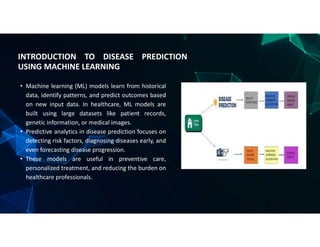
• Machine learning (ML) models learn from historical
data, identify patterns, and predict outcomes based
on new input data. In healthcare, ML models are
built using large datasets like patient records,
genetic information, or medical images.
• Predictive analytics in disease prediction focuses on
detecting risk factors, diagnosing diseases early, and
even forecasting disease progression.
• These models are useful in preventive care,
personalized treatment, and reducing the burden on
healthcare professionals.
TYPES OF DISEASES AND PREDICTION
MODELS
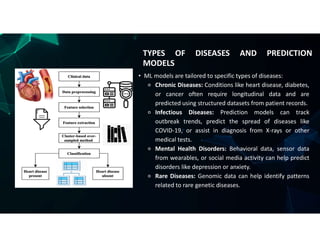
• ML models are tailored to specific types of diseases:
⚬ Chronic Diseases: Conditions like heart disease, diabetes,
or cancer often require longitudinal data and are
predicted using structured datasets from patient records.
⚬ Infectious Diseases: Prediction models can track
outbreak trends, predict the spread of diseases like
COVID-19, or assist in diagnosis from X-rays or other
medical tests.
⚬ Mental Health Disorders: Behavioral data, sensor data
from wearables, or social media activity can help predict
disorders like depression or anxiety.
⚬ Rare Diseases: Genomic data can help identify patterns
related to rare genetic diseases.
MACHINE LEARNING ALGORITHMS FOR
DISEASE PREDICTION
1. Logistic Regression
• Overview:
⚬ Logistic regression is a statistical method used for binary classification problems, where the
outcome is either 0 or 1, such as whether a person has a disease or not.
⚬ It calculates the probability of the target variable based on a set of input features (e.g., age, blood
pressure, cholesterol).
⚬ The algorithm uses a sigmoid function to map the output to a probability between 0 and 1.
• Use in Disease Prediction:
⚬ Widely used in predicting diseases like heart disease or diabetes, where the outcome is binary
(yes/no).
⚬ It’s simple, interpretable, and efficient for datasets where relationships between input features and
output are mostly linear.
MACHINE LEARNING ALGORITHMS FOR
DISEASE PREDICTION
2. Random Forest
• Overview:
⚬ Random Forest is an ensemble learning method that constructs multiple decision trees during
training. Each tree votes for the final prediction, making it robust and less prone to overfitting.
⚬ It handles both classification and regression tasks and can manage large datasets with higher
dimensionality.
• Use in Disease Prediction:
⚬ Commonly used for predicting diseases like cancer or heart disease based on structured patient
data (e.g., age, BMI, glucose levels).
⚬ It’s effective when relationships between features are non-linear and when there is noise in the
data.
MACHINE LEARNING ALGORITHMS FOR
DISEASE PREDICTION
3. Support Vector Machine (SVM)
• Overview:
⚬ SVM is a powerful classification algorithm that works by finding the hyperplane that best separates
data points of different classes.
⚬ It can perform both linear and non-linear classification using a technique called the "kernel trick" to
transform data into higher dimensions where it’s easier to separate.
• Use in Disease Prediction:
⚬ Frequently applied to cancer classification problems (e.g., detecting breast cancer from biopsy
data) and genetic disease prediction.
⚬ SVM is effective for datasets with a clear margin of separation between classes and is known for its
ability to handle high-dimensional data like gene expression profiles.
MACHINE LEARNING ALGORITHMS FOR
DISEASE PREDICTION
4. K-Nearest Neighbors (KNN)
• Overview:
⚬ KNN is a simple, non-parametric algorithm used for classification and regression. It works by
finding the ‘k’ closest data points in the training set to make predictions about new data.
⚬ It assigns a class based on the majority label among its nearest neighbors.
• Use in Disease Prediction:
⚬ KNN is useful for disease classification tasks such as diagnosing diabetes or heart disease based on
input features like glucose levels and age.
⚬ It’s intuitive and doesn’t make any assumptions about the underlying data distribution, making it
flexible but computationally expensive for large datasets.
MACHINE LEARNING ALGORITHMS FOR
DISEASE PREDICTION
5. Convolutional Neural Networks (CNN)
• Overview:
⚬ CNN is a type of deep learning algorithm mainly used for image classification tasks. It applies
convolutional layers to detect patterns and features (e.g., edges, textures) in images.
⚬ CNNs are highly efficient in tasks involving high-dimensional data, such as medical imaging (e.g., X-
rays, CT scans).
• Use in Disease Prediction:
⚬ Extensively used in medical imaging for tasks like detecting tumors in MRI scans or diagnosing lung
infections in chest X-rays.
⚬ CNNs are ideal for identifying disease patterns in radiology, pathology, and ophthalmology, where
complex image data requires automated analysis.
• Detailed Explanation:
⚬ Electronic Health Records (EHRs): Contain detailed patient
information such as age, medical history, lab results, and
treatments.
⚬ Genomic Data: Used for precision medicine, identifying gene
variants that may lead to specific diseases.
⚬ Medical Imaging: X-rays, MRIs, CT scans are analyzed with
ML algorithms to detect disease markers.
⚬ Wearable Devices: Data from fitness trackers (e.g., heart
rate, sleep data) are used for real-time disease risk
prediction.
⚬ Laboratory Data: Blood tests, glucose levels, cholesterol
levels, and other clinical lab results can help build predictive
models for diseases like diabetes or heart disease.
DATA SOURCES IN DISEASE PREDICTION
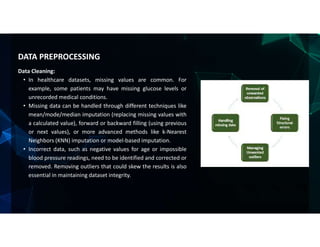
Data Cleaning:
• In healthcare datasets, missing values are common. For
example, some patients may have missing glucose levels or
unrecorded medical conditions.
• Missing data can be handled through different techniques like
mean/mode/median imputation (replacing missing values with
a calculated value), forward or backward filling (using previous
or next values), or more advanced methods like k-Nearest
Neighbors (KNN) imputation or model-based imputation.
• Incorrect data, such as negative values for age or impossible
blood pressure readings, need to be identified and corrected or
removed. Removing outliers that could skew the results is also
essential in maintaining dataset integrity.
DATA PREPROCESSING
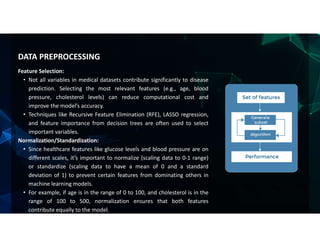
Feature Selection:
• Not all variables in medical datasets contribute significantly to disease
prediction. Selecting the most relevant features (e.g., age, blood
pressure, cholesterol levels) can reduce computational cost and
improve the model’s accuracy.
• Techniques like Recursive Feature Elimination (RFE), LASSO regression,
and feature importance from decision trees are often used to select
important variables.
Normalization/Standardization:
• Since healthcare features like glucose levels and blood pressure are on
different scales, it’s important to normalize (scaling data to 0-1 range)
or standardize (scaling data to have a mean of 0 and a standard
deviation of 1) to prevent certain features from dominating others in
machine learning models.
• For example, if age is in the range of 0 to 100, and cholesterol is in the
range of 100 to 500, normalization ensures that both features
contribute equally to the model.
DATA PREPROCESSING
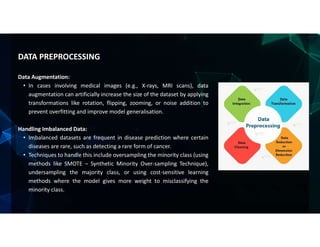
Data Augmentation:
• In cases involving medical images (e.g., X-rays, MRI scans), data
augmentation can artificially increase the size of the dataset by applying
transformations like rotation, flipping, zooming, or noise addition to
prevent overfitting and improve model generalisation.
Handling Imbalanced Data:
• Imbalanced datasets are frequent in disease prediction where certain
diseases are rare, such as detecting a rare form of cancer.
• Techniques to handle this include oversampling the minority class (using
methods like SMOTE – Synthetic Minority Over-sampling Technique),
undersampling the majority class, or using cost-sensitive learning
methods where the model gives more weight to misclassifying the
minority class.
DATA PREPROCESSING
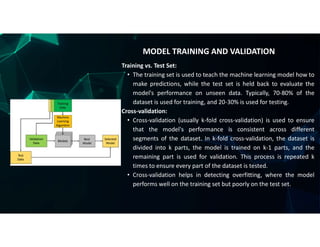
Training vs. Test Set:
• The training set is used to teach the machine learning model how to
make predictions, while the test set is held back to evaluate the
model's performance on unseen data. Typically, 70-80% of the
dataset is used for training, and 20-30% is used for testing.
Cross-validation:
• Cross-validation (usually k-fold cross-validation) is used to ensure
that the model's performance is consistent across different
segments of the dataset. In k-fold cross-validation, the dataset is
divided into k parts, the model is trained on k-1 parts, and the
remaining part is used for validation. This process is repeated k
times to ensure every part of the dataset is tested.
• Cross-validation helps in detecting overfitting, where the model
performs well on the training set but poorly on the test set.
MODEL TRAINING AND VALIDATION
Metrics:
• Accuracy: Measures the percentage of correct predictions, but may not be a good metric for imbalanced
datasets (e.g., if 95% of patients do not have a disease, a model could achieve 95% accuracy by always
predicting “no disease”).
• Precision and Recall: Precision measures the percentage of true positive predictions out of all positive
predictions made. Recall measures the percentage of actual positive cases that were correctly predicted.
Both metrics are crucial for medical applications where false positives and false negatives have serious
consequences.
• F1 Score: The harmonic mean of precision and recall, useful for balancing the trade-offs between the
two.
• ROC and AUC: The ROC (Receiver Operating Characteristic) curve plots the true positive rate vs. the false
positive rate at various threshold settings. The Area Under the Curve (AUC) measures the overall
performance of the model. It is especially useful for binary classification problems, like whether a patient
has a disease or not.
• Overfitting:
⚬ Overfitting occurs when the model memorizes the training data, capturing noise or irrelevant
patterns, and performs poorly on new, unseen data. In disease prediction, this could mean the
model performs well in predicting heart disease on a training dataset but fails to generalize to new
patients.
⚬ Regularization: Techniques like L1 (Lasso) and L2 (Ridge) regularization can reduce overfitting by
penalizing large coefficients in the model.
⚬ Dropout: In deep learning models, dropout randomly deactivates a certain percentage of neurons
during training to prevent over-reliance on specific paths in the neural network.
• Underfitting:
⚬ Underfitting occurs when the model is too simple to capture the underlying structure of the data.
This often happens when important features are left out or the model doesn’t have enough
capacity to learn complex patterns.
⚬ Increasing the model complexity (e.g., using deeper neural networks or adding more features) and
improving feature selection can mitigate underfitting.
HANDLING OVERFITTING AND UNDERFITTING
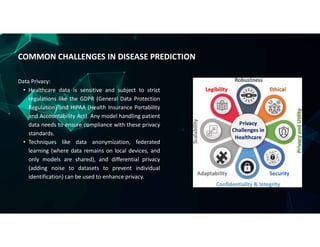
Data Privacy:
• Healthcare data is sensitive and subject to strict
regulations like the GDPR (General Data Protection
Regulation) and HIPAA (Health Insurance Portability
and Accountability Act). Any model handling patient
data needs to ensure compliance with these privacy
standards.
• Techniques like data anonymization, federated
learning (where data remains on local devices, and
only models are shared), and differential privacy
(adding noise to datasets to prevent individual
identification) can be used to enhance privacy.
COMMON CHALLENGES IN DISEASE PREDICTION
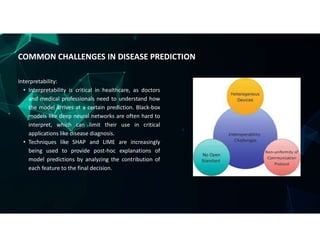
Interpretability:
• Interpretability is critical in healthcare, as doctors
and medical professionals need to understand how
the model arrives at a certain prediction. Black-box
models like deep neural networks are often hard to
interpret, which can limit their use in critical
applications like disease diagnosis.
• Techniques like SHAP and LIME are increasingly
being used to provide post-hoc explanations of
model predictions by analyzing the contribution of
each feature to the final decision.
COMMON CHALLENGES IN DISEASE PREDICTION
Class Imbalance:
• Many disease prediction models face imbalanced
datasets, where a large number of cases belong to one
class (e.g., healthy individuals), and only a small portion
belongs to the disease class. This can lead to biased
models that favor the majority class.
• Resampling methods (oversampling/undersampling) and
specialized algorithms like weighted loss functions can
help address this imbalance.
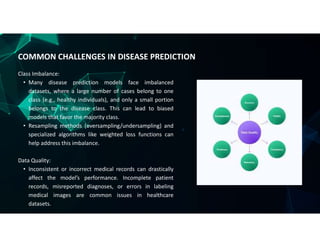
Data Quality:
• Inconsistent or incorrect medical records can drastically
affect the model’s performance. Incomplete patient
records, misreported diagnoses, or errors in labeling
medical images are common issues in healthcare
datasets.
COMMON CHALLENGES IN DISEASE PREDICTION
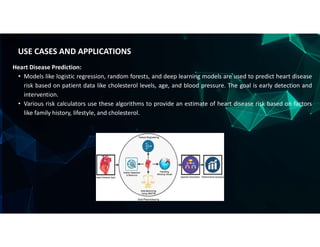
Heart Disease Prediction:
• Models like logistic regression, random forests, and deep learning models are used to predict heart disease
risk based on patient data like cholesterol levels, age, and blood pressure. The goal is early detection and
intervention.
• Various risk calculators use these algorithms to provide an estimate of heart disease risk based on factors
like family history, lifestyle, and cholesterol.
USE CASES AND APPLICATIONS
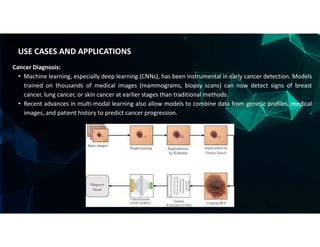
Cancer Diagnosis:
• Machine learning, especially deep learning (CNNs), has been instrumental in early cancer detection. Models
trained on thousands of medical images (mammograms, biopsy scans) can now detect signs of breast
cancer, lung cancer, or skin cancer at earlier stages than traditional methods.
• Recent advances in multi-modal learning also allow models to combine data from genetic profiles, medical
images, and patient history to predict cancer progression.
USE CASES AND APPLICATIONS
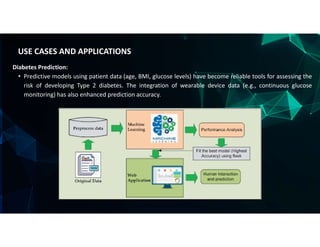
Diabetes Prediction:
• Predictive models using patient data (age, BMI, glucose levels) have become reliable tools for assessing the
risk of developing Type 2 diabetes. The integration of wearable device data (e.g., continuous glucose
monitoring) has also enhanced prediction accuracy.
USE CASES AND APPLICATIONS
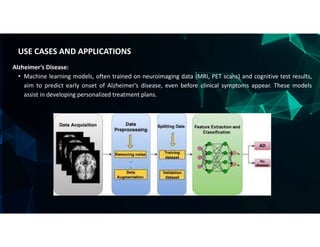
Alzheimer’s Disease:
• Machine learning models, often trained on neuroimaging data (MRI, PET scans) and cognitive test results,
aim to predict early onset of Alzheimer's disease, even before clinical symptoms appear. These models
assist in developing personalized treatment plans.
USE CASES AND APPLICATIONS
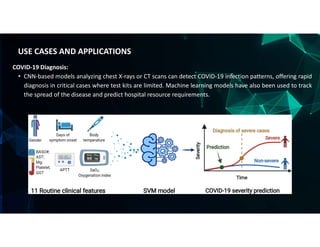
COVID-19 Diagnosis:
• CNN-based models analyzing chest X-rays or CT scans can detect COVID-19 infection patterns, offering rapid
diagnosis in critical cases where test kits are limited. Machine learning models have also been used to track
the spread of the disease and predict hospital resource requirements.
USE CASES AND APPLICATIONS
THANK YOU!

Disease prediction using machine learning.pdf

  • 1.
  • 2.
    INTRODUCTION TO DISEASEPREDICTION USING MACHINE LEARNING • Machine learning (ML) models learn from historical data, identify patterns, and predict outcomes based on new input data. In healthcare, ML models are built using large datasets like patient records, genetic information, or medical images. • Predictive analytics in disease prediction focuses on detecting risk factors, diagnosing diseases early, and even forecasting disease progression. • These models are useful in preventive care, personalized treatment, and reducing the burden on healthcare professionals.
  • 3.
    TYPES OF DISEASESAND PREDICTION MODELS • ML models are tailored to specific types of diseases: ⚬ Chronic Diseases: Conditions like heart disease, diabetes, or cancer often require longitudinal data and are predicted using structured datasets from patient records. ⚬ Infectious Diseases: Prediction models can track outbreak trends, predict the spread of diseases like COVID-19, or assist in diagnosis from X-rays or other medical tests. ⚬ Mental Health Disorders: Behavioral data, sensor data from wearables, or social media activity can help predict disorders like depression or anxiety. ⚬ Rare Diseases: Genomic data can help identify patterns related to rare genetic diseases.
  • 4.
    MACHINE LEARNING ALGORITHMSFOR DISEASE PREDICTION 1. Logistic Regression • Overview: ⚬ Logistic regression is a statistical method used for binary classification problems, where the outcome is either 0 or 1, such as whether a person has a disease or not. ⚬ It calculates the probability of the target variable based on a set of input features (e.g., age, blood pressure, cholesterol). ⚬ The algorithm uses a sigmoid function to map the output to a probability between 0 and 1. • Use in Disease Prediction: ⚬ Widely used in predicting diseases like heart disease or diabetes, where the outcome is binary (yes/no). ⚬ It’s simple, interpretable, and efficient for datasets where relationships between input features and output are mostly linear.
  • 5.
    MACHINE LEARNING ALGORITHMSFOR DISEASE PREDICTION 2. Random Forest • Overview: ⚬ Random Forest is an ensemble learning method that constructs multiple decision trees during training. Each tree votes for the final prediction, making it robust and less prone to overfitting. ⚬ It handles both classification and regression tasks and can manage large datasets with higher dimensionality. • Use in Disease Prediction: ⚬ Commonly used for predicting diseases like cancer or heart disease based on structured patient data (e.g., age, BMI, glucose levels). ⚬ It’s effective when relationships between features are non-linear and when there is noise in the data.
  • 6.
    MACHINE LEARNING ALGORITHMSFOR DISEASE PREDICTION 3. Support Vector Machine (SVM) • Overview: ⚬ SVM is a powerful classification algorithm that works by finding the hyperplane that best separates data points of different classes. ⚬ It can perform both linear and non-linear classification using a technique called the "kernel trick" to transform data into higher dimensions where it’s easier to separate. • Use in Disease Prediction: ⚬ Frequently applied to cancer classification problems (e.g., detecting breast cancer from biopsy data) and genetic disease prediction. ⚬ SVM is effective for datasets with a clear margin of separation between classes and is known for its ability to handle high-dimensional data like gene expression profiles.
  • 7.
    MACHINE LEARNING ALGORITHMSFOR DISEASE PREDICTION 4. K-Nearest Neighbors (KNN) • Overview: ⚬ KNN is a simple, non-parametric algorithm used for classification and regression. It works by finding the ‘k’ closest data points in the training set to make predictions about new data. ⚬ It assigns a class based on the majority label among its nearest neighbors. • Use in Disease Prediction: ⚬ KNN is useful for disease classification tasks such as diagnosing diabetes or heart disease based on input features like glucose levels and age. ⚬ It’s intuitive and doesn’t make any assumptions about the underlying data distribution, making it flexible but computationally expensive for large datasets.
  • 8.
    MACHINE LEARNING ALGORITHMSFOR DISEASE PREDICTION 5. Convolutional Neural Networks (CNN) • Overview: ⚬ CNN is a type of deep learning algorithm mainly used for image classification tasks. It applies convolutional layers to detect patterns and features (e.g., edges, textures) in images. ⚬ CNNs are highly efficient in tasks involving high-dimensional data, such as medical imaging (e.g., X- rays, CT scans). • Use in Disease Prediction: ⚬ Extensively used in medical imaging for tasks like detecting tumors in MRI scans or diagnosing lung infections in chest X-rays. ⚬ CNNs are ideal for identifying disease patterns in radiology, pathology, and ophthalmology, where complex image data requires automated analysis.
  • 9.
    • Detailed Explanation: ⚬Electronic Health Records (EHRs): Contain detailed patient information such as age, medical history, lab results, and treatments. ⚬ Genomic Data: Used for precision medicine, identifying gene variants that may lead to specific diseases. ⚬ Medical Imaging: X-rays, MRIs, CT scans are analyzed with ML algorithms to detect disease markers. ⚬ Wearable Devices: Data from fitness trackers (e.g., heart rate, sleep data) are used for real-time disease risk prediction. ⚬ Laboratory Data: Blood tests, glucose levels, cholesterol levels, and other clinical lab results can help build predictive models for diseases like diabetes or heart disease. DATA SOURCES IN DISEASE PREDICTION
  • 10.
    Data Cleaning: • Inhealthcare datasets, missing values are common. For example, some patients may have missing glucose levels or unrecorded medical conditions. • Missing data can be handled through different techniques like mean/mode/median imputation (replacing missing values with a calculated value), forward or backward filling (using previous or next values), or more advanced methods like k-Nearest Neighbors (KNN) imputation or model-based imputation. • Incorrect data, such as negative values for age or impossible blood pressure readings, need to be identified and corrected or removed. Removing outliers that could skew the results is also essential in maintaining dataset integrity. DATA PREPROCESSING
  • 11.
    Feature Selection: • Notall variables in medical datasets contribute significantly to disease prediction. Selecting the most relevant features (e.g., age, blood pressure, cholesterol levels) can reduce computational cost and improve the model’s accuracy. • Techniques like Recursive Feature Elimination (RFE), LASSO regression, and feature importance from decision trees are often used to select important variables. Normalization/Standardization: • Since healthcare features like glucose levels and blood pressure are on different scales, it’s important to normalize (scaling data to 0-1 range) or standardize (scaling data to have a mean of 0 and a standard deviation of 1) to prevent certain features from dominating others in machine learning models. • For example, if age is in the range of 0 to 100, and cholesterol is in the range of 100 to 500, normalization ensures that both features contribute equally to the model. DATA PREPROCESSING
  • 12.
    Data Augmentation: • Incases involving medical images (e.g., X-rays, MRI scans), data augmentation can artificially increase the size of the dataset by applying transformations like rotation, flipping, zooming, or noise addition to prevent overfitting and improve model generalisation. Handling Imbalanced Data: • Imbalanced datasets are frequent in disease prediction where certain diseases are rare, such as detecting a rare form of cancer. • Techniques to handle this include oversampling the minority class (using methods like SMOTE – Synthetic Minority Over-sampling Technique), undersampling the majority class, or using cost-sensitive learning methods where the model gives more weight to misclassifying the minority class. DATA PREPROCESSING
  • 13.
    Training vs. TestSet: • The training set is used to teach the machine learning model how to make predictions, while the test set is held back to evaluate the model's performance on unseen data. Typically, 70-80% of the dataset is used for training, and 20-30% is used for testing. Cross-validation: • Cross-validation (usually k-fold cross-validation) is used to ensure that the model's performance is consistent across different segments of the dataset. In k-fold cross-validation, the dataset is divided into k parts, the model is trained on k-1 parts, and the remaining part is used for validation. This process is repeated k times to ensure every part of the dataset is tested. • Cross-validation helps in detecting overfitting, where the model performs well on the training set but poorly on the test set. MODEL TRAINING AND VALIDATION
  • 14.
    MODEL TRAINING ANDVALIDATION Metrics: • Accuracy: Measures the percentage of correct predictions, but may not be a good metric for imbalanced datasets (e.g., if 95% of patients do not have a disease, a model could achieve 95% accuracy by always predicting “no disease”). • Precision and Recall: Precision measures the percentage of true positive predictions out of all positive predictions made. Recall measures the percentage of actual positive cases that were correctly predicted. Both metrics are crucial for medical applications where false positives and false negatives have serious consequences. • F1 Score: The harmonic mean of precision and recall, useful for balancing the trade-offs between the two. • ROC and AUC: The ROC (Receiver Operating Characteristic) curve plots the true positive rate vs. the false positive rate at various threshold settings. The Area Under the Curve (AUC) measures the overall performance of the model. It is especially useful for binary classification problems, like whether a patient has a disease or not.
  • 15.
    • Overfitting: ⚬ Overfittingoccurs when the model memorizes the training data, capturing noise or irrelevant patterns, and performs poorly on new, unseen data. In disease prediction, this could mean the model performs well in predicting heart disease on a training dataset but fails to generalize to new patients. ⚬ Regularization: Techniques like L1 (Lasso) and L2 (Ridge) regularization can reduce overfitting by penalizing large coefficients in the model. ⚬ Dropout: In deep learning models, dropout randomly deactivates a certain percentage of neurons during training to prevent over-reliance on specific paths in the neural network. • Underfitting: ⚬ Underfitting occurs when the model is too simple to capture the underlying structure of the data. This often happens when important features are left out or the model doesn’t have enough capacity to learn complex patterns. ⚬ Increasing the model complexity (e.g., using deeper neural networks or adding more features) and improving feature selection can mitigate underfitting. HANDLING OVERFITTING AND UNDERFITTING
  • 16.
    Data Privacy: • Healthcaredata is sensitive and subject to strict regulations like the GDPR (General Data Protection Regulation) and HIPAA (Health Insurance Portability and Accountability Act). Any model handling patient data needs to ensure compliance with these privacy standards. • Techniques like data anonymization, federated learning (where data remains on local devices, and only models are shared), and differential privacy (adding noise to datasets to prevent individual identification) can be used to enhance privacy. COMMON CHALLENGES IN DISEASE PREDICTION
  • 17.
    Interpretability: • Interpretability iscritical in healthcare, as doctors and medical professionals need to understand how the model arrives at a certain prediction. Black-box models like deep neural networks are often hard to interpret, which can limit their use in critical applications like disease diagnosis. • Techniques like SHAP and LIME are increasingly being used to provide post-hoc explanations of model predictions by analyzing the contribution of each feature to the final decision. COMMON CHALLENGES IN DISEASE PREDICTION
  • 18.
    Class Imbalance: • Manydisease prediction models face imbalanced datasets, where a large number of cases belong to one class (e.g., healthy individuals), and only a small portion belongs to the disease class. This can lead to biased models that favor the majority class. • Resampling methods (oversampling/undersampling) and specialized algorithms like weighted loss functions can help address this imbalance. Data Quality: • Inconsistent or incorrect medical records can drastically affect the model’s performance. Incomplete patient records, misreported diagnoses, or errors in labeling medical images are common issues in healthcare datasets. COMMON CHALLENGES IN DISEASE PREDICTION
  • 19.
    Heart Disease Prediction: •Models like logistic regression, random forests, and deep learning models are used to predict heart disease risk based on patient data like cholesterol levels, age, and blood pressure. The goal is early detection and intervention. • Various risk calculators use these algorithms to provide an estimate of heart disease risk based on factors like family history, lifestyle, and cholesterol. USE CASES AND APPLICATIONS
  • 20.
    Cancer Diagnosis: • Machinelearning, especially deep learning (CNNs), has been instrumental in early cancer detection. Models trained on thousands of medical images (mammograms, biopsy scans) can now detect signs of breast cancer, lung cancer, or skin cancer at earlier stages than traditional methods. • Recent advances in multi-modal learning also allow models to combine data from genetic profiles, medical images, and patient history to predict cancer progression. USE CASES AND APPLICATIONS
  • 21.
    Diabetes Prediction: • Predictivemodels using patient data (age, BMI, glucose levels) have become reliable tools for assessing the risk of developing Type 2 diabetes. The integration of wearable device data (e.g., continuous glucose monitoring) has also enhanced prediction accuracy. USE CASES AND APPLICATIONS
  • 22.
    Alzheimer’s Disease: • Machinelearning models, often trained on neuroimaging data (MRI, PET scans) and cognitive test results, aim to predict early onset of Alzheimer's disease, even before clinical symptoms appear. These models assist in developing personalized treatment plans. USE CASES AND APPLICATIONS
  • 23.
    COVID-19 Diagnosis: • CNN-basedmodels analyzing chest X-rays or CT scans can detect COVID-19 infection patterns, offering rapid diagnosis in critical cases where test kits are limited. Machine learning models have also been used to track the spread of the disease and predict hospital resource requirements. USE CASES AND APPLICATIONS
  • 24.