1
DECENTRALIZED DATA STORAGE AND ACCESS
OF CLOUD SERVER USING ATTRIBUTE BASED
ENCRYPTION
Under The Esteemed Guidance Of
B.NANADAN KUMAR, M.Tech,
Presented By
K.R.S.SPANDANA
189P1D5803
M.TECH CSE
II Year IV Semester
ABSTRACT
As we all know that all the sensitive data come from remote locations will
be stored in the centralized storage medium and then try to access the data from that
centralized storage space controlled by the cloud server. It is facing a problem like
there is no security for the data in terms of user authorization and data
authentication from the centralized storage location. Hence we need to migrate for a
new storage procedure like De-Centralized storage of cloud data in which the
systems that do not rely on a central authority, so that we can able to avoid the
collusion resistance by maintaining a Global Identifier. Here the term de-centralized
access means granting multi authorities to control the access for providing more
security for the sensitive data. In this current application we try to develop a new
scheme by adding a global identifier like Attribute Authority (AA) for providing
access keys for the data users who wish to access the sensitive information from the
cloud server. In our work we try to use Composite Order Bilinear Groups scheme
for providing access facility for the data users and provide more security for the
sensitive data. By conducting various experiments on our model, our result clearly
tells that our system is very efficient to access the data in a de-centralized manner
by using a global identifier.
EXISTING SYSTEM
In the existing cloud servers ,there was no concept like
encryption of cloud data and also there was no facility like a
global identifier like Attribute Authority (AA) for providing
access keys for the data users who wish to access the sensitive
information from the cloud server. The current cloud storage is
almost centralized and all the data which is stored along with
details of data owners and data users is clearly visible by the
cloud server department, which is almost a big problem in the
current cloud service providers. In the current cloud servers all
the data can be viewed and accessed by any one who is having an
account access within the cloud, so that the data is not having
integrity or security in terms of any modification or changes done
by any user. Also in the current cloud servers there is no facility
like multi authority data access for providing security in the
cloud.
LIMITATIONS OF EXISTING SYSTEM
In the existing or current clouds the following are the
main limitations that are available
1. All the existing schemes are limited to the single-owner model.
2. All the current cloud servers has search in a normal manner
under plain text model, but they don’t have any facility to
search in a ENRYPTED manner
3. There is no concept like multi authority which grants private
and secret keys for downloading the file in a secure manner.
4. The current cloud servers don’t have a facility to store the
sensitive information under a de-centralized manner in which
the access should lie in the hands of separate individual
departments.
5. There is no term like global identifier for the existing cloud and
there is no trust in the existing clouds.
PROPOSED SYSTEM
We try to develop a new scheme by adding a global identifier
like Attribute Authority (AA) for providing access keys for the data
users who wish to access the sensitive information from the cloud
server. In this proposed work we try to use Composite Order Bilinear
Groups scheme for providing access facility for the data users and
provide more security for the sensitive data. This will try to grant
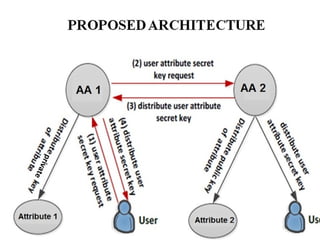
security for the data and users by using multi authority model. Here
the term multi authority means the data will been in the hands of
attribute authority where AA1 will generate private key for
encrypting the data before it gets stored in the cloud server and AA2
will generate secret key for the end users for using this to decrypt the
data.
ADVANTAGES OF PROPOSED SYSTEM
1. The proposed scheme is mostly multi owner model.
2. The proposed model follow the search in a secure manner by
restricting the open source access to the end users.
3. The data will be stored in an encrypted manner rather than in the
plain text manner.
4. There is a concept like multi authority which grants private and
secret keys for downloading the file in a secure manner.
5. There is a term like global identifier for the proposed cloud
which can greatly provide secure access of sensitive data in a
decentralized manner.
HARDWARE REQUIREMENTS
 System : Pentium Dual Core.
 Hard Disk : 120 GB.
 Monitor : 15’’ LED
 Input Devices : Keyboard, Mouse
 RAM : 1GB.
SOFTWARE REQUIREMENTS
 Operating system : Windows 7.
 Coding Language : JAVA/J2EE
 Database : MYSQL 5.0
 Web Server : Apache Tomcat 7.0
 Software : JDK 1.7
IMPLEMENTATION PHASE
Implementation is the stage where the theoretical design is converted
into programmatically manner. In this stage we will divide the application into
a number of modules and then coded for deployment. The front end of the
application takes JSP,HTML and Java Beans and as a Back-End Data base
we took My SQL data base. The application is divided mainly into following 4
modules. They are as follows:
1. Data Owner Module
2. Authentication Center Module
3. Cloud Server Module
4. Data User
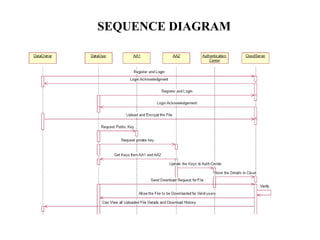
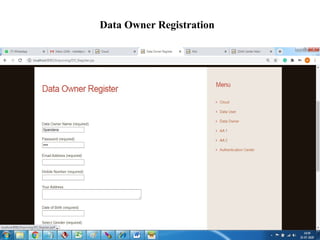
1.Data owner module
In this module, data owner has to register to
Authentication Center and Authentication Center checks
and authorizes the data owner login . Data owner browse
the file , encrypt and upload file with its mac. Once
uploaded the file all the authentication center must
provide the storage access for the file store on the cloud.
Data owner can also delete the file after the uploading of
the file to the cloud.
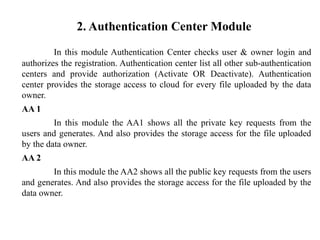
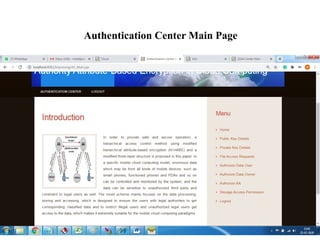
2. Authentication Center Module
In this module Authentication Center checks user & owner login and
authorizes the registration. Authentication center list all other sub-authentication
centers and provide authorization (Activate OR Deactivate). Authentication
center provides the storage access to cloud for every file uploaded by the data
owner.
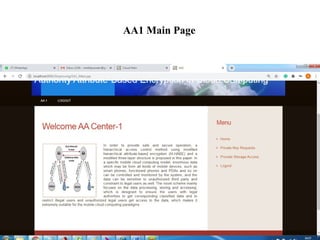
AA 1
In this module the AA1 shows all the private key requests from the
users and generates. And also provides the storage access for the file uploaded
by the data owner.
AA 2
In this module the AA2 shows all the public key requests from the users
and generates. And also provides the storage access for the file uploaded by the
data owner.
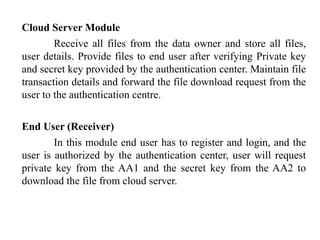
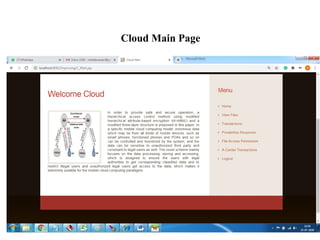
Cloud Server Module
Receive all files from the data owner and store all files,
user details. Provide files to end user after verifying Private key
and secret key provided by the authentication center. Maintain file
transaction details and forward the file download request from the
user to the authentication centre.
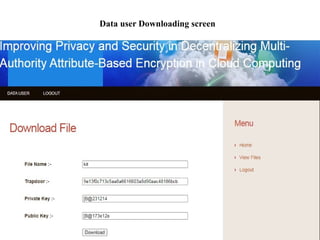
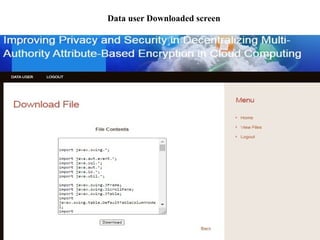
End User (Receiver)
In this module end user has to register and login, and the
user is authorized by the authentication center, user will request
private key from the AA1 and the secret key from the AA2 to
download the file from cloud server.
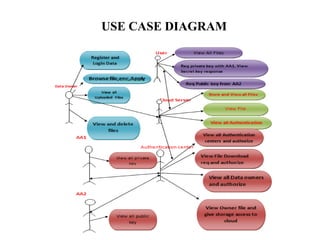
USE CASE DIAGRAM
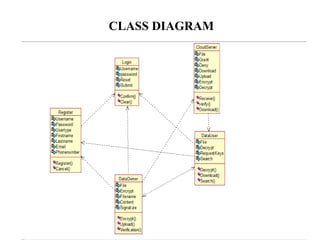
CLASS DIAGRAM
SEQUENCE DIAGRAM
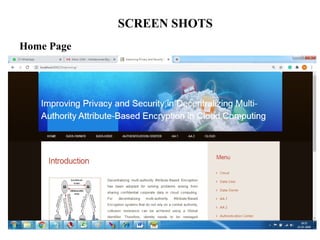
SCREEN SHOTS
Home Page
Cloud Main Page
AA1 Main Page
Data Owner Registration
Authentication Center Main Page
Data user Downloading screen
Data user Downloaded screen
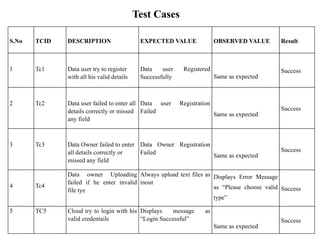
S.No TCID DESCRIPTION EXPECTED VALUE OBSERVED VALUE Result
1 Tc1 Data user try to register
with all his valid details
Data user Registered
Successfully Same as expected
Success
2 Tc2 Data user failed to enter all
details correctly or missed
any field
Data user Registration
Failed Same as expected
Success
3 Tc3 Data Owner failed to enter
all details correctly or
missed any field
Data Owner Registration
Failed Same as expected
Success
4 Tc4
Data owner Uploading
failed if he enter invalid
file tye
Always upload text files as
inout
Displays Error Message
as “Please choose valid
type”
Success
5 TC5 Cloud try to login with his
valid credentails
Displays message as
“Login Successful”
Same as expected
Success
Test Cases
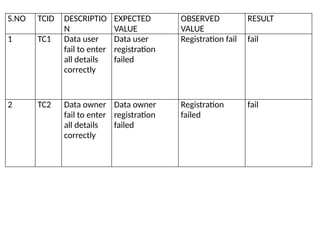
S.NO TCID DESCRIPTIO
N
EXPECTED
VALUE
OBSERVED
VALUE
RESULT
1 TC1 Data user
fail to enter
all details
correctly
Data user
registration
failed
Registration fail fail
2 TC2 Data owner
fail to enter
all details
correctly
Data owner
registration
failed
Registration
failed
fail
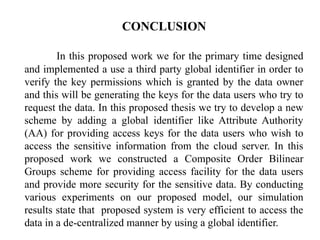
CONCLUSION
In this proposed work we for the primary time designed
and implemented a use a third party global identifier in order to
verify the key permissions which is granted by the data owner
and this will be generating the keys for the data users who try to
request the data. In this proposed thesis we try to develop a new
scheme by adding a global identifier like Attribute Authority
(AA) for providing access keys for the data users who wish to
access the sensitive information from the cloud server. In this
proposed work we constructed a Composite Order Bilinear
Groups scheme for providing access facility for the data users
and provide more security for the sensitive data. By conducting
various experiments on our proposed model, our simulation
results state that proposed system is very efficient to access the
data in a de-centralized manner by using a global identifier.
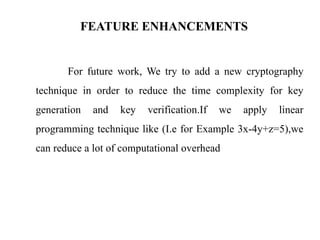
FEATURE ENHANCEMENTS
For future work, We try to add a new cryptography
technique in order to reduce the time complexity for key
generation and key verification.If we apply linear
programming technique like (I.e for Example 3x-4y+z=5),we
can reduce a lot of computational overhead
THANK YOU
ANY QUERIES?

Final PPT after cla after class (1).pptx

  • 1.
    1 DECENTRALIZED DATA STORAGEAND ACCESS OF CLOUD SERVER USING ATTRIBUTE BASED ENCRYPTION Under The Esteemed Guidance Of B.NANADAN KUMAR, M.Tech, Presented By K.R.S.SPANDANA 189P1D5803 M.TECH CSE II Year IV Semester
  • 2.
    ABSTRACT As we allknow that all the sensitive data come from remote locations will be stored in the centralized storage medium and then try to access the data from that centralized storage space controlled by the cloud server. It is facing a problem like there is no security for the data in terms of user authorization and data authentication from the centralized storage location. Hence we need to migrate for a new storage procedure like De-Centralized storage of cloud data in which the systems that do not rely on a central authority, so that we can able to avoid the collusion resistance by maintaining a Global Identifier. Here the term de-centralized access means granting multi authorities to control the access for providing more security for the sensitive data. In this current application we try to develop a new scheme by adding a global identifier like Attribute Authority (AA) for providing access keys for the data users who wish to access the sensitive information from the cloud server. In our work we try to use Composite Order Bilinear Groups scheme for providing access facility for the data users and provide more security for the sensitive data. By conducting various experiments on our model, our result clearly tells that our system is very efficient to access the data in a de-centralized manner by using a global identifier.
  • 3.
    EXISTING SYSTEM In theexisting cloud servers ,there was no concept like encryption of cloud data and also there was no facility like a global identifier like Attribute Authority (AA) for providing access keys for the data users who wish to access the sensitive information from the cloud server. The current cloud storage is almost centralized and all the data which is stored along with details of data owners and data users is clearly visible by the cloud server department, which is almost a big problem in the current cloud service providers. In the current cloud servers all the data can be viewed and accessed by any one who is having an account access within the cloud, so that the data is not having integrity or security in terms of any modification or changes done by any user. Also in the current cloud servers there is no facility like multi authority data access for providing security in the cloud.
  • 4.
    LIMITATIONS OF EXISTINGSYSTEM In the existing or current clouds the following are the main limitations that are available 1. All the existing schemes are limited to the single-owner model. 2. All the current cloud servers has search in a normal manner under plain text model, but they don’t have any facility to search in a ENRYPTED manner 3. There is no concept like multi authority which grants private and secret keys for downloading the file in a secure manner. 4. The current cloud servers don’t have a facility to store the sensitive information under a de-centralized manner in which the access should lie in the hands of separate individual departments. 5. There is no term like global identifier for the existing cloud and there is no trust in the existing clouds.
  • 5.
    PROPOSED SYSTEM We tryto develop a new scheme by adding a global identifier like Attribute Authority (AA) for providing access keys for the data users who wish to access the sensitive information from the cloud server. In this proposed work we try to use Composite Order Bilinear Groups scheme for providing access facility for the data users and provide more security for the sensitive data. This will try to grant security for the data and users by using multi authority model. Here the term multi authority means the data will been in the hands of attribute authority where AA1 will generate private key for encrypting the data before it gets stored in the cloud server and AA2 will generate secret key for the end users for using this to decrypt the data.
  • 6.
    ADVANTAGES OF PROPOSEDSYSTEM 1. The proposed scheme is mostly multi owner model. 2. The proposed model follow the search in a secure manner by restricting the open source access to the end users. 3. The data will be stored in an encrypted manner rather than in the plain text manner. 4. There is a concept like multi authority which grants private and secret keys for downloading the file in a secure manner. 5. There is a term like global identifier for the proposed cloud which can greatly provide secure access of sensitive data in a decentralized manner.
  • 8.
    HARDWARE REQUIREMENTS  System: Pentium Dual Core.  Hard Disk : 120 GB.  Monitor : 15’’ LED  Input Devices : Keyboard, Mouse  RAM : 1GB.
  • 9.
    SOFTWARE REQUIREMENTS  Operatingsystem : Windows 7.  Coding Language : JAVA/J2EE  Database : MYSQL 5.0  Web Server : Apache Tomcat 7.0  Software : JDK 1.7
  • 10.
    IMPLEMENTATION PHASE Implementation isthe stage where the theoretical design is converted into programmatically manner. In this stage we will divide the application into a number of modules and then coded for deployment. The front end of the application takes JSP,HTML and Java Beans and as a Back-End Data base we took My SQL data base. The application is divided mainly into following 4 modules. They are as follows: 1. Data Owner Module 2. Authentication Center Module 3. Cloud Server Module 4. Data User
  • 11.
    1.Data owner module Inthis module, data owner has to register to Authentication Center and Authentication Center checks and authorizes the data owner login . Data owner browse the file , encrypt and upload file with its mac. Once uploaded the file all the authentication center must provide the storage access for the file store on the cloud. Data owner can also delete the file after the uploading of the file to the cloud.
  • 12.
    2. Authentication CenterModule In this module Authentication Center checks user & owner login and authorizes the registration. Authentication center list all other sub-authentication centers and provide authorization (Activate OR Deactivate). Authentication center provides the storage access to cloud for every file uploaded by the data owner. AA 1 In this module the AA1 shows all the private key requests from the users and generates. And also provides the storage access for the file uploaded by the data owner. AA 2 In this module the AA2 shows all the public key requests from the users and generates. And also provides the storage access for the file uploaded by the data owner.
  • 13.
    Cloud Server Module Receiveall files from the data owner and store all files, user details. Provide files to end user after verifying Private key and secret key provided by the authentication center. Maintain file transaction details and forward the file download request from the user to the authentication centre. End User (Receiver) In this module end user has to register and login, and the user is authorized by the authentication center, user will request private key from the AA1 and the secret key from the AA2 to download the file from cloud server.
  • 14.
  • 15.
  • 16.
  • 17.
  • 18.
  • 19.
  • 20.
  • 21.
  • 22.
  • 23.
  • 24.
    S.No TCID DESCRIPTIONEXPECTED VALUE OBSERVED VALUE Result 1 Tc1 Data user try to register with all his valid details Data user Registered Successfully Same as expected Success 2 Tc2 Data user failed to enter all details correctly or missed any field Data user Registration Failed Same as expected Success 3 Tc3 Data Owner failed to enter all details correctly or missed any field Data Owner Registration Failed Same as expected Success 4 Tc4 Data owner Uploading failed if he enter invalid file tye Always upload text files as inout Displays Error Message as “Please choose valid type” Success 5 TC5 Cloud try to login with his valid credentails Displays message as “Login Successful” Same as expected Success Test Cases
  • 25.
    S.NO TCID DESCRIPTIO N EXPECTED VALUE OBSERVED VALUE RESULT 1TC1 Data user fail to enter all details correctly Data user registration failed Registration fail fail 2 TC2 Data owner fail to enter all details correctly Data owner registration failed Registration failed fail
  • 26.
    CONCLUSION In this proposedwork we for the primary time designed and implemented a use a third party global identifier in order to verify the key permissions which is granted by the data owner and this will be generating the keys for the data users who try to request the data. In this proposed thesis we try to develop a new scheme by adding a global identifier like Attribute Authority (AA) for providing access keys for the data users who wish to access the sensitive information from the cloud server. In this proposed work we constructed a Composite Order Bilinear Groups scheme for providing access facility for the data users and provide more security for the sensitive data. By conducting various experiments on our proposed model, our simulation results state that proposed system is very efficient to access the data in a de-centralized manner by using a global identifier.
  • 27.
    FEATURE ENHANCEMENTS For futurework, We try to add a new cryptography technique in order to reduce the time complexity for key generation and key verification.If we apply linear programming technique like (I.e for Example 3x-4y+z=5),we can reduce a lot of computational overhead
  • 28.
  • 29.