International Research Journal of Engineering and Technology (IRJET) e-ISSN: 2395-0056
Volume: 07 Issue: 01 | Jan 2020 www.irjet.net p-ISSN: 2395-0072
© 2020, IRJET | Impact Factor value: 7.34 | ISO 9001:2008 Certified Journal | Page 861
A Research paper on Block Design-based Key Agreement for Group
Data Sharing in Cloud Computing
Wajiha Nausheen1 & Shital Gaikwad2
1PG Student, Department of Computer Science and Engineering, Mathoshri Pratishthan Group of Institutions,
Khupsarwadi, Nanded, Maharashtra, India
2Associate Professor, Department of Computer Science and Engineering, Mathoshri Pratishthan Group of
Institutions, Khupsarwadi, Nanded, Maharashtra, India
---------------------------------------------------------------------***----------------------------------------------------------------------
Abstract - Cloud computing is evolving and considered next
generation architecture for computing. Typically cloud
computing is a combination of computing recourses accessible
via internet. Historically the client or organizations store data
in data centres with firewallandothersecuritytechniquesused
to protect data against intrudes to access the data. Howeverin
cloud computing, since the data is stored anywhere across the
globe, the client organizationshave lesscontroloverthestored
data. To build the trust for the growth of cloud computing the
cloud providersmustprotecttheuser’sdatafromunauthorized
access and disclosure.
Today, use of cloud computing is rapidly growing for several
purposes, mainly for large data storage and sharing data in
clouds. Here, users can share data for dynamic groups with
cost-effectively. Membership is frequently changing in a cloud.
The Existing system is using the protected (secure)
commutation channel fordata sharing.This implementationis
difficult for practice. Still, the existing system is suffering from
collusion attack and insecure key distribution with a single
cloud. There is no assurance of the data confidentiality and
accessibility. In the proposed system, multiple cloud services
are used to store data. The System is proposing a safe way for
key distribution without using any protected communication
channels, and the user can safely get their private keys from
group administrators (managers).Any users in the gathering
can use the source in the cloud and denied users cannot get to
the cloud once more. The system provides fine-grained access
control.
Also, the system supports the anti-collusion attack with an
untrustworthy cloud. Our system is proposing two levels of
encryption techniques and a file is stored in a split format on
multiple clouds in different groups using a hybrid cloud. The
system is providing secure revocation
Key Words: Key agreement protocol, symmetric balanced
incomplete block design (SBIBD), data sharing, cloud
computing
1. INTRODUCTION
In cloud computing, the cloud service providers offer single
or multiple cloud services for storing and sharing data
securelyamong users i.e.AmazonserviceS3.Cloudproviders
offers large storage space with abstraction for simplicity of
the user. The membership in the cloudisfrequentlychanging
and because of this, security-preserving are turned into a
challenging issue in the cloud. Company employees in the
same department can share and store files in the cloud.
However, here is a significant risk to the confidentiality of
those stored files. For security purpose, it is necessary to
encrypt data before uploading files in the cloud .These
schemes do not support for secure data sharing for dynamic
groups. Some systemshaveusedtechniquesforsecuringdata
sharing called cryptographyamong multiplegroupmembers
in an untrustworthy cloud .But these systems additionally
experiences a cost overheads and security risks. These
systems are not supported to dynamic group concept.re not
supported to dynamic group concept.
1.1 Background:
In some systems, combined approaches of key policy
attribute based encryption, proxy re-encryption,andlazyre-
encryption is used to achievefine-graineddataaccesscontrol
withoutdisclosingdatacontents.Othersystemusesthegroup
signatures and cipher text-policy attribute based encryption
techniques. But these systems does not support to efficient
user revocation. It breaches security. The multi-owner
schemes use the attribute-based techniques. If any owner
revokes from an application, it leads to security issues. This
approach is not safefordatasharing.Manyapproachesbased
on privacy-preserving policies in public clouds. These
approaches are easily suffering due to collusion attack. The
Existing approach supports secure data sharing scheme for
dynamic groups in a single cloud. The schemeuses attribute-
based techniques. It does not support protected/secure user
revocation. The proposedsystemusesrole-based techniques
for secure data sharing and key distribution for dynamic
groups by taking the advantage of multiple clouds. In
multiple clouds, storage space is again partitioned into
groups. The files get partitioned and then store in multiple
groups with two level of encryption. The system Supports
anti-collision attack and secure user revocation. Our system
overcomes cost overhead. Our approach removes a space
overhead by using the concept of the virtual storage server.
Here, the time and space constraints are applied. If the space
of storage became full, stored data is automatically
transferred to the virtual server according to the time and
spaceconstraint.
International Research Journal of Engineering and Technology (IRJET) e-ISSN: 2395-0056
Volume: 07 Issue: 01 | Jan 2020 www.irjet.net p-ISSN: 2395-0072
© 2020, IRJET | Impact Factor value: 7.34 | ISO 9001:2008 Certified Journal | Page 862
1.2 Motivation:
The Aim of this project is to propose a scheme that provides
the security, data sharing in multiuser cloud. To Calculated
the Fault Tolerances and fault Detection ofuserSideifhacker
hack any file of owner tolerance level increases.
 Data Security in Cloud.
 Mechanism to store data in cloud
 Mechanism to fetch data from cloud
 Access Control Lists with respect to roles on Data
 Performance improvement withusing lightweight
and flexible encryption mechanism to secure data
from cloud providers.
1.3 GOALS /OBJECTIVES
Authors wanted to show that is criticism about privacy in
cloud model, because of the fact that administrator have
access to data stored in the cloud. They can unintentionally
or intentionally access the clientdata.Traditional security or
protectiontechniquesneedreconsiderationforcloud.Except
for private cloud where organization does not have control
over the equipment, the progress of cloud is seems little
slow, because organizations think instead of compromising
on the security of the data, they are still willing to invest in
buying private equipment to setup their own infrastructure.
Security issues which are of concern to the client can be
classified into sensitive data access, data segregation, bug
exploitation, recovery,accountability,maliciousinsiders,and
account control issues. Like different disease have different
medicines, different cloud security issues have different
solutions, like cryptography, use of more than one cloud
provider, strong service level agreement between clientand
cloud service provider. Heavy investment is needed to
secure the compromising data in cloud. Following are some
of the concerns.
A. System Complexity: Compared to traditional data center
the cloud architecture is much more complex. Therefore
while considering security, security of all these components
and interaction of these components with each other needs
to be addressed.
B. Shared Multi-tenant Environment
Since the cloud needs to provide service to millions of client,
a logical separation of data is done at different level of the
application stack. Because of whichattackerinthefaceclient
can exploit the bugs gaining access to data from other
organizations.
C. Internet-facing Services: The cloud service which is
accessed over the internet via browser, thequalityofservice
delivered on the network is another concern.
D. Loss of control: As the data of client is stored anywhere
across the world control loss over physical, Logical of
system, and alternative control to client’s assets,
mismanagement of assets Are some additional concerns.
2. PROPOSED SYSTEM ARCHITECTURE
In Block level Design there are four module owner, user
and Admin and Cloud Service Provider. User entry in
application First user Register and Login then admin get
activated the user and given the token after entre the token
user login successfully after login user Search the ownerfile
and cloud Services Provider given the Key in format of
KASE. If user Entre the Wrong key (KASE) then leveloffault
Tolerances is level is increases and that level goes up to
three then owner known the user information and if owner
block the that user then after words user block from
particular owner the user are not able to get file of
particular owner
Advantages:
1. The scope of this project is to propose a scheme that
provides the anti-collusion data sharing in multiuser
cloud.
2. In cloud Computing Fault Detection from user side.
3. In cloud Computing FaultTolerancesand DataOwner.
4. Provide two level securities.
5. Cloud computing reduces the response time and
running time of job, also minimizes the risk in
deploying application, lowered cost of deployment,
and decreasing the effort and increasing innovation
6. Increased Throughput: Cloud makesuseofthousands
ofservers to finish an assignmentinreducedtimeunit
verses the time required by a solitary server
The system architecture is shown below,
International Research Journal of Engineering and Technology (IRJET) e-ISSN: 2395-0056
Volume: 07 Issue: 01 | Jan 2020 www.irjet.net p-ISSN: 2395-0072
© 2020, IRJET | Impact Factor value: 7.34 | ISO 9001:2008 Certified Journal | Page 863
Fig -1: Proposed System Architecture
3. RELATED WORK
The AES cipher is part of a family known as block ciphers,
which are algorithms that encrypt data on a per-block basis.
These “blocks” which are measured in bits determine the
input of plaintext and output of ciphertext. So for example,
since AES is 128 bits long, for every 128 bitsofplaintext, 128
bits of ciphertext are produced. Like nearly all encryption
algorithms, AES relies on the use of keys during the
encryption and decryption process. Since the AES algorithm
is symmetric, the same key is used for both encryption and
decryption. AES operates on what is knownasa 4x4column
major order matrix of bytes. Here is how the cycles break
down. A) 10 rounds are required for a 128-bit key. B) 12
Rounds are required for a 192-bit key. C) 14 Rounds are
required for a 256-bit key.
Fig -2: AES Algorithm
Broadly speaking the encryption/decryptioncan bedonevia
symmetric key or asymmetric key in symmetric algorithms,
both parties share the secret key for both
encryption/decryption, and from privacy perceptive it is
important that this key is not compromised, because
cascading data will then be compromised. Symmetric
encryption/decryption requireslesspowerforcomputation.
On the other hand asymmetric algorithms use pairs of keys,
of which one key is used for encryption while other key is
used for decryption. Generally the private key is kept secret
and generally held with the owner of data or trusted 3rd
party for the data, while the public key can be distributed to
others for encryption. The secret key can't be obtained from
the public key
3.1 Key Generation Algorithm:
Cipher(byte in[16], byte out[16], key_array
round_key[Nr+1])
Begin
byte state[16]; state = in;
AddRoundKey(state, round_key[0]);
for i = 1 to Nr-1 stepsize 1 do SubBytes(state);
ShiftRows(state);
MixColumns(state);
AddRoundKey(state, round_key[i]);
end for SubBytes(state);
ShiftRows(state);
AddRoundKey(state, round_key[Nr]);
End
International Research Journal of Engineering and Technology (IRJET) e-ISSN: 2395-0056
Volume: 07 Issue: 01 | Jan 2020 www.irjet.net p-ISSN: 2395-0072
© 2020, IRJET | Impact Factor value: 7.34 | ISO 9001:2008 Certified Journal | Page 864
3.2 High-level description of the algorithm
1. KeyExpansions—round keys are derived from the
cipher key using Rijndael's key schedule. AES
requires a separate 128-bit round key block for
each round plus one more.
2. InitialRound
1. AddRoundKey—each byte of the state is
combined with a block of the round key
using bitwise xor.
3. Rounds
1. SubBytes—a non-linear substitution step
where each byte is replaced with another
according to a lookup table.
2. ShiftRows—a transposition step where
the last three rows of the state are shifted
cyclically a certain number of steps.
3. MixColumns—a mixing operation which
operates on the columns of the state,
combining the four bytes in each column.
4. AddRoundKey
4. Final Round (no MixColumns)
1. SubBytes
2. ShiftRows
3. AddRoundKey.
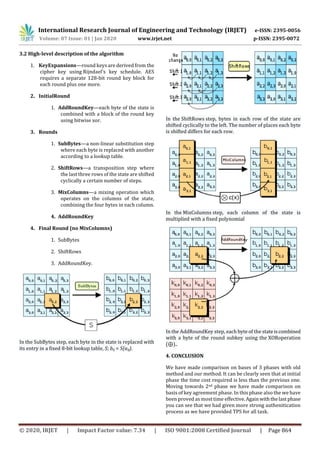
In the SubBytes step, each byte in the state is replaced with
its entry in a fixed 8-bit lookup table, S; bij = S(aij).
In the ShiftRows step, bytes in each row of the state are
shifted cyclically to the left. The number of places each byte
is shifted differs for each row.
In the MixColumns step, each column of the state is
multiplied with a fixed polynomial
In the AddRoundKey step, each byte of the stateiscombined
with a byte of the round subkey using the XORoperation
(⊕)..
4. CONCLUSION
We have made comparison on bases of 3 phases with old
method and our method. It can be clearly seen that at initial
phase the time cost required is less than the previous one.
Moving towards 2nd phase we have made comparison on
basis of key agreement phase. In this phase also the we have
been proved as most time effective.Againwiththelastphase
you can see that we had given more strong authenitication
process as we have provided TPS for all task.
International Research Journal of Engineering and Technology (IRJET) e-ISSN: 2395-0056
Volume: 07 Issue: 01 | Jan 2020 www.irjet.net p-ISSN: 2395-0072
© 2020, IRJET | Impact Factor value: 7.34 | ISO 9001:2008 Certified Journal | Page 865
In Cloud Computing as we provide a privacy-preserving
auditing protocol . It enables an external auditor to audit
user’s cloud data without learning the data content. This
scheme is the first to support scalable and efficient privacy
preserving public storage auditing in Cloud. Specifically, it
achieves batch auditing where multiple delegated auditing
tasks from different users can be performed simultaneously
by the TPA in a privacy-preserving manner. It achieves two
end data security level so it’s more secure.
REFERENCES
[1] L. Zhou, V. Varadharajan, and M. Hitchens,
“Cryptographic rolebased access control for secure cloud
data storage systems,” Information Forensics and Security
IEEE Transactions on, vol. 10, no. 11, pp. 2381–2395, 2015.
[2] F. Chen, T. Xiang, Y. Yang, and S. S. M. Chow,“Securecloud
storage meets with secure network coding,” in IEEE
INFOCOM, 2014, pp. 673– 681.
[3] J. Shen, S. Moh, and I. Chung, “Identity-based key
agreement protocol employing a symmetric balanced
incomplete block design,” Journal of Communications and
Networks, vol. 14, no. 6, pp. 682–691, 2012.

IRJET- A Research Paper on Block Design-based Key Agreement for Group Data Sharing in Cloud Computing

  • 1.
    International Research Journalof Engineering and Technology (IRJET) e-ISSN: 2395-0056 Volume: 07 Issue: 01 | Jan 2020 www.irjet.net p-ISSN: 2395-0072 © 2020, IRJET | Impact Factor value: 7.34 | ISO 9001:2008 Certified Journal | Page 861 A Research paper on Block Design-based Key Agreement for Group Data Sharing in Cloud Computing Wajiha Nausheen1 & Shital Gaikwad2 1PG Student, Department of Computer Science and Engineering, Mathoshri Pratishthan Group of Institutions, Khupsarwadi, Nanded, Maharashtra, India 2Associate Professor, Department of Computer Science and Engineering, Mathoshri Pratishthan Group of Institutions, Khupsarwadi, Nanded, Maharashtra, India ---------------------------------------------------------------------***---------------------------------------------------------------------- Abstract - Cloud computing is evolving and considered next generation architecture for computing. Typically cloud computing is a combination of computing recourses accessible via internet. Historically the client or organizations store data in data centres with firewallandothersecuritytechniquesused to protect data against intrudes to access the data. Howeverin cloud computing, since the data is stored anywhere across the globe, the client organizationshave lesscontroloverthestored data. To build the trust for the growth of cloud computing the cloud providersmustprotecttheuser’sdatafromunauthorized access and disclosure. Today, use of cloud computing is rapidly growing for several purposes, mainly for large data storage and sharing data in clouds. Here, users can share data for dynamic groups with cost-effectively. Membership is frequently changing in a cloud. The Existing system is using the protected (secure) commutation channel fordata sharing.This implementationis difficult for practice. Still, the existing system is suffering from collusion attack and insecure key distribution with a single cloud. There is no assurance of the data confidentiality and accessibility. In the proposed system, multiple cloud services are used to store data. The System is proposing a safe way for key distribution without using any protected communication channels, and the user can safely get their private keys from group administrators (managers).Any users in the gathering can use the source in the cloud and denied users cannot get to the cloud once more. The system provides fine-grained access control. Also, the system supports the anti-collusion attack with an untrustworthy cloud. Our system is proposing two levels of encryption techniques and a file is stored in a split format on multiple clouds in different groups using a hybrid cloud. The system is providing secure revocation Key Words: Key agreement protocol, symmetric balanced incomplete block design (SBIBD), data sharing, cloud computing 1. INTRODUCTION In cloud computing, the cloud service providers offer single or multiple cloud services for storing and sharing data securelyamong users i.e.AmazonserviceS3.Cloudproviders offers large storage space with abstraction for simplicity of the user. The membership in the cloudisfrequentlychanging and because of this, security-preserving are turned into a challenging issue in the cloud. Company employees in the same department can share and store files in the cloud. However, here is a significant risk to the confidentiality of those stored files. For security purpose, it is necessary to encrypt data before uploading files in the cloud .These schemes do not support for secure data sharing for dynamic groups. Some systemshaveusedtechniquesforsecuringdata sharing called cryptographyamong multiplegroupmembers in an untrustworthy cloud .But these systems additionally experiences a cost overheads and security risks. These systems are not supported to dynamic group concept.re not supported to dynamic group concept. 1.1 Background: In some systems, combined approaches of key policy attribute based encryption, proxy re-encryption,andlazyre- encryption is used to achievefine-graineddataaccesscontrol withoutdisclosingdatacontents.Othersystemusesthegroup signatures and cipher text-policy attribute based encryption techniques. But these systems does not support to efficient user revocation. It breaches security. The multi-owner schemes use the attribute-based techniques. If any owner revokes from an application, it leads to security issues. This approach is not safefordatasharing.Manyapproachesbased on privacy-preserving policies in public clouds. These approaches are easily suffering due to collusion attack. The Existing approach supports secure data sharing scheme for dynamic groups in a single cloud. The schemeuses attribute- based techniques. It does not support protected/secure user revocation. The proposedsystemusesrole-based techniques for secure data sharing and key distribution for dynamic groups by taking the advantage of multiple clouds. In multiple clouds, storage space is again partitioned into groups. The files get partitioned and then store in multiple groups with two level of encryption. The system Supports anti-collision attack and secure user revocation. Our system overcomes cost overhead. Our approach removes a space overhead by using the concept of the virtual storage server. Here, the time and space constraints are applied. If the space of storage became full, stored data is automatically transferred to the virtual server according to the time and spaceconstraint.
  • 2.
    International Research Journalof Engineering and Technology (IRJET) e-ISSN: 2395-0056 Volume: 07 Issue: 01 | Jan 2020 www.irjet.net p-ISSN: 2395-0072 © 2020, IRJET | Impact Factor value: 7.34 | ISO 9001:2008 Certified Journal | Page 862 1.2 Motivation: The Aim of this project is to propose a scheme that provides the security, data sharing in multiuser cloud. To Calculated the Fault Tolerances and fault Detection ofuserSideifhacker hack any file of owner tolerance level increases.  Data Security in Cloud.  Mechanism to store data in cloud  Mechanism to fetch data from cloud  Access Control Lists with respect to roles on Data  Performance improvement withusing lightweight and flexible encryption mechanism to secure data from cloud providers. 1.3 GOALS /OBJECTIVES Authors wanted to show that is criticism about privacy in cloud model, because of the fact that administrator have access to data stored in the cloud. They can unintentionally or intentionally access the clientdata.Traditional security or protectiontechniquesneedreconsiderationforcloud.Except for private cloud where organization does not have control over the equipment, the progress of cloud is seems little slow, because organizations think instead of compromising on the security of the data, they are still willing to invest in buying private equipment to setup their own infrastructure. Security issues which are of concern to the client can be classified into sensitive data access, data segregation, bug exploitation, recovery,accountability,maliciousinsiders,and account control issues. Like different disease have different medicines, different cloud security issues have different solutions, like cryptography, use of more than one cloud provider, strong service level agreement between clientand cloud service provider. Heavy investment is needed to secure the compromising data in cloud. Following are some of the concerns. A. System Complexity: Compared to traditional data center the cloud architecture is much more complex. Therefore while considering security, security of all these components and interaction of these components with each other needs to be addressed. B. Shared Multi-tenant Environment Since the cloud needs to provide service to millions of client, a logical separation of data is done at different level of the application stack. Because of whichattackerinthefaceclient can exploit the bugs gaining access to data from other organizations. C. Internet-facing Services: The cloud service which is accessed over the internet via browser, thequalityofservice delivered on the network is another concern. D. Loss of control: As the data of client is stored anywhere across the world control loss over physical, Logical of system, and alternative control to client’s assets, mismanagement of assets Are some additional concerns. 2. PROPOSED SYSTEM ARCHITECTURE In Block level Design there are four module owner, user and Admin and Cloud Service Provider. User entry in application First user Register and Login then admin get activated the user and given the token after entre the token user login successfully after login user Search the ownerfile and cloud Services Provider given the Key in format of KASE. If user Entre the Wrong key (KASE) then leveloffault Tolerances is level is increases and that level goes up to three then owner known the user information and if owner block the that user then after words user block from particular owner the user are not able to get file of particular owner Advantages: 1. The scope of this project is to propose a scheme that provides the anti-collusion data sharing in multiuser cloud. 2. In cloud Computing Fault Detection from user side. 3. In cloud Computing FaultTolerancesand DataOwner. 4. Provide two level securities. 5. Cloud computing reduces the response time and running time of job, also minimizes the risk in deploying application, lowered cost of deployment, and decreasing the effort and increasing innovation 6. Increased Throughput: Cloud makesuseofthousands ofservers to finish an assignmentinreducedtimeunit verses the time required by a solitary server The system architecture is shown below,
  • 3.
    International Research Journalof Engineering and Technology (IRJET) e-ISSN: 2395-0056 Volume: 07 Issue: 01 | Jan 2020 www.irjet.net p-ISSN: 2395-0072 © 2020, IRJET | Impact Factor value: 7.34 | ISO 9001:2008 Certified Journal | Page 863 Fig -1: Proposed System Architecture 3. RELATED WORK The AES cipher is part of a family known as block ciphers, which are algorithms that encrypt data on a per-block basis. These “blocks” which are measured in bits determine the input of plaintext and output of ciphertext. So for example, since AES is 128 bits long, for every 128 bitsofplaintext, 128 bits of ciphertext are produced. Like nearly all encryption algorithms, AES relies on the use of keys during the encryption and decryption process. Since the AES algorithm is symmetric, the same key is used for both encryption and decryption. AES operates on what is knownasa 4x4column major order matrix of bytes. Here is how the cycles break down. A) 10 rounds are required for a 128-bit key. B) 12 Rounds are required for a 192-bit key. C) 14 Rounds are required for a 256-bit key. Fig -2: AES Algorithm Broadly speaking the encryption/decryptioncan bedonevia symmetric key or asymmetric key in symmetric algorithms, both parties share the secret key for both encryption/decryption, and from privacy perceptive it is important that this key is not compromised, because cascading data will then be compromised. Symmetric encryption/decryption requireslesspowerforcomputation. On the other hand asymmetric algorithms use pairs of keys, of which one key is used for encryption while other key is used for decryption. Generally the private key is kept secret and generally held with the owner of data or trusted 3rd party for the data, while the public key can be distributed to others for encryption. The secret key can't be obtained from the public key 3.1 Key Generation Algorithm: Cipher(byte in[16], byte out[16], key_array round_key[Nr+1]) Begin byte state[16]; state = in; AddRoundKey(state, round_key[0]); for i = 1 to Nr-1 stepsize 1 do SubBytes(state); ShiftRows(state); MixColumns(state); AddRoundKey(state, round_key[i]); end for SubBytes(state); ShiftRows(state); AddRoundKey(state, round_key[Nr]); End
  • 4.
    International Research Journalof Engineering and Technology (IRJET) e-ISSN: 2395-0056 Volume: 07 Issue: 01 | Jan 2020 www.irjet.net p-ISSN: 2395-0072 © 2020, IRJET | Impact Factor value: 7.34 | ISO 9001:2008 Certified Journal | Page 864 3.2 High-level description of the algorithm 1. KeyExpansions—round keys are derived from the cipher key using Rijndael's key schedule. AES requires a separate 128-bit round key block for each round plus one more. 2. InitialRound 1. AddRoundKey—each byte of the state is combined with a block of the round key using bitwise xor. 3. Rounds 1. SubBytes—a non-linear substitution step where each byte is replaced with another according to a lookup table. 2. ShiftRows—a transposition step where the last three rows of the state are shifted cyclically a certain number of steps. 3. MixColumns—a mixing operation which operates on the columns of the state, combining the four bytes in each column. 4. AddRoundKey 4. Final Round (no MixColumns) 1. SubBytes 2. ShiftRows 3. AddRoundKey. In the SubBytes step, each byte in the state is replaced with its entry in a fixed 8-bit lookup table, S; bij = S(aij). In the ShiftRows step, bytes in each row of the state are shifted cyclically to the left. The number of places each byte is shifted differs for each row. In the MixColumns step, each column of the state is multiplied with a fixed polynomial In the AddRoundKey step, each byte of the stateiscombined with a byte of the round subkey using the XORoperation (⊕).. 4. CONCLUSION We have made comparison on bases of 3 phases with old method and our method. It can be clearly seen that at initial phase the time cost required is less than the previous one. Moving towards 2nd phase we have made comparison on basis of key agreement phase. In this phase also the we have been proved as most time effective.Againwiththelastphase you can see that we had given more strong authenitication process as we have provided TPS for all task.
  • 5.
    International Research Journalof Engineering and Technology (IRJET) e-ISSN: 2395-0056 Volume: 07 Issue: 01 | Jan 2020 www.irjet.net p-ISSN: 2395-0072 © 2020, IRJET | Impact Factor value: 7.34 | ISO 9001:2008 Certified Journal | Page 865 In Cloud Computing as we provide a privacy-preserving auditing protocol . It enables an external auditor to audit user’s cloud data without learning the data content. This scheme is the first to support scalable and efficient privacy preserving public storage auditing in Cloud. Specifically, it achieves batch auditing where multiple delegated auditing tasks from different users can be performed simultaneously by the TPA in a privacy-preserving manner. It achieves two end data security level so it’s more secure. REFERENCES [1] L. Zhou, V. Varadharajan, and M. Hitchens, “Cryptographic rolebased access control for secure cloud data storage systems,” Information Forensics and Security IEEE Transactions on, vol. 10, no. 11, pp. 2381–2395, 2015. [2] F. Chen, T. Xiang, Y. Yang, and S. S. M. Chow,“Securecloud storage meets with secure network coding,” in IEEE INFOCOM, 2014, pp. 673– 681. [3] J. Shen, S. Moh, and I. Chung, “Identity-based key agreement protocol employing a symmetric balanced incomplete block design,” Journal of Communications and Networks, vol. 14, no. 6, pp. 682–691, 2012.