STATE-OWNED ENTERPRISE
REFORM IN PEOPLE’S REPUBLIC OF
CHINA
Nastran Khalid, Marium Arshad,
Sarah Zaidi
BACKGROUND
 Excessive interference of the state in the economy
 The results were adverse on the entire national
economy (waste of human and material resources)
 The most distinctive characteristic of the growth in
China is the development of non-state
enterprises, the share of which increased from 22
percent to 57 percent.
 In the past five decades, public ownership was the
prevalent form of economy and SOEs played a
predominant role in the economy.
IMPORTANNCE OF SOEs
 As a whole SOEs absorb over half (over two-thirds in
the 1980s) of urban employment and provide about
70% government fiscal income.
 There was huge unemployment due to employment
adjustment which became a threat to social stability
delaying the introduction of SOE reforms.
 Workers in SOEs could normally benefit major
welfare services (from cradle to grave welfare), such
as housing, children education and health care.
REFORM PHASES OF SOEs AND
SPECIFIC REFORM MEASURES
The enterprises did not have any decision-making
power in production, investment or distribution.
The aim was to release state enterprises from
central planning administration, and adapt to
market economy.
The reform process so far has gone through four
phases
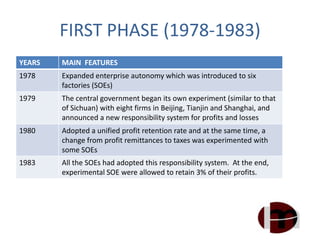
FIRST PHASE (1978-1983)
YEARS MAIN FEATURES
1978 Expanded enterprise autonomy which was introduced to six
factories (SOEs)
1979 The central government began its own experiment (similar to that
of Sichuan) with eight firms in Beijing, Tianjin and Shanghai, and
announced a new responsibility system for profits and losses
1980 Adopted a unified profit retention rate and at the same time, a
change from profit remittances to taxes was experimented with
some SOEs
1983 All the SOEs had adopted this responsibility system. At the end,
experimental SOE were allowed to retain 3% of their profits.
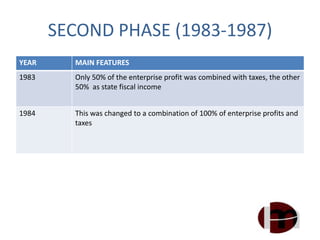
SECOND PHASE (1983-1987)
YEAR MAIN FEATURES
1983 Only 50% of the enterprise profit was combined with taxes, the other
50% as state fiscal income
1984 This was changed to a combination of 100% of enterprise profits and
taxes
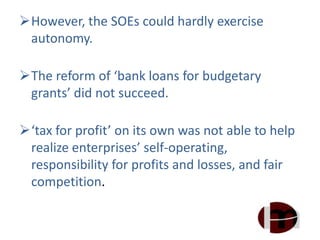
However, the SOEs could hardly exercise
autonomy.
The reform of ‘bank loans for budgetary
grants’ did not succeed.
‘tax for profit’ on its own was not able to help
realize enterprises’ self-operating,
responsibility for profits and losses, and fair
competition.
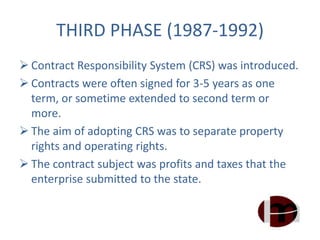
THIRD PHASE (1987-1992)
 Contract Responsibility System (CRS) was introduced.
 Contracts were often signed for 3-5 years as one
term, or sometime extended to second term or
more.
 The aim of adopting CRS was to separate property
rights and operating rights.
 The contract subject was profits and taxes that the
enterprise submitted to the state.
By 1992, nearly all large and medium-sized SOEs
had adopted the CRS.
It was aimed to reduce government intervention
in the operation of SOEs, and to make the
enterprise financially independent and focus on
profit rather than on plan fulfillment.
Its by-products were seen in short-termism of
SOE performance, which led to disorder in the
economy and rising prices.
FORTH PHASE (1992 -1997)
TARGET!- “establishment of social market
economy”
KEY ELEMENTS (autonomy and monitoring)
CHANGE IN SOEs REFORMS
PRINCIPAL FRAMEWORK
FOUR IMPORTANT ASPECTS:
i. clearly defined property rights,
ii. clear-cut responsibility and authority,
iii. separation of the function of government
and enterprises and
iv. scientific management.
 SHAREHOLDING SYSTEM
 ADVANTAGES OF SHAREHOLDING :
i. Separation of ownership
ii. Allocation of financial resources
iii. Decision making autonomy
 By the end of 1996, 4300 SOEs had been
converted into Joint Stock Companies
CURRENT PHASE (1998 ONWARDS)
THREE YEAR PROGRAM
• INTENTIONS:
i.Reversion of 3000 SOEs
ii. Building of 1000 large Group
• MEASURES :
i. Strong state inputs
ii. Strategic reorganization of assets
HOLDING THE BIG AND LETTING GO
THE SMALL
1. Transforming to Modern Enterprise System
2. Developing into large group enterprises (hold the
large SOEs)
3. Reorganization of small enterprises (sale to the non-
state enterprises)
SOEs NOW
 Prevalence of SOEs
 Politically-influenced management in SOEs
 Employee welfare and urban employment
provision
 Dilemma of retaining surplus workers and improving
efficiency

State Owned Enterprises Reforms in China

  • 1.
    STATE-OWNED ENTERPRISE REFORM INPEOPLE’S REPUBLIC OF CHINA Nastran Khalid, Marium Arshad, Sarah Zaidi
  • 2.
    BACKGROUND  Excessive interferenceof the state in the economy  The results were adverse on the entire national economy (waste of human and material resources)  The most distinctive characteristic of the growth in China is the development of non-state enterprises, the share of which increased from 22 percent to 57 percent.  In the past five decades, public ownership was the prevalent form of economy and SOEs played a predominant role in the economy.
  • 3.
    IMPORTANNCE OF SOEs As a whole SOEs absorb over half (over two-thirds in the 1980s) of urban employment and provide about 70% government fiscal income.  There was huge unemployment due to employment adjustment which became a threat to social stability delaying the introduction of SOE reforms.  Workers in SOEs could normally benefit major welfare services (from cradle to grave welfare), such as housing, children education and health care.
  • 4.
    REFORM PHASES OFSOEs AND SPECIFIC REFORM MEASURES The enterprises did not have any decision-making power in production, investment or distribution. The aim was to release state enterprises from central planning administration, and adapt to market economy. The reform process so far has gone through four phases
  • 5.
    FIRST PHASE (1978-1983) YEARSMAIN FEATURES 1978 Expanded enterprise autonomy which was introduced to six factories (SOEs) 1979 The central government began its own experiment (similar to that of Sichuan) with eight firms in Beijing, Tianjin and Shanghai, and announced a new responsibility system for profits and losses 1980 Adopted a unified profit retention rate and at the same time, a change from profit remittances to taxes was experimented with some SOEs 1983 All the SOEs had adopted this responsibility system. At the end, experimental SOE were allowed to retain 3% of their profits.
  • 6.
    SECOND PHASE (1983-1987) YEARMAIN FEATURES 1983 Only 50% of the enterprise profit was combined with taxes, the other 50% as state fiscal income 1984 This was changed to a combination of 100% of enterprise profits and taxes
  • 7.
    However, the SOEscould hardly exercise autonomy. The reform of ‘bank loans for budgetary grants’ did not succeed. ‘tax for profit’ on its own was not able to help realize enterprises’ self-operating, responsibility for profits and losses, and fair competition.
  • 8.
    THIRD PHASE (1987-1992) Contract Responsibility System (CRS) was introduced.  Contracts were often signed for 3-5 years as one term, or sometime extended to second term or more.  The aim of adopting CRS was to separate property rights and operating rights.  The contract subject was profits and taxes that the enterprise submitted to the state.
  • 9.
    By 1992, nearlyall large and medium-sized SOEs had adopted the CRS. It was aimed to reduce government intervention in the operation of SOEs, and to make the enterprise financially independent and focus on profit rather than on plan fulfillment. Its by-products were seen in short-termism of SOE performance, which led to disorder in the economy and rising prices.
  • 10.
    FORTH PHASE (1992-1997) TARGET!- “establishment of social market economy” KEY ELEMENTS (autonomy and monitoring) CHANGE IN SOEs REFORMS
  • 11.
    PRINCIPAL FRAMEWORK FOUR IMPORTANTASPECTS: i. clearly defined property rights, ii. clear-cut responsibility and authority, iii. separation of the function of government and enterprises and iv. scientific management.
  • 12.
     SHAREHOLDING SYSTEM ADVANTAGES OF SHAREHOLDING : i. Separation of ownership ii. Allocation of financial resources iii. Decision making autonomy  By the end of 1996, 4300 SOEs had been converted into Joint Stock Companies
  • 13.
    CURRENT PHASE (1998ONWARDS) THREE YEAR PROGRAM • INTENTIONS: i.Reversion of 3000 SOEs ii. Building of 1000 large Group • MEASURES : i. Strong state inputs ii. Strategic reorganization of assets
  • 14.
    HOLDING THE BIGAND LETTING GO THE SMALL 1. Transforming to Modern Enterprise System 2. Developing into large group enterprises (hold the large SOEs) 3. Reorganization of small enterprises (sale to the non- state enterprises)
  • 15.
    SOEs NOW  Prevalenceof SOEs  Politically-influenced management in SOEs  Employee welfare and urban employment provision  Dilemma of retaining surplus workers and improving efficiency

Editor's Notes

  • #3 The domination of the party also meant excessive interference of the state in the economy, its over-bureaucratic centralization and concentration of decision-making over economic productionSuch an over-interference (which separated production from market and management from economic accounting) has resulted in waste of human and material resources, sluggishness and ineffectiveness and inefficiency of the entire national economy The most distinctive characteristic of the growth in China is the development of non-state enterprises, the share of which increased from 22 percent to 57 percent. In the past five decades, public ownership was the prevalent form of economy and SOEs played a predominant role in the economy. Prior to the reform, it was the government that set targets for SOE production, allocated resources, appointed managers and arranged investment. In another word, the SOEs were owned, run and funded by the government and were not responsible for either profits or losses
  • #5 In order to enhance efficiency and competitive capacity, a number of measures have been taken although there is no coherent blueprint for the measures. The approach to SOE reform, as a whole, is trial-and-error,
  • #6 1978:these SOEs would have certain decision flexibility in production plans, product marketing, worker employment and technological innovation. They would also share the profits according to specified plan and above-plan profit retention rates.To sum up, the core component of the SOE reform was to grant more autonomy and allow profit-sharing between enterprise and government.
  • #7 The main focus of reform was on the adjustment and regulation of rights, responsibilities and benefits between enterprises and government. The major measures included two steps of ‘tax for profit’ and ‘the repayable loan for free grant’1984: . It was decided that all state investment would be on a repayable basis rather than free grant, allocated through the state banking system. The main purpose of which was to replace the previous co-existence of tax and profit remittance with a simple tax system and the SOEs could therefore pay taxes by following state regulations
  • #9 . When no other alternative measures were found effective in reforming SOEs, Contract Responsibility System (CRS) which had been proved useful and successful in the agricultural sector was seen to be more acceptable at that time, partly because it could maintain state ownershipthe CRS emphasized the responsibilities of SOEs while retaining the rights and incentives of the enterprises. CRS remained at the core of the SOE reforms until its weaknesses increasingly appeared and even hampered further reform of the SOEs in the early 1990s.
  • #10  BY 1987, 78% of SOEs has implemented CSR.It fell below the expectation of separating government and enterprises, also hampered the restructuring of the economy and consolidated the existing system.It was aimed to reduce government intervention in the operation of SOEs, and to make the enterprise financially independent and focus on profit rather than on plan fulfillment.However, the CRS was not as successful as expected in comparison with that used in the agricultural sectorContrary to government expectations, the contract responsibility system did not lead to a substantial increase in SOE profit; rather, the government revenue/GNP ratio continued to decline . For the first three phases, the common feature of the reforms was that state-ownership remained unchanged. Reforms were based on the theory on separation of property rights and operating rights of enterprise, concentrating on the readjustment of income redistribution relationship between enterprises and government.
  • #11 Monitoring became a new focus of the SOE reform because it was recognized the enterprises would hardly fulfill their full responsibilities if there were no effective monitoring
  • #12 According to the system, the state was prohibited from direct intervention with enterprise management. State enterprises, in turn, become legally responsible for self-management, profits and losses, taxes-payment, assets maintenance and so on
  • #13 . For SOEs being turned into shareholding companies, it is not solely the state that exercises the rights for enterprise assets, but all shareholders (including individuals, other state or non-state entities).
  • #14 Based on the notion that public ownership economy can be put into full play in a mixed ownership economy, and the rapid increase of loss-making SOEs, reform measures moved to fundamental and strategic restructuring By September of 2000, 54.9 per cent of the above cited key SOEs had managed to make profits
  • #15 Those which have lost the market demand for their products or services, or simply made net losses, are ordered to close, file for bankruptcy or merge as appropriate.