




Neoliberalism on China and
Beyond
Literature review presentation for SOSC530 Lecture 11
Prepared by Sharon Wong
Here we go…
• Neoliberalism “with Chinese Characteristics”
• State Neoliberalism
• Neoliberalism on Trial
• Freedom’s Prospect
Neoliberalism “with Chinese
Characteristics”
• Historical Background
• 1978 – political uncertainty due to Mao’s death
• Several years of economic stagnation
• Deng Xiaoping: ECONOMIC REFORMS!
• Coincided with the turn to neoliberal solutions in the U.S. and the
U.K.
What are the “Chinese Characteristics”
• Incorporating neoliberal elements with authoritarian
centralized control
• Chile, South Korea, Taiwan, and Singapore already established
the compatibility between authoritarianism and the capitalist
market
How?
• Bringing in Market Forces
• Stimulating competition and introducing market
pricing
• Devolution of political-economic power to the regions &
localities
• avoid confrontation with traditional power centers in BJ
• local initiatives could pioneer the way to a new social order
• Opening-up to foreign trade and investment under strict
state supervision
• Putting an end to China’s isolation from the world
market
Giving up Egalitarianism?
• Negative! Claimed to be still a long-term goal!
• But… individual and local initiative had to be unleashed
• So as to... ↑ productivity and spark economic growth
• Xiaokang (小康) & “Four Modernizations” (四个现代化)
• Agriculture
• Industry
• Education
• Science and Defense
Internal Transformations
• Socialism with Chinese characteristics vis-à-vis Privatization
with Chinese characteristics
• State-manipulated market economy delivering spectacular
economic growth and rising living standards for a significant
proportion of the population > 20 yrs
• State neoliberalization
So and Chu’s State Neoliberalism
• Contrasting between China’s experience of neoliberalism, and
that of the North
• A highly contradictory term:
• the party-state: communist and standing on the side of workers
and peasants,
• could not carry out all sorts of neoliberal policies to assault
workers and peasants and undermine their interests
General Path
• Singular and unique hold on power by the
Communist Party; at the same time, embraced
economic reforms
• Amass wealth and upgrade its technological
capacities
• So as to
• Better manage internal dissent and defend itself
against external aggression
• Project its power outwards onto its immediate
geopolitical sphere of interest, i.e. East and South-East
Asia
Situations before the late 1970s
• Rural and urban dwellers were conferred to their own
sector’s welfare benefits and rights  holding back any
mass rural migration to the cities
• Urban area: SOEs – State-owned enterprises
• Reasonably profitable
• Security of employment with wide range of welfare and pension
benefits
• The iron rice bowl 铁饭碗
• Rural area: Agrarian sector organized to a commune system
• State-owned banks a depository for savings and provided
investment moneys outside of the state budgets
In late 1970s and the 1980s
(So and Chu’s State neoliberalism)
• Decollectivization
• dissolution of agriculture commune system to promote “Personal
responsibility system”
• Proletarianization of peasants
• Marketization
• created labor market
• Fiscal decentralization and the weakening of the central
state
• bottom-up revenue-sharing system to build more independent
and powerful local states
• Opening up and spatial differentiation
• open door policy toward foreign investments
In the 1980s – Dissolution of agricultural
communes
• Peasants were given the right to use communal lands under
an individualized ‘personal responsibility system’
• could sell surpluses at free market prices
• By the end of 1980s, could lease the land, hire in labor and
sell their products at market prices
• Township village enterprises (TVEs) were created out of the
assets held by the communes and became centers of
• Entrepreneurialism
• Flexible labor practices
• Open market competition
The establishments of TVEs
• Constitution of December 1982 - causing the
political and administrative powers turned over
to newly created township and village
governments
• later those governments took possession of the
communes’ industrial assets and restructured them as
TVEs, allowed by legistlation
The TVEs
• Capital sources
• Savings by the initial surge in rural incomes
• JV with foreign capital (particularly from HK or through the Chinese
business diaspora)
• Active in rural peripheries of areas liberated for foreign
investment, e.g. Shanghai and Guangdong
• Significances of TVEs
• As proving grounds for reforms Gave dynamism in the economy
during the first 15 years of the reform period (late 1980s to 1990s)
• “Whatever worked with the TVEs could later become the basis of state
policy”
• Surge of development in light industry producing consumer goods for
export  export-led industrialization path (1987)
Second wave of neoliberal reforms
• The Tiananmen Incident
• Deng’s violent crackdown indicated neoliberalization in
the economy was not to be accompanied by progress
in the fields of human, civil, or democratic rights
• Another wave:
• Monetary policy became a prime means of control
• More opening to the outside, e.g. Shanghai Pudong
• Democracy of consumption to forestall social
unrest
The 1990s
(So and Chu’s State Neoliberalism)
• Strengthening of Managerial capacity
• Cadre responsibility system
• Strengthening of Fiscal capacity
• Tax Sharing Scheme
• The provinces that rely on the central government for revenue
• Debt-financed investments in huge mega-projects
“Liberating” the SOEs
• In early 1980s most of China’s phenomenal
growth rate was being powered from outside the
SOE sector
• In 1983s SOEs were allowed to hire ‘contract
workers’ with no social protections and limited
tenure
• Granted managerial autonomy
• Managers could retain a certain proportion of their
profits and sell any surplus they produced over their
targets at free market prices
Saving the SOEs
• Short-lived dual pricing system turned out
• Still, SOEs did not flourish
• Fell into debt and had to be supported
• by the central government or
• by the state-owned banks (lending to SOEs on favorable terms
and credits)
• Causing later serious non-performing loans to grew exponentially
in volumes
Corporatizing the SOEs
• In 1993, the state “turned targeted large and
medium SOEs into limited liability or shareholding
companies”; some could even offer public issues
of shares
• In 1994, all but the most important of the SOEs
were converted into ‘share-based co-operatives’
• all employees had the nominal right to purchase shares
• By 2002, SOEs accounted for only 14% of total
manufacturing employment relative to the 40 %
share they had held in 1990
Foreign Direct Investment
• 1980s – the 5 Special Economic Zones (经济特区)
• Xiamen 厦门
• Shantou 汕头
• Shenzhen 深圳
• Zhuhai 珠海
• Hainandao 海南岛
• Tax holidays, early remittances of profits and
better infrastructure facilities
• Produced goods for export to earn foreign
exchange and to observe foreign technologies
and managerial skills
• > 2/3 FDI came from overseas Chinese (esp. HK
and TW)
Bankruptcies of TVEs and SOEs
• More and more ‘open coastal cities’ and ‘open
economic regions’ for FDI
• After 1995 opened the whole country up to FDI
of any type
• Competitive pricing mechanisms took over from
the devolution of power from the central state to
the localities as the core process impelling the
restructuring of the economy
• Bankruptcies of TVEs and SOEs 
Unemployment surged  Labor unrests
Huge mega-projects
• Debt-financed investments to transform physical
infrastructures to absorb capital and labor
surpluses and solve labor unrest
• Three Gorges Dam
• New subway systems and highways
• High Speed Railway (HSR)
• The Olympic Games
• Deficit-financed  high risks of fiscal crisis
• Rapid urbanization
Rapid Urbanization
• Provides a way to absorb the massive labor
reserves from rural areas
• Provinces and cities engaged in inter-urban
competition
• They resist BJ’s effort to rein in their investments
 have the power to fund their own projects by
selling rights to develop real estate
Real-estate development and property
speculation
• Banks and other financial institutions
imprudently funded massive property
developments throughout China
• In 1996 Shanghai bubble burst but resumed even
more vigorously in the late 1990s
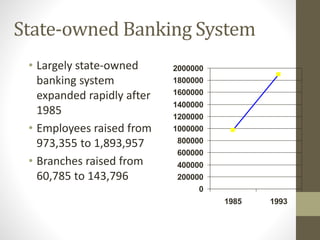
State-owned Banking System
• Largely state-owned
banking system
expanded rapidly after
1985
• Employees raised from
973,355 to 1,893,957
• Branches raised from
60,785 to 143,796
0
200000
400000
600000
800000
1000000
1200000
1400000
1600000
1800000
2000000
1985 1993
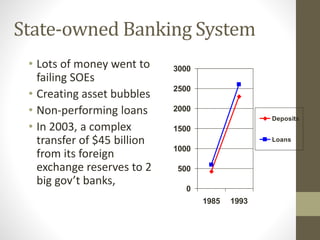
State-owned Banking System
• Lots of money went to
failing SOEs
• Creating asset bubbles
• Non-performing loans
• In 2003, a complex
transfer of $45 billion
from its foreign
exchange reserves to 2
big gov’t banks,
0
500
1000
1500
2000
2500
3000
1985 1993
Deposits
Loans
Modernization of education of science
• Investment in a definitive strategy of research
and development for both military and civilian
purposes
• Commercial satellite provider
• Foreign corporations transfer a significant
amount of their research and development
activity into China, e.g. Microsoft, Oracle,
Motorola, Siemens, IBM and Intel
• Cheap but skillful labors in China
• Huawei: selling at 1/3 lower than its rivals
External Relations
• Foreign Trade: From 7% in 1978 to 40% in 1990
• In 1994, abolished dual currency exchange rate
devaluated the official rate of 50% inducing
massive growth in trade and capital inflows
• By 2002, >40% GDP by FDI
• Export-led development strategy
• Not intended in 1978
• Fully forced after Deng’s southern tour in 1992
Connection with HK
• HK’s chaotic entrepreneurial capital attracted by
the cheap labor in Guangdong area in the late
1970s
• Interested in TVEs in rural areas (allowed to build
JV with foreign capitals)
• provided machinery, inputs and the global
marketing
• Emulated by other foreign capitalists, e.g. TW, JP,
S. Korea and the U.S.
• offshore production center
Internal Market
• Mid 1990s, attracted foreign capital
• 10% of a billion population constituted a huge
internal market
• Heavy reliance of FDI makes China a special case
different from JP or S. Korea
• Inter-regional trade is weak
More Export
• Joining WTO and shifting structures of
international competition
• inevitable realignment of trading relations
• In 1980s, low-value-added production
• In 1990s, low cost but highly skilled labor
attracted value-added ladder of production to
compete with S. Korea, JP, TW , Malaysia and SGP,
e.g. electronics and machine tools
• Causing negative competitive effects on other
countries
More Import
• Raw materials and energy
• In 2003, of the world’s production, China took
• 30% Coal
• 36% Steel
• 55% Cement
• Importing from everywhere, including
• Suadi Arabia, Sudan, Iran, Russia, Australia, Brazil,
Argentina and even the U.S.
Dominating East and SE Asia
• A regional hegemon with enormous global influence
• Looking like the imperial empires in the nineteenth
century but in economics term
• Slower growth can roil commodity and financial markets
everywhere (e.g. 2004)
External outlets for internal surpluses
• Fund the US debt
• Invest overseas to secure position in foreign markets
• E.g. TV assembled in Hungary to assure Europe
markets and N. Carolina to assure the US’s
Comparison
(So and Chu’s State Neoliberalism)
• 1980s – Expand private sector
• 1990s – Reducing public sector
• Privatization and corporatization
• Commodification of human services
• Deepening of liberalization
The dark side can be…
Environmental degradation
• Rural and communal lands were dispossessed and sold
to real-estate development
Banking system
• 50% of its loan portfolio is non-performing
• Only way out is by piling up balance of payments surpluses
against the US.
• But conversely, Chinese economic dynamism is held hostage
to US fiscal and monetary policy
• Excessive labor cannot be absorbed there comes a politics of
overt repression
Departing from the neoliberal template?
• Massive labor surpluses creating social and political
instability
• Either absorb or violently repress
• The latter, authoritarian
• High fixed capital and excessive production capital and
boom and bust cycle of urban investments
• All of the above require China to act like a Keynesian
state
• Maintain capital & Exchange rate controls
Dilemmas
• Chinese business diaspora reabsorbed into the
Chinese polity in 1997 already structured along
capitalistic lines
• The neoliberal rules of international trade set up
through the WTO, which China joined in 2001
• Political demands for liberalization began to
emerge
• Worker protests surfaced in 1986
• Student movement against corruptions and requesting
for greater freedoms climaxed 1989
Reconstructing class power?
• Fastest-growing economies at the same time one of the
most unequal societies
• Social inequality was never eradicated during the
revolutionary era
• Regional inequalities have also deepened
• Southern coastal cities vs. northern region
• Uncertain indicator of the constitution of class power
• Wholesale process of proletarianisation
Accumulation of wealth
• The privatized SOEs Managers
• Indigenous (土著) capital coming from TVEs
• Real-estate development encouraged by
dispossession
• Speculation in asset values using credit granted
on favorable terms
• Surging consumer culture emerged in the main
urban centers and postmodern culture including
westernization
Social Resistances in 1990s
(So and Chu’s State Neoliberalism)
• Cadre-capitalist class formation
• Fusion of political, economic and social capitals
embedded in the local society
• Trickily transforming communal capital into private
capital
• Working class formation
• Workers in the state sector begin to feel like
proletarians in a capitalist
• Peasants discontent
• The middle class intellectuals  the New Left
Social Unrests
• Super-exploitation of labor
• Capital accumulated by private and foreign firms comes from unpaid
labor
• Land seizures in rural area
• All manners of protests, ‘many of them violent, have broken out
with increasing frequency across the country in recent months’
• The party is clearly fearful of the potential breakdown in order
and is mobilizing party and police powers to forestall the
proliferation of any general social movement that may arise
• China was the 2nd largest spender of military expenses on the World in
2009
The moral claims of the Maoists
• Masses constituted by ‘workers, the peasantry,
the intelligentsia and the national bourgeoisie
whose interests were harmonious with each
other and also with the state’
Vs.
• Massive proletarianisation of workforce, the
breaking of the ‘iron rice bowl’, the evisceration
of social protections, the imposition of user fees,
the creation of a flexible labor market regime,
and the privatization of assets formerly held in
common
Harvey’s conclusion…
• China moved towards neoliberalization and the
reconstitution of class power, albeit ‘with distinctly Chinese
characteristics’
• At the same time, moving towards a confluence with the
neoconservative tide in the U.S.
• The authoritarianism
• The appeal to nationalism
• The revival of certain strains of imperialism
Turning point: the Retirement of
Jiang (2002)
• The Three Representatives
• 三個代表思想要求中国共产党要:
• 始终代表中国先进社会生产力的发展要求;
• 始终代表中国先进文化的前进方向;
• 始终代表中国最广大人民的根本利益。
• Hu & Wen’s policy
• “Return to the good old days of the 1950s when the
Maoist Party was in full control”
So and Chu’s Positive projection vs.
Harvey’s negative conclusion
• The Cadre-capitalist class has failed to capture
the central party-state. Thus, the central party-
state can still uphold the moral high ground of
state socialism
• Punishing Capitalist for tax evasion
• Safety net for peasants by cutting rural taxes
• State intervention of certain areas of capitals
• Develops plans for strategic development and decrees
prices and regulates the movement of capital
• Shares risks and underwrites research and
development
So and Chu’s Positive projection vs.
Harvey’s negative conclusion (con’t)
• Actively mobilized the ideology of nationalism
• Defines itself as carrying out a national project to make China strong
and powerful
• A national cohesiveness based on cultural heritage and tradition rather
than hostility toward the outside world
• No excessive nationalism – control anti-Japanese sentiment, restrain
anti-Americanism in the aftermath of the NATO bombing of the
Chinese embassy in Yugoslavia
• Adopts authoritarian policies to discipline labor, suppress
labor protests, and to deactivate civil society
• maintain a favorable environment to attract foreign investment
• facilitate capital accumulation
• seems unavoidable in export-led industrialization
• The way out – State Neoliberalism
Emergence of State Neoliberalism
(So and Chu’s State Neoliberalism)
• The late 1990s, began to feel the pains of a
neoliberal economy
• Super-exploitation of labor power
• The World’s most unequal societies
• Environmental degradation
• Leading to discontent and social conflict in
society
• Increasing call to regulate the market
• Growing numbers of labor protests, peasant
demonstrations, social movements, and other large-
scale social disturbances
TransitionfromNeoliberalismtoStateNeoliberalismin
the21st Century
(SoandChu’sStateNeoliberalism)
• Building a new socialist countryside and a harmonious society
signaling a change of ideological orientation if the Chinese
state
• State would play a more active role in moderating the
negative impacts of marketization
• Abolishment of agricultural tax
• Increase of rural expenditure by 15% to guarantee minimal living
allowances for farmers
• 87% hike for the health-care budget
• De-commodification of human services
• Promoting the spread of Mimumum Living Standard
Assistance for the rural population
Future Trajectory
• 4 possibilities
• Return to socialism
• Moved away from socialism >30 years
• Working class and the peasants are still disorganized
• Return to neoliberalism
• When matured and consolidated its power, will push forward the
neoliberal project
• Move to imperialism
• Great powers will try every means to prevent other states from
challenging its position
• The consolidation of state neoliberalism
Consolidation of State Neoliberalism
• The party-state is promoting domestic consumption and
to improve collective consumption and social insurance
• Facing sharp economic downturn and the prospect of
growing social unrest, the part-state has abundant
reasons to move away from neoliberalism to state
neoliberalism
• If going on like this, “China appears to be emerging as the
only poor country that has any chance in the foreseeable
future of subverting the Western-dominated global
hierarchy of wealth”.
Let’s go back to the Harvey’s
Neoliberalism on Trial
• Stimulating global capital accumulation? Nope!
• Reduction and control of inflation is the only systematic
success neoliberalization can claim
• Only success quoted: Sweden, a Circumscribed
neoliberalization
• Why are so many persuaded and fallen into the trap?
Persuading the many
• The volatility of uneven geographical development has
accelerated, permitting certain territories to advance
spectacularly at the expense of others
• Neoliberalization - a huge success from the standpoint of the
upper classes, either restored class power to ruling elites or
created conditions for capitalist class formation
• Spectacular shifts of emphasis under neoliberalizastion giving it
the appearance of incredible dynamism
• the rise of finance and of financial services
Main substantive “achievement”
• To redistribute, rather than regenerate, wealth and income
• Through accumulation by dispossession
• Including
• commodification and privatization of land and forceful expulsion
of peasant populations
• Conversion of various forms of property rights
• Suppression of rights to the commons
• Commodification of labor power and the suppression of
alternative forms of production and consumption
• Colonial, neocolonial, and imperial processes of appropriation of
assets
• Monetization of exchange and taxation
• Salve Trade
• Usury, the national debt and the use of the credit system as a
radical means of accumulation by dispossession
Achieving accumulation of
dispossession
• Privatization and commodification
• Financialization
• Management and manipulation of crises
• State redistributions
• Cutting expenditure on social welfare
• But increasing spending on surveillance and policing
Neoliberal’s evils
• Commodification of Everything
• Cutting powers of trade unions and other working-class
institutions
• Transformation in the spatial and temporal co-ordinates of the
labor market
• Degrading value of the labor
• Environmental Degradations
• Destruction of tropical rain forests due to unrestrained
application of neoliberal principles
On Rights
• Theoretically upholding liberalization and freedoms of
individuals
• Actual practices of neoliberalism underpins the restoration or
creation of class power and the results in terms of
impoverishment and environmental degradation
Universalism of rights
• Rights  only focus on political economic rights
• Became an imperialists’ tool for westernization
• To accept neoliberal regime of rights is to accept that we have
no alternative except to live under a regime of endless capital
accumulation and economic growth no matter what the
social, ecological, or political consequences
UN Charter
• Derivative rights
• Freedoms of speech and expression
• Of education and economic security
• Rights to organize unions
• Enforcing these rights would have posed a serious challenge to
neoliberalism
• Entailing a revolution of great significance in political-economic
practices
Freedom’s Prospect
• Roosevelt – excessive market freedoms lay at the root of the
economic and social problems of the 1930s Depression
• Vs.
• Bush – neoliberal freedoms at the center of his political
rhetoric
The End of Neoliberalism
• Heavy debts in the capitalist countries, both developed and
developing
• 2 worst-case scenarios from the standpoint of the U.S.
• A short burst of hyper-inflation would provide one way to delete the
outstanding international and consumer debt
• A long-drawn-out period of deflation of the sort that Japan has been
experiencing since 1989.
Consolidation of neoconservative
authoritarianism
• Maintaining global hegemony through control over oil
resources
• Fear and insecurity both internally and externally were easily
manipulated for political purposes
• God-given character manifesting destiny of the US to be the
greatest power on earth and as a beacon of freedom, liberty ,
and progress
• Actually the US hegemony is crumbling
• The New Imperialism
Alternatives
• Engaging with the plethora of oppositional movements
• Seek to distil from and through their activism the essence of a
broad-based oppositional programme
• Resort to theoretical and practical enquiries into our existing
condition
• Seek to derive alternatives through critical analysis
• Most importantly, initiate dialogue between those taking each
path and thereby to deepen collective understandings and
define more adequate lines of action
Oppositional movements
• Different from traditional labor movements
• Not in the form of organized political parties
• Direct relevance to particular issues and constituencies
• Choi Yuen Village
• The Korean Farmers
Critical Analysis
• Urging people to respond in class terms: If it looks like class
struggle and acts like class war then we have to name it
unshamedly for what it is
• Shows how and why popular movements are currently bifurcated
• Defining movement types
• Expanded reproduction concerning the exploitation of wage labor and
conditions defining the social wage
• Against accumulation by dispossession
• Points up exploitable contradictions within the neoliberal and
neoconservative agendas
• Monopolization, centralization and internationalization of corporate
and financial power
• Startling increase in class and regional inequalities
Critical Analysis (Con’t)
• Discourses to request for broader Rights
• To Life chances, Political association and Good Governance
• For control over production by the direct producers
• To the inviolability and integrity of the human body
• To engate in critique without fear of retaliation
• To a decent and healthy living environment
• To collective control of common property resources
• To the production of space
• To difference
Critical Analysis (con’t)
• Argue against the neoconservative assertion of a moral high
ground for its authority and legitimacy
• Criticizing the anti-democratic nature of neoliberalism backed
by the authoritarianism of the neoconservatives that should
surely be the main focus of political struggle
To Conclude…
• There is a far, far nobler prospect of freedom to be won
than that which neoliberalism preaches
• There is a far, far worthier system of governance to be
constructed than that which neoconservative allows
Movie recommendation
• Inside Job
• http://www.youtube.com/watch?v=XsAFyTZfd4o
Thank you!

Neoliberalism on china and beyond

  • 1.
    Neoliberalism on Chinaand Beyond Literature review presentation for SOSC530 Lecture 11 Prepared by Sharon Wong
  • 2.
    Here we go… •Neoliberalism “with Chinese Characteristics” • State Neoliberalism • Neoliberalism on Trial • Freedom’s Prospect
  • 3.
    Neoliberalism “with Chinese Characteristics” •Historical Background • 1978 – political uncertainty due to Mao’s death • Several years of economic stagnation • Deng Xiaoping: ECONOMIC REFORMS! • Coincided with the turn to neoliberal solutions in the U.S. and the U.K.
  • 4.
    What are the“Chinese Characteristics” • Incorporating neoliberal elements with authoritarian centralized control • Chile, South Korea, Taiwan, and Singapore already established the compatibility between authoritarianism and the capitalist market
  • 5.
    How? • Bringing inMarket Forces • Stimulating competition and introducing market pricing • Devolution of political-economic power to the regions & localities • avoid confrontation with traditional power centers in BJ • local initiatives could pioneer the way to a new social order • Opening-up to foreign trade and investment under strict state supervision • Putting an end to China’s isolation from the world market
  • 6.
    Giving up Egalitarianism? •Negative! Claimed to be still a long-term goal! • But… individual and local initiative had to be unleashed • So as to... ↑ productivity and spark economic growth • Xiaokang (小康) & “Four Modernizations” (四个现代化) • Agriculture • Industry • Education • Science and Defense
  • 7.
    Internal Transformations • Socialismwith Chinese characteristics vis-à-vis Privatization with Chinese characteristics • State-manipulated market economy delivering spectacular economic growth and rising living standards for a significant proportion of the population > 20 yrs • State neoliberalization
  • 8.
    So and Chu’sState Neoliberalism • Contrasting between China’s experience of neoliberalism, and that of the North • A highly contradictory term: • the party-state: communist and standing on the side of workers and peasants, • could not carry out all sorts of neoliberal policies to assault workers and peasants and undermine their interests
  • 9.
    General Path • Singularand unique hold on power by the Communist Party; at the same time, embraced economic reforms • Amass wealth and upgrade its technological capacities • So as to • Better manage internal dissent and defend itself against external aggression • Project its power outwards onto its immediate geopolitical sphere of interest, i.e. East and South-East Asia
  • 10.
    Situations before thelate 1970s • Rural and urban dwellers were conferred to their own sector’s welfare benefits and rights  holding back any mass rural migration to the cities • Urban area: SOEs – State-owned enterprises • Reasonably profitable • Security of employment with wide range of welfare and pension benefits • The iron rice bowl 铁饭碗 • Rural area: Agrarian sector organized to a commune system • State-owned banks a depository for savings and provided investment moneys outside of the state budgets
  • 11.
    In late 1970sand the 1980s (So and Chu’s State neoliberalism) • Decollectivization • dissolution of agriculture commune system to promote “Personal responsibility system” • Proletarianization of peasants • Marketization • created labor market • Fiscal decentralization and the weakening of the central state • bottom-up revenue-sharing system to build more independent and powerful local states • Opening up and spatial differentiation • open door policy toward foreign investments
  • 12.
    In the 1980s– Dissolution of agricultural communes • Peasants were given the right to use communal lands under an individualized ‘personal responsibility system’ • could sell surpluses at free market prices • By the end of 1980s, could lease the land, hire in labor and sell their products at market prices • Township village enterprises (TVEs) were created out of the assets held by the communes and became centers of • Entrepreneurialism • Flexible labor practices • Open market competition
  • 13.
    The establishments ofTVEs • Constitution of December 1982 - causing the political and administrative powers turned over to newly created township and village governments • later those governments took possession of the communes’ industrial assets and restructured them as TVEs, allowed by legistlation
  • 14.
    The TVEs • Capitalsources • Savings by the initial surge in rural incomes • JV with foreign capital (particularly from HK or through the Chinese business diaspora) • Active in rural peripheries of areas liberated for foreign investment, e.g. Shanghai and Guangdong • Significances of TVEs • As proving grounds for reforms Gave dynamism in the economy during the first 15 years of the reform period (late 1980s to 1990s) • “Whatever worked with the TVEs could later become the basis of state policy” • Surge of development in light industry producing consumer goods for export  export-led industrialization path (1987)
  • 15.
    Second wave ofneoliberal reforms • The Tiananmen Incident • Deng’s violent crackdown indicated neoliberalization in the economy was not to be accompanied by progress in the fields of human, civil, or democratic rights • Another wave: • Monetary policy became a prime means of control • More opening to the outside, e.g. Shanghai Pudong • Democracy of consumption to forestall social unrest
  • 16.
    The 1990s (So andChu’s State Neoliberalism) • Strengthening of Managerial capacity • Cadre responsibility system • Strengthening of Fiscal capacity • Tax Sharing Scheme • The provinces that rely on the central government for revenue • Debt-financed investments in huge mega-projects
  • 17.
    “Liberating” the SOEs •In early 1980s most of China’s phenomenal growth rate was being powered from outside the SOE sector • In 1983s SOEs were allowed to hire ‘contract workers’ with no social protections and limited tenure • Granted managerial autonomy • Managers could retain a certain proportion of their profits and sell any surplus they produced over their targets at free market prices
  • 18.
    Saving the SOEs •Short-lived dual pricing system turned out • Still, SOEs did not flourish • Fell into debt and had to be supported • by the central government or • by the state-owned banks (lending to SOEs on favorable terms and credits) • Causing later serious non-performing loans to grew exponentially in volumes
  • 19.
    Corporatizing the SOEs •In 1993, the state “turned targeted large and medium SOEs into limited liability or shareholding companies”; some could even offer public issues of shares • In 1994, all but the most important of the SOEs were converted into ‘share-based co-operatives’ • all employees had the nominal right to purchase shares • By 2002, SOEs accounted for only 14% of total manufacturing employment relative to the 40 % share they had held in 1990
  • 20.
    Foreign Direct Investment •1980s – the 5 Special Economic Zones (经济特区) • Xiamen 厦门 • Shantou 汕头 • Shenzhen 深圳 • Zhuhai 珠海 • Hainandao 海南岛 • Tax holidays, early remittances of profits and better infrastructure facilities • Produced goods for export to earn foreign exchange and to observe foreign technologies and managerial skills • > 2/3 FDI came from overseas Chinese (esp. HK and TW)
  • 21.
    Bankruptcies of TVEsand SOEs • More and more ‘open coastal cities’ and ‘open economic regions’ for FDI • After 1995 opened the whole country up to FDI of any type • Competitive pricing mechanisms took over from the devolution of power from the central state to the localities as the core process impelling the restructuring of the economy • Bankruptcies of TVEs and SOEs  Unemployment surged  Labor unrests
  • 22.
    Huge mega-projects • Debt-financedinvestments to transform physical infrastructures to absorb capital and labor surpluses and solve labor unrest • Three Gorges Dam • New subway systems and highways • High Speed Railway (HSR) • The Olympic Games • Deficit-financed  high risks of fiscal crisis • Rapid urbanization
  • 23.
    Rapid Urbanization • Providesa way to absorb the massive labor reserves from rural areas • Provinces and cities engaged in inter-urban competition • They resist BJ’s effort to rein in their investments  have the power to fund their own projects by selling rights to develop real estate
  • 24.
    Real-estate development andproperty speculation • Banks and other financial institutions imprudently funded massive property developments throughout China • In 1996 Shanghai bubble burst but resumed even more vigorously in the late 1990s
  • 25.
    State-owned Banking System •Largely state-owned banking system expanded rapidly after 1985 • Employees raised from 973,355 to 1,893,957 • Branches raised from 60,785 to 143,796 0 200000 400000 600000 800000 1000000 1200000 1400000 1600000 1800000 2000000 1985 1993
  • 26.
    State-owned Banking System •Lots of money went to failing SOEs • Creating asset bubbles • Non-performing loans • In 2003, a complex transfer of $45 billion from its foreign exchange reserves to 2 big gov’t banks, 0 500 1000 1500 2000 2500 3000 1985 1993 Deposits Loans
  • 27.
    Modernization of educationof science • Investment in a definitive strategy of research and development for both military and civilian purposes • Commercial satellite provider • Foreign corporations transfer a significant amount of their research and development activity into China, e.g. Microsoft, Oracle, Motorola, Siemens, IBM and Intel • Cheap but skillful labors in China • Huawei: selling at 1/3 lower than its rivals
  • 28.
    External Relations • ForeignTrade: From 7% in 1978 to 40% in 1990 • In 1994, abolished dual currency exchange rate devaluated the official rate of 50% inducing massive growth in trade and capital inflows • By 2002, >40% GDP by FDI • Export-led development strategy • Not intended in 1978 • Fully forced after Deng’s southern tour in 1992
  • 29.
    Connection with HK •HK’s chaotic entrepreneurial capital attracted by the cheap labor in Guangdong area in the late 1970s • Interested in TVEs in rural areas (allowed to build JV with foreign capitals) • provided machinery, inputs and the global marketing • Emulated by other foreign capitalists, e.g. TW, JP, S. Korea and the U.S. • offshore production center
  • 30.
    Internal Market • Mid1990s, attracted foreign capital • 10% of a billion population constituted a huge internal market • Heavy reliance of FDI makes China a special case different from JP or S. Korea • Inter-regional trade is weak
  • 31.
    More Export • JoiningWTO and shifting structures of international competition • inevitable realignment of trading relations • In 1980s, low-value-added production • In 1990s, low cost but highly skilled labor attracted value-added ladder of production to compete with S. Korea, JP, TW , Malaysia and SGP, e.g. electronics and machine tools • Causing negative competitive effects on other countries
  • 32.
    More Import • Rawmaterials and energy • In 2003, of the world’s production, China took • 30% Coal • 36% Steel • 55% Cement • Importing from everywhere, including • Suadi Arabia, Sudan, Iran, Russia, Australia, Brazil, Argentina and even the U.S.
  • 33.
    Dominating East andSE Asia • A regional hegemon with enormous global influence • Looking like the imperial empires in the nineteenth century but in economics term • Slower growth can roil commodity and financial markets everywhere (e.g. 2004)
  • 34.
    External outlets forinternal surpluses • Fund the US debt • Invest overseas to secure position in foreign markets • E.g. TV assembled in Hungary to assure Europe markets and N. Carolina to assure the US’s
  • 35.
    Comparison (So and Chu’sState Neoliberalism) • 1980s – Expand private sector • 1990s – Reducing public sector • Privatization and corporatization • Commodification of human services • Deepening of liberalization
  • 36.
    The dark sidecan be…
  • 37.
    Environmental degradation • Ruraland communal lands were dispossessed and sold to real-estate development
  • 38.
    Banking system • 50%of its loan portfolio is non-performing • Only way out is by piling up balance of payments surpluses against the US. • But conversely, Chinese economic dynamism is held hostage to US fiscal and monetary policy • Excessive labor cannot be absorbed there comes a politics of overt repression
  • 39.
    Departing from theneoliberal template? • Massive labor surpluses creating social and political instability • Either absorb or violently repress • The latter, authoritarian • High fixed capital and excessive production capital and boom and bust cycle of urban investments • All of the above require China to act like a Keynesian state • Maintain capital & Exchange rate controls
  • 40.
    Dilemmas • Chinese businessdiaspora reabsorbed into the Chinese polity in 1997 already structured along capitalistic lines • The neoliberal rules of international trade set up through the WTO, which China joined in 2001 • Political demands for liberalization began to emerge • Worker protests surfaced in 1986 • Student movement against corruptions and requesting for greater freedoms climaxed 1989
  • 41.
    Reconstructing class power? •Fastest-growing economies at the same time one of the most unequal societies • Social inequality was never eradicated during the revolutionary era • Regional inequalities have also deepened • Southern coastal cities vs. northern region • Uncertain indicator of the constitution of class power • Wholesale process of proletarianisation
  • 42.
    Accumulation of wealth •The privatized SOEs Managers • Indigenous (土著) capital coming from TVEs • Real-estate development encouraged by dispossession • Speculation in asset values using credit granted on favorable terms • Surging consumer culture emerged in the main urban centers and postmodern culture including westernization
  • 43.
    Social Resistances in1990s (So and Chu’s State Neoliberalism) • Cadre-capitalist class formation • Fusion of political, economic and social capitals embedded in the local society • Trickily transforming communal capital into private capital • Working class formation • Workers in the state sector begin to feel like proletarians in a capitalist • Peasants discontent • The middle class intellectuals  the New Left
  • 44.
    Social Unrests • Super-exploitationof labor • Capital accumulated by private and foreign firms comes from unpaid labor • Land seizures in rural area • All manners of protests, ‘many of them violent, have broken out with increasing frequency across the country in recent months’ • The party is clearly fearful of the potential breakdown in order and is mobilizing party and police powers to forestall the proliferation of any general social movement that may arise • China was the 2nd largest spender of military expenses on the World in 2009
  • 45.
    The moral claimsof the Maoists • Masses constituted by ‘workers, the peasantry, the intelligentsia and the national bourgeoisie whose interests were harmonious with each other and also with the state’ Vs. • Massive proletarianisation of workforce, the breaking of the ‘iron rice bowl’, the evisceration of social protections, the imposition of user fees, the creation of a flexible labor market regime, and the privatization of assets formerly held in common
  • 46.
    Harvey’s conclusion… • Chinamoved towards neoliberalization and the reconstitution of class power, albeit ‘with distinctly Chinese characteristics’ • At the same time, moving towards a confluence with the neoconservative tide in the U.S. • The authoritarianism • The appeal to nationalism • The revival of certain strains of imperialism
  • 47.
    Turning point: theRetirement of Jiang (2002) • The Three Representatives • 三個代表思想要求中国共产党要: • 始终代表中国先进社会生产力的发展要求; • 始终代表中国先进文化的前进方向; • 始终代表中国最广大人民的根本利益。 • Hu & Wen’s policy • “Return to the good old days of the 1950s when the Maoist Party was in full control”
  • 48.
    So and Chu’sPositive projection vs. Harvey’s negative conclusion • The Cadre-capitalist class has failed to capture the central party-state. Thus, the central party- state can still uphold the moral high ground of state socialism • Punishing Capitalist for tax evasion • Safety net for peasants by cutting rural taxes • State intervention of certain areas of capitals • Develops plans for strategic development and decrees prices and regulates the movement of capital • Shares risks and underwrites research and development
  • 49.
    So and Chu’sPositive projection vs. Harvey’s negative conclusion (con’t) • Actively mobilized the ideology of nationalism • Defines itself as carrying out a national project to make China strong and powerful • A national cohesiveness based on cultural heritage and tradition rather than hostility toward the outside world • No excessive nationalism – control anti-Japanese sentiment, restrain anti-Americanism in the aftermath of the NATO bombing of the Chinese embassy in Yugoslavia • Adopts authoritarian policies to discipline labor, suppress labor protests, and to deactivate civil society • maintain a favorable environment to attract foreign investment • facilitate capital accumulation • seems unavoidable in export-led industrialization • The way out – State Neoliberalism
  • 50.
    Emergence of StateNeoliberalism (So and Chu’s State Neoliberalism) • The late 1990s, began to feel the pains of a neoliberal economy • Super-exploitation of labor power • The World’s most unequal societies • Environmental degradation • Leading to discontent and social conflict in society • Increasing call to regulate the market • Growing numbers of labor protests, peasant demonstrations, social movements, and other large- scale social disturbances
  • 51.
    TransitionfromNeoliberalismtoStateNeoliberalismin the21st Century (SoandChu’sStateNeoliberalism) • Buildinga new socialist countryside and a harmonious society signaling a change of ideological orientation if the Chinese state • State would play a more active role in moderating the negative impacts of marketization • Abolishment of agricultural tax • Increase of rural expenditure by 15% to guarantee minimal living allowances for farmers • 87% hike for the health-care budget • De-commodification of human services • Promoting the spread of Mimumum Living Standard Assistance for the rural population
  • 52.
    Future Trajectory • 4possibilities • Return to socialism • Moved away from socialism >30 years • Working class and the peasants are still disorganized • Return to neoliberalism • When matured and consolidated its power, will push forward the neoliberal project • Move to imperialism • Great powers will try every means to prevent other states from challenging its position • The consolidation of state neoliberalism
  • 53.
    Consolidation of StateNeoliberalism • The party-state is promoting domestic consumption and to improve collective consumption and social insurance • Facing sharp economic downturn and the prospect of growing social unrest, the part-state has abundant reasons to move away from neoliberalism to state neoliberalism • If going on like this, “China appears to be emerging as the only poor country that has any chance in the foreseeable future of subverting the Western-dominated global hierarchy of wealth”.
  • 54.
    Let’s go backto the Harvey’s
  • 55.
    Neoliberalism on Trial •Stimulating global capital accumulation? Nope! • Reduction and control of inflation is the only systematic success neoliberalization can claim • Only success quoted: Sweden, a Circumscribed neoliberalization • Why are so many persuaded and fallen into the trap?
  • 56.
    Persuading the many •The volatility of uneven geographical development has accelerated, permitting certain territories to advance spectacularly at the expense of others • Neoliberalization - a huge success from the standpoint of the upper classes, either restored class power to ruling elites or created conditions for capitalist class formation • Spectacular shifts of emphasis under neoliberalizastion giving it the appearance of incredible dynamism • the rise of finance and of financial services
  • 57.
    Main substantive “achievement” •To redistribute, rather than regenerate, wealth and income • Through accumulation by dispossession • Including • commodification and privatization of land and forceful expulsion of peasant populations • Conversion of various forms of property rights • Suppression of rights to the commons • Commodification of labor power and the suppression of alternative forms of production and consumption • Colonial, neocolonial, and imperial processes of appropriation of assets • Monetization of exchange and taxation • Salve Trade • Usury, the national debt and the use of the credit system as a radical means of accumulation by dispossession
  • 58.
    Achieving accumulation of dispossession •Privatization and commodification • Financialization • Management and manipulation of crises • State redistributions • Cutting expenditure on social welfare • But increasing spending on surveillance and policing
  • 59.
    Neoliberal’s evils • Commodificationof Everything • Cutting powers of trade unions and other working-class institutions • Transformation in the spatial and temporal co-ordinates of the labor market • Degrading value of the labor • Environmental Degradations • Destruction of tropical rain forests due to unrestrained application of neoliberal principles
  • 60.
    On Rights • Theoreticallyupholding liberalization and freedoms of individuals • Actual practices of neoliberalism underpins the restoration or creation of class power and the results in terms of impoverishment and environmental degradation
  • 61.
    Universalism of rights •Rights  only focus on political economic rights • Became an imperialists’ tool for westernization • To accept neoliberal regime of rights is to accept that we have no alternative except to live under a regime of endless capital accumulation and economic growth no matter what the social, ecological, or political consequences
  • 62.
    UN Charter • Derivativerights • Freedoms of speech and expression • Of education and economic security • Rights to organize unions • Enforcing these rights would have posed a serious challenge to neoliberalism • Entailing a revolution of great significance in political-economic practices
  • 63.
    Freedom’s Prospect • Roosevelt– excessive market freedoms lay at the root of the economic and social problems of the 1930s Depression • Vs. • Bush – neoliberal freedoms at the center of his political rhetoric
  • 64.
    The End ofNeoliberalism • Heavy debts in the capitalist countries, both developed and developing • 2 worst-case scenarios from the standpoint of the U.S. • A short burst of hyper-inflation would provide one way to delete the outstanding international and consumer debt • A long-drawn-out period of deflation of the sort that Japan has been experiencing since 1989.
  • 65.
    Consolidation of neoconservative authoritarianism •Maintaining global hegemony through control over oil resources • Fear and insecurity both internally and externally were easily manipulated for political purposes • God-given character manifesting destiny of the US to be the greatest power on earth and as a beacon of freedom, liberty , and progress • Actually the US hegemony is crumbling • The New Imperialism
  • 66.
    Alternatives • Engaging withthe plethora of oppositional movements • Seek to distil from and through their activism the essence of a broad-based oppositional programme • Resort to theoretical and practical enquiries into our existing condition • Seek to derive alternatives through critical analysis • Most importantly, initiate dialogue between those taking each path and thereby to deepen collective understandings and define more adequate lines of action
  • 67.
    Oppositional movements • Differentfrom traditional labor movements • Not in the form of organized political parties • Direct relevance to particular issues and constituencies • Choi Yuen Village • The Korean Farmers
  • 68.
    Critical Analysis • Urgingpeople to respond in class terms: If it looks like class struggle and acts like class war then we have to name it unshamedly for what it is • Shows how and why popular movements are currently bifurcated • Defining movement types • Expanded reproduction concerning the exploitation of wage labor and conditions defining the social wage • Against accumulation by dispossession • Points up exploitable contradictions within the neoliberal and neoconservative agendas • Monopolization, centralization and internationalization of corporate and financial power • Startling increase in class and regional inequalities
  • 69.
    Critical Analysis (Con’t) •Discourses to request for broader Rights • To Life chances, Political association and Good Governance • For control over production by the direct producers • To the inviolability and integrity of the human body • To engate in critique without fear of retaliation • To a decent and healthy living environment • To collective control of common property resources • To the production of space • To difference
  • 70.
    Critical Analysis (con’t) •Argue against the neoconservative assertion of a moral high ground for its authority and legitimacy • Criticizing the anti-democratic nature of neoliberalism backed by the authoritarianism of the neoconservatives that should surely be the main focus of political struggle
  • 71.
    To Conclude… • Thereis a far, far nobler prospect of freedom to be won than that which neoliberalism preaches • There is a far, far worthier system of governance to be constructed than that which neoconservative allows
  • 72.
    Movie recommendation • InsideJob • http://www.youtube.com/watch?v=XsAFyTZfd4o
  • 73.