University of Manchester
  Institute for Development Policy and Management


Mock Assignment
Topic: 2) What is ‘information technology’? How is it changing our working lives?
Title: A Transformation of Human’s Working Lives by Information Technology
Personal tutors: Dr Sharon Morgan


Name : Larastri Kumaralalita
Program: M&IS
Word counts: 1,029 words
A. Introduction
   World has changed a lot within the existence of Information of Technology
   (IT). IT has transformed many aspect (Dutton, 2005; Stroman 2012) and has
   become a integral part of our life (Kling, 2000). General speaking, around
   some decades ago, we might think that IT was counted as extravagant items
   which expensive and not a primary need.


   Observing specifically in developing country, for instance Indonesia, back to
   end of 1990s, only a very rich people can afford to spend their money for a
   mobile phone handset. However, now, Rao (2012), a Research Project
   Director for MobileMonday, reports that, in Indonesia, total number of mobile
   subscriptions is 220 million of 240 million populations in totals by 92%
   percentage of mobile penetration. In the same idea, according to World Bank
   (2012) data of Indonesia, in 2001 there were merely 3 mobile cellular
   subscriptions per 100 people and the number rose rapidly in 2011 by 98
   subscriptions per 100 people. Cheap mobile data rate and devices are analysed
   as the stimulator of this high percentage of penetration (Rao, 2012). For the
   same reason, in another developing country, Uganda, because of the cheaper
   price of mobile phone, it enables urban or even rural - people with less income
   - are able to buy a mobile phone handset (Diga, 2008).


   We should be realized that IT has transformed and really become part of our
   life. This transformation of IT is on going and will continue beyond year 2012.
   Therefore, if we step back for a moment, and think about what changes that
   has been occurred, how far IT has been changing our working lives?


   This essay will discuss about the changing of IT in our working lives by
   exploring a little bit about terminology of IT and its major innovations, then
   continue to look more how it is changing our working lives by analysing
   several different sources.


                                                                                2
B. Information Technology
   Information Technology, or in short terms called ‘IT’, refers to all hardware
   and software – all computing - that a company utilized to achieve its business
   objective (ACM 2008, Laudon 2010). Another terms which often is seen as IT
   is information and communication technologies (ICT) since the moment of
   increasing role of telecommunications within information systems in the last
   twenty – thirty years (Heeks & Morgan 2012).


   Decade by decade, IT is transforming rapidly and still going to bring another
   interesting innovation. The major innovation in technical information
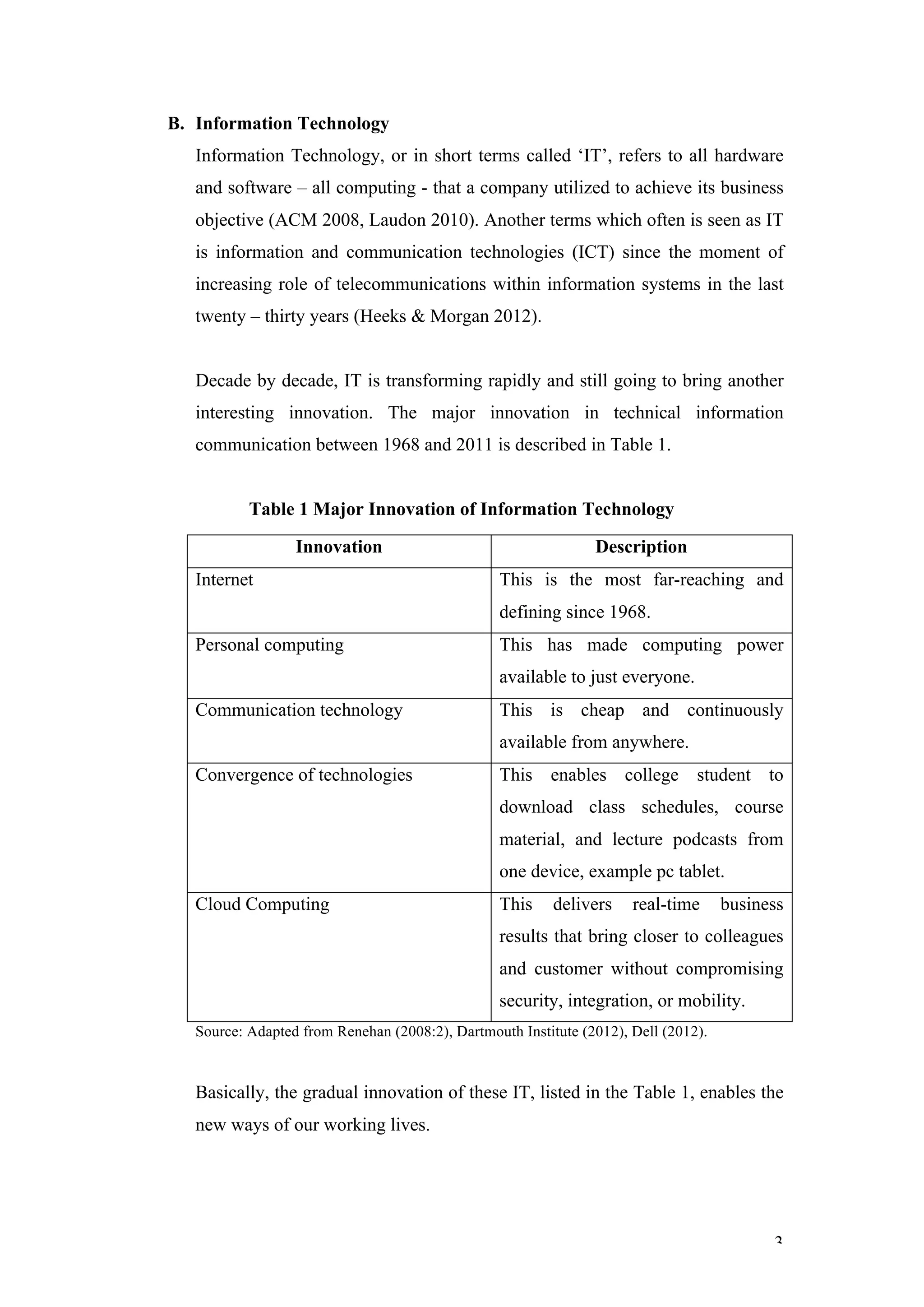
   communication between 1968 and 2011 is described in Table 1.


           Table 1 Major Innovation of Information Technology

                  Innovation                                    Description
   Internet                                      This is the most far-reaching and
                                                 defining since 1968.
   Personal computing                            This has made computing power
                                                 available to just everyone.
   Communication technology                      This is cheap and continuously
                                                 available from anywhere.
   Convergence of technologies                   This enables college student to
                                                 download class schedules, course
                                                 material, and lecture podcasts from
                                                 one device, example pc tablet.
   Cloud Computing                               This     delivers    real-time      business
                                                 results that bring closer to colleagues
                                                 and customer without compromising
                                                 security, integration, or mobility.
   Source: Adapted from Renehan (2008:2), Dartmouth Institute (2012), Dell (2012).


   Basically, the gradual innovation of these IT, listed in the Table 1, enables the
   new ways of our working lives.


                                                                                           3
C. What Changes Information Technology Brings to Working Lives
   After we followed the IT term and its gradual innovation, so how the
   transformation is occurred. First at all, we define the areas of working lives in
   this discussion: business and education.


   In business, around 1960s IT really started to take over, corporations and
   universities were buying of approximately 2000 computers per year (Renehan,
   2008). Furthermore, Kato (2007) stated that the structure and process of
   business world are revolutionized by electric network with the advance of
   technology. IT enables to link companies and people via email and intranets
   (Kato, 2007), group-ware and web technologies (Sánchez, 2006). With the
   existence of those technologies, some new ways of working in business are
   also created; one of them is called teleworking. Teleworking is an changing
   idea of work and workplace as an alternative way to organise or performing
   work by using complete or partial use of IT to enable workers work remotely
   from employer’s premises (Bailey & Kurland, 2002; Sánchez, 2006; European
   Foundation, 2010).


   Previous to the introduction of teleworking, employee has a fixed schedule
   and place of work. For example, they have to come to office and doing job
   from 09.00 am until 05.00 pm. By using email and groupware, workers is able
   to submit their job or communicate to office through the network without
   working physically at office. According to data Eurofound (2008) based on
   The United Kingdom (UK) Labour Force Survey (LFS), the number of
   teleworking users or teleworkers rose from 2.3 million (40%) in 1997 to 3.2
   million (79%) in 2007 as teleworkers contribute as 8.9% of national workforce
   in the spring 2007, rising slightly from 8.5% in 2005.


   In education, before the invention of internet, the traditional learning activities
   depends much on text books which are limited in number and content scope.
   The invention of internet has changed the way of learning experience quite
   much, for example by distance learning. The Levin Institute (2011) describes
   that IT improves education availability by eliminate barriers of distance
   between learners and the content and also improving the content of material


                                                                                    4
itself.   A big gratitude for internet that enable learners to access any
   information at anytime from different resources. Learners can also get
   flexibility by having distance learning. UNESCO (2002) supports this fact by
   stating that open and distance learning means increased access and flexibility
   and also the combination of work and education. Giving some example, a
   student who has a distance learning postgraduate can be registered as student
   for another country’s university. They don’t need to be physically in class like
   normal class but instead having the class through network.


D. Conclusion
   This essay has defined the nature of IT and also demonstrated how IT has
   transformed the way people in working lives. By delivering two examples in
   business (teleworking) and education (distance learning) has given a clear
   description on how the changing has occurred. Finally, the difference in doing
   things with and without IT has showed that IT has become important part of
   our working lives.


Reference
   1. Dartmouth Institute. (2012) Convergence Technology: Empowering Us or
      Controlling Us?, Darmouth Institute for Writing & Rhetoric, Available:
      http://www.dartmouth.edu/~writ8/index.php/perspectives/convergence-
      technology [Accessed: 1 November 2012].
   2. Dell. (2012) Cloud Computing, Dell [Online], Available:
      http://content.dell.com/us/en/gen/d/campaigns/cloud      [Accessed:      1
      November 2012].
   3. Diga, K. (2008) Mobile Cell Phones and Poverty Reduction: Technology
      Spending Patterns and Poverty Level Change among Households in
      Uganda International Development Research Centre. Workshop on The
      Role of Mobile Technologies in Fostering Social Development, Brazil.
   4. Dutton, H. W. (2005) ‘The Internet and Social Transformation:
      Reconfiguring Access’, Transforming Enterprise: Economic and Social
      Implications of Information Technology, 375-394, Cambridge, MA: MIT
      Press.
   5. European Foundation for Improvement of Living and Working Conditions.
      (2010)      Teleworks     in    The     European      Union     Available:
      http://www.eurofound.europa.eu/docs/eiro/tn0910050s/tn0910050s.pdf
      [Accessed: 1 November 2012].
   6. Heeks, R. & Morgan, S. (2012) Information Systems: Categories and
      Trends – Part 2 Handout. Fundamentals of Information Systems course
      unit hand out, IDPM, University of Manchester, Manchester, 28 Oct.
   7. Kling, R. (2000). Learning about information technologies and social
      change: The contribution of social informatics. Information Society, 16(3),

                                                                                 5
217-232.
8. Laudon, K.C & Laudon, J.P. (2010) Management Information Systems,
    11th edn, Prenctice Hall, Upper Saddle River, NJ.
9. Lunt, M., Barry. et.al. (2008) Information Technology 2008 Curriculum
    Guidelines for Undergraduate Degree Programs in Information
    Technology, Association for Computing Machinery (ACM) IEEE
    Computer                          Society,                     Available:
    http://www.acm.org/education/curricula/IT2008%20Curriculum.pdf
    [Accessed: 28 October 2012]
10. Parker, Jane. (2008) Telework in United Kingdom, European Industrial
    Relations            Observatory            On-Line,           Available:
    http://www.eurofound.europa.eu/eiro/2007/11/articles/uk0711039i.htm
    [Accessed: 1 November 2012].
11. Rao, M. (2012) Mobile Southeast Asia Report 2012 Crossroads of
    Innovation,                Mobile     Monday        [Online],  Available:
    http://www.mobilemonday.net/reports/SEA_Report_2012.pdf [Accessed:
    1 November 2012].
12. Stroman, S. J. (2012) Opinion: Information Technology Provides
    Powerful Catalyst for Change, New Jersey [Online], Available: http://
    http://www.nj.com/times-
    opinion/index.ssf/2012/10/opinion_information_technology.html
    [Accessed: 29 October 2012]
13. The Levin Institute (2011). Technology and Globalization, The State
    University        of       New        York        [Online],    Available:
    http://www.globalization101.org [Accesed 28 Oktober 2012].
14. UNESCO. (2002) Open and Distance Learning, Trends, Policy and
    Strategy Considerations, UNESCO Division of Higher Education, France.
15. Renehan, P. (2008), ‘Communicator Autumn 2008’ 40 Years of
     Technology           at         work          [Online],       Available:
     http://www.lloyd.co.uk/uploadedFiles/Main_articles/Info_Centre/40_year
     s_of_technology_at_work.pdf [Accesed 28 Oktober 2012].
16. The World Bank. (2011) Mobile Cellular Subscriptions (per 100 people)
     The            World           Bank            Group,         Available:
     http://data.worldbank.org/indicator/IT.CEL.SETS.P2/countries/1W?displa
     y=default [Accesed 01 November 2012].


                                                                           6

a transformation of human life by information technology

  • 1.
    University of Manchester Institute for Development Policy and Management Mock Assignment Topic: 2) What is ‘information technology’? How is it changing our working lives? Title: A Transformation of Human’s Working Lives by Information Technology Personal tutors: Dr Sharon Morgan Name : Larastri Kumaralalita Program: M&IS Word counts: 1,029 words
  • 2.
    A. Introduction World has changed a lot within the existence of Information of Technology (IT). IT has transformed many aspect (Dutton, 2005; Stroman 2012) and has become a integral part of our life (Kling, 2000). General speaking, around some decades ago, we might think that IT was counted as extravagant items which expensive and not a primary need. Observing specifically in developing country, for instance Indonesia, back to end of 1990s, only a very rich people can afford to spend their money for a mobile phone handset. However, now, Rao (2012), a Research Project Director for MobileMonday, reports that, in Indonesia, total number of mobile subscriptions is 220 million of 240 million populations in totals by 92% percentage of mobile penetration. In the same idea, according to World Bank (2012) data of Indonesia, in 2001 there were merely 3 mobile cellular subscriptions per 100 people and the number rose rapidly in 2011 by 98 subscriptions per 100 people. Cheap mobile data rate and devices are analysed as the stimulator of this high percentage of penetration (Rao, 2012). For the same reason, in another developing country, Uganda, because of the cheaper price of mobile phone, it enables urban or even rural - people with less income - are able to buy a mobile phone handset (Diga, 2008). We should be realized that IT has transformed and really become part of our life. This transformation of IT is on going and will continue beyond year 2012. Therefore, if we step back for a moment, and think about what changes that has been occurred, how far IT has been changing our working lives? This essay will discuss about the changing of IT in our working lives by exploring a little bit about terminology of IT and its major innovations, then continue to look more how it is changing our working lives by analysing several different sources. 2
  • 3.
    B. Information Technology Information Technology, or in short terms called ‘IT’, refers to all hardware and software – all computing - that a company utilized to achieve its business objective (ACM 2008, Laudon 2010). Another terms which often is seen as IT is information and communication technologies (ICT) since the moment of increasing role of telecommunications within information systems in the last twenty – thirty years (Heeks & Morgan 2012). Decade by decade, IT is transforming rapidly and still going to bring another interesting innovation. The major innovation in technical information communication between 1968 and 2011 is described in Table 1. Table 1 Major Innovation of Information Technology Innovation Description Internet This is the most far-reaching and defining since 1968. Personal computing This has made computing power available to just everyone. Communication technology This is cheap and continuously available from anywhere. Convergence of technologies This enables college student to download class schedules, course material, and lecture podcasts from one device, example pc tablet. Cloud Computing This delivers real-time business results that bring closer to colleagues and customer without compromising security, integration, or mobility. Source: Adapted from Renehan (2008:2), Dartmouth Institute (2012), Dell (2012). Basically, the gradual innovation of these IT, listed in the Table 1, enables the new ways of our working lives. 3
  • 4.
    C. What ChangesInformation Technology Brings to Working Lives After we followed the IT term and its gradual innovation, so how the transformation is occurred. First at all, we define the areas of working lives in this discussion: business and education. In business, around 1960s IT really started to take over, corporations and universities were buying of approximately 2000 computers per year (Renehan, 2008). Furthermore, Kato (2007) stated that the structure and process of business world are revolutionized by electric network with the advance of technology. IT enables to link companies and people via email and intranets (Kato, 2007), group-ware and web technologies (Sánchez, 2006). With the existence of those technologies, some new ways of working in business are also created; one of them is called teleworking. Teleworking is an changing idea of work and workplace as an alternative way to organise or performing work by using complete or partial use of IT to enable workers work remotely from employer’s premises (Bailey & Kurland, 2002; Sánchez, 2006; European Foundation, 2010). Previous to the introduction of teleworking, employee has a fixed schedule and place of work. For example, they have to come to office and doing job from 09.00 am until 05.00 pm. By using email and groupware, workers is able to submit their job or communicate to office through the network without working physically at office. According to data Eurofound (2008) based on The United Kingdom (UK) Labour Force Survey (LFS), the number of teleworking users or teleworkers rose from 2.3 million (40%) in 1997 to 3.2 million (79%) in 2007 as teleworkers contribute as 8.9% of national workforce in the spring 2007, rising slightly from 8.5% in 2005. In education, before the invention of internet, the traditional learning activities depends much on text books which are limited in number and content scope. The invention of internet has changed the way of learning experience quite much, for example by distance learning. The Levin Institute (2011) describes that IT improves education availability by eliminate barriers of distance between learners and the content and also improving the content of material 4
  • 5.
    itself. A big gratitude for internet that enable learners to access any information at anytime from different resources. Learners can also get flexibility by having distance learning. UNESCO (2002) supports this fact by stating that open and distance learning means increased access and flexibility and also the combination of work and education. Giving some example, a student who has a distance learning postgraduate can be registered as student for another country’s university. They don’t need to be physically in class like normal class but instead having the class through network. D. Conclusion This essay has defined the nature of IT and also demonstrated how IT has transformed the way people in working lives. By delivering two examples in business (teleworking) and education (distance learning) has given a clear description on how the changing has occurred. Finally, the difference in doing things with and without IT has showed that IT has become important part of our working lives. Reference 1. Dartmouth Institute. (2012) Convergence Technology: Empowering Us or Controlling Us?, Darmouth Institute for Writing & Rhetoric, Available: http://www.dartmouth.edu/~writ8/index.php/perspectives/convergence- technology [Accessed: 1 November 2012]. 2. Dell. (2012) Cloud Computing, Dell [Online], Available: http://content.dell.com/us/en/gen/d/campaigns/cloud [Accessed: 1 November 2012]. 3. Diga, K. (2008) Mobile Cell Phones and Poverty Reduction: Technology Spending Patterns and Poverty Level Change among Households in Uganda International Development Research Centre. Workshop on The Role of Mobile Technologies in Fostering Social Development, Brazil. 4. Dutton, H. W. (2005) ‘The Internet and Social Transformation: Reconfiguring Access’, Transforming Enterprise: Economic and Social Implications of Information Technology, 375-394, Cambridge, MA: MIT Press. 5. European Foundation for Improvement of Living and Working Conditions. (2010) Teleworks in The European Union Available: http://www.eurofound.europa.eu/docs/eiro/tn0910050s/tn0910050s.pdf [Accessed: 1 November 2012]. 6. Heeks, R. & Morgan, S. (2012) Information Systems: Categories and Trends – Part 2 Handout. Fundamentals of Information Systems course unit hand out, IDPM, University of Manchester, Manchester, 28 Oct. 7. Kling, R. (2000). Learning about information technologies and social change: The contribution of social informatics. Information Society, 16(3), 5
  • 6.
    217-232. 8. Laudon, K.C& Laudon, J.P. (2010) Management Information Systems, 11th edn, Prenctice Hall, Upper Saddle River, NJ. 9. Lunt, M., Barry. et.al. (2008) Information Technology 2008 Curriculum Guidelines for Undergraduate Degree Programs in Information Technology, Association for Computing Machinery (ACM) IEEE Computer Society, Available: http://www.acm.org/education/curricula/IT2008%20Curriculum.pdf [Accessed: 28 October 2012] 10. Parker, Jane. (2008) Telework in United Kingdom, European Industrial Relations Observatory On-Line, Available: http://www.eurofound.europa.eu/eiro/2007/11/articles/uk0711039i.htm [Accessed: 1 November 2012]. 11. Rao, M. (2012) Mobile Southeast Asia Report 2012 Crossroads of Innovation, Mobile Monday [Online], Available: http://www.mobilemonday.net/reports/SEA_Report_2012.pdf [Accessed: 1 November 2012]. 12. Stroman, S. J. (2012) Opinion: Information Technology Provides Powerful Catalyst for Change, New Jersey [Online], Available: http:// http://www.nj.com/times- opinion/index.ssf/2012/10/opinion_information_technology.html [Accessed: 29 October 2012] 13. The Levin Institute (2011). Technology and Globalization, The State University of New York [Online], Available: http://www.globalization101.org [Accesed 28 Oktober 2012]. 14. UNESCO. (2002) Open and Distance Learning, Trends, Policy and Strategy Considerations, UNESCO Division of Higher Education, France. 15. Renehan, P. (2008), ‘Communicator Autumn 2008’ 40 Years of Technology at work [Online], Available: http://www.lloyd.co.uk/uploadedFiles/Main_articles/Info_Centre/40_year s_of_technology_at_work.pdf [Accesed 28 Oktober 2012]. 16. The World Bank. (2011) Mobile Cellular Subscriptions (per 100 people) The World Bank Group, Available: http://data.worldbank.org/indicator/IT.CEL.SETS.P2/countries/1W?displa y=default [Accesed 01 November 2012]. 6