Operation Research Techniques

Project Report On:

Application of
Operation Research Techniques


Subject :    Operation Research

Submitted to: Prof. P.M. Bhole

Prepared by: Mohd. Adil (45)

Date:       17/3/2011


                                                             1
Operation Research Techniques

                   ACKNOWLEDGEMENT

First and foremost let I sincerely thank ALMIGHTY for the great opportunity
and blessings that he has showered up on us for the successful and timely
completion of our project work.

I extent my sincere gratitude to Dr. Vidya Hatangadi Director of AIAIMS
for her kind support and guidance for making our project great success.

I extent my sincere gratitude to guide Mr. P.M. Bhole, lecturer, Allana
Institute of Management Studies for the kind support and proper guidance
without which the project would not have been efficiently completed.

I render my whole hearted thanks to librarian, for their assistance and co-
operation given to me in regard to this work.

Once again I take this opportunity to convey me sincere thanks to each and
every person who helped me directly and indirectly in the successful
completion of this project.


                                                                          2
Operation Research Techniques

CONTENTS:
SR.NO                   TOPICS                       PAGE NO.


  1.    Introduction………………………………………                    04----05

  2.    Structure of Linear Programming…………………         06----08

  3.    Assumptions of Linear Programming ……….…...     09----11

  4.    Limitations of Linear Programming…..……….….     12----12

  5.    Applications of Linear Programming……….……..     13----15

  6.    Case Study……………………………………….                     16----26

  7.    Conclusion………………………………..………                    27---27

  8.    Bibliography……………………………….……..                   28---28


                                                                  3
Operation Research Techniques

INTRODUCTION:
In a decision-making embroilment, model formulation is important because it represents the
essence of business decision problem. The term formulation is used to mean the process
of converting the verbal description and numerical data into mathematical expressions
which represents the relevant relationship among decision factors, objectives and restrictions
on the use of resources. Linear Programming (LP) is a particular type of technique used for
economic allocation of 'scarce' or 'limited' resources, such as labour, material, machine, time,
warehouse space, capital, energy, etc. to several competing activities, such as products,
services, jobs, new equipment, projects, etc. on the basis of a given criterion of optimally.
The phrase scarce resources mean resources that are not in unlimited in availability during
the planning period. The criterion of optimality generally is either performance, return on
investment, profit, cost, utilily, time, distance, etc.


George B Dantzing while working with US Air Force during World War II developed this
technique, primarily for solving military logistics problems. But now, it is being used
extensively in all functional areas of management, hospitals, airlines, agriculture, military
operations, oil refining, education, energy planning, pollution control, transportation
planning and scheduling, research and development, etc. Even though these applications
are diverse, all I.P models consist of certain common properties and assumptions. Before
applying linear programming to a real-life decision problem, the decision-maker must be
aware of all these properties and assumptions, which are discussed later in this chapter.
Before discussing in detail the basic concepts and applications of linear programming, let us
be clear about the two words, linear and programming. The word linear refers to linear
relationship among variables in a model. Thus, a given change in one variable will always
cause a resulting proportional change in another variable. For example, doubling the
investment on a certain project will exactly double the rate of return. The word
programming refers to modelling and solving a problem mathematically that involves the
economic allocation of limited resources by choosing a particular course of action or strategy
among various alternative strategies to achieve the desired objective.


                                                                                              4
Operation Research Techniques


A large number of computer packages are available for solving a mathematical LP model but
there is no general package for building a model. Model building is an art that improves with
practice. To illustrate, how to build I.P models, a variety of examples are given in this
chapter.


                                                                                            5
Operation Research Techniques

STRUCTURE OF LINEAR PROGRAMMING
General Structure of LP Model
The general structure of LP model consists of three components.

Decision variables (activities):
We need to evaluate various alternatives (courses of action) for arriving at the optimal
value of objective function. Obviously, if there are no alternatives to select from, we would
not need LP. The evaluation of various alternatives is guided by the nature of objective
function and availability of resources. For this, we pursue certain activities usually denoted
by x1, x2…xn. The value of these activities represents the extent to which each of these is
performed. For example, in a product-mix manufacturing, the management may use LP to
decide how many units of each of the product to manufacture by using its limited
resources such as personnel, machinery, money, material, etc.

These activities are also known as decision variables because they arc under the decision-
maker's control. These decision variables, usually interrelated in terms of consumption of
limited resources, require simultaneous solutions. All decision variables are continuous,
controllable and non-negative. That is, x1>0, x2>0, ....xn>0.

The objective function:
The objective function of each L.P problem is a mathematical representation of the
objective in terms of a measurable quantity such as profit, cost, revenue, distance, etc. In its
general form, it is represented as:


Optimise (Maximise or Minimise) Z = c1x1 + c2X2. … cnxn
where Z is the mcasure-of-performance variable, which is a function of x1, x2 ..., xn.
Quantities c1, c2…cn are parameters that represent the contribution of a unit of the
respective variable x1, x2 ..., xn to the measure-of-performance Z. The optimal value of the
given objective function is obtained by the graphical method or simplex method.


                                                                                              6
Operation Research Techniques

The constraints:
There are always certain limitations (or constraints) on the use of resources, e.g. labour,
machine, raw material, space, money, etc. that limit the degree to which objective can be
achieved. Such constraints must be expressed as linear equalities or inequalities in terms of
decision variables. The solution of an L.P model must satisfy these constraints.

The linear programming method is a technique for choosing the best alternative from a set
of feasible alternatives, in situations in which the objective function as well as the constraints
can be expressed as linear mathematical functions. In order to apply linear programming,
there are certain requirements to me met.


    •   There should be an objective which should be clearly identifiable and measurable
        in quantitative terms. It could be, for example, maximisation of sales, of profit,
        minimisation of cost, and so on.


    •   The activities to be included should be distinctly identifiable and measurable in
        quantitative terms, for instance, the products included in a production planning
        problem.


    •   The resources of the system which arc to be allocated for the attainment of the goal
        should also be identifiable and measurable quantitatively. They must be in limited
        supply. The technique would involve allocation of these resources in a manner that
        would trade off the returns on the investment of the resources for the attainment of
        the objective.


    •   The relationships representing the objective as also the resource limitation
        considerations, represented by the objective function and the constraint equations or
        inequalities, respectively must be linear in nature.


                                                                                                7
Operation Research Techniques

   •   There should be a series of feasible alternative courses of action available to the
       decision makers, which are determined by the resource constraints.


When these stated conditions are satisfied in a given situation, the problem can be expressed
in algebraic form, called the Linear Programming Problem (LPP) and then solved for
optimal decision. We shall first illustrate the formulation of linear programming problems
and then consider the method of their solution.


                                                                                            8
Operation Research Techniques

ASSUMPTIONS OF LINEAR PROGRAMMING
The following four basic assumptions are necessary for all linear programming models.


Certainty:
In all LP models, it is assumed, that all model parameters such as availability of resources,
profit (or cost) contribution of a unit of decision variable and consumption of resources by a
unit of decision variable must be known and is constant. In some cases, these may be either
random variables represented by a known distribution (general or may be statistical) or may
tend to change, then the given problem can be solved by a stochastic LP model or
parametric programming. The linear programming is obviously deterministic in nature.

Divisibility (or continuity):
The solution values of decision variables and resources are assumed to have either whole
numbers (integers) or mixed numbers (integer and fractional). However, if only integer
variables are desired, e.g. machines, employees, etc. the integer programming method may be
applied to get the desired values.

It is also an assumption of a linear programming model that the decision variables are
continuous. As a consequence, combinations of output with fractional values, in the
context of production problems, are possible and obtained frequently. For example, the best
solution to a problem might be to produce 5 2/3 units of product A and 10 1/3 units of
product B per week.


Although in many situations we can have only integer values, but we can deal with the
fractional values, when they appear, in the following ways. Firstly, when the decision is a
one-shot decision, that is to say, it is not repetitive in nature and has to be taken only once,
we may round the fractional values to the nearest integer values. However, when we do so,
we should evaluate the revised solution to determine whether the solution represented by the
rounded values is a feasible solution and also whether the solution is the best integer solution.
Secondly, if the problem relates to a continuum of time and it is designed to determine


                                                                                               9
Operation Research Techniques

optimal solution for a given time period only, then the fractional values may not be
rounded. For instance in the context of a production problem, a solution like the one
given earlier to make 5 2/3 units of A and 10 units of B per week, can be adopted without
any difficulty. The fractional amount of production would be taken to be the work-in-
progress and become a portion of the production of the following week. In this case an
output of 17 units of A and 31 units of B over a three-week period would imply 5 2/3
units of A and 10 units of B per week. Lastly, if we must insist on obtaining only integer
values of the decision variables, we may restate the problem as an integer programming
problem, forcing the solutions to be in integers only.

Additively:
The value of the objective function for the given values of decision variables and the total
sum of resources used, must be equal to the sum of the contributions (profit or cost) earned
from each decision variable and the sum of the resources used by each decision variable,
respectively. For example, the total profit earned by the sale of two products A and B must
be equal to the sum of the profits earned separately from A and B. Similarly, the amount of a
resource consumed by A and B must be equal to the sum of resources used for A and B
individually.
This assumption implies that there is no interaction among the decision variables
(interaction is possible when, for example, some product is a by-product of another one).

Finite choices:
A linear programming model also assumes that a limited number of choices are
available to a decision-maker and the decision variables do not assume negative
values. Thus, only non-negative levels of activity are considered feasible. This
assumption is indeed a realistic one. For instance, in the production problems, the output
cannot obviously be negative, because a negative production implies that we should be able
to reverse the production process and convert the finished output back into the raw
materials!


                                                                                          10
Operation Research Techniques

Linearity (or proportionality):
All relationships in the LP model (i.e. in both objective function and constraints) must be
linear. In other words, for any decision variable j, the amount of particular resource say i
used and its contribution to the cost one in objective function must be proportional to its
amount. For example, if production of one unit of a product uses 5 hours of a particular
resource, then making 3 units of that product uses 3 x 5 = 15 hours of that resource.


                                                                                          11
Operation Research Techniques


LIMITATIONS OF LINEAR PROGRAMMING
In spite of having many advantages and wide areas of applications, there arc some limitations
associated with this technique. These are given below. Linear programming treats all
relationships among decision variables as linear. However, generally, neither the objective
functions nor the constraints in real-life situations concerning business and industrial
problems are linearly related to the variables.


    •   While solving an LP model, there is no guarantee that we will get integer valued
        solutions. For example, in finding out how many men and machines would be
        required lo perform a particular job, a non-integer valued solution will be
        meaningless. Rounding off the solution to the nearest integer will not yield an
        optimal solution. In such cases, integer programming is used to ensure integer value
        to the decision variables.
    •   Linear programming model does not take into consideration the effect of time and
        uncertainty. Thus, the LP model should be defined in such a way that any change
        due to internal as well as external factors can be incorporated.
    •   Sometimes large-scale problems can be solved with linear programming techniques
        even when assistance of computer is available. For it, the main problem can be
        fragmented into several small problems and solving each one separately.
    •   Parameters appearing in the model are assumed to be constant but in real-life
        situations, they are frequently neither known nor constant.

It deals with only single objective, whereas in real-life situations we may come across
conflicting multi-objective problems. In such cases, instead of the LP model, a goal
programming model is used to get satisfactory values of these objectives.


                                                                                          12
Operation Research Techniques

APPLICATION AREAS OF LINEAR PROGRAMMING
Linear programming is the most widely used technique of decision-making in business and
Industry and in various other fields. In this section, we will discuss a few of the broad
application areas of linear programming.


Agricultural Applications
These applications fall into categories of farm economics and farm management. The former
deals with agricultural economy of a nation or region, while the latter is concerned with the
problems of the individual farm.


The study of farm economics deals with inter-regional competition and optimum allocation
of crop production. Efficient production patterns can be specified by a linear programming
model under regional land resources and national demand constraints.


Linear programming can be applied in agricultural planning, e.g. allocation of limited
resources such as acreage, labour, water supply and working capital, etc. in a way so as to
maximise net revenue.


Military Applications
Military applications include the problem of selecting an air weapon system against enemy
so as to keep them pinned down and at the same time minimising the amount of aviation
gasoline used. A variation of the transportation problem that maximises the total tonnage of
bombs dropped on a set of targets and the problem of community defence against disaster,
the solution of which yields the number of defence units that should be used in a given
attack in order to provide the required level of protection at the lowest possible cost.


                                                                                           13
Operation Research Techniques

Production Management
  •   Product mix: A company can produce several different products, each of which
      requires the use of limited production resources. In such cases, it is essential to
      determine the quantity of each product to be produced knowing its marginal
      contribution and amount of available resource used by it. The objective is to
      maximise the total contribution, subject to all constraints.
  •   Production planning: This deals with the determination of minimum cost
      production plan over planning period of an item with a fluctuating demand,
      considering the initial number of units in inventory, production capacity, constraints
      on production, manpower and all relevant cost factors. The objective is to minimise
      total operation costs.
  •   Assembly-line balancing: this problem is likely to arise when an item can be made
      by assembling different components. The process of assembling requires some
      specified sequcnce(s). The objective is to minimise the total elapse time.
  •   Blending problems: These problems arise when a product can be made from a
      variety of available raw materials, each of which has a particular composition and
      price. The objective here is to determine the minimum cost blend, subject to
      availability of the raw materials, and minimum and maximum constraints on certain
      product constituents.
  •   Trim loss: When an item is made to a standard size (e.g. glass, paper sheet), the
      problem that arises is to determine which combination of requirements should be
      produced from standard materials in order to minimise the trim loss.


Financial Management
  •   Portfolio selection: This deals with the selection of specific investment activity
      among several other activities. The objective is to find the allocation which
      maximises the total expected return or minimises risk under certain limitations.
  •   Profit planning: This deals with the maximisation of the profit margin from
      investment in plant facilities and equipment, cash in hand and inventory.


                                                                                         14
Operation Research Techniques

Marketing Management
   •   Media selection: Linear programming technique helps in determining the
       advertising media mix so as to maximise the effective exposure, subject to
       limitation of budget, specified exposure rates to different market segments, specified
       minimum and maximum number of advertisements in various media.
   •   Travelling salesman problem: The problem of salesman is to find the shortest
       route from a given city, visiting each of the specified cities and then returning to the
       original point of departure, provided no city shall be visited twice during the tour.
       Such type of problems can be solved with the help of the modified assignment
       technique.
   •   Physical distribution: Linear programming determines the most economic and
       efficient manner of locating manufacturing plants and distribution centres for
       physical distribution.


Personnel Management
   •   Staffing problem: Linear programming is used to allocate optimum manpower to a
       particular job so as to minimise the total overtime cost or total manpower.
   •   Determination of equitable salaries: Linear programming technique has been used
       in determining equitable salaries and sales incentives.
   •   Job evaluation and selection: Selection of suitable person for a specified job and
       evaluation of job in organisations has been done with the help of linear
       programming technique.


Other applications of linear programming lie in the area of administration, education, fleet
utilisation, awarding contracts, hospital administration and capital budgeting, etc.


                                                                                            15
Operation Research Techniques

                                        Case Study:
       LINEAR PROGRAMMING APPLICATION FOR
     EFFICIENT TELECOMMUNICATION NETWORKS
                  PROVISIONING

Abstract
This paper presents a practical proposition for the application of the Linear Programming
quantitative method in order to assist planning and control of customercircuit delivery
activities in telecommunications companies working with thecorporative market. Based upon
data provided for by a telecom company operating in Brazil, the Linear Programming
method was employed for one of the classical problems of determining the optimum mix of
production quantities for a set of five products of that company: Private Telephone
Network, Internet Network, Intranet Network, Low Speed Data Network, and High Speed
Data Network, in face of several limitations of the productive resources, seeking to
maximize the company’s monthly revenue. By fitting the production data available into a
primary model, observation was made as to what number of monthly activations for each
product would be mostly optimized in order to achieve maximum revenues in the company.
The final delivery of a complete network was not observed but the delivery of the circuits
that make it up, and this was a limiting factor for the study herein, which, however, brings an
innovative proposition for the planning of private telecommunications network
provisioning.


Introduction
In the past few years telecommunications have become an input of great business
importance, especially for large companies. The need for their own telecommunications
network provisioning has been a constant concern of large- and medium-sized enterprises
the world over. Even when a large telecommunications company is outsourced to operate a
customer’s network, the circuits provisioning of that network is of utmost importance for
the continuation of the business regarding time and quality. Upon delivery of circuits to
customers, the large telecom network providers seek ways to reduce their costs by relying on


                                                                                            16
Operation Research Techniques

smaller teams and even more reduced delivery schedules in an attempt to meet the
customer’s needs before their competitors do. A data communication network provisioning,
for instance, which in 1999 was activated in 45 days by Europe’s biggest players, BTI, and by
U.S.A.’s MCI, nowadays is


Prepared and delivered to the customer in 21 to 25 days (YANKEE GROUP, 2005).
However, these are average schedules since urgent activations are special cases that can be
delivered in less than a week.


In Brazil the telecommunications industry is facing a scenario with an excessive number of
telecom service providers, with an overestimated demand that marks a scenario of hyper
competition. Thus, the briefness in activating a service overcomes all of the other features of
that service provisioning, also putting aside an adequate planning of delivery of the products
that make up the customer’s network and this prioritization of delivery brings about some
loss to the service provider’s cash. This paper, which is based on data provided by one
telecom provider in Brazil, presents an essay that aims to propose a simple alternative, yet
with a solid mathematical basis, in order to ensure there is a marker in the prioritization of
customers’ circuit provisioning that aims at the main goal of sales and the business, its
profitability.


Circuit Activation in Telecom Companies
In order to better understand the proposition of this paper, one must get to know a little
about the activation or delivery process of a telecommunications network provisioning. This
network, presented in Figure 1, is a set of circuits interlocking through a large telecom
operator backbone several customer environments (sites), from which he operates his
business. This process includes all the activities from the request of a service order by the
customer to the provisioning of the network in operation (the beginning of its commercial
running), going through assembly of every physical part of the network, the configuration of
its logical parameters, and the running test with customer’s application, simulating the day
today of the business as shown in Figure 2.


                                                                                            17
Operation Research Techniques


In Figure 2, it can also be noticed that within the assembly of the backbone’s physical part
the local access granting activities (2), also known as ‘last mile’; equipment acquisition
activities for installation at customers’ sites (4); facility allocation activities (communication
channels to be used in the customer’s network) within the operator’s large backbone (1); and
customer’s network configuration (3) are all capital availability activities of fundamental
importance in order to ensure activation of all the circuits making up the customer’s network
provisioning.


                                                                                               18
Operation Research Techniques

The lack, or poor distribution, of such capital brings about a delay in the provisioning of the
networks, resulting in loss of profit to the telecom operator. Moreover, the random
allocation, as in a line-up system – FIFO - First In First Out, or simply proportional to the
resources available, might bring about an undesired delay effect on large capital inflow to the
operator, thus representing a problem that can be solved in a structured way through a
Linear Programming Model.


Brazilian Telecom Company
The customer network provisioning division of a big telecommunications company in the
Brazilian market activates on a monthly basis 3,000 circuits of different products (types of
network), which are offered to the market in the following categories: Private Telephone
Network, Internet Network, Intranet Network, Low Speed Data Network, and High Speed
Data Network. Its limited capital and output capacity allow it to activate only 35% out of the
8,500 circuits backlog monthly. This does not pose a problem for the customers since they
accept delivery of their networks in up to 60 days depending upon the complexity of the
network and the kind of business it is intended for.


However, since the prices charged for the circuits in each kind of network are different, the
company expects that priority be given to the activation of the circuits that represent higher
earnings to the company. Nowadays, there is no indicator of how many circuits for each
kind of product must be activated on average per month, so that guidance from the
company’s higher management can be followed. So, in a typical month of 2004, a survey was
conducted as to the situation of the company’s circuit delivery and the following results were
attained:


Figure 3 – Table that summarizes Circuit Backlog (Circuit Delivery) per Service Backlog of a
Brazilian Telecom Company in a typical month.


                                                                                            19
Operation Research Techniques


Where:
Service Backlog: Circuit delivery orders for each product of the company;
Physical Backlog: Number of telecommunications circuits to be delivered;
Financial Backlog: Total revenue of the company after circuit activations (deliveries) (in
R$: 1US$ = R$ 2,66; 1R$ = US$ 0,375 on Dec/30/2004);


Price per Circuit: Average unit price of each circuit in each kind of network.
An attempt was made to understand the existing limitations to carry out circuit delivery in
addition to the monthly production capacity, which is already estimated in 3,000 circuits per
month without any additional work shift or engagement of temporary labor. Five main
limiters were attained as well as their quantities that are required per month per type of
product, as shown in Figure 4 below.


                                                                                          20
Operation Research Techniques

Figure 4 – Table that summarizes the required amount of each component that make up
Customer’s circuits per type of service backlog.


Where:
Type of Resource: Part required for making up a customer’s circuit: Access or Last Mile is
the linking point between the customer’s site and the operator’s backbone; Equipment for
the customers’ sites are modems, routers or other equipment required for customer
communication on each of his sites; Network Facilities are communications channels within
the operator’s backbone that carry customers’ signals from one side of the country or the
world to the other; Customer Network Configuration is a set of manual operations by a
technician from the provider company in order to prepare the operator’s backbone to allow
traffic of the customer’s network circuits through its facilities; Other Resources are a set of
minor factors that have been grouped into a single item.
PT: Private Telephone Networks;
INTER: Internet networks;
INTRA: Intranet Networks;
LSD: Low Speed Data Networks;
HSD: High Speed Data Networks.


Finally, the available amount of each limiting resource in a month was attained, from the
physical viewpoint, as shown in Figure 5 below.


                                                                                            21
Operation Research Techniques

Figure 5 – Physical Limit Table for each resource
required for Activations
Based upon these data, the network activation division
had to come up with a marker so that the selection of
the circuits to have priority activation was favorable to
the company’s revenue formation, resulting from the
greater amount of earnings as possible and considering
the existing limitations.


The    Solution     Proposed       Through      a   Linear
Programming Model
What the company’s higher management requires can be achieved through a simple linear
programming model, which, unfortunately, is not used by any telecom company in Brazil
despite the amount of engineers making up their staff. The model’s automation is guaranteed
through Microsoft Office’s Excel application available in any of the telecom companies’ PCs
in Brazil. In addition to the information made available by the company, only a calculation of
the limit of activations in financial values is required for each set of resource limitations
(access, equipment, network facilities, configurations and others). In order to achieve this,
we considered that the maximum amount of activated circuits for each limiting resource,
considered separately, is the limit figure for each resource. That is, for instance, if all
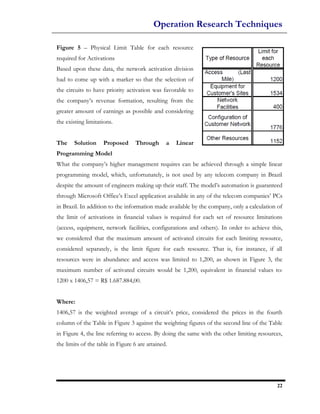
resources were in abundance and access was limited to 1,200, as shown in Figure 3, the
maximum number of activated circuits would be 1,200, equivalent in financial values to:
1200 x 1406,57 = R$ 1.687.884,00.


Where:
1406,57 is the weighted average of a circuit’s price, considered the prices in the fourth
column of the Table in Figure 3 against the weighting figures of the second line of the Table
in Figure 4, the line referring to access. By doing the same with the other limiting resources,
the limits of the table in Figure 6 are attained.


                                                                                            22
Operation Research Techniques

Figure 6 – Table for the monthly physical and financial limit of each resource required for
the activations.

By building now the primary linear programming model applied to the problem proposed,
and considering that all the data are now available, we get the following elements: Object


function: Max M 1545,65 x1 + 1856,36 x2 + 445,01 x3 + 1081,22 x4 + 1492,51 x5
Once what is intended is to maximize the revenue from the prices of the circuits of each
product (see Figure 1).


Restrictions to the Model:


                                                                                              23
Operation Research Techniques

R1) 998 x1 + 162 x2 + 132 x3 + 289 x4 + 108 x5 <= 1.687.884,00;
R2) 1276 x1 + 206 x2 +169 x3 + 369 x4 + 137 x5 <= 2.157.202,84;
R3) 333 x1 + 54 x2 + 44 x3 + 96 x4 + 36 x5 <= 562.736,00;
R4) 1477 x1 + 239 x2 + 196 x3 + 428 x4 + 159 x5 <= 2.497.269,12;
R5) 958 x1 + 155 x2 + 127 x3 + 277 x4 + 103 x5 <= 1.620.057,60;
Once each type of limiting resource (see Figure 2) leads to a maximum limit of revenue
acquisition resulting from circuit delivery, if analyzed separately from the others (see Figure
4).
R6) x1 + x2 + x3 + x4 + x5 <= 3000; maximum output capacity considered.
R7) x1 <= 5042;
R8) x2 <= 816;
R9) x3 <= 668;
R10) x4 <= 1459;
R11) x5 <= 543;
Once there is a finite set of circuits to be activated per month per type of network (product).
R12 a R16) x1, x2, x3, x4, x5, x6 >=0. Since there are no negative activations (Deliveries).
By submitting the Model to the SOLVER function in Microsoft’s Excel application, the
results shown in Figure 7 are attained.


                                                                                               24
Operation Research Techniques

The most outstanding points shown through the Excel’s results are: the optimum outputs
for the topic month would be the activation of 1,441 private telephone network circuit
activations; 816 Internet network circuit activations; 200 low speed data network circuit
activations; 543 high speed data network circuit activations; and postponing for the
following period the activations of the Intranet network circuits, coming to a total of 3,000
activations monthly, amounting to a revenue of R$ 4.768.888,31 for the company in the
month of study. If the same model is calculated, bringing production up to 4,000 circuits a
month, the distribution would be: Telephone networks 1,062, Internet 816, Intranet 120,
Low Speed Data 1,459, High Speed Data 543, for a revenue of R$ 5.597.053,12, leaving only
the Telephone and Intranet circuits to be solved in over 30 days, as Figure 8 below shows.


                                                                                             25
Operation Research Techniques

Conclusions and Recommendations
Some conclusions and recommendations can be taken from the information presented in
this paper that help in the day-to-day of a telecommunications company working with
activations (delivery) of customer corporate network circuits. First of all, the linear
programming methodology proposes markers for the activations that further focus on
parameters predefined by the company’s management personnel. As for the case presented
in this paper, if average figures were to be used, by sharing the efforts of the activations
teams per service, circuits would be activated that would add to earnings of 3000 x R$
1.406,39 = R$ 4.219.170,00, which is R$ 549.718,31 lower than the revenue made available,
by following the linear programming model. This means some revenue anticipation of
roughly 2.5 million American dollars per year. On the other hand, within a hyper-
competitive environment, an output efficiency increase becomes urgent for any industry or
service provider company. Through a Linear Programming Model, it gets easy to verify, for
instance, that by increasing output capacity to 4,000 circuits per month, the revenue
anticipation is increased by (R$ 5.597.053,12 – 4.768.888,31) R$ 828.164,81 monthly, and
this can be enough reason for the company to hire further human resources to meet this
revenue anticipation.


Finally, the utilization of statistics-based methodologies is recommended for output
environments even in service providing, aiming at production maximization or even cost
reduction. It is worth reminding that the model proposed here presents guidelines for the
priorities, not ignoring other underlying factors in prioritizing activation, such as a
customer’s urgent need or its category in segmentation by size or importance. The same
method used in this paper can guide the acquisition of resources for circuit activation, rental
of third parties’ access or vacation scheduling of the personnel involved in the provisioning,
aiming at a more compatible distribution of human resources throughout the year regarding
the demand for networks and services by customers.


                                                                                            26
Operation Research Techniques


                              BIBLIOGRAPHY


The information included in this project is taken from the reference:


Books:
Operation Research


Websites:
http://www.yankeegroup.com/custom/search/search_results.jsp#search_results
http://www.wikipedia.org/
http://www.google.com
http://www.mydigitalfc.com/op-ed/importance-fun-work-613www.answers.com


                                                                             27

Final hrm project 2003

  • 1.
    Operation Research Techniques ProjectReport On: Application of Operation Research Techniques Subject : Operation Research Submitted to: Prof. P.M. Bhole Prepared by: Mohd. Adil (45) Date: 17/3/2011 1
  • 2.
    Operation Research Techniques ACKNOWLEDGEMENT First and foremost let I sincerely thank ALMIGHTY for the great opportunity and blessings that he has showered up on us for the successful and timely completion of our project work. I extent my sincere gratitude to Dr. Vidya Hatangadi Director of AIAIMS for her kind support and guidance for making our project great success. I extent my sincere gratitude to guide Mr. P.M. Bhole, lecturer, Allana Institute of Management Studies for the kind support and proper guidance without which the project would not have been efficiently completed. I render my whole hearted thanks to librarian, for their assistance and co- operation given to me in regard to this work. Once again I take this opportunity to convey me sincere thanks to each and every person who helped me directly and indirectly in the successful completion of this project. 2
  • 3.
    Operation Research Techniques CONTENTS: SR.NO TOPICS PAGE NO. 1. Introduction……………………………………… 04----05 2. Structure of Linear Programming………………… 06----08 3. Assumptions of Linear Programming ……….…... 09----11 4. Limitations of Linear Programming…..……….…. 12----12 5. Applications of Linear Programming……….…….. 13----15 6. Case Study………………………………………. 16----26 7. Conclusion………………………………..……… 27---27 8. Bibliography……………………………….…….. 28---28 3
  • 4.
    Operation Research Techniques INTRODUCTION: Ina decision-making embroilment, model formulation is important because it represents the essence of business decision problem. The term formulation is used to mean the process of converting the verbal description and numerical data into mathematical expressions which represents the relevant relationship among decision factors, objectives and restrictions on the use of resources. Linear Programming (LP) is a particular type of technique used for economic allocation of 'scarce' or 'limited' resources, such as labour, material, machine, time, warehouse space, capital, energy, etc. to several competing activities, such as products, services, jobs, new equipment, projects, etc. on the basis of a given criterion of optimally. The phrase scarce resources mean resources that are not in unlimited in availability during the planning period. The criterion of optimality generally is either performance, return on investment, profit, cost, utilily, time, distance, etc. George B Dantzing while working with US Air Force during World War II developed this technique, primarily for solving military logistics problems. But now, it is being used extensively in all functional areas of management, hospitals, airlines, agriculture, military operations, oil refining, education, energy planning, pollution control, transportation planning and scheduling, research and development, etc. Even though these applications are diverse, all I.P models consist of certain common properties and assumptions. Before applying linear programming to a real-life decision problem, the decision-maker must be aware of all these properties and assumptions, which are discussed later in this chapter. Before discussing in detail the basic concepts and applications of linear programming, let us be clear about the two words, linear and programming. The word linear refers to linear relationship among variables in a model. Thus, a given change in one variable will always cause a resulting proportional change in another variable. For example, doubling the investment on a certain project will exactly double the rate of return. The word programming refers to modelling and solving a problem mathematically that involves the economic allocation of limited resources by choosing a particular course of action or strategy among various alternative strategies to achieve the desired objective. 4
  • 5.
    Operation Research Techniques Alarge number of computer packages are available for solving a mathematical LP model but there is no general package for building a model. Model building is an art that improves with practice. To illustrate, how to build I.P models, a variety of examples are given in this chapter. 5
  • 6.
    Operation Research Techniques STRUCTUREOF LINEAR PROGRAMMING General Structure of LP Model The general structure of LP model consists of three components. Decision variables (activities): We need to evaluate various alternatives (courses of action) for arriving at the optimal value of objective function. Obviously, if there are no alternatives to select from, we would not need LP. The evaluation of various alternatives is guided by the nature of objective function and availability of resources. For this, we pursue certain activities usually denoted by x1, x2…xn. The value of these activities represents the extent to which each of these is performed. For example, in a product-mix manufacturing, the management may use LP to decide how many units of each of the product to manufacture by using its limited resources such as personnel, machinery, money, material, etc. These activities are also known as decision variables because they arc under the decision- maker's control. These decision variables, usually interrelated in terms of consumption of limited resources, require simultaneous solutions. All decision variables are continuous, controllable and non-negative. That is, x1>0, x2>0, ....xn>0. The objective function: The objective function of each L.P problem is a mathematical representation of the objective in terms of a measurable quantity such as profit, cost, revenue, distance, etc. In its general form, it is represented as: Optimise (Maximise or Minimise) Z = c1x1 + c2X2. … cnxn where Z is the mcasure-of-performance variable, which is a function of x1, x2 ..., xn. Quantities c1, c2…cn are parameters that represent the contribution of a unit of the respective variable x1, x2 ..., xn to the measure-of-performance Z. The optimal value of the given objective function is obtained by the graphical method or simplex method. 6
  • 7.
    Operation Research Techniques Theconstraints: There are always certain limitations (or constraints) on the use of resources, e.g. labour, machine, raw material, space, money, etc. that limit the degree to which objective can be achieved. Such constraints must be expressed as linear equalities or inequalities in terms of decision variables. The solution of an L.P model must satisfy these constraints. The linear programming method is a technique for choosing the best alternative from a set of feasible alternatives, in situations in which the objective function as well as the constraints can be expressed as linear mathematical functions. In order to apply linear programming, there are certain requirements to me met. • There should be an objective which should be clearly identifiable and measurable in quantitative terms. It could be, for example, maximisation of sales, of profit, minimisation of cost, and so on. • The activities to be included should be distinctly identifiable and measurable in quantitative terms, for instance, the products included in a production planning problem. • The resources of the system which arc to be allocated for the attainment of the goal should also be identifiable and measurable quantitatively. They must be in limited supply. The technique would involve allocation of these resources in a manner that would trade off the returns on the investment of the resources for the attainment of the objective. • The relationships representing the objective as also the resource limitation considerations, represented by the objective function and the constraint equations or inequalities, respectively must be linear in nature. 7
  • 8.
    Operation Research Techniques • There should be a series of feasible alternative courses of action available to the decision makers, which are determined by the resource constraints. When these stated conditions are satisfied in a given situation, the problem can be expressed in algebraic form, called the Linear Programming Problem (LPP) and then solved for optimal decision. We shall first illustrate the formulation of linear programming problems and then consider the method of their solution. 8
  • 9.
    Operation Research Techniques ASSUMPTIONSOF LINEAR PROGRAMMING The following four basic assumptions are necessary for all linear programming models. Certainty: In all LP models, it is assumed, that all model parameters such as availability of resources, profit (or cost) contribution of a unit of decision variable and consumption of resources by a unit of decision variable must be known and is constant. In some cases, these may be either random variables represented by a known distribution (general or may be statistical) or may tend to change, then the given problem can be solved by a stochastic LP model or parametric programming. The linear programming is obviously deterministic in nature. Divisibility (or continuity): The solution values of decision variables and resources are assumed to have either whole numbers (integers) or mixed numbers (integer and fractional). However, if only integer variables are desired, e.g. machines, employees, etc. the integer programming method may be applied to get the desired values. It is also an assumption of a linear programming model that the decision variables are continuous. As a consequence, combinations of output with fractional values, in the context of production problems, are possible and obtained frequently. For example, the best solution to a problem might be to produce 5 2/3 units of product A and 10 1/3 units of product B per week. Although in many situations we can have only integer values, but we can deal with the fractional values, when they appear, in the following ways. Firstly, when the decision is a one-shot decision, that is to say, it is not repetitive in nature and has to be taken only once, we may round the fractional values to the nearest integer values. However, when we do so, we should evaluate the revised solution to determine whether the solution represented by the rounded values is a feasible solution and also whether the solution is the best integer solution. Secondly, if the problem relates to a continuum of time and it is designed to determine 9
  • 10.
    Operation Research Techniques optimalsolution for a given time period only, then the fractional values may not be rounded. For instance in the context of a production problem, a solution like the one given earlier to make 5 2/3 units of A and 10 units of B per week, can be adopted without any difficulty. The fractional amount of production would be taken to be the work-in- progress and become a portion of the production of the following week. In this case an output of 17 units of A and 31 units of B over a three-week period would imply 5 2/3 units of A and 10 units of B per week. Lastly, if we must insist on obtaining only integer values of the decision variables, we may restate the problem as an integer programming problem, forcing the solutions to be in integers only. Additively: The value of the objective function for the given values of decision variables and the total sum of resources used, must be equal to the sum of the contributions (profit or cost) earned from each decision variable and the sum of the resources used by each decision variable, respectively. For example, the total profit earned by the sale of two products A and B must be equal to the sum of the profits earned separately from A and B. Similarly, the amount of a resource consumed by A and B must be equal to the sum of resources used for A and B individually. This assumption implies that there is no interaction among the decision variables (interaction is possible when, for example, some product is a by-product of another one). Finite choices: A linear programming model also assumes that a limited number of choices are available to a decision-maker and the decision variables do not assume negative values. Thus, only non-negative levels of activity are considered feasible. This assumption is indeed a realistic one. For instance, in the production problems, the output cannot obviously be negative, because a negative production implies that we should be able to reverse the production process and convert the finished output back into the raw materials! 10
  • 11.
    Operation Research Techniques Linearity(or proportionality): All relationships in the LP model (i.e. in both objective function and constraints) must be linear. In other words, for any decision variable j, the amount of particular resource say i used and its contribution to the cost one in objective function must be proportional to its amount. For example, if production of one unit of a product uses 5 hours of a particular resource, then making 3 units of that product uses 3 x 5 = 15 hours of that resource. 11
  • 12.
    Operation Research Techniques LIMITATIONSOF LINEAR PROGRAMMING In spite of having many advantages and wide areas of applications, there arc some limitations associated with this technique. These are given below. Linear programming treats all relationships among decision variables as linear. However, generally, neither the objective functions nor the constraints in real-life situations concerning business and industrial problems are linearly related to the variables. • While solving an LP model, there is no guarantee that we will get integer valued solutions. For example, in finding out how many men and machines would be required lo perform a particular job, a non-integer valued solution will be meaningless. Rounding off the solution to the nearest integer will not yield an optimal solution. In such cases, integer programming is used to ensure integer value to the decision variables. • Linear programming model does not take into consideration the effect of time and uncertainty. Thus, the LP model should be defined in such a way that any change due to internal as well as external factors can be incorporated. • Sometimes large-scale problems can be solved with linear programming techniques even when assistance of computer is available. For it, the main problem can be fragmented into several small problems and solving each one separately. • Parameters appearing in the model are assumed to be constant but in real-life situations, they are frequently neither known nor constant. It deals with only single objective, whereas in real-life situations we may come across conflicting multi-objective problems. In such cases, instead of the LP model, a goal programming model is used to get satisfactory values of these objectives. 12
  • 13.
    Operation Research Techniques APPLICATIONAREAS OF LINEAR PROGRAMMING Linear programming is the most widely used technique of decision-making in business and Industry and in various other fields. In this section, we will discuss a few of the broad application areas of linear programming. Agricultural Applications These applications fall into categories of farm economics and farm management. The former deals with agricultural economy of a nation or region, while the latter is concerned with the problems of the individual farm. The study of farm economics deals with inter-regional competition and optimum allocation of crop production. Efficient production patterns can be specified by a linear programming model under regional land resources and national demand constraints. Linear programming can be applied in agricultural planning, e.g. allocation of limited resources such as acreage, labour, water supply and working capital, etc. in a way so as to maximise net revenue. Military Applications Military applications include the problem of selecting an air weapon system against enemy so as to keep them pinned down and at the same time minimising the amount of aviation gasoline used. A variation of the transportation problem that maximises the total tonnage of bombs dropped on a set of targets and the problem of community defence against disaster, the solution of which yields the number of defence units that should be used in a given attack in order to provide the required level of protection at the lowest possible cost. 13
  • 14.
    Operation Research Techniques ProductionManagement • Product mix: A company can produce several different products, each of which requires the use of limited production resources. In such cases, it is essential to determine the quantity of each product to be produced knowing its marginal contribution and amount of available resource used by it. The objective is to maximise the total contribution, subject to all constraints. • Production planning: This deals with the determination of minimum cost production plan over planning period of an item with a fluctuating demand, considering the initial number of units in inventory, production capacity, constraints on production, manpower and all relevant cost factors. The objective is to minimise total operation costs. • Assembly-line balancing: this problem is likely to arise when an item can be made by assembling different components. The process of assembling requires some specified sequcnce(s). The objective is to minimise the total elapse time. • Blending problems: These problems arise when a product can be made from a variety of available raw materials, each of which has a particular composition and price. The objective here is to determine the minimum cost blend, subject to availability of the raw materials, and minimum and maximum constraints on certain product constituents. • Trim loss: When an item is made to a standard size (e.g. glass, paper sheet), the problem that arises is to determine which combination of requirements should be produced from standard materials in order to minimise the trim loss. Financial Management • Portfolio selection: This deals with the selection of specific investment activity among several other activities. The objective is to find the allocation which maximises the total expected return or minimises risk under certain limitations. • Profit planning: This deals with the maximisation of the profit margin from investment in plant facilities and equipment, cash in hand and inventory. 14
  • 15.
    Operation Research Techniques MarketingManagement • Media selection: Linear programming technique helps in determining the advertising media mix so as to maximise the effective exposure, subject to limitation of budget, specified exposure rates to different market segments, specified minimum and maximum number of advertisements in various media. • Travelling salesman problem: The problem of salesman is to find the shortest route from a given city, visiting each of the specified cities and then returning to the original point of departure, provided no city shall be visited twice during the tour. Such type of problems can be solved with the help of the modified assignment technique. • Physical distribution: Linear programming determines the most economic and efficient manner of locating manufacturing plants and distribution centres for physical distribution. Personnel Management • Staffing problem: Linear programming is used to allocate optimum manpower to a particular job so as to minimise the total overtime cost or total manpower. • Determination of equitable salaries: Linear programming technique has been used in determining equitable salaries and sales incentives. • Job evaluation and selection: Selection of suitable person for a specified job and evaluation of job in organisations has been done with the help of linear programming technique. Other applications of linear programming lie in the area of administration, education, fleet utilisation, awarding contracts, hospital administration and capital budgeting, etc. 15
  • 16.
    Operation Research Techniques Case Study: LINEAR PROGRAMMING APPLICATION FOR EFFICIENT TELECOMMUNICATION NETWORKS PROVISIONING Abstract This paper presents a practical proposition for the application of the Linear Programming quantitative method in order to assist planning and control of customercircuit delivery activities in telecommunications companies working with thecorporative market. Based upon data provided for by a telecom company operating in Brazil, the Linear Programming method was employed for one of the classical problems of determining the optimum mix of production quantities for a set of five products of that company: Private Telephone Network, Internet Network, Intranet Network, Low Speed Data Network, and High Speed Data Network, in face of several limitations of the productive resources, seeking to maximize the company’s monthly revenue. By fitting the production data available into a primary model, observation was made as to what number of monthly activations for each product would be mostly optimized in order to achieve maximum revenues in the company. The final delivery of a complete network was not observed but the delivery of the circuits that make it up, and this was a limiting factor for the study herein, which, however, brings an innovative proposition for the planning of private telecommunications network provisioning. Introduction In the past few years telecommunications have become an input of great business importance, especially for large companies. The need for their own telecommunications network provisioning has been a constant concern of large- and medium-sized enterprises the world over. Even when a large telecommunications company is outsourced to operate a customer’s network, the circuits provisioning of that network is of utmost importance for the continuation of the business regarding time and quality. Upon delivery of circuits to customers, the large telecom network providers seek ways to reduce their costs by relying on 16
  • 17.
    Operation Research Techniques smallerteams and even more reduced delivery schedules in an attempt to meet the customer’s needs before their competitors do. A data communication network provisioning, for instance, which in 1999 was activated in 45 days by Europe’s biggest players, BTI, and by U.S.A.’s MCI, nowadays is Prepared and delivered to the customer in 21 to 25 days (YANKEE GROUP, 2005). However, these are average schedules since urgent activations are special cases that can be delivered in less than a week. In Brazil the telecommunications industry is facing a scenario with an excessive number of telecom service providers, with an overestimated demand that marks a scenario of hyper competition. Thus, the briefness in activating a service overcomes all of the other features of that service provisioning, also putting aside an adequate planning of delivery of the products that make up the customer’s network and this prioritization of delivery brings about some loss to the service provider’s cash. This paper, which is based on data provided by one telecom provider in Brazil, presents an essay that aims to propose a simple alternative, yet with a solid mathematical basis, in order to ensure there is a marker in the prioritization of customers’ circuit provisioning that aims at the main goal of sales and the business, its profitability. Circuit Activation in Telecom Companies In order to better understand the proposition of this paper, one must get to know a little about the activation or delivery process of a telecommunications network provisioning. This network, presented in Figure 1, is a set of circuits interlocking through a large telecom operator backbone several customer environments (sites), from which he operates his business. This process includes all the activities from the request of a service order by the customer to the provisioning of the network in operation (the beginning of its commercial running), going through assembly of every physical part of the network, the configuration of its logical parameters, and the running test with customer’s application, simulating the day today of the business as shown in Figure 2. 17
  • 18.
    Operation Research Techniques InFigure 2, it can also be noticed that within the assembly of the backbone’s physical part the local access granting activities (2), also known as ‘last mile’; equipment acquisition activities for installation at customers’ sites (4); facility allocation activities (communication channels to be used in the customer’s network) within the operator’s large backbone (1); and customer’s network configuration (3) are all capital availability activities of fundamental importance in order to ensure activation of all the circuits making up the customer’s network provisioning. 18
  • 19.
    Operation Research Techniques Thelack, or poor distribution, of such capital brings about a delay in the provisioning of the networks, resulting in loss of profit to the telecom operator. Moreover, the random allocation, as in a line-up system – FIFO - First In First Out, or simply proportional to the resources available, might bring about an undesired delay effect on large capital inflow to the operator, thus representing a problem that can be solved in a structured way through a Linear Programming Model. Brazilian Telecom Company The customer network provisioning division of a big telecommunications company in the Brazilian market activates on a monthly basis 3,000 circuits of different products (types of network), which are offered to the market in the following categories: Private Telephone Network, Internet Network, Intranet Network, Low Speed Data Network, and High Speed Data Network. Its limited capital and output capacity allow it to activate only 35% out of the 8,500 circuits backlog monthly. This does not pose a problem for the customers since they accept delivery of their networks in up to 60 days depending upon the complexity of the network and the kind of business it is intended for. However, since the prices charged for the circuits in each kind of network are different, the company expects that priority be given to the activation of the circuits that represent higher earnings to the company. Nowadays, there is no indicator of how many circuits for each kind of product must be activated on average per month, so that guidance from the company’s higher management can be followed. So, in a typical month of 2004, a survey was conducted as to the situation of the company’s circuit delivery and the following results were attained: Figure 3 – Table that summarizes Circuit Backlog (Circuit Delivery) per Service Backlog of a Brazilian Telecom Company in a typical month. 19
  • 20.
    Operation Research Techniques Where: ServiceBacklog: Circuit delivery orders for each product of the company; Physical Backlog: Number of telecommunications circuits to be delivered; Financial Backlog: Total revenue of the company after circuit activations (deliveries) (in R$: 1US$ = R$ 2,66; 1R$ = US$ 0,375 on Dec/30/2004); Price per Circuit: Average unit price of each circuit in each kind of network. An attempt was made to understand the existing limitations to carry out circuit delivery in addition to the monthly production capacity, which is already estimated in 3,000 circuits per month without any additional work shift or engagement of temporary labor. Five main limiters were attained as well as their quantities that are required per month per type of product, as shown in Figure 4 below. 20
  • 21.
    Operation Research Techniques Figure4 – Table that summarizes the required amount of each component that make up Customer’s circuits per type of service backlog. Where: Type of Resource: Part required for making up a customer’s circuit: Access or Last Mile is the linking point between the customer’s site and the operator’s backbone; Equipment for the customers’ sites are modems, routers or other equipment required for customer communication on each of his sites; Network Facilities are communications channels within the operator’s backbone that carry customers’ signals from one side of the country or the world to the other; Customer Network Configuration is a set of manual operations by a technician from the provider company in order to prepare the operator’s backbone to allow traffic of the customer’s network circuits through its facilities; Other Resources are a set of minor factors that have been grouped into a single item. PT: Private Telephone Networks; INTER: Internet networks; INTRA: Intranet Networks; LSD: Low Speed Data Networks; HSD: High Speed Data Networks. Finally, the available amount of each limiting resource in a month was attained, from the physical viewpoint, as shown in Figure 5 below. 21
  • 22.
    Operation Research Techniques Figure5 – Physical Limit Table for each resource required for Activations Based upon these data, the network activation division had to come up with a marker so that the selection of the circuits to have priority activation was favorable to the company’s revenue formation, resulting from the greater amount of earnings as possible and considering the existing limitations. The Solution Proposed Through a Linear Programming Model What the company’s higher management requires can be achieved through a simple linear programming model, which, unfortunately, is not used by any telecom company in Brazil despite the amount of engineers making up their staff. The model’s automation is guaranteed through Microsoft Office’s Excel application available in any of the telecom companies’ PCs in Brazil. In addition to the information made available by the company, only a calculation of the limit of activations in financial values is required for each set of resource limitations (access, equipment, network facilities, configurations and others). In order to achieve this, we considered that the maximum amount of activated circuits for each limiting resource, considered separately, is the limit figure for each resource. That is, for instance, if all resources were in abundance and access was limited to 1,200, as shown in Figure 3, the maximum number of activated circuits would be 1,200, equivalent in financial values to: 1200 x 1406,57 = R$ 1.687.884,00. Where: 1406,57 is the weighted average of a circuit’s price, considered the prices in the fourth column of the Table in Figure 3 against the weighting figures of the second line of the Table in Figure 4, the line referring to access. By doing the same with the other limiting resources, the limits of the table in Figure 6 are attained. 22
  • 23.
    Operation Research Techniques Figure6 – Table for the monthly physical and financial limit of each resource required for the activations. By building now the primary linear programming model applied to the problem proposed, and considering that all the data are now available, we get the following elements: Object function: Max M 1545,65 x1 + 1856,36 x2 + 445,01 x3 + 1081,22 x4 + 1492,51 x5 Once what is intended is to maximize the revenue from the prices of the circuits of each product (see Figure 1). Restrictions to the Model: 23
  • 24.
    Operation Research Techniques R1)998 x1 + 162 x2 + 132 x3 + 289 x4 + 108 x5 <= 1.687.884,00; R2) 1276 x1 + 206 x2 +169 x3 + 369 x4 + 137 x5 <= 2.157.202,84; R3) 333 x1 + 54 x2 + 44 x3 + 96 x4 + 36 x5 <= 562.736,00; R4) 1477 x1 + 239 x2 + 196 x3 + 428 x4 + 159 x5 <= 2.497.269,12; R5) 958 x1 + 155 x2 + 127 x3 + 277 x4 + 103 x5 <= 1.620.057,60; Once each type of limiting resource (see Figure 2) leads to a maximum limit of revenue acquisition resulting from circuit delivery, if analyzed separately from the others (see Figure 4). R6) x1 + x2 + x3 + x4 + x5 <= 3000; maximum output capacity considered. R7) x1 <= 5042; R8) x2 <= 816; R9) x3 <= 668; R10) x4 <= 1459; R11) x5 <= 543; Once there is a finite set of circuits to be activated per month per type of network (product). R12 a R16) x1, x2, x3, x4, x5, x6 >=0. Since there are no negative activations (Deliveries). By submitting the Model to the SOLVER function in Microsoft’s Excel application, the results shown in Figure 7 are attained. 24
  • 25.
    Operation Research Techniques Themost outstanding points shown through the Excel’s results are: the optimum outputs for the topic month would be the activation of 1,441 private telephone network circuit activations; 816 Internet network circuit activations; 200 low speed data network circuit activations; 543 high speed data network circuit activations; and postponing for the following period the activations of the Intranet network circuits, coming to a total of 3,000 activations monthly, amounting to a revenue of R$ 4.768.888,31 for the company in the month of study. If the same model is calculated, bringing production up to 4,000 circuits a month, the distribution would be: Telephone networks 1,062, Internet 816, Intranet 120, Low Speed Data 1,459, High Speed Data 543, for a revenue of R$ 5.597.053,12, leaving only the Telephone and Intranet circuits to be solved in over 30 days, as Figure 8 below shows. 25
  • 26.
    Operation Research Techniques Conclusionsand Recommendations Some conclusions and recommendations can be taken from the information presented in this paper that help in the day-to-day of a telecommunications company working with activations (delivery) of customer corporate network circuits. First of all, the linear programming methodology proposes markers for the activations that further focus on parameters predefined by the company’s management personnel. As for the case presented in this paper, if average figures were to be used, by sharing the efforts of the activations teams per service, circuits would be activated that would add to earnings of 3000 x R$ 1.406,39 = R$ 4.219.170,00, which is R$ 549.718,31 lower than the revenue made available, by following the linear programming model. This means some revenue anticipation of roughly 2.5 million American dollars per year. On the other hand, within a hyper- competitive environment, an output efficiency increase becomes urgent for any industry or service provider company. Through a Linear Programming Model, it gets easy to verify, for instance, that by increasing output capacity to 4,000 circuits per month, the revenue anticipation is increased by (R$ 5.597.053,12 – 4.768.888,31) R$ 828.164,81 monthly, and this can be enough reason for the company to hire further human resources to meet this revenue anticipation. Finally, the utilization of statistics-based methodologies is recommended for output environments even in service providing, aiming at production maximization or even cost reduction. It is worth reminding that the model proposed here presents guidelines for the priorities, not ignoring other underlying factors in prioritizing activation, such as a customer’s urgent need or its category in segmentation by size or importance. The same method used in this paper can guide the acquisition of resources for circuit activation, rental of third parties’ access or vacation scheduling of the personnel involved in the provisioning, aiming at a more compatible distribution of human resources throughout the year regarding the demand for networks and services by customers. 26
  • 27.
    Operation Research Techniques BIBLIOGRAPHY The information included in this project is taken from the reference: Books: Operation Research Websites: http://www.yankeegroup.com/custom/search/search_results.jsp#search_results http://www.wikipedia.org/ http://www.google.com http://www.mydigitalfc.com/op-ed/importance-fun-work-613www.answers.com 27