Critical analysis of
GlaxoSmithKline’s Strategy
     - Clifford Moon
Content
 Introduction (‘GlaxoSmithKline’)
 Organisational Goals
 Planning of the company
 Competitive Advantage
 Corporate Social Responsibility of company
 Positioning of the company
 Strategy Implementations
 Recommendations
 References
GlaxoSmithKline plc
• Our organisation has rich history it starts from early 18th century.
• GlaxoSmithKline was formed in 2000 after merging of Glaxo Wellcome plc
  and SmithKline Beecham plc.
• It is one of the worlds largest pharmaceutical company in terms of revenues.
• It has delivered 1.4 billion doses of drugs in 179 countries in 2010.

Mission
“To improve the quality of human life by enabling people to do more, feel
better and live longer”.

Vision
“To become the indisputable leader in the Pharmaceutical industry not only in
terms of size but also by to achieve their mission and improve the quality of
human life”.
Organisational Goals
Every organisations have goals and to achieve this they need strategy. GSK
adopted various strategies to achieve growth, reduce risk and improve GSK‟s
long term financial performance.

Grow a diversified global business:
GSK is focusing mainly growth in emerging markets and also on its consumer
products operation then developed economies.

Deliver more products of value:
To be leader in the market companies need three elements like classic brands,
vaccines and innovative products.

Simplify GSK’s operating model:
Business continues to change shape, it is essential to transform the operating
model to reduce complexities, improve efficiencies and reduce cost.
 (GSK, 2011)
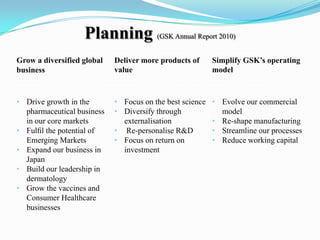
Planning             (GSK Annual Report 2010)


Grow a diversified global   Deliver more products of      Simplify GSK’s operating
business                    value                         model


• Drive growth in the       • Focus on the best science   • Evolve our commercial
  pharmaceutical business   • Diversify through             model
  in our core markets         externalisation             • Re-shape manufacturing
• Fulfil the potential of    • Re-personalise R&D          • Streamline our processes
  Emerging Markets          • Focus on return on          • Reduce working capital
• Expand our business in      investment
  Japan
• Build our leadership in
  dermatology
• Grow the vaccines and
  Consumer Healthcare
  businesses
GSK’S Business Model


(Annual Report, 2010)
Group Sales (GSK Annual Report 2010)
Competitive advantage


(Chandon, 2003)
Top Pharmaceutical Companies
                           3 years Ranking Trend
                           2008   2009    2010


                                                   7
                                                       3
                                                   7   8
                              5
                      4                  2
                              4          2         7   6
                      3                  4
         1
         1            2       3
         1


(Roth, 2008, 2009, 2010)
Corporate social responsibility of GSK’s
• Reduce the price of the medicine in the under-developed countries to 25% of
  developed world prices.

• Flexible pricing structure for middle-income countries.

• Reinvest 20% of its profits from sales of medicines in developing countries
  to support the strengthening of healthcare infrastructure.

Example

13,500 compound from GSKs library that have shown activity against the
malaria parasite have been made freely available online, a first for the
pharmaceutical industry.

 (Barham, 2010)
Positioning


Strategic positioning is mainly concerned with the impact on strategy of the
external environment, internal resources and competences, and the
expectations and influence of stakeholders.

(Johnson and Scholes, 2005)
Positioning of GSK
 Two and a half years ago, GSK has changed its business
  strategy to provide cost effective , new and effective medicines
  by restructuring and rigorous capital allocation.

 Restructuring programme has allowed to diversify its sales
  base from low growth markets to key growth areas such as
  emerging economies.

 During 2010 it has continued to improve its R&D
  pipeline, environmental sustainability and commitment towards
  neglected tropical diseases.

 (GSK, 2011)
SWOT
Analysis of key environmental issues and the strategic capability could give the
Current strategic position of GSK. SWOT involves analysis of company's
internal environment in terms of its strengths, weaknesses and external
environment in terms of opportunities and threats.

Strengths:                                   Weakness :

 Global presence and well                    Patent infringement claims.
    diversified.                              Increasing generic competition.
   Industry leader in R&D.                   Dependence on low growth
   Strong sales and marketing.                 products.
   Life cycle management strategies.
   Strong financial position.

    (Alacra.com, 2010)
Opportunities                   Threats

 Growth in emerging markets.    Competitive pressures.


 Enhanced product offering.     Increasing presence of counterfeit
                                  Drugs.
 Movement into oncology and
  biologics market.              Impact of generic products on
                                  sales made by franchises.
 Organic growth.
                                 Further setbacks in R&D pipeline.


 (Alacra.com, 2010)
Bowman's strategic clock


(Faulkner & Bowman, 1995)
Porters Five Forces Model for Developing Countries :


                                 New Market Entrants :
                                 • Recognized Marketing Code


                                                                         Buyers Powers :
                                  Competitive Priority :                 • Consumers do not have
Barriers to Entry :
                                  • Highly Competitive
• Government policy                                                         bargaining power.
                                  • Low Fixed Costs & High               • Price sensitivity is less.
• Brand Recognition
                                    Working Capital                      • Brand identity in the hands of
                                  • Differentiation Strategy                influencer.


                               Power of Product and Technology
                               Development :
                               • Reforming R & D
                               • Entrants of New Vaccines by 2011 end.
                               • Restructuring for Diversity and
                                  Strengthening.

 (Porter, 2008)
• Strategy can be weighed not only based on the positioning and
  planning phases, but carry great weight when it is actually
  being carried out “Implementation”.


• Implementation should consider the time scale of the
  operation, resources and available funds.


•   It also must monitor and control the operations.
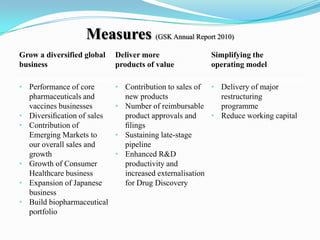
Measures (GSK Annual Report 2010)
Grow a diversified global   Deliver more               Simplifying the
business                    products of value          operating model

• Performance of core       • Contribution to sales of • Delivery of major
  pharmaceuticals and         new products                restructuring
  vaccines businesses       • Number of reimbursable      programme
• Diversification of sales     product approvals and     • Reduce working capital
• Contribution of             filings
  Emerging Markets to       • Sustaining late-stage
  our overall sales and       pipeline
  growth                    • Enhanced R&D
• Growth of Consumer          productivity and
  Healthcare business         increased externalisation
• Expansion of Japanese       for Drug Discovery
  business
• Build biopharmaceutical
  portfolio
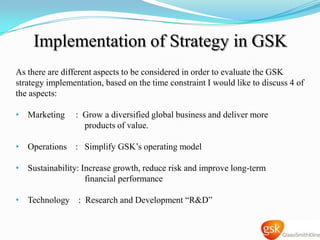
Implementation of Strategy in GSK
As there are different aspects to be considered in order to evaluate the GSK
strategy implementation, based on the time constraint I would like to discuss 4 of
the aspects:

• Marketing      : Grow a diversified global business and deliver more
                   products of value.

• Operations : Simplify GSK‟s operating model

• Sustainability: Increase growth, reduce risk and improve long-term
                   financial performance

• Technology : Research and Development “R&D”
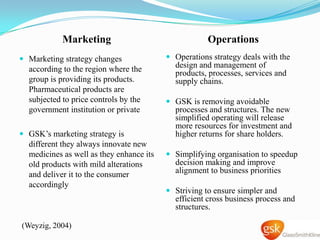
Marketing                                 Operations
 Marketing strategy changes               Operations strategy deals with the
  according to the region where the         design and management of
                                            products, processes, services and
  group is providing its products.          supply chains.
  Pharmaceutical products are
  subjected to price controls by the       GSK is removing avoidable
  government institution or private         processes and structures. The new
                                            simplified operating will release
                                            more resources for investment and
 GSK‟s marketing strategy is               higher returns for share holders.
  different they always innovate new
  medicines as well as they enhance its    Simplifying organisation to speedup
  old products with mild alterations        decision making and improve
  and deliver it to the consumer            alignment to business priorities
  accordingly
                                           Striving to ensure simpler and
                                            efficient cross business process and
                                            structures.

(Weyzig, 2004)
Sustainability                                 Technology
 As part of environment, health, safety      Technology depends on a vibrant
  and sustainability policy (EHSS) and         and productive R&D function that
  to achieve global leadership and             encourages creativity and facilitates
  excellence it works with various stake       the accelerated discovery and
  holders to reduce its carbon foot print.     development of new medicines and
                                               vaccines.
 GSK has revised its sustainability
  strategy in 2010 to reduce its annual       A refocus on the best science led us
  costs by £100 million by 2020.               to create an entrepreneurial
                                               environment in discovery and
 It acts beyond the operations to reduce      medicine development.
  carbon emissions resulting from
  supply chain and sales to customers.
                                              GSK have strongest development
                                               pipelines of potential new medicines
 Its vision is to reduce co2 emissions        and vaccines in the industry.
  by 25% in coming ten years and make
  its products carbon neutral by 2050.
                                              GSK build collaborations and links
                                               with other research groups

(GSK, 2011)
Recommendations

 In emerging markets it should adapt a strategy to
 protect itself from counterfeiting of its drugs.

 Create new modelling tools to update data and
 influence strategic decision making.
References
   Alacra.com (2010) GlaxoSmithKline plc (GSK) - Financial and Strategic Analysis Review [Online]
    http://www.alacra.com/acm/2087_sample.pdf [Accessed 17th November 2011]
   Barham, L. (2010) GSK's approach to corporate social responsibility [Online]
    http://social.eyeforpharma.com/marketing/gsks-approach-corporate-social-responsibility [Accessed 15th
    November 2011]
   Chandon, P. (2003) „Innovative marketing strategies after patent expiry: The case of GSK‟s antibiotic
    Clamoxyl in France‟,. International Journal of Medical Marketing, Vol. 4 No. 1, pp. 65-73
   Faulkner, D. & Bowman, C. (1995) The Essence of Competitive Strategy, 1st edition, Prentice Hall PTR
   GlaxoSmithKline plc. (2011) Our Strategy [Online] http://www.gsk.com/about/our-strategy.htm [Accessed
    10th November 2011]
   GlaxoSmithKline plc. (2010) GlaxoSmithKline Annual Report 2010 [Online]
    http://www.gsk.com/investors/reps10/GSK-Annual-Report-2010.pdf [Accessed 11th November 2011]
   Johnson, G. and Scholes, K. (2005) Exploring corporate strategy: text and cases, 7th edition, Harlow:
    Financial Times Prentice Hall
   Porter, M.E. (2008) On Competition, Upd Exp edition, Harvard Business School Press
   Roth, G.Y. (2008)(2009)(2010) Top 20 Pharmaceutical Companies Report [Online]
    http://www.contractpharma.com/issues/2009-07/view_features/2009-top-20-pharmaceutical-companies-
    report/ [Accessed 17th November 2011]
   Weyzig, F. (2004) GlaxoSmithKline company profile [Online]
    http://www.docstoc.com/docs/15102099/GlaxoSmithKline-company-profile [Accessed 19th
    November, 2011]

Final group presentation

  • 1.
  • 2.
    Content  Introduction (‘GlaxoSmithKline’) Organisational Goals  Planning of the company  Competitive Advantage  Corporate Social Responsibility of company  Positioning of the company  Strategy Implementations  Recommendations  References
  • 3.
    GlaxoSmithKline plc • Ourorganisation has rich history it starts from early 18th century. • GlaxoSmithKline was formed in 2000 after merging of Glaxo Wellcome plc and SmithKline Beecham plc. • It is one of the worlds largest pharmaceutical company in terms of revenues. • It has delivered 1.4 billion doses of drugs in 179 countries in 2010. Mission “To improve the quality of human life by enabling people to do more, feel better and live longer”. Vision “To become the indisputable leader in the Pharmaceutical industry not only in terms of size but also by to achieve their mission and improve the quality of human life”.
  • 4.
    Organisational Goals Every organisationshave goals and to achieve this they need strategy. GSK adopted various strategies to achieve growth, reduce risk and improve GSK‟s long term financial performance. Grow a diversified global business: GSK is focusing mainly growth in emerging markets and also on its consumer products operation then developed economies. Deliver more products of value: To be leader in the market companies need three elements like classic brands, vaccines and innovative products. Simplify GSK’s operating model: Business continues to change shape, it is essential to transform the operating model to reduce complexities, improve efficiencies and reduce cost. (GSK, 2011)
  • 5.
    Planning (GSK Annual Report 2010) Grow a diversified global Deliver more products of Simplify GSK’s operating business value model • Drive growth in the • Focus on the best science • Evolve our commercial pharmaceutical business • Diversify through model in our core markets externalisation • Re-shape manufacturing • Fulfil the potential of • Re-personalise R&D • Streamline our processes Emerging Markets • Focus on return on • Reduce working capital • Expand our business in investment Japan • Build our leadership in dermatology • Grow the vaccines and Consumer Healthcare businesses
  • 6.
  • 7.
    Group Sales (GSKAnnual Report 2010)
  • 8.
  • 9.
    Top Pharmaceutical Companies 3 years Ranking Trend 2008 2009 2010 7 3 7 8 5 4 2 4 2 7 6 3 4 1 1 2 3 1 (Roth, 2008, 2009, 2010)
  • 10.
    Corporate social responsibilityof GSK’s • Reduce the price of the medicine in the under-developed countries to 25% of developed world prices. • Flexible pricing structure for middle-income countries. • Reinvest 20% of its profits from sales of medicines in developing countries to support the strengthening of healthcare infrastructure. Example 13,500 compound from GSKs library that have shown activity against the malaria parasite have been made freely available online, a first for the pharmaceutical industry. (Barham, 2010)
  • 11.
    Positioning Strategic positioning ismainly concerned with the impact on strategy of the external environment, internal resources and competences, and the expectations and influence of stakeholders. (Johnson and Scholes, 2005)
  • 12.
    Positioning of GSK Two and a half years ago, GSK has changed its business strategy to provide cost effective , new and effective medicines by restructuring and rigorous capital allocation.  Restructuring programme has allowed to diversify its sales base from low growth markets to key growth areas such as emerging economies.  During 2010 it has continued to improve its R&D pipeline, environmental sustainability and commitment towards neglected tropical diseases. (GSK, 2011)
  • 13.
    SWOT Analysis of keyenvironmental issues and the strategic capability could give the Current strategic position of GSK. SWOT involves analysis of company's internal environment in terms of its strengths, weaknesses and external environment in terms of opportunities and threats. Strengths: Weakness :  Global presence and well  Patent infringement claims. diversified.  Increasing generic competition.  Industry leader in R&D.  Dependence on low growth  Strong sales and marketing. products.  Life cycle management strategies.  Strong financial position. (Alacra.com, 2010)
  • 14.
    Opportunities Threats  Growth in emerging markets.  Competitive pressures.  Enhanced product offering.  Increasing presence of counterfeit Drugs.  Movement into oncology and biologics market.  Impact of generic products on sales made by franchises.  Organic growth.  Further setbacks in R&D pipeline. (Alacra.com, 2010)
  • 15.
  • 16.
    Porters Five ForcesModel for Developing Countries : New Market Entrants : • Recognized Marketing Code Buyers Powers : Competitive Priority : • Consumers do not have Barriers to Entry : • Highly Competitive • Government policy bargaining power. • Low Fixed Costs & High • Price sensitivity is less. • Brand Recognition Working Capital • Brand identity in the hands of • Differentiation Strategy influencer. Power of Product and Technology Development : • Reforming R & D • Entrants of New Vaccines by 2011 end. • Restructuring for Diversity and Strengthening. (Porter, 2008)
  • 17.
    • Strategy canbe weighed not only based on the positioning and planning phases, but carry great weight when it is actually being carried out “Implementation”. • Implementation should consider the time scale of the operation, resources and available funds. • It also must monitor and control the operations.
  • 18.
    Measures (GSK AnnualReport 2010) Grow a diversified global Deliver more Simplifying the business products of value operating model • Performance of core • Contribution to sales of • Delivery of major pharmaceuticals and new products restructuring vaccines businesses • Number of reimbursable programme • Diversification of sales product approvals and • Reduce working capital • Contribution of filings Emerging Markets to • Sustaining late-stage our overall sales and pipeline growth • Enhanced R&D • Growth of Consumer productivity and Healthcare business increased externalisation • Expansion of Japanese for Drug Discovery business • Build biopharmaceutical portfolio
  • 19.
    Implementation of Strategyin GSK As there are different aspects to be considered in order to evaluate the GSK strategy implementation, based on the time constraint I would like to discuss 4 of the aspects: • Marketing : Grow a diversified global business and deliver more products of value. • Operations : Simplify GSK‟s operating model • Sustainability: Increase growth, reduce risk and improve long-term financial performance • Technology : Research and Development “R&D”
  • 20.
    Marketing Operations  Marketing strategy changes  Operations strategy deals with the according to the region where the design and management of products, processes, services and group is providing its products. supply chains. Pharmaceutical products are subjected to price controls by the  GSK is removing avoidable government institution or private processes and structures. The new simplified operating will release more resources for investment and  GSK‟s marketing strategy is higher returns for share holders. different they always innovate new medicines as well as they enhance its  Simplifying organisation to speedup old products with mild alterations decision making and improve and deliver it to the consumer alignment to business priorities accordingly  Striving to ensure simpler and efficient cross business process and structures. (Weyzig, 2004)
  • 21.
    Sustainability Technology  As part of environment, health, safety  Technology depends on a vibrant and sustainability policy (EHSS) and and productive R&D function that to achieve global leadership and encourages creativity and facilitates excellence it works with various stake the accelerated discovery and holders to reduce its carbon foot print. development of new medicines and vaccines.  GSK has revised its sustainability strategy in 2010 to reduce its annual  A refocus on the best science led us costs by £100 million by 2020. to create an entrepreneurial environment in discovery and  It acts beyond the operations to reduce medicine development. carbon emissions resulting from supply chain and sales to customers.  GSK have strongest development pipelines of potential new medicines  Its vision is to reduce co2 emissions and vaccines in the industry. by 25% in coming ten years and make its products carbon neutral by 2050.  GSK build collaborations and links with other research groups (GSK, 2011)
  • 22.
    Recommendations  In emergingmarkets it should adapt a strategy to protect itself from counterfeiting of its drugs.  Create new modelling tools to update data and influence strategic decision making.
  • 23.
    References  Alacra.com (2010) GlaxoSmithKline plc (GSK) - Financial and Strategic Analysis Review [Online] http://www.alacra.com/acm/2087_sample.pdf [Accessed 17th November 2011]  Barham, L. (2010) GSK's approach to corporate social responsibility [Online] http://social.eyeforpharma.com/marketing/gsks-approach-corporate-social-responsibility [Accessed 15th November 2011]  Chandon, P. (2003) „Innovative marketing strategies after patent expiry: The case of GSK‟s antibiotic Clamoxyl in France‟,. International Journal of Medical Marketing, Vol. 4 No. 1, pp. 65-73  Faulkner, D. & Bowman, C. (1995) The Essence of Competitive Strategy, 1st edition, Prentice Hall PTR  GlaxoSmithKline plc. (2011) Our Strategy [Online] http://www.gsk.com/about/our-strategy.htm [Accessed 10th November 2011]  GlaxoSmithKline plc. (2010) GlaxoSmithKline Annual Report 2010 [Online] http://www.gsk.com/investors/reps10/GSK-Annual-Report-2010.pdf [Accessed 11th November 2011]  Johnson, G. and Scholes, K. (2005) Exploring corporate strategy: text and cases, 7th edition, Harlow: Financial Times Prentice Hall  Porter, M.E. (2008) On Competition, Upd Exp edition, Harvard Business School Press  Roth, G.Y. (2008)(2009)(2010) Top 20 Pharmaceutical Companies Report [Online] http://www.contractpharma.com/issues/2009-07/view_features/2009-top-20-pharmaceutical-companies- report/ [Accessed 17th November 2011]  Weyzig, F. (2004) GlaxoSmithKline company profile [Online] http://www.docstoc.com/docs/15102099/GlaxoSmithKline-company-profile [Accessed 19th November, 2011]