Generally referred to as a third‐person note.
It takes the place of a signed note and has the same value as a signed note.
It is less formal than a first‐person note and for this reason it is the form of communication most used.
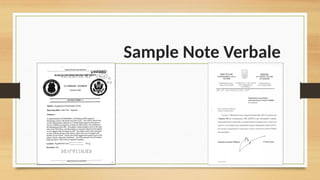
Note Verbale
Generally referredto as a third person note.
‐
It takes the place of a signed note and has the same value as a signed note.
It is less formal than a first person note and for this reason it is the form of
‐
communication most used.
A Note Verbale begins with the following formula of diplomatic courtesy:
The Embassy (or the Ministry of Foreign Affairs) of the Republic of
ʺ
Uzbekistan presents its compliments to the Ministry of Foreign Affairs of (n
ame of country) and has the honor to...ʺ
4.
Note Verbale cont.
Theusual ending is:
The Embassy avails itself of this opportunity to renew to the
ʺ
Ministry the assurances of its highest consideration.ʺ
It may also be in the name of the Minister, as:
The Minister of Foreign Affairs presents his compliments to His Exc
ʺ
ellency, the Ambassador of (name of country)...ʺ
It is not signed but initialed in the lower right hand corner of the last
‐
page of text by a duly authorized signing officer.
5.
Aide-mémoire
In international relations,an aide-mémoire (French pronunciation:
[ɛdmemwaʁ]
, memory aid) is a proposed agreement or negotiating text circulated informally among
delegations for discussion without committing the originating delegation's country to
the contents.
It has no identified source, title, or attribution and no standing in the relationship
involved.
Such a text is also referred to as a non-paper in many international organizations,
including the General Agreement on Tariffs and Trade/World Trade Organization[1][2]
and
sometimes within the European Union.[3]
The term also has a more general meaning, as a French loanword, meaning "a memory-
aid; a reminder or memorandum, especially a book or document serving this purpose."
6.
Aide-mémoire cont.
The BritishArmy issues Tactical Aide Memoires (TAM) to officers and soldiers as
reminder guides outlining tactics and techniques.
An informal summary of a diplomatic interview or conversation
between the foreign minister or his assistant and a diplomatic envoy or his
representative.
It merely serves as an aid to memory and does not begin with a formula of
courtesy.
It is usually left at the foreign office by the
ambassador or minister concerned (or his representative), or is handed to
the ambassador or the minister concerned (or his representative) at the
foreign office by the foreign minister or his representative.
7.
Letter of Credence/Diplomaticcredentials
A formal note from the head of one state to the head of another state,
accrediting ambassador, as one authorized to act for his government or
head of state. It may be addressed to a head of a republic or to the head of a kingdom.
The documents, which follow a standard text, identify the diplomats as representatives of
their governments and empowered to speak for them.
According to diplomatic protocol, ambassadors or ministers may not represent their
governments before a host government's foreign ministry until their credentials have been
formally presented in person and have been accepted by the host government's chief of state.
Once their credentials are accepted, they are considered diplomatically accreditedto the host
government and are considered an officer of the host government as well as their own.
A recall letter of previously presented credentials is often submitted along with new
credentials.[1]
8.
Letter of Recall
A formal note from the head of one state to the head of another state, recalling a previously accredited
ambassador, a minister, or other diplomatic agents.
An incoming chief of mission usually hands a letter of recall of his predecessor to the head of state of a forei
gn government before handing his letter of credence.
Consular Commission.
A document in the form of a commission or similar instrument,
provided by the sending state to the head of a consular post.
It certifies his capacity and as a general rule shows his full name, his category and class,
the consular district and the seal of the consular post. (See Art. 11, Vienna Convention on Consular
Relation, 1963).
A Consular Commission is written in both the language of the issuing country and the official language of
the receiving country.
9.
Executive agreement
An executiveagreement[1]
is an agreement between the
heads of government of two or more nations that has not been ratified by
the legislature as treaties are ratified.
Executive agreements are considered politically binding to distinguish them
from treaties which are legally binding.
In the United States, executive agreements are made solely by the
President of the United States.
They are one of three mechanisms by which the United States enters into
binding international obligations.
10.
Executive agreement
Some authorsconsider executive agreements to be treaties under
international law in that they bind both signing sovereign states.
However, under constitution of Kenya 2010, executive agreements are not
considered treaties for the purpose of the Treaty Clause which requires the
advice and consent of Parliament to qualify as a treaty.
Some other nations have similar provisions with regard to the ratification
of treaties.
11.
Ultimatum
• An ultimatum(Latin: the last one) is a demand whose fulfillment is requested in
a specified period of time and which is backed up by a threat to be followed
through in case of noncompliance.
• An ultimatum is generally the final demand in a series of requests.
• As such, the time allotted is usually short, and the request is understood not to
be open to further negotiation.
• The threat which backs up the ultimatum can vary depending on the demand in
question and on the other circumstances.[citation needed]
• The word is used in diplomacy to signify the final terms submitted by one of the
parties in negotiation for settlement of any subject of disagreement.
12.
Ultimatum cont.
It isaccompanied by an intimation as to how refusal will be regarded.
English diplomacy has devised the adroit reservation that refusal will be
regarded as an "unfriendly act", a phrase which serves as a warning that
the consequences of the rupture of negotiations will be considered from
the point of view of forcing a settlement.
This opens up a variety of possibilities, such as good offices, mediation,
the appointment of a commission of inquiry, arbitration, reprisals, pacific
blockade and war.[a]
13.
Note
A written communicationfrom a minister of foreign affairs to foreign
diplomatic envoys or high foreign government officials and vice versa.
‐
It is the most generally used form of correspondence between a
sending state,
the Kenya government and the receiving state, a foreign government.
The reply to an incoming note is in the same form as the note it
is answering.
This is written either in the first person or third person.
14.
Circular diplomatic note(s)
•Identical notes addressed to:
• Their Excellencies and Messieurs the Chief
ʺ
of Mission.ʺ
• It is not signed but initialed in the lower right hand
‐
corner of the last page of text by a duly authorized sig
ning officer.
15.
Note diplomatique
A formalnote between governments.
It is understood to speak for and on behalf of
the government presented by its duly
designated representative.
It is signed, or initialed in the lower right hand corner of
‐
the last page of text by a duly authorized signing officer.
16.
Collective note
A veryformal note addressed by the representatives of several states to a
government in regard to some matter in which they have been
instructed to make a joint representation.
Generally referred to as a joint note, it involves close relations among the signing
states.
It is seldom used because of the danger that the state or the states to whom it is
addressed may consider it offensive.
It is signed, not merely initialed, by the representatives of the sending states.
17.
Identical notes
Notes identicalin substance though not always in wording even as
they are drafted as similarly as possible.
As a rule they are sent separately yet almost simultaneously by the
government of one state to the
governments of two or more states, or by the governments of two or m
ore states to the government of one or more states.
The Collective Note and Identic Notes are rarely used for they convey
an impression of ganging up against a state or states.
ʺ ʺ
18.
Memorandum
A detailed statementof facts, and of arguments based on theory. It is
essentially similar to a Note.
Unlike a Note, however, it does not begin and
end with usual diplomatic courtesy.
Also, it need not be signed, since it is
usually delivered either personally, following an interview, or by means of
a short covering note.
Sometimes it is called a memoire, or aide memoire or pro memoria
‐ ‐
when it embodies a summary of conversation.
19.
Pro Memoria
‐
A formalrecord of a subject discussed.
It differs from an aide memoire which is an informal
‐
summary of a diplomatic interview.
It is understood
to speak for and under direction of the government whose rep
resentative presents it and is usually left at
the foreign office by the ambassador or minister concerned or
his representative, or is handed to the ambassador or
20.
Oral Interview
This typeof communication generally takes place in the foreign office
at a date and hour previously arranged either in writing or by telephone.
In cases where there are many matters to be discussed so that it becomes
difficult to relay on one s memory, the diplomatic envoy may, after the
ʹ
interview, leave an aide memoire or memorandum with the foreign
‐
minister or the later may hand an aide memoire or memorandum to the
‐
diplomatic representative after the interview usually arranged.
This is done to avoid misunderstanding.
21.
Oral Interview cont.
Forless important matters, a member of the diplomatic staff of the
mission arranges (also by telephone) to call on an
appropriate member of the ministry staff.
Diplomats who arrange such a meeting must conduct such
interviews and discussions briefly and succinctly.
When no further matters need to be discussed, the diplomatic official
concerned should extend the usual courtesies and leave promptly.
22.
Exequatur
An authorization givenby the receiving
state to the head of a consular agent to
the exercise of his functions. (See Art.
12, Vienna Convention on Consular
Relations, 1963).
23.
Full Powers
A documentissued by a head of a state/president accrediting one or more
persons to represent him or the government in international
conferences and negotiations or expressing the consent of the state to be
bound by a treaty, convention or agreement.
The essential feature of the Full Powers is that the representative to
whom it is issued is rested with all the necessary power and authority to take
part, negotiate, conclude and sign agreements on behalf of the state.
In the signing of treaties or agreements, the action of the representative is
essentially subject to ratification by the government concerned.
24.
Exchange of Notes
Itis a means whereby states subscribe to certain understandings o
r recognize certain obligations as binding upon them.
Agreements on
matters of minor importance are frequently made by means of for
mal notes exchanged between the minister of foreign affair,
acting for his government, and the
resident diplomatic representative of the another
country, similarly authorized.
25.
Ceremonial Communications
These mayconsist of congratulatory messages on the occasion of the
election of the head of state, the birth of a royal heir, a royal marriage,
the anniversary of a country's independence, or any other national
holiday.
It may also be an expression of condolence on the death of the head of
state or expression of sympathy/regret for his illness, the
occurrence of an accident or any other similar happening.

![Aide-mémoire
In international relations, an aide-mémoire (French pronunciation:
[ɛdmemwaʁ]
, memory aid) is a proposed agreement or negotiating text circulated informally among
delegations for discussion without committing the originating delegation's country to
the contents.
It has no identified source, title, or attribution and no standing in the relationship
involved.
Such a text is also referred to as a non-paper in many international organizations,
including the General Agreement on Tariffs and Trade/World Trade Organization[1][2]
and
sometimes within the European Union.[3]
The term also has a more general meaning, as a French loanword, meaning "a memory-
aid; a reminder or memorandum, especially a book or document serving this purpose."](https://image.slidesharecdn.com/documentsofdiplomacy-250610161025-f347959a/85/DOCUMENTS-OF-DIPLOMACY-DIPLOMATIC-PRACTICE-pptx-5-320.jpg)
![Letter of Credence/Diplomatic credentials
A formal note from the head of one state to the head of another state,
accrediting ambassador, as one authorized to act for his government or
head of state. It may be addressed to a head of a republic or to the head of a kingdom.
The documents, which follow a standard text, identify the diplomats as representatives of
their governments and empowered to speak for them.
According to diplomatic protocol, ambassadors or ministers may not represent their
governments before a host government's foreign ministry until their credentials have been
formally presented in person and have been accepted by the host government's chief of state.
Once their credentials are accepted, they are considered diplomatically accreditedto the host
government and are considered an officer of the host government as well as their own.
A recall letter of previously presented credentials is often submitted along with new
credentials.[1]](https://image.slidesharecdn.com/documentsofdiplomacy-250610161025-f347959a/85/DOCUMENTS-OF-DIPLOMACY-DIPLOMATIC-PRACTICE-pptx-7-320.jpg)
![Executive agreement
An executive agreement[1]
is an agreement between the
heads of government of two or more nations that has not been ratified by
the legislature as treaties are ratified.
Executive agreements are considered politically binding to distinguish them
from treaties which are legally binding.
In the United States, executive agreements are made solely by the
President of the United States.
They are one of three mechanisms by which the United States enters into
binding international obligations.](https://image.slidesharecdn.com/documentsofdiplomacy-250610161025-f347959a/85/DOCUMENTS-OF-DIPLOMACY-DIPLOMATIC-PRACTICE-pptx-9-320.jpg)
![Ultimatum
• An ultimatum (Latin: the last one) is a demand whose fulfillment is requested in
a specified period of time and which is backed up by a threat to be followed
through in case of noncompliance.
• An ultimatum is generally the final demand in a series of requests.
• As such, the time allotted is usually short, and the request is understood not to
be open to further negotiation.
• The threat which backs up the ultimatum can vary depending on the demand in
question and on the other circumstances.[citation needed]
• The word is used in diplomacy to signify the final terms submitted by one of the
parties in negotiation for settlement of any subject of disagreement.](https://image.slidesharecdn.com/documentsofdiplomacy-250610161025-f347959a/85/DOCUMENTS-OF-DIPLOMACY-DIPLOMATIC-PRACTICE-pptx-11-320.jpg)
![Ultimatum cont.
It is accompanied by an intimation as to how refusal will be regarded.
English diplomacy has devised the adroit reservation that refusal will be
regarded as an "unfriendly act", a phrase which serves as a warning that
the consequences of the rupture of negotiations will be considered from
the point of view of forcing a settlement.
This opens up a variety of possibilities, such as good offices, mediation,
the appointment of a commission of inquiry, arbitration, reprisals, pacific
blockade and war.[a]](https://image.slidesharecdn.com/documentsofdiplomacy-250610161025-f347959a/85/DOCUMENTS-OF-DIPLOMACY-DIPLOMATIC-PRACTICE-pptx-12-320.jpg)