Lecturer :
Dr. Fatma Elzahraa
Elsayed
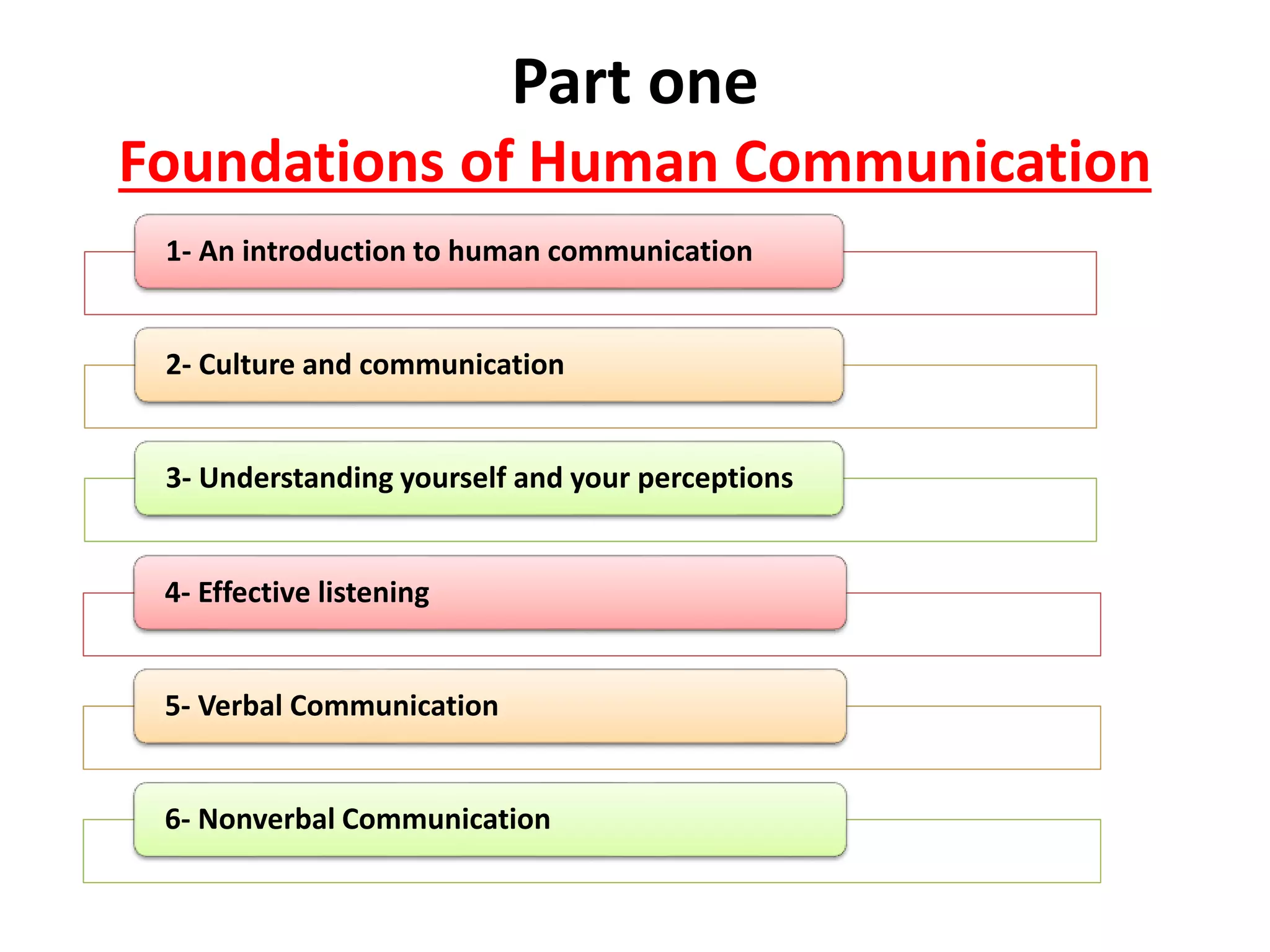
Part one
Foundations of Human Communication
1- An introduction to human communication
2- Culture and communication
3- Understanding yourself and your perceptions
4- Effective listening
5- Verbal Communication
6- Nonverbal Communication
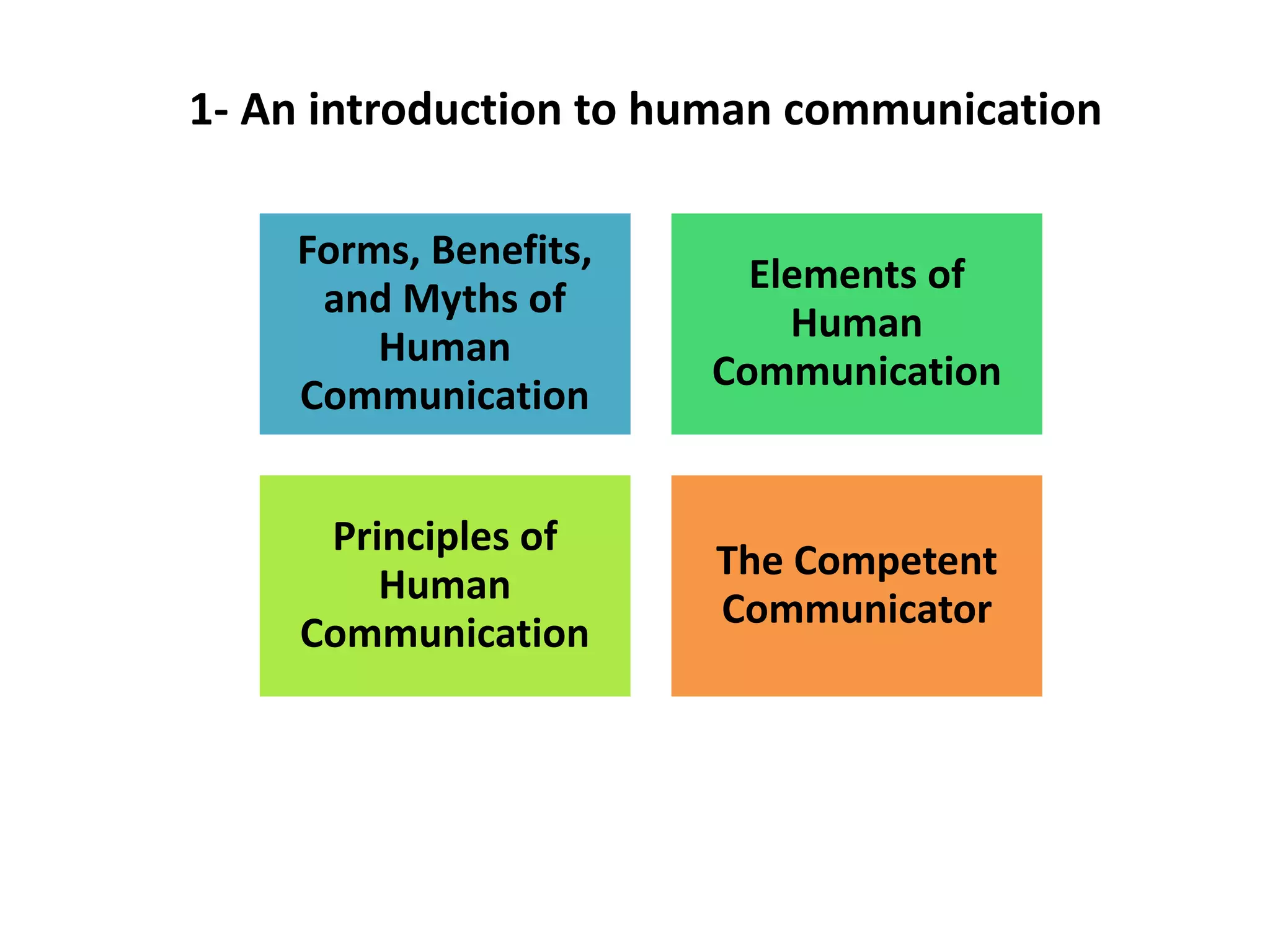
1- An introduction to human communication
Forms, Benefits,
and Myths of
Human
Communication
Elements of
Human
Communication
Principles of
Human
Communication
The Competent
Communicator
• 8 - Forms of Human Communication:
 Intrapersonal Communication
 Interpersonal Communication
 Interviewing
 Small Group Communication
 Organizational Communication
Public Speaking
Computer-Mediated Communication
Mass Communication
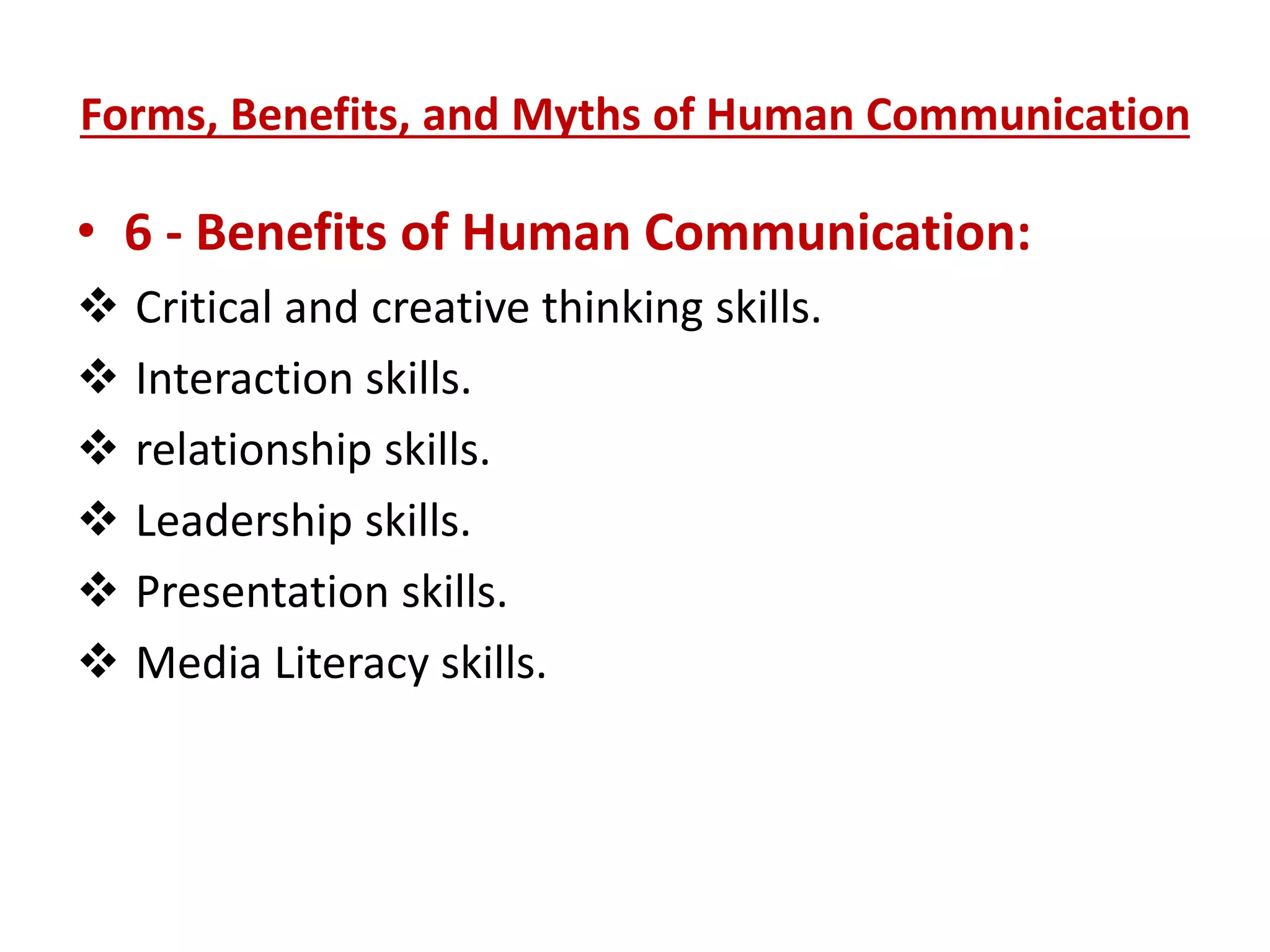
Forms, Benefits, and Myths of Human Communication
• 6 - Benefits of Human Communication:
 Critical and creative thinking skills.
 Interaction skills.
 relationship skills.
 Leadership skills.
 Presentation skills.
 Media Literacy skills.
Forms, Benefits, and Myths of Human Communication
• 7 – Myths of Human Communication:
(to be illustrated by two students)
Forms, Benefits, and Myths of Human Communication
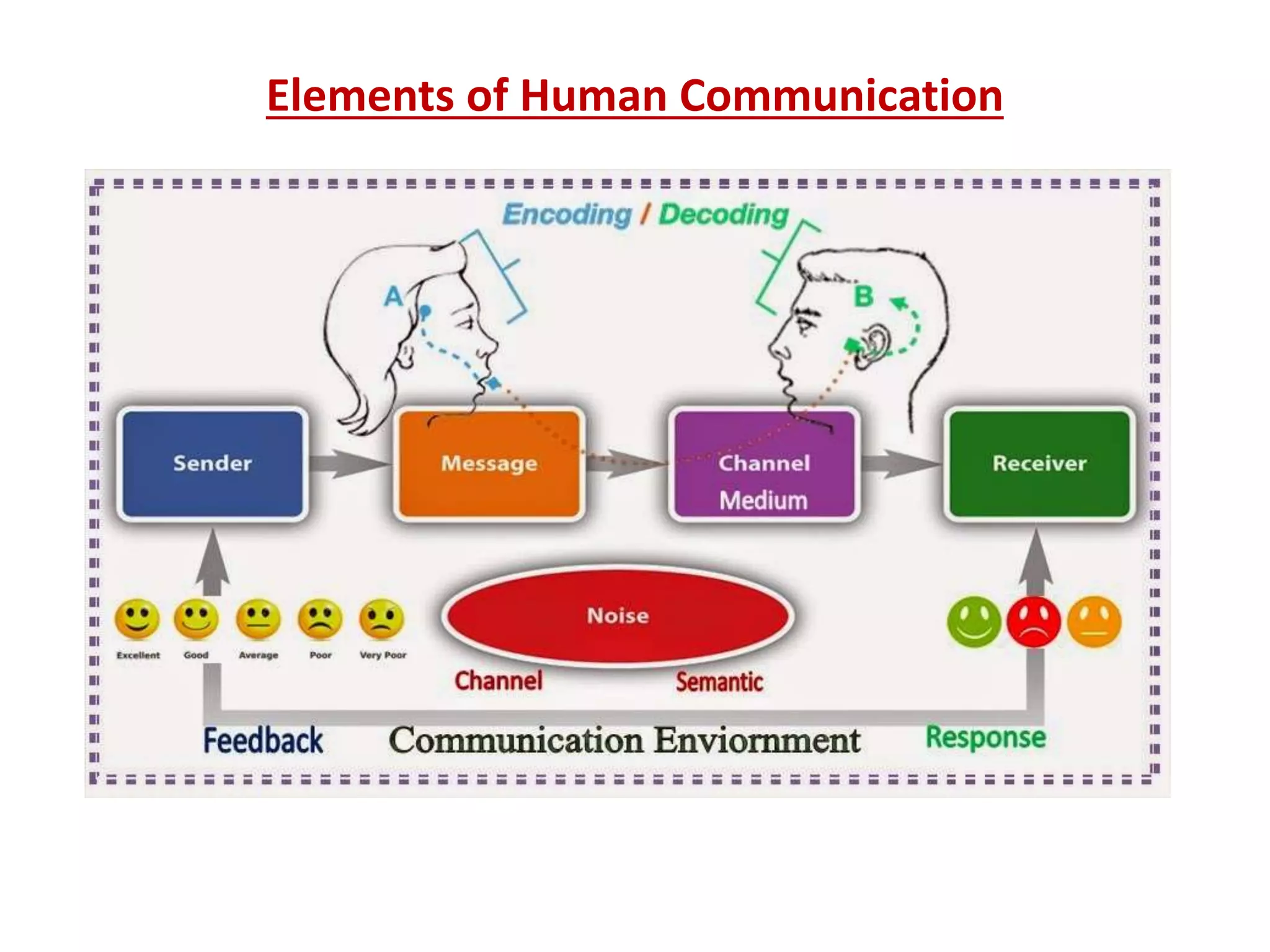
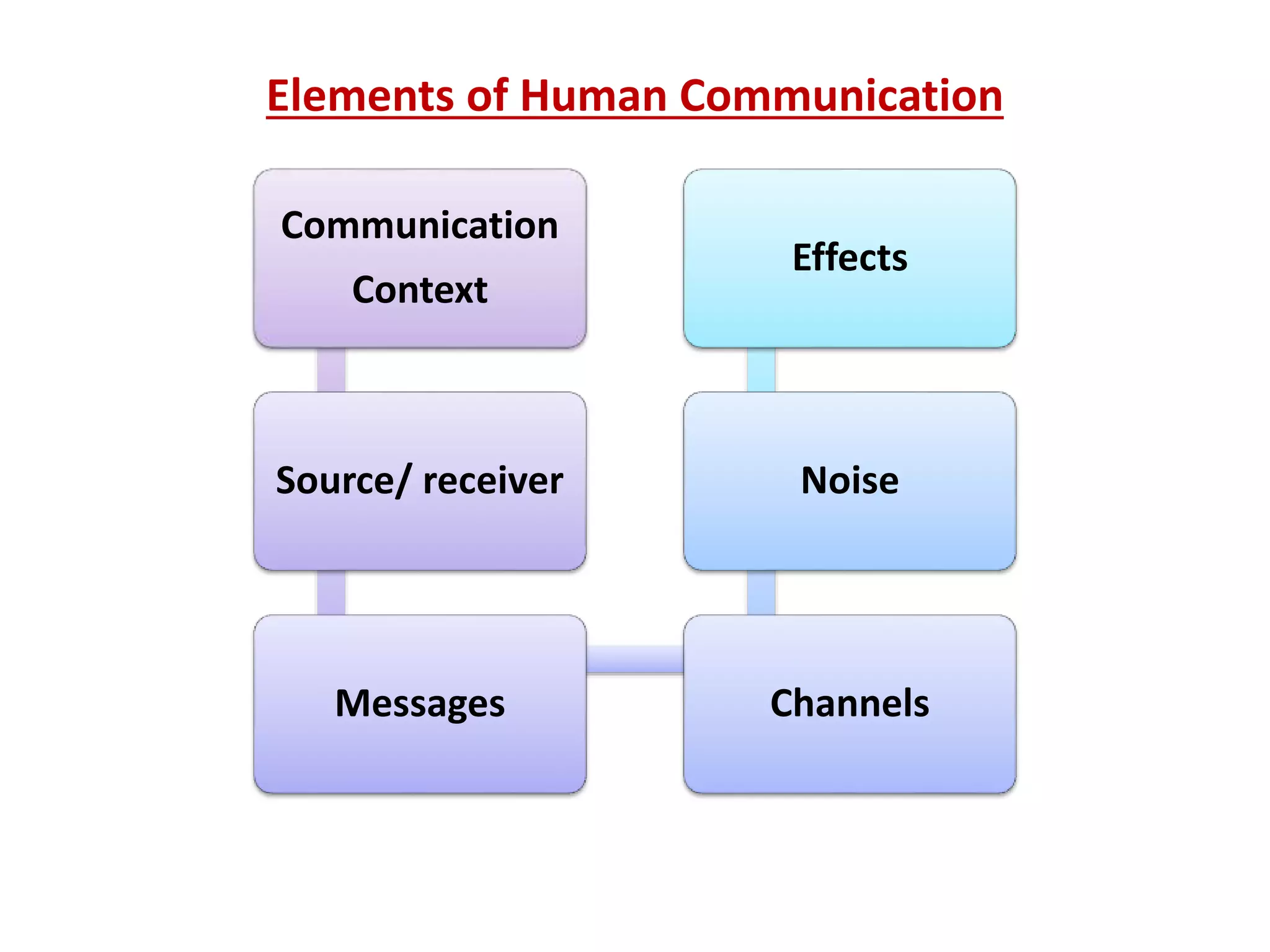
Elements of Human Communication
Communication
Context
Source/ receiver
Messages Channels
Noise
Effects
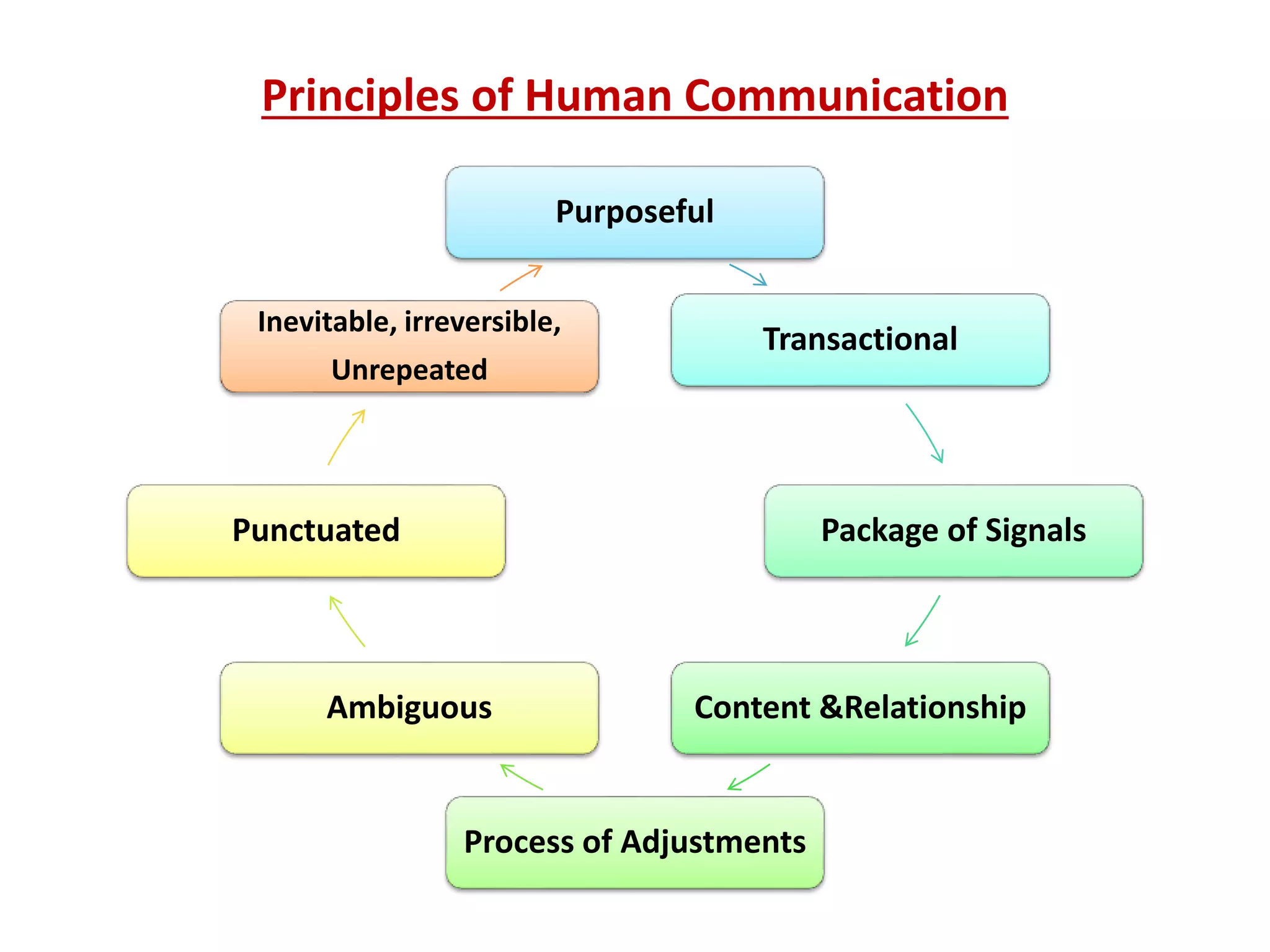
Principles of Human Communication
Purposeful
Transactional
Package of Signals
Content &Relationship
Process of Adjustments
Ambiguous
Punctuated
Inevitable, irreversible,
Unrepeated
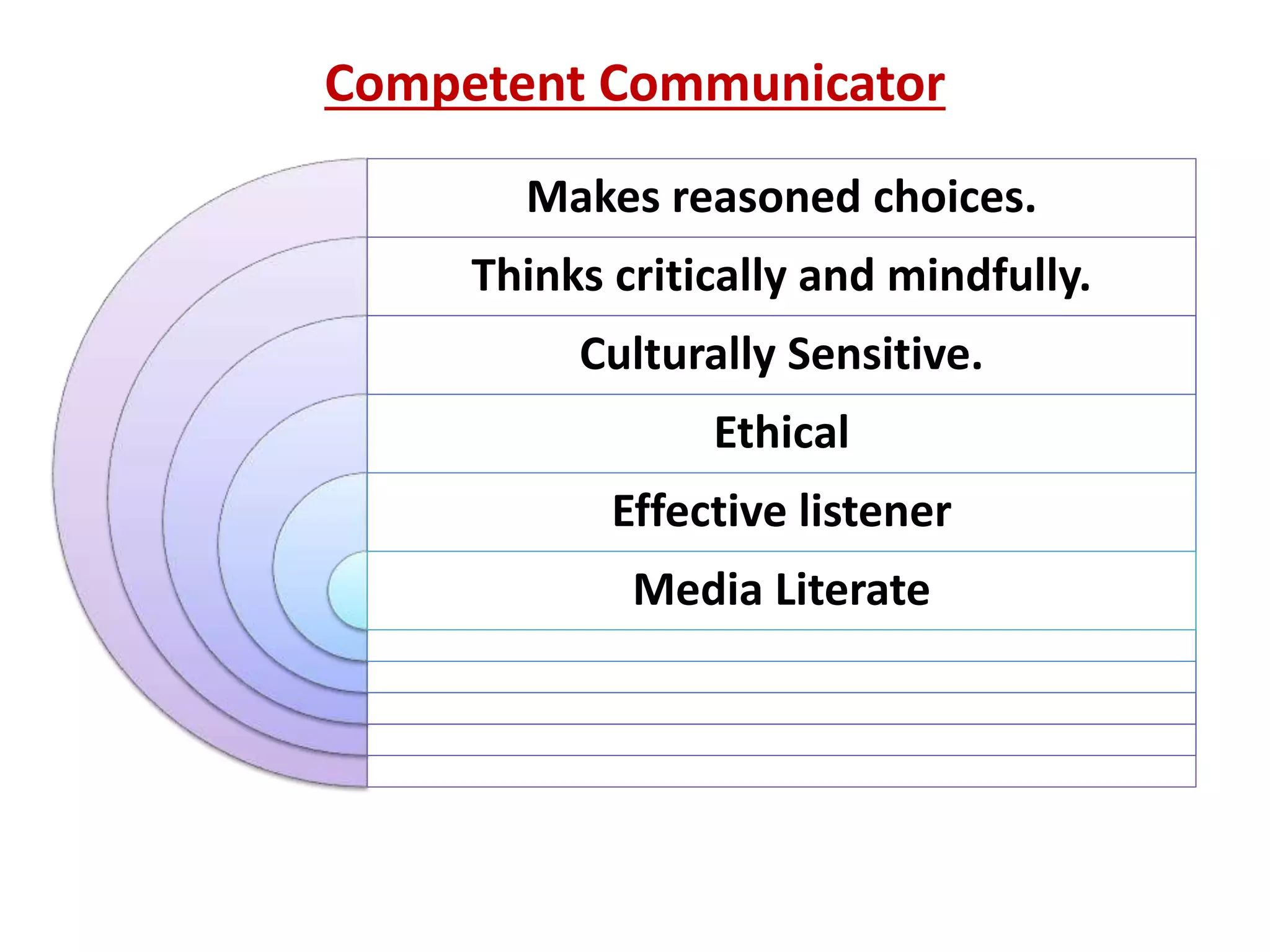
Competent Communicator
Makes reasoned choices.
Thinks critically and mindfully.
Culturally Sensitive.
Ethical
Effective listener
Media Literate
Next Time we will Study:
Culture and Communication
P. 45
• What is Culture?
• Cultural Differences.
• Intercultural Communication.
2- Culture and Communication
2.1- What is Culture?
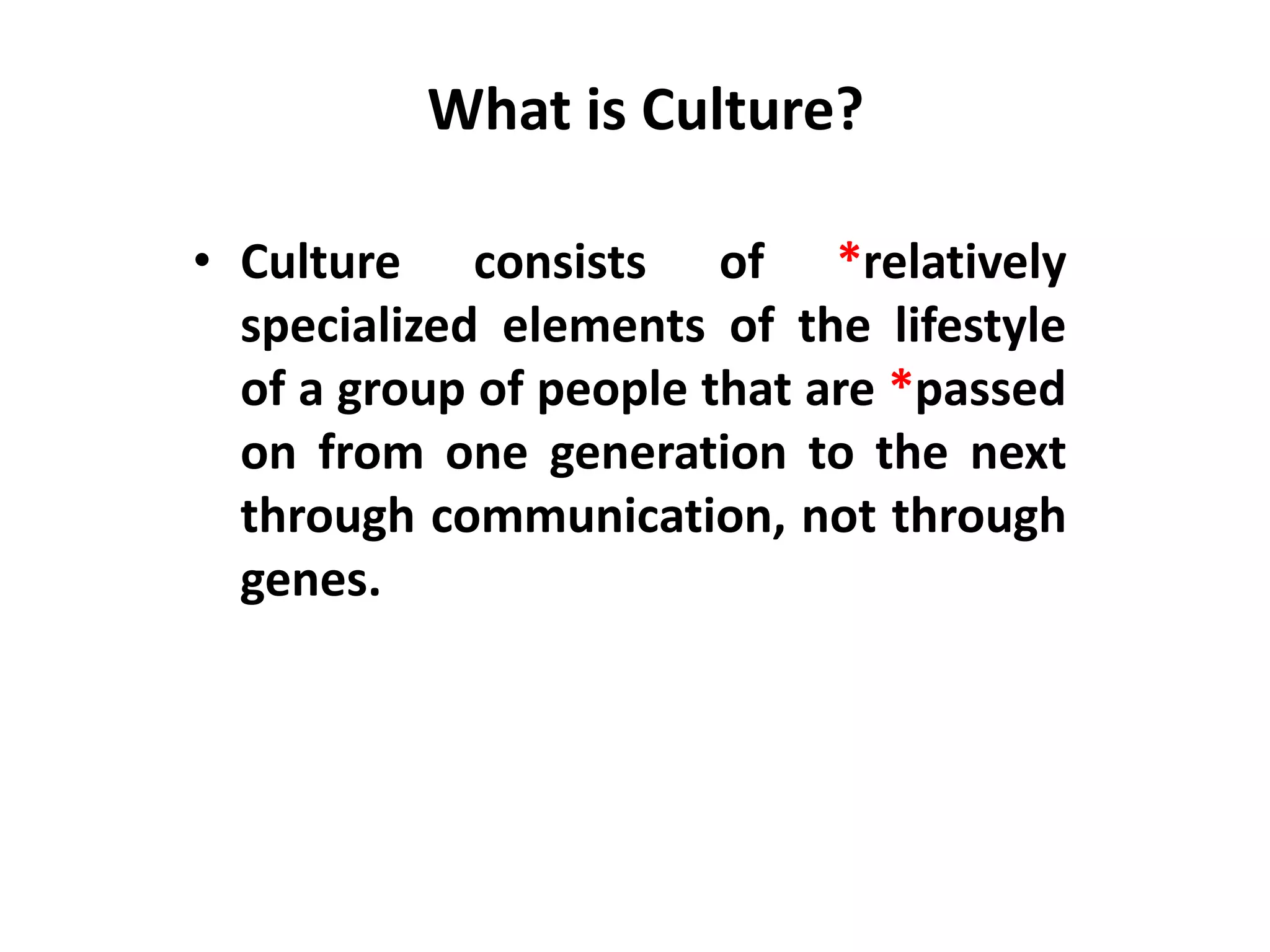
What is Culture?
• Culture consists of *relatively
specialized elements of the lifestyle
of a group of people that are *passed
on from one generation to the next
through communication, not through
genes.
Seven Metaphors of Culture
Salad/ jelly
beans
Iceberg
Melting
Pot Tree
Organism
Software
Mosaic
7
Metaphors
Sex and Gender
• Sex
• refers to the biological and
physiological qualities that
characterize men and women, and
it determined by biology.
• Gender
• refers to the socially constructed
roles and behaviors that society
deems appropriate for males and
females, and it is learned from
society.
The Transmission of Culture
Enculturation
The process by
which you learn
the culture into
which you are
born.
Acculturation
The process by
which you learn
the rules and
norms of a culture
different from
your native
culture.
(Assimilation)
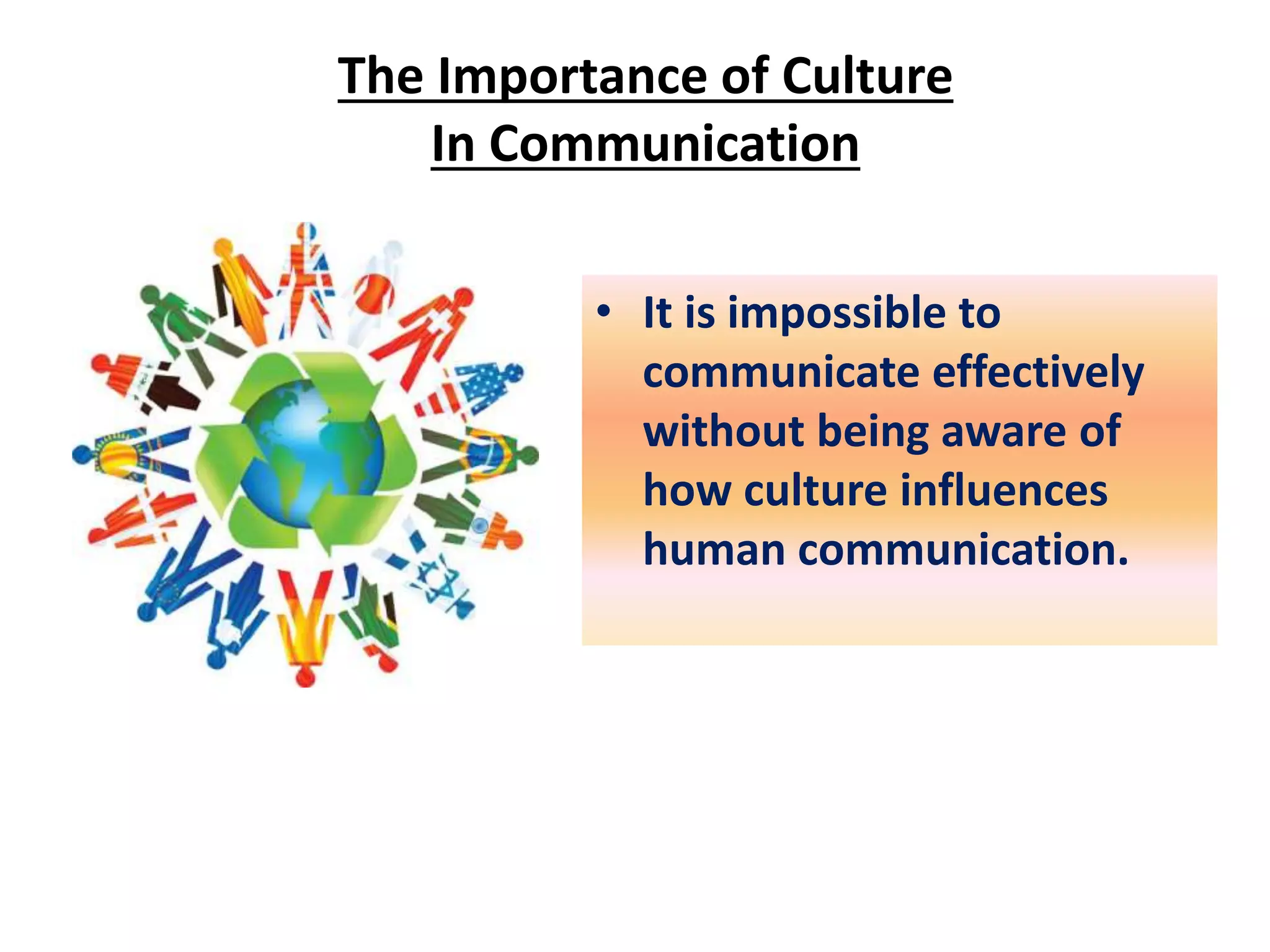
The Importance of Culture
In Communication
• It is impossible to
communicate effectively
without being aware of
how culture influences
human communication.
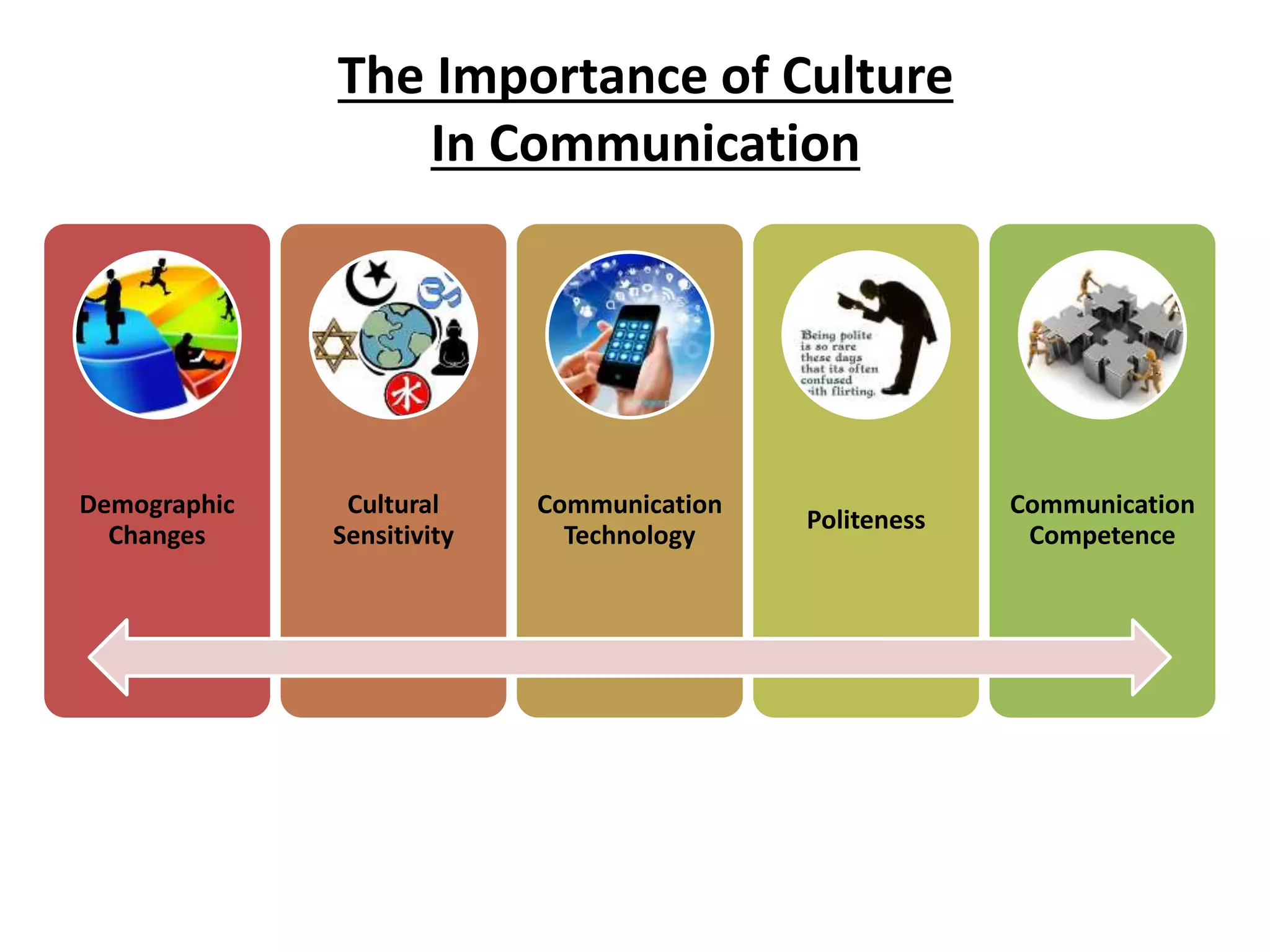
The Importance of Culture
In Communication
Demographic
Changes
Cultural
Sensitivity
Communication
Technology
Politeness
Communication
Competence
The Aim of a Cultural Perspective
• Success in Communication depends on your
ability to communicate effectively with persons
who are culturally different from yourself.
2.2- Cultural Differences
• Good intentions are helpful but not
enough to be effective, you need to
know how cultures differ and how these
differences influence communication.
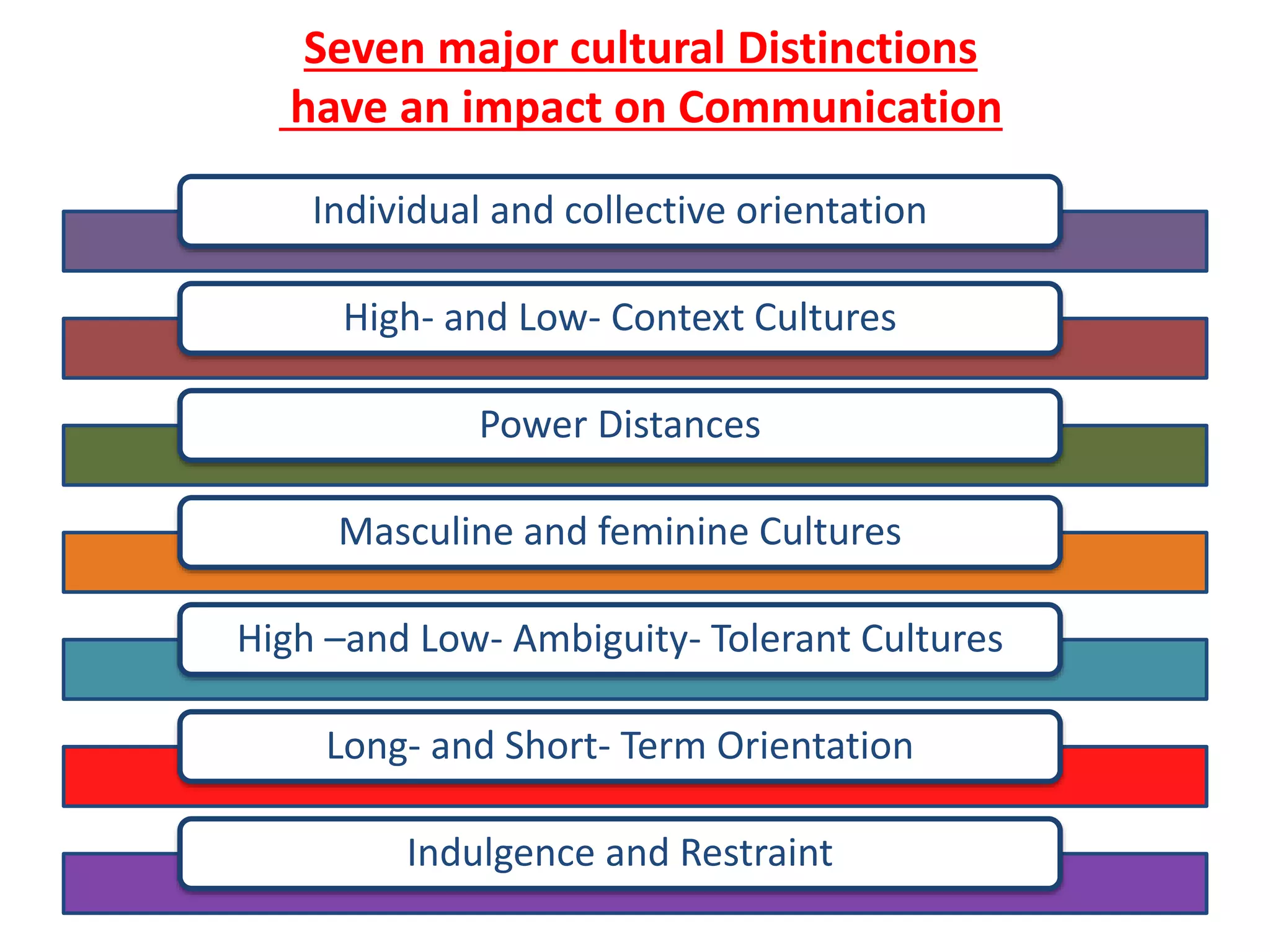
Seven major cultural Distinctions
have an impact on Communication
Individual and collective orientation
High- and Low- Context Cultures
Power Distances
Masculine and feminine Cultures
High –and Low- Ambiguity- Tolerant Cultures
Long- and Short- Term Orientation
Indulgence and Restraint
2.3- Intercultural Communication
• Refers to communication between
persons who have different cultural
beliefs, values or ways of behaving.
• These differences may be Slight or Great.
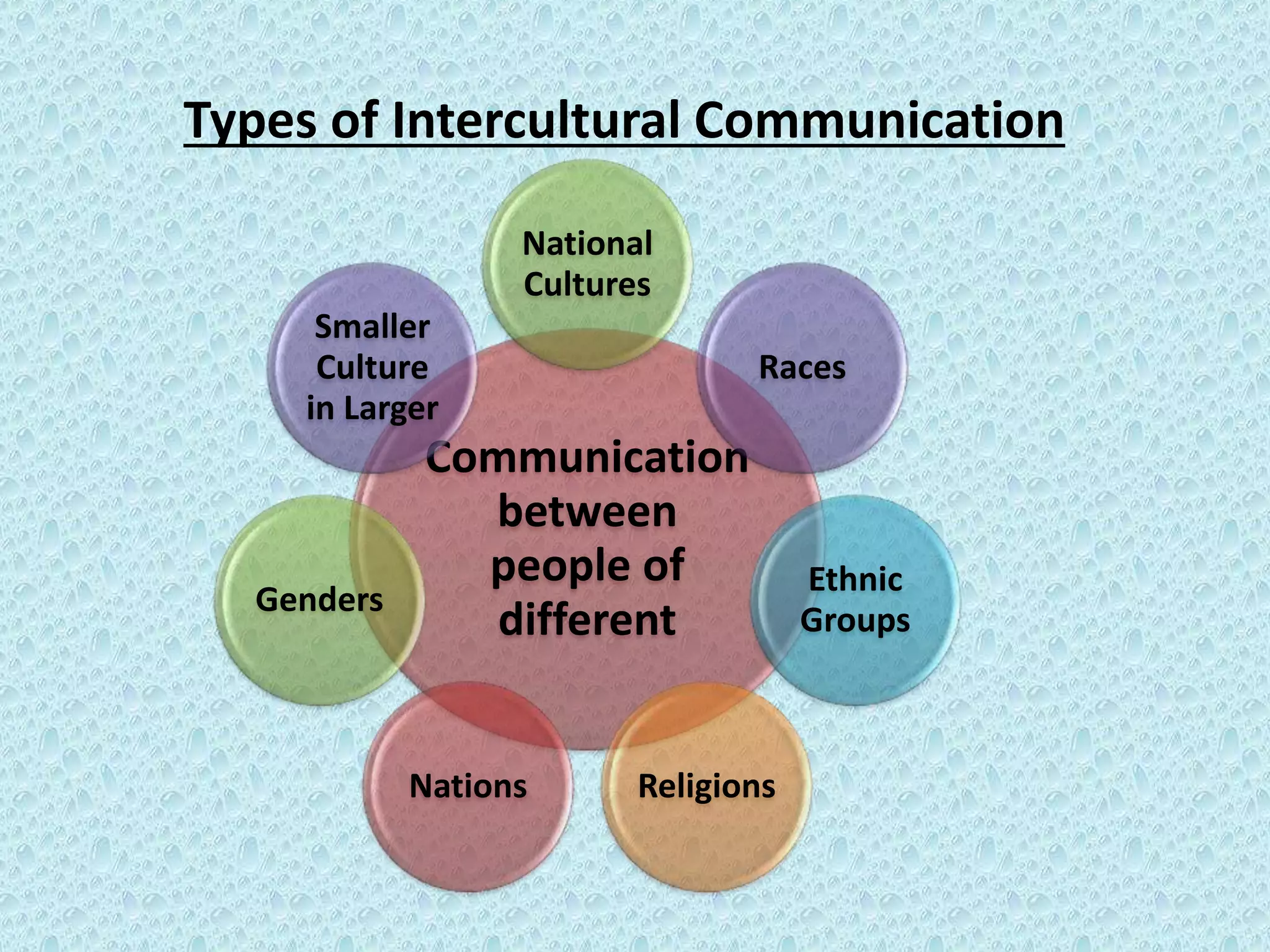
Types of Intercultural Communication
Communication
between
people of
different
National
Cultures
Races
Ethnic
Groups
Religions
Nations
Genders
Smaller
Culture
in Larger
Improving Intercultural Communication
• Intercultural communication depends on the
cultural sensitivity of both individuals.
• Cultural sensitivity is an attitude and way of
behaving in which you are aware of (mindful)
and acknowledge cultural differences.
Guidelines help you improve your
Intercultural Communication
IC
Improvement
Prepare yourself
Reduce
Ethno-
centrism
Confront
Stereotypes
Increase
Mindfulness Avoid
Over- attribution
Recognize
Differences
Adjust
Communication
End Of Chapter 2
Part Two
Interpersonal, Small Group, and
organizational Communication
7- The art of successful conversation
8- The realm of the relationships
9- Friendly, Romantic, and Familial relationships
10- Working in small groups
11- Group interaction and leadership
12- Organizational Communication
13- Dealing with interpersonal conflict
Part Three
Public Speaking
14- Public Speaking: topics, research, and audience analysis
15- Speech: Content Preparation
16- Delivering effective speeches
17- The informative speech: Principles and types
18- The persuasive speech: Goals, Principles, and strategies
14- Public Speaking: topics, research, and
audience analysis
14.1- Introduction to
Public Speaking
14.2- Managing your
apprehension
14.3- Step 1:
select your topic,
purposes, and thesis
14.4- Step 2:
Analyse your
audience
14.5- Step 3:
Research your topic
14.1- Introduction to Public Speaking
- In public speaking a speaker
presents a relatively
continuous message to a
relatively large audience.
- Public speaking is
transactional.
- The listeners also send
messages in the form of
feedback (applause, nods,
looks, etc. )
A Brief History
- Ancient Greece (Aristotle's Rhetoric)
explained the three kinds of persuasion
appeals:
- Logos (logical appeals)
- Pathos (emotional appeals)
- Ethos (appeals based on speaker
character)
- Roman Rhetorician, Marcus Fabius
Quintilianus, He developed the effective
and responsible orator (speaker)
- Now, public speaking depending on
incorporation insights from humanities,
social sciences, computer science, and
information technology.
The benefits of public speaking
Improve your Public
Speaking abilities
Improve your
personal and social
abilities
Improve your
academic and career
skills
14.2- Manage your apprehension
- Some people have a general
communication apprehension which
is a general fear of communication.
- State apprehension is only fear
connected to certain communication
situations.
- Some people are so apprehensive,
others are mildly apprehensive, most
of us are between these extremes.
- In fact, apprehension can work for
you, fear can energize and motivate
you to work harder.
1- Select your
topic, purposes,
and thesis
2- Analyse your
audience
3- Research
your topic
4- Collecting
supporting
materials
5- Develop your
main points
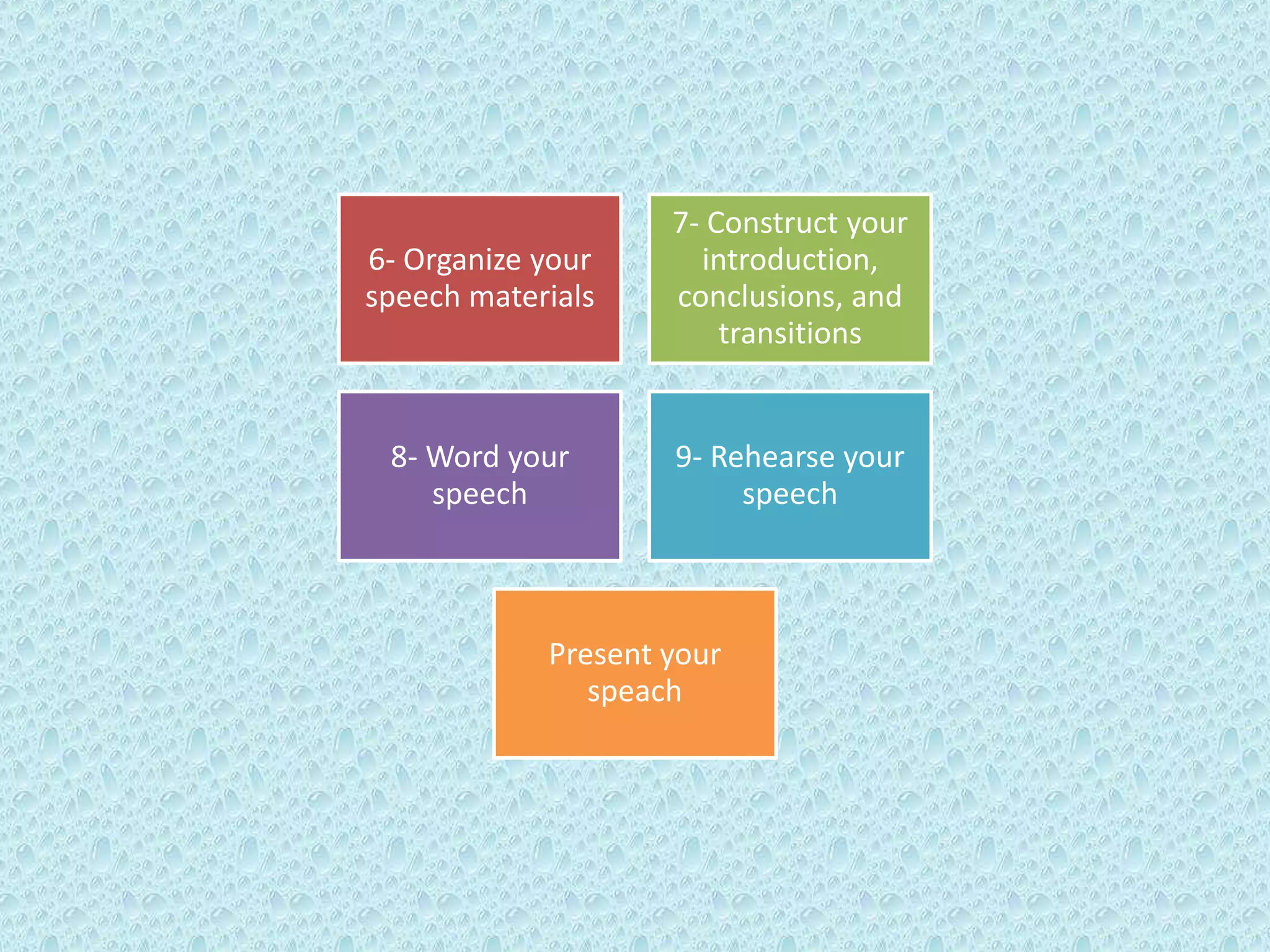
Essential steps for preparation an effective public speech
6- Organize your
speech materials
7- Construct your
introduction,
conclusions, and
transitions
8- Word your
speech
9- Rehearse your
speech
Present your
speach
14.3- Step1- Select your Topic, purposes, and thesis
Substantive Appropriate
Culturally
Sensitive
Yourself Brainstorming Surveys News Items Topic lists
Topoi
Tree
Diagrams
Search
directories
General
Purpose
Specific
Purpose
- Informative or
Persuasive Speeches
- Use an infinitive phrase.
- Focus on the Audience.
- Limit your specific purpose to
one idea.
- Limit your specific purpose to
what is reasonable.
- What is a Thesis?
A thesis is your point of view, Its what
you want the audience to get out of
your speech.
Wording and using your thesis:
- Limit your thesis to one central
idea.
- State your thesis as a complete
declarative sentence.
- Use your thesis to focus audience
attention.
14.4- Step2- Analyze your audience
Cultural
Factors
Gender
Age
Affectional
Orientation
Religion and
Religiousness
Analysing the psychology of the Audience
How Willing is your Audience?
How Favourable is your Audience?
How Knowledgeable is your Audience?
Analysing and Adapting during the Speech
Focus on listeners as message senders
Address audience responses directly
Use answers to your “What if” questions
14.5- Step 3- Research Your Topic
Throughout research you will find examples,
illustrations, and definitions to help you inform
your listeners; testimony, statistics, arguments to
support your major ideas.
Research for specifics
Research to support a
position
Research to discover
what is Known
Research Notes
Create folders
Key your notes
Take complete Notes
Libraries and Bookstores
Interviewing for Information
Select the person you wish to interview
Secure an appointment
Create a cheat sheet
Ask Open ended questions
Ask for permission to record or print the interview
Close and follow up with an expression of
appreciation
Primary, Secondary, and Tertiary Sources Material
Scholarly and Popular Journals
General Reference Works
Encyclopaedias
Almanacs
Biographical Materials
Statistical information
Evaluating internet resources
Fairness Accuracy Currency Sufficiency Qualification
The Web
The
Government
News Sources
End Of Chapter 14
15.1- Step 4- Collect Supporting Materials
Examples, Illustrations, and Narratives
Analogies
Definitions
Testimony
Numerical Data
Presentation Aids
Computer-Assisted Presentations
Examples
Illustrations
Narratives
Examples are to make your ideas vivid and easily understood.
Distinguish between real and hypothetical examples.
Analogies
Figurative
analogies
Literal analogies
1- What are analogies? - Comparisons
2- Guides in using analogies.
(analogies are not proofs for right or wrong)
Definitions
Definition by etymology
Definition by authority
Definition by negation
Definition by specific Examples
1- Guides in using definitions. (only when it needs)
2- Websites offer a wide variety of definitions.
Testimony
Expert witness
testimony
Eyewitness
testimony
1- Guides in using testimony.
(Competence, unbiased, newness)
Numerical Data
Raw Numbers
Statistics
1- Guides in using numbers.
(be sure it is clear, current, reliable)
Presentation Aids
Help you gain attention and maintain interest
Aids add clarity
Reinforce your message
Contribute to credibility and confidence
Reduce apprehension
Types of presentation aids:
 The object itself.
 Models.
 Graphs.
 Word charts.
 Maps.
 People.
 Photographs and illustrations.
15.2- Step 5- Develop your main points
Brainstorming to generate
suggestions
Eliminate points that seem less importance
Combine those points that have a common focus
Select points that are most relevant
Use limited number of points
Word each point in the same style
Develop your main points separately
Computer-Assisted Presentations
Use the templates provided by software
Use consistent typeface, size and colour
Be brief
Use colours wisely
Include needed visuals only
Appropriate tables and charts
Anticipate questions
Anticipate technical problems
15.3- Step 6- Organize your speech
Help guide the speech preparation
Help your audience understand your speech
Help the audience to remember the speech
Establish your credibility
Pattern Options to organize your speech
Spatial
Temporal
Topical
Problem-
Solving
The
motivated
Sequence
Cause/effect-
Effect/cause
15.4- Step 7- Construct your introduction,
conclusion, and transitions
Three
Functions:
Gain attention
Orient the
audience
Establish a S-A-T
relationship
Introduction
Some ways to secure audience attention:
1- Ask a question.
2- Refer to audience members.
3- Refer to recent happenings.
4- use humor.
5- Stress the importance of the topic.
6- Use a presentation aid.
7- Tell the audience to pay attention.
8- use a quotation.
9- Cite little-known fact or statistics.
10- Use an illustration or dramatic story.
Different ways to make S-A-T connection:
 Refer to others presence.
 Refer to the occasion.
 Express your pleasure or interest on speaking.
 Establish your competence in the subject.
 Express similarities with the audience.
 Compliment the audience.
Orient the audience:
 Give a general idea about your subject.
 Identify the main points you'll cover.
(give a detailed preview)
 Identify your goal.
Three
Functions:
Summarize
Provide
closure
motivate
Conclusion
You may summarize in several ways:
 Restate your thesis or purpose.
 Restate the importance of the topic.
 Restate your main points.
You can motivate the audience by:
 Asking for a specific response.
 Provide directions for future actions.
Closure may be achieved through a variety of methods:
o Use a quotation.
o Refer to subsequent events.
o Pose a challenge or question.
o Thank the audience.
o Refer back to the introduction.
Transitions
Four
Functions
To
Connect
To
Preview
To
Review
To
Signal
15.5- Outlining Your Speech
The outline is the blueprint of your speech.
Constructing the outline
Preface the outline with identifying data
Outline the introduction, body, and conclusion as separate units
Insert transitions
Include a list of references
Use a consistent set of symbols
Visualize the aspects to reflect the organizational pattern
Use one discrete idea per symbol
Use complete declarative sentences
Principles of informative speaking
Focus on your audience.
Stress relevance and usefulness.
Limit the information.
Adjust the level of complexity.
Relate new information to old.
Vary the levels of abstraction.
Principles of persuasive speaking
o Motivate your listeners with limited choices.
o Focus on your audience.
o Identify with your audience.
o Secure a YES response.
o Anticipate selective exposure.
o Use positive labelling.
o Ask for reasonable amount of change.
o Provide social proof.

Final [CH12] NOTES ppt, Human Communication.pdf

  • 1.
    Lecturer : Dr. FatmaElzahraa Elsayed
  • 2.
    Part one Foundations ofHuman Communication 1- An introduction to human communication 2- Culture and communication 3- Understanding yourself and your perceptions 4- Effective listening 5- Verbal Communication 6- Nonverbal Communication
  • 3.
    1- An introductionto human communication Forms, Benefits, and Myths of Human Communication Elements of Human Communication Principles of Human Communication The Competent Communicator
  • 4.
    • 8 -Forms of Human Communication:  Intrapersonal Communication  Interpersonal Communication  Interviewing  Small Group Communication  Organizational Communication Public Speaking Computer-Mediated Communication Mass Communication Forms, Benefits, and Myths of Human Communication
  • 5.
    • 6 -Benefits of Human Communication:  Critical and creative thinking skills.  Interaction skills.  relationship skills.  Leadership skills.  Presentation skills.  Media Literacy skills. Forms, Benefits, and Myths of Human Communication
  • 6.
    • 7 –Myths of Human Communication: (to be illustrated by two students) Forms, Benefits, and Myths of Human Communication
  • 7.
    Elements of HumanCommunication
  • 8.
    Elements of HumanCommunication Communication Context Source/ receiver Messages Channels Noise Effects
  • 9.
    Principles of HumanCommunication Purposeful Transactional Package of Signals Content &Relationship Process of Adjustments Ambiguous Punctuated Inevitable, irreversible, Unrepeated
  • 11.
    Competent Communicator Makes reasonedchoices. Thinks critically and mindfully. Culturally Sensitive. Ethical Effective listener Media Literate
  • 12.
    Next Time wewill Study: Culture and Communication P. 45
  • 13.
    • What isCulture? • Cultural Differences. • Intercultural Communication. 2- Culture and Communication
  • 14.
    2.1- What isCulture?
  • 15.
    What is Culture? •Culture consists of *relatively specialized elements of the lifestyle of a group of people that are *passed on from one generation to the next through communication, not through genes.
  • 16.
    Seven Metaphors ofCulture Salad/ jelly beans Iceberg Melting Pot Tree Organism Software Mosaic 7 Metaphors
  • 17.
    Sex and Gender •Sex • refers to the biological and physiological qualities that characterize men and women, and it determined by biology. • Gender • refers to the socially constructed roles and behaviors that society deems appropriate for males and females, and it is learned from society.
  • 18.
    The Transmission ofCulture Enculturation The process by which you learn the culture into which you are born. Acculturation The process by which you learn the rules and norms of a culture different from your native culture. (Assimilation)
  • 19.
    The Importance ofCulture In Communication • It is impossible to communicate effectively without being aware of how culture influences human communication.
  • 20.
    The Importance ofCulture In Communication Demographic Changes Cultural Sensitivity Communication Technology Politeness Communication Competence
  • 21.
    The Aim ofa Cultural Perspective • Success in Communication depends on your ability to communicate effectively with persons who are culturally different from yourself.
  • 22.
    2.2- Cultural Differences •Good intentions are helpful but not enough to be effective, you need to know how cultures differ and how these differences influence communication.
  • 23.
    Seven major culturalDistinctions have an impact on Communication Individual and collective orientation High- and Low- Context Cultures Power Distances Masculine and feminine Cultures High –and Low- Ambiguity- Tolerant Cultures Long- and Short- Term Orientation Indulgence and Restraint
  • 24.
    2.3- Intercultural Communication •Refers to communication between persons who have different cultural beliefs, values or ways of behaving. • These differences may be Slight or Great.
  • 25.
    Types of InterculturalCommunication Communication between people of different National Cultures Races Ethnic Groups Religions Nations Genders Smaller Culture in Larger
  • 26.
    Improving Intercultural Communication •Intercultural communication depends on the cultural sensitivity of both individuals. • Cultural sensitivity is an attitude and way of behaving in which you are aware of (mindful) and acknowledge cultural differences.
  • 27.
    Guidelines help youimprove your Intercultural Communication IC Improvement Prepare yourself Reduce Ethno- centrism Confront Stereotypes Increase Mindfulness Avoid Over- attribution Recognize Differences Adjust Communication
  • 28.
  • 29.
    Part Two Interpersonal, SmallGroup, and organizational Communication 7- The art of successful conversation 8- The realm of the relationships 9- Friendly, Romantic, and Familial relationships 10- Working in small groups 11- Group interaction and leadership 12- Organizational Communication 13- Dealing with interpersonal conflict
  • 30.
    Part Three Public Speaking 14-Public Speaking: topics, research, and audience analysis 15- Speech: Content Preparation 16- Delivering effective speeches 17- The informative speech: Principles and types 18- The persuasive speech: Goals, Principles, and strategies
  • 31.
    14- Public Speaking:topics, research, and audience analysis 14.1- Introduction to Public Speaking 14.2- Managing your apprehension 14.3- Step 1: select your topic, purposes, and thesis 14.4- Step 2: Analyse your audience 14.5- Step 3: Research your topic
  • 32.
    14.1- Introduction toPublic Speaking - In public speaking a speaker presents a relatively continuous message to a relatively large audience. - Public speaking is transactional. - The listeners also send messages in the form of feedback (applause, nods, looks, etc. )
  • 33.
    A Brief History -Ancient Greece (Aristotle's Rhetoric) explained the three kinds of persuasion appeals: - Logos (logical appeals) - Pathos (emotional appeals) - Ethos (appeals based on speaker character) - Roman Rhetorician, Marcus Fabius Quintilianus, He developed the effective and responsible orator (speaker) - Now, public speaking depending on incorporation insights from humanities, social sciences, computer science, and information technology.
  • 34.
    The benefits ofpublic speaking Improve your Public Speaking abilities Improve your personal and social abilities Improve your academic and career skills
  • 35.
    14.2- Manage yourapprehension - Some people have a general communication apprehension which is a general fear of communication. - State apprehension is only fear connected to certain communication situations. - Some people are so apprehensive, others are mildly apprehensive, most of us are between these extremes. - In fact, apprehension can work for you, fear can energize and motivate you to work harder.
  • 37.
    1- Select your topic,purposes, and thesis 2- Analyse your audience 3- Research your topic 4- Collecting supporting materials 5- Develop your main points Essential steps for preparation an effective public speech
  • 38.
    6- Organize your speechmaterials 7- Construct your introduction, conclusions, and transitions 8- Word your speech 9- Rehearse your speech Present your speach
  • 39.
    14.3- Step1- Selectyour Topic, purposes, and thesis Substantive Appropriate Culturally Sensitive Yourself Brainstorming Surveys News Items Topic lists Topoi Tree Diagrams Search directories
  • 40.
    General Purpose Specific Purpose - Informative or PersuasiveSpeeches - Use an infinitive phrase. - Focus on the Audience. - Limit your specific purpose to one idea. - Limit your specific purpose to what is reasonable.
  • 41.
    - What isa Thesis? A thesis is your point of view, Its what you want the audience to get out of your speech. Wording and using your thesis: - Limit your thesis to one central idea. - State your thesis as a complete declarative sentence. - Use your thesis to focus audience attention.
  • 42.
    14.4- Step2- Analyzeyour audience Cultural Factors Gender Age Affectional Orientation Religion and Religiousness
  • 43.
    Analysing the psychologyof the Audience How Willing is your Audience? How Favourable is your Audience? How Knowledgeable is your Audience?
  • 44.
    Analysing and Adaptingduring the Speech Focus on listeners as message senders Address audience responses directly Use answers to your “What if” questions
  • 45.
    14.5- Step 3-Research Your Topic Throughout research you will find examples, illustrations, and definitions to help you inform your listeners; testimony, statistics, arguments to support your major ideas. Research for specifics Research to support a position Research to discover what is Known
  • 46.
    Research Notes Create folders Keyyour notes Take complete Notes
  • 47.
  • 48.
    Interviewing for Information Selectthe person you wish to interview Secure an appointment Create a cheat sheet Ask Open ended questions Ask for permission to record or print the interview Close and follow up with an expression of appreciation
  • 49.
    Primary, Secondary, andTertiary Sources Material Scholarly and Popular Journals General Reference Works Encyclopaedias Almanacs Biographical Materials Statistical information
  • 50.
    Evaluating internet resources FairnessAccuracy Currency Sufficiency Qualification The Web The Government News Sources
  • 51.
  • 52.
    15.1- Step 4-Collect Supporting Materials Examples, Illustrations, and Narratives Analogies Definitions Testimony Numerical Data Presentation Aids Computer-Assisted Presentations
  • 53.
    Examples Illustrations Narratives Examples are tomake your ideas vivid and easily understood. Distinguish between real and hypothetical examples.
  • 54.
    Analogies Figurative analogies Literal analogies 1- Whatare analogies? - Comparisons 2- Guides in using analogies. (analogies are not proofs for right or wrong)
  • 55.
    Definitions Definition by etymology Definitionby authority Definition by negation Definition by specific Examples 1- Guides in using definitions. (only when it needs) 2- Websites offer a wide variety of definitions.
  • 56.
    Testimony Expert witness testimony Eyewitness testimony 1- Guidesin using testimony. (Competence, unbiased, newness)
  • 57.
    Numerical Data Raw Numbers Statistics 1-Guides in using numbers. (be sure it is clear, current, reliable)
  • 58.
    Presentation Aids Help yougain attention and maintain interest Aids add clarity Reinforce your message Contribute to credibility and confidence Reduce apprehension Types of presentation aids:  The object itself.  Models.  Graphs.  Word charts.  Maps.  People.  Photographs and illustrations.
  • 59.
    15.2- Step 5-Develop your main points Brainstorming to generate suggestions Eliminate points that seem less importance Combine those points that have a common focus Select points that are most relevant Use limited number of points Word each point in the same style Develop your main points separately
  • 60.
    Computer-Assisted Presentations Use thetemplates provided by software Use consistent typeface, size and colour Be brief Use colours wisely Include needed visuals only Appropriate tables and charts Anticipate questions Anticipate technical problems
  • 61.
    15.3- Step 6-Organize your speech Help guide the speech preparation Help your audience understand your speech Help the audience to remember the speech Establish your credibility
  • 62.
    Pattern Options toorganize your speech Spatial Temporal Topical Problem- Solving The motivated Sequence Cause/effect- Effect/cause
  • 63.
    15.4- Step 7-Construct your introduction, conclusion, and transitions Three Functions: Gain attention Orient the audience Establish a S-A-T relationship Introduction
  • 64.
    Some ways tosecure audience attention: 1- Ask a question. 2- Refer to audience members. 3- Refer to recent happenings. 4- use humor. 5- Stress the importance of the topic. 6- Use a presentation aid. 7- Tell the audience to pay attention. 8- use a quotation. 9- Cite little-known fact or statistics. 10- Use an illustration or dramatic story.
  • 65.
    Different ways tomake S-A-T connection:  Refer to others presence.  Refer to the occasion.  Express your pleasure or interest on speaking.  Establish your competence in the subject.  Express similarities with the audience.  Compliment the audience.
  • 66.
    Orient the audience: Give a general idea about your subject.  Identify the main points you'll cover. (give a detailed preview)  Identify your goal.
  • 67.
  • 68.
    You may summarizein several ways:  Restate your thesis or purpose.  Restate the importance of the topic.  Restate your main points.
  • 69.
    You can motivatethe audience by:  Asking for a specific response.  Provide directions for future actions.
  • 70.
    Closure may beachieved through a variety of methods: o Use a quotation. o Refer to subsequent events. o Pose a challenge or question. o Thank the audience. o Refer back to the introduction.
  • 71.
  • 72.
    15.5- Outlining YourSpeech The outline is the blueprint of your speech.
  • 73.
    Constructing the outline Prefacethe outline with identifying data Outline the introduction, body, and conclusion as separate units Insert transitions Include a list of references Use a consistent set of symbols Visualize the aspects to reflect the organizational pattern Use one discrete idea per symbol Use complete declarative sentences
  • 74.
    Principles of informativespeaking Focus on your audience. Stress relevance and usefulness. Limit the information. Adjust the level of complexity. Relate new information to old. Vary the levels of abstraction.
  • 75.
    Principles of persuasivespeaking o Motivate your listeners with limited choices. o Focus on your audience. o Identify with your audience. o Secure a YES response. o Anticipate selective exposure. o Use positive labelling. o Ask for reasonable amount of change. o Provide social proof.