Public Speaking
Module 1: Introduction to Public Speaking
Module Learning Outcomes
Outline the fundamental elements, skills, and goals of Public Speaking
1.1: Explain the goals and benefits of public speaking
1.2: Recognize communication apprehension and explain how to reduce it
1.3: Describe how public speaking can be used to advocate or create change
1.4: Recognize the social and historical contexts of speech, oratory, and rhetoric
Speaking Effectively
Learning Outcomes: Speaking Effectively
1.1: Explain the goals and benefits of public speaking
1.1.1: Explain the benefits of public speaking in your education, your personal
life, and your career
1.1.2: Understand the process of communicating with others
1.1.3: Describe the fundamental elements of a speech
1.1.4: Identify the main differences between writing a paper and delivering a
speech
1.1.5: Outline the goals of a speech
Benefits of Public Speaking
Education Career Personal
Research Effectively Be a More Effective Leader Inspire People
Make Stronger Arguments
Develop Problem-Solving and
Critical Thinking Skills
Grow Your Confidence
Organize Your Ideas Hone Presentation Skills Be a Better Listener
Increase Confidence in Class
Participation
Become a Powerful Advocate
What is Communication?
Communication Defined:
The act of conveying meanings from one entity or group to another using mutually
understood signs, symbols, and semiotic rules
Miscommunication Defined:
When the intended meaning of a communication does not match the way the message
is interpreted
Models of Communication
• Linear Model of Communication (Shannon 1948)
• Communication moves linearly and one-directional: from source to destination
• Emphasized transmission of the signal over the meaning of the message
• Disruption of transmitted signal is called NOISE
• Used by Bell in developing the telephone
• Transactional Model of Communication (Barnlund 1970)
• Communication is a two-way process
• Meaning is created at multiple points within the process
• Meaning is co-created simultaneously by both communicators
• Encoding/Decoding Model(Hall 1973)
• Cultural, political, and economic contexts influence how messages are produced and received
• Decoding a message determines meaning as much as encoding
• Used to analyze television discourse
Creation of Meaning
Communicators Message Channel Feedback Interference Context
• Encode
• Decode
• Verbal
• Nonverbal
• In-person
• Mediated
• Verbal
• Nonverbal
• Internal Noise
• External Noise
• Situation
• Relationship
• Setting
Class Discussion:
• Discuss the benefits and drawbacks of communicating through each
channel
• In-person
• Phone
• Radio
• Email
• TV/Internet Broadcast
• Video Chat
• Text
• Social Media
Goals of a Speech
• To Inform
• Overcome confusion, clarify misunderstanding, learn new
information
• To Persuade
• Change attitudes, beliefs, behaviors, or policy
• To Entertain
• Form a connection with the audience through emotion for
its own sake
• To Commemorate a person, occasion, or event
• Build an emotional connection between audience and
person, occasion, or event
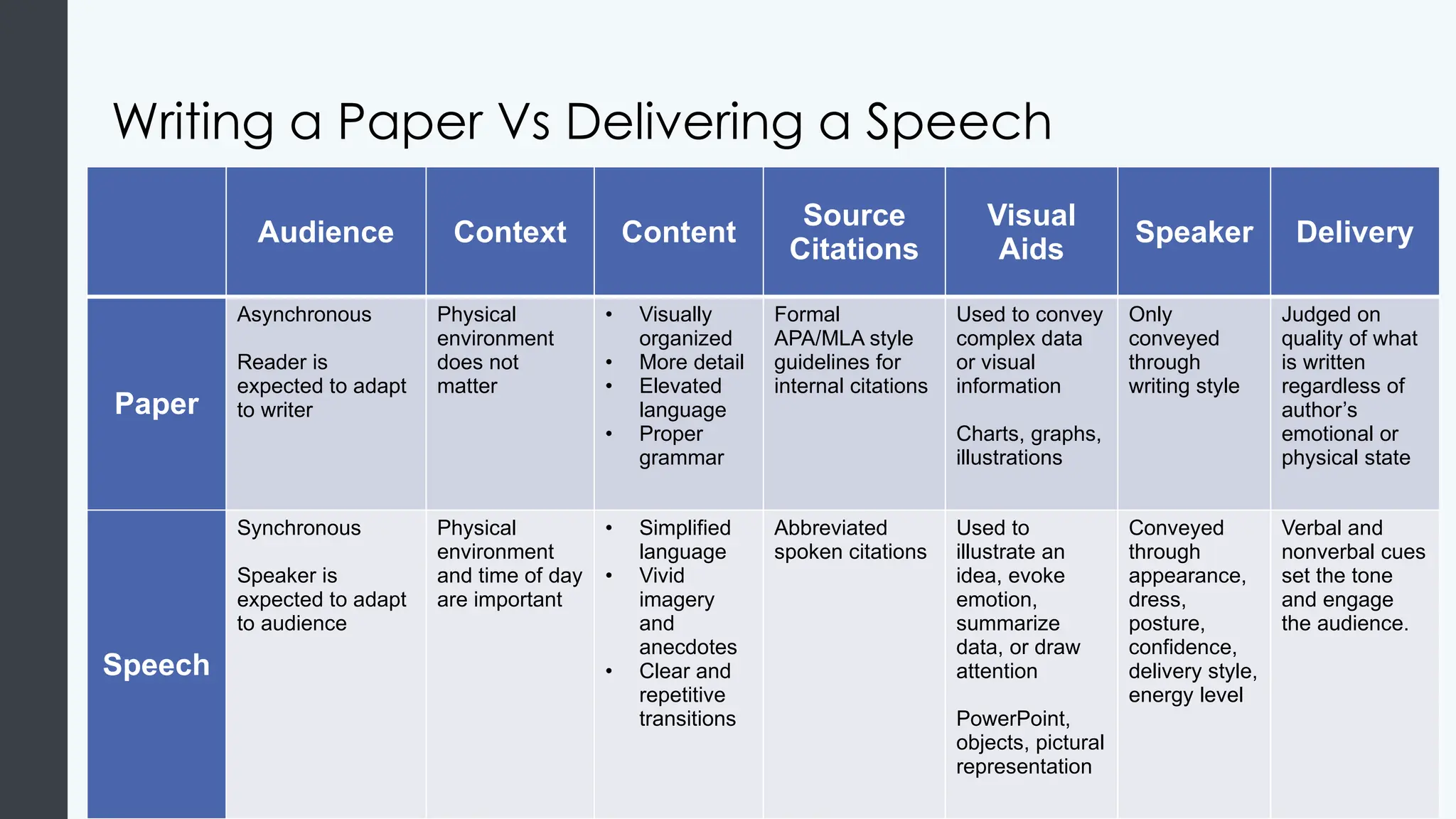
Writing a Paper Vs Delivering a Speech
Audience Context Content
Source
Citations
Visual
Aids
Speaker Delivery
Paper
Asynchronous
Reader is
expected to adapt
to writer
Physical
environment
does not
matter
• Visually
organized
• More detail
• Elevated
language
• Proper
grammar
Formal
APA/MLA style
guidelines for
internal citations
Used to convey
complex data
or visual
information
Charts, graphs,
illustrations
Only
conveyed
through
writing style
Judged on
quality of what
is written
regardless of
author’s
emotional or
physical state
Speech
Synchronous
Speaker is
expected to adapt
to audience
Physical
environment
and time of day
are important
• Simplified
language
• Vivid
imagery
and
anecdotes
• Clear and
repetitive
transitions
Abbreviated
spoken citations
Used to
illustrate an
idea, evoke
emotion,
summarize
data, or draw
attention
PowerPoint,
objects, pictural
representation
Conveyed
through
appearance,
dress,
posture,
confidence,
delivery style,
energy level
Verbal and
nonverbal cues
set the tone
and engage
the audience.
Class Activity : Synchronous and Asynchronous Communicators
• Break into 6 groups
• Your group will be assigned 1 of the elements in the creation of meaning
• 5 minutes: Use your respective element, to discuss how the creation of meaning may change
between a synchronous and an asynchronous audience
• 5 minutes: Brainstorm adaptations you might make in your communication to accommodate the
differences in synchronous and asynchronous audiences
• Share with the class
Communicators Message Channel Feedback Interference Context
• Encode
• Decode
• Verbal
• Nonverbal
• In-person
• Mediated
• Verbal
• Nonverbal
• Internal Noise
• External Noise
• Situation
• Relationship
• Setting
Elements of a Speech
Speech
Audience
Context
Content
Source
Citations Visual
Aids
Speaker
Delivery
Practice Question 1
Which model of communication asserts that the creation of meaning occurs at
multiple points within the process?
A. Encoding/Decoding Model
B. Linear Model of Communication
C. Interactive Communication Process
D. Transactional Model of Communication
Practice Question 2
What is the goal of a graduation keynote speech?
A. To Inform
B. To Persuade
C. To Entertain
D. To Commemorate
LO: Speaking Confidently
Learning Outcomes: Speaking Confidently
1.2: Recognize communication apprehension and explain how to
reduce it
1.2.1: Define communication apprehension
1.2.2: Explain what causes communication apprehension
1.2.3: Understand ways to reduce your own apprehension
Communication Apprehension
Communication Apprehension Defined:
Anxiety or fear related to real or anticipated communication with others
TRAIT:
Anxious across most communication scenarios
SITUATIONAL:
Anxiety over a particular situation at a particular time
Adrenaline
“Fight or Flight”
hormone
• Shortness of breath
• Pounding heartbeat
• Dizziness
• Vision changes
• Sweating
• Shaking
• Blushing
• Shaky voice
• Speaking quickly
Causes of Communication Apprehension
• Fear of Failure
• Feeling Different or Inferior to the Audience
• High Stakes
• Uncertainty
• Being the Center of Attention
Reducing Communication Apprehension
Preparation Positivity Practice
Conduct Audience Analysis Focus on message, not yourself Talk through your speech until you
are familiar with it
Visit performance space to learn A/V
setup, acoustics, and room layout
Do vocal warm-ups, breathing
exercises, and physical relaxers
Practice the same way you will
deliver your speech
Ask questions about expectations,
logistics
Remember the audience wants you
to do well
Practice in chunks before doing full
run-throughs
Research topic thoroughly Use positive self-talk Practice in front of many different
types of audiences
Prepare physically and mentally Visualize your speech going well Time every run-through
Prepare and practice using speaking
notes
Practice without any speaking notes
Identify your own strengths and
weaknesses
Practice Question 3
Feeling as though you haven’t prepared enough is an example of which cause
of communication apprehension?
A. Feeling different or inferior to the audience
B. Uncertainty
C. Fear of Failure
D. High Stakes
Practice Question 4
Which preparation step is useful to reduce one’s fear of uncertainty?
A. Focus on your message, not yourself
B. Visit performance space and learn about the A/V setup
C. Practice without any speaking notes to get familiar with your speech
D. Use positive self-talk
Speaking Powerfully
Learning Outcomes: Speaking Powerfully
1.3: Describe how public speaking can be used to advocate or
create change
1.3.1: Outline public speaking as a form of advocacy or civic engagement
1.3.2: Describe how public speaking can create change in a community
3 Tasks of Civic Agency
The Ideal civic agent carries out all 3 of tasks:
• Disinterested Deliberation
• Citizens gathered in an assembly
• Polite and respectful discourse and debate
• Prophetic frame shifting:
• Intended to shift a society’s values
• Songs, books, signs, essays, speeches
• Fair Fighting/Activist
• Transparent interest
• Public actor for legal change
• Pursues cause passionately
Civic Engagement
• Civic Engagement:
• Move beyond social circles
• Speak to oppositional and undecided audiences
• Advocacy:
• Identify what you hope to accomplish
• Ask audience to consider our ideas, take action, find solutions, support a policy
Civic Agency
Disinterested
Discourse
Prophetic
Frame
Shifting
Fair Fighting
Activist
Civic Engagement Advocacy
Creating Community Change
• Action 1: Unify
• Action 2: Develop Specific Calls to Action
• Action 3: Identify who needs to hear your speech
• Action 4: Put yourself on the agenda
Unify
Specific
Calls to
Action
Identify
audience
Make
yourself
heard
Practice Question 5
Attending a conference to discuss the potential benefits and drawbacks of a
new energy bill is an example of which type of civic agency?
A. Advocacy
B. Prophetic Frame Shifting
C. Fair Fighting Activist
D. Disinterested Discourse
Public Speaking through History
Learning Outcomes: Public Speaking through
History
1.4: Recognize the social and historical contexts of speech, oratory,
and rhetoric
1.4.1: Recognize the roots of modern rhetoric in ancient cultures
1.4.2: Recognize the variety of approaches to rhetoric and oratory in different
times and cultures
1.4.3: Explain how social movements in the U.S. have used public speaking to
advance their causes
1.4.4: Identify how new technologies change the context of public
communication
Rhetorical Influence on Society throughout History
Set Societal
Behavioral
Standards
Exploration of Truth
and Ethics
Create and Change
Government
Preserve and
Advance Culture
Ancient Mesopotamia
Greece & Rome
*Plato’s Dialectic
Aristotle European Renaissance
Ancient Egypt Francis Bacon Griots (Mali)
Indigenous North
America
Confucius
Middle East & Islam:
The Decisive Treatise
Aztecs
Influential Theory to Modern Public Speaking
• Aristotle (Greece)
• Ethos, Pathos, Logos
• Cicero (Rome)
• 5 Canons of Rhetoric: invention, arrangement, style, memory, delivery
• Muhammad ibn ‘Abd al-Rahman al-Qazwini (Middle East)
• Al-balāgha
• ‘llm al-ma’ani: the science of meanings
• ‘ilm al-bayan: the science of clarity
• ‘llm al-badi: the science of ornamentation
Public Speaking and US Social Movements
• Religious Movement – The Great Awakening (18th – 19th
century)
• Evangelical Preaching, traveling preachers
• Fiery, emotionally evocative style
• United religious fractions into one evangelical umbrella
• Established first black congregations and churches
• Abolitionism
• Frederick Douglass “What to the Slave is the Fourth of July?”
• Women’s Suffrage
• Sojourner Truth “Ain’t I a Woman?”
• Introduction of specific, individual, and relatable examples
• The Labor Movement
• Mother Jones -
• César Estrada Chávez – National Farm Workers Association
• Organized consumer boycotts
• Civil Rights
• The March on Washington
• Decentralized Movements
• #MeToo
• BLM
Technologies of Public Communication
• The Printing Press (1440)
• Made information available to a wider audience
• Rise in literacy
• Radio (1900)
• Political Broadcasts
• Reached a national audience
• Vocal quality matters
• Television (1945)
• Primary medium for influencing public opinion
• Presidential debates
• Appearance matters
• Internet (2000)
• Removed the “gatekeepers” in mass communication
• Widest audience ever
• Trolls
• Social Media
Practice Question 6
Which technology of public communication has eliminated “gatekeepers”?
A. Television
B. Printing Press
C. Radio
D. Internet
Class Discussion : Is the Medium the Message?
• Consider the different mediums in which you consume information
• Social Media
• Television
• Blogs
• Websites
• Friends and Family
• Books
• What role does the medium of the message influence how you interpret
meaning?
Quick Review
• Becoming and effective public speaker benefits your education, career, and personal life
• Communication Models have evolved to study the creation of meaning through 6 main elements:
• Communicators
• Message
• Channel
• Feedback
• Interference
• Context
• Almost everyone feels communication apprehension at some point and can reduce it by understanding its
causes, manifestations, and taking appropriate steps to reduce it
• Public Speakers can become civic agents by engaging in 3 tasks
• Disinterested Discourse
• Prophetic Frame Shifting
• Fair Fighting Activist
• Rhetoric and Public Speaking has been studied and used to influence societies since Ancient Mesopotamia
• Set societal behavioral standards and ethics
• Seek to uncover truth
• Create and change government
• Preserve and advance culture
• Evolving Technology has created wider audiences and shaped the rhetoric of Public Communication

Public Speaking presentation introduction

  • 1.
    Public Speaking Module 1:Introduction to Public Speaking
  • 2.
    Module Learning Outcomes Outlinethe fundamental elements, skills, and goals of Public Speaking 1.1: Explain the goals and benefits of public speaking 1.2: Recognize communication apprehension and explain how to reduce it 1.3: Describe how public speaking can be used to advocate or create change 1.4: Recognize the social and historical contexts of speech, oratory, and rhetoric
  • 3.
  • 4.
    Learning Outcomes: SpeakingEffectively 1.1: Explain the goals and benefits of public speaking 1.1.1: Explain the benefits of public speaking in your education, your personal life, and your career 1.1.2: Understand the process of communicating with others 1.1.3: Describe the fundamental elements of a speech 1.1.4: Identify the main differences between writing a paper and delivering a speech 1.1.5: Outline the goals of a speech
  • 5.
    Benefits of PublicSpeaking Education Career Personal Research Effectively Be a More Effective Leader Inspire People Make Stronger Arguments Develop Problem-Solving and Critical Thinking Skills Grow Your Confidence Organize Your Ideas Hone Presentation Skills Be a Better Listener Increase Confidence in Class Participation Become a Powerful Advocate
  • 6.
    What is Communication? CommunicationDefined: The act of conveying meanings from one entity or group to another using mutually understood signs, symbols, and semiotic rules Miscommunication Defined: When the intended meaning of a communication does not match the way the message is interpreted
  • 7.
    Models of Communication •Linear Model of Communication (Shannon 1948) • Communication moves linearly and one-directional: from source to destination • Emphasized transmission of the signal over the meaning of the message • Disruption of transmitted signal is called NOISE • Used by Bell in developing the telephone • Transactional Model of Communication (Barnlund 1970) • Communication is a two-way process • Meaning is created at multiple points within the process • Meaning is co-created simultaneously by both communicators • Encoding/Decoding Model(Hall 1973) • Cultural, political, and economic contexts influence how messages are produced and received • Decoding a message determines meaning as much as encoding • Used to analyze television discourse
  • 8.
    Creation of Meaning CommunicatorsMessage Channel Feedback Interference Context • Encode • Decode • Verbal • Nonverbal • In-person • Mediated • Verbal • Nonverbal • Internal Noise • External Noise • Situation • Relationship • Setting
  • 9.
    Class Discussion: • Discussthe benefits and drawbacks of communicating through each channel • In-person • Phone • Radio • Email • TV/Internet Broadcast • Video Chat • Text • Social Media
  • 10.
    Goals of aSpeech • To Inform • Overcome confusion, clarify misunderstanding, learn new information • To Persuade • Change attitudes, beliefs, behaviors, or policy • To Entertain • Form a connection with the audience through emotion for its own sake • To Commemorate a person, occasion, or event • Build an emotional connection between audience and person, occasion, or event
  • 11.
    Writing a PaperVs Delivering a Speech Audience Context Content Source Citations Visual Aids Speaker Delivery Paper Asynchronous Reader is expected to adapt to writer Physical environment does not matter • Visually organized • More detail • Elevated language • Proper grammar Formal APA/MLA style guidelines for internal citations Used to convey complex data or visual information Charts, graphs, illustrations Only conveyed through writing style Judged on quality of what is written regardless of author’s emotional or physical state Speech Synchronous Speaker is expected to adapt to audience Physical environment and time of day are important • Simplified language • Vivid imagery and anecdotes • Clear and repetitive transitions Abbreviated spoken citations Used to illustrate an idea, evoke emotion, summarize data, or draw attention PowerPoint, objects, pictural representation Conveyed through appearance, dress, posture, confidence, delivery style, energy level Verbal and nonverbal cues set the tone and engage the audience.
  • 12.
    Class Activity :Synchronous and Asynchronous Communicators • Break into 6 groups • Your group will be assigned 1 of the elements in the creation of meaning • 5 minutes: Use your respective element, to discuss how the creation of meaning may change between a synchronous and an asynchronous audience • 5 minutes: Brainstorm adaptations you might make in your communication to accommodate the differences in synchronous and asynchronous audiences • Share with the class Communicators Message Channel Feedback Interference Context • Encode • Decode • Verbal • Nonverbal • In-person • Mediated • Verbal • Nonverbal • Internal Noise • External Noise • Situation • Relationship • Setting
  • 13.
    Elements of aSpeech Speech Audience Context Content Source Citations Visual Aids Speaker Delivery
  • 14.
    Practice Question 1 Whichmodel of communication asserts that the creation of meaning occurs at multiple points within the process? A. Encoding/Decoding Model B. Linear Model of Communication C. Interactive Communication Process D. Transactional Model of Communication
  • 15.
    Practice Question 2 Whatis the goal of a graduation keynote speech? A. To Inform B. To Persuade C. To Entertain D. To Commemorate
  • 16.
  • 17.
    Learning Outcomes: SpeakingConfidently 1.2: Recognize communication apprehension and explain how to reduce it 1.2.1: Define communication apprehension 1.2.2: Explain what causes communication apprehension 1.2.3: Understand ways to reduce your own apprehension
  • 18.
    Communication Apprehension Communication ApprehensionDefined: Anxiety or fear related to real or anticipated communication with others TRAIT: Anxious across most communication scenarios SITUATIONAL: Anxiety over a particular situation at a particular time Adrenaline “Fight or Flight” hormone • Shortness of breath • Pounding heartbeat • Dizziness • Vision changes • Sweating • Shaking • Blushing • Shaky voice • Speaking quickly
  • 19.
    Causes of CommunicationApprehension • Fear of Failure • Feeling Different or Inferior to the Audience • High Stakes • Uncertainty • Being the Center of Attention
  • 20.
    Reducing Communication Apprehension PreparationPositivity Practice Conduct Audience Analysis Focus on message, not yourself Talk through your speech until you are familiar with it Visit performance space to learn A/V setup, acoustics, and room layout Do vocal warm-ups, breathing exercises, and physical relaxers Practice the same way you will deliver your speech Ask questions about expectations, logistics Remember the audience wants you to do well Practice in chunks before doing full run-throughs Research topic thoroughly Use positive self-talk Practice in front of many different types of audiences Prepare physically and mentally Visualize your speech going well Time every run-through Prepare and practice using speaking notes Practice without any speaking notes Identify your own strengths and weaknesses
  • 21.
    Practice Question 3 Feelingas though you haven’t prepared enough is an example of which cause of communication apprehension? A. Feeling different or inferior to the audience B. Uncertainty C. Fear of Failure D. High Stakes
  • 22.
    Practice Question 4 Whichpreparation step is useful to reduce one’s fear of uncertainty? A. Focus on your message, not yourself B. Visit performance space and learn about the A/V setup C. Practice without any speaking notes to get familiar with your speech D. Use positive self-talk
  • 23.
  • 24.
    Learning Outcomes: SpeakingPowerfully 1.3: Describe how public speaking can be used to advocate or create change 1.3.1: Outline public speaking as a form of advocacy or civic engagement 1.3.2: Describe how public speaking can create change in a community
  • 25.
    3 Tasks ofCivic Agency The Ideal civic agent carries out all 3 of tasks: • Disinterested Deliberation • Citizens gathered in an assembly • Polite and respectful discourse and debate • Prophetic frame shifting: • Intended to shift a society’s values • Songs, books, signs, essays, speeches • Fair Fighting/Activist • Transparent interest • Public actor for legal change • Pursues cause passionately
  • 26.
    Civic Engagement • CivicEngagement: • Move beyond social circles • Speak to oppositional and undecided audiences • Advocacy: • Identify what you hope to accomplish • Ask audience to consider our ideas, take action, find solutions, support a policy
  • 27.
  • 28.
    Creating Community Change •Action 1: Unify • Action 2: Develop Specific Calls to Action • Action 3: Identify who needs to hear your speech • Action 4: Put yourself on the agenda Unify Specific Calls to Action Identify audience Make yourself heard
  • 29.
    Practice Question 5 Attendinga conference to discuss the potential benefits and drawbacks of a new energy bill is an example of which type of civic agency? A. Advocacy B. Prophetic Frame Shifting C. Fair Fighting Activist D. Disinterested Discourse
  • 30.
  • 31.
    Learning Outcomes: PublicSpeaking through History 1.4: Recognize the social and historical contexts of speech, oratory, and rhetoric 1.4.1: Recognize the roots of modern rhetoric in ancient cultures 1.4.2: Recognize the variety of approaches to rhetoric and oratory in different times and cultures 1.4.3: Explain how social movements in the U.S. have used public speaking to advance their causes 1.4.4: Identify how new technologies change the context of public communication
  • 32.
    Rhetorical Influence onSociety throughout History Set Societal Behavioral Standards Exploration of Truth and Ethics Create and Change Government Preserve and Advance Culture Ancient Mesopotamia Greece & Rome *Plato’s Dialectic Aristotle European Renaissance Ancient Egypt Francis Bacon Griots (Mali) Indigenous North America Confucius Middle East & Islam: The Decisive Treatise Aztecs
  • 33.
    Influential Theory toModern Public Speaking • Aristotle (Greece) • Ethos, Pathos, Logos • Cicero (Rome) • 5 Canons of Rhetoric: invention, arrangement, style, memory, delivery • Muhammad ibn ‘Abd al-Rahman al-Qazwini (Middle East) • Al-balāgha • ‘llm al-ma’ani: the science of meanings • ‘ilm al-bayan: the science of clarity • ‘llm al-badi: the science of ornamentation
  • 34.
    Public Speaking andUS Social Movements • Religious Movement – The Great Awakening (18th – 19th century) • Evangelical Preaching, traveling preachers • Fiery, emotionally evocative style • United religious fractions into one evangelical umbrella • Established first black congregations and churches • Abolitionism • Frederick Douglass “What to the Slave is the Fourth of July?” • Women’s Suffrage • Sojourner Truth “Ain’t I a Woman?” • Introduction of specific, individual, and relatable examples • The Labor Movement • Mother Jones - • César Estrada Chávez – National Farm Workers Association • Organized consumer boycotts • Civil Rights • The March on Washington • Decentralized Movements • #MeToo • BLM
  • 35.
    Technologies of PublicCommunication • The Printing Press (1440) • Made information available to a wider audience • Rise in literacy • Radio (1900) • Political Broadcasts • Reached a national audience • Vocal quality matters • Television (1945) • Primary medium for influencing public opinion • Presidential debates • Appearance matters • Internet (2000) • Removed the “gatekeepers” in mass communication • Widest audience ever • Trolls • Social Media
  • 36.
    Practice Question 6 Whichtechnology of public communication has eliminated “gatekeepers”? A. Television B. Printing Press C. Radio D. Internet
  • 37.
    Class Discussion :Is the Medium the Message? • Consider the different mediums in which you consume information • Social Media • Television • Blogs • Websites • Friends and Family • Books • What role does the medium of the message influence how you interpret meaning?
  • 38.
    Quick Review • Becomingand effective public speaker benefits your education, career, and personal life • Communication Models have evolved to study the creation of meaning through 6 main elements: • Communicators • Message • Channel • Feedback • Interference • Context • Almost everyone feels communication apprehension at some point and can reduce it by understanding its causes, manifestations, and taking appropriate steps to reduce it • Public Speakers can become civic agents by engaging in 3 tasks • Disinterested Discourse • Prophetic Frame Shifting • Fair Fighting Activist • Rhetoric and Public Speaking has been studied and used to influence societies since Ancient Mesopotamia • Set societal behavioral standards and ethics • Seek to uncover truth • Create and change government • Preserve and advance culture • Evolving Technology has created wider audiences and shaped the rhetoric of Public Communication

Editor's Notes

  • #1 Cover Image: “Audience @ LeWeb 11 Les Docks-9321” Authored by: LeWeb14 Provided by: Creative Commons Located at: https://www.flickr.com/photos/86704644@N00/6498827487 License: CC BY 2.0 All text in these slides is taken from [[COURSE URL]] where it is published under one or more open licenses. All images in these slides are attributed in the notes of the slide on which they appear and licensed as indicated.
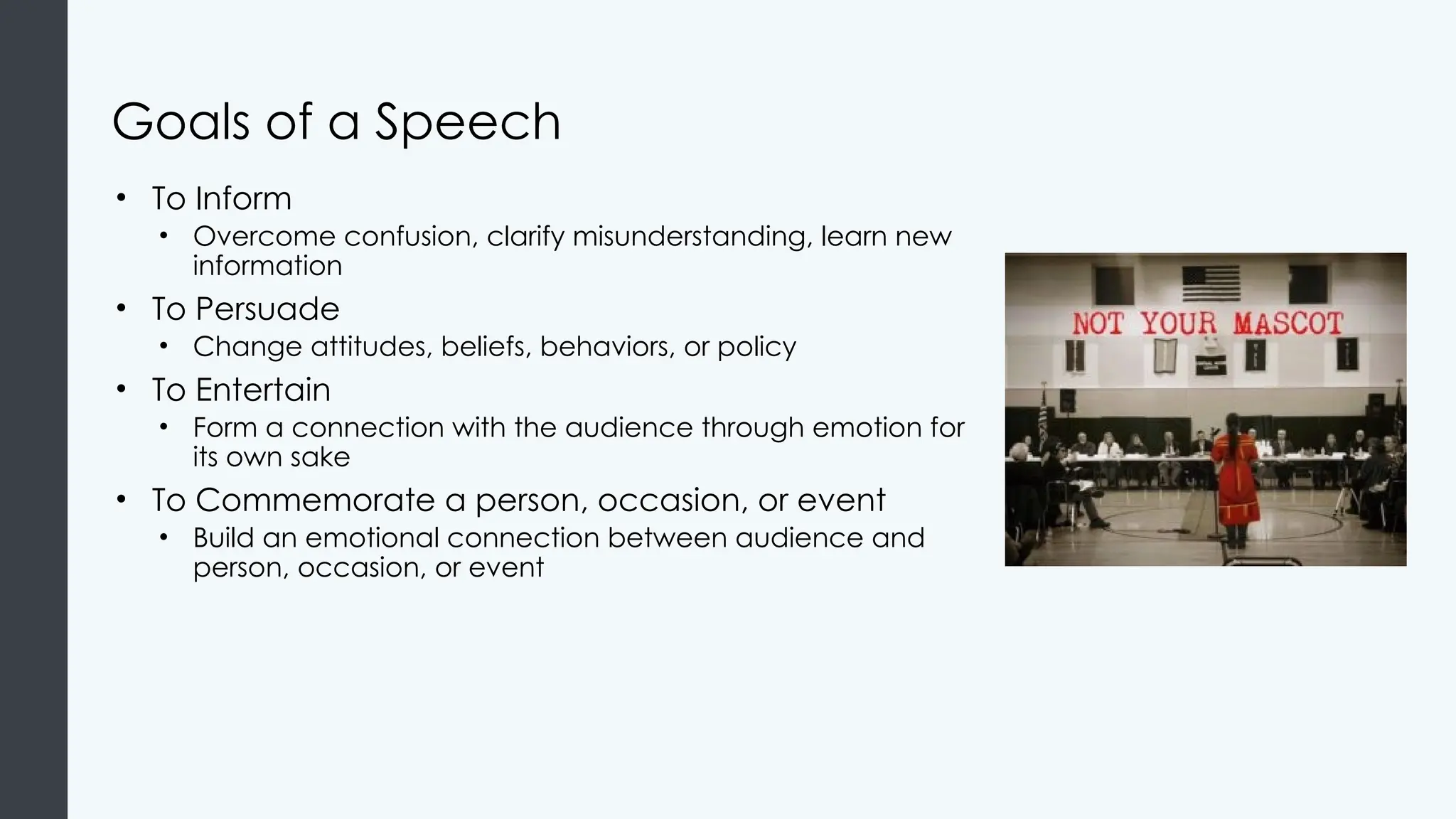
  • #10 Not Your Mascot. Authored by: Amelia Tuplin. Located at: https://en.wikipedia.org/wiki/Maulian_Dana#/media/File:Maulian_Dana,_mascot_issue.jpg. License: CC BY-SA: Attribution-ShareAlike
  • #12 Instructions: assign each group 1 of the following: communicators, message, channel, feedback, interference, context If needed, provide examples of asynchronous audiences (readers, television audiences, etc.) and synchronous audiences (live classes, live web meetings, etc.) Debrief questions: Has this discussion revealed any sources of miscommunication in a past communication you’ve had? How has this influenced how you will communicate in various scenarios in the future?
  • #14 Answer: D
  • #15 Answer: D – To commemorate an occasion
  • #19 "fear is a tool of punishment" by joseph.antoniello is licensed under CC BY-SA 2.0 Located at: https://www.flickr.com/photos/21331458@N08/2077145404
  • #21 Answer: C
  • #22 Answer: B
  • #25 Image: Elizabeth Cady Stanton (1880) Authored by: Unknown. Provided by: Wikimedia Commons. Located at: https://commons.wikimedia.org/wiki/File:Elizabeth_Stanton.jpg. License: Public Domain: No Known Copyright Example: Cady Elizabeth Stanton: Disinterested Deliberation – Seneca Falls Convention – deliberative task for the debate about the text of the Declaration of Sentiments Prophetic Mode – drafted the text and gave speeches Fair Fighting Mode: campaigning for legal change, adoption of the Woman’s Property Bill in New York - activist
  • #27 Image 1: “Debate sobre Direitos Urbanos e Cinema” Authored by: Direitos Urbanos. Provided by: Creative Commons. Located at: https://www.flickr.com/photos/78787798@N04/7331115622 License: CC BY 2.0 Image 2: “Black Lives Matter” Authored by: Seikoesquepayne. Provided by: Creative Commons. Located at: https://www.flickr.com/photos/34076322@N07/27950807420 License: CC BY 2.0 Image 3: “Malala Yousafzai” Authored by: Southbank Centre London. Provided by: Creative Commons. Located at: https://www.flickr.com/photos/37584375@N02/13008430294 License: CC BY 2.0
  • #29 Answer: D
  • #33 “Bust of Aristotle. Marble. Roman copy after a Greek bronze original by Lysippos from 330 BC” Authored by: Jastrow (2006). Provided by: Wikimedia Commons. Located at: https://commons.wikimedia.org/wiki/File:Aristotle_Altemps_Inv8575.jpg License: Public Domain/No known copyright
  • #34 Martin Luther King, Jr.. Authored by: Rowland Scherman. Provided by: U.S. Information Agency. Press and Publications Service. Located at:  https://en.wikipedia.org/wiki/March_on_Washington_for_Jobs_and_Freedom#/media/File:Martin_Luther_King_-_March_on_Washington.jpg. License: Public Domain: No Known Copyright
  • #35 *Is the medium the message? Nixon Kennedy Debate. Located at: https://en.wikipedia.org/wiki/United_States_presidential_debates#/media/File:Kennedy_Nixon_Debat_(1960).jpg. License: Public Domain: No Known Copyright
  • #36 Answer: D