


Meshless Point collocation Method For 1D and 2D 
Groundwater Flow Simulation 
By Under Supervision of 
Ashvini Kumar Prof Anirban Dhar 
10CE31005
Introduction 
 Groundwater contamination and soil pollution have been recognized as 
critical environment problems therefore flow of groundwater must be 
analysed. 
 Analysing flow of ground water through analytical method or numerical 
methods like FEM and FDM or boundary element method is complex. 
 Meshfree method is a powerful numerical technique to obtain more accurate 
approximate solutions in a more convenient manner for complex systems. 
 This method is used to establish algebraic equation for the whole problem 
domain without the use of pre-defined mesh. 
 Different from FDM and FEM, Mfree method use a set of scatted nodes in the 
problem domain and boundaries of the domain. 
 In present project, Mfree model is developed for groundwater flow problems 
in 1D and 2D based on collocation techniques.
Literature Review 
 Type of models use to study flow of groundwater can be classified in three 
categories 
 Sand Tank Models 
 Analog Model 
 Viscous Fluid Model 
 Electrical Models 
 Mathematical Models 
 Analytical Models 
 Numerical Models
Problem Description 
In this project, a meshless method called as Polynomial Point collocation method 
(PPCM) with radial basis function has been developed for the groundwater flow 
simulation in porous media in one and two dimensions. The developed model has 
been applied for computing head distribution in a hypothetical confined aquifer 
having different boundary conditions and source, and sink terms. The developed 
model is tested with analytical and FEM solutions available in literature and 
found to be satisfactory.
Development of PPCM Equation for analysis of flow of 
groundwater 
 Governing equation of flow of groundwater
PPCM formulation for 1D transient Flow equation for 
confined aquifer 
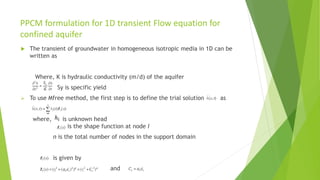
 The transient of groundwater in homogeneous isotropic media in 1D can be 
written as 
Where, K is hydraulic conductivity (m/d) of the aquifer 
Sy is specific yield 
 To use Mfree method, the first step is to define the trial solution as 
where, is unknown head 
is the shape function at node I 
n is the total number of nodes in the support domain 
is given by 
and 
ℎ푖
PPCM formulation for 1D transient Flow equation for 
confined aquifer 
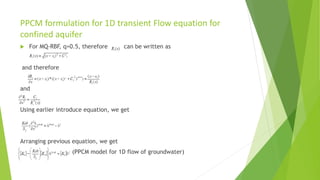
 For MQ-RBF, q=0.5, therefore can be written as 
and therefore 
and 
Using earlier introduce equation, we get 
Arranging previous equation, we get 
(PPCM model for 1D flow of groundwater)
PPCM formulation for 2D transient flow equation for 
confined aquifer 
 The transient of groundwater in homogeneous isotropic media in 2D can be written as 
 Again to use Mfree method, the first step is to define the trial solution as 
where, 
 Single and double derivatives of shape function w.r.t x and y can be written as 
 Putting these equation in first equation and arranging the terms, we get 
where, [K1] is global matrix of shape function 
[K2] is global matrix of double derivative of shape function w.r.t. x 
[K3] is global matrix of double derivative of shape function w.r.t y
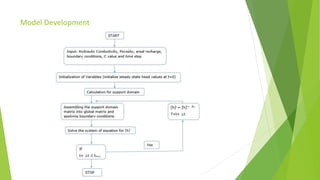
Model Development
Support Domain and Collocation Point 
1D Model 2D Model
Verification of 1D Model
Verification of 1D model
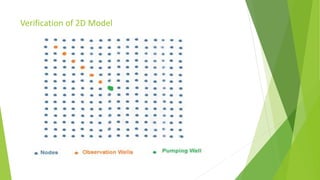
Verification of 2D Model
Verification of 2D Model 
Node No. t=0.2 days t=1day 
Analytical FEM % Error 
(analytical 
with FEM) 
PPCM %Error 
(Analytical with 
PPCM) 
FEM PPCM %Difference 
FEM with 
PPCM 
29 97.013 96.993 0.02 97.0316 0.019 97.2316 97.2316 0.084 
43 93.804 93.768 0.036 93.7606 0.046 94.0059 94.0059 0.047 
57 90.095 90.051 0.044 90.0756 0.022 90.0245 90.0245 0.133 
71 85.451 85.413 0.038 8 0.07 85.6105 85.6105 0.041 
85 78.983 78.974 0.009 78.9544 0.024 78.8544 78.8544 0.272 
99 67.953 67.762 0.191 67.8552 0.144 67.8212 67.8212 0.204
Verification of 2D Model
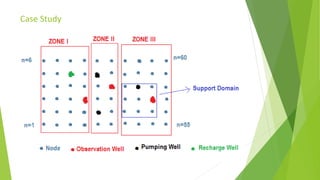
Case Study
Case Study 
Properties ZONE I ZONE II ZONE III 
Transmissivity Tx (m2/d) 500 400 250 
Transmissivity Ty (m2/d) 300 250 200 
Porosity 0.2 0.25 0.15
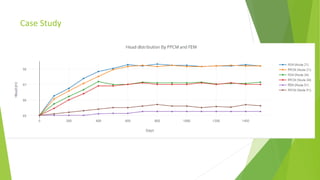
Case Study 
Node No. FEM PPCM % Difference 
21 98.2 98.149 0.0129 
34 97.1 96.927 0.0445 
51 95.25 95.313 0.0165
Case Study
Thank You All

Meshless Point collocation Method For 1D and 2D Groundwater Flow Simulation

  • 1.
    Meshless Point collocationMethod For 1D and 2D Groundwater Flow Simulation By Under Supervision of Ashvini Kumar Prof Anirban Dhar 10CE31005
  • 2.
    Introduction  Groundwatercontamination and soil pollution have been recognized as critical environment problems therefore flow of groundwater must be analysed.  Analysing flow of ground water through analytical method or numerical methods like FEM and FDM or boundary element method is complex.  Meshfree method is a powerful numerical technique to obtain more accurate approximate solutions in a more convenient manner for complex systems.  This method is used to establish algebraic equation for the whole problem domain without the use of pre-defined mesh.  Different from FDM and FEM, Mfree method use a set of scatted nodes in the problem domain and boundaries of the domain.  In present project, Mfree model is developed for groundwater flow problems in 1D and 2D based on collocation techniques.
  • 3.
    Literature Review Type of models use to study flow of groundwater can be classified in three categories  Sand Tank Models  Analog Model  Viscous Fluid Model  Electrical Models  Mathematical Models  Analytical Models  Numerical Models
  • 4.
    Problem Description Inthis project, a meshless method called as Polynomial Point collocation method (PPCM) with radial basis function has been developed for the groundwater flow simulation in porous media in one and two dimensions. The developed model has been applied for computing head distribution in a hypothetical confined aquifer having different boundary conditions and source, and sink terms. The developed model is tested with analytical and FEM solutions available in literature and found to be satisfactory.
  • 5.
    Development of PPCMEquation for analysis of flow of groundwater  Governing equation of flow of groundwater
  • 6.
    PPCM formulation for1D transient Flow equation for confined aquifer  The transient of groundwater in homogeneous isotropic media in 1D can be written as Where, K is hydraulic conductivity (m/d) of the aquifer Sy is specific yield  To use Mfree method, the first step is to define the trial solution as where, is unknown head is the shape function at node I n is the total number of nodes in the support domain is given by and ℎ푖
  • 7.
    PPCM formulation for1D transient Flow equation for confined aquifer  For MQ-RBF, q=0.5, therefore can be written as and therefore and Using earlier introduce equation, we get Arranging previous equation, we get (PPCM model for 1D flow of groundwater)
  • 8.
    PPCM formulation for2D transient flow equation for confined aquifer  The transient of groundwater in homogeneous isotropic media in 2D can be written as  Again to use Mfree method, the first step is to define the trial solution as where,  Single and double derivatives of shape function w.r.t x and y can be written as  Putting these equation in first equation and arranging the terms, we get where, [K1] is global matrix of shape function [K2] is global matrix of double derivative of shape function w.r.t. x [K3] is global matrix of double derivative of shape function w.r.t y
  • 9.
  • 10.
    Support Domain andCollocation Point 1D Model 2D Model
  • 11.
  • 12.
  • 13.
  • 14.
    Verification of 2DModel Node No. t=0.2 days t=1day Analytical FEM % Error (analytical with FEM) PPCM %Error (Analytical with PPCM) FEM PPCM %Difference FEM with PPCM 29 97.013 96.993 0.02 97.0316 0.019 97.2316 97.2316 0.084 43 93.804 93.768 0.036 93.7606 0.046 94.0059 94.0059 0.047 57 90.095 90.051 0.044 90.0756 0.022 90.0245 90.0245 0.133 71 85.451 85.413 0.038 8 0.07 85.6105 85.6105 0.041 85 78.983 78.974 0.009 78.9544 0.024 78.8544 78.8544 0.272 99 67.953 67.762 0.191 67.8552 0.144 67.8212 67.8212 0.204
  • 15.
  • 16.
  • 17.
    Case Study PropertiesZONE I ZONE II ZONE III Transmissivity Tx (m2/d) 500 400 250 Transmissivity Ty (m2/d) 300 250 200 Porosity 0.2 0.25 0.15
  • 18.
    Case Study NodeNo. FEM PPCM % Difference 21 98.2 98.149 0.0129 34 97.1 96.927 0.0445 51 95.25 95.313 0.0165
  • 19.
  • 20.