UW Neuromuscular
Biomechanics
Lab
MRI Findings Regarding
Hamstring Strain Injury and
Recovery
Bryan Heiderscheit, PT, PhD
Professor
Department of Orthopedics and Rehabilitation
Department of Biomedical Engineering
Director, UW Runners’ Clinic
Director, Badger Athletic Performance Research
Co-director, UW Neuromuscular Biomechanics Lab
UW Neuromuscular
Biomechanics
Lab
MRI Use
 MRI typically reserved when
rupture is suspected
 Provide estimate of
recovery time
 injury length and cross
sectional area (CSA)
proportional to time away from
sport
Heiderscheit et al (2010) J Orthop Sports Phys Ther
Connell et al (2004) Am J Roentgenol
Slavotinek et al (2002) Am J Roentgenol
UW Neuromuscular
Biomechanics
Lab
Can MRI predict Re-injury Risk?
Gibbs et al (2004) J Sci Med Sport
Koulouris et al (2007) Am J Sports Med
Verrall et al (2006) J Orthop Sports Phys Ther
Warren et al (2010) Br J Sports Med
Ekstrand et al (2011) Br J Sports Med
 re-injury is most common with:
 injury to biceps femoris
 history of hamstring strain injury
 injuries that present as more severe, based on initial
physical exam or MRI findings, do not have greater rate
of injury recurrence
 characterizing the extent of musculotendon recovery at
time of return to sport may provide prognostic value
regarding re-injury risk
UW Neuromuscular
Biomechanics
Lab
Increased Risk of Re-injury
Recurrent
Strain Injury
Initial
Strain Injury
persistent deficits
Weakness
Altered musculotendon
dynamics
Scar tissue
UW Neuromuscular
Biomechanics
Lab
Prior Hamstring Strain Injury
Recurrent
Strain Injury
Initial
Strain Injury
persistent deficits
Weakness
Altered musculotendon
dynamics
Scar tissue
Project 1
UW Neuromuscular
Biomechanics
Lab
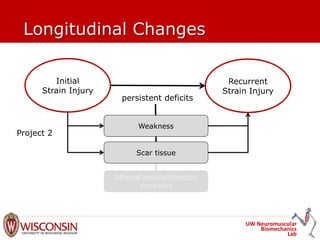
Longitudinal Changes
Recurrent
Strain Injury
Initial
Strain Injury
persistent deficits
Weakness
Altered musculotendon
dynamics
Scar tissue
Project 2
UW Neuromuscular
Biomechanics
Lab
Volume Estimates from MRI
Silder et al. (2008) Skel Radiol
UW Neuromuscular
Biomechanics
Lab
Muscle Volume Changes
BFLH BFSH
-12%
**p<0.01
+22%
**p=0.06
Injured Healthy
**Compared to
healthy controls
Silder et al. (2008) Skel Radiol
UW Neuromuscular
Biomechanics
Lab
Persistent Scar Tissue
Silder et al. (2008) Skel Radiol
 92% increase in biceps
tendon volume
 healthy controls, ~10%
absolute bilateral difference
8 months post-injury
UW Neuromuscular
Biomechanics
Lab
Fatty Infiltration
 Inconsistent finding of greater fatty infiltration on previously
injured side (white arrow) compared to non-injured side
(black arrow)
Silder et al. (2008) Skel Radiol
UW Neuromuscular
Biomechanics
Lab
Silder et al. (2010) Clin Biomech
No significant bilateral
differences in peak
musculotendon stretch
Symmetrical Running Mechanics
UW Neuromuscular
Biomechanics
Lab
Muscle-Tendon Dynamics
 Muscle tissue strain largely
dependent on tendon compliance
Normal
Tendon
Tendon/Scar
Lieber et al., Am J Physiol, 1991
Thelen et al., Med Sci Sports Exerc, 2005
Fukashiro et al., J Appl Biomech, 2006
Greater muscle fiber strain with
increased tendon stiffness
UW Neuromuscular
Biomechanics
Lab
MRI Compatible Loading Device
Elastic Loading Inertial Loading
 28 cycles/min
 ~15-20% of maximum strength
Silder et al (2010) J Biomechanics
UW Neuromuscular
Biomechanics
Lab
 28 cycles/min
 1’39” per scan
 1.4 x 1.4 x 6 mm
Dynamic Hamstring Imaging
Proximal
Tendon and
Aponeurosis
Biceps Femoris
Long Head
UW Neuromuscular
Biomechanics
Lab
Proximal tendon and
aponeurosis
Four regions
0-1 cm
1-2 cm
2-3 cm
3-4 cm
Regional Comparisons within
Biceps Femoris Long Head
Silder et al (2010) J Biomechanics
UW Neuromuscular
Biomechanics
Lab
Tissue Displacements
Elastic vs Inertial Loading
6
4
2
0
Displacement
(mm)Elastic Loading Inertial Loading
 Proximal tissue moved least for
both loading conditions
 Greater overall muscle displacement
 More uniform motion, but larger
gradients near proximal MTJ
Silder et al (2010) J Biomechanics
UW Neuromuscular
Biomechanics
Lab
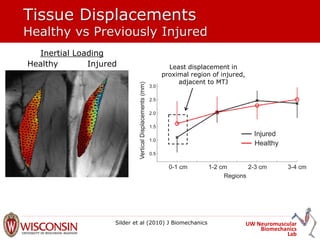
Tissue Displacements
Healthy vs Previously Injured
Healthy Injured
Inertial Loading
Silder et al (2010) J Biomechanics
Least displacement in
proximal region of injured,
adjacent to MTJ
UW Neuromuscular
Biomechanics
Lab
First Principal Strains
Inertial Loading
Healthy Injured
0.15
0.10
0.05
0.00
Strain
Silder et al (2010) J Biomechanics
UW Neuromuscular
Biomechanics
Lab
First Principal Strains
Healthy vs Injured
 Largest strains adjacent to MTJ
 Strains greater for injured subjects
Healthy Injured
Inertial Loading
Silder et al (2010) J Biomechanics
UW Neuromuscular
Biomechanics
Lab
Longitudinal Changes
Recurrent
Strain Injury
Initial
Strain Injury
persistent deficits
Weakness
Altered musculotendon
dynamics
Scar tissue
Project 2
UW Neuromuscular
Biomechanics
Lab
Morphological and Strength
Changes during Recovery
Acute hamstring
strain injury
Standardized
Rehabilitation
Return to
Sport
6 month F/U
from Return
to Sport
MRI
MRI &
strength
MRI &
strength
7 day
window
UW Neuromuscular
Biomechanics
Lab
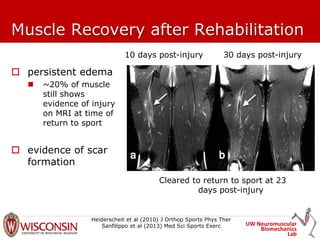
Muscle Recovery after Rehabilitation
10 days post-injury 30 days post-injury
Cleared to return to sport at 23
days post-injury
Heiderscheit et al (2010) J Orthop Sports Phys Ther
Sanfilippo et al (2013) Med Sci Sports Exerc
 persistent edema
 ~20% of muscle
still shows
evidence of injury
on MRI at time of
return to sport
 evidence of scar
formation
UW Neuromuscular
Biomechanics
Lab
Post-Injury Remodeling
 Persistent edema
 Evidence of scar tissue
Silder et al. (2008) Skeletal Radiology
Connell et al. (2004) AJR
7 days post-injury 2 mo. post-injury 7 mo. post-injury
 Edema resolved
 Fully formed scar tissue
UW Neuromuscular
Biomechanics
Lab
7 days post-injury 2 mo. post-injury 7 mo. post-injury
Predicting Scar Tissue
 Moderate correlation (r=0.49) between volume of initial injury
and subsequent size of scar
Davidson et al. (2011) Proc, N Am Soc Clin Radiol
UW Neuromuscular
Biomechanics
Lab
Predicting Time to Return to Sport
and Re-injury from MRI
 MRI measures associated with increased recovery time:
 Baseline: cradio-caudal length of injury on MRI (r=0.41)
 Post-rehabilitation: none
 Baseline MRI measures associated with re-injury
 Cross sectional area of injury (% of total cross sectional
area)
 Re-injury (n=4): 87% [95% CI: 68%, 100%]
 No re-injury (n=25): 54% [95% CI: 43%, 65%]
Silder et al. (2013) J Orthop Sports Phys Ther
UW Neuromuscular
Biomechanics
Lab
Edema Drainage in Fascial Plane
 Edema and hemorrhage can
extend into the fascial plane
 Over time, fascial drainage can
lengthen the craniocaudal extent
of injury and result in MRI
measurements longer than the
actual muscle/tendon damage
Silder et al. (2013) J Orthop Sports Phys Ther
UW Neuromuscular
Biomechanics
Lab
Post-Rehab Strength Deficit
0
0.2
0.4
0.6
0.8
1
1.2
1.4
1.6
Return-to-Sport 6-month F/U
KneeFlexionPeakTorque
(Nm/kg)
Injured Limb
Non-injured Limb
*
 ~10% deficit in
peak torque
between limbs at
time to return to
sport
 No deficit present
at 6 month F/U
Sanfilippo et al. (2013) Med Sci Sports Exerc
UW Neuromuscular
Biomechanics
Lab
Persistent Strength Deficits
Sanfilippo et al. (2013) Med Sci Sports Exerc
Silder et al. (2013) J Orthop Sports Phys Ther
long short
Hamstring
Length
 Strength deficits
pronounced at long
muscle lengths
 Shift in angle of peak
torque occurred in both
limbs despite only one
limb displaying scar
tissue
 Neuromuscular deficit at
return to sport
 Likely accounts for
strength loss and shift
in angle of peak torque
UW Neuromuscular
Biomechanics
Lab
Summary
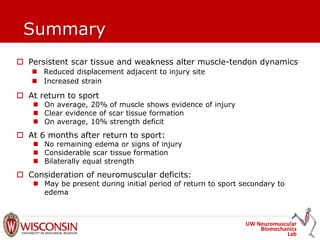
 Persistent scar tissue and weakness alter muscle-tendon dynamics
 Reduced displacement adjacent to injury site
 Increased strain
 At return to sport
 On average, 20% of muscle shows evidence of injury
 Clear evidence of scar tissue formation
 On average, 10% strength deficit
 At 6 months after return to sport:
 No remaining edema or signs of injury
 Considerable scar tissue formation
 Bilaterally equal strength
 Consideration of neuromuscular deficits:
 May be present during initial period of return to sport secondary to
edema
UW Neuromuscular
Biomechanics
Lab
Acknowledgements
 Collaborators
 Amy Silder, PhD
 Liz Chumanov, PhD, DPT
 Jen Sanfilippo, MS, LAT
 Darryl Thelen, PhD
 Christopher Westphal, MS
 Marc Sherry, DPT, LAT
 Mike Tuite, MD
 Steve Swanson, MS
 Thomas Best, MD, PhD
 Funding
 Aircast Foundation
 NFL Charities
 NIH AR056201
 NIH 1UL1RR025011
UW Neuromuscular
Biomechanics
Lab
Thank You - Gracias
Madison, WI, USA

Bryan Heiderscheit - MRI findings

  • 1.
    UW Neuromuscular Biomechanics Lab MRI FindingsRegarding Hamstring Strain Injury and Recovery Bryan Heiderscheit, PT, PhD Professor Department of Orthopedics and Rehabilitation Department of Biomedical Engineering Director, UW Runners’ Clinic Director, Badger Athletic Performance Research Co-director, UW Neuromuscular Biomechanics Lab
  • 2.
    UW Neuromuscular Biomechanics Lab MRI Use MRI typically reserved when rupture is suspected  Provide estimate of recovery time  injury length and cross sectional area (CSA) proportional to time away from sport Heiderscheit et al (2010) J Orthop Sports Phys Ther Connell et al (2004) Am J Roentgenol Slavotinek et al (2002) Am J Roentgenol
  • 3.
    UW Neuromuscular Biomechanics Lab Can MRIpredict Re-injury Risk? Gibbs et al (2004) J Sci Med Sport Koulouris et al (2007) Am J Sports Med Verrall et al (2006) J Orthop Sports Phys Ther Warren et al (2010) Br J Sports Med Ekstrand et al (2011) Br J Sports Med  re-injury is most common with:  injury to biceps femoris  history of hamstring strain injury  injuries that present as more severe, based on initial physical exam or MRI findings, do not have greater rate of injury recurrence  characterizing the extent of musculotendon recovery at time of return to sport may provide prognostic value regarding re-injury risk
  • 4.
    UW Neuromuscular Biomechanics Lab Increased Riskof Re-injury Recurrent Strain Injury Initial Strain Injury persistent deficits Weakness Altered musculotendon dynamics Scar tissue
  • 5.
    UW Neuromuscular Biomechanics Lab Prior HamstringStrain Injury Recurrent Strain Injury Initial Strain Injury persistent deficits Weakness Altered musculotendon dynamics Scar tissue Project 1
  • 6.
    UW Neuromuscular Biomechanics Lab Longitudinal Changes Recurrent StrainInjury Initial Strain Injury persistent deficits Weakness Altered musculotendon dynamics Scar tissue Project 2
  • 7.
    UW Neuromuscular Biomechanics Lab Volume Estimatesfrom MRI Silder et al. (2008) Skel Radiol
  • 8.
    UW Neuromuscular Biomechanics Lab Muscle VolumeChanges BFLH BFSH -12% **p<0.01 +22% **p=0.06 Injured Healthy **Compared to healthy controls Silder et al. (2008) Skel Radiol
  • 9.
    UW Neuromuscular Biomechanics Lab Persistent ScarTissue Silder et al. (2008) Skel Radiol  92% increase in biceps tendon volume  healthy controls, ~10% absolute bilateral difference 8 months post-injury
  • 10.
    UW Neuromuscular Biomechanics Lab Fatty Infiltration Inconsistent finding of greater fatty infiltration on previously injured side (white arrow) compared to non-injured side (black arrow) Silder et al. (2008) Skel Radiol
  • 11.
    UW Neuromuscular Biomechanics Lab Silder etal. (2010) Clin Biomech No significant bilateral differences in peak musculotendon stretch Symmetrical Running Mechanics
  • 12.
    UW Neuromuscular Biomechanics Lab Muscle-Tendon Dynamics Muscle tissue strain largely dependent on tendon compliance Normal Tendon Tendon/Scar Lieber et al., Am J Physiol, 1991 Thelen et al., Med Sci Sports Exerc, 2005 Fukashiro et al., J Appl Biomech, 2006 Greater muscle fiber strain with increased tendon stiffness
  • 13.
    UW Neuromuscular Biomechanics Lab MRI CompatibleLoading Device Elastic Loading Inertial Loading  28 cycles/min  ~15-20% of maximum strength Silder et al (2010) J Biomechanics
  • 14.
    UW Neuromuscular Biomechanics Lab  28cycles/min  1’39” per scan  1.4 x 1.4 x 6 mm Dynamic Hamstring Imaging Proximal Tendon and Aponeurosis Biceps Femoris Long Head
  • 15.
    UW Neuromuscular Biomechanics Lab Proximal tendonand aponeurosis Four regions 0-1 cm 1-2 cm 2-3 cm 3-4 cm Regional Comparisons within Biceps Femoris Long Head Silder et al (2010) J Biomechanics
  • 16.
    UW Neuromuscular Biomechanics Lab Tissue Displacements Elasticvs Inertial Loading 6 4 2 0 Displacement (mm)Elastic Loading Inertial Loading  Proximal tissue moved least for both loading conditions  Greater overall muscle displacement  More uniform motion, but larger gradients near proximal MTJ Silder et al (2010) J Biomechanics
  • 17.
    UW Neuromuscular Biomechanics Lab Tissue Displacements Healthyvs Previously Injured Healthy Injured Inertial Loading Silder et al (2010) J Biomechanics Least displacement in proximal region of injured, adjacent to MTJ
  • 18.
    UW Neuromuscular Biomechanics Lab First PrincipalStrains Inertial Loading Healthy Injured 0.15 0.10 0.05 0.00 Strain Silder et al (2010) J Biomechanics
  • 19.
    UW Neuromuscular Biomechanics Lab First PrincipalStrains Healthy vs Injured  Largest strains adjacent to MTJ  Strains greater for injured subjects Healthy Injured Inertial Loading Silder et al (2010) J Biomechanics
  • 20.
    UW Neuromuscular Biomechanics Lab Longitudinal Changes Recurrent StrainInjury Initial Strain Injury persistent deficits Weakness Altered musculotendon dynamics Scar tissue Project 2
  • 21.
    UW Neuromuscular Biomechanics Lab Morphological andStrength Changes during Recovery Acute hamstring strain injury Standardized Rehabilitation Return to Sport 6 month F/U from Return to Sport MRI MRI & strength MRI & strength 7 day window
  • 22.
    UW Neuromuscular Biomechanics Lab Muscle Recoveryafter Rehabilitation 10 days post-injury 30 days post-injury Cleared to return to sport at 23 days post-injury Heiderscheit et al (2010) J Orthop Sports Phys Ther Sanfilippo et al (2013) Med Sci Sports Exerc  persistent edema  ~20% of muscle still shows evidence of injury on MRI at time of return to sport  evidence of scar formation
  • 23.
    UW Neuromuscular Biomechanics Lab Post-Injury Remodeling Persistent edema  Evidence of scar tissue Silder et al. (2008) Skeletal Radiology Connell et al. (2004) AJR 7 days post-injury 2 mo. post-injury 7 mo. post-injury  Edema resolved  Fully formed scar tissue
  • 24.
    UW Neuromuscular Biomechanics Lab 7 dayspost-injury 2 mo. post-injury 7 mo. post-injury Predicting Scar Tissue  Moderate correlation (r=0.49) between volume of initial injury and subsequent size of scar Davidson et al. (2011) Proc, N Am Soc Clin Radiol
  • 25.
    UW Neuromuscular Biomechanics Lab Predicting Timeto Return to Sport and Re-injury from MRI  MRI measures associated with increased recovery time:  Baseline: cradio-caudal length of injury on MRI (r=0.41)  Post-rehabilitation: none  Baseline MRI measures associated with re-injury  Cross sectional area of injury (% of total cross sectional area)  Re-injury (n=4): 87% [95% CI: 68%, 100%]  No re-injury (n=25): 54% [95% CI: 43%, 65%] Silder et al. (2013) J Orthop Sports Phys Ther
  • 26.
    UW Neuromuscular Biomechanics Lab Edema Drainagein Fascial Plane  Edema and hemorrhage can extend into the fascial plane  Over time, fascial drainage can lengthen the craniocaudal extent of injury and result in MRI measurements longer than the actual muscle/tendon damage Silder et al. (2013) J Orthop Sports Phys Ther
  • 27.
    UW Neuromuscular Biomechanics Lab Post-Rehab StrengthDeficit 0 0.2 0.4 0.6 0.8 1 1.2 1.4 1.6 Return-to-Sport 6-month F/U KneeFlexionPeakTorque (Nm/kg) Injured Limb Non-injured Limb *  ~10% deficit in peak torque between limbs at time to return to sport  No deficit present at 6 month F/U Sanfilippo et al. (2013) Med Sci Sports Exerc
  • 28.
    UW Neuromuscular Biomechanics Lab Persistent StrengthDeficits Sanfilippo et al. (2013) Med Sci Sports Exerc Silder et al. (2013) J Orthop Sports Phys Ther long short Hamstring Length  Strength deficits pronounced at long muscle lengths  Shift in angle of peak torque occurred in both limbs despite only one limb displaying scar tissue  Neuromuscular deficit at return to sport  Likely accounts for strength loss and shift in angle of peak torque
  • 29.
    UW Neuromuscular Biomechanics Lab Summary  Persistentscar tissue and weakness alter muscle-tendon dynamics  Reduced displacement adjacent to injury site  Increased strain  At return to sport  On average, 20% of muscle shows evidence of injury  Clear evidence of scar tissue formation  On average, 10% strength deficit  At 6 months after return to sport:  No remaining edema or signs of injury  Considerable scar tissue formation  Bilaterally equal strength  Consideration of neuromuscular deficits:  May be present during initial period of return to sport secondary to edema
  • 30.
    UW Neuromuscular Biomechanics Lab Acknowledgements  Collaborators Amy Silder, PhD  Liz Chumanov, PhD, DPT  Jen Sanfilippo, MS, LAT  Darryl Thelen, PhD  Christopher Westphal, MS  Marc Sherry, DPT, LAT  Mike Tuite, MD  Steve Swanson, MS  Thomas Best, MD, PhD  Funding  Aircast Foundation  NFL Charities  NIH AR056201  NIH 1UL1RR025011
  • 31.