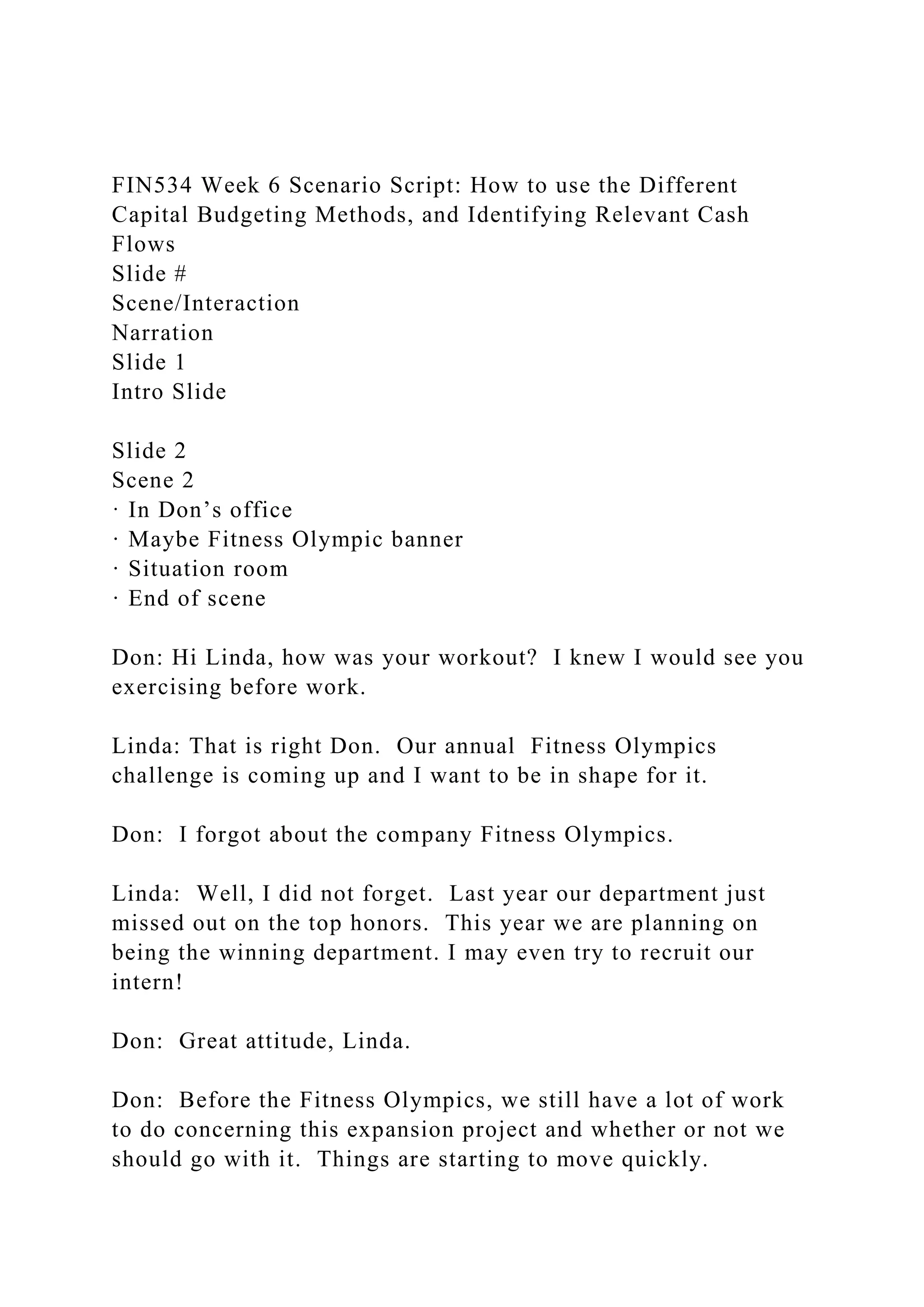
FIN534 Week 6 Scenario Script: How to use the Different
Capital Budgeting Methods, and Identifying Relevant Cash
Flows
Slide #
Scene/Interaction
Narration
Slide 1
Intro Slide
Slide 2
Scene 2
· In Don’s office
· Maybe Fitness Olympic banner
· Situation room
· End of scene
Don: Hi Linda, how was your workout? I knew I would see you
exercising before work.
Linda: That is right Don. Our annual Fitness Olympics
challenge is coming up and I want to be in shape for it.
Don: I forgot about the company Fitness Olympics.
Linda: Well, I did not forget. Last year our department just
missed out on the top honors. This year we are planning on
being the winning department. I may even try to recruit our
intern!
Don: Great attitude, Linda.
Don: Before the Fitness Olympics, we still have a lot of work
to do concerning this expansion project and whether or not we
should go with it. Things are starting to move quickly.
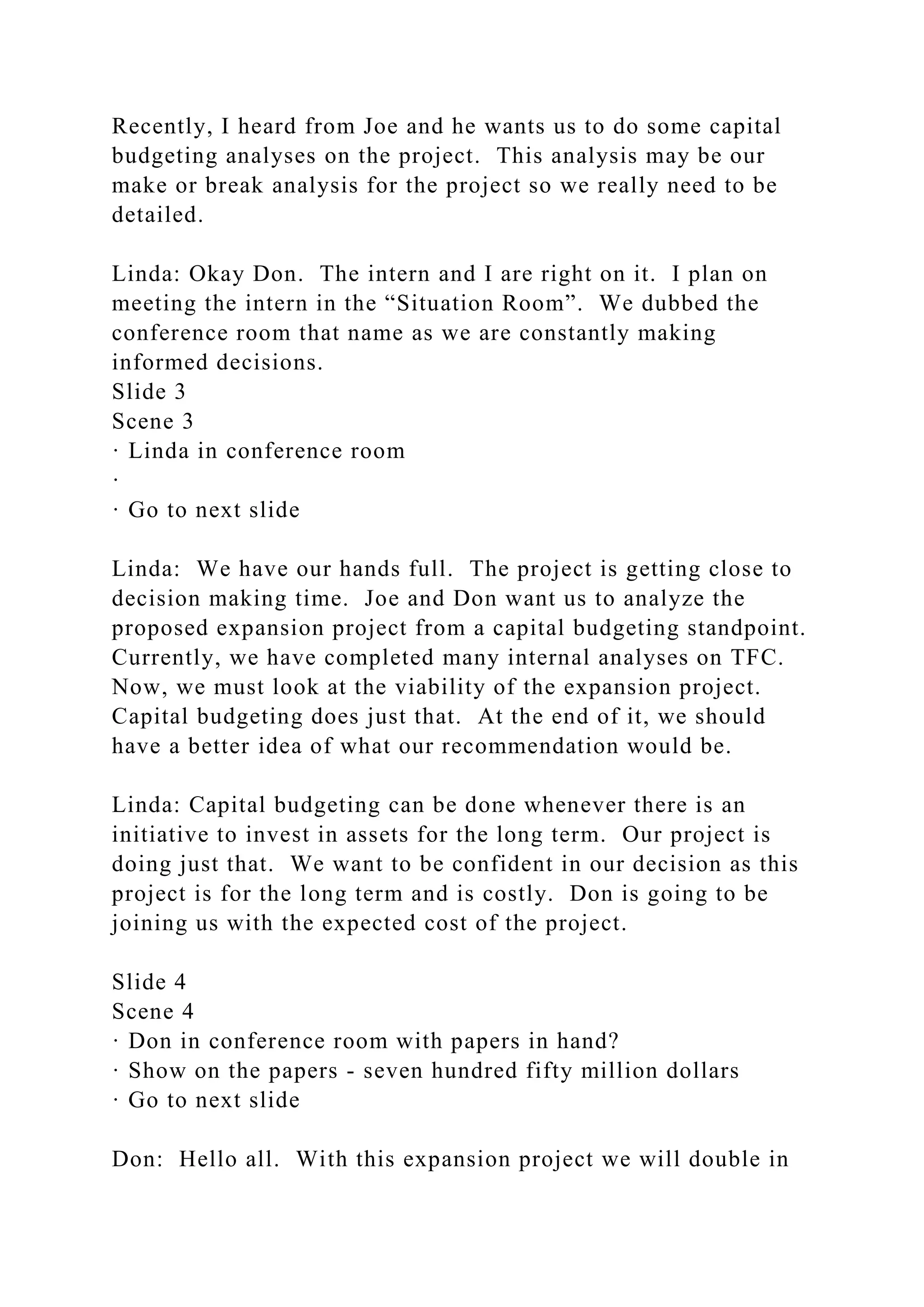
Recently, I heard from Joe and he wants us to do some capital
budgeting analyses on the project. This analysis may be our
make or break analysis for the project so we really need to be
detailed.
Linda: Okay Don. The intern and I are right on it. I plan on
meeting the intern in the “Situation Room”. We dubbed the
conference room that name as we are constantly making
informed decisions.
Slide 3
Scene 3
· Linda in conference room
·
· Go to next slide
Linda: We have our hands full. The project is getting close to
decision making time. Joe and Don want us to analyze the
proposed expansion project from a capital budgeting standpoint.
Currently, we have completed many internal analyses on TFC.
Now, we must look at the viability of the expansion project.
Capital budgeting does just that. At the end of it, we should
have a better idea of what our recommendation would be.
Linda: Capital budgeting can be done whenever there is an
initiative to invest in assets for the long term. Our project is
doing just that. We want to be confident in our decision as this
project is for the long term and is costly. Don is going to be
joining us with the expected cost of the project.
Slide 4
Scene 4
· Don in conference room with papers in hand?
· Show on the papers - seven hundred fifty million dollars
· Go to next slide
Don: Hello all. With this expansion project we will double in
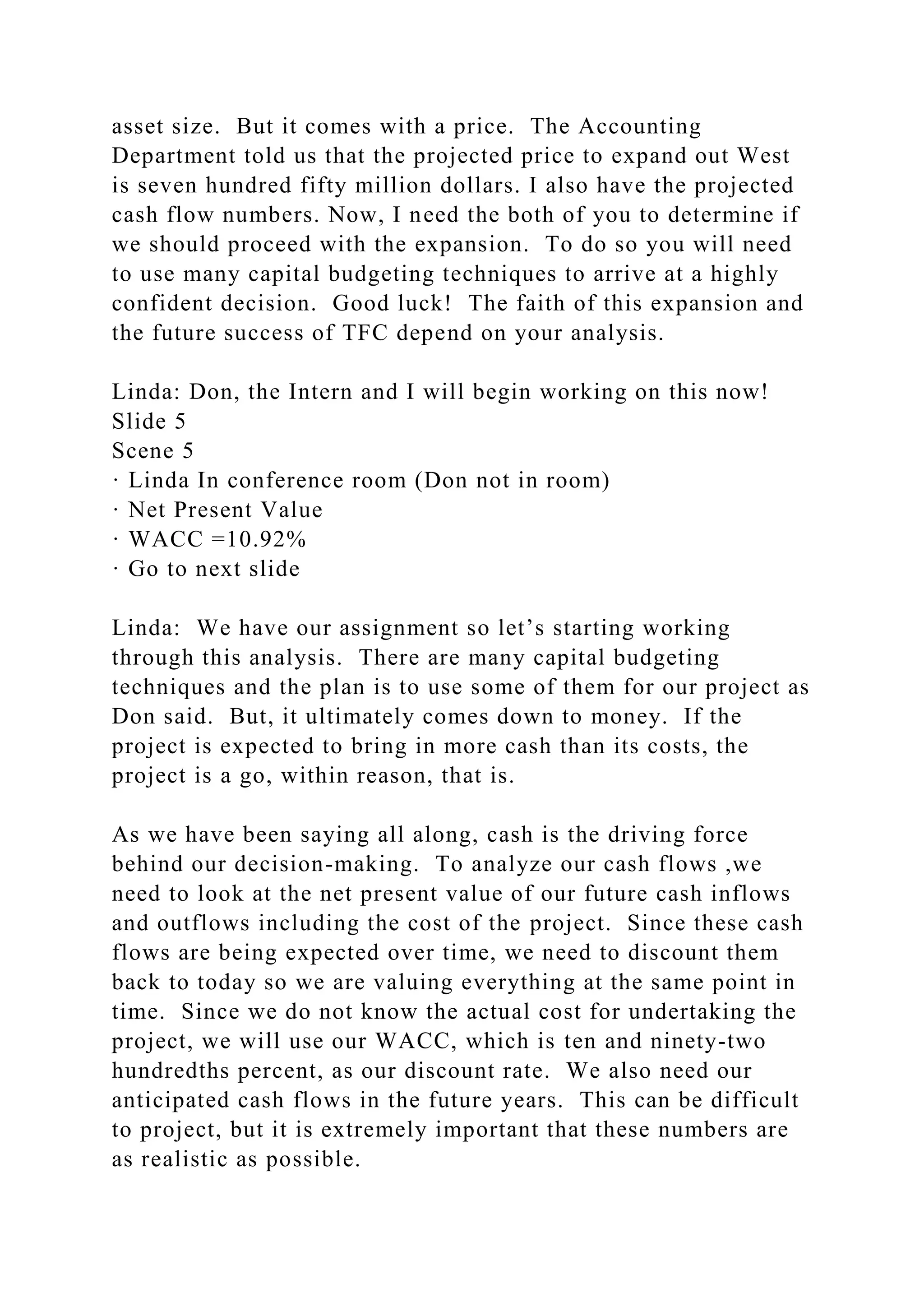
asset size. But it comes with a price. The Accounting
Department told us that the projected price to expand out West
is seven hundred fifty million dollars. I also have the projected
cash flow numbers. Now, I need the both of you to determine if
we should proceed with the expansion. To do so you will need
to use many capital budgeting techniques to arrive at a highly
confident decision. Good luck! The faith of this expansion and
the future success of TFC depend on your analysis.
Linda: Don, the Intern and I will begin working on this now!
Slide 5
Scene 5
· Linda In conference room (Don not in room)
· Net Present Value
· WACC =10.92%
· Go to next slide
Linda: We have our assignment so let’s starting working
through this analysis. There are many capital budgeting
techniques and the plan is to use some of them for our project as
Don said. But, it ultimately comes down to money. If the
project is expected to bring in more cash than its costs, the
project is a go, within reason, that is.
As we have been saying all along, cash is the driving force
behind our decision-making. To analyze our cash flows ,we
need to look at the net present value of our future cash inflows
and outflows including the cost of the project. Since these cash
flows are being expected over time, we need to discount them
back to today so we are valuing everything at the same point in
time. Since we do not know the actual cost for undertaking the
project, we will use our WACC, which is ten and ninety-two
hundredths percent, as our discount rate. We also need our
anticipated cash flows in the future years. This can be difficult
to project, but it is extremely important that these numbers are
as realistic as possible.
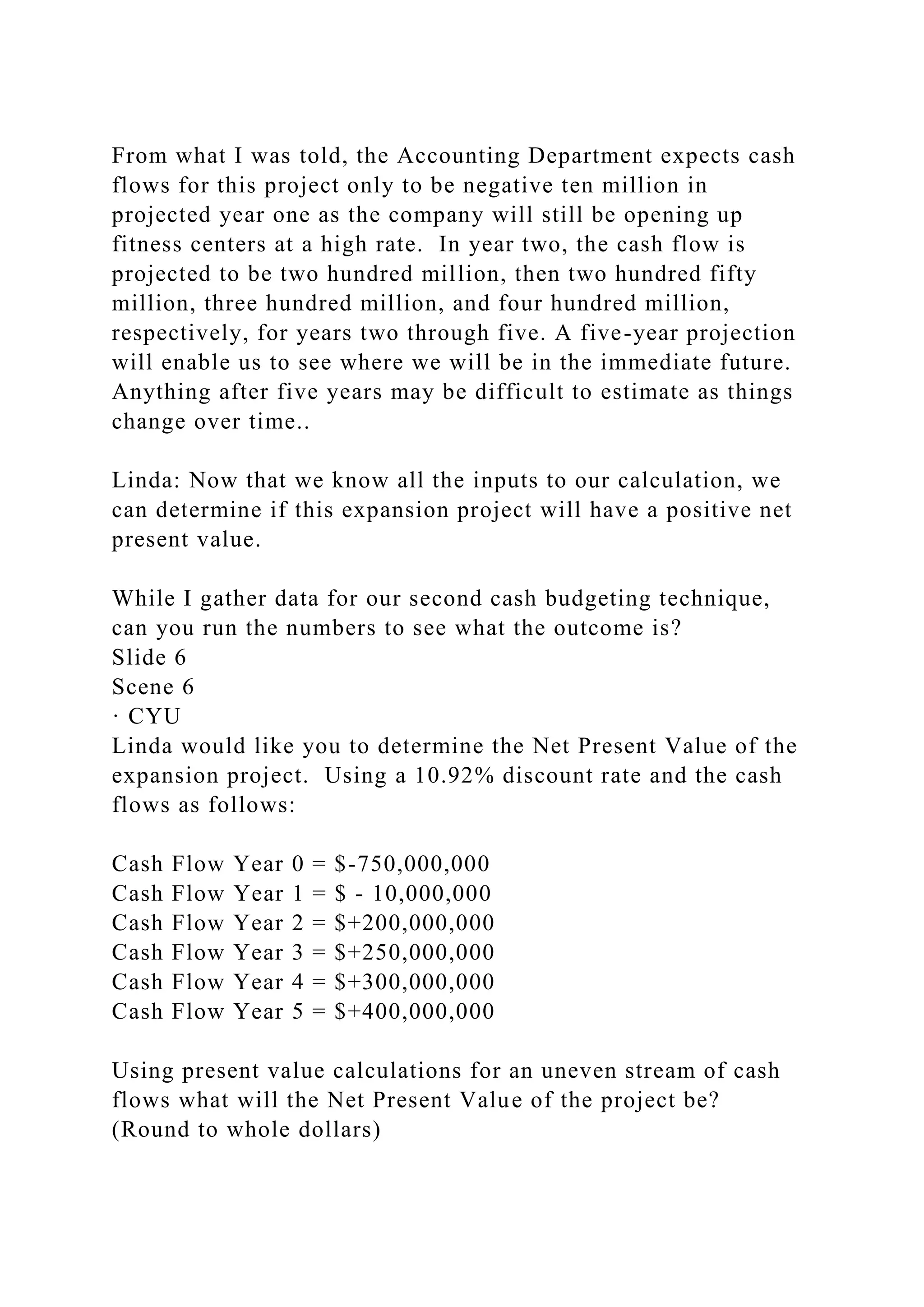
From what I was told, the Accounting Department expects cash
flows for this project only to be negative ten million in
projected year one as the company will still be opening up
fitness centers at a high rate. In year two, the cash flow is
projected to be two hundred million, then two hundred fifty
million, three hundred million, and four hundred million,
respectively, for years two through five. A five-year projection
will enable us to see where we will be in the immediate future.
Anything after five years may be difficult to estimate as things
change over time..
Linda: Now that we know all the inputs to our calculation, we
can determine if this expansion project will have a positive net
present value.
While I gather data for our second cash budgeting technique,
can you run the numbers to see what the outcome is?
Slide 6
Scene 6
· CYU
Linda would like you to determine the Net Present Value of the
expansion project. Using a 10.92% discount rate and the cash
flows as follows:
Cash Flow Year 0 = $-750,000,000
Cash Flow Year 1 = $ - 10,000,000
Cash Flow Year 2 = $+200,000,000
Cash Flow Year 3 = $+250,000,000
Cash Flow Year 4 = $+300,000,000
Cash Flow Year 5 = $+400,000,000
Using present value calculations for an uneven stream of cash
flows what will the Net Present Value of the project be?
(Round to whole dollars)
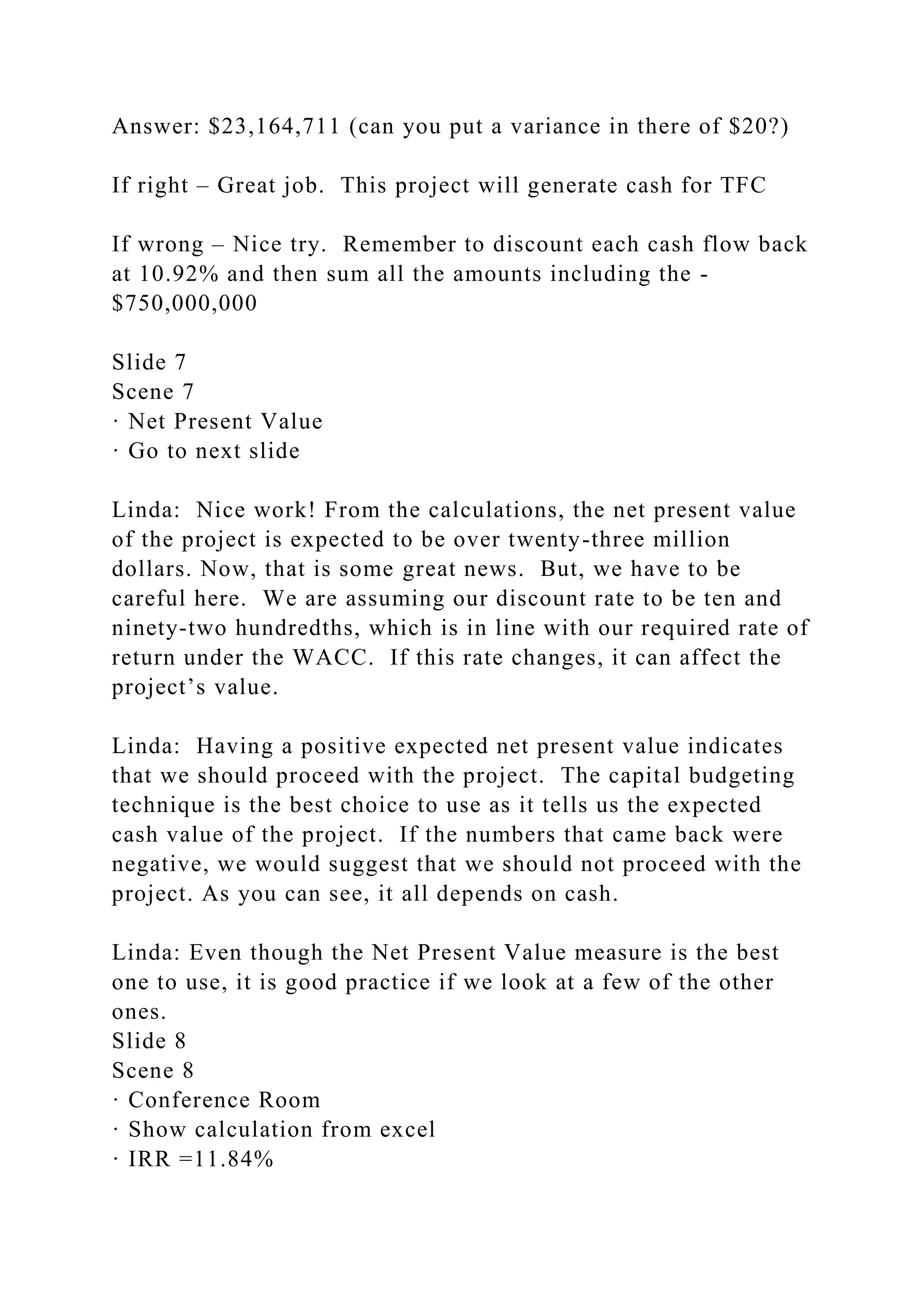
Answer: $23,164,711 (can you put a variance in there of $20?)
If right – Great job. This project will generate cash for TFC
If wrong – Nice try. Remember to discount each cash flow back
at 10.92% and then sum all the amounts including the -
$750,000,000
Slide 7
Scene 7
· Net Present Value
· Go to next slide
Linda: Nice work! From the calculations, the net present value
of the project is expected to be over twenty-three million
dollars. Now, that is some great news. But, we have to be
careful here. We are assuming our discount rate to be ten and
ninety-two hundredths, which is in line with our required rate of
return under the WACC. If this rate changes, it can affect the
project’s value.
Linda: Having a positive expected net present value indicates
that we should proceed with the project. The capital budgeting
technique is the best choice to use as it tells us the expected
cash value of the project. If the numbers that came back were
negative, we would suggest that we should not proceed with the
project. As you can see, it all depends on cash.
Linda: Even though the Net Present Value measure is the best
one to use, it is good practice if we look at a few of the other
ones.
Slide 8
Scene 8
· Conference Room
· Show calculation from excel
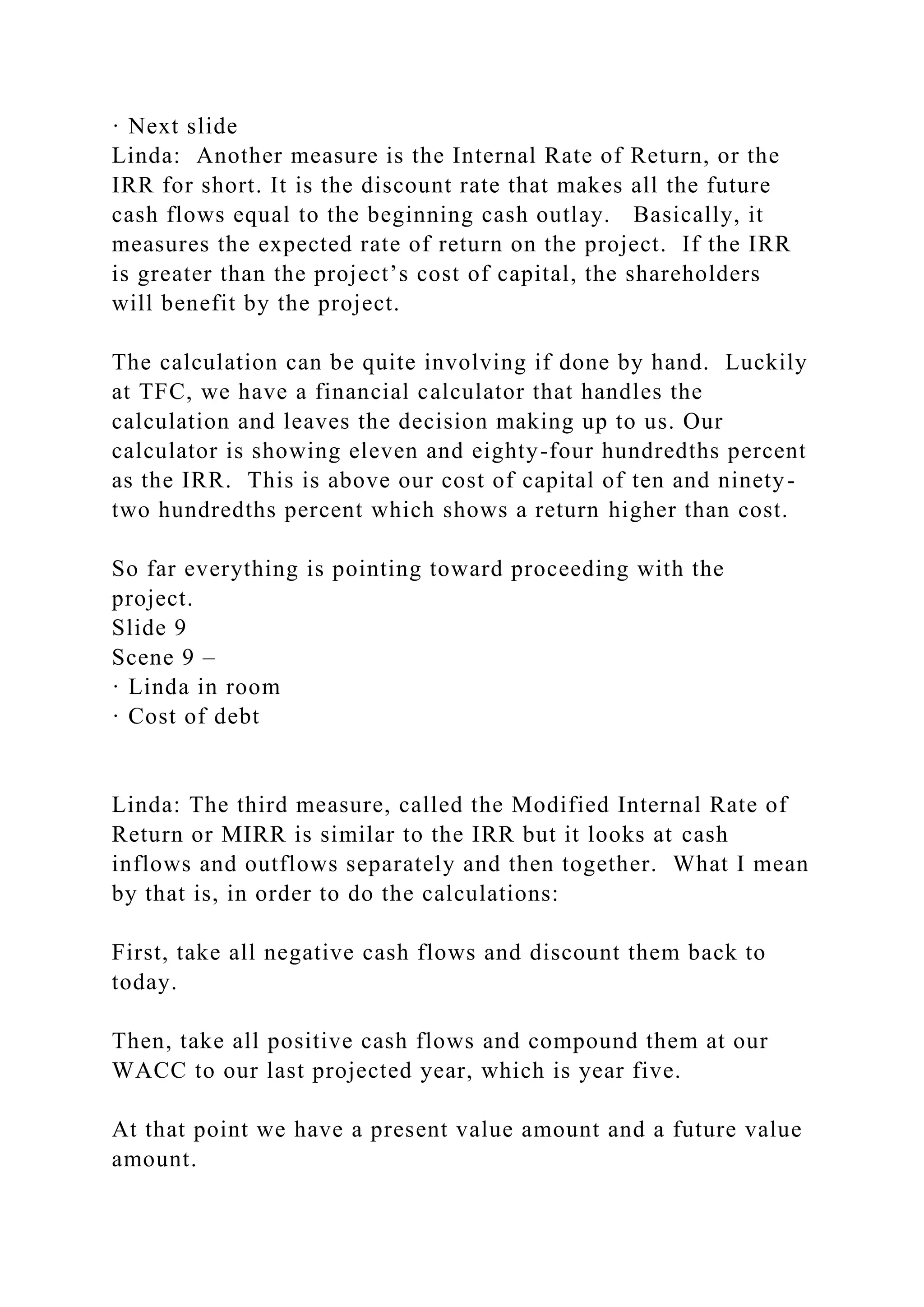
· IRR =11.84%
· Next slide
Linda: Another measure is the Internal Rate of Return, or the
IRR for short. It is the discount rate that makes all the future
cash flows equal to the beginning cash outlay. Basically, it
measures the expected rate of return on the project. If the IRR
is greater than the project’s cost of capital, the shareholders
will benefit by the project.
The calculation can be quite involving if done by hand. Luckily
at TFC, we have a financial calculator that handles the
calculation and leaves the decision making up to us. Our
calculator is showing eleven and eighty-four hundredths percent
as the IRR. This is above our cost of capital of ten and ninety-
two hundredths percent which shows a return higher than cost.
So far everything is pointing toward proceeding with the
project.
Slide 9
Scene 9 –
· Linda in room
· Cost of debt
Linda: The third measure, called the Modified Internal Rate of
Return or MIRR is similar to the IRR but it looks at cash
inflows and outflows separately and then together. What I mean
by that is, in order to do the calculations:
First, take all negative cash flows and discount them back to
today.
Then, take all positive cash flows and compound them at our
WACC to our last projected year, which is year five.
At that point we have a present value amount and a future value
amount.
The MIRR is the rate that links the two cash flows, the present
value and future value.
Keep in mind, the present value cash flows are all the negative
cash flows discounted, including today, while the future cash
flows are all the positive cash flows compounded to the future,
which is year five for TFC.
Linda: Let’s now calculate the MIRR.
Slide 10
Scene 10
· CYU
Linda would like you to determine the MIRR of the expansion
project. Using a 10.92% as the discount and compounded rates
to rate and the cash flows as follows:
Cash Flow Year 0 = $-750,000,000
Cash Flow Year 1 = $ - 10,000,000
Cash Flow Year 2 = $+200,000,000
Cash Flow Year 3 = $+250,000,000
Cash Flow Year 4 = $+300,000,000
Cash Flow Year 5 = $+400,000,000
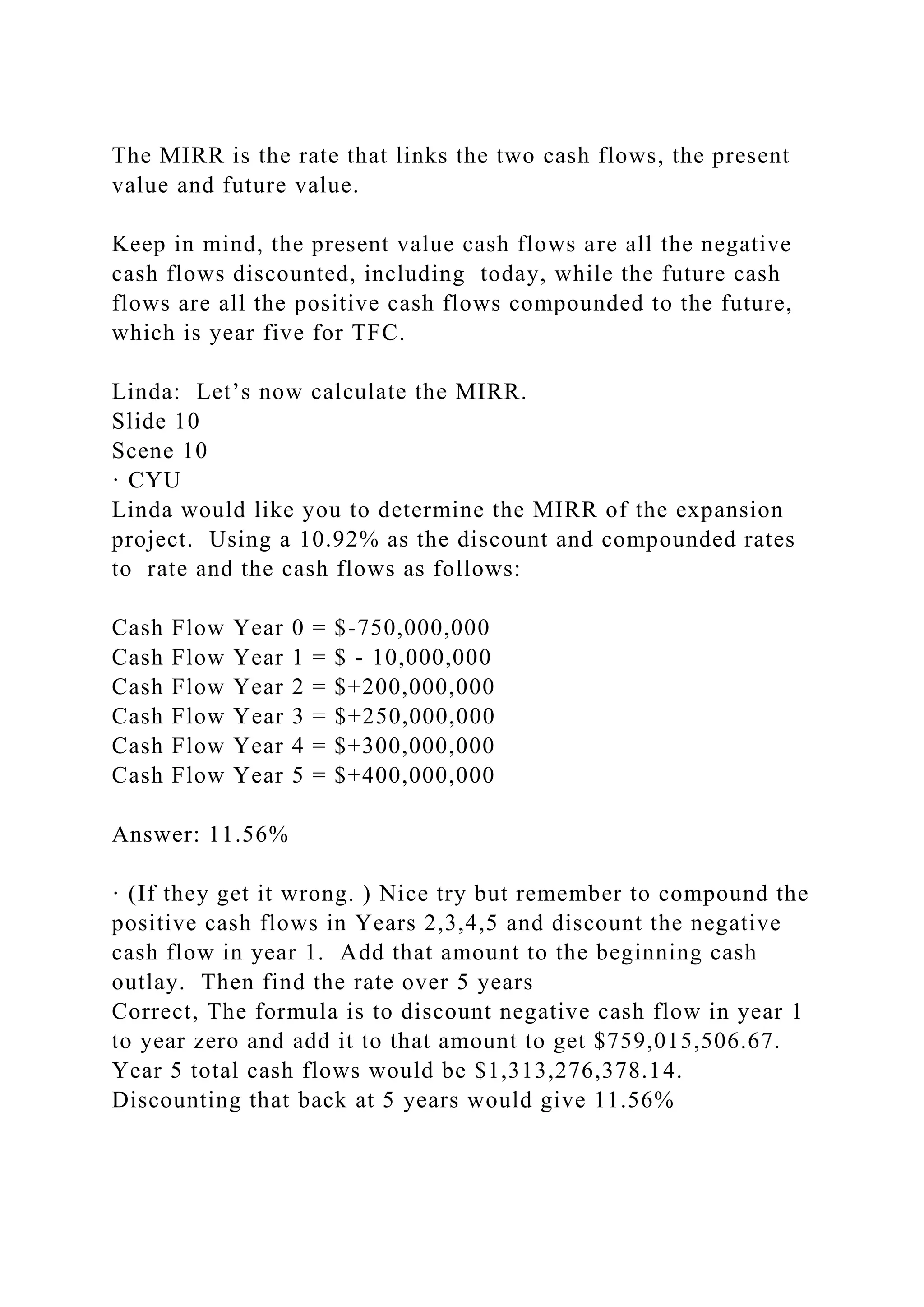
Answer: 11.56%
· (If they get it wrong. ) Nice try but remember to compound the
positive cash flows in Years 2,3,4,5 and discount the negative
cash flow in year 1. Add that amount to the beginning cash
outlay. Then find the rate over 5 years
Correct, The formula is to discount negative cash flow in year 1
to year zero and add it to that amount to get $759,015,506.67.
Year 5 total cash flows would be $1,313,276,378.14.
Discounting that back at 5 years would give 11.56%
Slide 11
Scene 11
· Set up the cash flows on a clip board
Cash Flow Year 0 = $-750,000,000
Cash Flow Year 1 = $ - 10,000,000
Cash Flow Year 2 = $+200,000,000
Cash Flow Year 3 = $+250,000,000
Cash Flow Year 4 = $+300,000,000
Cash Flow Year 5 = $+400,000,000
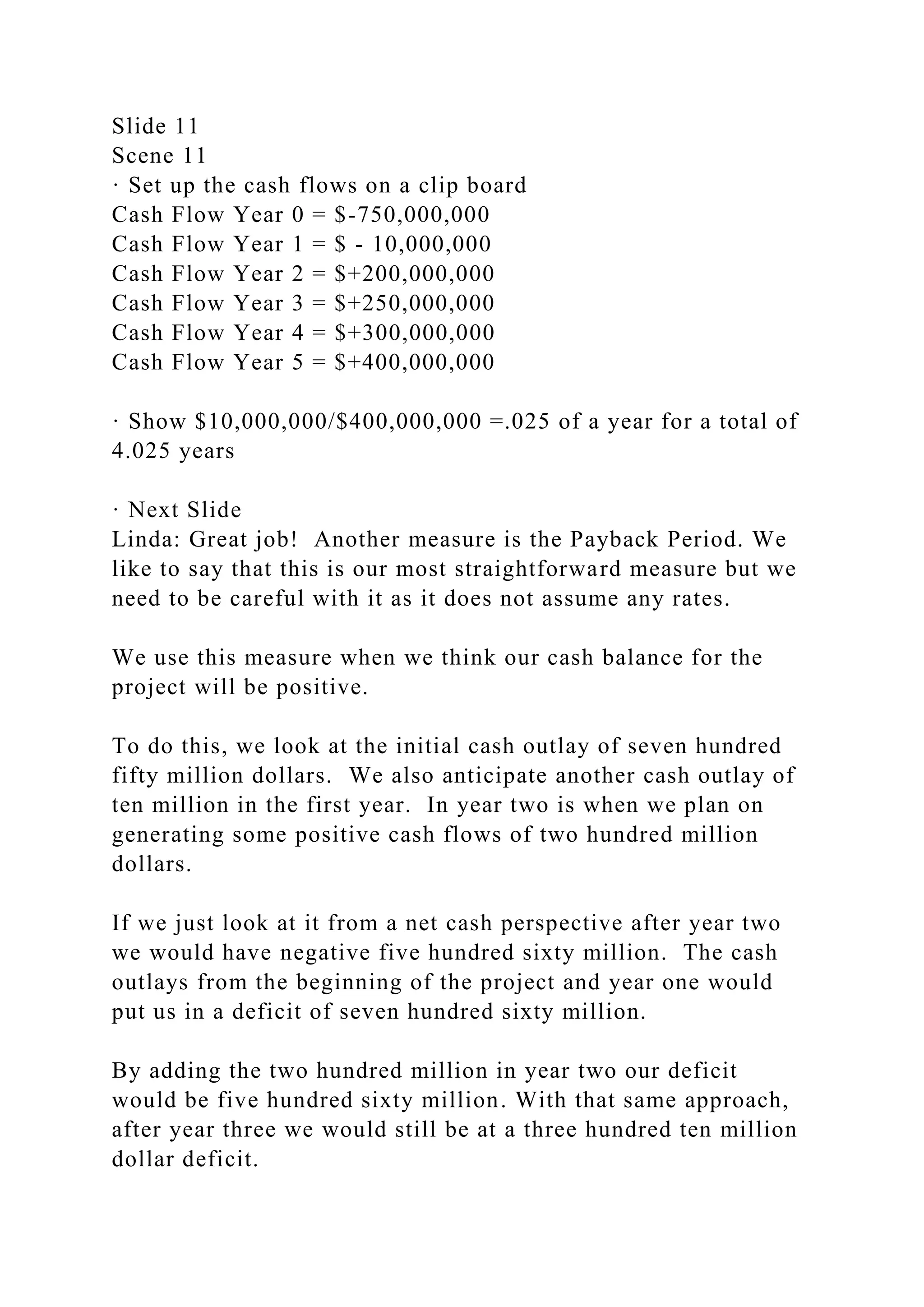
· Show $10,000,000/$400,000,000 =.025 of a year for a total of
4.025 years
· Next Slide
Linda: Great job! Another measure is the Payback Period. We
like to say that this is our most straightforward measure but we
need to be careful with it as it does not assume any rates.
We use this measure when we think our cash balance for the
project will be positive.
To do this, we look at the initial cash outlay of seven hundred
fifty million dollars. We also anticipate another cash outlay of
ten million in the first year. In year two is when we plan on
generating some positive cash flows of two hundred million
dollars.
If we just look at it from a net cash perspective after year two
we would have negative five hundred sixty million. The cash
outlays from the beginning of the project and year one would
put us in a deficit of seven hundred sixty million.
By adding the two hundred million in year two our deficit
would be five hundred sixty million. With that same approach,
after year three we would still be at a three hundred ten million
dollar deficit.
After year four we are almost there at a deficit of ten million
dollars. In year five, we anticipate the deficit to go away with
the first ten million of the anticipated four hundred million in
positive cash flows.
When you take that ratio of what is needed to break even or ten
million dollars over the expected cash flow in year five of four
hundred million, the result is point zero two five of a year.
When we put it all together, we can expect to be in the positive
for the project in four point zero twofive years.
So, the project will pay for itself in just over four years.
Linda: This payback period measure has some drawbacks
especially in the area of discounting. We are not factoring in
time but for a quick measurement it is a good one to use. Also,
this measure is not our deciding factor. As you know by now,
our deciding factor is the net present value calculation.
Slide 12
Scene 12
· Don in room
· Show results on screen
· Thumbs up!
Don: I left you with the most critical piece of the project.
What were you able to find out?
Linda: Don, I think you will be pleased by our analysis. We
did a number of capital budgeting measures and the results are
as follows:
Net Present Value is positive twenty three million, one hundred
sixty-four thousand, seven hundred eleven dollars.
Internal Rate of Return is eleven and eighty-four hundredths
percent, which is greater than our discount rate.
Modified Internal Rate of Return is eleven and fifty six
hundredths percent.
And the Payback Period is four point zero two five years.
Don: Wow. Great job. I can’t wait to share the results with
Joe. But, before I do. Are you giving us thumbs up on the
project?
Linda: Of course from a financial standpoint we would always
like to do some more analyses, but based on our numbers to
date, Yes!A double thumbs up!
Slide 13
Scene 13
· Linda talking about cash flows
· Put words “Relevant Cash Flows” on board
· Don enters
Linda: Great job with the capital budgeting analysis. While we
do four different measures here at TFC, there are others, such as
the Profitability Index and using the discount rate on the
payback period measurement. But in our decision making, it all
comes down to cash flow and the net present value tells us the
cash outlook for the project.
Linda: So I’ve been mentioning cash a lot...... When we started
on the cash budgeting, we were given projected amounts from
the Accounting Department. I’ve even mentioned that there was
much debate on the cash flows. Keep in mind these are
projected cash flows, so a lot of analysis and decision making
goes into it. Probably the most critical part of our expansion
project is projecting the cash flows from it. Our Accounting
Department spent countless hours discussing what should be
included in the analysis and what is not relevant.
Don: That is right Linda. I spent some time in the Accounting
Department when this analysis was being done and some of the
points that were being considered included the following.
First, there is a distinction betweenfree cash flows and
accounting income. Typically accounting income is on an
accrual basis which is different from actual cash flow.
Remember for this project we are only concerned with the cash
flows related to this project and not other areas of TFC.
Second, depreciation needs to be added back into the project. It

is a not cash item that needs to be added back when estimating
cash flows. In fact all non cash charges related to the project
should be added back for cash flow purposes.
Third, we do not deduct any interest charges related to the
project as this was already considered when we determined the
WACC, which is the rate we use to discount all the cash flows.
Fourth, change in net operating working capital is a factor.
Any activity related to this expansion project, whether assets or
liabilities, need to be considered. This is one of the areas that
really need to be looked at closely.
Another area involves sunk costs, which are cash outlays that
occurred prior to moving forward with the project and should be
ignored. The Accounting Department determined that all of the
research on the different locations to expand into are sunk costs
and are not included in the net cash flow.
Slide 14
Scene 14
· Don and Linda in room
· Next Slide
Don: These are just a few of the areas that need to be
considered. For the most part, if it is a cash transaction and it
is part of the project, then it should be included in determining
cash flows.
Linda: That is true. And at TFC we have many computer tools
and spreadsheets that we use to aid us in making these cash
flow decisions. That is why we were confident in our analysis.
Don: And I passed that on to Joe. Working together as a team
really helps in decision making.
I can’t wait to see this project move forward. But like any hard
day at work, it is always good to finish it with a workout.
Before we head to the gym, let’s briefly go over what we
accomplished today.
Slide 15
Scene 15
· Summary Slide –
Linda: Another great job by the team at TFC. We covered
many capital budgeting techniques when looking at a project’s
cash flows including the Net Present Value, Internal Rate of
Return, Modified Internal Rate of Return, and Payback Period.
While all are important, the Net present Value should be used at
the final deciding factor.
We also looked at identifying relevant cash flows. They should
be those activities that are related to the project now. There are
many software packages that can help in the decision making.
Don: Linda, you and the intern are doing fabulous work. You
two made the determination to proceed with the project but your
work is not done. Enjoy your workout as I have another project
when you are finished.
Slide 16
Scene 16
· Closing slide
Closing slide
FIN534 Week 5 Scenario Script: The Weighted Average Cost of
Capital
Slide #
Scene/Interaction
Narration
1
Scene 1
Intro slide
Slide 2
Scene 2
· ½ banner in a break room with cake or goodies?
· Joe there
· Show Strayer banner
· End of scene
Wacc is pronounced like whack
FIN534_5_2_Joe-1: Hello, everyone. It has been awhile
since we have seen each other! Long time no see everyone. My
job has me out of the office more than usual, but I wanted to
stop by and congratulate you on some fabulous work so far.
You have been asked to do a lot of calculating as part of our
financial analysis regarding our current state at TFC and the
expansion project. I can see that your Strayer University
education is paying off. They are really preparing you for
making informed business decisions.
FIN534_5_2_Joe-2: I brought some snacks and refreshments;
help yourself. They are in the break-room. At TFC we
encourage our employees to work out but that does not mean
you cannot have some snacks. It just means you will have to
work out a little more at the gym later. (laughter)
FIN534_5_2_Joe-3: Well, I have to go. I have a busy day -
full of meetings, but before I leave I would like you to continue
your financial analysis. First, I would like you to do some
research on financial options as we may be interested in using
some of our cash to invest in those financial vehicles.
Secondly, I would like you to determine our WACC, or
weighted average cost of capital. Good luck and I’m excited to
see the reports on my desk.
FIN534_5_2_Joe-4: Have a great day! You are the best
financial team in the world!
Slide 3
Scene 3
· Don in break room. Don's voice is excitable and convincing.
·
· Go to next slide
FIN534_5_3_Don-1: Joe is the most energetic and positive-
minded CEO on the planet. He gave us some tall orders but, I
am confident you and Linda will complete them with the highest
standards.
FIN534_5_3_Linda-1: Yes Don, we will. Our first task is to
review what our financial options are in case we want to go
down that investment road in the future. I have always learned
that the more you are prepared ahead of time, the better the
decision making is.
FIN534_5_3_Don-2: I agree, Linda. That is why we have you
and your Intern on this highly visible project. We want to make
sure we are going to make the best practical decision for TFC.
I will leave you two now so you can start preparing.
FIN534_5_3_Linda-2: Let us meet in the conference room. I
will meet you there. I want to pick up some of my textbooks
dealing with financial options.
Slide 4
Scene 4
· Linda In conference room with a finance book in hand
· Show Call Option, Strike (Exercise) Price and Put Option on a
chart
· Go to next slide
FIN534_5_4_Linda-1: Here we are back in what I am now
calling the “Financial Management Room”. I was able to find
some text books on financial options. They are the part of
investing that I like to call “The Great Unknown.”; because you
are taking a chance on how stock will react in the future. An
option is basically an investor’s choice to buy or sell a
particular security at a predetermined price in the future and
within the certain time period. For example, you may only have
ninety days to have the option of buying a share of stock at an
already agreed upon price. Also, options are traded on an
options exchangemarket just like stocks are traded on a stock
exchange market.
Slide 5
Scene 5
· Linda In conference room with a finance book in hand
· Show Call Option, Strike (Exercise) Price and Put Option on a
chart
· Go to next slide
FIN534_5_5_Linda-1: The two types of options that we are
going to look at are the Call Option and Put Option.
FIN534_5_5_Linda-2: With a Call Option, the holder of the
option is given the right to buy a share of stock at a
predetermined price within a certain period. If the owner
decides to buy the share, then it is exercised. The
predetermined price is called the strike or exercised price,
because that is the agreed upon price and it is only carried out if
the owner strikes a deal.
FIN534_5_5_Linda-3: Let us look at an example. If someone
buys a call option for two dollars and it comes with the terms of
a strike price of thirty dollars a share with an expiration date of
six months, the owner has six months to buy a share of stock at
thirty dollars. If the stock is currently selling for twenty
dollars, the owner would not exercise that option as the strike
price is greater than the trading price. However, if the trading
price goes over thirty dollars, actually thirty two since the
owner paid two dollars for the option, then the owner has to
decide if the option should be exercised. In our example, if the
trading price is forty dollars then the owner should exercise the
option as the share can be bought for thirty dollars. Whenever
there is a profit involved, meaning that the stock price is greater
than the exercised price, the option is said to be “in-the-
money.” In our example, the owner would be “in-the money.”
When the owner is “out-of-the-money”, that is when the
exercised price is greater than the current price; the owner
would not want to go through with the transaction. Of course
for either transaction, you need to also consider the price you
paid for such an option.
FIN534_5_5_Linda-4: Personally, I like to think of the Call
Option as the “High Rise” option, as the higher the share price
goes the better as the owner is locked into a price. Keep in
mind that most options come with an expiration date, meaning
that if the owner does not exercise it within a certain period of
time, the option is no good.
Slide 6
Scene 6
· Linda In conference room with a finance book in hand
· Show Call Option, Strike (Exercise) Price and Put Option on a
chart
· Go to next slide
FIN534_5_6_Linda-1: The second type of option can be
thought of as the exact opposite of the Call Option. It is the Put
Option. This option gives the owner the right to sell a share of
stock at a predetermined price. An owner would most likely
execute this when the price of a share of stock falls below the
exercised price, and of course the price paid for the put option.
FIN534_5_6_Linda-2: Let us look at another example but this
time with put options. If an investor buys a put option for one
dollar at an exercised price of forty dollars and the stock is
currently selling for fifty dollars, the investor would not
exercise the option as the selling price is higher than the
exercised price. In that case it would be better for the investor
to sell a share of the company at fifty dollars if the owner has
shares of it.
FIN534_5_6_Linda-3: Now, let’s go back to our example. If
the share price of the stock drops to ten dollars a share, the
investor can exercise the put option at the price of forty dollars.
Even though the share price is only ten dollars the investor
would get forty dollars. Like the Call Option, the Put Option
usually comes with an expiration date.
FIN534_5_6_Linda-4: The difference with the Put Option is
the owner is taking a risk that the price of the stock will go
down.
FIN534_5_6_Linda-5: As you can see, futures trading has risk
involved. The owner of the option is taking a chance on what
the price will be in the future, whether higher or lower than
when the option was purchased. If the stock does not move in
the direction you are hoping, then you stand the chance of
losing money.
(Phone rings)
FIN534_5_6_Linda-6: Hello. Okay I will be right over.
(Hangs up)
FIN534_5_6_Linda-7: That was Don. He wants me to
come by and pick up the information he has for our second task,
calculating TFC’s weighted average cost of capital or WACC.
In the meantime, can you do some decision making on options
so we can put it in our report to Joe? I will see you later.
Slide 7
Scene 7
Check Your Understanding:
Linda would like you to complete make some determinations on
call and put options. Please selected the best choice
If an investor purchases a call option on a particular stock
today, what is the investor is hoping the stock price will do?
a) Price will go up? – Correct! The owner is hoping the price
will go up as the call option provides for a fixed purchase price.
If the fixed purchased price is less than the stock price, the
owner will have a gain on the investment when executed.
b) Price will stay the same? Nice try, but stock price volatility
can provide for a gain or loss on an investment
c) Price will go down? Nice try, but if the price goes down the
investor will not be able to execute the option as the option will
cost more than what the open market is asking
If an investor purchases a put option on a particular stock today,
what is the investor is hoping the stock price will do?
a) Price will go down? – Correct! The owner is hoping the
price will go down as the put option provides for a fixed
selling price. If the fixed selling price is more than the stock
price, the owner will not lose as much
b) Price will stay the same? Nice try, but stock price volatility
can provide for a gain or loss on an investment
c) Price will go up? Nice try, but if the price goes up the
investor will not be able to execute the option as investors will
be able to sell their securities for more than what the put option
is worth
Slide 8
Scene 8
· Move into Linda’s office
· WACC on slide
WACC = wdrd(1-T) + wstdrstd(1-T)+wpsrps+wsrs
Wacc is pronounced like whack
· Next slide
· Is it possible to be pointing to the formula when Linda is
reading the formula calculation?
FIN534_5_8_Linda-1: Great work! While we are not too
familiar with options at TFC, it is always good to increase your
knowledge base. This may be an investment choice for us later.
FIN534_5_8_Linda-2: Now for our second task. The
company wants us to calculate TFC’s Weighted Cost of Capital,
more commonly known as the WACC.
FIN534_5_8_Linda-3: The WACC includes many of the
rates we have calculated earlier. It is like bringing the pieces
together in a puzzle.
FIN534_5_8_Linda-4: The formula to calculate the WACC
is:
Weight of debt times coupon rate of debt times one minus the
tax rate plus weight of short term debt times interest rate on
short term debt times one minus the tax rate plus weight of
preferred stock times required return on preferred stock plus
weight of common stock times required return on common
stock.
Slide 9
Scene 9 –
· Linda in her office
· Cost of debt
FIN534_5_9_Linda-1: As we have done before, let us look
at each component of the WACC.
FIN534_5_9_Linda-2: The first component is the r sub d,
which is the Before-Tax Cost of Long Term Debt. While there
can be many different ways to determine this debt, we will
consider it to be the coupon rate that we plan on issuing for
long term bonds. Previously, we determined that rate to be
eight percent.
FIN534_5_9_Linda-3: As the WACC suggests, we have to
make an adjustment for the tax rate. This is because interest
paid is deductible on the income statement for TFC, so in
essence we are saving on taxes being paid. Think of it this way,
since interest expense is deductible, TFC is already saving the
tax rate on its bonds, so the rate being paid is really one minus
the tax rate. For us, we are paying eight percent on our bonds
and our tax rate is forty percent.
FIN534_5_9_Linda-4: And the short term component of cost
of debt is handled the same way. Let’s move back to the
conference room to meet up with Don.
Slide 10
Scene 10
· Don and Linda in conference room, different part of room
· Put factors on screen – roll them out
· Stock Price (Psub0) = Dsub 0 times (1 plus dividend rate) all
divided by (rate of return minus the dividend rate)
· Next screen
FIN534_5_10_Don-1: Another component of the WACC is the
required rate of return on preferred stock. While TFC has never
issued preferred stock, it is important to note should we ever
decide. Preferred Stock is different than Common Stock, as it
usually pays a better dividend than Common Stock and it is
higher up on the order of being paid should a company decide to
liquidate assets. To determine the required rate on preferred
stock, the dividend divided by the price per share times one
minus the flotation cost would be used. Flotation costs are
those costs that are paid by the company who issues stock, like
TFC, to an investment banking company, the company who
would handle all of the transactions for the new offering. These
costs need to be included in the calculation as the WACC is
used to help determine the cost of raising new capital. Any new
stock would have floatation costs included. For example, if we
want to issue new shares of stock at one hundred dollars a
share, and investment banking firm would handle the new issue
for us. They would charge a fee. If they charge five percent of
the offering price, in this case one hundred dollars, we would
only get ninety-five dollars for each share sold and the five
dollars would go to the investment banking company for taking
care of the new issue.
Bottom line is it costs money to issue new shares,
Slide 11
Scene 11
· Cost of Debt
· Next Slide
FIN534_5_11_Linda-1: The last component is the required rate
of return on common stock or r sub s. For this component we
use the CAPM as our required rate of return for common stock.
Typically, when doing a project that involves an equity
contribution, a company would first look at using their retained
earnings. After they are used up, they would look at selling
stock. The main reason is retained earnings do not have
flotation costs which will result in a lower overall cost of equity
for a company. Previously we calculated our CAPM to be
fifteen percent.
Slide 12
Scene 12
· Show WACC again
· Show weights – as in gym weights
FIN534_5_12_Linda-1: Now that we have all the components to
the WACC, we are still missing one critical piece. And that is,
how are we going to raise the capital? We know it will be
through issuing bonds and selling stock, but what percentage of
each. Or better yet, what weighted percentages will be assigned
to each component? These are the ”W’s” on our WACC
formula.
FIN534_5_12_Don-1: Linda that is an excellent point. We
have the components but the weights come from what we at TFC
feels is our optional capital structure and then keep that in mind
when we are trying to raise new capital. While it is a work in
progress, we feel that our optimal capital structure is sixty
percent equity and forty percent debt. We also do not plan on
issuing any preferred stock and all of our debt will be long term
debt.
FIN534_5_12_Linda-2: Well, now it is time to put all the
pieces together.
Slide 13
Scene 13
Check Your Understanding – From the information given in
prior scenes what would TFC’s WACC be?
WACC = wdrd(1-T) + wstdrstd(1-T)+wpsrps+wsrs
.40*.08*.60 + .60*.15
Answer = 10.92%
If get wrong, good try but remember
WACC = wdrd(1-T) + wstdrstd(1-T)+wpsrps+wsrs
Also, with weights being .40 for bonds and .60 for stocks.
There is no short term debt or preferred stock
·
Slide 14
Scene 14
· Linda in office room
· Linda moves to another spot
· Next Slide
FIN534_5_14_Linda-1: Great work. The ten and ninety-two
hundredths percent tells us what the cost of raising new capital
will be for our company. In order for us to proceed with a
project, we have to make sure the return will be at least ten and
ninety-two hundredths percent or we should not do the project.
This WACC can be used to help us value our operations as it
can be used as the discount factor for future cash flows.
FIN534_5_14_Linda-2: There are many factors and
assumptions that went into deriving the WACC. That is why it
is important that we are confident in our analysis. We can also
do situational analysis here and consider a different optimal
capital structure or required rates of return.
FIN534_5_14_Linda-3: This was a lot of work and now it is
time to work off those extra calories from our mini celebration
by Joe. Let us go to the pool for a swim. But before we go to
the pool, let’s stop by Don’s office to invite him to the pool and
to review what we covered today.
Slide 15
Scene 15
· In Don’s office
· Summary Slide – CAPM and Valuing Stocks
FIN534_5_15_Don-1: You both did much work on this
assignment. The two main areas were financial options and the
WACC. While different, they both are needed for decision
making.
FIN534_5_15_Don-2: We first looked at some financial
options and learned what they were and when they should be
exercised. We then learned that call options are bought in
hopes that a company stock will go up while put options are the
opposite.
FIN534_5_15_Don-3: The WACC is thought of as the cost of
a project to a company. Just like diversifying an investment
portfolio, a company should also look at different options when
raising capital. The two common components are debt and
equity. The optimal capital structure will assign a percent to
each component which will be used in calculating the WACC.
FIN534_5_15_Don-4: Great work by the two of you. I
already know your next assignment. It has to do with cash
flow. I will fill you in later. Now it is time to start burning off
those calories. (laughter)
Slide 16
Scene 16
· Closing slide
Closing slide

FIN534 Week 6 Scenario Script How to use the Different Capital Bu.docx

  • 1.
    FIN534 Week 6Scenario Script: How to use the Different Capital Budgeting Methods, and Identifying Relevant Cash Flows Slide # Scene/Interaction Narration Slide 1 Intro Slide Slide 2 Scene 2 · In Don’s office · Maybe Fitness Olympic banner · Situation room · End of scene Don: Hi Linda, how was your workout? I knew I would see you exercising before work. Linda: That is right Don. Our annual Fitness Olympics challenge is coming up and I want to be in shape for it. Don: I forgot about the company Fitness Olympics. Linda: Well, I did not forget. Last year our department just missed out on the top honors. This year we are planning on being the winning department. I may even try to recruit our intern! Don: Great attitude, Linda. Don: Before the Fitness Olympics, we still have a lot of work to do concerning this expansion project and whether or not we should go with it. Things are starting to move quickly.
  • 2.
    Recently, I heardfrom Joe and he wants us to do some capital budgeting analyses on the project. This analysis may be our make or break analysis for the project so we really need to be detailed. Linda: Okay Don. The intern and I are right on it. I plan on meeting the intern in the “Situation Room”. We dubbed the conference room that name as we are constantly making informed decisions. Slide 3 Scene 3 · Linda in conference room · · Go to next slide Linda: We have our hands full. The project is getting close to decision making time. Joe and Don want us to analyze the proposed expansion project from a capital budgeting standpoint. Currently, we have completed many internal analyses on TFC. Now, we must look at the viability of the expansion project. Capital budgeting does just that. At the end of it, we should have a better idea of what our recommendation would be. Linda: Capital budgeting can be done whenever there is an initiative to invest in assets for the long term. Our project is doing just that. We want to be confident in our decision as this project is for the long term and is costly. Don is going to be joining us with the expected cost of the project. Slide 4 Scene 4 · Don in conference room with papers in hand? · Show on the papers - seven hundred fifty million dollars · Go to next slide Don: Hello all. With this expansion project we will double in
  • 3.
    asset size. Butit comes with a price. The Accounting Department told us that the projected price to expand out West is seven hundred fifty million dollars. I also have the projected cash flow numbers. Now, I need the both of you to determine if we should proceed with the expansion. To do so you will need to use many capital budgeting techniques to arrive at a highly confident decision. Good luck! The faith of this expansion and the future success of TFC depend on your analysis. Linda: Don, the Intern and I will begin working on this now! Slide 5 Scene 5 · Linda In conference room (Don not in room) · Net Present Value · WACC =10.92% · Go to next slide Linda: We have our assignment so let’s starting working through this analysis. There are many capital budgeting techniques and the plan is to use some of them for our project as Don said. But, it ultimately comes down to money. If the project is expected to bring in more cash than its costs, the project is a go, within reason, that is. As we have been saying all along, cash is the driving force behind our decision-making. To analyze our cash flows ,we need to look at the net present value of our future cash inflows and outflows including the cost of the project. Since these cash flows are being expected over time, we need to discount them back to today so we are valuing everything at the same point in time. Since we do not know the actual cost for undertaking the project, we will use our WACC, which is ten and ninety-two hundredths percent, as our discount rate. We also need our anticipated cash flows in the future years. This can be difficult to project, but it is extremely important that these numbers are as realistic as possible.
  • 4.
    From what Iwas told, the Accounting Department expects cash flows for this project only to be negative ten million in projected year one as the company will still be opening up fitness centers at a high rate. In year two, the cash flow is projected to be two hundred million, then two hundred fifty million, three hundred million, and four hundred million, respectively, for years two through five. A five-year projection will enable us to see where we will be in the immediate future. Anything after five years may be difficult to estimate as things change over time.. Linda: Now that we know all the inputs to our calculation, we can determine if this expansion project will have a positive net present value. While I gather data for our second cash budgeting technique, can you run the numbers to see what the outcome is? Slide 6 Scene 6 · CYU Linda would like you to determine the Net Present Value of the expansion project. Using a 10.92% discount rate and the cash flows as follows: Cash Flow Year 0 = $-750,000,000 Cash Flow Year 1 = $ - 10,000,000 Cash Flow Year 2 = $+200,000,000 Cash Flow Year 3 = $+250,000,000 Cash Flow Year 4 = $+300,000,000 Cash Flow Year 5 = $+400,000,000 Using present value calculations for an uneven stream of cash flows what will the Net Present Value of the project be? (Round to whole dollars)
  • 5.
    Answer: $23,164,711 (canyou put a variance in there of $20?) If right – Great job. This project will generate cash for TFC If wrong – Nice try. Remember to discount each cash flow back at 10.92% and then sum all the amounts including the - $750,000,000 Slide 7 Scene 7 · Net Present Value · Go to next slide Linda: Nice work! From the calculations, the net present value of the project is expected to be over twenty-three million dollars. Now, that is some great news. But, we have to be careful here. We are assuming our discount rate to be ten and ninety-two hundredths, which is in line with our required rate of return under the WACC. If this rate changes, it can affect the project’s value. Linda: Having a positive expected net present value indicates that we should proceed with the project. The capital budgeting technique is the best choice to use as it tells us the expected cash value of the project. If the numbers that came back were negative, we would suggest that we should not proceed with the project. As you can see, it all depends on cash. Linda: Even though the Net Present Value measure is the best one to use, it is good practice if we look at a few of the other ones. Slide 8 Scene 8 · Conference Room · Show calculation from excel · IRR =11.84%
  • 6.
    · Next slide Linda:Another measure is the Internal Rate of Return, or the IRR for short. It is the discount rate that makes all the future cash flows equal to the beginning cash outlay. Basically, it measures the expected rate of return on the project. If the IRR is greater than the project’s cost of capital, the shareholders will benefit by the project. The calculation can be quite involving if done by hand. Luckily at TFC, we have a financial calculator that handles the calculation and leaves the decision making up to us. Our calculator is showing eleven and eighty-four hundredths percent as the IRR. This is above our cost of capital of ten and ninety- two hundredths percent which shows a return higher than cost. So far everything is pointing toward proceeding with the project. Slide 9 Scene 9 – · Linda in room · Cost of debt Linda: The third measure, called the Modified Internal Rate of Return or MIRR is similar to the IRR but it looks at cash inflows and outflows separately and then together. What I mean by that is, in order to do the calculations: First, take all negative cash flows and discount them back to today. Then, take all positive cash flows and compound them at our WACC to our last projected year, which is year five. At that point we have a present value amount and a future value amount.
  • 7.
    The MIRR isthe rate that links the two cash flows, the present value and future value. Keep in mind, the present value cash flows are all the negative cash flows discounted, including today, while the future cash flows are all the positive cash flows compounded to the future, which is year five for TFC. Linda: Let’s now calculate the MIRR. Slide 10 Scene 10 · CYU Linda would like you to determine the MIRR of the expansion project. Using a 10.92% as the discount and compounded rates to rate and the cash flows as follows: Cash Flow Year 0 = $-750,000,000 Cash Flow Year 1 = $ - 10,000,000 Cash Flow Year 2 = $+200,000,000 Cash Flow Year 3 = $+250,000,000 Cash Flow Year 4 = $+300,000,000 Cash Flow Year 5 = $+400,000,000 Answer: 11.56% · (If they get it wrong. ) Nice try but remember to compound the positive cash flows in Years 2,3,4,5 and discount the negative cash flow in year 1. Add that amount to the beginning cash outlay. Then find the rate over 5 years Correct, The formula is to discount negative cash flow in year 1 to year zero and add it to that amount to get $759,015,506.67. Year 5 total cash flows would be $1,313,276,378.14. Discounting that back at 5 years would give 11.56%
  • 8.
    Slide 11 Scene 11 ·Set up the cash flows on a clip board Cash Flow Year 0 = $-750,000,000 Cash Flow Year 1 = $ - 10,000,000 Cash Flow Year 2 = $+200,000,000 Cash Flow Year 3 = $+250,000,000 Cash Flow Year 4 = $+300,000,000 Cash Flow Year 5 = $+400,000,000 · Show $10,000,000/$400,000,000 =.025 of a year for a total of 4.025 years · Next Slide Linda: Great job! Another measure is the Payback Period. We like to say that this is our most straightforward measure but we need to be careful with it as it does not assume any rates. We use this measure when we think our cash balance for the project will be positive. To do this, we look at the initial cash outlay of seven hundred fifty million dollars. We also anticipate another cash outlay of ten million in the first year. In year two is when we plan on generating some positive cash flows of two hundred million dollars. If we just look at it from a net cash perspective after year two we would have negative five hundred sixty million. The cash outlays from the beginning of the project and year one would put us in a deficit of seven hundred sixty million. By adding the two hundred million in year two our deficit would be five hundred sixty million. With that same approach, after year three we would still be at a three hundred ten million dollar deficit.
  • 9.
    After year fourwe are almost there at a deficit of ten million dollars. In year five, we anticipate the deficit to go away with the first ten million of the anticipated four hundred million in positive cash flows. When you take that ratio of what is needed to break even or ten million dollars over the expected cash flow in year five of four hundred million, the result is point zero two five of a year. When we put it all together, we can expect to be in the positive for the project in four point zero twofive years. So, the project will pay for itself in just over four years. Linda: This payback period measure has some drawbacks especially in the area of discounting. We are not factoring in time but for a quick measurement it is a good one to use. Also, this measure is not our deciding factor. As you know by now, our deciding factor is the net present value calculation. Slide 12 Scene 12 · Don in room · Show results on screen · Thumbs up! Don: I left you with the most critical piece of the project. What were you able to find out? Linda: Don, I think you will be pleased by our analysis. We did a number of capital budgeting measures and the results are as follows: Net Present Value is positive twenty three million, one hundred sixty-four thousand, seven hundred eleven dollars. Internal Rate of Return is eleven and eighty-four hundredths
  • 10.
    percent, which isgreater than our discount rate. Modified Internal Rate of Return is eleven and fifty six hundredths percent. And the Payback Period is four point zero two five years. Don: Wow. Great job. I can’t wait to share the results with Joe. But, before I do. Are you giving us thumbs up on the project? Linda: Of course from a financial standpoint we would always like to do some more analyses, but based on our numbers to date, Yes!A double thumbs up! Slide 13 Scene 13 · Linda talking about cash flows · Put words “Relevant Cash Flows” on board · Don enters Linda: Great job with the capital budgeting analysis. While we do four different measures here at TFC, there are others, such as the Profitability Index and using the discount rate on the payback period measurement. But in our decision making, it all comes down to cash flow and the net present value tells us the cash outlook for the project. Linda: So I’ve been mentioning cash a lot...... When we started on the cash budgeting, we were given projected amounts from the Accounting Department. I’ve even mentioned that there was much debate on the cash flows. Keep in mind these are projected cash flows, so a lot of analysis and decision making goes into it. Probably the most critical part of our expansion project is projecting the cash flows from it. Our Accounting Department spent countless hours discussing what should be included in the analysis and what is not relevant.
  • 11.
    Don: That isright Linda. I spent some time in the Accounting Department when this analysis was being done and some of the points that were being considered included the following. First, there is a distinction betweenfree cash flows and accounting income. Typically accounting income is on an accrual basis which is different from actual cash flow. Remember for this project we are only concerned with the cash flows related to this project and not other areas of TFC. Second, depreciation needs to be added back into the project. It is a not cash item that needs to be added back when estimating cash flows. In fact all non cash charges related to the project should be added back for cash flow purposes. Third, we do not deduct any interest charges related to the project as this was already considered when we determined the WACC, which is the rate we use to discount all the cash flows. Fourth, change in net operating working capital is a factor. Any activity related to this expansion project, whether assets or liabilities, need to be considered. This is one of the areas that really need to be looked at closely. Another area involves sunk costs, which are cash outlays that occurred prior to moving forward with the project and should be ignored. The Accounting Department determined that all of the research on the different locations to expand into are sunk costs and are not included in the net cash flow. Slide 14 Scene 14 · Don and Linda in room · Next Slide Don: These are just a few of the areas that need to be considered. For the most part, if it is a cash transaction and it
  • 12.
    is part ofthe project, then it should be included in determining cash flows. Linda: That is true. And at TFC we have many computer tools and spreadsheets that we use to aid us in making these cash flow decisions. That is why we were confident in our analysis. Don: And I passed that on to Joe. Working together as a team really helps in decision making. I can’t wait to see this project move forward. But like any hard day at work, it is always good to finish it with a workout. Before we head to the gym, let’s briefly go over what we accomplished today. Slide 15 Scene 15 · Summary Slide – Linda: Another great job by the team at TFC. We covered many capital budgeting techniques when looking at a project’s cash flows including the Net Present Value, Internal Rate of Return, Modified Internal Rate of Return, and Payback Period. While all are important, the Net present Value should be used at the final deciding factor. We also looked at identifying relevant cash flows. They should be those activities that are related to the project now. There are many software packages that can help in the decision making. Don: Linda, you and the intern are doing fabulous work. You two made the determination to proceed with the project but your work is not done. Enjoy your workout as I have another project when you are finished. Slide 16 Scene 16 · Closing slide
  • 13.
    Closing slide FIN534 Week5 Scenario Script: The Weighted Average Cost of Capital Slide # Scene/Interaction Narration 1 Scene 1 Intro slide Slide 2 Scene 2 · ½ banner in a break room with cake or goodies? · Joe there · Show Strayer banner · End of scene Wacc is pronounced like whack FIN534_5_2_Joe-1: Hello, everyone. It has been awhile since we have seen each other! Long time no see everyone. My job has me out of the office more than usual, but I wanted to stop by and congratulate you on some fabulous work so far. You have been asked to do a lot of calculating as part of our financial analysis regarding our current state at TFC and the expansion project. I can see that your Strayer University education is paying off. They are really preparing you for making informed business decisions. FIN534_5_2_Joe-2: I brought some snacks and refreshments; help yourself. They are in the break-room. At TFC we encourage our employees to work out but that does not mean you cannot have some snacks. It just means you will have to work out a little more at the gym later. (laughter)
  • 14.
    FIN534_5_2_Joe-3: Well, Ihave to go. I have a busy day - full of meetings, but before I leave I would like you to continue your financial analysis. First, I would like you to do some research on financial options as we may be interested in using some of our cash to invest in those financial vehicles. Secondly, I would like you to determine our WACC, or weighted average cost of capital. Good luck and I’m excited to see the reports on my desk. FIN534_5_2_Joe-4: Have a great day! You are the best financial team in the world! Slide 3 Scene 3 · Don in break room. Don's voice is excitable and convincing. · · Go to next slide FIN534_5_3_Don-1: Joe is the most energetic and positive- minded CEO on the planet. He gave us some tall orders but, I am confident you and Linda will complete them with the highest standards. FIN534_5_3_Linda-1: Yes Don, we will. Our first task is to review what our financial options are in case we want to go down that investment road in the future. I have always learned that the more you are prepared ahead of time, the better the decision making is. FIN534_5_3_Don-2: I agree, Linda. That is why we have you and your Intern on this highly visible project. We want to make sure we are going to make the best practical decision for TFC. I will leave you two now so you can start preparing. FIN534_5_3_Linda-2: Let us meet in the conference room. I will meet you there. I want to pick up some of my textbooks
  • 15.
    dealing with financialoptions. Slide 4 Scene 4 · Linda In conference room with a finance book in hand · Show Call Option, Strike (Exercise) Price and Put Option on a chart · Go to next slide FIN534_5_4_Linda-1: Here we are back in what I am now calling the “Financial Management Room”. I was able to find some text books on financial options. They are the part of investing that I like to call “The Great Unknown.”; because you are taking a chance on how stock will react in the future. An option is basically an investor’s choice to buy or sell a particular security at a predetermined price in the future and within the certain time period. For example, you may only have ninety days to have the option of buying a share of stock at an already agreed upon price. Also, options are traded on an options exchangemarket just like stocks are traded on a stock exchange market. Slide 5 Scene 5 · Linda In conference room with a finance book in hand · Show Call Option, Strike (Exercise) Price and Put Option on a chart · Go to next slide FIN534_5_5_Linda-1: The two types of options that we are going to look at are the Call Option and Put Option. FIN534_5_5_Linda-2: With a Call Option, the holder of the option is given the right to buy a share of stock at a predetermined price within a certain period. If the owner decides to buy the share, then it is exercised. The
  • 16.
    predetermined price iscalled the strike or exercised price, because that is the agreed upon price and it is only carried out if the owner strikes a deal. FIN534_5_5_Linda-3: Let us look at an example. If someone buys a call option for two dollars and it comes with the terms of a strike price of thirty dollars a share with an expiration date of six months, the owner has six months to buy a share of stock at thirty dollars. If the stock is currently selling for twenty dollars, the owner would not exercise that option as the strike price is greater than the trading price. However, if the trading price goes over thirty dollars, actually thirty two since the owner paid two dollars for the option, then the owner has to decide if the option should be exercised. In our example, if the trading price is forty dollars then the owner should exercise the option as the share can be bought for thirty dollars. Whenever there is a profit involved, meaning that the stock price is greater than the exercised price, the option is said to be “in-the- money.” In our example, the owner would be “in-the money.” When the owner is “out-of-the-money”, that is when the exercised price is greater than the current price; the owner would not want to go through with the transaction. Of course for either transaction, you need to also consider the price you paid for such an option. FIN534_5_5_Linda-4: Personally, I like to think of the Call Option as the “High Rise” option, as the higher the share price goes the better as the owner is locked into a price. Keep in mind that most options come with an expiration date, meaning that if the owner does not exercise it within a certain period of time, the option is no good. Slide 6 Scene 6 · Linda In conference room with a finance book in hand
  • 17.
    · Show CallOption, Strike (Exercise) Price and Put Option on a chart · Go to next slide FIN534_5_6_Linda-1: The second type of option can be thought of as the exact opposite of the Call Option. It is the Put Option. This option gives the owner the right to sell a share of stock at a predetermined price. An owner would most likely execute this when the price of a share of stock falls below the exercised price, and of course the price paid for the put option. FIN534_5_6_Linda-2: Let us look at another example but this time with put options. If an investor buys a put option for one dollar at an exercised price of forty dollars and the stock is currently selling for fifty dollars, the investor would not exercise the option as the selling price is higher than the exercised price. In that case it would be better for the investor to sell a share of the company at fifty dollars if the owner has shares of it. FIN534_5_6_Linda-3: Now, let’s go back to our example. If the share price of the stock drops to ten dollars a share, the investor can exercise the put option at the price of forty dollars. Even though the share price is only ten dollars the investor would get forty dollars. Like the Call Option, the Put Option usually comes with an expiration date. FIN534_5_6_Linda-4: The difference with the Put Option is the owner is taking a risk that the price of the stock will go down. FIN534_5_6_Linda-5: As you can see, futures trading has risk involved. The owner of the option is taking a chance on what
  • 18.
    the price willbe in the future, whether higher or lower than when the option was purchased. If the stock does not move in the direction you are hoping, then you stand the chance of losing money. (Phone rings) FIN534_5_6_Linda-6: Hello. Okay I will be right over. (Hangs up) FIN534_5_6_Linda-7: That was Don. He wants me to come by and pick up the information he has for our second task, calculating TFC’s weighted average cost of capital or WACC. In the meantime, can you do some decision making on options so we can put it in our report to Joe? I will see you later. Slide 7 Scene 7 Check Your Understanding: Linda would like you to complete make some determinations on call and put options. Please selected the best choice If an investor purchases a call option on a particular stock today, what is the investor is hoping the stock price will do? a) Price will go up? – Correct! The owner is hoping the price will go up as the call option provides for a fixed purchase price. If the fixed purchased price is less than the stock price, the owner will have a gain on the investment when executed. b) Price will stay the same? Nice try, but stock price volatility can provide for a gain or loss on an investment c) Price will go down? Nice try, but if the price goes down the investor will not be able to execute the option as the option will cost more than what the open market is asking If an investor purchases a put option on a particular stock today,
  • 19.
    what is theinvestor is hoping the stock price will do? a) Price will go down? – Correct! The owner is hoping the price will go down as the put option provides for a fixed selling price. If the fixed selling price is more than the stock price, the owner will not lose as much b) Price will stay the same? Nice try, but stock price volatility can provide for a gain or loss on an investment c) Price will go up? Nice try, but if the price goes up the investor will not be able to execute the option as investors will be able to sell their securities for more than what the put option is worth Slide 8 Scene 8 · Move into Linda’s office · WACC on slide WACC = wdrd(1-T) + wstdrstd(1-T)+wpsrps+wsrs Wacc is pronounced like whack · Next slide · Is it possible to be pointing to the formula when Linda is reading the formula calculation? FIN534_5_8_Linda-1: Great work! While we are not too familiar with options at TFC, it is always good to increase your knowledge base. This may be an investment choice for us later. FIN534_5_8_Linda-2: Now for our second task. The company wants us to calculate TFC’s Weighted Cost of Capital, more commonly known as the WACC. FIN534_5_8_Linda-3: The WACC includes many of the rates we have calculated earlier. It is like bringing the pieces
  • 20.
    together in apuzzle. FIN534_5_8_Linda-4: The formula to calculate the WACC is: Weight of debt times coupon rate of debt times one minus the tax rate plus weight of short term debt times interest rate on short term debt times one minus the tax rate plus weight of preferred stock times required return on preferred stock plus weight of common stock times required return on common stock. Slide 9 Scene 9 – · Linda in her office · Cost of debt FIN534_5_9_Linda-1: As we have done before, let us look at each component of the WACC. FIN534_5_9_Linda-2: The first component is the r sub d, which is the Before-Tax Cost of Long Term Debt. While there can be many different ways to determine this debt, we will consider it to be the coupon rate that we plan on issuing for long term bonds. Previously, we determined that rate to be eight percent. FIN534_5_9_Linda-3: As the WACC suggests, we have to make an adjustment for the tax rate. This is because interest paid is deductible on the income statement for TFC, so in essence we are saving on taxes being paid. Think of it this way, since interest expense is deductible, TFC is already saving the tax rate on its bonds, so the rate being paid is really one minus the tax rate. For us, we are paying eight percent on our bonds and our tax rate is forty percent.
  • 21.
    FIN534_5_9_Linda-4: And theshort term component of cost of debt is handled the same way. Let’s move back to the conference room to meet up with Don. Slide 10 Scene 10 · Don and Linda in conference room, different part of room · Put factors on screen – roll them out · Stock Price (Psub0) = Dsub 0 times (1 plus dividend rate) all divided by (rate of return minus the dividend rate) · Next screen FIN534_5_10_Don-1: Another component of the WACC is the required rate of return on preferred stock. While TFC has never issued preferred stock, it is important to note should we ever decide. Preferred Stock is different than Common Stock, as it usually pays a better dividend than Common Stock and it is higher up on the order of being paid should a company decide to liquidate assets. To determine the required rate on preferred stock, the dividend divided by the price per share times one minus the flotation cost would be used. Flotation costs are those costs that are paid by the company who issues stock, like TFC, to an investment banking company, the company who would handle all of the transactions for the new offering. These costs need to be included in the calculation as the WACC is used to help determine the cost of raising new capital. Any new stock would have floatation costs included. For example, if we want to issue new shares of stock at one hundred dollars a share, and investment banking firm would handle the new issue for us. They would charge a fee. If they charge five percent of the offering price, in this case one hundred dollars, we would only get ninety-five dollars for each share sold and the five dollars would go to the investment banking company for taking care of the new issue. Bottom line is it costs money to issue new shares,
  • 22.
    Slide 11 Scene 11 ·Cost of Debt · Next Slide FIN534_5_11_Linda-1: The last component is the required rate of return on common stock or r sub s. For this component we use the CAPM as our required rate of return for common stock. Typically, when doing a project that involves an equity contribution, a company would first look at using their retained earnings. After they are used up, they would look at selling stock. The main reason is retained earnings do not have flotation costs which will result in a lower overall cost of equity for a company. Previously we calculated our CAPM to be fifteen percent. Slide 12 Scene 12 · Show WACC again · Show weights – as in gym weights FIN534_5_12_Linda-1: Now that we have all the components to the WACC, we are still missing one critical piece. And that is, how are we going to raise the capital? We know it will be through issuing bonds and selling stock, but what percentage of each. Or better yet, what weighted percentages will be assigned to each component? These are the ”W’s” on our WACC formula. FIN534_5_12_Don-1: Linda that is an excellent point. We have the components but the weights come from what we at TFC feels is our optional capital structure and then keep that in mind when we are trying to raise new capital. While it is a work in progress, we feel that our optimal capital structure is sixty percent equity and forty percent debt. We also do not plan on issuing any preferred stock and all of our debt will be long term debt.
  • 23.
    FIN534_5_12_Linda-2: Well, nowit is time to put all the pieces together. Slide 13 Scene 13 Check Your Understanding – From the information given in prior scenes what would TFC’s WACC be? WACC = wdrd(1-T) + wstdrstd(1-T)+wpsrps+wsrs .40*.08*.60 + .60*.15 Answer = 10.92% If get wrong, good try but remember WACC = wdrd(1-T) + wstdrstd(1-T)+wpsrps+wsrs Also, with weights being .40 for bonds and .60 for stocks. There is no short term debt or preferred stock · Slide 14 Scene 14 · Linda in office room · Linda moves to another spot · Next Slide FIN534_5_14_Linda-1: Great work. The ten and ninety-two hundredths percent tells us what the cost of raising new capital will be for our company. In order for us to proceed with a project, we have to make sure the return will be at least ten and ninety-two hundredths percent or we should not do the project. This WACC can be used to help us value our operations as it can be used as the discount factor for future cash flows.
  • 24.
    FIN534_5_14_Linda-2: There aremany factors and assumptions that went into deriving the WACC. That is why it is important that we are confident in our analysis. We can also do situational analysis here and consider a different optimal capital structure or required rates of return. FIN534_5_14_Linda-3: This was a lot of work and now it is time to work off those extra calories from our mini celebration by Joe. Let us go to the pool for a swim. But before we go to the pool, let’s stop by Don’s office to invite him to the pool and to review what we covered today. Slide 15 Scene 15 · In Don’s office · Summary Slide – CAPM and Valuing Stocks FIN534_5_15_Don-1: You both did much work on this assignment. The two main areas were financial options and the WACC. While different, they both are needed for decision making. FIN534_5_15_Don-2: We first looked at some financial options and learned what they were and when they should be exercised. We then learned that call options are bought in hopes that a company stock will go up while put options are the opposite. FIN534_5_15_Don-3: The WACC is thought of as the cost of a project to a company. Just like diversifying an investment portfolio, a company should also look at different options when raising capital. The two common components are debt and equity. The optimal capital structure will assign a percent to each component which will be used in calculating the WACC.
  • 25.
    FIN534_5_15_Don-4: Great workby the two of you. I already know your next assignment. It has to do with cash flow. I will fill you in later. Now it is time to start burning off those calories. (laughter) Slide 16 Scene 16 · Closing slide Closing slide