University Of Delhi
Department of Electronic Science
Design of Low Pass Filter for UWB Applications
Reference : IEEE – Authors Alena Poetrikova, Kornel Ruman, Igor Vehec, Pavol Galajda
Department of Technologies in Electronics, Technical University of Kosice, Slovakia
Presented By :
Name -Jeevesh Kumar
Roll No. -1107/20
M.Tech 2nd Semester
Abstract
Presenting design, simulation and experimental testing of a low pass (LP)
filter for Ultra Wide-Band (UWB) radar applications. This focuses on
various technological possibilities of production that are used in the branch
of UWB filters. Simulated and measured results of insertion loss and return
loss response of LP filter for UWB radar are presented. Also focused on the
design of passive filters used in UWB radar systems with emphasis on issues
of quality of transmitted signals in the HF range.
1. Design Parameters of Filter
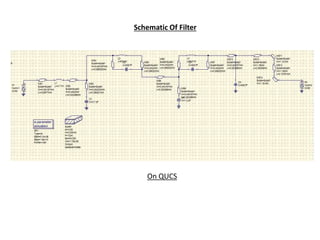
2. Schematic of Filter
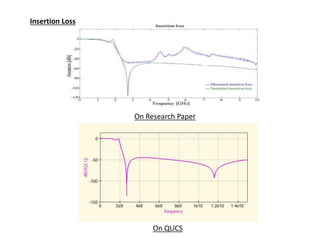
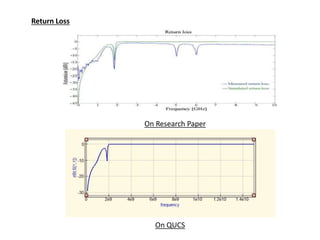
3. Insertion Loss and Attenuation Graph of Low Pass Filter
4. Comparison Table
Table of Contents
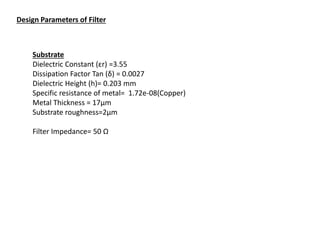
Design Parameters of Filter
Substrate
Dielectric Constant (εr) =3.55
Dissipation Factor Tan (δ) = 0.0027
Dielectric Height (h)= 0.203 mm
Specific resistance of metal= 1.72e-08(Copper)
Metal Thickness = 17µm
Substrate roughness=2µm
Filter Impedance= 50 Ω
Schematic Of Filter
On QUCS
Insertion Loss
On Research Paper
On QUCS
Return Loss
On QUCS
On Research Paper
On Research Paper
On QUCS
Performance
0 2e9 4e9 6e9 8e9 1e10 1.2e10 1.4e10
-150
-100
-50
0
frequency
frequency
dB(S[1,1])
dB(S[2,1])
frequency: 1.91e+09
dB: -3.57
frequency: 1.91e+09
dB: -3.57
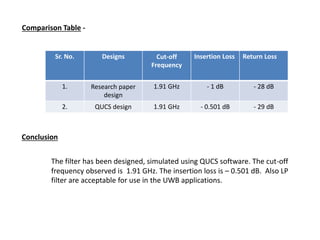
Sr. No. Designs Cut-off
Frequency
Insertion Loss Return Loss
1. Research paper
design
1.91 GHz - 1 dB - 28 dB
2. QUCS design 1.91 GHz - 0.501 dB - 29 dB
Comparison Table -
Conclusion
The filter has been designed, simulated using QUCS software. The cut-off
frequency observed is 1.91 GHz. The insertion loss is – 0.501 dB. Also LP
filter are acceptable for use in the UWB applications.
Filter ppt

Filter ppt

  • 1.
    University Of Delhi Departmentof Electronic Science Design of Low Pass Filter for UWB Applications Reference : IEEE – Authors Alena Poetrikova, Kornel Ruman, Igor Vehec, Pavol Galajda Department of Technologies in Electronics, Technical University of Kosice, Slovakia Presented By : Name -Jeevesh Kumar Roll No. -1107/20 M.Tech 2nd Semester
  • 2.
    Abstract Presenting design, simulationand experimental testing of a low pass (LP) filter for Ultra Wide-Band (UWB) radar applications. This focuses on various technological possibilities of production that are used in the branch of UWB filters. Simulated and measured results of insertion loss and return loss response of LP filter for UWB radar are presented. Also focused on the design of passive filters used in UWB radar systems with emphasis on issues of quality of transmitted signals in the HF range.
  • 3.
    1. Design Parametersof Filter 2. Schematic of Filter 3. Insertion Loss and Attenuation Graph of Low Pass Filter 4. Comparison Table Table of Contents
  • 4.
    Design Parameters ofFilter Substrate Dielectric Constant (εr) =3.55 Dissipation Factor Tan (δ) = 0.0027 Dielectric Height (h)= 0.203 mm Specific resistance of metal= 1.72e-08(Copper) Metal Thickness = 17µm Substrate roughness=2µm Filter Impedance= 50 Ω
  • 5.
  • 6.
  • 7.
    Return Loss On QUCS OnResearch Paper
  • 8.
    On Research Paper OnQUCS Performance 0 2e9 4e9 6e9 8e9 1e10 1.2e10 1.4e10 -150 -100 -50 0 frequency frequency dB(S[1,1]) dB(S[2,1]) frequency: 1.91e+09 dB: -3.57 frequency: 1.91e+09 dB: -3.57
  • 9.
    Sr. No. DesignsCut-off Frequency Insertion Loss Return Loss 1. Research paper design 1.91 GHz - 1 dB - 28 dB 2. QUCS design 1.91 GHz - 0.501 dB - 29 dB Comparison Table - Conclusion The filter has been designed, simulated using QUCS software. The cut-off frequency observed is 1.91 GHz. The insertion loss is – 0.501 dB. Also LP filter are acceptable for use in the UWB applications.