Dana Summerfield
Narrative Terms
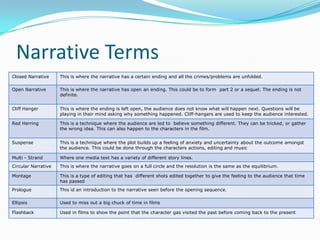
Closed Narrative     This is where the narrative has a certain ending and all the crimes/problems are unfolded.

Open Narrative       This is where the narrative has open an ending. This could be to form part 2 or a sequel. The ending is not
                     definite.


Cliff Hanger         This is where the ending is left open, the audience does not know what will happen next. Questions will be
                     playing in their mind asking why something happened. Cliff-hangers are used to keep the audience interested.

Red Herring          This is a technique where the audience are led to believe something different. They can be tricked, or gather
                     the wrong idea. This can also happen to the characters in the film.


Suspense             This is a technique where the plot builds up a feeling of anxiety and uncertainty about the outcome amongst
                     the audience. This could be done through the characters actions, editing and music

Multi - Strand       Where one media text has a variety of different story lines.
Circular Narrative   This is where the narrative goes on a full circle and the resolution is the same as the equilibrium.

Montage              This is a type of editing that has different shots edited together to give the feeling to the audience that time
                     has passed
Prologue             This id an introduction to the narrative seen before the opening sequence.

Ellipsis             Used to miss out a big chuck of time in films

Flashback            Used in films to show the point that the character gas visited the past before coming back to the present
Openings
Many crime thrillers begin with an opening sequence teasing
 the audience. We see someone attacked but we don't see
 the perpetrator. Maybe there is a random passer-by who
 finds a corpse and screams in close-up at the camera.
 However not all crime dramas begin like this, all films have
 their own ways for opening the film. The main point of the
 opening sequence is to draw the audience into the plot
 which makes them want to carry on watching. The teaser
 sets up the question in your mind “who did this and how did
 this happen?”. This is a cold opening
Levi-Strauss Theory
   Levi-Strauss was a social anthropologist, he studied myths of tribal cultures, examined how stories
      unconsciously reflect the values, beliefs and myths of a culture.
   These are usually expressed in the form of binary oppositions, his research has been adapted by media
      theorists to reveal underlying themes and s symbolic oppositions in media text.
   What is Binary Oppositions?
   Binary Oppositions are conflicts between two qualities. Some examples in crime dramas are:
    Good vs. Evil
    Suspect vs. victim
    Female vs. Male
    Police vs. Crime


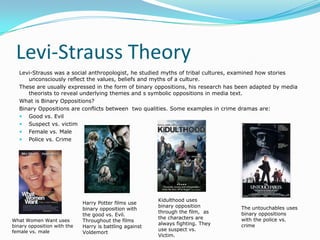
                                                         Kidulthood uses
                             Harry Potter films use
                                                         binary opposition         The untouchables uses
                             binary opposition with
                                                         through the film, as      binary oppositions
                             the good vs. Evil.
                                                         the characters are        with the police vs.
What Women Want uses         Throughout the films
binary opposition with the
                                                         always fighting. They     crime
                             Harry is battling against
female vs. male                                          use suspect vs.
                             Voldemort
                                                         Victim.
Roland Barthes
Roland Barthes was a French semiologist, he suggested that
  narrative works with five different codes which activate the
  audience to make sense of what is going on. He came up
  with the idea of denotation and connotation. This is the
  extra layer the audience base their understanding on they
  analyse what is going on/what is going to happen.
Symbolic = Connotation.
Semic = Denotation.

Film techniques

  • 1.
  • 2.
    Narrative Terms Closed Narrative This is where the narrative has a certain ending and all the crimes/problems are unfolded. Open Narrative This is where the narrative has open an ending. This could be to form part 2 or a sequel. The ending is not definite. Cliff Hanger This is where the ending is left open, the audience does not know what will happen next. Questions will be playing in their mind asking why something happened. Cliff-hangers are used to keep the audience interested. Red Herring This is a technique where the audience are led to believe something different. They can be tricked, or gather the wrong idea. This can also happen to the characters in the film. Suspense This is a technique where the plot builds up a feeling of anxiety and uncertainty about the outcome amongst the audience. This could be done through the characters actions, editing and music Multi - Strand Where one media text has a variety of different story lines. Circular Narrative This is where the narrative goes on a full circle and the resolution is the same as the equilibrium. Montage This is a type of editing that has different shots edited together to give the feeling to the audience that time has passed Prologue This id an introduction to the narrative seen before the opening sequence. Ellipsis Used to miss out a big chuck of time in films Flashback Used in films to show the point that the character gas visited the past before coming back to the present
  • 3.
    Openings Many crime thrillersbegin with an opening sequence teasing the audience. We see someone attacked but we don't see the perpetrator. Maybe there is a random passer-by who finds a corpse and screams in close-up at the camera. However not all crime dramas begin like this, all films have their own ways for opening the film. The main point of the opening sequence is to draw the audience into the plot which makes them want to carry on watching. The teaser sets up the question in your mind “who did this and how did this happen?”. This is a cold opening
  • 4.
    Levi-Strauss Theory Levi-Strauss was a social anthropologist, he studied myths of tribal cultures, examined how stories unconsciously reflect the values, beliefs and myths of a culture. These are usually expressed in the form of binary oppositions, his research has been adapted by media theorists to reveal underlying themes and s symbolic oppositions in media text. What is Binary Oppositions? Binary Oppositions are conflicts between two qualities. Some examples in crime dramas are:  Good vs. Evil  Suspect vs. victim  Female vs. Male  Police vs. Crime Kidulthood uses Harry Potter films use binary opposition The untouchables uses binary opposition with through the film, as binary oppositions the good vs. Evil. the characters are with the police vs. What Women Want uses Throughout the films binary opposition with the always fighting. They crime Harry is battling against female vs. male use suspect vs. Voldemort Victim.
  • 5.
    Roland Barthes Roland Bartheswas a French semiologist, he suggested that narrative works with five different codes which activate the audience to make sense of what is going on. He came up with the idea of denotation and connotation. This is the extra layer the audience base their understanding on they analyse what is going on/what is going to happen. Symbolic = Connotation. Semic = Denotation.