Impact of Moodle usage practices
on students’ performance in the
context of a blended learning
environment
Filippidi Andromahi, afilippidi@upatras.gr
Nikolaos Tselios, nitse@ece.upatras.gr
Vassilis Komis, komis@upatras.gr
University of Patras, Department of Educational Sciences and Early
Childhood Education, Patras, Greece
Plan presentation
Background
Research objectives
Methodology
Method of study
 Procedure
 Instruments
Findings
Conclusions and implications
SALL 2010
2
Background 1/3
 During the recent years a significant LMS usage in higher education is
observed
 a series of important questions emerge related to
the study of the appropriate teaching methods,
the effective design of technological infrastructure
and the design of the interaction of students with the system
 The last dimension depends largely on the earlier attitudes and perceptions
of the learning community’s members like students and teachers
SALL 2010
3
Background 2/3
 The usage of those technologies produces new teaching
practices and paradigms such as
 mixed models of traditional learning like blended learning, (Garrison &
Kanuca, 2004)
the development of a mixed model of learning is a complex
process of transforming an existing educational framework
based on the following factors:
(a) the context of the lesson
(b) development of appropriate materials and resources,
(c) adjustment of platform’s tools
(d) support of active participation for all members of the learning
community,
while transforming the role of teachers to cooperators
(C.Dalsgaard, and M.Godsk, 2007)
4
Background 3/3
Referring to the students’ practices, according to
R.Valle, and M. Duffy , 2009 expressed usage
practices are concerned, 3 categories are
distinguished:
 mastery oriented users,
 task focused users,
 and minimalist in effort users
The usage patterns, are being studied through
processing and meaning extraction of quantitative
usage data, such as
 total time of use,
 usage spreading,
 times pan across reconnection in the ODL system,
 intensity of interaction
 and amount of communication with other learners and/or teachers.
5
Research objectives
The goal of the study was to identify the factors that
influence students’ performance while using
Moodle, in the context of blended learning
environment
The objectives of the study were
a) to investigate possible relations of students’ practices,
as represented using a variety of interaction metrics, with
their performance
and b) to specify which of the students’ interaction metrics
practices were strongly related to their performance
SALL 2010
6
Method of study
Case study approach was adopted, for the
implementation of the research
117 University students, participated in the study
 of the Department of Educational Sciences and Early
Childhood Education,University of Patras,
 The academic year 2008-2009
The materials and the didactic approaches used in the
course were gradually reformed previously
 in order to be suitable with the adopted blended learning
approach.
The LMS used for this purpose was Moodle
 available at
http://150.140.160.60/moodle/course/view.php?id=30
SALL 2010
7
Procedure
Course :"Information and Communication Technologies in
Education"
The students attended a two-hour compulsory laboratory
session for 11 consecutive weeks
Each laboratory session
 dealt with a particular topic, related to the goals of the course
Afterwards, the students had to deliver a personal report after
solving a problem based assignment
During each lab the tutors
 provided information about the topic and the goals of the session
 subsequently explained each assignment given to the students
The materials provided to the students
 were organized accordingly to each subject
 were available to the students until the end of the semester
8
Available features 9
Services Resources Assessment
Calendar Papers
Final
examination
Forum Web pages
Questionnaires Educational
software Weekly
assignments
Assignments
Filament
analysis
Chat
Recourses
Design of the activities
Design and delivery of the course was
based on a social constructive
pedagogical context
A number of principles of the blended
learning were also adopted with respect
to the goals and the context of the
course
In addition, face to face characteristics
and online technologies (Moodle) were
utilized (D.R. Garrison, and H. Kanuka,
2004)
SALL 2010
10
participated in the study
Example of the LMS system
SALL 2010
11
participated in the study
The adopted pedagogical
model was based on the
problem based learning
approach proposed by
(Duffy,and J.
Kirkley.,2004)
Instruments
 Data collection
Moodle
used to collect participants’ log files and
 a tool developed from our research group was used
for data preprocessing of the user’s log files.
 Analysis of data
SPSS (17.0)
 data collected from the
 users’ log actions actions,
 the students worksheets’ grades and
 their final examination,
were encoded into categorical and numeric variables
SALL 2010
12
Results 1/5
From the analysis of the log files (86345 records in total),
 the majority (79 out of 117, 67.5%) of the students, used the
Moodle 3-4 times per week
 It was also observed a significant variation, concerning the
frequency of students’ access to the Moodle platform
SALL 2010
13
Results 2/5
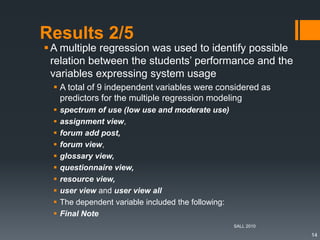
A multiple regression was used to identify possible
relation between the students’ performance and the
variables expressing system usage
 A total of 9 independent variables were considered as
predictors for the multiple regression modeling
 spectrum of use (low use and moderate use)
 assignment view,
 forum add post,
 forum view,
 glossary view,
 questionnaire view,
 resource view,
 user view and user view all
 The dependent variable included the following:
 Final Note
SALL 2010
14
Results 3/5
We assumed a linear relation between
independent (predictor) and dependent
(criterion) variables,
which means that we would expect either increase or
decrease of the dependent variable caused by the
increase of the independent one.
Regression coefficients (b-weights), which
describe the relation between a predictor and a
criterion, with a significance of p < 0.05 were
considered
SALL 2010
15
Results 4/5
SALL 2010
16
Model B Std. Error Beta t Sig.
low_use .892 .696 .195 1.281 .203
moderate_use
2.545 1.006 .389 2.530 .013
assignment_view
.002 .008 .040 .317 .752
forum_add_post
-.022 .393 -.006 -.057 .955
forum_view
.000 .018 -.001 -.010 .992
glossary_view
.035 .017 .206 1.993 .049
questionnaire_view
.006 .003 .255 2.201 .030
resource_view
-.011 .006 -.296 -1.812 .073
user_view .004 .018 .032 .225 .822
user_view_all
-.006 .012 -.062 -.486 .628
Results 5/5
 The multiple regression analysis resulted in a model that
explains 20.2% of the of students’ performance
 Three out of nine independent variables were found to be
significant correlated with the dependent variable,
 F = 2.679,
 p= 0.006< 0.01,
 adjusted R2 =0.126.
 The three independent variables, that found to be statistically
significant were:
 (a) moderate use, β = 0.389, p= 0.013< 0.05
 (b) questionnaire view, β= 0.255, p = 0.030 <0.05 and
 (c) glossary view, β= 0.206, p=0 .049 <0.05
SALL 2010
17
Conclusions 1/2
The recorded students’ interaction variables,
describing Moodle usage, is correlated with the
students’ performance
Moderate use appeared as the most critical
variable as a predictor in this study
it was also revealed that the usage variables that
also explain students’ performance are
Questionnaire view and glossary view
SALL 2010
18
Conclusions 2/2
Students’ performance was significantly correlated to
their system usage.
 3 variables mostly contributed to the correlation:
 spectrum of use and specifically moderate use,
 That indicates that students who used Moodle more intensively and more
frequently also received higher grade
 questionnaire and glossary inspection were important due to the
problem solving learning environment nature of the requested
projects
these results do not indicate a causal relationship,
they do indicate that the three independent usage
variables were related to higher scores on the final
students’ performance
SALL 2010
19
Future work
Future research goals are:
Further investigations in different contexts and
levels of education are required for the
generalization of results
In addition, further examination requires
the degree of contribution of each interaction’s
characteristics
and perceptions to the students' learning outcome
SALL 2010
20
Andromahi Filippidi, afilippidi@upatras.gr
Nikolaos Tselios, nitse@ece.upatras.gr
Vassilis Komis, komis@upatras.gr
ICT in Education Group, University of Patras
http://ecedu.upatras.gr/icte
References
D.R. Garrison, and H. Kanuka, “Blended learning: Uncovering its transformative
potential in higher education”, The Internet and Higher Education, vol. 7, May
2004, 95-105, doi:10.1016/j.iheduc.2004.02.001.
C.Dalsgaard, and M.Godsk, “Transforming traditional lectures into problem-based
blended learning: challenges and experiences. Open Learning”, The Journal of
Open and Distance Learning, vol. 22, Feb. 2007, pp. 29-42,
10.1080/02680510601100143.
T.Duffy,and J. Kirkley, Learner-Centred Theory and practice In Distance Education
Cases From Higher Education, Mahwah, N.J.: Lawrence Erlbaum Associates,
2004.
R.Valle, and M. Duffy, “Online learning: Learner characteristics and their
approaches to managing learning”, Instructional Science, vol. 37, Mar. 2009, pp.
129-149, 10.1007/s11251-007-9039-0D
SALL 2010
22

Filippidi sall2010

  • 1.
    Impact of Moodleusage practices on students’ performance in the context of a blended learning environment Filippidi Andromahi, afilippidi@upatras.gr Nikolaos Tselios, nitse@ece.upatras.gr Vassilis Komis, komis@upatras.gr University of Patras, Department of Educational Sciences and Early Childhood Education, Patras, Greece
  • 2.
    Plan presentation Background Research objectives Methodology Methodof study  Procedure  Instruments Findings Conclusions and implications SALL 2010 2
  • 3.
    Background 1/3  Duringthe recent years a significant LMS usage in higher education is observed  a series of important questions emerge related to the study of the appropriate teaching methods, the effective design of technological infrastructure and the design of the interaction of students with the system  The last dimension depends largely on the earlier attitudes and perceptions of the learning community’s members like students and teachers SALL 2010 3
  • 4.
    Background 2/3  Theusage of those technologies produces new teaching practices and paradigms such as  mixed models of traditional learning like blended learning, (Garrison & Kanuca, 2004) the development of a mixed model of learning is a complex process of transforming an existing educational framework based on the following factors: (a) the context of the lesson (b) development of appropriate materials and resources, (c) adjustment of platform’s tools (d) support of active participation for all members of the learning community, while transforming the role of teachers to cooperators (C.Dalsgaard, and M.Godsk, 2007) 4
  • 5.
    Background 3/3 Referring tothe students’ practices, according to R.Valle, and M. Duffy , 2009 expressed usage practices are concerned, 3 categories are distinguished:  mastery oriented users,  task focused users,  and minimalist in effort users The usage patterns, are being studied through processing and meaning extraction of quantitative usage data, such as  total time of use,  usage spreading,  times pan across reconnection in the ODL system,  intensity of interaction  and amount of communication with other learners and/or teachers. 5
  • 6.
    Research objectives The goalof the study was to identify the factors that influence students’ performance while using Moodle, in the context of blended learning environment The objectives of the study were a) to investigate possible relations of students’ practices, as represented using a variety of interaction metrics, with their performance and b) to specify which of the students’ interaction metrics practices were strongly related to their performance SALL 2010 6
  • 7.
    Method of study Casestudy approach was adopted, for the implementation of the research 117 University students, participated in the study  of the Department of Educational Sciences and Early Childhood Education,University of Patras,  The academic year 2008-2009 The materials and the didactic approaches used in the course were gradually reformed previously  in order to be suitable with the adopted blended learning approach. The LMS used for this purpose was Moodle  available at http://150.140.160.60/moodle/course/view.php?id=30 SALL 2010 7
  • 8.
    Procedure Course :"Information andCommunication Technologies in Education" The students attended a two-hour compulsory laboratory session for 11 consecutive weeks Each laboratory session  dealt with a particular topic, related to the goals of the course Afterwards, the students had to deliver a personal report after solving a problem based assignment During each lab the tutors  provided information about the topic and the goals of the session  subsequently explained each assignment given to the students The materials provided to the students  were organized accordingly to each subject  were available to the students until the end of the semester 8
  • 9.
    Available features 9 ServicesResources Assessment Calendar Papers Final examination Forum Web pages Questionnaires Educational software Weekly assignments Assignments Filament analysis Chat Recourses
  • 10.
    Design of theactivities Design and delivery of the course was based on a social constructive pedagogical context A number of principles of the blended learning were also adopted with respect to the goals and the context of the course In addition, face to face characteristics and online technologies (Moodle) were utilized (D.R. Garrison, and H. Kanuka, 2004) SALL 2010 10 participated in the study
  • 11.
    Example of theLMS system SALL 2010 11 participated in the study The adopted pedagogical model was based on the problem based learning approach proposed by (Duffy,and J. Kirkley.,2004)
  • 12.
    Instruments  Data collection Moodle usedto collect participants’ log files and  a tool developed from our research group was used for data preprocessing of the user’s log files.  Analysis of data SPSS (17.0)  data collected from the  users’ log actions actions,  the students worksheets’ grades and  their final examination, were encoded into categorical and numeric variables SALL 2010 12
  • 13.
    Results 1/5 From theanalysis of the log files (86345 records in total),  the majority (79 out of 117, 67.5%) of the students, used the Moodle 3-4 times per week  It was also observed a significant variation, concerning the frequency of students’ access to the Moodle platform SALL 2010 13
  • 14.
    Results 2/5 A multipleregression was used to identify possible relation between the students’ performance and the variables expressing system usage  A total of 9 independent variables were considered as predictors for the multiple regression modeling  spectrum of use (low use and moderate use)  assignment view,  forum add post,  forum view,  glossary view,  questionnaire view,  resource view,  user view and user view all  The dependent variable included the following:  Final Note SALL 2010 14
  • 15.
    Results 3/5 We assumeda linear relation between independent (predictor) and dependent (criterion) variables, which means that we would expect either increase or decrease of the dependent variable caused by the increase of the independent one. Regression coefficients (b-weights), which describe the relation between a predictor and a criterion, with a significance of p < 0.05 were considered SALL 2010 15
  • 16.
    Results 4/5 SALL 2010 16 ModelB Std. Error Beta t Sig. low_use .892 .696 .195 1.281 .203 moderate_use 2.545 1.006 .389 2.530 .013 assignment_view .002 .008 .040 .317 .752 forum_add_post -.022 .393 -.006 -.057 .955 forum_view .000 .018 -.001 -.010 .992 glossary_view .035 .017 .206 1.993 .049 questionnaire_view .006 .003 .255 2.201 .030 resource_view -.011 .006 -.296 -1.812 .073 user_view .004 .018 .032 .225 .822 user_view_all -.006 .012 -.062 -.486 .628
  • 17.
    Results 5/5  Themultiple regression analysis resulted in a model that explains 20.2% of the of students’ performance  Three out of nine independent variables were found to be significant correlated with the dependent variable,  F = 2.679,  p= 0.006< 0.01,  adjusted R2 =0.126.  The three independent variables, that found to be statistically significant were:  (a) moderate use, β = 0.389, p= 0.013< 0.05  (b) questionnaire view, β= 0.255, p = 0.030 <0.05 and  (c) glossary view, β= 0.206, p=0 .049 <0.05 SALL 2010 17
  • 18.
    Conclusions 1/2 The recordedstudents’ interaction variables, describing Moodle usage, is correlated with the students’ performance Moderate use appeared as the most critical variable as a predictor in this study it was also revealed that the usage variables that also explain students’ performance are Questionnaire view and glossary view SALL 2010 18
  • 19.
    Conclusions 2/2 Students’ performancewas significantly correlated to their system usage.  3 variables mostly contributed to the correlation:  spectrum of use and specifically moderate use,  That indicates that students who used Moodle more intensively and more frequently also received higher grade  questionnaire and glossary inspection were important due to the problem solving learning environment nature of the requested projects these results do not indicate a causal relationship, they do indicate that the three independent usage variables were related to higher scores on the final students’ performance SALL 2010 19
  • 20.
    Future work Future researchgoals are: Further investigations in different contexts and levels of education are required for the generalization of results In addition, further examination requires the degree of contribution of each interaction’s characteristics and perceptions to the students' learning outcome SALL 2010 20
  • 21.
    Andromahi Filippidi, afilippidi@upatras.gr NikolaosTselios, nitse@ece.upatras.gr Vassilis Komis, komis@upatras.gr ICT in Education Group, University of Patras http://ecedu.upatras.gr/icte
  • 22.
    References D.R. Garrison, andH. Kanuka, “Blended learning: Uncovering its transformative potential in higher education”, The Internet and Higher Education, vol. 7, May 2004, 95-105, doi:10.1016/j.iheduc.2004.02.001. C.Dalsgaard, and M.Godsk, “Transforming traditional lectures into problem-based blended learning: challenges and experiences. Open Learning”, The Journal of Open and Distance Learning, vol. 22, Feb. 2007, pp. 29-42, 10.1080/02680510601100143. T.Duffy,and J. Kirkley, Learner-Centred Theory and practice In Distance Education Cases From Higher Education, Mahwah, N.J.: Lawrence Erlbaum Associates, 2004. R.Valle, and M. Duffy, “Online learning: Learner characteristics and their approaches to managing learning”, Instructional Science, vol. 37, Mar. 2009, pp. 129-149, 10.1007/s11251-007-9039-0D SALL 2010 22