CREATIVE WRITING
(DHVSU-SHS HUMSS
MALIKHAIN CLASS OF 2021)
Discussant:
Mr. Banj L. Somera, LPT
Creative Writing:
Creative writing is writing that expresses
the writer's thoughts and feelings in an
imaginative, often unique, and poetic
way. Creative writing is guided more
by the writer's need to express feelings
and ideas than by restrictive demands
of factual and logical progression of
expository writing.
1. Poetry
2. Plays
3. Movie and television scripts
4. Fiction (novels, novellas, and short stories)
5. Songs
6. Speeches
7. Memoirs
8. Personal essays
Technical Writing:
Technical writing is a type of writing where
the author is writing about a particular
subject that requires direction, instruction,
or explanation. This style of writing has a
very different purpose and different
characteristics than other writing styles
such as creative writing, academic writing
1. an instructional manual for repairing machinery;
2. a memo listing meeting agendas;
3. a letter from a vendor to a client; and
4. a recommendation report proposing a new
computer system.
Technical writing, which must be understood
easily and quickly, includes:
1. Memos and e-mail
2. Letters
3. Reports
4. Instructions
5. Brochures and newsletters
6. The job search
7. Web pages
8. Fliers
9. PowerPoint
presentations
10. Graphic
Academic Writing:
Academic writing or scholarly writing is
nonfiction writing produced as part of
academic work. Writing that reports on
university research, writing produced by
university students, and writing in which
scholars analyze culture or propose new
theories are all sometimes described as
academic writing
Imagery:
Creating a picture in the reader’s mind by
making the reader see, hear, taste, smell, or
touch what is being described is imagery.
Sensory details:
Sensory details include sight, sound, touch,
smell, and taste. Writers employ the five senses
to engage a reader's interest. If you want your
writing to jump off the page, then bring your
reader into the world you are creating.
Figures of Speech:
1. Simile - comparison of two unlike things using like, as or as if.
Example: Procrastination is like a thief that steals time.
2. Metaphor - suggests a comparison of unlike things or particulars
without using like, as or as if.
Example: The teacher was an encyclopedia of information.
3. Assonance - focuses on repetition of vowel sounds in the
middle of a word
Example: The pig in a wig did a jig.
4. Alliteration - repetition of first consonant sounds in several words
Example: Betty bought butter but the butter was bitter.
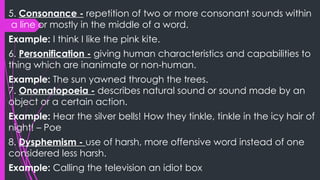
5. Consonance - repetition of two or more consonant sounds within
a line or mostly in the middle of a word.
Example: I think I like the pink kite.
6. Personification - giving human characteristics and capabilities to
thing which are inanimate or non-human.
Example: The sun yawned through the trees.
7. Onomatopoeia - describes natural sound or sound made by an
object or a certain action.
Example: Hear the silver bells! How they tinkle, tinkle in the icy hair of
night! – Poe
8. Dysphemism - use of harsh, more offensive word instead of one
considered less harsh.
Example: Calling the television an idiot box
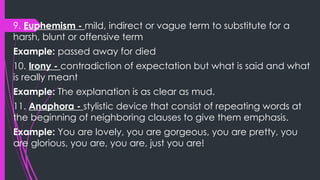
9. Euphemism - mild, indirect or vague term to substitute for a
harsh, blunt or offensive term
Example: passed away for died
10. Irony - contradiction of expectation but what is said and what
is really meant
Example: The explanation is as clear as mud.
11. Anaphora - stylistic device that consist of repeating words at
the beginning of neighboring clauses to give them emphasis.
Example: You are lovely, you are gorgeous, you are pretty, you
are glorious, you are, you are, just you are!
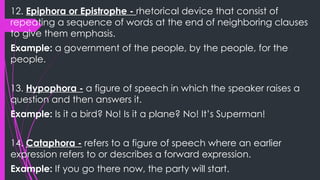
12. Epiphora or Epistrophe - rhetorical device that consist of
repeating a sequence of words at the end of neighboring clauses
to give them emphasis.
Example: a government of the people, by the people, for the
people.
13. Hypophora - a figure of speech in which the speaker raises a
question and then answers it.
Example: Is it a bird? No! Is it a plane? No! It’s Superman!
14. Cataphora - refers to a figure of speech where an earlier
expression refers to or describes a forward expression.
Example: If you go there now, the party will start.
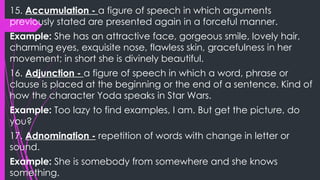
15. Accumulation - a figure of speech in which arguments
previously stated are presented again in a forceful manner.
Example: She has an attractive face, gorgeous smile, lovely hair,
charming eyes, exquisite nose, flawless skin, gracefulness in her
movement; in short she is divinely beautiful.
16. Adjunction - a figure of speech in which a word, phrase or
clause is placed at the beginning or the end of a sentence. Kind of
how the character Yoda speaks in Star Wars.
Example: Too lazy to find examples, I am. But get the picture, do
you?
17. Adnomination - repetition of words with change in letter or
sound.
Example: She is somebody from somewhere and she knows
something.
18. Allusion - is a brief and indirect reference to a person, place,
thing or idea of historical, cultural, literary or political significance. It
does not describe in detail the person or thing to which it refers.
Example: The rise in poverty will unlock the Pandora’s box of crimes
19. Atanaclasis - rhetorical device in which a word is repeated and
whose meaning changes in the second instance.
Example: The excuse is sound, nothing but sound.
20. Antiphrasis - a word or phrase is used to mean the opposite of
its normal meaning to create ironic humorous effect.
Example: She is 65 years young.
21. Antithesis - refers to the juxtaposition of opposing or contrasting
ideas. It involves the bringing out of a contrast in the ideas by an
obvious contrast in the words, clauses or sentences within a parallel
grammatical structure.
Example: Too many choices, too little time.
22. Apostrophe - an exclamatory rhetorical figure in which a
speaker or writer breaks off and directs speech to an imaginary
person or abstract quality or idea.
Example: Oh moon! You have seen everything.
23. Anticlimax - refers to a figure of speech in which statements
gradually descend in order of importance.
Example: He got back his dignity, his job and his company car.
24. Climax - refers to a figure of speech in which words, phrases,
or clauses are arranged in order of increasing importance.
Example: Three things will remain: faith, hope and love. But the
greatest of these is love.
25. Chiasmus- words, grammatical constructions or concepts are
repeated in reverse order in the same or modified form.
Example: People must live to work not just work to live.
26. Merism - figure of speech by which something is referred to by
a conventional phrase that enumerates several of its constituents
or traits.
Example: Flesh and bone means whole body
27. Metalepsis - Metalepsis is derived from a Greek
word metōnymia, which means substitution or sharing. It is
a figure of speech like metonymy or metaphor. However, it
is an advanced form of figurative speech in which one
thing is referred to another thing that is only slightly related
to it. There are two ways to make this association. One is
through showing causal relationship to seemingly
unrelated things. The other is through indirect intermediate
replacement of terms.
Example: Pallid death
The effect of death is to make the body pale. Ascribing
this effect to death itself as an adjective here is an
example of metalepsis.
28. Metonymy - is frequently used in literature and in everyday
speech. A metonymy is a word or phrase that is used to stand in
for another word. Sometimes a metonymy is chosen because it is
a well-known characteristic of the word.
Example: One famous example of metonymy is the saying, "The
pen is mightier than the sword," which originally came from
Edward Bulwer Lytton's play Richelieu. This sentence has two
examples of metonymy:
The "pen" stands in for "the written word."
The "sword"
29. Oxymoron - is a figure of speech in which two opposite ideas
are joined to create an effect. The common oxymoron phrase is a
combination of an adjective proceeded by a noun with
contrasting meanings, e.g. “cruel kindness” or “living death”.
30. Pun (Paranomasia) - A pun is a play on words in which a
humorous effect is produced by using a word that suggests two
or more meanings or by exploiting similar sounding words having
different meanings.
Example: The life of a patient of hypertension is always at steak.
31. Synechdoche - is a literary device in which a part of
something represents the whole or it may use a whole to
represent a part.
Synecdoche may also use larger groups to refer to smaller groups
or vice versa. It may also call a thing by the name of the material
it is made of or it may refer to a thing in a container or packing
by the name of that container or packing.
Example: The word “bread” refers to food or money as in “Writing
is my bread and butter” or “sole breadwinner”.
32. Ellipsis - is the omission of a word or series of words. There are
two slightly different definitions of ellipsis which are pertinent to
literature. The first definition of ellipsis is the commonly used series of
three dots, which can be place at the beginning, in the middle, or
at the end of a sentence or clause. These three dots can stand in
for whole sections of text that are omitted that do not change the
overall meaning. The dots can also indicate a mysterious or
unfinished thought, a leading sentence, or a pause or silence. This
punctuation is also referred to as a suspension point, points of
ellipsis, periods of ellipsis, or in speech may be called, “dot-dot-
dot.”
33. Hyperbole - derived from a Greek word meaning “over-
casting” is a figure of speech, which involves an exaggeration of
ideas for the sake of emphasis.
Example: My grandmother is as old as the hills.
34. Litotes - derived from a Greek word meaning “simple”,
is a figure of speech which employs an understatement by
using double negatives or, in other words, positive
statement is expressed by negating its opposite
expressions.
Example: They do not seem the happiest couple around.
35. Understatement – is a figure of speech employed by
writers or speakers to intentionally make a situation seem
less important than it really is
Example: “It rained a bit more than usual.” – Describing an
area being flooded by heavy rainfall.
Idiom:
An idiom is a phrase that is common to a
certain population. It is typically figurative
and usually is not understandable based
solely on the words within the phrase. A prior
understanding of its usage is usually
necessary. Idioms are crucial to the
progression of language.
Diction:
The writer’s purpose – whether to convince,
entertain, amuse, inform, or plead – partly
determines diction. Diction refers to the
author’s choice of words. Words chosen to
impart a particular effect on the reader
reflect and sustain a writer’s purpose.
READING AND
WRITING POETRY
What Is Poetry?:
It is words arranged in a rhythmic pattern with
regular accents (like beats in music), words
which are carefully selected for sound,
accent and meaning to express
imaginatively ideas and emotions. Each
poem has rhythm, melody, imagery, and
form.
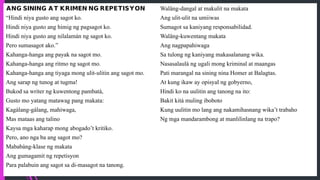
𝗔𝗡𝗚 𝗦𝗜𝗡𝗜𝗡𝗚 𝗔𝗧 𝗞𝗥𝗜𝗠𝗘𝗡 𝗡𝗚 𝗥𝗘𝗣𝗘𝗧𝗜𝗦𝗬𝗢𝗡
“Hindi niya gusto ang sagot ko.
Hindi niya gusto ang himig ng pagsagot ko.
Hindi niya gusto ang nilalamán ng sagot ko.
Pero sumasagot ako.”
Kahanga-hanga ang payak na sagot mo.
Kahanga-hanga ang ritmo ng sagot mo.
Kahanga-hanga ang tiyaga mong ulit-ulitin ang sagot mo.
Ang sarap ng tunog at tugma!
Bukod sa writer ng kuwentong pambatà,
Gusto mo yatang matawag pang makata:
Kagálang-gálang, mahiwaga,
Mas mataas ang talino
Kaysa mga kaharap mong abogado’t kritiko.
Pero, ano nga ba ang sagot mo?
Mababàng-klase ng makata
Ang gumagamit ng repetisyon
Para palabuin ang sagot sa di-masagot na tanong.
Walâng-dangal at makulit na makata
Ang ulit-ulit na umiiwas
Sumagot sa kaniyang responsabilidad.
Walâng-kuwentang makata
Ang nagpapahiwaga
Sa tulong ng kaniyang makasalanang wika.
Nasasalaulà ng ugali mong kriminal at maangas
Pati marangal na sining nina Homer at Balagtas.
At kung ikaw ay opisyal ng gobyerno,
Hindi ko na uulitin ang tanong na ito:
Bakit kitá muling iboboto
Kung uulitin mo lang ang nakamihasnang wika’t trabaho
Ng mga mandarambong at manlilinlang na trapo?
What Is Poetry?:
Stanza
Rhythm
Melody
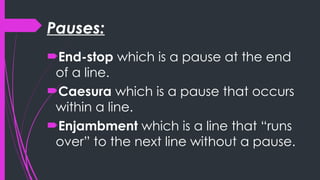
Pauses:
End-stop which is a pause at the end
of a line.
Caesura which is a pause that occurs
within a line.
Enjambment which is a line that “runs
over” to the next line without a pause.
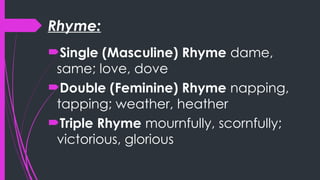
Rhyme:
Single (Masculine) Rhyme dame,
same; love, dove
Double (Feminine) Rhyme napping,
tapping; weather, heather
Triple Rhyme mournfully, scornfully;
victorious, glorious
Other Rhyming Terms Include:
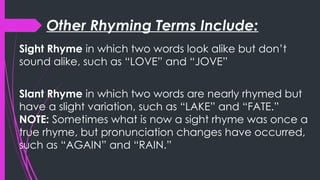
Sight Rhyme in which two words look alike but don’t
sound alike, such as “LOVE” and “JOVE”
Slant Rhyme in which two words are nearly rhymed but
have a slight variation, such as “LAKE” and “FATE.”
NOTE: Sometimes what is now a sight rhyme was once a
true rhyme, but pronunciation changes have occurred,
such as “AGAIN” and “RAIN.”
Other Rhyming Terms Include:
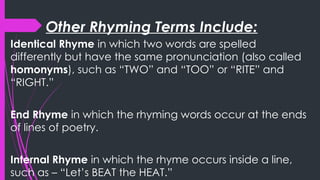
Identical Rhyme in which two words are spelled
differently but have the same pronunciation (also called
homonyms), such as “TWO” and “TOO” or “RITE” and
“RIGHT.”
End Rhyme in which the rhyming words occur at the ends
of lines of poetry.
Internal Rhyme in which the rhyme occurs inside a line,
such as – “Let’s BEAT the HEAT.”
Form:
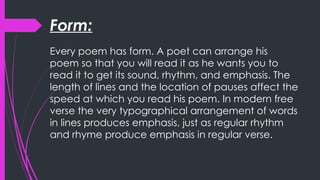
Every poem has form. A poet can arrange his
poem so that you will read it as he wants you to
read it to get its sound, rhythm, and emphasis. The
length of lines and the location of pauses affect the
speed at which you read his poem. In modern free
verse the very typographical arrangement of words
in lines produces emphasis, just as regular rhythm
and rhyme produce emphasis in regular verse.
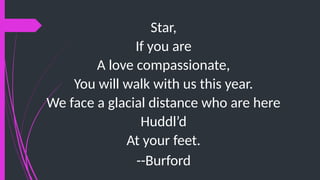
Star,
If you are
A love compassionate,
You will walk with us this year.
We face a glacial distance who are here
Huddl’d
At your feet.
--Burford
The appearance of the poem is often a clue to its
form, since form is usually determined by the
number of lines, the length of the lines, the
rhythmic pattern, and/or the rhyming scheme.
The rhyming scheme (rhyme pattern) can be
determined only by looking at the form of the
whole poem. Rhyme schemes are indicated by
the use of letters to designate rhyming
combinations, such as “a-b-a-b” or “a-a-b-b”
KINDS OF POETRY ACCORDING TO FORM:
REGULAR VERSE:
Has both rhyme and rhythm
BLANK VERSE:
Any number No rhyme Usually iambic
pentameter
FREE VERSE:
Any number No rhyme No meter
POETRY IS ALSO CLASSIFIED
BY CONTENT:
Narrative Poetry A nondramatic poem which tells a story
or presents a narrative, whether simple or complex, long
or short; e.g., ballad, epic, metrical romance
Ballad: a short poem, often written by an
anonymous author, comprised of short verses
intended to be sung or recited.
Epic: A long narrative poem detailing a hero’s
deeds. Examples include The Odyssey, The Aeneid,
and Beowulf
Dramatic Poetry which employs
dramatic form or dramatic
techniques as a means of achieving
poetic ends; e.g., verse drama,
dramatic monologue, verse
dialogue. You can find excellent
examples of these in all of the works
of Shakespeare.
Lyric Poetry A brief subjective poem marked by imagination,
melody, and emotion, but strict definition is impossible. The
following are the most common types:
Elegy: a poem that serves as a mournful lament for the dead.
Examples include Robert Louis Stevenson’s “Requiem” and
Alfred, Lord Tennyson’s “In Memoriam.”
Sonnet: a fourteen-line poem, usually written in iambic
pentameter, with a varied rhyme scheme. The two main types
are the Petrarchan (or Italian) and the Shakespearean (or
English). A Petrarchan sonnet opens with an octave that states
the proposition and ends with a sestet that states the solution. A
Shakespearean sonnet includes three quatrains and a couplet.
Epitaph: a commemorative inscription on a
tomb or mortuary monument written in
praise, or reflecting the life, of a deceased
person.
Ode: a poem that praises people, the arts
of music and poetry, natural scenes, or
abstract concepts. Examples include:
Keats’s “Ode to a Nightingale” and Percy
Shelley’s in "Ode to the West Wind."
Pastoral: a poem dealing with the lives of
shepherds or rural life in general and typically
drawing a contrast between the innocence and
serenity of a simple life and the misery and
corruption of city and especially court life.
Examples include: Christopher Marlowe's “The
Passionate Shepherd to His Love,” Sir Walter
Raleigh's “The Nymph's Reply to the Shepherd,”
and Thomas Campion’s “I Care Not For These
Ladies.”
OTHER FORMS:
Tanka is a classic form of Japanese poetry related
to the haiku with five unrhymed lines of five,
seven, five, seven, and seven syllables. (5, 7, 5, 7,
7)
A cool wind blows in
With a blanket of silence.
Straining to listen
For those first few drops of rain,
The storm begins in earnest.
A traditional Japanese haiku is a three-line poem with
seventeen syllables, written in a 5/7/5 syllable count. Often
focusing on images from nature, haiku emphasizes simplicity,
intensity, and directness of expression.
An old pond!
A frog jumps in—
the sound of water
As the form has evolved, many of its regular traits—including
its famous syllabic pattern—have been routinely broken.
However, the philosophy of haiku has been preserved: the
focus on a brief moment in time; a use of provocative,
colorful images; an ability to be read in one breath; and a
sense of sudden enlightenment.
The Tagalog tanaga, which dates back to
1500, has been referred to as the Philippine
equivalent of the Japanese haiku, but this
is totally wrong. Tanaga is a poem
composed of
four lines with each line having seven
syllables, written in aaaa or aabb, abba, or
abab rhyming
pattern. Tanaga have no titles. Below is an
example of a tanaga.
bango ay todo bigay living life at
full pelt
rosas siyang donselya she is a rose
so pure
tinik na kapamilya yet her
own prickles
hindi man lang mapugay she just
overlooks
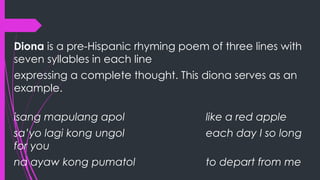
Diona is a pre-Hispanic rhyming poem of three lines with
seven syllables in each line
expressing a complete thought. This diona serves as an
example.
isang mapulang apol like a red apple
sa’yo lagi kong ungol each day I so long
for you
na ayaw kong pumatol to depart from me
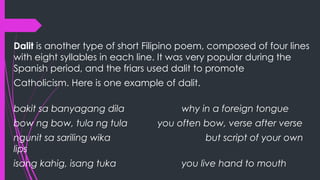
Dalit is another type of short Filipino poem, composed of four lines
with eight syllables in each line. It was very popular during the
Spanish period, and the friars used dalit to promote
Catholicism. Here is one example of dalit.
bakit sa banyagang dila why in a foreign tongue
bow ng bow, tula ng tula you often bow, verse after verse
ngunit sa sariling wika but script of your own
lips
isang kahig, isang tuka you live hand to mouth
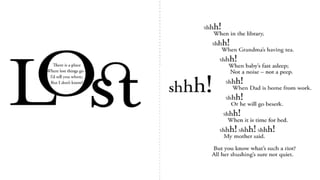
Typography:
Typography is the art and technique of
arranging type to make written language
eligible, readable, and appealing when
displayed. The term typography is also
applied to the style, arrangement, and
appearance of the letters, numbers, and
symbols created by the process.
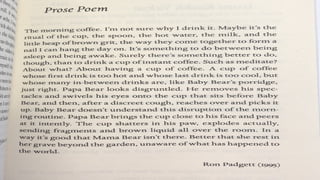
Prose poem:
Looks like prose (written in
paragraphs) Focuses on images that
include instances of poetic meter,
contains language play, such as
repetition.
Performance poetry/ Spoken Poetry:
A form of poetry intended to be perf
ormed as a dramatic monologue or
exchange and frequently involving
improvisation.
OTHER ELEMENTS:
Theme:
-the central idea, the thesis, the message a story conveys, or
a generalization or an abstraction from it
Tone:
- the attitude of the poet towards the aaudience
- refers to the intellectual and emotional attitudes of the poet
towards his or her intended audience
- there are many varieties of tone that an aspiring poet can
assume. He/she can be dead serious or humorous, formal or
casual, intimate or distant, solemn or flippant, somber or
cheerful, ironic or poignant, deferential or condescending,
among others.
Mood:
- the attitude of the poet towards the subject matter
- is defined by some critics as a quality of literature that is synonymous
with tone, by others as synonymous with atmosphere, and by still
others as synonymous with both.
-refer to the emotional and intellectual attitudes of the author
towards his/her subject matter in a given literary work.
Persona:
-the speaking voice of the poem
- comes in any point of view
-originally refers to the mask worn by a Greek actor when he
performs a role in a classical tragedy or comedy, hence the related
theatrical term dramatis personae or the list of cast members in a
play.
Atmosphere:
- the dominant emotional aura of the poem
- in arts including literature, the term atmosphere
denotes the dominant mood or emotional tone of a
work, be it a painting, a play, a ballet, a film, a novel, or
a poem.
- in literature, atmosphere refers to the dominant
emotional aura or general feeling created in the
readers or audience by a work at any given point.
-directly appeals to the readers’ five senses by making
the descriptions more palpable and the implied ideas
more accessible and easy to comprehend.
READING AND
WRITING FICTION
FICTION:
Fiction is make-believe, invented stories. They
may be short stories, fables, vignettes, plays,
novellas, or novels. Although writers may base a
character on people they have met in real life,
the characters and the experiences that the
character faces in the story are not real.
Characters, setting, plot, conflict, point of view,
and theme are six key elements for writing
fiction.
Characters:
Antagonist
Protagonist
Round
Flat
Static
Developing
stereotypical
Setting:
The immediate surroundings of the characters such as
props in a scene: trees, furniture, food, inside of a house
or car, etc.
time of day
weather
time of year
The historical period such as what century or decade
the story takes place.
The geographical location including the city, state,
country, and possibly even the universe
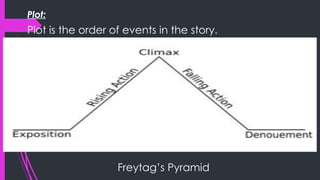
Plot:
Plot is the order of events in the story.
Freytag’s Pyramid
Types of Plot:
Dramatic
Episodic
Parallel
In Medias res
Flashback
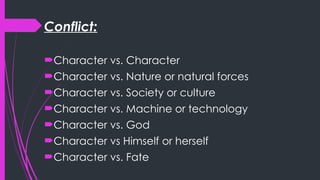
Conflict:
Character vs. Character
Character vs. Nature or natural forces
Character vs. Society or culture
Character vs. Machine or technology
Character vs. God
Character vs Himself or herself
Character vs. Fate
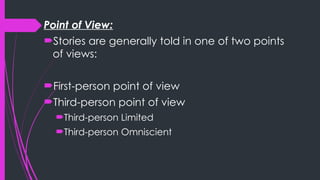
Point of View:
Stories are generally told in one of two points
of views:
First-person point of view
Third-person point of view
Third-person Limited
Third-person Omniscient
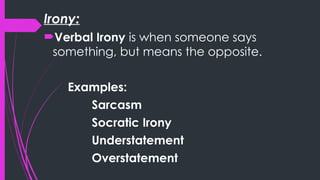
Irony:
Verbal Irony is when someone says
something, but means the opposite.
Examples:
Sarcasm
Socratic Irony
Understatement
Overstatement
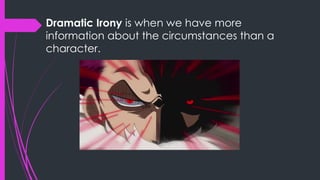
Dramatic Irony is when we have more
information about the circumstances than a
character.
Situational Irony is when we
expect one thing, but get the
opposite.
Foreshadowing:
Foreshadowing is a literary device that is
utilized to give a hint or indication of a future
event in the story. It can be a very effective
tool for developing curiosity, suspense, and
even narrative harmony at the end of a film or
novel. Writers often utilize foreshadowing earlier
in their story to set up a later event. “Indicate”
and “foretell'' are both foreshadow synonyms.
Motif:
A motif is a symbolic
image or idea that
appears frequently in
a story.
THANK YOU!

CREATIVE WRITING Chapter One topic about creative writing skills

  • 1.
    CREATIVE WRITING (DHVSU-SHS HUMSS MALIKHAINCLASS OF 2021) Discussant: Mr. Banj L. Somera, LPT
  • 2.
    Creative Writing: Creative writingis writing that expresses the writer's thoughts and feelings in an imaginative, often unique, and poetic way. Creative writing is guided more by the writer's need to express feelings and ideas than by restrictive demands of factual and logical progression of expository writing.
  • 3.
    1. Poetry 2. Plays 3.Movie and television scripts 4. Fiction (novels, novellas, and short stories) 5. Songs 6. Speeches 7. Memoirs 8. Personal essays
  • 4.
    Technical Writing: Technical writingis a type of writing where the author is writing about a particular subject that requires direction, instruction, or explanation. This style of writing has a very different purpose and different characteristics than other writing styles such as creative writing, academic writing
  • 5.
    1. an instructionalmanual for repairing machinery; 2. a memo listing meeting agendas; 3. a letter from a vendor to a client; and 4. a recommendation report proposing a new computer system.
  • 6.
    Technical writing, whichmust be understood easily and quickly, includes: 1. Memos and e-mail 2. Letters 3. Reports 4. Instructions 5. Brochures and newsletters 6. The job search 7. Web pages 8. Fliers 9. PowerPoint presentations 10. Graphic
  • 7.
    Academic Writing: Academic writingor scholarly writing is nonfiction writing produced as part of academic work. Writing that reports on university research, writing produced by university students, and writing in which scholars analyze culture or propose new theories are all sometimes described as academic writing
  • 8.
    Imagery: Creating a picturein the reader’s mind by making the reader see, hear, taste, smell, or touch what is being described is imagery. Sensory details: Sensory details include sight, sound, touch, smell, and taste. Writers employ the five senses to engage a reader's interest. If you want your writing to jump off the page, then bring your reader into the world you are creating.
  • 9.
    Figures of Speech: 1.Simile - comparison of two unlike things using like, as or as if. Example: Procrastination is like a thief that steals time. 2. Metaphor - suggests a comparison of unlike things or particulars without using like, as or as if. Example: The teacher was an encyclopedia of information. 3. Assonance - focuses on repetition of vowel sounds in the middle of a word Example: The pig in a wig did a jig. 4. Alliteration - repetition of first consonant sounds in several words Example: Betty bought butter but the butter was bitter.
  • 10.
    5. Consonance -repetition of two or more consonant sounds within a line or mostly in the middle of a word. Example: I think I like the pink kite. 6. Personification - giving human characteristics and capabilities to thing which are inanimate or non-human. Example: The sun yawned through the trees. 7. Onomatopoeia - describes natural sound or sound made by an object or a certain action. Example: Hear the silver bells! How they tinkle, tinkle in the icy hair of night! – Poe 8. Dysphemism - use of harsh, more offensive word instead of one considered less harsh. Example: Calling the television an idiot box
  • 11.
    9. Euphemism -mild, indirect or vague term to substitute for a harsh, blunt or offensive term Example: passed away for died 10. Irony - contradiction of expectation but what is said and what is really meant Example: The explanation is as clear as mud. 11. Anaphora - stylistic device that consist of repeating words at the beginning of neighboring clauses to give them emphasis. Example: You are lovely, you are gorgeous, you are pretty, you are glorious, you are, you are, just you are!
  • 12.
    12. Epiphora orEpistrophe - rhetorical device that consist of repeating a sequence of words at the end of neighboring clauses to give them emphasis. Example: a government of the people, by the people, for the people. 13. Hypophora - a figure of speech in which the speaker raises a question and then answers it. Example: Is it a bird? No! Is it a plane? No! It’s Superman! 14. Cataphora - refers to a figure of speech where an earlier expression refers to or describes a forward expression. Example: If you go there now, the party will start.
  • 13.
    15. Accumulation -a figure of speech in which arguments previously stated are presented again in a forceful manner. Example: She has an attractive face, gorgeous smile, lovely hair, charming eyes, exquisite nose, flawless skin, gracefulness in her movement; in short she is divinely beautiful. 16. Adjunction - a figure of speech in which a word, phrase or clause is placed at the beginning or the end of a sentence. Kind of how the character Yoda speaks in Star Wars. Example: Too lazy to find examples, I am. But get the picture, do you? 17. Adnomination - repetition of words with change in letter or sound. Example: She is somebody from somewhere and she knows something.
  • 14.
    18. Allusion -is a brief and indirect reference to a person, place, thing or idea of historical, cultural, literary or political significance. It does not describe in detail the person or thing to which it refers. Example: The rise in poverty will unlock the Pandora’s box of crimes 19. Atanaclasis - rhetorical device in which a word is repeated and whose meaning changes in the second instance. Example: The excuse is sound, nothing but sound. 20. Antiphrasis - a word or phrase is used to mean the opposite of its normal meaning to create ironic humorous effect. Example: She is 65 years young.
  • 15.
    21. Antithesis -refers to the juxtaposition of opposing or contrasting ideas. It involves the bringing out of a contrast in the ideas by an obvious contrast in the words, clauses or sentences within a parallel grammatical structure. Example: Too many choices, too little time. 22. Apostrophe - an exclamatory rhetorical figure in which a speaker or writer breaks off and directs speech to an imaginary person or abstract quality or idea. Example: Oh moon! You have seen everything. 23. Anticlimax - refers to a figure of speech in which statements gradually descend in order of importance. Example: He got back his dignity, his job and his company car.
  • 16.
    24. Climax -refers to a figure of speech in which words, phrases, or clauses are arranged in order of increasing importance. Example: Three things will remain: faith, hope and love. But the greatest of these is love. 25. Chiasmus- words, grammatical constructions or concepts are repeated in reverse order in the same or modified form. Example: People must live to work not just work to live. 26. Merism - figure of speech by which something is referred to by a conventional phrase that enumerates several of its constituents or traits. Example: Flesh and bone means whole body
  • 17.
    27. Metalepsis -Metalepsis is derived from a Greek word metōnymia, which means substitution or sharing. It is a figure of speech like metonymy or metaphor. However, it is an advanced form of figurative speech in which one thing is referred to another thing that is only slightly related to it. There are two ways to make this association. One is through showing causal relationship to seemingly unrelated things. The other is through indirect intermediate replacement of terms. Example: Pallid death The effect of death is to make the body pale. Ascribing this effect to death itself as an adjective here is an example of metalepsis.
  • 18.
    28. Metonymy -is frequently used in literature and in everyday speech. A metonymy is a word or phrase that is used to stand in for another word. Sometimes a metonymy is chosen because it is a well-known characteristic of the word. Example: One famous example of metonymy is the saying, "The pen is mightier than the sword," which originally came from Edward Bulwer Lytton's play Richelieu. This sentence has two examples of metonymy: The "pen" stands in for "the written word." The "sword" 29. Oxymoron - is a figure of speech in which two opposite ideas are joined to create an effect. The common oxymoron phrase is a combination of an adjective proceeded by a noun with contrasting meanings, e.g. “cruel kindness” or “living death”.
  • 19.
    30. Pun (Paranomasia)- A pun is a play on words in which a humorous effect is produced by using a word that suggests two or more meanings or by exploiting similar sounding words having different meanings. Example: The life of a patient of hypertension is always at steak. 31. Synechdoche - is a literary device in which a part of something represents the whole or it may use a whole to represent a part. Synecdoche may also use larger groups to refer to smaller groups or vice versa. It may also call a thing by the name of the material it is made of or it may refer to a thing in a container or packing by the name of that container or packing. Example: The word “bread” refers to food or money as in “Writing is my bread and butter” or “sole breadwinner”.
  • 20.
    32. Ellipsis -is the omission of a word or series of words. There are two slightly different definitions of ellipsis which are pertinent to literature. The first definition of ellipsis is the commonly used series of three dots, which can be place at the beginning, in the middle, or at the end of a sentence or clause. These three dots can stand in for whole sections of text that are omitted that do not change the overall meaning. The dots can also indicate a mysterious or unfinished thought, a leading sentence, or a pause or silence. This punctuation is also referred to as a suspension point, points of ellipsis, periods of ellipsis, or in speech may be called, “dot-dot- dot.” 33. Hyperbole - derived from a Greek word meaning “over- casting” is a figure of speech, which involves an exaggeration of ideas for the sake of emphasis. Example: My grandmother is as old as the hills.
  • 21.
    34. Litotes -derived from a Greek word meaning “simple”, is a figure of speech which employs an understatement by using double negatives or, in other words, positive statement is expressed by negating its opposite expressions. Example: They do not seem the happiest couple around. 35. Understatement – is a figure of speech employed by writers or speakers to intentionally make a situation seem less important than it really is Example: “It rained a bit more than usual.” – Describing an area being flooded by heavy rainfall.
  • 22.
    Idiom: An idiom isa phrase that is common to a certain population. It is typically figurative and usually is not understandable based solely on the words within the phrase. A prior understanding of its usage is usually necessary. Idioms are crucial to the progression of language.
  • 23.
    Diction: The writer’s purpose– whether to convince, entertain, amuse, inform, or plead – partly determines diction. Diction refers to the author’s choice of words. Words chosen to impart a particular effect on the reader reflect and sustain a writer’s purpose.
  • 24.
  • 25.
    What Is Poetry?: Itis words arranged in a rhythmic pattern with regular accents (like beats in music), words which are carefully selected for sound, accent and meaning to express imaginatively ideas and emotions. Each poem has rhythm, melody, imagery, and form.
  • 26.
    𝗔𝗡𝗚 𝗦𝗜𝗡𝗜𝗡𝗚 𝗔𝗧𝗞𝗥𝗜𝗠𝗘𝗡 𝗡𝗚 𝗥𝗘𝗣𝗘𝗧𝗜𝗦𝗬𝗢𝗡 “Hindi niya gusto ang sagot ko. Hindi niya gusto ang himig ng pagsagot ko. Hindi niya gusto ang nilalamán ng sagot ko. Pero sumasagot ako.” Kahanga-hanga ang payak na sagot mo. Kahanga-hanga ang ritmo ng sagot mo. Kahanga-hanga ang tiyaga mong ulit-ulitin ang sagot mo. Ang sarap ng tunog at tugma! Bukod sa writer ng kuwentong pambatà, Gusto mo yatang matawag pang makata: Kagálang-gálang, mahiwaga, Mas mataas ang talino Kaysa mga kaharap mong abogado’t kritiko. Pero, ano nga ba ang sagot mo? Mababàng-klase ng makata Ang gumagamit ng repetisyon Para palabuin ang sagot sa di-masagot na tanong. Walâng-dangal at makulit na makata Ang ulit-ulit na umiiwas Sumagot sa kaniyang responsabilidad. Walâng-kuwentang makata Ang nagpapahiwaga Sa tulong ng kaniyang makasalanang wika. Nasasalaulà ng ugali mong kriminal at maangas Pati marangal na sining nina Homer at Balagtas. At kung ikaw ay opisyal ng gobyerno, Hindi ko na uulitin ang tanong na ito: Bakit kitá muling iboboto Kung uulitin mo lang ang nakamihasnang wika’t trabaho Ng mga mandarambong at manlilinlang na trapo?
  • 27.
  • 28.
    Pauses: End-stop which isa pause at the end of a line. Caesura which is a pause that occurs within a line. Enjambment which is a line that “runs over” to the next line without a pause.
  • 29.
    Rhyme: Single (Masculine) Rhymedame, same; love, dove Double (Feminine) Rhyme napping, tapping; weather, heather Triple Rhyme mournfully, scornfully; victorious, glorious
  • 30.
    Other Rhyming TermsInclude: Sight Rhyme in which two words look alike but don’t sound alike, such as “LOVE” and “JOVE” Slant Rhyme in which two words are nearly rhymed but have a slight variation, such as “LAKE” and “FATE.” NOTE: Sometimes what is now a sight rhyme was once a true rhyme, but pronunciation changes have occurred, such as “AGAIN” and “RAIN.”
  • 31.
    Other Rhyming TermsInclude: Identical Rhyme in which two words are spelled differently but have the same pronunciation (also called homonyms), such as “TWO” and “TOO” or “RITE” and “RIGHT.” End Rhyme in which the rhyming words occur at the ends of lines of poetry. Internal Rhyme in which the rhyme occurs inside a line, such as – “Let’s BEAT the HEAT.”
  • 32.
    Form: Every poem hasform. A poet can arrange his poem so that you will read it as he wants you to read it to get its sound, rhythm, and emphasis. The length of lines and the location of pauses affect the speed at which you read his poem. In modern free verse the very typographical arrangement of words in lines produces emphasis, just as regular rhythm and rhyme produce emphasis in regular verse.
  • 33.
    Star, If you are Alove compassionate, You will walk with us this year. We face a glacial distance who are here Huddl’d At your feet. --Burford
  • 34.
    The appearance ofthe poem is often a clue to its form, since form is usually determined by the number of lines, the length of the lines, the rhythmic pattern, and/or the rhyming scheme. The rhyming scheme (rhyme pattern) can be determined only by looking at the form of the whole poem. Rhyme schemes are indicated by the use of letters to designate rhyming combinations, such as “a-b-a-b” or “a-a-b-b”
  • 35.
    KINDS OF POETRYACCORDING TO FORM: REGULAR VERSE: Has both rhyme and rhythm BLANK VERSE: Any number No rhyme Usually iambic pentameter FREE VERSE: Any number No rhyme No meter
  • 36.
    POETRY IS ALSOCLASSIFIED BY CONTENT:
  • 37.
    Narrative Poetry Anondramatic poem which tells a story or presents a narrative, whether simple or complex, long or short; e.g., ballad, epic, metrical romance Ballad: a short poem, often written by an anonymous author, comprised of short verses intended to be sung or recited. Epic: A long narrative poem detailing a hero’s deeds. Examples include The Odyssey, The Aeneid, and Beowulf
  • 38.
    Dramatic Poetry whichemploys dramatic form or dramatic techniques as a means of achieving poetic ends; e.g., verse drama, dramatic monologue, verse dialogue. You can find excellent examples of these in all of the works of Shakespeare.
  • 39.
    Lyric Poetry Abrief subjective poem marked by imagination, melody, and emotion, but strict definition is impossible. The following are the most common types: Elegy: a poem that serves as a mournful lament for the dead. Examples include Robert Louis Stevenson’s “Requiem” and Alfred, Lord Tennyson’s “In Memoriam.” Sonnet: a fourteen-line poem, usually written in iambic pentameter, with a varied rhyme scheme. The two main types are the Petrarchan (or Italian) and the Shakespearean (or English). A Petrarchan sonnet opens with an octave that states the proposition and ends with a sestet that states the solution. A Shakespearean sonnet includes three quatrains and a couplet.
  • 40.
    Epitaph: a commemorativeinscription on a tomb or mortuary monument written in praise, or reflecting the life, of a deceased person. Ode: a poem that praises people, the arts of music and poetry, natural scenes, or abstract concepts. Examples include: Keats’s “Ode to a Nightingale” and Percy Shelley’s in "Ode to the West Wind."
  • 41.
    Pastoral: a poemdealing with the lives of shepherds or rural life in general and typically drawing a contrast between the innocence and serenity of a simple life and the misery and corruption of city and especially court life. Examples include: Christopher Marlowe's “The Passionate Shepherd to His Love,” Sir Walter Raleigh's “The Nymph's Reply to the Shepherd,” and Thomas Campion’s “I Care Not For These Ladies.”
  • 42.
    OTHER FORMS: Tanka isa classic form of Japanese poetry related to the haiku with five unrhymed lines of five, seven, five, seven, and seven syllables. (5, 7, 5, 7, 7) A cool wind blows in With a blanket of silence. Straining to listen For those first few drops of rain, The storm begins in earnest.
  • 43.
    A traditional Japanesehaiku is a three-line poem with seventeen syllables, written in a 5/7/5 syllable count. Often focusing on images from nature, haiku emphasizes simplicity, intensity, and directness of expression. An old pond! A frog jumps in— the sound of water As the form has evolved, many of its regular traits—including its famous syllabic pattern—have been routinely broken. However, the philosophy of haiku has been preserved: the focus on a brief moment in time; a use of provocative, colorful images; an ability to be read in one breath; and a sense of sudden enlightenment.
  • 44.
    The Tagalog tanaga,which dates back to 1500, has been referred to as the Philippine equivalent of the Japanese haiku, but this is totally wrong. Tanaga is a poem composed of four lines with each line having seven syllables, written in aaaa or aabb, abba, or abab rhyming pattern. Tanaga have no titles. Below is an example of a tanaga.
  • 45.
    bango ay todobigay living life at full pelt rosas siyang donselya she is a rose so pure tinik na kapamilya yet her own prickles hindi man lang mapugay she just overlooks
  • 46.
    Diona is apre-Hispanic rhyming poem of three lines with seven syllables in each line expressing a complete thought. This diona serves as an example. isang mapulang apol like a red apple sa’yo lagi kong ungol each day I so long for you na ayaw kong pumatol to depart from me
  • 47.
    Dalit is anothertype of short Filipino poem, composed of four lines with eight syllables in each line. It was very popular during the Spanish period, and the friars used dalit to promote Catholicism. Here is one example of dalit. bakit sa banyagang dila why in a foreign tongue bow ng bow, tula ng tula you often bow, verse after verse ngunit sa sariling wika but script of your own lips isang kahig, isang tuka you live hand to mouth
  • 48.
    Typography: Typography is theart and technique of arranging type to make written language eligible, readable, and appealing when displayed. The term typography is also applied to the style, arrangement, and appearance of the letters, numbers, and symbols created by the process.
  • 50.
    Prose poem: Looks likeprose (written in paragraphs) Focuses on images that include instances of poetic meter, contains language play, such as repetition.
  • 52.
    Performance poetry/ SpokenPoetry: A form of poetry intended to be perf ormed as a dramatic monologue or exchange and frequently involving improvisation.
  • 53.
    OTHER ELEMENTS: Theme: -the centralidea, the thesis, the message a story conveys, or a generalization or an abstraction from it Tone: - the attitude of the poet towards the aaudience - refers to the intellectual and emotional attitudes of the poet towards his or her intended audience - there are many varieties of tone that an aspiring poet can assume. He/she can be dead serious or humorous, formal or casual, intimate or distant, solemn or flippant, somber or cheerful, ironic or poignant, deferential or condescending, among others.
  • 54.
    Mood: - the attitudeof the poet towards the subject matter - is defined by some critics as a quality of literature that is synonymous with tone, by others as synonymous with atmosphere, and by still others as synonymous with both. -refer to the emotional and intellectual attitudes of the author towards his/her subject matter in a given literary work. Persona: -the speaking voice of the poem - comes in any point of view -originally refers to the mask worn by a Greek actor when he performs a role in a classical tragedy or comedy, hence the related theatrical term dramatis personae or the list of cast members in a play.
  • 55.
    Atmosphere: - the dominantemotional aura of the poem - in arts including literature, the term atmosphere denotes the dominant mood or emotional tone of a work, be it a painting, a play, a ballet, a film, a novel, or a poem. - in literature, atmosphere refers to the dominant emotional aura or general feeling created in the readers or audience by a work at any given point. -directly appeals to the readers’ five senses by making the descriptions more palpable and the implied ideas more accessible and easy to comprehend.
  • 56.
  • 57.
    FICTION: Fiction is make-believe,invented stories. They may be short stories, fables, vignettes, plays, novellas, or novels. Although writers may base a character on people they have met in real life, the characters and the experiences that the character faces in the story are not real. Characters, setting, plot, conflict, point of view, and theme are six key elements for writing fiction.
  • 58.
  • 59.
    Setting: The immediate surroundingsof the characters such as props in a scene: trees, furniture, food, inside of a house or car, etc. time of day weather time of year The historical period such as what century or decade the story takes place. The geographical location including the city, state, country, and possibly even the universe
  • 60.
    Plot: Plot is theorder of events in the story. Freytag’s Pyramid
  • 61.
  • 63.
    Conflict: Character vs. Character Charactervs. Nature or natural forces Character vs. Society or culture Character vs. Machine or technology Character vs. God Character vs Himself or herself Character vs. Fate
  • 64.
    Point of View: Storiesare generally told in one of two points of views: First-person point of view Third-person point of view Third-person Limited Third-person Omniscient
  • 65.
    Irony: Verbal Irony iswhen someone says something, but means the opposite. Examples: Sarcasm Socratic Irony Understatement Overstatement
  • 67.
    Dramatic Irony iswhen we have more information about the circumstances than a character.
  • 69.
    Situational Irony iswhen we expect one thing, but get the opposite.
  • 71.
    Foreshadowing: Foreshadowing is aliterary device that is utilized to give a hint or indication of a future event in the story. It can be a very effective tool for developing curiosity, suspense, and even narrative harmony at the end of a film or novel. Writers often utilize foreshadowing earlier in their story to set up a later event. “Indicate” and “foretell'' are both foreshadow synonyms.
  • 72.
    Motif: A motif isa symbolic image or idea that appears frequently in a story.
  • 73.