FIELD OF RATIONAL NUMBERS
AND INFINITE FIELD
PRESENTED BY:-
Pragya Subha Ramawat &
Prabhjot Kaur
CONTENTS
• Introduction
• Rational number
•Fields
• Field of rational numbers
•Irrational numbers
•Historical remarks
•Infinite field
INTRODUCTION
we are going to construct the rational number from the
integers. Historically, the positive rational numbers
came first: the Babylonians, Egyptians and Greeks knew
how to work with fractions, but negative numbers were
introduced by the Hindus hundreds of years later. It is
possible to reflect this in the build-up of the rationals
from the natural numbers by first constructing the
positive rational numbers from the naturals, and then
introducing negatives (Landau proceeds like this in his
Foundations of Analysis). While being closer to history,
this has the disadvantage of getting a ring structure
only at the end.
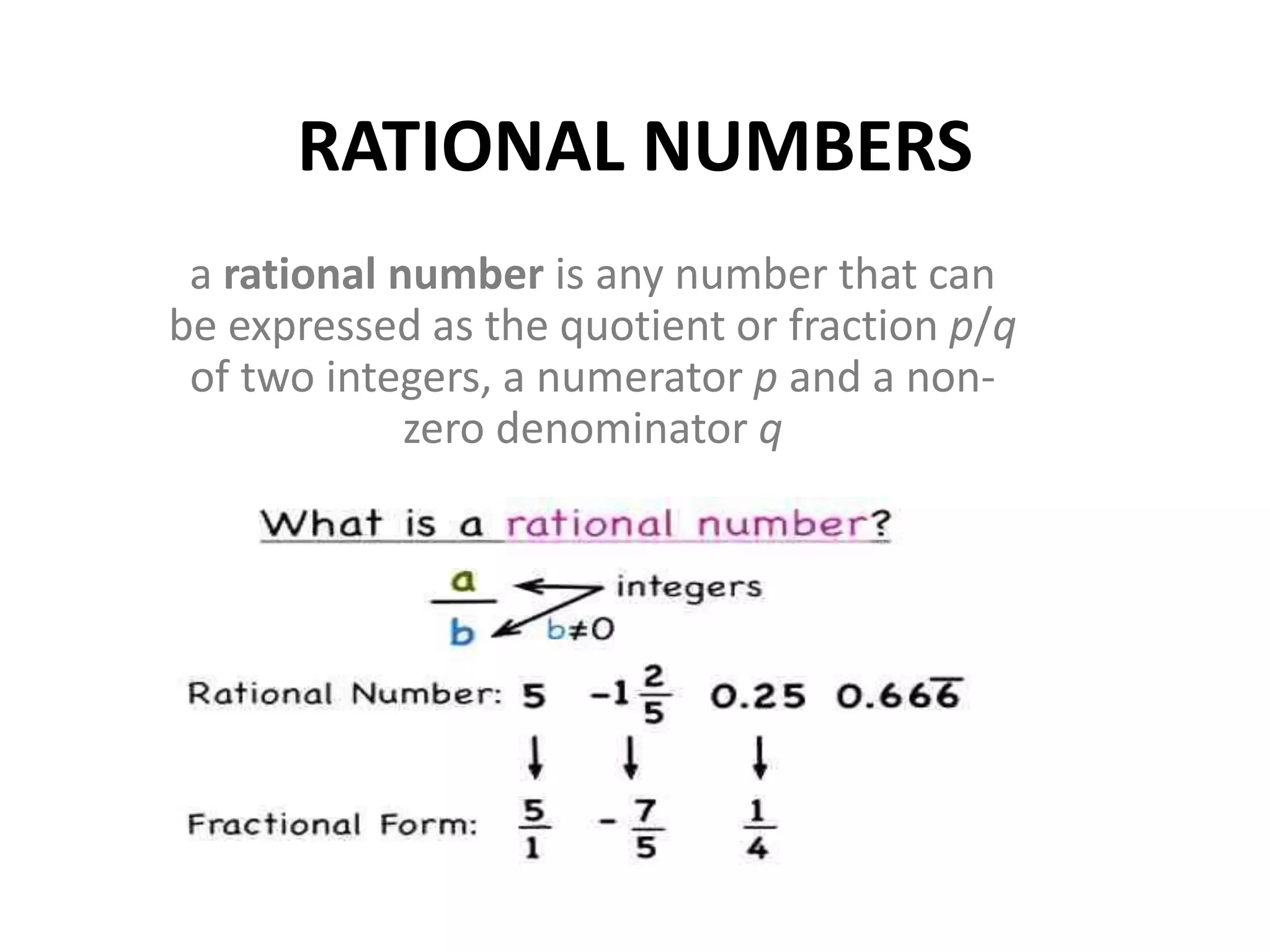
RATIONAL NUMBERS
a rational number is any number that can
be expressed as the quotient or fraction p/q
of two integers, a numerator p and a non-
zero denominator q
FIELD
A field is a set on which addition, subtraction,
multiplication, and division are defined, and
behave as when they are applied to rational
and real numbers. The best known fields are
the field of rational numbers and the field of
real numbers.
FIELD OF RATIONAL NUMBERS
The set of all rational numbers, often
referred to as "the rationals", the field
of rationals or the field of rational
numbers is usually denoted by a
boldface Q (or blackboard bold Q ,
Unicode ℚ)
Irrational Numbers
The irrationality of 2, at least in its geometric
form (the side and the diagonal of a square are
incommensurable) seems to have been
discovered by the Pythagoreans. Although by
the time of Euclid it was known that square
roots of non squares are irrational, Euclid’s
elements only contain the proof that √2 is not
rational; in this case, a proof can be given
depending only on the ‘theory of the odd and
the even’, as the Greeks called the most
elementary parts of number theory.
Some Historical Remarks
Long before mankind discovered 0 and the negative
numbers, they started working with positive rational
numbers. The Babylonians had sexagesimal fractions,
and the Egyptians essentially worked with pure
fractions, that is, those that can be written in the form
1 n . Every fraction was represented by a sum of
different pure fractions.
Fractions were not regarded as numbers in Euclid’s
elements; Eudoxos’ theory of proportions dealt with
magnitudes, that is, ‘lengths’ and ‘areas’ etc.
Archimedes and Diophantus, on the other hand,
worked freely with positive rational numbers.
Thank you

Field of rational numbers

  • 1.
    FIELD OF RATIONALNUMBERS AND INFINITE FIELD PRESENTED BY:- Pragya Subha Ramawat & Prabhjot Kaur
  • 2.
    CONTENTS • Introduction • Rationalnumber •Fields • Field of rational numbers •Irrational numbers •Historical remarks •Infinite field
  • 3.
    INTRODUCTION we are goingto construct the rational number from the integers. Historically, the positive rational numbers came first: the Babylonians, Egyptians and Greeks knew how to work with fractions, but negative numbers were introduced by the Hindus hundreds of years later. It is possible to reflect this in the build-up of the rationals from the natural numbers by first constructing the positive rational numbers from the naturals, and then introducing negatives (Landau proceeds like this in his Foundations of Analysis). While being closer to history, this has the disadvantage of getting a ring structure only at the end.
  • 4.
    RATIONAL NUMBERS a rationalnumber is any number that can be expressed as the quotient or fraction p/q of two integers, a numerator p and a non- zero denominator q
  • 5.
    FIELD A field isa set on which addition, subtraction, multiplication, and division are defined, and behave as when they are applied to rational and real numbers. The best known fields are the field of rational numbers and the field of real numbers.
  • 6.
    FIELD OF RATIONALNUMBERS The set of all rational numbers, often referred to as "the rationals", the field of rationals or the field of rational numbers is usually denoted by a boldface Q (or blackboard bold Q , Unicode ℚ)
  • 7.
    Irrational Numbers The irrationalityof 2, at least in its geometric form (the side and the diagonal of a square are incommensurable) seems to have been discovered by the Pythagoreans. Although by the time of Euclid it was known that square roots of non squares are irrational, Euclid’s elements only contain the proof that √2 is not rational; in this case, a proof can be given depending only on the ‘theory of the odd and the even’, as the Greeks called the most elementary parts of number theory.
  • 8.
    Some Historical Remarks Longbefore mankind discovered 0 and the negative numbers, they started working with positive rational numbers. The Babylonians had sexagesimal fractions, and the Egyptians essentially worked with pure fractions, that is, those that can be written in the form 1 n . Every fraction was represented by a sum of different pure fractions. Fractions were not regarded as numbers in Euclid’s elements; Eudoxos’ theory of proportions dealt with magnitudes, that is, ‘lengths’ and ‘areas’ etc. Archimedes and Diophantus, on the other hand, worked freely with positive rational numbers.
  • 10.