The FIDO Approach
to PrivacyHannes Tschofenig, ARM Limited
1
Privacy by Design History
2
• Ann	Cavoukian,	the	former	Information	and	Privacy	
Commissioner	of	Ontario/Canada,	coined	the	term	
“Privacy	by	Design”	back	in	the	late	90’s.	
• Idea	was	to	take	privacy	into	account	already	early	in	
the	design	process.
• Cavoukian went	a	step	further	and	developed	7	
principles.	
• It	took	years	to	investigate	the	idea	further	and	to	
become	familiar	with	privacy	as	an	engineering	
concept.
Privacy Principles
3
https://fidoalliance.org/wp-content/uploads/2014/12/FIDO_Alliance_Whitepaper_Privacy_Principles.pdf
4
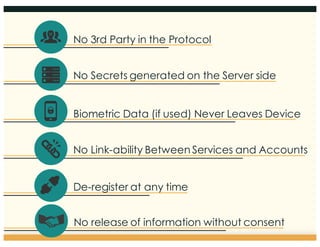
No 3rd Party in the Protocol
No Secrets generated on the Server side
Biometric Data (if used) Never Leaves Device
No Link-ability Between Services and Accounts
De-register at any time
No release of information without consent
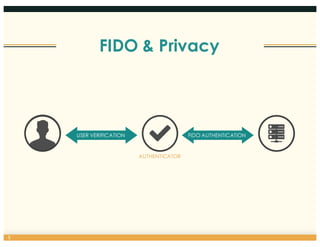
FIDO & Privacy
AUTHENTICATOR
5
USER VERIFICATION FIDO AUTHENTICATION
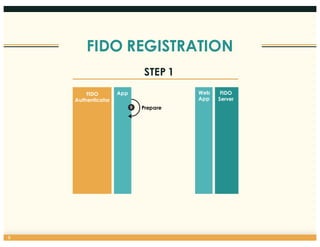
Prepare0
STEP 1
FIDO
Authenticator
FIDO
Server
App Web
App
6
FIDO REGISTRATION
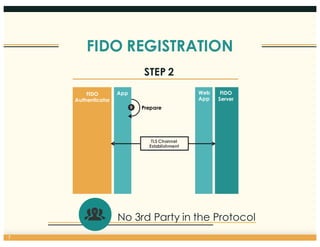
FIDO REGISTRATION
Prepare0
STEP 2
FIDO
Authenticator
FIDO
Server
App Web
App
7
TLS Channel
Establishment
1
No 3rd Party in the Protocol
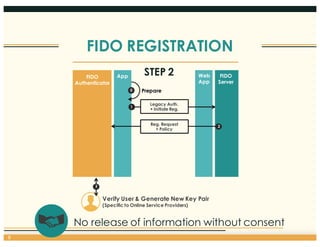
FIDO REGISTRATION
Prepare0
STEP 2FIDO
Authenticator
FIDO
Server
App Web
App
8
Verify User & Generate New Key Pair
(Specific to Online Service Providers)
Legacy Auth.
+ Initiate Reg.
Reg. Request
+ Policy
1
2
3
No release of information without consent
FIDO REGISTRATION
Prepare0
STEP 3
FIDO
Authenticator
FIDO
Server
App Web
App
9
3
Legacy Auth.
+ Initiate Reg.
Reg. Request
[Policy]
1
2
Reg. Response4
Verify User & Generate New Key Pair
(Specific to Online Service Providers)
No Secrets generated on the Server side
10
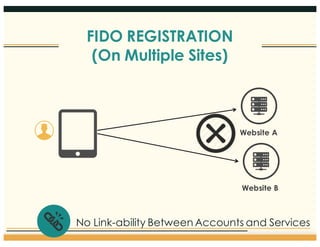
No Link-ability Between Accounts and Services
Website A
Website B
FIDO REGISTRATION
(On Multiple Sites)
FIDO REGISTRATION
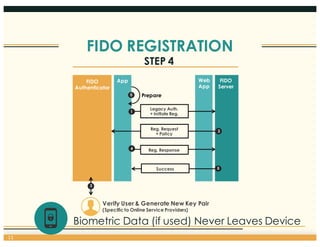
Prepare0
STEP 4
FIDO
Authenticator
FIDO
Server
App Web
App
11
3
Verify User & Generate New Key Pair
(Specific to Online Service Providers)
Success 5
Legacy Auth.
+ Initiate Reg.
Reg. Request
+ Policy
1
2
Reg. Response4
Biometric Data (if used) Never Leaves Device
PERSONAL DATA
12
Application-specific Data
Depending on the service
(e.g., shipping address, credit card details)
User Verification Data
Biometric data
(e.g., fingerprint or voice template,
heart-rate variation data)
FIDO-related Data
Identifiers used by
the FIDO and protocols
(e.g., public key, key handle)
Data
Minimization,
Purpose
Limitation
and
protection
against
unauthorized
access
Outside the
scope of
FIDO
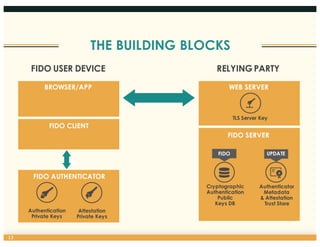
THE BUILDING BLOCKS
BROWSER/APP
FIDO USER DEVICE RELYING PARTY
WEB SERVER
FIDO AUTHENTICATOR
FIDO SERVER
FIDO CLIENT
ASM
TLS Server Key
Cryptographic
Authentication
Public
Keys DB
Authentication
Private Keys
Attestation
Private Keys
Authenticator
Metadata
& Attestation
Trust Store
FIDO UPDATE
13
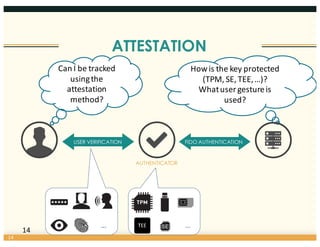
ATTESTATION
14
… …SE
How	is	the	key	protected	
(TPM,	SE,	TEE,	…)?
What	user	gesture	is	
used?
14
Can	I	be	tracked	
using	the	
attestation	
method?	
AUTHENTICATOR
USER VERIFICATION FIDO AUTHENTICATION
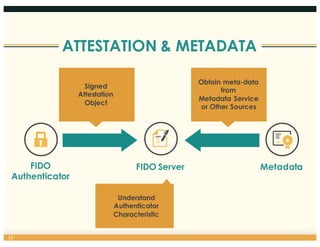
ATTESTATION & METADATA
FIDO ServerFIDO
Authenticator
Metadata
Signed
Attestation
Object
Obtain meta-data
from
Metadata Service
or Other Sources
Understand
Authenticator
Characteristic
15
ATTESTATION & METADATA
16
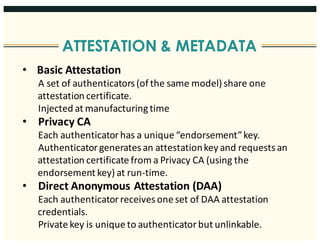
• Basic	Attestation
A	set	of	authenticators	(of	the	same	model)	share	one	
attestation	certificate.	
Injected	at	manufacturing	time
• Privacy	CA
Each	authenticator	has	a	unique	“endorsement”	key.
Authenticator	generates	an	attestation	key	and	requests	an	
attestation	certificate	from	a	Privacy	CA	(using	the	
endorsement	key)	at	run-time.
• Direct	Anonymous	Attestation	(DAA)
Each	authenticator	receives	one	set	of	DAA	attestation	
credentials.	
Private	key	is	unique	to	authenticator	but	unlinkable.
Mapping to Regulatory
Requirements
17
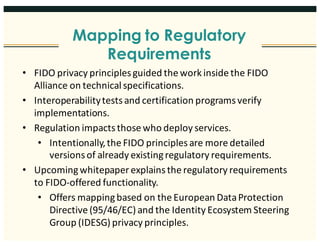
• FIDO	privacy	principles	guided	the	work	inside	the	FIDO	
Alliance	on	technical	specifications.	
• Interoperability	tests	and	certification	programs	verify	
implementations.
• Regulation	impacts	those	who	deploy	services.	
• Intentionally,	the	FIDO	principles	are	more	detailed	
versions	of	already	existing	regulatory	requirements.		
• Upcoming	whitepaper	explains	the	regulatory	requirements	
to	FIDO-offered	functionality.
• Offers	mapping	based	on	the	European	Data	Protection	
Directive	(95/46/EC)	and	the	Identity	Ecosystem	Steering	
Group	(IDESG)	privacy	principles.
Summary
18
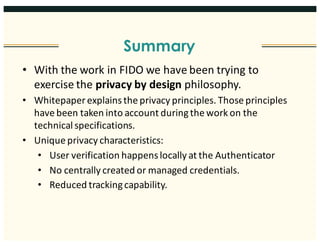
• With	the	work	in	FIDO	we	have	been	trying	to	
exercise	the	privacy	by	design philosophy.	
• Whitepaper	explains	the	privacy	principles.	Those	principles	
have	been	taken	into	account	during	the	work	on	the	
technical	specifications.	
• Unique	privacy	characteristics:
• User	verification	happens	locally	at	the	Authenticator
• No	centrally	created	or	managed	credentials.	
• Reduced	tracking	capability.

FIDO Privacy Principles and Approach