Preparing for
the Interview
Rachel Lynch | Support Group Facilitator FibroIreland
Fibromy-WHAT?
Understanding &
Managing Fibromyalgia
Understanding Fibro
 Definitions of Fibromyalgia, ME/CFS
 Symptoms
 Pain cycle
 The 3 Ps
 How do you get it?
 Breaking the pain cycle
 Multidisciplinary approach
 Where do I start?
 Therapeutic Interventions
 Latest Research
 Conclusion
Traditional Definition
 This definition describes Fibromyalgia as fibre
muscle pain that is widespread and chronic.
 - Fibro (fibres)
 - my (muscles)
 - algia (pain)
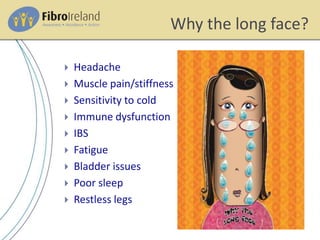
Why the long face?
 Headache
 Muscle pain/stiffness
 Sensitivity to cold
 Immune dysfunction
 IBS
 Fatigue
 Bladder issues
 Poor sleep
 Restless legs
Am I off my trolley?
 Cognitive dysfunction called fibro fog
• Poor concentration
• Difficulty in understanding speech
• Difficulty in speaking
• Reading dysfunction
• Memory problems
• Bumping into things
• Dropping things
• Diminished comprehension
• Anxiety/Depression
• Panic attacks
Newer Definition
 Research is now pointing to the CNS. Fibro is a
neurological hypersensitivity syndrome resulting
in over activity of the sensory and autonomic
nervous pathways.
 In layman's terms Fibro is a change in the way
the brain and spinal cord 'listen' to the body.
Diagnosis
 Doctors used criteria set in 2010 by the American College of
Rheumatology (ACR) to diagnose the syndrome. According to these rules,
you have fibromyalgia if both of the following are true:
 You experience constant pain in all four quadrants of the body (left and
right sides, above and below the waist) for at least three consecutive
months
 You have tenderness in at least 11 of the 18 tender points associated
with fibromyalgia
 Criteria updated to include Widespread Pain Index (WPI) that involves a
checklist of 19 areas of the body.
 Symptom Severity score (SS) uses categories unrelated to pain (including
fatigue, cognitive problems, etc.)
 WPI score greater than 7 and SS score greater than 5
 WPI score between 3 and 6 and SS score greater than 9
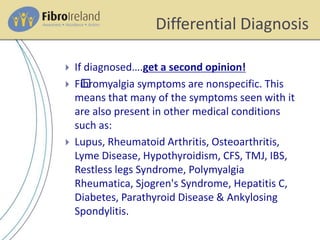
Differential Diagnosis
 If diagnosed….get a second opinion!
 Fibromyalgia symptoms are nonspecific. This
means that many of the symptoms seen with it
are also present in other medical conditions
such as:
 Lupus, Rheumatoid Arthritis, Osteoarthritis,
Lyme Disease, Hypothyroidism, CFS, TMJ, IBS,
Restless legs Syndrome, Polymyalgia
Rheumatica, Sjogren's Syndrome, Hepatitis C,
Diabetes, Parathyroid Disease & Ankylosing
Spondylitis.
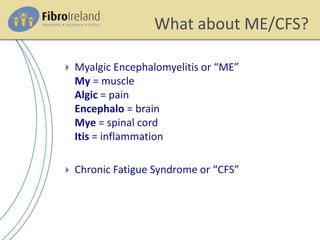
What about ME/CFS?
 Myalgic Encephalomyelitis or “ME”
My = muscle
Algic = pain
Encephalo = brain
Mye = spinal cord
Itis = inflammation
 Chronic Fatigue Syndrome or “CFS”
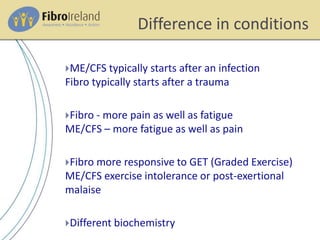
Difference in conditions
ME/CFS typically starts after an infection
Fibro typically starts after a trauma
Fibro - more pain as well as fatigue
ME/CFS – more fatigue as well as pain
Fibro more responsive to GET (Graded Exercise)
ME/CFS exercise intolerance or post-exertional
malaise
Different biochemistry
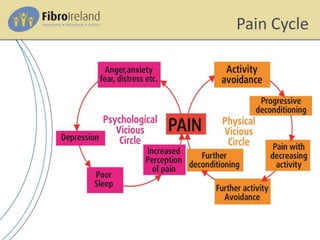
Pain Cycle
The 3 Ps
 Predisposition
Genetics, being female, personality traits, early trauma.
 Precipitating
These are events that precede the onset of Fibromyalgia. They
represent a change in situation, either biologically or
environmentally, and are often quite identifiable.
 Perpetuating
These are the factors which can stop us from recovering. Unless
addressed, they can erode and destroy the efforts being made by
the person, their family and their doctor in overcoming
Fibromyalgia.
How do you get it?
 1. Cervical trauma - 25% developed it as a result of a neck trauma.
 2. Toxic exposure - E.g. a mechanic breathing in exhaust fumes 8 hrs a day.
 3. Stress based - Exposure to long-term stress leads to adrenal fatigue and
interferes with sleep creating a pain-stress cycle.
 4. Food – allergies, intolerance and poor nutrition.
 5. Perimenopause - Hormonal disturbances and chemical imbalances affect
nerve signaling.
 6. Immunisation - Bad reaction to immunisation and never fully recover.
 7. Genetic predisposition - Family history of diabetes, thyroid, hypermobility and
scoliosis.
 8. Gender - If you're female you are more likely to get it. Ratio is 6:1
 9. Insect Bite- Lyme disease or associated co-infections
Breaking the Pain cycle
Multidisciplinary Approach
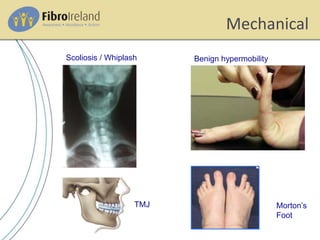
Mechanical
• Spine • Hypermobility • TMJ • Morton’s Foot
Biochemical
• Diet • Environmental toxins • Medication
Emotional
• Self-care • CBT • Letting go • Sleep hygiene
Great…but where do I start?
 Consider how personal relationships are
affecting recovery.
 Designate a partner in wellness.
 Prioritise symptoms and deal with most
troublesome ones first.
 Get a good health care team in place
e.g. GP, consultant, manual therapist &
counsellor.
 Review your sleep, nutrition, movement,
medications and stress management.
 Remember…Action before motivation.
Mechanical
Scoliosis / Whiplash Benign hypermobility
TMJ Morton’s
Foot
Treatments
 Chiropractor
 Osteopath
 Physio
 Amatsu
 Shiatsu
 Frequency Specific Microcurrent
 Lymphatic drainage
 Myofasical release
 Dry needling
 Bowen technique
 Acupuncture
 Reflexology
 Alexander technique
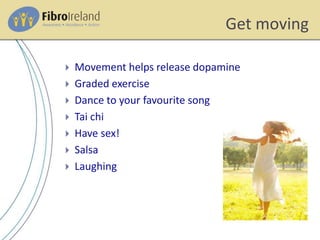
Get moving
 Movement helps release dopamine
 Graded exercise
 Dance to your favourite song
 Tai chi
 Have sex!
 Salsa
 Laughing
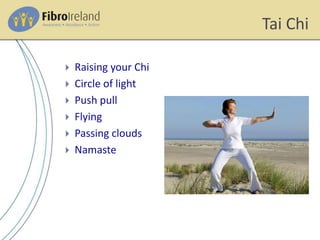
Tai Chi
 Raising your Chi
 Circle of light
 Push pull
 Flying
 Passing clouds
 Namaste
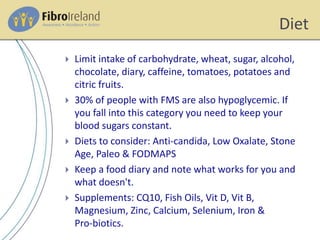
Diet
 Limit intake of carbohydrate, wheat, sugar, alcohol,
chocolate, diary, caffeine, tomatoes, potatoes and
citric fruits.
 30% of people with FMS are also hypoglycemic. If
you fall into this category you need to keep your
blood sugars constant.
 Diets to consider: Anti-candida, Low Oxalate, Stone
Age, Paleo & FODMAPS
 Keep a food diary and note what works for you and
what doesn't.
 Supplements: CQ10, Fish Oils, Vit D, Vit B,
Magnesium, Zinc, Calcium, Selenium, Iron &
Pro-biotics.
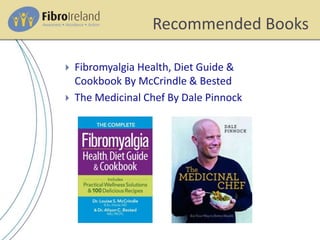
Recommended Books
 Fibromyalgia Health, Diet Guide &
Cookbook By McCrindle & Bested
 The Medicinal Chef By Dale Pinnock
FibroFridge
 Online peer support for nutrition at
www.facebook.com/groups/FibroFridg
e
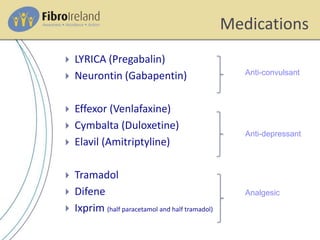
Medications
 LYRICA (Pregabalin)
 Neurontin (Gabapentin)
 Effexor (Venlafaxine)
 Cymbalta (Duloxetine)
 Elavil (Amitriptyline)
 Tramadol
 Difene
 Ixprim (half paracetamol and half tramadol)
Anti-convulsant
Anti-depressant
Analgesic
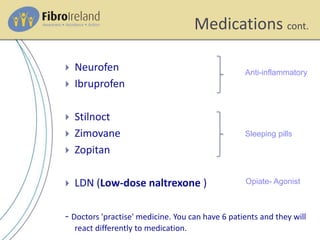
Medications cont.
 Neurofen
 Ibruprofen
 Stilnoct
 Zimovane
 Zopitan
 LDN (Low-dose naltrexone )
- Doctors 'practise' medicine. You can have 6 patients and they will
react differently to medication.
Anti-inflammatory
Sleeping pills
Opiate- Agonist
Counselling/CBT/AT
 Cognitive Behavourial Therapy
 Deals with the here and now
 Set realistic goals
 Identify triggers
 Understand dysfunctional thought patterns
 Counteract negative automatic thoughts
 Autogenic Training
 Relaxation technique to improve skills in
stress and/or pain management.
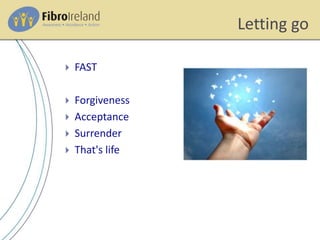
Letting go
 FAST
 Forgiveness
 Acceptance
 Surrender
 That's life
Sleep
 No caffeine after 4pm. No liquids after 7pm
 Bedroom is only for the 3 S’s - Sleep, sex & sick
 No naps
 Establish a regular go to bed time & wake up time
 Change the stress to ‘enjoy the rest’
 Dump your day
 Exercise but not too close to bed time
 If you are not asleep within 20 mins get up
 No heavy meals before bedtime
 Is snoring or sleep apnea a problem?
Latest Research
 Pridgen and Duffy (USA)
Stressors could result in recurrent reactivations of latent
herpes virus infections, which could lead to the development
of fibromyalgia
Famciclovir + celecoxib combination treatment currently in
phase III trials.
 Dr. Minerbi (Canada)
A research team has shown, for the first time, that there are
alterations in the bacteria in the gastrointestinal tracts of
people with fibromyalgia. Approximately 20 different species
of bacteria were found in either greater or are lesser
quantities in the microbiomes of participants suffering from
the disease than in the healthy control group.
Conclusion
 Fibromyalgia is real and is manageable
 It is different from ME/CFS
 Get an accurate diagnosis
 Utilise a multidisciplinary approach
 You are what you eat
 You are what you think
 Learn to say No!
 Get a partner in wellness
 Find true connection with yourself and others
 Action before motivation

Fibromywhat

  • 1.
    Preparing for the Interview RachelLynch | Support Group Facilitator FibroIreland Fibromy-WHAT? Understanding & Managing Fibromyalgia
  • 2.
    Understanding Fibro  Definitionsof Fibromyalgia, ME/CFS  Symptoms  Pain cycle  The 3 Ps  How do you get it?  Breaking the pain cycle  Multidisciplinary approach  Where do I start?  Therapeutic Interventions  Latest Research  Conclusion
  • 3.
    Traditional Definition  Thisdefinition describes Fibromyalgia as fibre muscle pain that is widespread and chronic.  - Fibro (fibres)  - my (muscles)  - algia (pain)
  • 4.
    Why the longface?  Headache  Muscle pain/stiffness  Sensitivity to cold  Immune dysfunction  IBS  Fatigue  Bladder issues  Poor sleep  Restless legs
  • 5.
    Am I offmy trolley?  Cognitive dysfunction called fibro fog • Poor concentration • Difficulty in understanding speech • Difficulty in speaking • Reading dysfunction • Memory problems • Bumping into things • Dropping things • Diminished comprehension • Anxiety/Depression • Panic attacks
  • 6.
    Newer Definition  Researchis now pointing to the CNS. Fibro is a neurological hypersensitivity syndrome resulting in over activity of the sensory and autonomic nervous pathways.  In layman's terms Fibro is a change in the way the brain and spinal cord 'listen' to the body.
  • 7.
    Diagnosis  Doctors usedcriteria set in 2010 by the American College of Rheumatology (ACR) to diagnose the syndrome. According to these rules, you have fibromyalgia if both of the following are true:  You experience constant pain in all four quadrants of the body (left and right sides, above and below the waist) for at least three consecutive months  You have tenderness in at least 11 of the 18 tender points associated with fibromyalgia  Criteria updated to include Widespread Pain Index (WPI) that involves a checklist of 19 areas of the body.  Symptom Severity score (SS) uses categories unrelated to pain (including fatigue, cognitive problems, etc.)  WPI score greater than 7 and SS score greater than 5  WPI score between 3 and 6 and SS score greater than 9
  • 8.
    Differential Diagnosis  Ifdiagnosed….get a second opinion!  Fibromyalgia symptoms are nonspecific. This means that many of the symptoms seen with it are also present in other medical conditions such as:  Lupus, Rheumatoid Arthritis, Osteoarthritis, Lyme Disease, Hypothyroidism, CFS, TMJ, IBS, Restless legs Syndrome, Polymyalgia Rheumatica, Sjogren's Syndrome, Hepatitis C, Diabetes, Parathyroid Disease & Ankylosing Spondylitis.
  • 9.
    What about ME/CFS? Myalgic Encephalomyelitis or “ME” My = muscle Algic = pain Encephalo = brain Mye = spinal cord Itis = inflammation  Chronic Fatigue Syndrome or “CFS”
  • 10.
    Difference in conditions ME/CFStypically starts after an infection Fibro typically starts after a trauma Fibro - more pain as well as fatigue ME/CFS – more fatigue as well as pain Fibro more responsive to GET (Graded Exercise) ME/CFS exercise intolerance or post-exertional malaise Different biochemistry
  • 11.
  • 12.
    The 3 Ps Predisposition Genetics, being female, personality traits, early trauma.  Precipitating These are events that precede the onset of Fibromyalgia. They represent a change in situation, either biologically or environmentally, and are often quite identifiable.  Perpetuating These are the factors which can stop us from recovering. Unless addressed, they can erode and destroy the efforts being made by the person, their family and their doctor in overcoming Fibromyalgia.
  • 13.
    How do youget it?  1. Cervical trauma - 25% developed it as a result of a neck trauma.  2. Toxic exposure - E.g. a mechanic breathing in exhaust fumes 8 hrs a day.  3. Stress based - Exposure to long-term stress leads to adrenal fatigue and interferes with sleep creating a pain-stress cycle.  4. Food – allergies, intolerance and poor nutrition.  5. Perimenopause - Hormonal disturbances and chemical imbalances affect nerve signaling.  6. Immunisation - Bad reaction to immunisation and never fully recover.  7. Genetic predisposition - Family history of diabetes, thyroid, hypermobility and scoliosis.  8. Gender - If you're female you are more likely to get it. Ratio is 6:1  9. Insect Bite- Lyme disease or associated co-infections
  • 14.
    Breaking the Paincycle Multidisciplinary Approach Mechanical • Spine • Hypermobility • TMJ • Morton’s Foot Biochemical • Diet • Environmental toxins • Medication Emotional • Self-care • CBT • Letting go • Sleep hygiene
  • 15.
    Great…but where doI start?  Consider how personal relationships are affecting recovery.  Designate a partner in wellness.  Prioritise symptoms and deal with most troublesome ones first.  Get a good health care team in place e.g. GP, consultant, manual therapist & counsellor.  Review your sleep, nutrition, movement, medications and stress management.  Remember…Action before motivation.
  • 16.
    Mechanical Scoliosis / WhiplashBenign hypermobility TMJ Morton’s Foot
  • 17.
    Treatments  Chiropractor  Osteopath Physio  Amatsu  Shiatsu  Frequency Specific Microcurrent  Lymphatic drainage  Myofasical release  Dry needling  Bowen technique  Acupuncture  Reflexology  Alexander technique
  • 18.
    Get moving  Movementhelps release dopamine  Graded exercise  Dance to your favourite song  Tai chi  Have sex!  Salsa  Laughing
  • 19.
    Tai Chi  Raisingyour Chi  Circle of light  Push pull  Flying  Passing clouds  Namaste
  • 20.
    Diet  Limit intakeof carbohydrate, wheat, sugar, alcohol, chocolate, diary, caffeine, tomatoes, potatoes and citric fruits.  30% of people with FMS are also hypoglycemic. If you fall into this category you need to keep your blood sugars constant.  Diets to consider: Anti-candida, Low Oxalate, Stone Age, Paleo & FODMAPS  Keep a food diary and note what works for you and what doesn't.  Supplements: CQ10, Fish Oils, Vit D, Vit B, Magnesium, Zinc, Calcium, Selenium, Iron & Pro-biotics.
  • 21.
    Recommended Books  FibromyalgiaHealth, Diet Guide & Cookbook By McCrindle & Bested  The Medicinal Chef By Dale Pinnock
  • 22.
    FibroFridge  Online peersupport for nutrition at www.facebook.com/groups/FibroFridg e
  • 23.
    Medications  LYRICA (Pregabalin) Neurontin (Gabapentin)  Effexor (Venlafaxine)  Cymbalta (Duloxetine)  Elavil (Amitriptyline)  Tramadol  Difene  Ixprim (half paracetamol and half tramadol) Anti-convulsant Anti-depressant Analgesic
  • 24.
    Medications cont.  Neurofen Ibruprofen  Stilnoct  Zimovane  Zopitan  LDN (Low-dose naltrexone ) - Doctors 'practise' medicine. You can have 6 patients and they will react differently to medication. Anti-inflammatory Sleeping pills Opiate- Agonist
  • 25.
    Counselling/CBT/AT  Cognitive BehavourialTherapy  Deals with the here and now  Set realistic goals  Identify triggers  Understand dysfunctional thought patterns  Counteract negative automatic thoughts  Autogenic Training  Relaxation technique to improve skills in stress and/or pain management.
  • 26.
    Letting go  FAST Forgiveness  Acceptance  Surrender  That's life
  • 27.
    Sleep  No caffeineafter 4pm. No liquids after 7pm  Bedroom is only for the 3 S’s - Sleep, sex & sick  No naps  Establish a regular go to bed time & wake up time  Change the stress to ‘enjoy the rest’  Dump your day  Exercise but not too close to bed time  If you are not asleep within 20 mins get up  No heavy meals before bedtime  Is snoring or sleep apnea a problem?
  • 28.
    Latest Research  Pridgenand Duffy (USA) Stressors could result in recurrent reactivations of latent herpes virus infections, which could lead to the development of fibromyalgia Famciclovir + celecoxib combination treatment currently in phase III trials.  Dr. Minerbi (Canada) A research team has shown, for the first time, that there are alterations in the bacteria in the gastrointestinal tracts of people with fibromyalgia. Approximately 20 different species of bacteria were found in either greater or are lesser quantities in the microbiomes of participants suffering from the disease than in the healthy control group.
  • 29.
    Conclusion  Fibromyalgia isreal and is manageable  It is different from ME/CFS  Get an accurate diagnosis  Utilise a multidisciplinary approach  You are what you eat  You are what you think  Learn to say No!  Get a partner in wellness  Find true connection with yourself and others  Action before motivation