Alissa Caron
Migraines: The Mystery
  Revealed (Or Not…)
Alissa Caron

March 26, 2012
WHAT IS A MIGRAINE, AND WHY DOES IT
                HAPPEN?

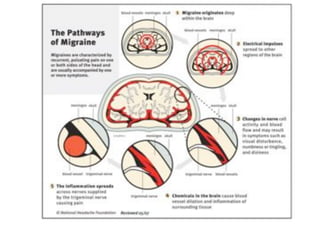
!! A migraine is caused by abnormal brain activity.
!! However, the exact sequence of events leading to
   a migraine remains unclear:
  !!   Doctors think that attacks begin in the brain and then
       spreads via nerve signals to affect other pathways
       throughout the body.
!! The  headache itself causes intense pain (normally
   on one side of the head) that lasts from 4 hours to
   3 days.
!! Migraine headaches often begin to affect people in
   childhood, adolescence, or early adulthood.
4 STAGES OF A MIGRAINE HEADACHE


           Prodrome:
     1-2 days before migraine:
    subtle changes including depression,
  irritability, hyperactivity, constipation,
   diarrhea, food cravings, neck stiffness
4 STAGES OF A MIGRAINE HEADACHE


               Aura:
Visual or sensory disturbances 10-15
     minutes before migraine:
blurred vision, bright spots, loss of vision, pins
   and needles in arms and/or legs, speech
                    problems
4 STAGES OF A MIGRAINE HEADACHE

                     Attack:
        pulsating pain on one side of the head
       sensitivity to light, sound, and/or smells
                 nausea and vomiting
                     blurred vision
                         diarrhea
              lightheadedness, fainting
                 numbness, tingling
                        chills
                      sweating
                 increased urination
  problems concentrating or speaking the right words
4 STAGES OF A MIGRAINE HEADACHE


   Postdrome, aka migraine
           hangover:
  After the attack, you will feel
drained, and these symptoms may
              linger:
Lack of clear thinking, weariness (need for
             sleep), neck pain
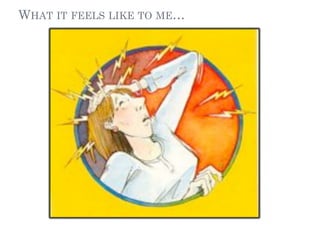
WHAT IT FEELS LIKE TO ME…
IN CASE YOU THINK YOU HAVE MIGRAINES…
!! Migraines   normally continue undiagnosed and
   untreated. If you regularly experience the signs
   and symptoms, start to keep a journal of your
   attacks and visit your doctor…
!! If you have typical migraine symptoms and/or
   family history, your doctor can diagnose migraines
   based on your medical history.
!! In addition, the following tests can be done to rule
   out critical causes for pain:
                    Blood Work and Urinalysis
                    Computerized tomography (CT) scan
                    Magnetic resonance imaging (MRI)
                    Spinal tap
“DIAGNOSIS OF EXCLUSION”
!! The   bottom line of diagnosis is that…


There is NO specific test that can be performed
   to prove that your headache is actually a
             migraine. Tough luck!


!! Current   scientific understanding is limited.
MIGRAINE TREATMENT
!! Preventive
            medications: taken regularly (often daily), to
 reduce the severity or frequency of migraines.
  !!   Beta blockers (Inderal) , calcium channel blockers (Calan)
  !!   Tricyclic antidepressants (amitriptyline)
  !!   Anti-seizure drugs (Topamax)


!! Pain-relieving
               medications: acute or abortive treatment,
 taken during migraine attacks, designed to stop
 symptoms that have already begun.
  !!   Modest pain relievers (ibuprofen, acetaminophen)
  !!   Triptans (Relpax, Imitrex, Zomig): most effective
  !!   Ergot (ergotamine + caffeine): less effective
COMPLICATIONS FROM TREATMENT

!! Rebound headaches: medications taken often and/or
 in high doses can start to cause additional
 headaches

!! Abdominal pain, bleeding, ulcers from high doses of
 certain pain relievers (ex/ ibuprofen)

!! Life-threatening
                  serotonin syndrome if taking
 certain migraine medicines (triptans, ex/ Zomig,
 Imitrex) and selective serotonin reuptake inhibitors
 (SSRIs) or serotonin-norepinephrine reuptake
 inhibitors (SNRIs) anti-depressants simultaneously
THE MYSTERY OF MIGRAINES: WHO                    GETS
THEM AND WHY?

!! Family history: Some sources claim that 90%           of
   people with migraines have a family history of migraine
   attacks.
!! Age:!Migraine can begin at any age, though most
   people experience their first migraine during their
   teenage years.
!! Gender: Women are three times more likely to have
   migraines than men. During childhood, headaches tend
   to affect boys more than girls, but by adolescence, more
   girls are affected.
!! Hormonal changes: Women may experience
   migraines just before or after their period. During
   pregnancy, attacks may be more intense during the first
   trimester but should occur less frequently during the
   rest of the pregnancy.
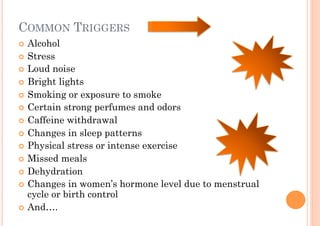
COMMON TRIGGERS
!! Alcohol
!! Stress
!! Loud noise
!! Bright lights
!! Smoking or exposure to smoke
!! Certain strong perfumes and odors
!! Caffeine withdrawal
!! Changes in sleep patterns
!! Physical stress or intense exercise
!! Missed meals
!! Dehydration
!! Changes in women’s hormone level due to menstrual
   cycle or birth control
!! And….
…AND FOOD! WHO KNEW?
!! More than 100 foods contain certain chemicals that
   are known to set off migraines.! These chemicals
   include tannin, nitrates, sulfites, monosodium
   glutamate (MSG), tyramine, and phenylethylamine (in
   aspartame). The most common food triggers are:
!! Any processed, fermented, pickled, or marinated foods
!! Baked goods, chocolate, nuts, peanut butter, and dairy
   products
!! Foods containing tyramine: red wine, aged cheeses,
   smoked fish, chicken livers, figs, and certain beans
!! Some fruits: avocado, banana, citrus fruit, tomato
!! Meats containing nitrates: bacon, hot dogs, salami,
   cured meats
!! Onions
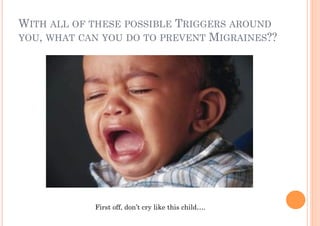
WITH ALL OF THESE POSSIBLE TRIGGERS AROUND
YOU, WHAT CAN YOU DO TO PREVENT MIGRAINES??


            First off, don’t cry like this child….
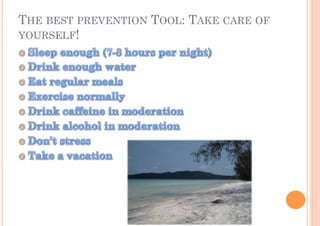
THE BEST PREVENTION TOOL: TAKE CARE OF
YOURSELF!
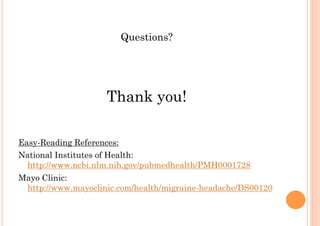
Questions?


                    Thank you!

Easy-Reading References:
National Institutes of Health:
  http://www.ncbi.nlm.nih.gov/pubmedhealth/PMH0001728
Mayo Clinic:
 http://www.mayoclinic.com/health/migraine-headache/DS00120
Thank You!
Alissa Caron

Alissa Caron - Migraines: The Mystery Revealed (Or Not...)

  • 2.
    Alissa Caron Migraines: TheMystery Revealed (Or Not…)
  • 3.
  • 5.
    WHAT IS AMIGRAINE, AND WHY DOES IT HAPPEN? !! A migraine is caused by abnormal brain activity. !! However, the exact sequence of events leading to a migraine remains unclear: !! Doctors think that attacks begin in the brain and then spreads via nerve signals to affect other pathways throughout the body. !! The headache itself causes intense pain (normally on one side of the head) that lasts from 4 hours to 3 days. !! Migraine headaches often begin to affect people in childhood, adolescence, or early adulthood.
  • 7.
    4 STAGES OFA MIGRAINE HEADACHE Prodrome: 1-2 days before migraine: subtle changes including depression, irritability, hyperactivity, constipation, diarrhea, food cravings, neck stiffness
  • 8.
    4 STAGES OFA MIGRAINE HEADACHE Aura: Visual or sensory disturbances 10-15 minutes before migraine: blurred vision, bright spots, loss of vision, pins and needles in arms and/or legs, speech problems
  • 9.
    4 STAGES OFA MIGRAINE HEADACHE Attack: pulsating pain on one side of the head sensitivity to light, sound, and/or smells nausea and vomiting blurred vision diarrhea lightheadedness, fainting numbness, tingling chills sweating increased urination problems concentrating or speaking the right words
  • 10.
    4 STAGES OFA MIGRAINE HEADACHE Postdrome, aka migraine hangover: After the attack, you will feel drained, and these symptoms may linger: Lack of clear thinking, weariness (need for sleep), neck pain
  • 11.
    WHAT IT FEELSLIKE TO ME…
  • 12.
    IN CASE YOUTHINK YOU HAVE MIGRAINES… !! Migraines normally continue undiagnosed and untreated. If you regularly experience the signs and symptoms, start to keep a journal of your attacks and visit your doctor… !! If you have typical migraine symptoms and/or family history, your doctor can diagnose migraines based on your medical history. !! In addition, the following tests can be done to rule out critical causes for pain: Blood Work and Urinalysis Computerized tomography (CT) scan Magnetic resonance imaging (MRI) Spinal tap
  • 13.
    “DIAGNOSIS OF EXCLUSION” !!The bottom line of diagnosis is that… There is NO specific test that can be performed to prove that your headache is actually a migraine. Tough luck! !! Current scientific understanding is limited.
  • 14.
    MIGRAINE TREATMENT !! Preventive medications: taken regularly (often daily), to reduce the severity or frequency of migraines. !! Beta blockers (Inderal) , calcium channel blockers (Calan) !! Tricyclic antidepressants (amitriptyline) !! Anti-seizure drugs (Topamax) !! Pain-relieving medications: acute or abortive treatment, taken during migraine attacks, designed to stop symptoms that have already begun. !! Modest pain relievers (ibuprofen, acetaminophen) !! Triptans (Relpax, Imitrex, Zomig): most effective !! Ergot (ergotamine + caffeine): less effective
  • 15.
    COMPLICATIONS FROM TREATMENT !!Rebound headaches: medications taken often and/or in high doses can start to cause additional headaches !! Abdominal pain, bleeding, ulcers from high doses of certain pain relievers (ex/ ibuprofen) !! Life-threatening serotonin syndrome if taking certain migraine medicines (triptans, ex/ Zomig, Imitrex) and selective serotonin reuptake inhibitors (SSRIs) or serotonin-norepinephrine reuptake inhibitors (SNRIs) anti-depressants simultaneously
  • 16.
    THE MYSTERY OFMIGRAINES: WHO GETS THEM AND WHY? !! Family history: Some sources claim that 90% of people with migraines have a family history of migraine attacks. !! Age:!Migraine can begin at any age, though most people experience their first migraine during their teenage years. !! Gender: Women are three times more likely to have migraines than men. During childhood, headaches tend to affect boys more than girls, but by adolescence, more girls are affected. !! Hormonal changes: Women may experience migraines just before or after their period. During pregnancy, attacks may be more intense during the first trimester but should occur less frequently during the rest of the pregnancy.
  • 17.
    COMMON TRIGGERS !! Alcohol !!Stress !! Loud noise !! Bright lights !! Smoking or exposure to smoke !! Certain strong perfumes and odors !! Caffeine withdrawal !! Changes in sleep patterns !! Physical stress or intense exercise !! Missed meals !! Dehydration !! Changes in women’s hormone level due to menstrual cycle or birth control !! And….
  • 18.
    …AND FOOD! WHOKNEW? !! More than 100 foods contain certain chemicals that are known to set off migraines.! These chemicals include tannin, nitrates, sulfites, monosodium glutamate (MSG), tyramine, and phenylethylamine (in aspartame). The most common food triggers are: !! Any processed, fermented, pickled, or marinated foods !! Baked goods, chocolate, nuts, peanut butter, and dairy products !! Foods containing tyramine: red wine, aged cheeses, smoked fish, chicken livers, figs, and certain beans !! Some fruits: avocado, banana, citrus fruit, tomato !! Meats containing nitrates: bacon, hot dogs, salami, cured meats !! Onions
  • 19.
    WITH ALL OFTHESE POSSIBLE TRIGGERS AROUND YOU, WHAT CAN YOU DO TO PREVENT MIGRAINES?? First off, don’t cry like this child….
  • 20.
    THE BEST PREVENTIONTOOL: TAKE CARE OF YOURSELF!
  • 21.
    Questions? Thank you! Easy-Reading References: National Institutes of Health: http://www.ncbi.nlm.nih.gov/pubmedhealth/PMH0001728 Mayo Clinic: http://www.mayoclinic.com/health/migraine-headache/DS00120
  • 22.