LOGO 
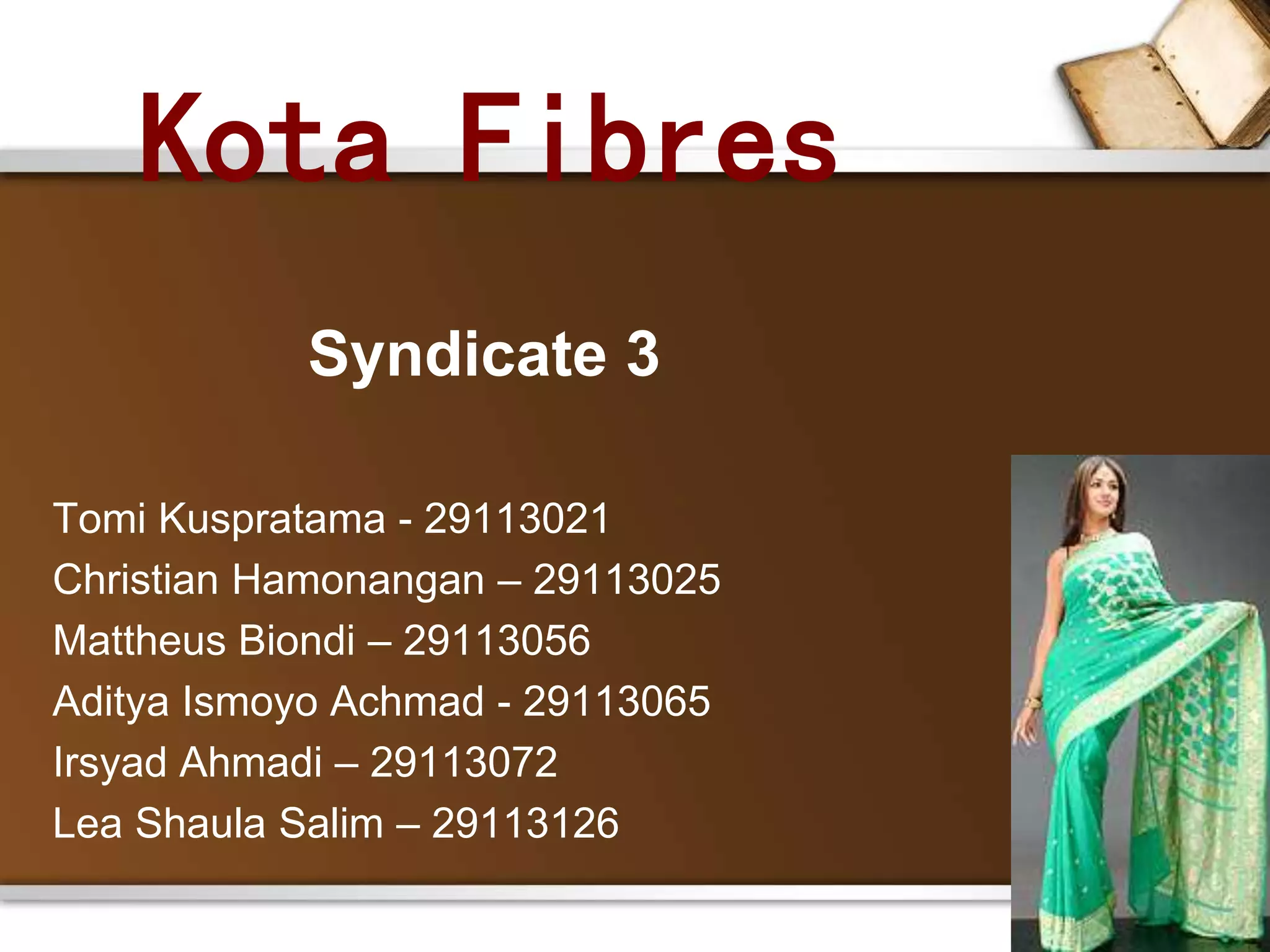
Kota Fibres 
Syndicate 3 
Tomi Kuspratama - 29113021 
Christian Hamonangan – 29113025 
Mattheus Biondi – 29113056 
Aditya Ismoyo Achmad - 29113065 
Irsyad Ahmadi – 29113072 
Lea Shaula Salim – 29113126
LOGO 
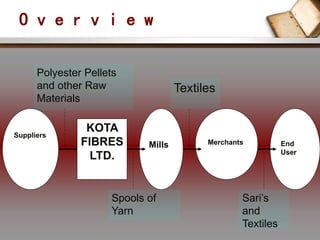
O v e r v i e w 
Suppliers 
KOTA 
FIBRES 
LTD. 
Merchants End 
User 
Mills 
Polyester Pellets 
and other Raw 
Materials 
Spools of 
Yarn 
Textiles 
Sari’s 
and 
Textiles
LOGO 
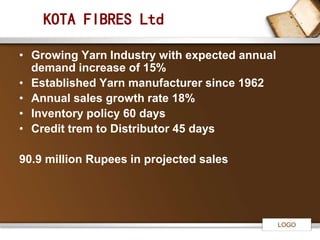
KOTA FIBRES Ltd 
• Growing Yarn Industry with expected annual 
demand increase of 15% 
• Established Yarn manufacturer since 1962 
• Annual sales growth rate 18% 
• Inventory policy 60 days 
• Credit trem to Distributor 45 days 
90.9 million Rupees in projected sales
LOGO 
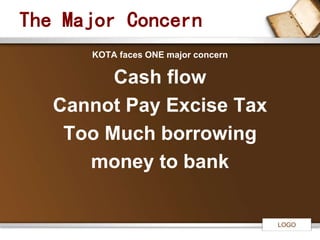
The Major Concern 
KOTA faces ONE major concern 
Cash flow 
Cannot Pay Excise Tax 
Too Much borrowing 
money to bank
LOGO 
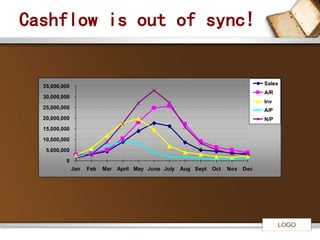
Cashflow is out of sync! 
35,000,000 
30,000,000 
25,000,000 
20,000,000 
15,000,000 
10,000,000 
5,000,000 
0 
Jan Feb Mar April May June July Aug Sept Oct Nov Dec 
Sales 
A/R 
Inv 
A/P 
N/P
The following issues surfaced in 2001 
with Kota Fibres, Ltd.: 
LOGO 
• 1. Payment of excise tax to move their product 
2. Line of credit not being repaid according to the 
term. 
3. Request for new loans from All-India Bank & Trust 
Company. 
4. Due to inflation, interest rate may be higher in 
upcoming year on the loans
LOGO 
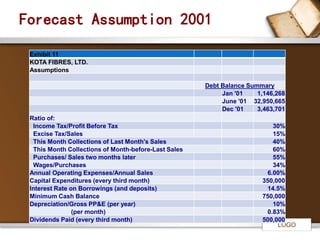
Forecast Assumption 2001 
Exhibit 11 
KOTA FIBRES, LTD. 
Assumptions 
Debt Balance Summary 
Jan '01 1,146,268 
June '01 32,950,665 
Dec '01 3,463,701 
Ratio of: 
Income Tax/Profit Before Tax 30% 
Excise Tax/Sales 15% 
This Month Collections of Last Month's Sales 40% 
This Month Collections of Month-before-Last Sales 60% 
Purchases/ Sales two months later 55% 
Wages/Purchases 34% 
Annual Operating Expenses/Annual Sales 6.00% 
Capital Expenditures (every third month) 350,000 
Interest Rate on Borrowings (and deposits) 14.5% 
Minimum Cash Balance 750,000 
Depreciation/Gross PP&E (per year) 10% 
(per month) 0.83% 
Dividends Paid (every third month) 500,000
LOGO 
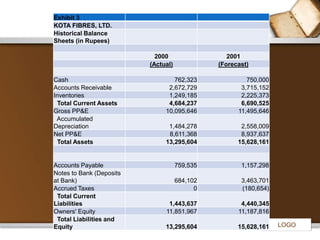
Exhibit 3 
KOTA FIBRES, LTD. 
Historical Balance 
Sheets (in Rupees) 
2000 2001 
(Actual) (Forecast) 
Cash 762,323 750,000 
Accounts Receivable 2,672,729 3,715,152 
Inventories 1,249,185 2,225,373 
Total Current Assets 4,684,237 6,690,525 
Gross PP&E 10,095,646 11,495,646 
Accumulated 
Depreciation 1,484,278 2,558,009 
Net PP&E 8,611,368 8,937,637 
Total Assets 13,295,604 15,628,161 
Accounts Payable 759,535 1,157,298 
Notes to Bank (Deposits 
at Bank) 684,102 3,463,701 
Accrued Taxes 0 (180,654) 
Total Current 
Liabilities 1,443,637 4,440,345 
Owners' Equity 11,851,967 11,187,816 
Total Liabilities and 
Equity 13,295,604 15,628,161
LOGO 
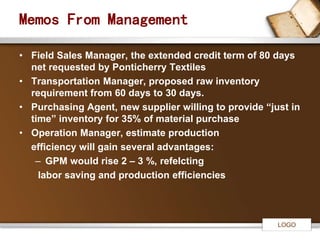
Memos From Management 
• Field Sales Manager, the extended credit term of 80 days 
net requested by Ponticherry Textiles 
• Transportation Manager, proposed raw inventory 
requirement from 60 days to 30 days. 
• Purchasing Agent, new supplier willing to provide “just in 
time” inventory for 35% of material purchase 
• Operation Manager, estimate production 
efficiency will gain several advantages: 
– GPM would rise 2 – 3 %, refelcting 
labor saving and production efficiencies
LOGO 
Critical Questioning 
• Why the company still lend the money to the bank? 
Beside, in 2000 the company has a good financial 
condition or in state gaining profit. 
• Mrs. Pundir believe if we stick on the Mr. Metha 
forecast model, the bank will not lend the money 
again to us. So, Mrs. Pundir wants to modified the 
forecast model. Which is the best modified forecast 
model for our company?
LOGO 
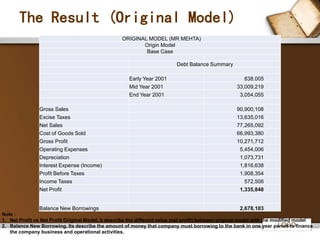
The Result (Original Model) 
ORIGINAL MODEL (MR MEHTA) 
Origin Model 
Base Case 
Debt Balance Summary 
Early Year 2001 838,005 
Mid Year 2001 33,009,219 
End Year 2001 3,054,055 
Gross Sales 90,900,108 
Excise Taxes 13,635,016 
Net Sales 77,265,092 
Cost of Goods Sold 66,993,380 
Gross Profit 10,271,712 
Operating Expenses 5,454,006 
Depreciation 1,073,731 
Interest Expense (Income) 1,816,638 
Profit Before Taxes 1,908,354 
Income Taxes 572,506 
Net Profit 1,335,848 
Balance New Borrowings 2,678,103 
Note : 
1. Net Profit vs Net Profit Original Model, it describe the different value (net profit) between original model with the modified model 
2. Balance New Borrowing, Its describe the amount of money that company must borrowing to the bank in one year period to finance 
the company business and operational activities.
LOGO 
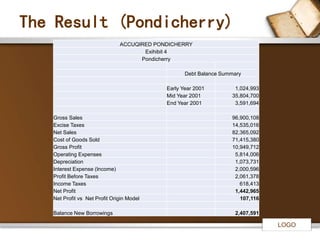
The Result (Pondicherry) 
ACCUQIRED PONDICHERRY 
Exihibit 4 
Pondicherry 
Debt Balance Summary 
Early Year 2001 1,024,993 
Mid Year 2001 35,804,700 
End Year 2001 3,591,694 
Gross Sales 96,900,108 
Excise Taxes 14,535,016 
Net Sales 82,365,092 
Cost of Goods Sold 71,415,380 
Gross Profit 10,949,712 
Operating Expenses 5,814,006 
Depreciation 1,073,731 
Interest Expense (Income) 2,000,596 
Profit Before Taxes 2,061,378 
Income Taxes 618,413 
Net Profit 1,442,965 
Net Profit vs Net Profit Origin Model 107,116 
Balance New Borrowings 2,407,591
LOGO 
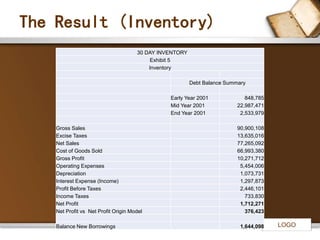
The Result (Inventory) 
30 DAY INVENTORY 
Exhibit 5 
Inventory 
Debt Balance Summary 
Early Year 2001 848,785 
Mid Year 2001 22,987,471 
End Year 2001 2,533,979 
Gross Sales 90,900,108 
Excise Taxes 13,635,016 
Net Sales 77,265,092 
Cost of Goods Sold 66,993,380 
Gross Profit 10,271,712 
Operating Expenses 5,454,006 
Depreciation 1,073,731 
Interest Expense (Income) 1,297,873 
Profit Before Taxes 2,446,101 
Income Taxes 733,830 
Net Profit 1,712,271 
Net Profit vs Net Profit Origin Model 376,423 
Balance New Borrowings 1,644,098
LOGO 
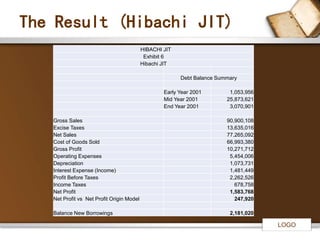
The Result (Hibachi JIT) 
HIBACHI JIT 
Exhibit 6 
Hibachi JIT 
Debt Balance Summary 
Early Year 2001 1,053,956 
Mid Year 2001 25,873,621 
End Year 2001 3,070,901 
Gross Sales 90,900,108 
Excise Taxes 13,635,016 
Net Sales 77,265,092 
Cost of Goods Sold 66,993,380 
Gross Profit 10,271,712 
Operating Expenses 5,454,006 
Depreciation 1,073,731 
Interest Expense (Income) 1,481,449 
Profit Before Taxes 2,262,526 
Income Taxes 678,758 
Net Profit 1,583,768 
Net Profit vs Net Profit Origin Model 247,920 
Balance New Borrowings 2,181,020
LOGO 
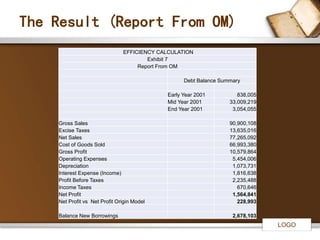
The Result (Report From OM) 
EFFICIENCY CALCULATION 
Exhibit 7 
Report From OM 
Debt Balance Summary 
Early Year 2001 838,005 
Mid Year 2001 33,009,219 
End Year 2001 3,054,055 
Gross Sales 90,900,108 
Excise Taxes 13,635,016 
Net Sales 77,265,092 
Cost of Goods Sold 66,993,380 
Gross Profit 10,579,864 
Operating Expenses 5,454,006 
Depreciation 1,073,731 
Interest Expense (Income) 1,816,638 
Profit Before Taxes 2,235,488 
Income Taxes 670,646 
Net Profit 1,564,841 
Net Profit vs Net Profit Origin Model 228,993 
Balance New Borrowings 2,678,103
LOGO 
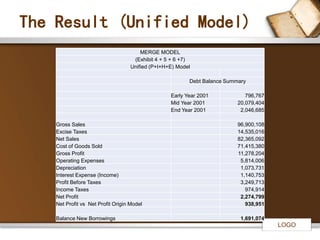
The Result (Unified Model) 
MERGE MODEL 
(Exhibit 4 + 5 + 6 +7) 
Unified (P+I+H+E) Model 
Debt Balance Summary 
Early Year 2001 796,767 
Mid Year 2001 20,079,404 
End Year 2001 2,046,685 
Gross Sales 96,900,108 
Excise Taxes 14,535,016 
Net Sales 82,365,092 
Cost of Goods Sold 71,415,380 
Gross Profit 11,278,204 
Operating Expenses 5,814,006 
Depreciation 1,073,731 
Interest Expense (Income) 1,140,753 
Profit Before Taxes 3,249,713 
Income Taxes 974,914 
Net Profit 2,274,799 
Net Profit vs Net Profit Origin Model 938,951 
Balance New Borrowings 1,691,074
LOGO 
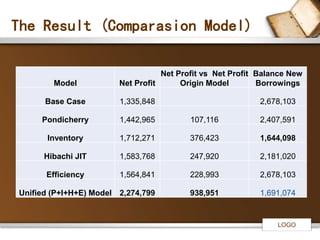
The Result (Comparasion Model) 
Model Net Profit 
Net Profit vs Net Profit 
Origin Model 
Balance New 
Borrowings 
Base Case 1,335,848 2,678,103 
Pondicherry 1,442,965 107,116 2,407,591 
Inventory 1,712,271 376,423 1,644,098 
Hibachi JIT 1,583,768 247,920 2,181,020 
Efficiency 1,564,841 228,993 2,678,103 
Unified (P+I+H+E) Model 2,274,799 938,951 1,691,074
LOGO 
Final Analysis 
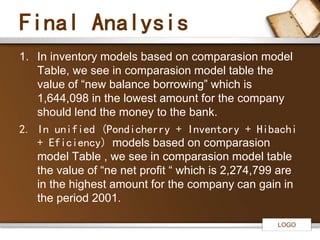
1. In inventory models based on comparasion model 
Table, we see in comparasion model table the 
value of “new balance borrowing” which is 
1,644,098 in the lowest amount for the company 
should lend the money to the bank. 
2. In unified (Pondicherry + Inventory + Hibachi 
+ Eficiency) models based on comparasion 
model Table , we see in comparasion model table 
the value of “ne net profit “ which is 2,274,799 are 
in the highest amount for the company can gain in 
the period 2001.
LOGO 
Conclussion (Part 1) 
1. If the company wants reduce the money 
should lend to the bank as less as possible, 
the forecast model we recommended to the 
Mrs.Pundir are “Inventory Model”. 
2. If the company wants had a good financial 
performance, the model we recommended 
to the Mrs.Pundir are “Unified Model”. 
Which is provide the largest profit and can 
be a good promised for submit the loan 
proposal to the bank.
LOGO 
Conclussion (Part 2) 
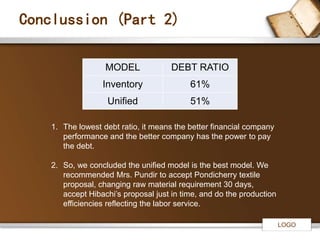
MODEL DEBT RATIO 
Inventory 61% 
Unified 51% 
1. The lowest debt ratio, it means the better financial company 
performance and the better company has the power to pay 
the debt. 
2. So, we concluded the unified model is the best model. We 
recommended Mrs. Pundir to accept Pondicherry textile 
proposal, changing raw material requirement 30 days, 
accept Hibachi’s proposal just in time, and do the production 
efficiencies reflecting the labor service.

Fibres City

  • 1.
    LOGO Kota Fibres Syndicate 3 Tomi Kuspratama - 29113021 Christian Hamonangan – 29113025 Mattheus Biondi – 29113056 Aditya Ismoyo Achmad - 29113065 Irsyad Ahmadi – 29113072 Lea Shaula Salim – 29113126
  • 2.
    LOGO O ve r v i e w Suppliers KOTA FIBRES LTD. Merchants End User Mills Polyester Pellets and other Raw Materials Spools of Yarn Textiles Sari’s and Textiles
  • 3.
    LOGO KOTA FIBRESLtd • Growing Yarn Industry with expected annual demand increase of 15% • Established Yarn manufacturer since 1962 • Annual sales growth rate 18% • Inventory policy 60 days • Credit trem to Distributor 45 days 90.9 million Rupees in projected sales
  • 4.
    LOGO The MajorConcern KOTA faces ONE major concern Cash flow Cannot Pay Excise Tax Too Much borrowing money to bank
  • 5.
    LOGO Cashflow isout of sync! 35,000,000 30,000,000 25,000,000 20,000,000 15,000,000 10,000,000 5,000,000 0 Jan Feb Mar April May June July Aug Sept Oct Nov Dec Sales A/R Inv A/P N/P
  • 6.
    The following issuessurfaced in 2001 with Kota Fibres, Ltd.: LOGO • 1. Payment of excise tax to move their product 2. Line of credit not being repaid according to the term. 3. Request for new loans from All-India Bank & Trust Company. 4. Due to inflation, interest rate may be higher in upcoming year on the loans
  • 7.
    LOGO Forecast Assumption2001 Exhibit 11 KOTA FIBRES, LTD. Assumptions Debt Balance Summary Jan '01 1,146,268 June '01 32,950,665 Dec '01 3,463,701 Ratio of: Income Tax/Profit Before Tax 30% Excise Tax/Sales 15% This Month Collections of Last Month's Sales 40% This Month Collections of Month-before-Last Sales 60% Purchases/ Sales two months later 55% Wages/Purchases 34% Annual Operating Expenses/Annual Sales 6.00% Capital Expenditures (every third month) 350,000 Interest Rate on Borrowings (and deposits) 14.5% Minimum Cash Balance 750,000 Depreciation/Gross PP&E (per year) 10% (per month) 0.83% Dividends Paid (every third month) 500,000
  • 8.
    LOGO Exhibit 3 KOTA FIBRES, LTD. Historical Balance Sheets (in Rupees) 2000 2001 (Actual) (Forecast) Cash 762,323 750,000 Accounts Receivable 2,672,729 3,715,152 Inventories 1,249,185 2,225,373 Total Current Assets 4,684,237 6,690,525 Gross PP&E 10,095,646 11,495,646 Accumulated Depreciation 1,484,278 2,558,009 Net PP&E 8,611,368 8,937,637 Total Assets 13,295,604 15,628,161 Accounts Payable 759,535 1,157,298 Notes to Bank (Deposits at Bank) 684,102 3,463,701 Accrued Taxes 0 (180,654) Total Current Liabilities 1,443,637 4,440,345 Owners' Equity 11,851,967 11,187,816 Total Liabilities and Equity 13,295,604 15,628,161
  • 9.
    LOGO Memos FromManagement • Field Sales Manager, the extended credit term of 80 days net requested by Ponticherry Textiles • Transportation Manager, proposed raw inventory requirement from 60 days to 30 days. • Purchasing Agent, new supplier willing to provide “just in time” inventory for 35% of material purchase • Operation Manager, estimate production efficiency will gain several advantages: – GPM would rise 2 – 3 %, refelcting labor saving and production efficiencies
  • 10.
    LOGO Critical Questioning • Why the company still lend the money to the bank? Beside, in 2000 the company has a good financial condition or in state gaining profit. • Mrs. Pundir believe if we stick on the Mr. Metha forecast model, the bank will not lend the money again to us. So, Mrs. Pundir wants to modified the forecast model. Which is the best modified forecast model for our company?
  • 11.
    LOGO The Result(Original Model) ORIGINAL MODEL (MR MEHTA) Origin Model Base Case Debt Balance Summary Early Year 2001 838,005 Mid Year 2001 33,009,219 End Year 2001 3,054,055 Gross Sales 90,900,108 Excise Taxes 13,635,016 Net Sales 77,265,092 Cost of Goods Sold 66,993,380 Gross Profit 10,271,712 Operating Expenses 5,454,006 Depreciation 1,073,731 Interest Expense (Income) 1,816,638 Profit Before Taxes 1,908,354 Income Taxes 572,506 Net Profit 1,335,848 Balance New Borrowings 2,678,103 Note : 1. Net Profit vs Net Profit Original Model, it describe the different value (net profit) between original model with the modified model 2. Balance New Borrowing, Its describe the amount of money that company must borrowing to the bank in one year period to finance the company business and operational activities.
  • 12.
    LOGO The Result(Pondicherry) ACCUQIRED PONDICHERRY Exihibit 4 Pondicherry Debt Balance Summary Early Year 2001 1,024,993 Mid Year 2001 35,804,700 End Year 2001 3,591,694 Gross Sales 96,900,108 Excise Taxes 14,535,016 Net Sales 82,365,092 Cost of Goods Sold 71,415,380 Gross Profit 10,949,712 Operating Expenses 5,814,006 Depreciation 1,073,731 Interest Expense (Income) 2,000,596 Profit Before Taxes 2,061,378 Income Taxes 618,413 Net Profit 1,442,965 Net Profit vs Net Profit Origin Model 107,116 Balance New Borrowings 2,407,591
  • 13.
    LOGO The Result(Inventory) 30 DAY INVENTORY Exhibit 5 Inventory Debt Balance Summary Early Year 2001 848,785 Mid Year 2001 22,987,471 End Year 2001 2,533,979 Gross Sales 90,900,108 Excise Taxes 13,635,016 Net Sales 77,265,092 Cost of Goods Sold 66,993,380 Gross Profit 10,271,712 Operating Expenses 5,454,006 Depreciation 1,073,731 Interest Expense (Income) 1,297,873 Profit Before Taxes 2,446,101 Income Taxes 733,830 Net Profit 1,712,271 Net Profit vs Net Profit Origin Model 376,423 Balance New Borrowings 1,644,098
  • 14.
    LOGO The Result(Hibachi JIT) HIBACHI JIT Exhibit 6 Hibachi JIT Debt Balance Summary Early Year 2001 1,053,956 Mid Year 2001 25,873,621 End Year 2001 3,070,901 Gross Sales 90,900,108 Excise Taxes 13,635,016 Net Sales 77,265,092 Cost of Goods Sold 66,993,380 Gross Profit 10,271,712 Operating Expenses 5,454,006 Depreciation 1,073,731 Interest Expense (Income) 1,481,449 Profit Before Taxes 2,262,526 Income Taxes 678,758 Net Profit 1,583,768 Net Profit vs Net Profit Origin Model 247,920 Balance New Borrowings 2,181,020
  • 15.
    LOGO The Result(Report From OM) EFFICIENCY CALCULATION Exhibit 7 Report From OM Debt Balance Summary Early Year 2001 838,005 Mid Year 2001 33,009,219 End Year 2001 3,054,055 Gross Sales 90,900,108 Excise Taxes 13,635,016 Net Sales 77,265,092 Cost of Goods Sold 66,993,380 Gross Profit 10,579,864 Operating Expenses 5,454,006 Depreciation 1,073,731 Interest Expense (Income) 1,816,638 Profit Before Taxes 2,235,488 Income Taxes 670,646 Net Profit 1,564,841 Net Profit vs Net Profit Origin Model 228,993 Balance New Borrowings 2,678,103
  • 16.
    LOGO The Result(Unified Model) MERGE MODEL (Exhibit 4 + 5 + 6 +7) Unified (P+I+H+E) Model Debt Balance Summary Early Year 2001 796,767 Mid Year 2001 20,079,404 End Year 2001 2,046,685 Gross Sales 96,900,108 Excise Taxes 14,535,016 Net Sales 82,365,092 Cost of Goods Sold 71,415,380 Gross Profit 11,278,204 Operating Expenses 5,814,006 Depreciation 1,073,731 Interest Expense (Income) 1,140,753 Profit Before Taxes 3,249,713 Income Taxes 974,914 Net Profit 2,274,799 Net Profit vs Net Profit Origin Model 938,951 Balance New Borrowings 1,691,074
  • 17.
    LOGO The Result(Comparasion Model) Model Net Profit Net Profit vs Net Profit Origin Model Balance New Borrowings Base Case 1,335,848 2,678,103 Pondicherry 1,442,965 107,116 2,407,591 Inventory 1,712,271 376,423 1,644,098 Hibachi JIT 1,583,768 247,920 2,181,020 Efficiency 1,564,841 228,993 2,678,103 Unified (P+I+H+E) Model 2,274,799 938,951 1,691,074
  • 18.
    LOGO Final Analysis 1. In inventory models based on comparasion model Table, we see in comparasion model table the value of “new balance borrowing” which is 1,644,098 in the lowest amount for the company should lend the money to the bank. 2. In unified (Pondicherry + Inventory + Hibachi + Eficiency) models based on comparasion model Table , we see in comparasion model table the value of “ne net profit “ which is 2,274,799 are in the highest amount for the company can gain in the period 2001.
  • 19.
    LOGO Conclussion (Part1) 1. If the company wants reduce the money should lend to the bank as less as possible, the forecast model we recommended to the Mrs.Pundir are “Inventory Model”. 2. If the company wants had a good financial performance, the model we recommended to the Mrs.Pundir are “Unified Model”. Which is provide the largest profit and can be a good promised for submit the loan proposal to the bank.
  • 20.
    LOGO Conclussion (Part2) MODEL DEBT RATIO Inventory 61% Unified 51% 1. The lowest debt ratio, it means the better financial company performance and the better company has the power to pay the debt. 2. So, we concluded the unified model is the best model. We recommended Mrs. Pundir to accept Pondicherry textile proposal, changing raw material requirement 30 days, accept Hibachi’s proposal just in time, and do the production efficiencies reflecting the labor service.