Fiber Optics Technology
Dr. A. USHARANI
Asst. Professor / AAGASC
KARAIKAL
Puducherry (UT)
Overview
• Basics of Fiber optics
• Structure of Fiber Optics
• Advantages
• Disadvantages
• Applications
• Conclusion
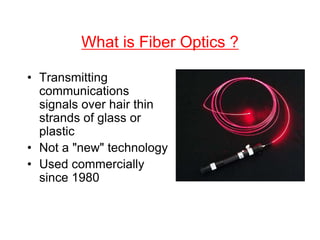
What is Fiber Optics ?
• Transmitting
communications
signals over hair thin
strands of glass or
plastic
• Not a "new" technology
• Used commercially
since 1980
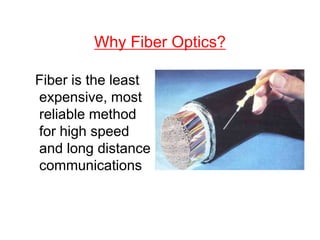
Why Fiber Optics?
Fiber is the least
expensive, most
reliable method
for high speed
and long distance
communications
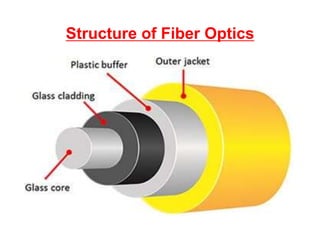
Structure of Fiber Optics
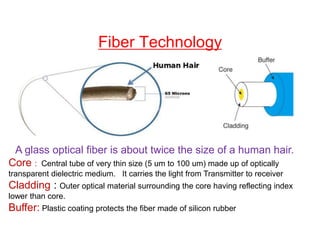
Fiber Technology
A glass optical fiber is about twice the size of a human hair.
Core : Central tube of very thin size (5 um to 100 um) made up of optically
transparent dielectric medium. It carries the light from Transmitter to receiver
Cladding : Outer optical material surrounding the core having reflecting index
lower than core.
Buffer: Plastic coating protects the fiber made of silicon rubber
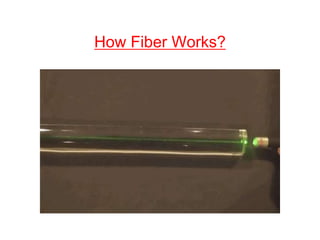
How Fiber Works?
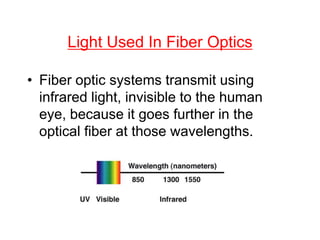
Light Used In Fiber Optics
• Fiber optic systems transmit using
infrared light, invisible to the human
eye, because it goes further in the
optical fiber at those wavelengths.
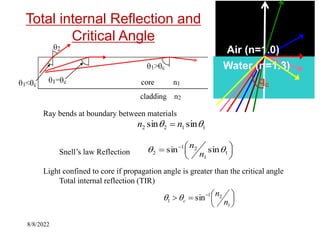
Ray bends at boundary between materials
Snell’s law Reflection
Light confined to core if propagation angle is greater than the critical angle
Total internal reflection (TIR)
1
1
2
2 sin
sin 
 n
n 






 
1
1
2
1
2 sin
sin 
 n
n







 
1
2
1
1 sin
n
n
c


Total internal Reflection and
Critical Angle
qc
Water (n=1.3)
Air (n=1.0)
8/8/2022
Fiber Optic Advantages
• Life of Fiber is longer than copper wire.
• Handling and installation cost is very nominal.
• Unaffected with electromagnetic interference.
• No additional equipment required for
protecting against grounding and voltage
problems.
• Doesn’t radiate energy. Any antenna or
detector cannot detect it, hence provides
signal security.
Fiber Optic Disadvantages
• Skilled staff would be required for
maintenance.
• Precise and costly instrument would be
required.
• Costly if underutilized.
• Jointing of Fiber and Splicing is a time
consuming.
Fiber Optic Applications
• In Tele communication field
• In Space Applications
• Broadband applications
• Computer Applications
• Medical Applications.
• Military Applications, etc.
Conclusion
• Now we looked at how Fiber Optics work and
how they are made.
• We examined the properties of Fibers,
discussed the Advantages, Disadvantages
and Application areas of Fiber Optics.
• Although this presentation does not cover all
the aspects of Fiber optics, it will be useful to
equip your knowledge & skills essential to the
Fiber optics industry.
Fiber optic technology final.ppt

Fiber optic technology final.ppt

  • 1.
    Fiber Optics Technology Dr.A. USHARANI Asst. Professor / AAGASC KARAIKAL Puducherry (UT)
  • 2.
    Overview • Basics ofFiber optics • Structure of Fiber Optics • Advantages • Disadvantages • Applications • Conclusion
  • 3.
    What is FiberOptics ? • Transmitting communications signals over hair thin strands of glass or plastic • Not a "new" technology • Used commercially since 1980
  • 4.
    Why Fiber Optics? Fiberis the least expensive, most reliable method for high speed and long distance communications
  • 5.
  • 6.
    Fiber Technology A glassoptical fiber is about twice the size of a human hair. Core : Central tube of very thin size (5 um to 100 um) made up of optically transparent dielectric medium. It carries the light from Transmitter to receiver Cladding : Outer optical material surrounding the core having reflecting index lower than core. Buffer: Plastic coating protects the fiber made of silicon rubber
  • 7.
  • 8.
    Light Used InFiber Optics • Fiber optic systems transmit using infrared light, invisible to the human eye, because it goes further in the optical fiber at those wavelengths.
  • 9.
    Ray bends atboundary between materials Snell’s law Reflection Light confined to core if propagation angle is greater than the critical angle Total internal reflection (TIR) 1 1 2 2 sin sin   n n          1 1 2 1 2 sin sin   n n          1 2 1 1 sin n n c   Total internal Reflection and Critical Angle qc Water (n=1.3) Air (n=1.0) 8/8/2022
  • 10.
    Fiber Optic Advantages •Life of Fiber is longer than copper wire. • Handling and installation cost is very nominal. • Unaffected with electromagnetic interference. • No additional equipment required for protecting against grounding and voltage problems. • Doesn’t radiate energy. Any antenna or detector cannot detect it, hence provides signal security.
  • 11.
    Fiber Optic Disadvantages •Skilled staff would be required for maintenance. • Precise and costly instrument would be required. • Costly if underutilized. • Jointing of Fiber and Splicing is a time consuming.
  • 12.
    Fiber Optic Applications •In Tele communication field • In Space Applications • Broadband applications • Computer Applications • Medical Applications. • Military Applications, etc.
  • 13.
    Conclusion • Now welooked at how Fiber Optics work and how they are made. • We examined the properties of Fibers, discussed the Advantages, Disadvantages and Application areas of Fiber Optics. • Although this presentation does not cover all the aspects of Fiber optics, it will be useful to equip your knowledge & skills essential to the Fiber optics industry.