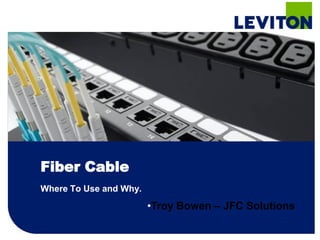
Fiber Cable
Where To Use and Why.
                        •Troy Bowen – JFC Solutions
Agenda
   Cable Types
        What?
        Why?
        Which used Where?
   Inside Plant
        Distribution
        Break-out
        Fire Rating - OFN, OFNR, OFNP
   Outside Plant
        Loose Tube
        Central Tube
        Water Blocking
        Armoring
   High Density
        Ribbon Cable
        Loose Tube
   Operation Specific
        Indoor / Outdoor
        ADSS
        OPGW
        Figure 8


 2
 CONFIDENTIAL
Fiber Optic Cables
   How do you choose the type of cable to use?
   Why use one over the other?
   What’s the big deal?


 3
 CONFIDENTIAL
Cable Types
   Primary Cable Types
        Indoor (ISP) – Tight Buffered design
             Tight-buffered cable is primarily used inside buildings.
             With tight-buffered cable designs, the buffering material is in direct contact with the fiber.
        This design is suited for
              "jumper cables" which connect outside plant cables to terminal equipment.
             linking various devices in a premises network.
             Multi-fiber, tight-buffered cables often are used for intra-building, risers, general building
             and plenum applications.
        Outdoor (OSP) – Loose Tube design
             Loose-tube cable is used in the majority of outside-plant installations.
             It is a modular design of buffer tubes which typically holds up to 12 fibers per buffer tube.
             They can be all-dielectric or armored.
             The modular buffer tube design permits easy drop-off of groups of fibers at intermediate
             points, without interfering with other protected buffer tubes being routed to other locations.
             The loose-tube design also helps in the identification and administration of fibers in the
             system.
   Why
        Environmental
             Heat, cold, water
        Physical Protection
             Sheath composition, number of sheaths, armoring, type of armor, number of armored wraps
        NFPA, OSHA, MSHA
             Non-rated, riser, plenum, LSZH, ship board, mining.
   Which used where


 4
 CONFIDENTIAL
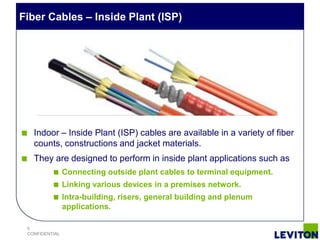
Fiber Cables – Inside Plant (ISP)


   Indoor – Inside Plant (ISP) cables are available in a variety of fiber
   counts, constructions and jacket materials.
   They are designed to perform in inside plant applications such as
                Connecting outside plant cables to terminal equipment.
                Linking various devices in a premises network.
                Intra-building, risers, general building and plenum
                applications.

 5
 CONFIDENTIAL
ISP Cables – Distribution
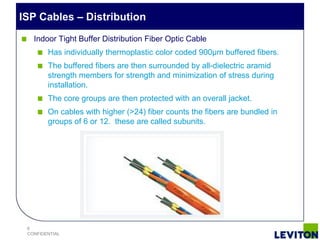
   Indoor Tight Buffer Distribution Fiber Optic Cable
        Has individually thermoplastic color coded 900μm buffered fibers.
        The buffered fibers are then surrounded by all-dielectric aramid
        strength members for strength and minimization of stress during
        installation.
        The core groups are then protected with an overall jacket.
        On cables with higher (>24) fiber counts the fibers are bundled in
        groups of 6 or 12. these are called subunits.


 6
 CONFIDENTIAL
ISP Cables – Breakout

   Indoor Tight Buffer Breakout Fiber Optic
   Cable
        900 μm tight buffered
         fibers
        Color coded for easy
        termination
        Flame Retardant
        UL listed for code
        compliance
        Direct connectorization


 7
 CONFIDENTIAL
ISP Cables – Fire Rating
   National Fire Protection Association® (NFPA®) NEC The NFPA/NEC develops and produces fire and safety
   codes relating to telecommunications. Article 770 of the National Electrical Code (NEC), also known as NFPA
   70, covers requirements for optical fiber cables.
   Fire Rating – Optical Fiber Cables are normally rated OFN, OFC, OFCR, OFNR, OFCP and OFNP
        OFN, stands for Optical Fiber Nonconductive Non-rated / OFC, stands for Optical Fiber Conductive Non-rated
        OFNR, stands for Optical Fiber Nonconductive Riser-rated/ OFCR, stands for Optical Fiber Conductive Riser-rated
        OFNP, stands for Optical Fiber Nonconductive Plenum-rated / OFCP, stands for Optical Fiber Conductive Plenum-
        rated
   NEC dictates where and how cables my be used within buildings.
        Non rated and General cables can be used in non-fire rated environments and these cables can be brought into a
        building < 50 ft.
        Riser Rated cables can be used in riser rated and non-fire rated environments.
        Plenum Rated cables can be used in plenum, riser and non-fire rated environments.


 8
 CONFIDENTIAL
Fiber Cables – Outside Plant (OSP)


   Outdoor – Outside Plant (OSP) cables are available in a variety of
   fiber counts, constructions and jacket materials.
   They are designed to perform in outside plant applications such as
        ducts,
        aerial and
        direct buried applications.

 9
 CONFIDENTIAL
OSP Cables – Duct, Conduit, Aerial
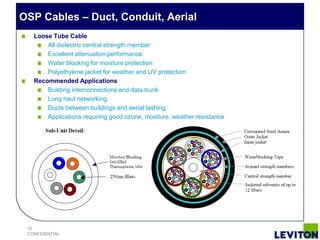
   Loose Tube Cable
       All dielectric central strength member
       Excellent attenuation performance
       Water blocking for moisture protection
       Polyethylene jacket for weather and UV protection
   Recommended Applications
       Building interconnections and data trunk
       Long haul networking
       Ducts between buildings and aerial lashing
       Applications requiring good ozone, moisture, weather resistance


 10
 CONFIDENTIAL
OSP Cables


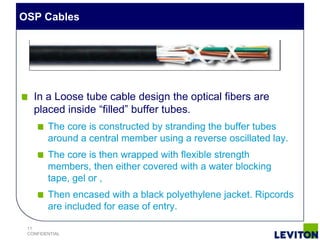
   In a Loose tube cable design the optical fibers are
   placed inside “filled” buffer tubes.
        The core is constructed by stranding the buffer tubes
        around a central member using a reverse oscillated lay.
        The core is then wrapped with flexible strength
        members, then either covered with a water blocking
        tape, gel or ,
        Then encased with a black polyethylene jacket. Ripcords
        are included for ease of entry.

 11
 CONFIDENTIAL
OSP Cables


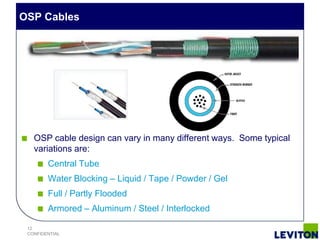
   OSP cable design can vary in many different ways. Some typical
   variations are:
        Central Tube
        Water Blocking – Liquid / Tape / Powder / Gel
        Full / Partly Flooded
        Armored – Aluminum / Steel / Interlocked

 12
 CONFIDENTIAL
ISP / OSP Cable Commonalities

   Fiber Types Supported
        Multimode
        Single mode
        Hybrid
   Physical Protection
        Armoring
        Aramid Yarn
   Fire Rating
        Riser –CMR or FT-4(indoor/outdoor)
        Plenum CMP or FT-6(tight buffer/MSHA)


 13
 CONFIDENTIAL
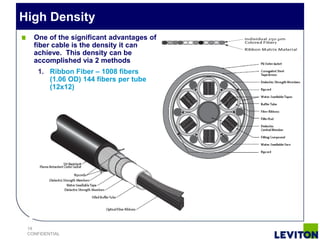
High Density
   One of the significant advantages of
   fiber cable is the density it can
   achieve. This density can be
   accomplished via 2 methods
    1. Ribbon Fiber – 1008 fibers
       (1.06 OD) 144 fibers per tube
       (12x12)


 14
 CONFIDENTIAL
High Density

2. High Count Loose Tube – 432
   fibers (.91 OD) 12 fibers per tube –
   36 tubes


 15
 CONFIDENTIAL
Application Specific
   In general, “indoor” implies that the cable has at minimum an NEC Fire Resistance Rating so that the
   cable is not subject to the typical 50-foot indoor length limitation that applies to outside plant (OSP)
   cables. “Outdoor” generally implies that the construction of the cable is such that it will withstand
   certain environmental extremes typically only experienced outdoors.
        Designs are available in loose-tube and tight-buffered construction and are suitable for all fiber
        types.
        Indoor/outdoor fiber optic cables are generally all-dielectric and thus exempt from the grounding
        issues inherent to copper conductor cables.
   Indoor / Outdoor Cable – This cable is water-blocked/sunlight resistant indoor/outdoor tight buffer –
   Riser Rated OFNR
        Indoor/outdoor cable offers a premises fiber optic cable versatility.
        Can be extended inside the building and not require a transition splice.
        Can be installed in open spaces, trays, conduits, inner-ducts, trenches, steam tunnels and building
        riser locations.
        Dry-water blocking technology eliminates the need to clean off the traditional gel-based water-
        blocking compounds
        Breakout kits and or other special termination equipment are not required
        Outer jacket is UL listed sunlight resistant polymer for exposure to long-term direct sunlight
        without the concern of material degradation.


 16
 CONFIDENTIAL
Application Specific
   ADSS - for use on distribution and
   high voltage transmission lines as it
   is unaffected by electromagnetic fields
   OPGW - dual functioning cable a
   static ground wire incorporating
   optical fibers into the design of the
   cable


   Figure 8 - black polyethylene outer jacket with integrated EHS steel messenger


 17
 CONFIDENTIAL
Obsolete Fiber Optic Connectors
                           Optimate
  The AMP Optimate was
  popular in the early
  80s. It used a conical
  plastic ferrule and
  screw-on nut. It was
  available for every fiber
  size including plastic
  fiber. Some may still be
  in use in utility and
  industrial systems.


18
CONFIDENTIAL

Fiber cable --where to use & why

  • 1.
    Fiber Cable Where ToUse and Why. •Troy Bowen – JFC Solutions
  • 2.
    Agenda Cable Types What? Why? Which used Where? Inside Plant Distribution Break-out Fire Rating - OFN, OFNR, OFNP Outside Plant Loose Tube Central Tube Water Blocking Armoring High Density Ribbon Cable Loose Tube Operation Specific Indoor / Outdoor ADSS OPGW Figure 8 2 CONFIDENTIAL
  • 3.
    Fiber Optic Cables How do you choose the type of cable to use? Why use one over the other? What’s the big deal? 3 CONFIDENTIAL
  • 4.
    Cable Types Primary Cable Types Indoor (ISP) – Tight Buffered design Tight-buffered cable is primarily used inside buildings. With tight-buffered cable designs, the buffering material is in direct contact with the fiber. This design is suited for "jumper cables" which connect outside plant cables to terminal equipment. linking various devices in a premises network. Multi-fiber, tight-buffered cables often are used for intra-building, risers, general building and plenum applications. Outdoor (OSP) – Loose Tube design Loose-tube cable is used in the majority of outside-plant installations. It is a modular design of buffer tubes which typically holds up to 12 fibers per buffer tube. They can be all-dielectric or armored. The modular buffer tube design permits easy drop-off of groups of fibers at intermediate points, without interfering with other protected buffer tubes being routed to other locations. The loose-tube design also helps in the identification and administration of fibers in the system. Why Environmental Heat, cold, water Physical Protection Sheath composition, number of sheaths, armoring, type of armor, number of armored wraps NFPA, OSHA, MSHA Non-rated, riser, plenum, LSZH, ship board, mining. Which used where 4 CONFIDENTIAL
  • 5.
    Fiber Cables –Inside Plant (ISP) Indoor – Inside Plant (ISP) cables are available in a variety of fiber counts, constructions and jacket materials. They are designed to perform in inside plant applications such as Connecting outside plant cables to terminal equipment. Linking various devices in a premises network. Intra-building, risers, general building and plenum applications. 5 CONFIDENTIAL
  • 6.
    ISP Cables –Distribution Indoor Tight Buffer Distribution Fiber Optic Cable Has individually thermoplastic color coded 900μm buffered fibers. The buffered fibers are then surrounded by all-dielectric aramid strength members for strength and minimization of stress during installation. The core groups are then protected with an overall jacket. On cables with higher (>24) fiber counts the fibers are bundled in groups of 6 or 12. these are called subunits. 6 CONFIDENTIAL
  • 7.
    ISP Cables –Breakout Indoor Tight Buffer Breakout Fiber Optic Cable 900 μm tight buffered fibers Color coded for easy termination Flame Retardant UL listed for code compliance Direct connectorization 7 CONFIDENTIAL
  • 8.
    ISP Cables –Fire Rating National Fire Protection Association® (NFPA®) NEC The NFPA/NEC develops and produces fire and safety codes relating to telecommunications. Article 770 of the National Electrical Code (NEC), also known as NFPA 70, covers requirements for optical fiber cables. Fire Rating – Optical Fiber Cables are normally rated OFN, OFC, OFCR, OFNR, OFCP and OFNP OFN, stands for Optical Fiber Nonconductive Non-rated / OFC, stands for Optical Fiber Conductive Non-rated OFNR, stands for Optical Fiber Nonconductive Riser-rated/ OFCR, stands for Optical Fiber Conductive Riser-rated OFNP, stands for Optical Fiber Nonconductive Plenum-rated / OFCP, stands for Optical Fiber Conductive Plenum- rated NEC dictates where and how cables my be used within buildings. Non rated and General cables can be used in non-fire rated environments and these cables can be brought into a building < 50 ft. Riser Rated cables can be used in riser rated and non-fire rated environments. Plenum Rated cables can be used in plenum, riser and non-fire rated environments. 8 CONFIDENTIAL
  • 9.
    Fiber Cables –Outside Plant (OSP) Outdoor – Outside Plant (OSP) cables are available in a variety of fiber counts, constructions and jacket materials. They are designed to perform in outside plant applications such as ducts, aerial and direct buried applications. 9 CONFIDENTIAL
  • 10.
    OSP Cables –Duct, Conduit, Aerial Loose Tube Cable All dielectric central strength member Excellent attenuation performance Water blocking for moisture protection Polyethylene jacket for weather and UV protection Recommended Applications Building interconnections and data trunk Long haul networking Ducts between buildings and aerial lashing Applications requiring good ozone, moisture, weather resistance 10 CONFIDENTIAL
  • 11.
    OSP Cables In a Loose tube cable design the optical fibers are placed inside “filled” buffer tubes. The core is constructed by stranding the buffer tubes around a central member using a reverse oscillated lay. The core is then wrapped with flexible strength members, then either covered with a water blocking tape, gel or , Then encased with a black polyethylene jacket. Ripcords are included for ease of entry. 11 CONFIDENTIAL
  • 12.
    OSP Cables OSP cable design can vary in many different ways. Some typical variations are: Central Tube Water Blocking – Liquid / Tape / Powder / Gel Full / Partly Flooded Armored – Aluminum / Steel / Interlocked 12 CONFIDENTIAL
  • 13.
    ISP / OSPCable Commonalities Fiber Types Supported Multimode Single mode Hybrid Physical Protection Armoring Aramid Yarn Fire Rating Riser –CMR or FT-4(indoor/outdoor) Plenum CMP or FT-6(tight buffer/MSHA) 13 CONFIDENTIAL
  • 14.
    High Density One of the significant advantages of fiber cable is the density it can achieve. This density can be accomplished via 2 methods 1. Ribbon Fiber – 1008 fibers (1.06 OD) 144 fibers per tube (12x12) 14 CONFIDENTIAL
  • 15.
    High Density 2. HighCount Loose Tube – 432 fibers (.91 OD) 12 fibers per tube – 36 tubes 15 CONFIDENTIAL
  • 16.
    Application Specific In general, “indoor” implies that the cable has at minimum an NEC Fire Resistance Rating so that the cable is not subject to the typical 50-foot indoor length limitation that applies to outside plant (OSP) cables. “Outdoor” generally implies that the construction of the cable is such that it will withstand certain environmental extremes typically only experienced outdoors. Designs are available in loose-tube and tight-buffered construction and are suitable for all fiber types. Indoor/outdoor fiber optic cables are generally all-dielectric and thus exempt from the grounding issues inherent to copper conductor cables. Indoor / Outdoor Cable – This cable is water-blocked/sunlight resistant indoor/outdoor tight buffer – Riser Rated OFNR Indoor/outdoor cable offers a premises fiber optic cable versatility. Can be extended inside the building and not require a transition splice. Can be installed in open spaces, trays, conduits, inner-ducts, trenches, steam tunnels and building riser locations. Dry-water blocking technology eliminates the need to clean off the traditional gel-based water- blocking compounds Breakout kits and or other special termination equipment are not required Outer jacket is UL listed sunlight resistant polymer for exposure to long-term direct sunlight without the concern of material degradation. 16 CONFIDENTIAL
  • 17.
    Application Specific ADSS - for use on distribution and high voltage transmission lines as it is unaffected by electromagnetic fields OPGW - dual functioning cable a static ground wire incorporating optical fibers into the design of the cable Figure 8 - black polyethylene outer jacket with integrated EHS steel messenger 17 CONFIDENTIAL
  • 18.
    Obsolete Fiber OpticConnectors Optimate The AMP Optimate was popular in the early 80s. It used a conical plastic ferrule and screw-on nut. It was available for every fiber size including plastic fiber. Some may still be in use in utility and industrial systems. 18 CONFIDENTIAL