+
Seven50
Executive
Committee
Presentation
James Carras
+ Seven 50 - Sustainable Communities
Regional Planning Grant – Fair Housing
and Equity Assessment (FHEA)
 Understand the historical, current and future
context for opportunity in the region and the
data and evidence that demonstrates those
dynamics
 Engage regional leaders and stakeholders on
findings and implications of analysis
 Integrate knowledge developed through the
Regional FHEA exercise into the Regional Plan
strategy development process (e.g., priority
setting and decision making)
2
Carras Community Investment, Inc.
+
Why the FHEA?
 ―Sustainability also means creating ‗geographies of
opportunity,‘ places that effectively connect people to
jobs, quality public schools, and other amenities.
 Today, too many HUD-assisted families are stuck in
neighborhoods of concentrated poverty and
segregation, where one's zip code predicts poor
education, employment, and even health outcomes.
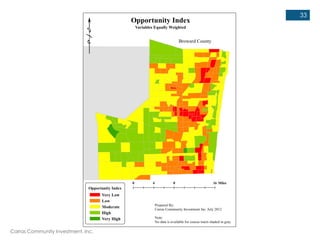
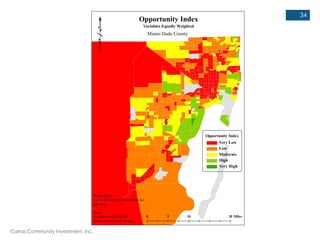
 These neighborhoods are not sustainable in their present
state.
—HUD Secretary Shaun Donovan, February 23, 2010
Carras Community Investment, Inc.
3
+
FHEA
Fair and just inclusion.
Goal: To make our region a more fair
and just place where all residents
can access and take advantage of
the region‘s economic, social, and
environmental assets
4Carras Community Investment, Inc.
+
Opportunity = Prosperity
• Southeast Florida
demographic transformation
• Pursuing strategies that
create more inclusion are no
longer only moral
imperatives—they are
economic ones.
• Addressing income
disparities/poverty and
business development are
fundamental to region‘s
economic future. 5Carras Community Investment, Inc.
+
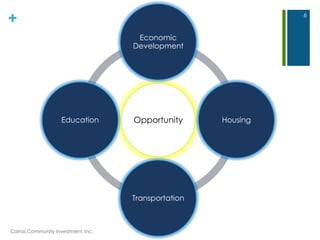
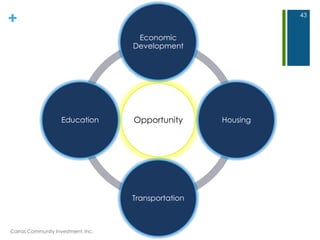
Opportunity
Economic
Development
Housing
Transportation
Education
6
Carras Community Investment, Inc.
+
Barriers and
Access to
Opportunity
Existing Conditions
7Carras Community Investment, Inc.
+
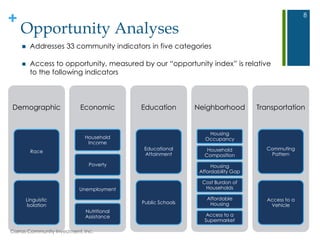
Opportunity Analyses
 Addresses 33 community indicators in five categories
 Access to opportunity, measured by our ―opportunity index‖ is relative
to the following indicators
8
Demographic
Race
Linguistic
Isolation
Economic
Household
Income
Poverty
Unemployment
Nutritional
Assistance
Education
Educational
Attainment
Public Schools
Neighborhood
Housing
Occupancy
Household
Composition
Housing
Affordability Gap
Cost Burdon of
Households
Affordable
Housing
Access to a
Supermarket
Transportation
Commuting
Pattern
Access to a
Vehicle
Carras Community Investment, Inc.
+
Homeowners & Renters
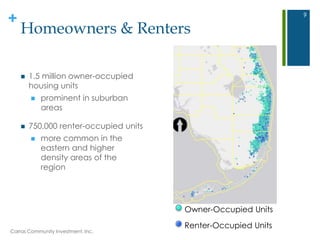
 1.5 million owner-occupied
housing units
 prominent in suburban
areas
 750,000 renter-occupied units
 more common in the
eastern and higher
density areas of the
region
9
Owner-Occupied Units
Renter-Occupied Units
Carras Community Investment, Inc.
+
Cost-Burdened Households
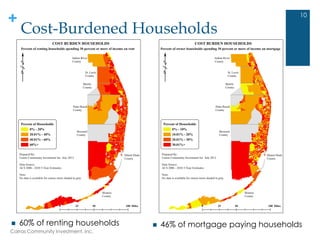
 60% of renting households  46% of mortgage paying households
10
Carras Community Investment, Inc.
+
13.50%
18.2%
0%
4%
8%
12%
16%
20%
Less than
$20,000
$20,000 to
$34,999
$35,000 to
$49,999
$50,000 to
$74,999
$75,000 or
more
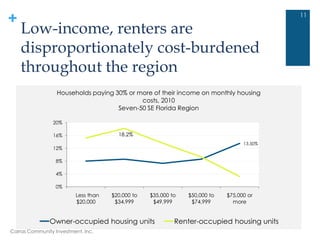
Households paying 30% or more of their income on monthly housing
costs, 2010
Seven-50 SE Florida Region
Owner-occupied housing units Renter-occupied housing units
Low-income, renters are
disproportionately cost-burdened
throughout the region
11
Carras Community Investment, Inc.
+
Concentrations of
Poverty
12
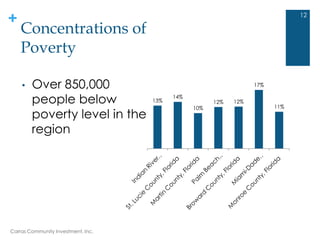
• Over 850,000
people below
poverty level in the
region
13%
14%
10%
12% 12%
17%
11%
Carras Community Investment, Inc.
+
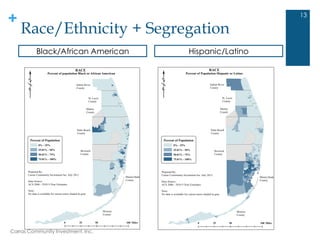
Race/Ethnicity + Segregation
13
Black/African American Hispanic/Latino
Carras Community Investment, Inc.
+
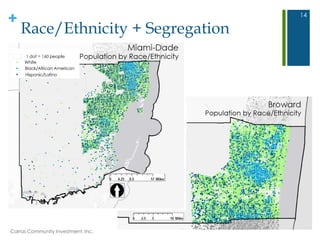
Race/Ethnicity + Segregation
14
Carras Community Investment, Inc.
+
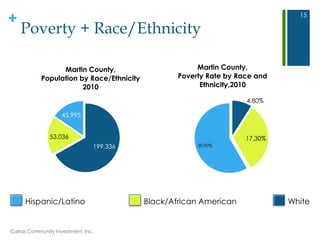
4.80%
17.30%
30.90%
Martin County,
Poverty Rate by Race and
Ethnicity,2010
199,336
53,036
45,995
Martin County,
Population by Race/Ethnicity
2010
Hispanic/Latino Black/African American White
Poverty + Race/Ethnicity
15
Carras Community Investment, Inc.
+
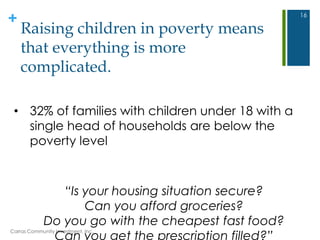
Raising children in poverty means
that everything is more
complicated.
16
• 32% of families with children under 18 with a
single head of households are below the
poverty level
“Is your housing situation secure?
Can you afford groceries?
Do you go with the cheapest fast food?
Can you get the prescription filled?”
Carras Community Investment, Inc.
+
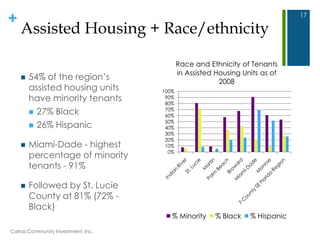
Assisted Housing + Race/ethnicity
 54% of the region‘s
assisted housing units
have minority tenants
 27% Black
 26% Hispanic
 Miami-Dade - highest
percentage of minority
tenants - 91%
 Followed by St. Lucie
County at 81% (72% -
Black)
17
0%
10%
20%
30%
40%
50%
60%
70%
80%
90%
100%
Race and Ethnicity of Tenants
in Assisted Housing Units as of
2008
% Minority % Black % Hispanic
Carras Community Investment, Inc.
+
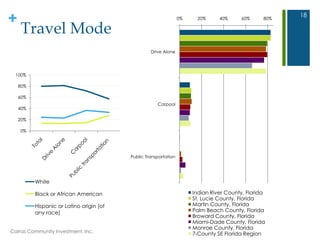
Travel Mode
180% 20% 40% 60% 80%
Drive Alone
Carpool
Public Transportation
Indian River County, Florida
St. Lucie County, Florida
Martin County, Florida
Palm Beach County, Florida
Broward County, Florida
Miami-Dade County, Florida
Monroe County, Florida
7-County SE Florida Region
0%
20%
40%
60%
80%
100%
White
Black or African American
Hispanic or Latino origin (of
any race)
Carras Community Investment, Inc.
+
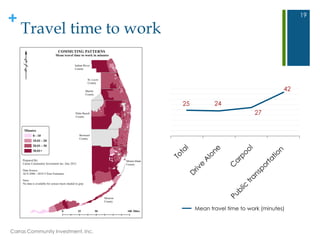
Travel time to work
19
25 24
27
42
Mean travel time to work (minutes)
Carras Community Investment, Inc.
+
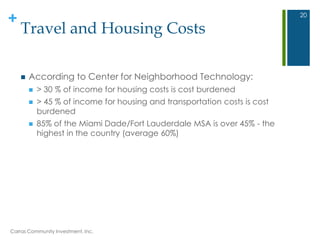
Travel and Housing Costs
 According to Center for Neighborhood Technology:
 > 30 % of income for housing costs is cost burdened
 > 45 % of income for housing and transportation costs is cost
burdened
 85% of the Miami Dade/Fort Lauderdale MSA is over 45% - the
highest in the country (average 60%)
Carras Community Investment, Inc.
20
+
Educational Attainment–
No High School
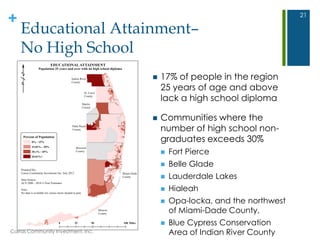
 17% of people in the region
25 years of age and above
lack a high school diploma
 Communities where the
number of high school non-
graduates exceeds 30%
 Fort Pierce
 Belle Glade
 Lauderdale Lakes
 Hialeah
 Opa-locka, and the northwest
of Miami-Dade County,
 Blue Cypress Conservation
Area of Indian River County
21
Carras Community Investment, Inc.
+
Educational Attainment-
High School
22
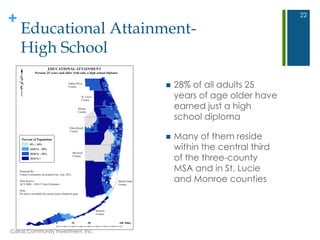
 28% of all adults 25
years of age older have
earned just a high
school diploma
 Many of them reside
within the central third
of the three-county
MSA and in St. Lucie
and Monroe counties
Carras Community Investment, Inc.
+
Educational Attainment-
College Graduates
23
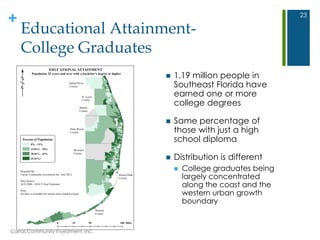
 1.19 million people in
Southeast Florida have
earned one or more
college degrees
 Same percentage of
those with just a high
school diploma
 Distribution is different
 College graduates being
largely concentrated
along the coast and the
western urban growth
boundary
Carras Community Investment, Inc.
+
Educational Attainment-
FCAT Scores
24
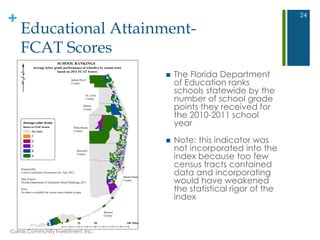
 The Florida Department
of Education ranks
schools statewide by the
number of school grade
points they received for
the 2010-2011 school
year
 Note: this indicator was
not incorporated into the
index because too few
census tracts contained
data and incorporating
would have weakened
the statistical rigor of the
index
Carras Community Investment, Inc.
+
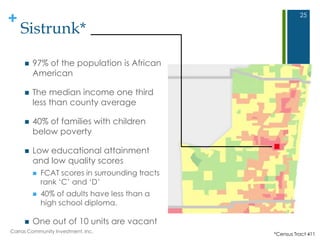
Sistrunk*
 97% of the population is African
American
 The median income one third
less than county average
 40% of families with children
below poverty
 Low educational attainment
and low quality scores
 FCAT scores in surrounding tracts
rank ‗C‘ and ‗D‘
 40% of adults have less than a
high school diploma.
 One out of 10 units are vacant
25
*Census Tract 411
Carras Community Investment, Inc.
+
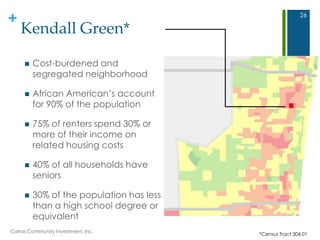
Kendall Green*
 Cost-burdened and
segregated neighborhood
 African American‘s account
for 90% of the population
 75% of renters spend 30% or
more of their income on
related housing costs
 40% of all households have
seniors
 30% of the population has less
than a high school degree or
equivalent
26
*Census Tract 304.01
Carras Community Investment, Inc.
+
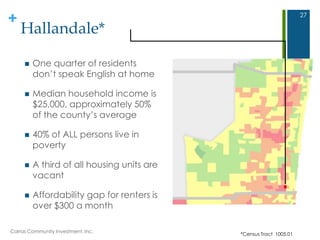
Hallandale*
 One quarter of residents
don‘t speak English at home
 Median household income is
$25,000, approximately 50%
of the county‘s average
 40% of ALL persons live in
poverty
 A third of all housing units are
vacant
 Affordability gap for renters is
over $300 a month
27
*Census Tract 1005.01
Carras Community Investment, Inc.
+
Opportunity
Indices
28Carras Community Investment, Inc.
+
Addressing Poverty
Key issue in all low opportunity
communities is poverty.
We need to plan to address poverty and
its ramifications on people and the
regional economy.
Carras Community Investment, Inc.
29
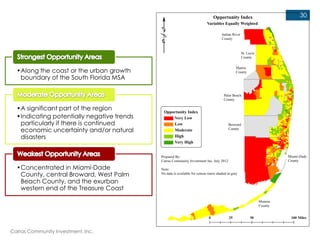
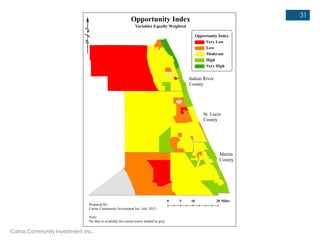
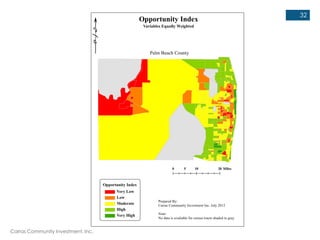
•Along the coast or the urban growth
boundary of the South Florida MSA
•A significant part of the region
•Indicating potentially negative trends
particularly if there is continued
economic uncertainty and/or natural
disasters
•Concentrated in Miami-Dade
County, central Broward, West Palm
Beach County, and the exurban
western end of the Treasure Coast
30
Carras Community Investment, Inc.
31
Carras Community Investment, Inc.
32
Carras Community Investment, Inc.
33
Carras Community Investment, Inc.
34
Carras Community Investment, Inc.
+
Moving
Forward
Building Access to Opportunity
35Carras Community Investment, Inc.
+
Advancing Regional Opportunity
 The Seven50 Regional Plan needs to create regional:
 Goals
 Policies
 Strategies and Actions
 FHEA helps inform the Regional Plan in developing a
vision, framework, and roadmap that increases access to
opportunity:
 Housing
 Transportation
 Environmental Justice
 Education
 Economic Development
 Public Infrastructure
Carras Community Investment, Inc.
36
+
Community Deliberation
 Over twenty public meetings and FHEA/RAI presentations
including:
 Seven50 Opportunity in the Region Workshop
 HOPE Fair Housing workshops
 Broward Alliance for Neighborhood Development
 Seven50 Summit Two
 Raise Florida/War on Poverty Regional Meeting
 1200 Participants
 Key stakeholder interviews
Carras Community Investment, Inc.
37
+
In your discussion group…
 Establish a shared vision and set of aspirational values
related to your sense of opportunity.
 Establish and recommend goals to be addressed in the
Regional Plan
 Establish attainable strategies, so that a long-term and
empowering vision is balanced with shorter
term, concrete steps to get there.
Carras Community Investment, Inc.
38
+ Need to Address in Regional Plan
 Strengthening low opportunity communities
 Stabilizing and Improving moderate opportunity
communities
 Maintaining high opportunity communities and
creating greater access for all
 Focus on interrelationship of
housing, transportation, economic
development opportunities and education
 Ongoing mechanism that updates data
indicators and progress
 Create inclusive leadership model
39
Carras Community Investment, Inc.
+
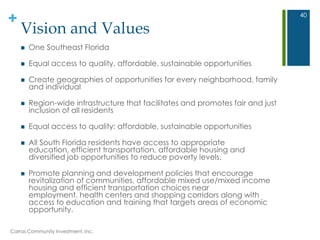
Vision and Values
 One Southeast Florida
 Equal access to quality, affordable, sustainable opportunities
 Create geographies of opportunities for every neighborhood, family
and individual
 Region-wide infrastructure that facilitates and promotes fair and just
inclusion of all residents
 Equal access to quality: affordable, sustainable opportunities
 All South Florida residents have access to appropriate
education, efficient transportation, affordable housing and
diversified job opportunities to reduce poverty levels.
 Promote planning and development policies that encourage
revitalization of communities, affordable mixed use/mixed income
housing and efficient transportation choices near
employment, health centers and shopping corridors along with
access to education and training that targets areas of economic
opportunity.
Carras Community Investment, Inc.
40
+
Goals
 Create diverse, walkable and connected
communities
 Form a Regional Opportunity Network to
provide a Resource Tool Kit to assist
communities in addressing
shelter, education, jobs, food
issues, transportation
 Provide inclusionary mixed-income housing near
job centers and public transportation
 Promote urban farming/gardens and access to
healthy foods
 Enhance accessible public transportation
connecting residents to jobs and education.
 Help build family assets
Carras Community Investment, Inc.
41
+ Strategies
 Harness capital resources – especially private sector
investments and debt
 Increase financial services and products for homeownership
and business development.
 Create workforce training that matches residents with job
opportunities. Improve educational outcomes for low-
income youth and youth of color.
 Create double/triple bottom line funds that leverage federal
resources including New Market Tax Credits and EB5
 Help build Capacity – over 150 government entities –
municipalities, counties, CRAs. Need to provide sustainable
development assistance (resources, tools)
 Combat NIMBYism
Carras Community Investment, Inc.
42
+
Opportunity
Economic
Development
Housing
Transportation
Education
43
Carras Community Investment, Inc.
+
Further information:
 Project Manager: James Carras
 FHEA
 Urban Revitalizations Solutions, Inc. Rebecca Walter, Serge
Atherwood
 RAI
 Anna McMaster
 Rasheed Shotoyo
 FHEA and RAI Documents are available at seven50.org
 For further information contact James Carras
 Phone: 954.415.2022
 Email: carras@bellsouth.net
44
Carras Community Investment, Inc.

FHEA Executive Committee Power Point Presentation

  • 1.
  • 2.
    + Seven 50- Sustainable Communities Regional Planning Grant – Fair Housing and Equity Assessment (FHEA)  Understand the historical, current and future context for opportunity in the region and the data and evidence that demonstrates those dynamics  Engage regional leaders and stakeholders on findings and implications of analysis  Integrate knowledge developed through the Regional FHEA exercise into the Regional Plan strategy development process (e.g., priority setting and decision making) 2 Carras Community Investment, Inc.
  • 3.
    + Why the FHEA? ―Sustainability also means creating ‗geographies of opportunity,‘ places that effectively connect people to jobs, quality public schools, and other amenities.  Today, too many HUD-assisted families are stuck in neighborhoods of concentrated poverty and segregation, where one's zip code predicts poor education, employment, and even health outcomes.  These neighborhoods are not sustainable in their present state. —HUD Secretary Shaun Donovan, February 23, 2010 Carras Community Investment, Inc. 3
  • 4.
    + FHEA Fair and justinclusion. Goal: To make our region a more fair and just place where all residents can access and take advantage of the region‘s economic, social, and environmental assets 4Carras Community Investment, Inc.
  • 5.
    + Opportunity = Prosperity •Southeast Florida demographic transformation • Pursuing strategies that create more inclusion are no longer only moral imperatives—they are economic ones. • Addressing income disparities/poverty and business development are fundamental to region‘s economic future. 5Carras Community Investment, Inc.
  • 6.
  • 7.
    + Barriers and Access to Opportunity ExistingConditions 7Carras Community Investment, Inc.
  • 8.
    + Opportunity Analyses  Addresses33 community indicators in five categories  Access to opportunity, measured by our ―opportunity index‖ is relative to the following indicators 8 Demographic Race Linguistic Isolation Economic Household Income Poverty Unemployment Nutritional Assistance Education Educational Attainment Public Schools Neighborhood Housing Occupancy Household Composition Housing Affordability Gap Cost Burdon of Households Affordable Housing Access to a Supermarket Transportation Commuting Pattern Access to a Vehicle Carras Community Investment, Inc.
  • 9.
    + Homeowners & Renters 1.5 million owner-occupied housing units  prominent in suburban areas  750,000 renter-occupied units  more common in the eastern and higher density areas of the region 9 Owner-Occupied Units Renter-Occupied Units Carras Community Investment, Inc.
  • 10.
    + Cost-Burdened Households  60%of renting households  46% of mortgage paying households 10 Carras Community Investment, Inc.
  • 11.
    + 13.50% 18.2% 0% 4% 8% 12% 16% 20% Less than $20,000 $20,000 to $34,999 $35,000to $49,999 $50,000 to $74,999 $75,000 or more Households paying 30% or more of their income on monthly housing costs, 2010 Seven-50 SE Florida Region Owner-occupied housing units Renter-occupied housing units Low-income, renters are disproportionately cost-burdened throughout the region 11 Carras Community Investment, Inc.
  • 12.
    + Concentrations of Poverty 12 • Over850,000 people below poverty level in the region 13% 14% 10% 12% 12% 17% 11% Carras Community Investment, Inc.
  • 13.
    + Race/Ethnicity + Segregation 13 Black/AfricanAmerican Hispanic/Latino Carras Community Investment, Inc.
  • 14.
    + Race/Ethnicity + Segregation 14 CarrasCommunity Investment, Inc.
  • 15.
    + 4.80% 17.30% 30.90% Martin County, Poverty Rateby Race and Ethnicity,2010 199,336 53,036 45,995 Martin County, Population by Race/Ethnicity 2010 Hispanic/Latino Black/African American White Poverty + Race/Ethnicity 15 Carras Community Investment, Inc.
  • 16.
    + Raising children inpoverty means that everything is more complicated. 16 • 32% of families with children under 18 with a single head of households are below the poverty level “Is your housing situation secure? Can you afford groceries? Do you go with the cheapest fast food? Can you get the prescription filled?” Carras Community Investment, Inc.
  • 17.
    + Assisted Housing +Race/ethnicity  54% of the region‘s assisted housing units have minority tenants  27% Black  26% Hispanic  Miami-Dade - highest percentage of minority tenants - 91%  Followed by St. Lucie County at 81% (72% - Black) 17 0% 10% 20% 30% 40% 50% 60% 70% 80% 90% 100% Race and Ethnicity of Tenants in Assisted Housing Units as of 2008 % Minority % Black % Hispanic Carras Community Investment, Inc.
  • 18.
    + Travel Mode 180% 20%40% 60% 80% Drive Alone Carpool Public Transportation Indian River County, Florida St. Lucie County, Florida Martin County, Florida Palm Beach County, Florida Broward County, Florida Miami-Dade County, Florida Monroe County, Florida 7-County SE Florida Region 0% 20% 40% 60% 80% 100% White Black or African American Hispanic or Latino origin (of any race) Carras Community Investment, Inc.
  • 19.
    + Travel time towork 19 25 24 27 42 Mean travel time to work (minutes) Carras Community Investment, Inc.
  • 20.
    + Travel and HousingCosts  According to Center for Neighborhood Technology:  > 30 % of income for housing costs is cost burdened  > 45 % of income for housing and transportation costs is cost burdened  85% of the Miami Dade/Fort Lauderdale MSA is over 45% - the highest in the country (average 60%) Carras Community Investment, Inc. 20
  • 21.
    + Educational Attainment– No HighSchool  17% of people in the region 25 years of age and above lack a high school diploma  Communities where the number of high school non- graduates exceeds 30%  Fort Pierce  Belle Glade  Lauderdale Lakes  Hialeah  Opa-locka, and the northwest of Miami-Dade County,  Blue Cypress Conservation Area of Indian River County 21 Carras Community Investment, Inc.
  • 22.
    + Educational Attainment- High School 22 28% of all adults 25 years of age older have earned just a high school diploma  Many of them reside within the central third of the three-county MSA and in St. Lucie and Monroe counties Carras Community Investment, Inc.
  • 23.
    + Educational Attainment- College Graduates 23 1.19 million people in Southeast Florida have earned one or more college degrees  Same percentage of those with just a high school diploma  Distribution is different  College graduates being largely concentrated along the coast and the western urban growth boundary Carras Community Investment, Inc.
  • 24.
    + Educational Attainment- FCAT Scores 24 The Florida Department of Education ranks schools statewide by the number of school grade points they received for the 2010-2011 school year  Note: this indicator was not incorporated into the index because too few census tracts contained data and incorporating would have weakened the statistical rigor of the index Carras Community Investment, Inc.
  • 25.
    + Sistrunk*  97% ofthe population is African American  The median income one third less than county average  40% of families with children below poverty  Low educational attainment and low quality scores  FCAT scores in surrounding tracts rank ‗C‘ and ‗D‘  40% of adults have less than a high school diploma.  One out of 10 units are vacant 25 *Census Tract 411 Carras Community Investment, Inc.
  • 26.
    + Kendall Green*  Cost-burdenedand segregated neighborhood  African American‘s account for 90% of the population  75% of renters spend 30% or more of their income on related housing costs  40% of all households have seniors  30% of the population has less than a high school degree or equivalent 26 *Census Tract 304.01 Carras Community Investment, Inc.
  • 27.
    + Hallandale*  One quarterof residents don‘t speak English at home  Median household income is $25,000, approximately 50% of the county‘s average  40% of ALL persons live in poverty  A third of all housing units are vacant  Affordability gap for renters is over $300 a month 27 *Census Tract 1005.01 Carras Community Investment, Inc.
  • 28.
  • 29.
    + Addressing Poverty Key issuein all low opportunity communities is poverty. We need to plan to address poverty and its ramifications on people and the regional economy. Carras Community Investment, Inc. 29
  • 30.
    •Along the coastor the urban growth boundary of the South Florida MSA •A significant part of the region •Indicating potentially negative trends particularly if there is continued economic uncertainty and/or natural disasters •Concentrated in Miami-Dade County, central Broward, West Palm Beach County, and the exurban western end of the Treasure Coast 30 Carras Community Investment, Inc.
  • 31.
  • 32.
  • 33.
  • 34.
  • 35.
    + Moving Forward Building Access toOpportunity 35Carras Community Investment, Inc.
  • 36.
    + Advancing Regional Opportunity The Seven50 Regional Plan needs to create regional:  Goals  Policies  Strategies and Actions  FHEA helps inform the Regional Plan in developing a vision, framework, and roadmap that increases access to opportunity:  Housing  Transportation  Environmental Justice  Education  Economic Development  Public Infrastructure Carras Community Investment, Inc. 36
  • 37.
    + Community Deliberation  Overtwenty public meetings and FHEA/RAI presentations including:  Seven50 Opportunity in the Region Workshop  HOPE Fair Housing workshops  Broward Alliance for Neighborhood Development  Seven50 Summit Two  Raise Florida/War on Poverty Regional Meeting  1200 Participants  Key stakeholder interviews Carras Community Investment, Inc. 37
  • 38.
    + In your discussiongroup…  Establish a shared vision and set of aspirational values related to your sense of opportunity.  Establish and recommend goals to be addressed in the Regional Plan  Establish attainable strategies, so that a long-term and empowering vision is balanced with shorter term, concrete steps to get there. Carras Community Investment, Inc. 38
  • 39.
    + Need toAddress in Regional Plan  Strengthening low opportunity communities  Stabilizing and Improving moderate opportunity communities  Maintaining high opportunity communities and creating greater access for all  Focus on interrelationship of housing, transportation, economic development opportunities and education  Ongoing mechanism that updates data indicators and progress  Create inclusive leadership model 39 Carras Community Investment, Inc.
  • 40.
    + Vision and Values One Southeast Florida  Equal access to quality, affordable, sustainable opportunities  Create geographies of opportunities for every neighborhood, family and individual  Region-wide infrastructure that facilitates and promotes fair and just inclusion of all residents  Equal access to quality: affordable, sustainable opportunities  All South Florida residents have access to appropriate education, efficient transportation, affordable housing and diversified job opportunities to reduce poverty levels.  Promote planning and development policies that encourage revitalization of communities, affordable mixed use/mixed income housing and efficient transportation choices near employment, health centers and shopping corridors along with access to education and training that targets areas of economic opportunity. Carras Community Investment, Inc. 40
  • 41.
    + Goals  Create diverse,walkable and connected communities  Form a Regional Opportunity Network to provide a Resource Tool Kit to assist communities in addressing shelter, education, jobs, food issues, transportation  Provide inclusionary mixed-income housing near job centers and public transportation  Promote urban farming/gardens and access to healthy foods  Enhance accessible public transportation connecting residents to jobs and education.  Help build family assets Carras Community Investment, Inc. 41
  • 42.
    + Strategies  Harnesscapital resources – especially private sector investments and debt  Increase financial services and products for homeownership and business development.  Create workforce training that matches residents with job opportunities. Improve educational outcomes for low- income youth and youth of color.  Create double/triple bottom line funds that leverage federal resources including New Market Tax Credits and EB5  Help build Capacity – over 150 government entities – municipalities, counties, CRAs. Need to provide sustainable development assistance (resources, tools)  Combat NIMBYism Carras Community Investment, Inc. 42
  • 43.
  • 44.
    + Further information:  ProjectManager: James Carras  FHEA  Urban Revitalizations Solutions, Inc. Rebecca Walter, Serge Atherwood  RAI  Anna McMaster  Rasheed Shotoyo  FHEA and RAI Documents are available at seven50.org  For further information contact James Carras  Phone: 954.415.2022  Email: carras@bellsouth.net 44 Carras Community Investment, Inc.

Editor's Notes

  • #7 Incongruence betweenwhere we livewhere we workhow we transport ourselves in-between these spacesAnd the educational attainment of minority and low-income citizens of Southeast FloridaThe Seven50 Prosperity Plan needs to address how to bridge these silos, break down barriers to opportunity while building access
  • #9 Describe FHEA
  • #11 60% of renting households, regardless of income, pay more than 30% of their monthly income on housing costs while 46% of households making payments to a mortgage pay more than 30% of their monthly income on housing costs
  • #12 Renter-occupied households as a whole are more likely to spend more than 30% of their monthly income on housing costs than those that own. When considering various incomes, within lower income brackets there are more renters than owners. Also within this income range, households that rent have higher probabilities of paying above 30% of their household income than those that own. Conversely within the higher income brackets there are more owner-occupied housing units and henceforth more owners are cost-burdened in these brackets. Proportionally, however renting households making less than $20,000 are the most cost-burdened group within each county in SEFLA
  • #13 13% percent of the total population
  • #14 A significant divide exists based on race between the economic performance of whites and non-whites. Poverty is clearly linked to race and ethnicity throughout the region. While the predominant race throughout the region is white, proportionally there are about half as many white people in poverty in comparison to both African American and Hispanic populations.
  • #15 Geographic distribution of the population by race is notable for its spatial patterns: whites make up more of the population in the Treasure Coast and Monroe County, plus the higher-income census tracts along the Atlantic Coast throughout the tri-county MSA and the western urban growth boundary in Broward County. African Americans, on the other hand, make up more of the population in the Belle Glade area, central Broward County, and north-central Miami-Dade County (each of these areas also exhibit similar concentrations of low-income census tracts). As for Hispanics, Miami-Dade County is notable for being the only county of the region where they comprise the majority of the population.
  • #16 An example of the disproportionate relationship between race/ethnicity and poverty
  • #17 Single female householders with children as especially in need. As a region, one third of all single-female households with children are below poverty level.
  • #19 By far the most common means to get to work across all seven counties is private automobile—78.4 percent of all workers get to work in this manner. In all but 75 census tracts, 70 percent or more of workers drive or carpool to work. In fact, in 48.4 percent of all tracts, the number of workers commuting by car is 90 percent or greater.Proportionally, minorities tend to take pubic transportation more than whites. The next slide shows that this mode of travel takes significantly longer than driving alone and carpoolingAlternate commute modes remain overshadowed by commute by car across the majority of the region. Only 119 census tracts feature 15 percent or more of workers who take an alternate commute. The majority of them (86 tracts) are in Miami-Dade County; there are none in Indian River, St. Lucie, or Martin counties). Conversely, there are 166 census tracts (12.5 percent of the region’s total tracts) in which no workers commute by an alternate means. Palm Beach County has the largest number, with 67.
  • #20 The longest commutes are experienced by residents of communities inthe westernmost side of the urban corridor and the south half of Miami-Dade County. Only sixcensus tracts in Miami-Dade enjoy average commute times of less than 15 minutes; incidentally,all six have a commute time of zero minutes and are located either immediately downtown Miamior in the western exurbs.
  • #34 Concentration of Race, Poverty +
  • #40 Insert Options
  • #44 Incongruence betweenwhere we livewhere we workhow we transport ourselves in-between these spacesAnd the educational attainment of minority and low-income citizens of Southeast FloridaThe Seven50 Prosperity Plan needs to address how to bridge these silos, break down barriers to opportunity while building access