HANGE
C
e
is th

NEW NORMAL

Presented By:
Lisa Slayton, M.S. HRM,
CEG, Consultant
“Those that choose to build their present
out of the images of the past will miss the
opportunities of the future.”
-- Winston Churchill
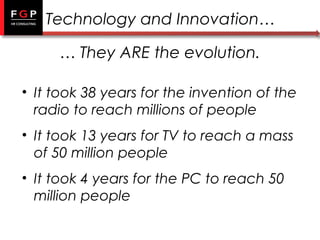
Technology and Innovation…
… They ARE the evolution.
• It took 38 years for the invention of the
radio to reach millions of people
• It took 13 years for TV to reach a mass
of 50 million people
• It took 4 years for the PC to reach 50
million people
Today Everything is Faster and Better
• A video on YouTube can reach over a billion
people in a matter of seconds
• The average 21 year old has spent 20,000
hours or 833 days watching TV
• 10,000 hours or 416 days playing video games
• 10,000 hours or 416 days on the cell phone
• Has sent over 250,000 emails and texts
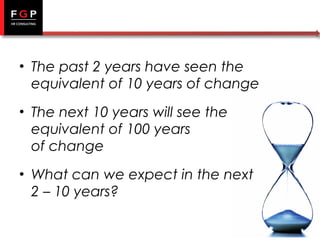
• The past 2 years have seen the
equivalent of 10 years of change
• The next 10 years will see the
equivalent of 100 years
of change
• What can we expect in the next
2 – 10 years?
In the Year 2020 We DO Know:
• Leap Year
• Olympics – 32nd year
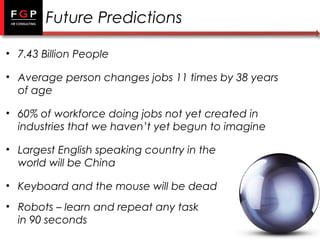
Future Predictions
• 7.43 Billion People
• Average person changes jobs 11 times by 38 years
of age
• 60% of workforce doing jobs not yet created in
industries that we haven’t yet begun to imagine
• Largest English speaking country in the
world will be China
• Keyboard and the mouse will be dead
• Robots – learn and repeat any task
in 90 seconds
Future Predictions
• Conducting business online using personal avatars
• We will be growing replacement skin and bones
• 25% of all cancers will be tamed
• Computers will be fast enough to mimic the brain
• 3D printing
• The first person to live to 300 is already alive
• Zillions of devices will be wired to the Internet
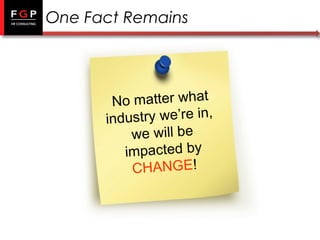
One Fact Remains

No matter
tter what
No maindustry
what
ustry we’re in,
ind we’re in,
will e
wewillbbe
we
y
impacted bby
impacted
CHANGE!
change!
What are the Implications?
• For our businesses?
• For our marketing?
• Our logistics?
• Our staff?
• Our bottom line?
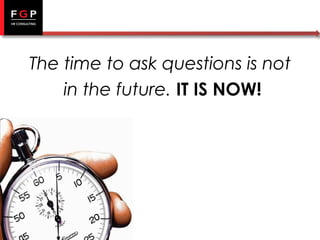
The time to ask questions is not
in the future. IT IS NOW!
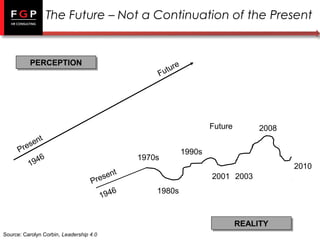
The Future – Not a Continuation of the Present

PERCEPTION
PERCEPTION

re
u tu
F

Future
nt
se
Pre
46
19

1970s
nt
ese
Pr

6
194

2008

1990s
2010
2001 2003

1980s

REALITY
REALITY
Source: Carolyn Corbin, Leadership 4.0
Business Trends – Envisioning the Future
• Climate Change
• Science and technology producing massive
changes
• Globalization
• Alternative energy
• Healthcare innovation
• Changing labor market: aging population,
continued rightsizings, skills shortage
Results =
Constant CHANGE
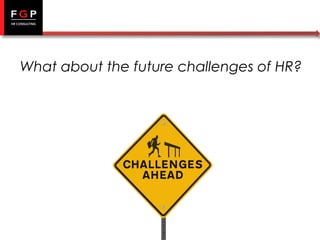
What about the future challenges of HR?
2010 SHRM Global Survey
C-Suite executives believe their two biggest
challenges through 2020 will be:
1.Attracting the best people to the
organization
2.Retaining and rewarding the best people
HR Futurists Believe HR Challenges will be:

1. Aging population
– 3-4 generations of workers
– Boomers working longer

1. Skilled labor shortage
2. Continued “rightsizing”
3. Virtual workforce increasing
HR Futurists Believe HR Trends will be:
• Globalization will require network-based
knowledge sharing and collaboration
• Continued growth of social media
• Thinking “post” baby boomer revolution
• Getting to know Generation Z (born 1980 to
present)
• 50% unemployment
• The project work lifestyle
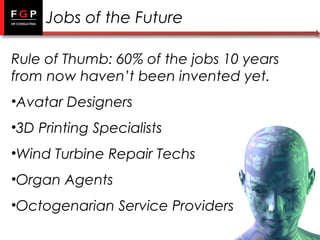
Jobs of the Future
Rule of Thumb: 60% of the jobs 10 years
from now haven’t been invented yet.
•Avatar Designers
•3D Printing Specialists
•Wind Turbine Repair Techs
•Organ Agents
•Octogenarian Service Providers
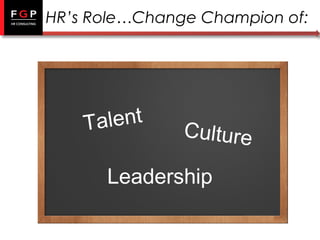
HR’s Role…Change Champion of:

alent
T

Culture

Leadership
2012 SHRM Study
Challenges Facing HR Executives Over the
Next 10 Years
•Four bodies of knowledge rated as most
important:
– Strategic business management
– Talent management
– CHANGE management
– Workforce planning and employment
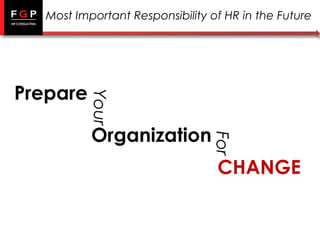
Most Important Responsibility of HR in the Future

Your

Prepare

For

Organization

CHANGE
HOW?
Become a futurist!
Anticipate change!
Be the change champion!
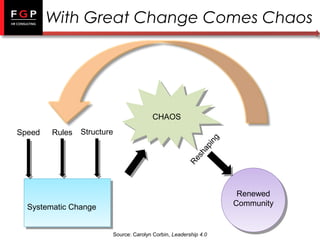
With Great Change Comes Chaos

CHAOS
Rules

Structure
Re
sh
ap
in
g

Speed

Renewed
Community

Systematic Change

Source: Carolyn Corbin, Leadership 4.0
The Cost of Chaos
• Stress
• Culture Clash – Polarization
• Turnover
• Withdrawal – loss of productivity
We believe that human choice
is the biggest driver of change.
We can CHOOSE to change
our behavior.
WRONG! (studies prove this)
-- Joseph Grenny
Change Anything
I know I SHOULD change
I WANT to change
I DON’T change
It takes 26 conscious repetitions to make or break a habit. It takes 26
conscious repetitions to make or break a habit. It takes 26 conscious
It to make 26 conscious
repetitions takesor break a habit. It takes 26 conscious repetitions to
make or repetitionstakes make orrepetitions to make or
break a habit. It to 26 conscious break a
break a habit. It takes 26 conscious repetitions to make or break a habit.
habit.
It takes 26 conscious repetitions to make or break a habit. It takes 26
conscious repetitions to make or break a habit. It takes 26 conscious
repetitions to make or break a habit. It takes 26 conscious repetitions to
make or break a habit. It takes 26 conscious repetitions to make or
break a habit. It takes 26 conscious repetitions to make or break a habit.
It takes 26 conscious repetitions to make or break a habit. It takes 26
conscious repetitions to make or break a habit. It takes 26 conscious
repetitions to make or break a habit. It takes 26 conscious repetitions to
make or break a habit. It takes 26 conscious repetitions to make or
break a habit. It takes 26 conscious repetitions to make or break a habit.
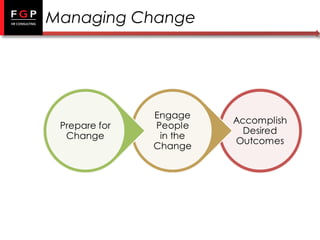
Managing Change
Change is the
“New Normal.”
Embrace it!

FGP: The New Normal

  • 1.
    HANGE C e is th NEW NORMAL PresentedBy: Lisa Slayton, M.S. HRM, CEG, Consultant
  • 2.
    “Those that chooseto build their present out of the images of the past will miss the opportunities of the future.” -- Winston Churchill
  • 3.
    Technology and Innovation… …They ARE the evolution. • It took 38 years for the invention of the radio to reach millions of people • It took 13 years for TV to reach a mass of 50 million people • It took 4 years for the PC to reach 50 million people
  • 4.
    Today Everything isFaster and Better • A video on YouTube can reach over a billion people in a matter of seconds • The average 21 year old has spent 20,000 hours or 833 days watching TV • 10,000 hours or 416 days playing video games • 10,000 hours or 416 days on the cell phone • Has sent over 250,000 emails and texts
  • 5.
    • The past2 years have seen the equivalent of 10 years of change • The next 10 years will see the equivalent of 100 years of change • What can we expect in the next 2 – 10 years?
  • 6.
    In the Year2020 We DO Know: • Leap Year • Olympics – 32nd year
  • 7.
    Future Predictions • 7.43Billion People • Average person changes jobs 11 times by 38 years of age • 60% of workforce doing jobs not yet created in industries that we haven’t yet begun to imagine • Largest English speaking country in the world will be China • Keyboard and the mouse will be dead • Robots – learn and repeat any task in 90 seconds
  • 8.
    Future Predictions • Conductingbusiness online using personal avatars • We will be growing replacement skin and bones • 25% of all cancers will be tamed • Computers will be fast enough to mimic the brain • 3D printing • The first person to live to 300 is already alive • Zillions of devices will be wired to the Internet
  • 9.
    One Fact Remains Nomatter tter what No maindustry what ustry we’re in, ind we’re in, will e wewillbbe we y impacted bby impacted CHANGE! change!
  • 10.
    What are theImplications? • For our businesses? • For our marketing? • Our logistics? • Our staff? • Our bottom line?
  • 11.
    The time toask questions is not in the future. IT IS NOW!
  • 12.
    The Future –Not a Continuation of the Present PERCEPTION PERCEPTION re u tu F Future nt se Pre 46 19 1970s nt ese Pr 6 194 2008 1990s 2010 2001 2003 1980s REALITY REALITY Source: Carolyn Corbin, Leadership 4.0
  • 13.
    Business Trends –Envisioning the Future • Climate Change • Science and technology producing massive changes • Globalization • Alternative energy • Healthcare innovation • Changing labor market: aging population, continued rightsizings, skills shortage
  • 14.
  • 15.
    What about thefuture challenges of HR?
  • 16.
    2010 SHRM GlobalSurvey C-Suite executives believe their two biggest challenges through 2020 will be: 1.Attracting the best people to the organization 2.Retaining and rewarding the best people
  • 17.
    HR Futurists BelieveHR Challenges will be: 1. Aging population – 3-4 generations of workers – Boomers working longer 1. Skilled labor shortage 2. Continued “rightsizing” 3. Virtual workforce increasing
  • 18.
    HR Futurists BelieveHR Trends will be: • Globalization will require network-based knowledge sharing and collaboration • Continued growth of social media • Thinking “post” baby boomer revolution • Getting to know Generation Z (born 1980 to present) • 50% unemployment • The project work lifestyle
  • 19.
    Jobs of theFuture Rule of Thumb: 60% of the jobs 10 years from now haven’t been invented yet. •Avatar Designers •3D Printing Specialists •Wind Turbine Repair Techs •Organ Agents •Octogenarian Service Providers
  • 20.
    HR’s Role…Change Championof: alent T Culture Leadership
  • 21.
    2012 SHRM Study ChallengesFacing HR Executives Over the Next 10 Years •Four bodies of knowledge rated as most important: – Strategic business management – Talent management – CHANGE management – Workforce planning and employment
  • 22.
    Most Important Responsibilityof HR in the Future Your Prepare For Organization CHANGE
  • 23.
  • 24.
    Become a futurist! Anticipatechange! Be the change champion!
  • 25.
    With Great ChangeComes Chaos CHAOS Rules Structure Re sh ap in g Speed Renewed Community Systematic Change Source: Carolyn Corbin, Leadership 4.0
  • 26.
    The Cost ofChaos • Stress • Culture Clash – Polarization • Turnover • Withdrawal – loss of productivity
  • 27.
    We believe thathuman choice is the biggest driver of change. We can CHOOSE to change our behavior.
  • 28.
    WRONG! (studies provethis) -- Joseph Grenny Change Anything
  • 29.
    I know ISHOULD change I WANT to change I DON’T change
  • 30.
    It takes 26conscious repetitions to make or break a habit. It takes 26 conscious repetitions to make or break a habit. It takes 26 conscious It to make 26 conscious repetitions takesor break a habit. It takes 26 conscious repetitions to make or repetitionstakes make orrepetitions to make or break a habit. It to 26 conscious break a break a habit. It takes 26 conscious repetitions to make or break a habit. habit. It takes 26 conscious repetitions to make or break a habit. It takes 26 conscious repetitions to make or break a habit. It takes 26 conscious repetitions to make or break a habit. It takes 26 conscious repetitions to make or break a habit. It takes 26 conscious repetitions to make or break a habit. It takes 26 conscious repetitions to make or break a habit. It takes 26 conscious repetitions to make or break a habit. It takes 26 conscious repetitions to make or break a habit. It takes 26 conscious repetitions to make or break a habit. It takes 26 conscious repetitions to make or break a habit. It takes 26 conscious repetitions to make or break a habit. It takes 26 conscious repetitions to make or break a habit.
  • 31.
  • 32.
    Change is the “NewNormal.” Embrace it!