
Building Capacity to Practice
    the Ecosystem Approach


               STEPHEN B. OLSEN
                          Director Emeritus
                  Coastal Resources Center
                  University of Rhode Island
TITLE OF SESSION FOR INTRO


   Lorem ipsum dolor sit amet, consectetur adipiscing elit. Suspendisse
    interdum sollicitudin lobortis.

   Vivamus gravida dui non tortor imperdiet lobortis.

   Phasellus dignissim nisi felis. Ut luctus scelerisque ipsum eleifend viverra
A CERTIFIED PROFESSIONAL


   Is educated, experienced and competent

   Complies with defined ethical standards

   Will act in the best interest of society and the public

   Certification may define levels of capacity or specialization

   The focus is upon what an individual can do
THE CERTIFICATION OPTION REQUIRES


   A codification of good practices

   Setting standards for defined competencies

   Developing the mechanisms by which such standards can be objectively
    assessed and verified
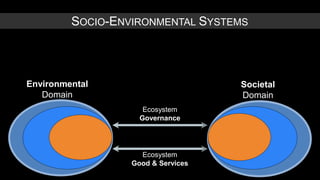
SOCIO-ENVIRONMENTAL SYSTEMS


Environmental                       Societal
   Domain                           Domain
                     Ecosystem
                    Governance


                    Ecosystem
                  Good & Services
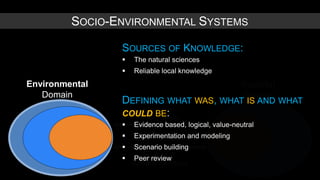
SOCIO-ENVIRONMENTAL SYSTEMS

                SOURCES OF KNOWLEDGE:
                   The natural sciences
                   Reliable local knowledge
Environmental                         Societal
   Domain                              Domain
                DEFINING WHAT WAS, WHAT IS AND WHAT
                    Ecosystem
                COULD BE:
                   Governance
                   Evidence based, logical, value-neutral
                   Experimentation and modeling
                 Scenario building
                    Ecosystem
                 Peer review
                  Good & Services
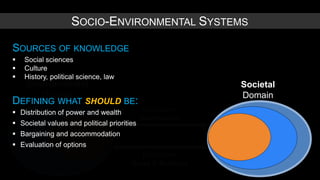
SOCIO-ENVIRONMENTAL SYSTEMS

SOURCES OF KNOWLEDGE
   Social sciences
   Culture
   History, political science, law
  Environmental                                           Societal
      Domain                                              Domain
DEFINING WHAT SHOULD BE:
 Distribution of power and wealth            Ecosystem
                                             Governance
 Societal values and political priorities
 Bargaining and accommodation
 Evaluation of options
                                          Ecosystem
                                        Good & Services
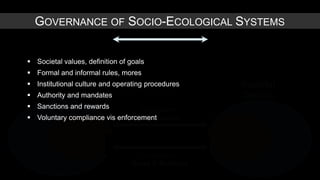
GOVERNANCE OF SOCIO-ECOLOGICAL SYSTEMS


 Societal values, definition of goals
 Formal and informal rules, mores
 Institutional culture
Environmental and operating procedures             Societal
 Authority and mandates
    Domain                                         Domain
 Sanctions and rewards            Ecosystem
 Voluntary compliance vis enforcement
                                  Governance


                                   Ecosystem
                                 Good & Services
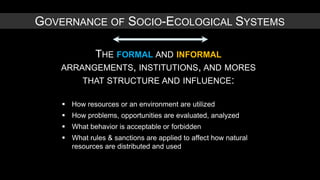
GOVERNANCE OF SOCIO-ECOLOGICAL SYSTEMS

          THE FORMAL AND INFORMAL
    ARRANGEMENTS, INSTITUTIONS, AND MORES
        THAT STRUCTURE AND INFLUENCE:

     How resources or an environment are utilized
     How problems, opportunities are evaluated, analyzed
     What behavior is acceptable or forbidden
     What rules & sanctions are applied to affect how natural
      resources are distributed and used
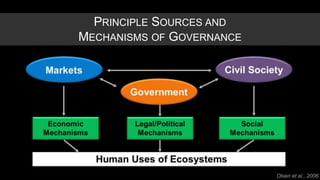
PRINCIPLE SOURCES AND
MECHANISMS OF GOVERNANCE


                           Olsen et al., 2006
THE CHALLENGES OF PRACTICING
             THE ECOSYSTEM APPROACH

 One person cannot know it all

 Deep knowledge of at least one component signals ability, rigor
  and discipline

 The critical attribute is system thinking and a world view that
  senses the great transition in which we as a species are embarked
  in the Anthropocene
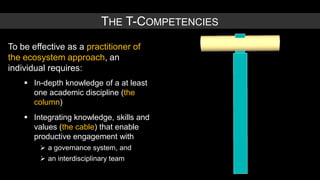
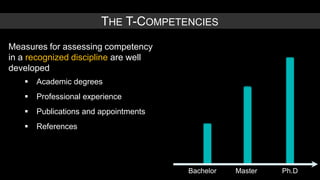
THE T-COMPETENCIES
To be effective as a practitioner of
the ecosystem approach, an
individual requires:
     In-depth knowledge of a at least
      one academic discipline (the
      column)
     Integrating knowledge, skills and
      values (the cable) that enable
      productive engagement with
         a governance system, and
         an interdisciplinary team
THE T-COMPETENCIES
Measures for assessing competency
in a recognized discipline are well
developed
      Academic degrees
      Professional experience
      Publications and appointments
      References


                                       Bachelor   Master   Ph.D
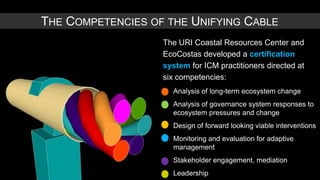
THE COMPETENCIES OF THE UNIFYING CABLE
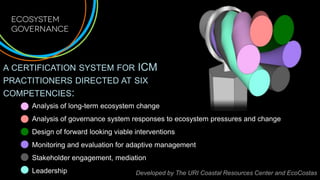
                   The URI Coastal Resources Center and
                   EcoCostas developed a certification
                   system for ICM practitioners directed at
                   six competencies:
                    Analysis of long-term ecosystem change
                    Analysis of governance system responses to
                     ecosystem pressures and change
                    Design of forward looking viable interventions
                    Monitoring and evaluation for adaptive
                     management
                    Stakeholder engagement, mediation
                    Leadership
THE CRC-ECOCOSTAS CERTIFICATION IN COASTAL
             ECOSYSTEM GOVERNANCE
   Standards for Junior and Senior practitioners
      Education
      Experience
      Performance assessment
   A sequence of linked trainings
   A practicum designed to gauge abilities to diagnose the issues and
    governance dynamics of a place and prescribe a viable way forward
   Rubrics for the assessment of the 6 competencies
   A Code of Good Practices and a Code of Ethics
REFLECTIONS ON ICM CERTIFICATION


   Certification is appropriate as a means for gauging competencies in the
    unifying cable

   Is an excellent means for codifying an evolving practice and profession

   Fosters a community of professional ICM practitioners

   The challenges lie in developing the standards and mechanics of the
    assessment process
THANK YOU


 sbo@crc.uri.edu
 solsen@sustainametrix.com
The Science-based Approach
• Science provides a special way of knowing
   – Logical problem solving
   – Emphasis on evidence
• Associated skills
   – Ability to engage in scientific discourse
   – Judgments based on evidence
• Science is not a form of revealed truth
   – Does not provide simplistic answers to complex questions
                     • National Research Council, 2009?
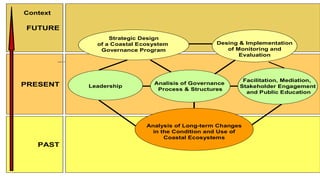
Context

FUTURE
                Strategic Design
            of a Coastal Ecosystem              Desing & Implementation
             Governance Program                    of Monitoring and
                                                       Evaluation


                                                        Facilitation, Mediation,
PRESENT                      Analisis of Governance
          Leadership                                   Stakeholder Engagement
                              Process & Structures
                                                         and Public Education


                           Analysis of Long-term Changes
                             in the Condition and Use of
                                 Coastal Ecosystems
   PAST
A CERTIFICATION SYSTEM FOR             ICM
PRACTITIONERS DIRECTED AT SIX
COMPETENCIES:
    Analysis of long-term ecosystem change
    Analysis of governance system responses to ecosystem pressures and change
    Design of forward looking viable interventions
    Monitoring and evaluation for adaptive management
    Stakeholder engagement, mediation
    Leadership                       Developed by The URI Coastal Resources Center and EcoCostas
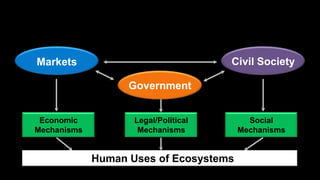
Markets                               Civil Society

                   Government


 Economic           Legal/Political       Social
Mechanisms           Mechanisms         Mechanisms


             Human Uses of Ecosystems
Title

Title

  • 1.
    Building Capacity toPractice the Ecosystem Approach STEPHEN B. OLSEN Director Emeritus Coastal Resources Center University of Rhode Island
  • 2.
    TITLE OF SESSIONFOR INTRO  Lorem ipsum dolor sit amet, consectetur adipiscing elit. Suspendisse interdum sollicitudin lobortis.  Vivamus gravida dui non tortor imperdiet lobortis.  Phasellus dignissim nisi felis. Ut luctus scelerisque ipsum eleifend viverra
  • 3.
    A CERTIFIED PROFESSIONAL  Is educated, experienced and competent  Complies with defined ethical standards  Will act in the best interest of society and the public  Certification may define levels of capacity or specialization  The focus is upon what an individual can do
  • 4.
    THE CERTIFICATION OPTIONREQUIRES  A codification of good practices  Setting standards for defined competencies  Developing the mechanisms by which such standards can be objectively assessed and verified
  • 5.
    SOCIO-ENVIRONMENTAL SYSTEMS Environmental Societal Domain Domain Ecosystem Governance Ecosystem Good & Services
  • 6.
    SOCIO-ENVIRONMENTAL SYSTEMS SOURCES OF KNOWLEDGE:  The natural sciences  Reliable local knowledge Environmental Societal Domain Domain DEFINING WHAT WAS, WHAT IS AND WHAT Ecosystem COULD BE: Governance  Evidence based, logical, value-neutral  Experimentation and modeling  Scenario building Ecosystem  Peer review Good & Services
  • 7.
    SOCIO-ENVIRONMENTAL SYSTEMS SOURCES OFKNOWLEDGE  Social sciences  Culture  History, political science, law Environmental Societal Domain Domain DEFINING WHAT SHOULD BE:  Distribution of power and wealth Ecosystem Governance  Societal values and political priorities  Bargaining and accommodation  Evaluation of options Ecosystem Good & Services
  • 8.
    GOVERNANCE OF SOCIO-ECOLOGICALSYSTEMS  Societal values, definition of goals  Formal and informal rules, mores  Institutional culture Environmental and operating procedures Societal  Authority and mandates Domain Domain  Sanctions and rewards Ecosystem  Voluntary compliance vis enforcement Governance Ecosystem Good & Services
  • 9.
    GOVERNANCE OF SOCIO-ECOLOGICALSYSTEMS THE FORMAL AND INFORMAL ARRANGEMENTS, INSTITUTIONS, AND MORES THAT STRUCTURE AND INFLUENCE:  How resources or an environment are utilized  How problems, opportunities are evaluated, analyzed  What behavior is acceptable or forbidden  What rules & sanctions are applied to affect how natural resources are distributed and used
  • 10.
    PRINCIPLE SOURCES AND MECHANISMSOF GOVERNANCE Olsen et al., 2006
  • 11.
    THE CHALLENGES OFPRACTICING THE ECOSYSTEM APPROACH  One person cannot know it all  Deep knowledge of at least one component signals ability, rigor and discipline  The critical attribute is system thinking and a world view that senses the great transition in which we as a species are embarked in the Anthropocene
  • 12.
    THE T-COMPETENCIES To beeffective as a practitioner of the ecosystem approach, an individual requires:  In-depth knowledge of a at least one academic discipline (the column)  Integrating knowledge, skills and values (the cable) that enable productive engagement with  a governance system, and  an interdisciplinary team
  • 13.
    THE T-COMPETENCIES Measures forassessing competency in a recognized discipline are well developed  Academic degrees  Professional experience  Publications and appointments  References Bachelor Master Ph.D
  • 14.
    THE COMPETENCIES OFTHE UNIFYING CABLE The URI Coastal Resources Center and EcoCostas developed a certification system for ICM practitioners directed at six competencies:  Analysis of long-term ecosystem change  Analysis of governance system responses to ecosystem pressures and change  Design of forward looking viable interventions  Monitoring and evaluation for adaptive management  Stakeholder engagement, mediation  Leadership
  • 15.
    THE CRC-ECOCOSTAS CERTIFICATIONIN COASTAL ECOSYSTEM GOVERNANCE  Standards for Junior and Senior practitioners  Education  Experience  Performance assessment  A sequence of linked trainings  A practicum designed to gauge abilities to diagnose the issues and governance dynamics of a place and prescribe a viable way forward  Rubrics for the assessment of the 6 competencies  A Code of Good Practices and a Code of Ethics
  • 16.
    REFLECTIONS ON ICMCERTIFICATION  Certification is appropriate as a means for gauging competencies in the unifying cable  Is an excellent means for codifying an evolving practice and profession  Fosters a community of professional ICM practitioners  The challenges lie in developing the standards and mechanics of the assessment process
  • 17.
    THANK YOU sbo@crc.uri.edu solsen@sustainametrix.com
  • 18.
    The Science-based Approach •Science provides a special way of knowing – Logical problem solving – Emphasis on evidence • Associated skills – Ability to engage in scientific discourse – Judgments based on evidence • Science is not a form of revealed truth – Does not provide simplistic answers to complex questions • National Research Council, 2009?
  • 19.
    Context FUTURE Strategic Design of a Coastal Ecosystem Desing & Implementation Governance Program of Monitoring and Evaluation Facilitation, Mediation, PRESENT Analisis of Governance Leadership Stakeholder Engagement Process & Structures and Public Education Analysis of Long-term Changes in the Condition and Use of Coastal Ecosystems PAST
  • 20.
    A CERTIFICATION SYSTEMFOR ICM PRACTITIONERS DIRECTED AT SIX COMPETENCIES:  Analysis of long-term ecosystem change  Analysis of governance system responses to ecosystem pressures and change  Design of forward looking viable interventions  Monitoring and evaluation for adaptive management  Stakeholder engagement, mediation  Leadership Developed by The URI Coastal Resources Center and EcoCostas
  • 21.
    Markets Civil Society Government Economic Legal/Political Social Mechanisms Mechanisms Mechanisms Human Uses of Ecosystems

Editor's Notes

  • #2 Workshop 2: 10AM (TUE July 10th) 8PM in US.Put three logo here as well.
  • #4 Remove checks on # 3 and 4
  • #10 Make title Governance of Socio-Ecological Systems and put double headed arrow under the title. Make text of 4 bullets bigger
  • #11 When this comes up on my screen there is part of a repeat to right of slide – please remove
  • #12 Remove the circles lower left
  • #13 Highlight the words (the column) and (the cable) as in the top statement (orange color)
  • #14 Please remove the hooks, columns only
  • #15 Put 6 threaded model here.This replaces #16
  • #16 On slides 15, 17 and 18 the logos on EcoCostas and CRC are indistinct. Perhaps show as a reference as text in another color at lower right
  • #18 www.crc.uri.edu ridPut Stephen’s sustainametrix and crc e-mail.Put all three logo
  • #22 Back up for #10. Principle Sources and Mechanisms of GovernanceNeed this slide if #10 needs edit (#10 is pasted as picture)