Festivals and Traditions Migration, a Pilgrimage to Welfare Igualada 2010
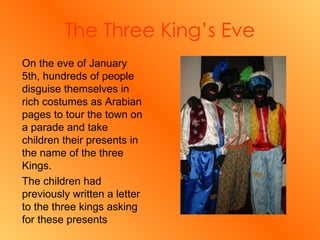
The Three King’s Eve On the eve of January 5th, hundreds of people disguise themselves in rich costumes as Arabian pages to tour the town on a parade and take children their presents in the name of the three Kings.  The children had previously written a letter to the three kings asking for these presents
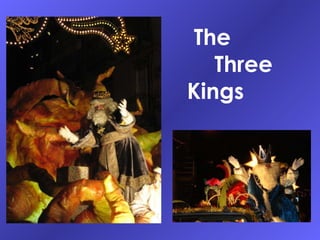
The    Three Kings
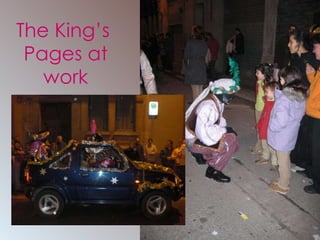
The King’s  Pages at work
Els Tres Tombs Each  17th of January people go out to see people driving carts or carriages or riding horses. The parade goes round the town three times and that’s why it’s called “Els tres tombs” (three rounds).  Following the tradition all the members of the family have lunch all together. And for desert, there’s a special cake called “Tortell”, it’s a sponge cake in the shape of a ring.
Els tres tombs
La ‘’Mona’’ The ‘’mona’’ is a typical Catalan tradition celebrated on Easter Monday. Godparents make or buy their godchildren a cake decorated with a coat of jam or marmalate or  chocolate, feathers, cream, fruit, chocolate figures or eggs, photographs and small toys. The ‘’mona’’ is eaten with the family. There are also typical Easter eggs, made of chocolate.
Sant Jordi’s Day St. Jordi ‘s Day is the day of  lovers in Catalonia. We celebrate it on the 23th of April. The boys give  the girls a red rose to demostrate their love to them, and the girls give  the boys a book for the same reason. There are a lot of stands in the street to sell books, roses, cakes and love candies. It’s a very emotional and important day for lovers.
Sant Jordi’s Legend The celebration comes from a very famous Catalan legend, “The Legend of Sant Jordi”: Once upon a time there was a small village. Next to it there was a cave with a dragon living in it. That creature ate all the animals and, one day, there weren’t any more animals to eat and the inhabitants were very scared. They decided to give  the dragon one girl every day, and one day the princess was selected. Then, when the princess was in front of the cave, Sant Jordi killed the dragon and saved the girl. Then the blood of the dragon changed into red roses and Saint Jordi gave her one of those flowers and he left.
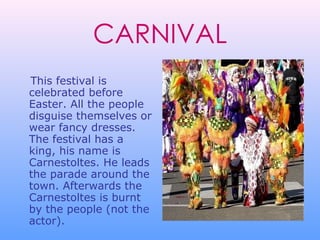
This festival is celebrated before Easter. All the people disguise themselves or wear fancy dresses. The festival has a king, his name is Carnestoltes. He leads the parade around the town. Afterwards the Carnestoltes is burnt by the people (not the actor).   CARNIVAL
Human    Castles In Igualada, as in  many other places  in Catalonia, we  build human castles that can be really  high.
Saint John’s Eve On Saint John’s Eve (24th June), we have a great summer festival. The tradition is to burn bonfires and play with firecrackers
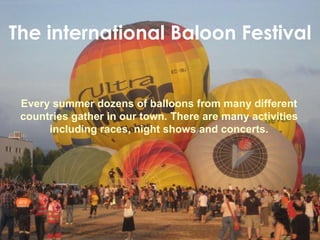
The international Baloon Festival Every summer dozens of balloons from many different countries gather in our town. There are many activities including races, night shows and concerts.
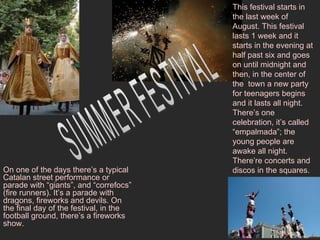
This festival starts in the last week of August. This festival lasts 1 week and it starts in the evening at half past six and goes on until midnight and then, in the center of the  town a new party for teenagers begins and it lasts all night. There’s one celebration, it’s called “empalmada”; the young people are awake all night. There’re concerts and discos in the squares. SUMMER FESTIVAL On one of the days there’s a typical Catalan street performance or parade with “giants”, and “correfocs” (fire runners). It’s a parade with dragons, fireworks and devils. On the final day of the festival, in the football ground, there’s a fireworks show.
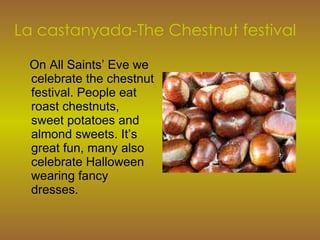
La castanyada-The Chestnut festival On All Saints’ Eve we celebrate the chestnut festival. People eat roast chestnuts, sweet potatoes and almond sweets. It’s great fun, many also celebrate Halloween wearing fancy dresses.
Mushroom  collecting In autumn thousands of people go to the mountains to collect wild mushrooms. It’s a typical Catalan tradition and a big craze!!
The Nativity Scene At Christmas, many people set their nativity scene at home. It’s a miniature reproduction of some of the scenes found in the Bible describing the birth of Jesus Christ.
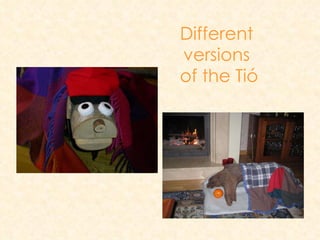
El tió is a very typical Catalan tradition. It’s celebrated on Christmas Day. El tió is a magic log that arrives from the forest just before Christmas. For several days the children feed the log so that on Christmas Day it “shits” (delivers) presents. On Christmas Day, the children go to a room and they sing Christmas carols. Then the parents tell the children that they can hit the log to make him “defecate”. The children sing a traditional song and when they finish, they look under the log for the presents, and they are very, very happy when they find them. El Tió
Different  versions  of the Tió
Made by: Roser Bagó Anna Cano Clara Casares Carlos Espinar Anna Custodi Alba Fernández Malina Gaianu Gisela Gómez Laura Just Jordina Marsal Mireia Mayol Laura Molina Nora Muñoz Jaume Pregonas Mònica Roldán Marc Sánchez  Laura Sánchez Andrea Vernengo

Festivals and traditions final

  • 1.
    Festivals and TraditionsMigration, a Pilgrimage to Welfare Igualada 2010
  • 2.
    The Three King’sEve On the eve of January 5th, hundreds of people disguise themselves in rich costumes as Arabian pages to tour the town on a parade and take children their presents in the name of the three Kings. The children had previously written a letter to the three kings asking for these presents
  • 3.
    The Three Kings
  • 4.
    The King’s Pages at work
  • 5.
    Els Tres TombsEach 17th of January people go out to see people driving carts or carriages or riding horses. The parade goes round the town three times and that’s why it’s called “Els tres tombs” (three rounds). Following the tradition all the members of the family have lunch all together. And for desert, there’s a special cake called “Tortell”, it’s a sponge cake in the shape of a ring.
  • 6.
  • 7.
    La ‘’Mona’’ The‘’mona’’ is a typical Catalan tradition celebrated on Easter Monday. Godparents make or buy their godchildren a cake decorated with a coat of jam or marmalate or chocolate, feathers, cream, fruit, chocolate figures or eggs, photographs and small toys. The ‘’mona’’ is eaten with the family. There are also typical Easter eggs, made of chocolate.
  • 8.
    Sant Jordi’s DaySt. Jordi ‘s Day is the day of lovers in Catalonia. We celebrate it on the 23th of April. The boys give the girls a red rose to demostrate their love to them, and the girls give the boys a book for the same reason. There are a lot of stands in the street to sell books, roses, cakes and love candies. It’s a very emotional and important day for lovers.
  • 9.
    Sant Jordi’s LegendThe celebration comes from a very famous Catalan legend, “The Legend of Sant Jordi”: Once upon a time there was a small village. Next to it there was a cave with a dragon living in it. That creature ate all the animals and, one day, there weren’t any more animals to eat and the inhabitants were very scared. They decided to give the dragon one girl every day, and one day the princess was selected. Then, when the princess was in front of the cave, Sant Jordi killed the dragon and saved the girl. Then the blood of the dragon changed into red roses and Saint Jordi gave her one of those flowers and he left.
  • 10.
    This festival iscelebrated before Easter. All the people disguise themselves or wear fancy dresses. The festival has a king, his name is Carnestoltes. He leads the parade around the town. Afterwards the Carnestoltes is burnt by the people (not the actor). CARNIVAL
  • 11.
    Human Castles In Igualada, as in many other places in Catalonia, we build human castles that can be really high.
  • 12.
    Saint John’s EveOn Saint John’s Eve (24th June), we have a great summer festival. The tradition is to burn bonfires and play with firecrackers
  • 13.
    The international BaloonFestival Every summer dozens of balloons from many different countries gather in our town. There are many activities including races, night shows and concerts.
  • 14.
    This festival startsin the last week of August. This festival lasts 1 week and it starts in the evening at half past six and goes on until midnight and then, in the center of the town a new party for teenagers begins and it lasts all night. There’s one celebration, it’s called “empalmada”; the young people are awake all night. There’re concerts and discos in the squares. SUMMER FESTIVAL On one of the days there’s a typical Catalan street performance or parade with “giants”, and “correfocs” (fire runners). It’s a parade with dragons, fireworks and devils. On the final day of the festival, in the football ground, there’s a fireworks show.
  • 15.
    La castanyada-The Chestnutfestival On All Saints’ Eve we celebrate the chestnut festival. People eat roast chestnuts, sweet potatoes and almond sweets. It’s great fun, many also celebrate Halloween wearing fancy dresses.
  • 16.
    Mushroom collectingIn autumn thousands of people go to the mountains to collect wild mushrooms. It’s a typical Catalan tradition and a big craze!!
  • 17.
    The Nativity SceneAt Christmas, many people set their nativity scene at home. It’s a miniature reproduction of some of the scenes found in the Bible describing the birth of Jesus Christ.
  • 18.
    El tió isa very typical Catalan tradition. It’s celebrated on Christmas Day. El tió is a magic log that arrives from the forest just before Christmas. For several days the children feed the log so that on Christmas Day it “shits” (delivers) presents. On Christmas Day, the children go to a room and they sing Christmas carols. Then the parents tell the children that they can hit the log to make him “defecate”. The children sing a traditional song and when they finish, they look under the log for the presents, and they are very, very happy when they find them. El Tió
  • 19.
    Different versions of the Tió
  • 20.
    Made by: RoserBagó Anna Cano Clara Casares Carlos Espinar Anna Custodi Alba Fernández Malina Gaianu Gisela Gómez Laura Just Jordina Marsal Mireia Mayol Laura Molina Nora Muñoz Jaume Pregonas Mònica Roldán Marc Sánchez Laura Sánchez Andrea Vernengo