USING MIR SPECTROMETRY TO
PREDICT SOIL ORGANIC CARBON
AND SOIL ORGANIC MATTER FOR THE
SOIL SURVEY PROGRAM IN THE USA
Fall, 2019
Rich Ferguson, National Soil Survey Center
N a t i o n a l S o i l S u r v e y C e n t e r
The findings and conclusions in this preliminary presentation have not been formally
disseminated by the US Department of Agriculture and should not be construed to
represent any agency determination or policy. This research was supported by the
intramural research program of the US Department of Agriculture, NRCS.
The USDA-NRCS Kellogg Soil Survey Laboratory
Mid-infrared (MIR) Spectral Library
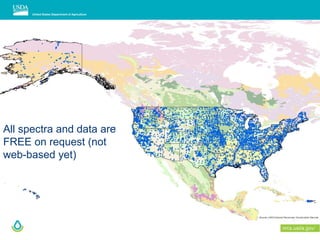
Over 80000 soil samples scanned, representing a great
diversity of soil types. LOTS more samples to scan
Kellogg Soil
Survey
Laboratory Soil
Archive. With
over 500,000
specimens, the
largest public
soil archive in
the USA!
Locations of pedons in the MIR library, to date
All spectra and data are
FREE on request (not
web-based yet)
The Electromagnetic Spectrum
MIR – 2500-25000 nm
*
𝜹 −
𝜹 +
𝜹 +
**
MIR radiation is
partially absorbed
by soil constituents
* By Lookang. Many thanks to Fu-Kwun Hwang and author of Easy Java Simulation = Francisco Esquembre (Own work)
[CC BY-SA 3.0 (https://creativecommons.org/licenses/by-sa/3.0)], via Wikimedia Commons
** Courtesy of gfycat.com
Calibration models are being developed to
predict soil organic carbon from MIR spectra
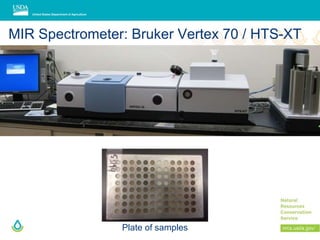
Plate of samples
MIR Spectrometer: Bruker Vertex 70 / HTS-XT
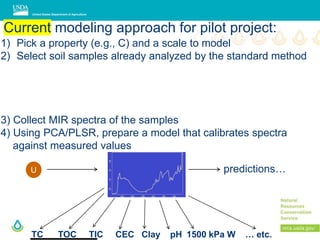
1) Pick a property (e.g., C) and a scale to model
2) Select soil samples already analyzed by the standard method
3) Collect MIR spectra of the samples
4) Using PCA/PLSR, prepare a model that calibrates spectra
against measured values
32 21 120 12 35 14 28 34 80 23 …
…
Org C, g/kg
U
TC TOC TIC CEC Clay pH 1500 kPa W … etc.
predictions…
Current modeling approach for pilot project:
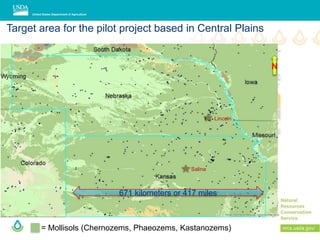
Target area for the pilot project based in Central Plains
= Mollisols (Chernozems, Phaeozems, Kastanozems)
N
Lincoln
Salina
671 kilometers or 417 miles
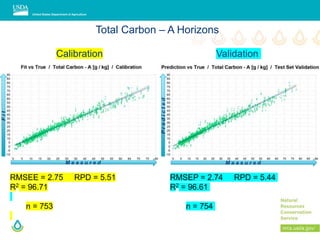
Fit
PredictedM e a s u r e d M e a s u r e d
RMSEE = 2.75 RPD = 5.51 RMSEP = 2.74 RPD = 5.44
R2 = 96.71 R2 = 96.61
n = 753 n = 754
Total Carbon – A Horizons
Calibration Validation
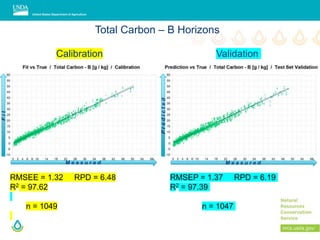
Fit
PredictedM e a s u r e d M e a s u r e d
Total Carbon – B Horizons
Calibration Validation
RMSEE = 1.32 RPD = 6.48 RMSEP = 1.37 RPD = 6.19
R2 = 97.62 R2 = 97.39
n = 1049 n = 1047
Fit
PredictedM e a s u r e d M e a s u r e d
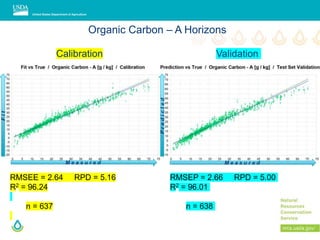
Organic Carbon – A Horizons
Calibration Validation
RMSEE = 2.64 RPD = 5.16 RMSEP = 2.66 RPD = 5.00
R2 = 96.24 R2 = 96.01
n = 637 n = 638
Fit
PredictedM e a s u r e d M e a s u r e d
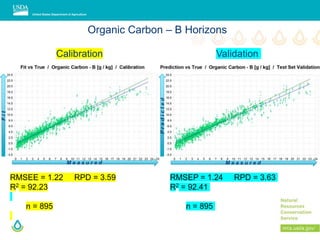
Organic Carbon – B Horizons
Calibration Validation
RMSEE = 1.22 RPD = 3.59 RMSEP = 1.24 RPD = 3.63
R2 = 92.23 R2 = 92.41
n = 895 n = 895
Fit
PredictedM e a s u r e d M e a s u r e d
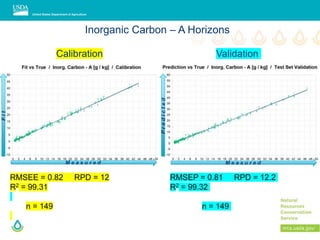
Inorganic Carbon – A Horizons
Calibration Validation
RMSEE = 0.82 RPD = 12 RMSEP = 0.81 RPD = 12.2
R2 = 99.31 R2 = 99.32
n = 149 n = 149
Fit
PredictedM e a s u r e d M e a s u r e d
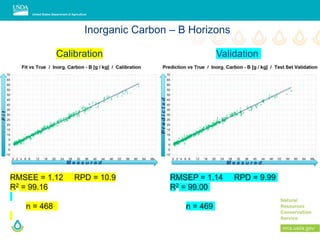
Inorganic Carbon – B Horizons
Calibration Validation
RMSEE = 1.12 RPD = 10.9 RMSEP = 1.14 RPD = 9.99
R2 = 99.16 R2 = 99.00
n = 468 n = 469
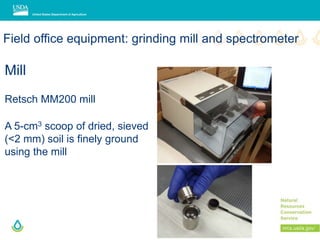
Field office equipment: grinding mill and spectrometer
Mill
Retsch MM200 mill
A 5-cm3 scoop of dried, sieved
(<2 mm) soil is finely ground
using the mill
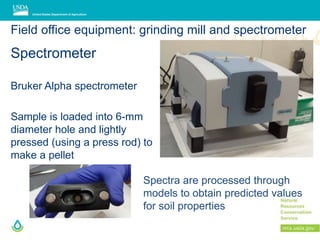
Field office equipment: grinding mill and spectrometer
Spectrometer
Bruker Alpha spectrometer
Sample is loaded into 6-mm
diameter hole and lightly
pressed (using a press rod) to
make a pellet
Spectra are processed through
models to obtain predicted values
for soil properties
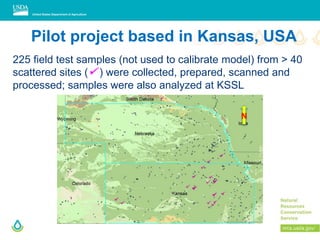
Pilot project based in Kansas, USA
225 field test samples (not used to calibrate model) from > 40
scattered sites ( ) were collected, prepared, scanned and
processed; samples were also analyzed at KSSL
N
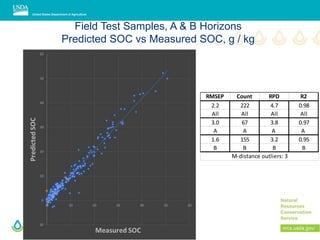
Field Test Samples, A & B Horizons
Predicted SOC vs Measured SOC, g / kg
RMSEP Count RPD R2
2.2 222 4.7 0.98
All All All All
3.0 67 3.8 0.97
A A A A
1.6 155 3.2 0.95
B B B B
M-distance outliers: 3
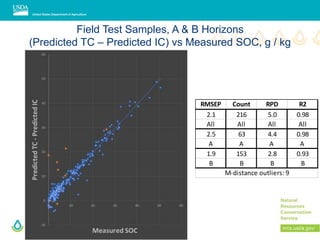
Field Test Samples, A & B Horizons
(Predicted TC – Predicted IC) vs Measured SOC, g / kg
RMSEP Count RPD R2
2.1 216 5.0 0.98
All All All All
2.5 63 4.4 0.98
A A A A
1.9 153 2.8 0.93
B B B B
M-distance outliers: 9
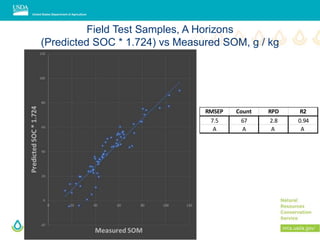
Field Test Samples, A Horizons
(Predicted SOC * 1.724) vs Measured SOM, g / kg
RMSEP Count RPD R2
7.5 67 2.8 0.94
A A A A
Work continues. Thanks for listening!
Joe Anderson Maxine Levin Suzy Riedel
Scarlett Bailey Zamir Libohova Cathy Seybold
Jonathan Comstock David Lindbo Sonam Sherpa
Michelle Etmund Steve Monteith Phil Schoeneberger
Rich Ferguson Rick Nesser Pam Thomas
Jon Hempel Brian Nester John Warner
David Hoover Kathy Newman Skye Wills
Patty Jones Chad Remley David Wolfe
Doug WysockiThe findings and conclusions in this preliminary presentation have
not been formally disseminated by the US Department of Agriculture
and should not be construed to represent any agency determination
or policy. This research was supported by the intramural research
program of the US Department of Agriculture, NRCS.

Ferguson glosolan spectrometry

  • 1.
    USING MIR SPECTROMETRYTO PREDICT SOIL ORGANIC CARBON AND SOIL ORGANIC MATTER FOR THE SOIL SURVEY PROGRAM IN THE USA Fall, 2019 Rich Ferguson, National Soil Survey Center N a t i o n a l S o i l S u r v e y C e n t e r The findings and conclusions in this preliminary presentation have not been formally disseminated by the US Department of Agriculture and should not be construed to represent any agency determination or policy. This research was supported by the intramural research program of the US Department of Agriculture, NRCS.
  • 2.
    The USDA-NRCS KelloggSoil Survey Laboratory Mid-infrared (MIR) Spectral Library Over 80000 soil samples scanned, representing a great diversity of soil types. LOTS more samples to scan Kellogg Soil Survey Laboratory Soil Archive. With over 500,000 specimens, the largest public soil archive in the USA!
  • 3.
    Locations of pedonsin the MIR library, to date All spectra and data are FREE on request (not web-based yet)
  • 4.
    The Electromagnetic Spectrum MIR– 2500-25000 nm * 𝜹 − 𝜹 + 𝜹 + ** MIR radiation is partially absorbed by soil constituents * By Lookang. Many thanks to Fu-Kwun Hwang and author of Easy Java Simulation = Francisco Esquembre (Own work) [CC BY-SA 3.0 (https://creativecommons.org/licenses/by-sa/3.0)], via Wikimedia Commons ** Courtesy of gfycat.com Calibration models are being developed to predict soil organic carbon from MIR spectra
  • 5.
    Plate of samples MIRSpectrometer: Bruker Vertex 70 / HTS-XT
  • 6.
    1) Pick aproperty (e.g., C) and a scale to model 2) Select soil samples already analyzed by the standard method 3) Collect MIR spectra of the samples 4) Using PCA/PLSR, prepare a model that calibrates spectra against measured values 32 21 120 12 35 14 28 34 80 23 … … Org C, g/kg U TC TOC TIC CEC Clay pH 1500 kPa W … etc. predictions… Current modeling approach for pilot project:
  • 7.
    Target area forthe pilot project based in Central Plains = Mollisols (Chernozems, Phaeozems, Kastanozems) N Lincoln Salina 671 kilometers or 417 miles
  • 8.
    Fit PredictedM e as u r e d M e a s u r e d RMSEE = 2.75 RPD = 5.51 RMSEP = 2.74 RPD = 5.44 R2 = 96.71 R2 = 96.61 n = 753 n = 754 Total Carbon – A Horizons Calibration Validation
  • 9.
    Fit PredictedM e as u r e d M e a s u r e d Total Carbon – B Horizons Calibration Validation RMSEE = 1.32 RPD = 6.48 RMSEP = 1.37 RPD = 6.19 R2 = 97.62 R2 = 97.39 n = 1049 n = 1047
  • 10.
    Fit PredictedM e as u r e d M e a s u r e d Organic Carbon – A Horizons Calibration Validation RMSEE = 2.64 RPD = 5.16 RMSEP = 2.66 RPD = 5.00 R2 = 96.24 R2 = 96.01 n = 637 n = 638
  • 11.
    Fit PredictedM e as u r e d M e a s u r e d Organic Carbon – B Horizons Calibration Validation RMSEE = 1.22 RPD = 3.59 RMSEP = 1.24 RPD = 3.63 R2 = 92.23 R2 = 92.41 n = 895 n = 895
  • 12.
    Fit PredictedM e as u r e d M e a s u r e d Inorganic Carbon – A Horizons Calibration Validation RMSEE = 0.82 RPD = 12 RMSEP = 0.81 RPD = 12.2 R2 = 99.31 R2 = 99.32 n = 149 n = 149
  • 13.
    Fit PredictedM e as u r e d M e a s u r e d Inorganic Carbon – B Horizons Calibration Validation RMSEE = 1.12 RPD = 10.9 RMSEP = 1.14 RPD = 9.99 R2 = 99.16 R2 = 99.00 n = 468 n = 469
  • 14.
    Field office equipment:grinding mill and spectrometer Mill Retsch MM200 mill A 5-cm3 scoop of dried, sieved (<2 mm) soil is finely ground using the mill
  • 15.
    Field office equipment:grinding mill and spectrometer Spectrometer Bruker Alpha spectrometer Sample is loaded into 6-mm diameter hole and lightly pressed (using a press rod) to make a pellet Spectra are processed through models to obtain predicted values for soil properties
  • 16.
    Pilot project basedin Kansas, USA 225 field test samples (not used to calibrate model) from > 40 scattered sites ( ) were collected, prepared, scanned and processed; samples were also analyzed at KSSL N
  • 17.
    Field Test Samples,A & B Horizons Predicted SOC vs Measured SOC, g / kg RMSEP Count RPD R2 2.2 222 4.7 0.98 All All All All 3.0 67 3.8 0.97 A A A A 1.6 155 3.2 0.95 B B B B M-distance outliers: 3
  • 18.
    Field Test Samples,A & B Horizons (Predicted TC – Predicted IC) vs Measured SOC, g / kg RMSEP Count RPD R2 2.1 216 5.0 0.98 All All All All 2.5 63 4.4 0.98 A A A A 1.9 153 2.8 0.93 B B B B M-distance outliers: 9
  • 19.
    Field Test Samples,A Horizons (Predicted SOC * 1.724) vs Measured SOM, g / kg RMSEP Count RPD R2 7.5 67 2.8 0.94 A A A A
  • 20.
    Work continues. Thanksfor listening! Joe Anderson Maxine Levin Suzy Riedel Scarlett Bailey Zamir Libohova Cathy Seybold Jonathan Comstock David Lindbo Sonam Sherpa Michelle Etmund Steve Monteith Phil Schoeneberger Rich Ferguson Rick Nesser Pam Thomas Jon Hempel Brian Nester John Warner David Hoover Kathy Newman Skye Wills Patty Jones Chad Remley David Wolfe Doug WysockiThe findings and conclusions in this preliminary presentation have not been formally disseminated by the US Department of Agriculture and should not be construed to represent any agency determination or policy. This research was supported by the intramural research program of the US Department of Agriculture, NRCS.

Editor's Notes

  • #2 GO TO VIEW > MASTER > SLIDE MASTER TO EDIT THE IMAGES ON THE TITLE AND DIVIDER SLIDES RIGHT CLICK ON THE INDIVIDUAL IMAGES TO CHANGE THE IMAGE
  • #3 Put Kellogg in context of larger mission within NRCS and USDA
  • #6 The reference material is an empty well made of anodized aluminum, which has high reflectivity in the mid-infrared region. Spectra were obtained using Vertex-70 FTIR spectrometer (Bruker Optics) equipped with a mercury cadmium telluride detector cooled by liquid nitrogen. Settings are: Spectral resolution of 4 cm-1; 32 scans per sample and per background, a background spectrum is collected before each sample spectrum; no purge gas is used. 4 subsamples
  • #21 GO TO VIEW > MASTER > SLIDE MASTER TO EDIT THE IMAGES ON THE TITLE AND DIVIDER SLIDES