Developing Baseline Broadband Photometry on Potentially Active
Galaxy KUG-0012-000
Alexander H. Reedy and E.J. Guerra Rowan University Department of Physics and Astronomy
Abstract
The purpose of this research is to perform broadband photometry on potentially active galaxies. This is done using a 0.4 meter DFM Cassegrain telescope and imaging with an SBIG STXL-6303E CCD camera and SBIG
FW8G-STXL filter wheel to acquire images of the galaxy KUG 0012-000 in blue, green, and red (B,V,R) filters. Using data reduction and analysis software, color magnitudes of the galaxy were determined as baseline
photometry for the future study of variability within the active galactic nucleus (AGN).
Equipment
• DFM Engineering 0.4-meter Cassegrain Telescope
• SBIG STXL-6303E CCD Camera
• SBIG FW8G-STXL Filter Wheel
• Filters by Custom Scientific
• Data reduction done in Qfits View 3.1
• Photometry done in FV Hera.
• All observations performed at the Rowan
University observatory
KUG 0012-000
Morphology: Spiral Galaxy (Sbc)
Redshift (z) = 0.039
Distance = 146.1 Mpc (476.4ly)
Right Ascension (RA) = 00h 14min 55.1sec
Declination (δ) = +00d 15min 08sec
First Bright Quasar Study (FBQS) Magnitudes
Blue - (B) = 11.04
Red - (R) = 10.98
2 Micron All Sky Survey (2MASS)
J = 13.178
H = 12.551
K = 12.008
Sloan Digital Sky Survey (SDSS) Magnitudes:
UV - (u) = 16.239
Green - (g) = 15.125
IR - (i) = 14.296
Red - (r) = 14.647
Target Selection
• Target galaxy was selected from the First Bright Quasar Survey’s (FBQS) southern subset.
• Objects classified as stars or objects that had no spectral classification were cut from list of target objects
• Targets with an R magnitude < 11.50 as according to Minnesota Automated Plate Scanner (MAPS) catalogue
of National Geographic-Palomar Observatory Sky Survey (POSS I).
• Target with a declination (δ) > -2.5
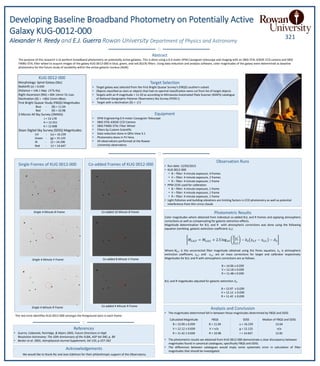
Single Frames of KUG 0012-000
Single 4 Minute B Frame
Single 4 Minute V Frame
Single 4 Minute R Frame
Co-added Frames of KUG 0012-000
Co-added 16 Minute B Frame
Co-added 8 Minute V Frame
Co-added 4 Minute R Frame
Observation Runs
• Run date: 12/03/2015
• KUG 0012-000
• B – filter: 4 minute exposure, 4 frames
• V – filter: 4 minute exposure, 2 frames
• R – filter: 4 minute exposure, 1 frame
• PPM 2235 used for calibration
• B – filter: 4 minute exposure, 1 frame
• V – filter: 4 minute exposure, 1 frame
• R – filter: 4 minute exposure, 1 frame
• Light Pollution and building vibrations are limiting factors in CCD photometry as well as potential
interference from thin cirrus clouds
Photometric Results
Color magnitudes where obtained from individual co-added B,V, and R frames and applying atmospheric
corrections as well as compensating for galactic extinction effects.
Magnitude determination for B,V, and R with atmospheric corrections was done using the following
equation (omitting galactic extinction coefficient 𝐴λ).
𝑀𝜆,0,𝑇 = 𝑀λ,0,𝐶 + 2.5 log10
𝑓λ,𝐶
𝑓λ,𝑇
− 𝑘 𝜆 𝑥 𝜆,𝑇 − 𝑥 𝜆,𝐶 − 𝐴λ
Where 𝑀𝜆,𝑇 is the uncorrected filter magnitude obtained using the Pores equation, 𝑘 𝜆 is atmospheric
extinction coefficient, 𝑥 𝜆,𝑇 and 𝑥 𝜆,𝐶 are air mass corrections for target and calibrator respectively.
Magnitudes for B,V, and R with atmospheric corrections are as follows.
B = 14.06 ± 0.039
V = 12.18 ± 0.039
R = 11.48 ± 0.039
B,V, and R magnitudes adjusted for galactic extinction 𝐴λ.
B = 13.97 ± 0.039
V = 12.12 ± 0.039
R = 11.42 ± 0.039
Analysis and Conclusion
• The magnitudes determined fall in between those magnitudes determined by FBQS and SDSS
• The photometric results we obtained from KUG 0012-000 demonstrate a clear discrepancy between
magnitudes found in canonical catalogues, specifically FBQS and SDSS.
• The differences between catalogues would imply some systematic error in calculation of filter
magnitudes that should be investigated.
References
• Guerra, Cabanela, Partridge, & Myers 2005, Future Directions in High
Resolution Astronomy: The 10th Anniversary of the VLBA, ASP Vol 340, p. 89
• Becker et al. 2001, Astrophysical Journal Supplement, Vol 135, p 227-262
Acknowledgements
We would like to thank Ric and Jean Edelman for their philanthropic support of the Observatory.
321
The red circle identifies KUG 0012-000 amongst the foreground stars in each frame.
Calculated Magnitude FBQS SDSS Median of FBQS and SDSS
B = 13.90 ± 0.039 B = 11.04 u = 16.239 13.64
V = 12.12 ± 0.039 V = n/a g = 15.125 n/a
R = 11.42 ± 0.039 R = 10.98 r = 14.647 12.81

AGN STEM FINAL

  • 1.
    Developing Baseline BroadbandPhotometry on Potentially Active Galaxy KUG-0012-000 Alexander H. Reedy and E.J. Guerra Rowan University Department of Physics and Astronomy Abstract The purpose of this research is to perform broadband photometry on potentially active galaxies. This is done using a 0.4 meter DFM Cassegrain telescope and imaging with an SBIG STXL-6303E CCD camera and SBIG FW8G-STXL filter wheel to acquire images of the galaxy KUG 0012-000 in blue, green, and red (B,V,R) filters. Using data reduction and analysis software, color magnitudes of the galaxy were determined as baseline photometry for the future study of variability within the active galactic nucleus (AGN). Equipment • DFM Engineering 0.4-meter Cassegrain Telescope • SBIG STXL-6303E CCD Camera • SBIG FW8G-STXL Filter Wheel • Filters by Custom Scientific • Data reduction done in Qfits View 3.1 • Photometry done in FV Hera. • All observations performed at the Rowan University observatory KUG 0012-000 Morphology: Spiral Galaxy (Sbc) Redshift (z) = 0.039 Distance = 146.1 Mpc (476.4ly) Right Ascension (RA) = 00h 14min 55.1sec Declination (δ) = +00d 15min 08sec First Bright Quasar Study (FBQS) Magnitudes Blue - (B) = 11.04 Red - (R) = 10.98 2 Micron All Sky Survey (2MASS) J = 13.178 H = 12.551 K = 12.008 Sloan Digital Sky Survey (SDSS) Magnitudes: UV - (u) = 16.239 Green - (g) = 15.125 IR - (i) = 14.296 Red - (r) = 14.647 Target Selection • Target galaxy was selected from the First Bright Quasar Survey’s (FBQS) southern subset. • Objects classified as stars or objects that had no spectral classification were cut from list of target objects • Targets with an R magnitude < 11.50 as according to Minnesota Automated Plate Scanner (MAPS) catalogue of National Geographic-Palomar Observatory Sky Survey (POSS I). • Target with a declination (δ) > -2.5 Single Frames of KUG 0012-000 Single 4 Minute B Frame Single 4 Minute V Frame Single 4 Minute R Frame Co-added Frames of KUG 0012-000 Co-added 16 Minute B Frame Co-added 8 Minute V Frame Co-added 4 Minute R Frame Observation Runs • Run date: 12/03/2015 • KUG 0012-000 • B – filter: 4 minute exposure, 4 frames • V – filter: 4 minute exposure, 2 frames • R – filter: 4 minute exposure, 1 frame • PPM 2235 used for calibration • B – filter: 4 minute exposure, 1 frame • V – filter: 4 minute exposure, 1 frame • R – filter: 4 minute exposure, 1 frame • Light Pollution and building vibrations are limiting factors in CCD photometry as well as potential interference from thin cirrus clouds Photometric Results Color magnitudes where obtained from individual co-added B,V, and R frames and applying atmospheric corrections as well as compensating for galactic extinction effects. Magnitude determination for B,V, and R with atmospheric corrections was done using the following equation (omitting galactic extinction coefficient 𝐴λ). 𝑀𝜆,0,𝑇 = 𝑀λ,0,𝐶 + 2.5 log10 𝑓λ,𝐶 𝑓λ,𝑇 − 𝑘 𝜆 𝑥 𝜆,𝑇 − 𝑥 𝜆,𝐶 − 𝐴λ Where 𝑀𝜆,𝑇 is the uncorrected filter magnitude obtained using the Pores equation, 𝑘 𝜆 is atmospheric extinction coefficient, 𝑥 𝜆,𝑇 and 𝑥 𝜆,𝐶 are air mass corrections for target and calibrator respectively. Magnitudes for B,V, and R with atmospheric corrections are as follows. B = 14.06 ± 0.039 V = 12.18 ± 0.039 R = 11.48 ± 0.039 B,V, and R magnitudes adjusted for galactic extinction 𝐴λ. B = 13.97 ± 0.039 V = 12.12 ± 0.039 R = 11.42 ± 0.039 Analysis and Conclusion • The magnitudes determined fall in between those magnitudes determined by FBQS and SDSS • The photometric results we obtained from KUG 0012-000 demonstrate a clear discrepancy between magnitudes found in canonical catalogues, specifically FBQS and SDSS. • The differences between catalogues would imply some systematic error in calculation of filter magnitudes that should be investigated. References • Guerra, Cabanela, Partridge, & Myers 2005, Future Directions in High Resolution Astronomy: The 10th Anniversary of the VLBA, ASP Vol 340, p. 89 • Becker et al. 2001, Astrophysical Journal Supplement, Vol 135, p 227-262 Acknowledgements We would like to thank Ric and Jean Edelman for their philanthropic support of the Observatory. 321 The red circle identifies KUG 0012-000 amongst the foreground stars in each frame. Calculated Magnitude FBQS SDSS Median of FBQS and SDSS B = 13.90 ± 0.039 B = 11.04 u = 16.239 13.64 V = 12.12 ± 0.039 V = n/a g = 15.125 n/a R = 11.42 ± 0.039 R = 10.98 r = 14.647 12.81