FEMINIST THEORY
IBRAHIM MAYTHAM
Definition
Feminism or feminist theory is a range of political movements, ideologies, and social movements
that share a common goal which is to define and advance political, economic, personal, and social
rights for women.
This includes seeking to establish equal opportunities for women in education and employment.
History
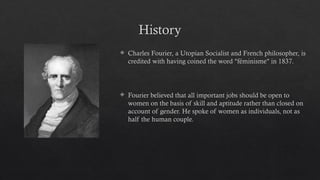
 Charles Fourier, a Utopian Socialist and French philosopher, is
credited with having coined the word "féminisme" in 1837.
 Fourier believed that all important jobs should be open to
women on the basis of skill and aptitude rather than closed on
account of gender. He spoke of women as individuals, not as
half the human couple.
History
The words "féminisme" and "féminist" first appeared in France and the Netherlands in 1872.
Great Britain in the 1890s,
and the United States in 1910.
Feminist Movements
 The history of the modern western feminist movements is divided into three "waves”
 Each wave dealt with different aspects of the same feminist issues.
First Wave
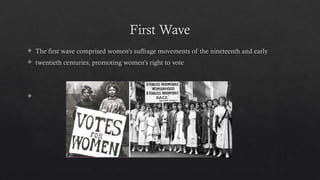
 The first wave comprised women's suffrage movements of the nineteenth and early
 twentieth centuries, promoting women's right to vote

Second Wave
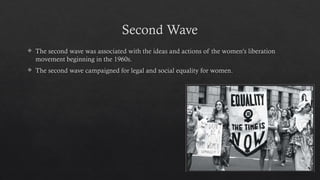
 The second wave was associated with the ideas and actions of the women's liberation
movement beginning in the 1960s.
 The second wave campaigned for legal and social equality for women.
Third Wave
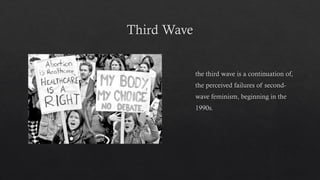
 the third wave is a continuation of,
 the perceived failures of second-
 wave feminism, beginning in the
 1990s.
3 Basic Principles in Feminism
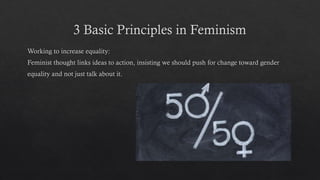
Working to increase equality:
Feminist thought links ideas to action, insisting we should push for change toward gender
equality and not just talk about it.
3 Basic Principles in Feminism
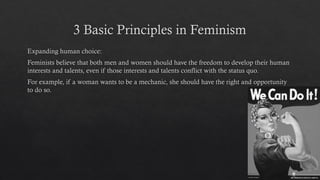
Expanding human choice:
Feminists believe that both men and women should have the freedom to develop their human
interests and talents, even if those interests and talents conflict with the status quo.
For example, if a woman wants to be a mechanic, she should have the right and opportunity
to do so.
3 Basic Principles in Feminism
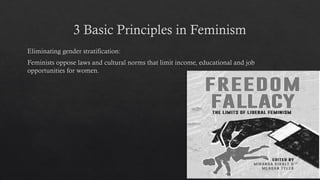
Eliminating gender stratification:
Feminists oppose laws and cultural norms that limit income, educational and job
opportunities for women.
Types of Feminism
There are three basic forms of feminism:
• Liberal Feminism
• Social Feminism
• Radical Feminism
Liberal Feminism
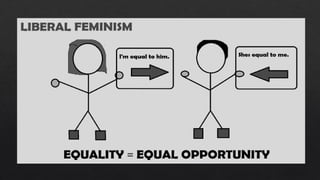
Liberal feminism is an individualistic form of feminist theory, which focuses on women’s
ability to maintain their equality through their own actions and choices.
Liberal feminists argue that society holds the false belief that women are, by nature, less
intellectually and physically capable than men
Socialist Feminism
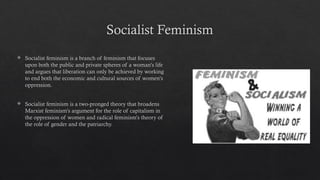
 Socialist feminism is a branch of feminism that focuses
upon both the public and private spheres of a woman's life
and argues that liberation can only be achieved by working
to end both the economic and cultural sources of women's
oppression.
 Socialist feminism is a two-pronged theory that broadens
Marxist feminism's argument for the role of capitalism in
the oppression of women and radical feminism's theory of
the role of gender and the patriarchy.
Radical Feminism
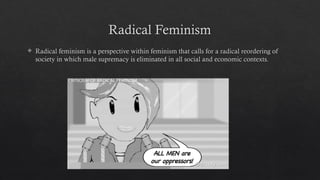
 Radical feminism is a perspective within feminism that calls for a radical reordering of
society in which male supremacy is eliminated in all social and economic contexts.
Radical Feminism
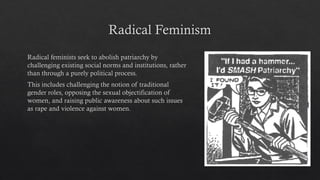
Radical feminists seek to abolish patriarchy by
challenging existing social norms and institutions, rather
than through a purely political process.
This includes challenging the notion of traditional
gender roles, opposing the sexual objectification of
women, and raising public awareness about such issues
as rape and violence against women.
If you have any question please keep it for
yourself im not google
THANK YOU
FEMINIST THEORY.pptxsacfdvcdsvsdvsdfvfsfvv

FEMINIST THEORY.pptxsacfdvcdsvsdvsdfvfsfvv

  • 1.
  • 2.
    Definition Feminism or feministtheory is a range of political movements, ideologies, and social movements that share a common goal which is to define and advance political, economic, personal, and social rights for women. This includes seeking to establish equal opportunities for women in education and employment.
  • 4.
    History  Charles Fourier,a Utopian Socialist and French philosopher, is credited with having coined the word "féminisme" in 1837.  Fourier believed that all important jobs should be open to women on the basis of skill and aptitude rather than closed on account of gender. He spoke of women as individuals, not as half the human couple.
  • 5.
    History The words "féminisme"and "féminist" first appeared in France and the Netherlands in 1872. Great Britain in the 1890s, and the United States in 1910.
  • 6.
    Feminist Movements  Thehistory of the modern western feminist movements is divided into three "waves”  Each wave dealt with different aspects of the same feminist issues.
  • 7.
    First Wave  Thefirst wave comprised women's suffrage movements of the nineteenth and early  twentieth centuries, promoting women's right to vote 
  • 8.
    Second Wave  Thesecond wave was associated with the ideas and actions of the women's liberation movement beginning in the 1960s.  The second wave campaigned for legal and social equality for women.
  • 9.
    Third Wave  thethird wave is a continuation of,  the perceived failures of second-  wave feminism, beginning in the  1990s.
  • 10.
    3 Basic Principlesin Feminism Working to increase equality: Feminist thought links ideas to action, insisting we should push for change toward gender equality and not just talk about it.
  • 11.
    3 Basic Principlesin Feminism Expanding human choice: Feminists believe that both men and women should have the freedom to develop their human interests and talents, even if those interests and talents conflict with the status quo. For example, if a woman wants to be a mechanic, she should have the right and opportunity to do so.
  • 12.
    3 Basic Principlesin Feminism Eliminating gender stratification: Feminists oppose laws and cultural norms that limit income, educational and job opportunities for women.
  • 13.
    Types of Feminism Thereare three basic forms of feminism: • Liberal Feminism • Social Feminism • Radical Feminism
  • 14.
    Liberal Feminism Liberal feminismis an individualistic form of feminist theory, which focuses on women’s ability to maintain their equality through their own actions and choices. Liberal feminists argue that society holds the false belief that women are, by nature, less intellectually and physically capable than men
  • 16.
    Socialist Feminism  Socialistfeminism is a branch of feminism that focuses upon both the public and private spheres of a woman's life and argues that liberation can only be achieved by working to end both the economic and cultural sources of women's oppression.  Socialist feminism is a two-pronged theory that broadens Marxist feminism's argument for the role of capitalism in the oppression of women and radical feminism's theory of the role of gender and the patriarchy.
  • 17.
    Radical Feminism  Radicalfeminism is a perspective within feminism that calls for a radical reordering of society in which male supremacy is eliminated in all social and economic contexts.
  • 18.
    Radical Feminism Radical feministsseek to abolish patriarchy by challenging existing social norms and institutions, rather than through a purely political process. This includes challenging the notion of traditional gender roles, opposing the sexual objectification of women, and raising public awareness about such issues as rape and violence against women.
  • 19.
    If you haveany question please keep it for yourself im not google THANK YOU