Procedia CIRP 8 (2013) 3 – 8
2212-8271 © 2013 The Authors. Published by Elsevier B.V.
Selection and peer-review under responsibility of The International Scientific Committee of the “14th CIRP Conference on Modeling of Machining
Operations” in the person of the Conference Chair Prof. Luca Settineri
doi:10.1016/j.procir.2013.06.056
14th
CIRP Conference on Modeling of Machining Operations (CIRP CMMO)
FEM-Based Modelling of the Influence of Thermophysical Properties
of Work and Cutting Tool Materials on the Process Performance
Piotr Nieslonya
*, Wit Grzesika
, Piotr Laskowskib
, Witold Habratc
a
Opole University of Technology, 76 Proszkowska str., 45-758 Opole, Poland
b
PZL WSK Rzeszów, 120 -078 Rzeszów, Poland
c
-959 Rzeszów, Poland
* Corresponding author. Tel.: +49 77 449 8460; fax: +49 77 449 8460; .E-mail address: p.nieslony@po.opole.pl.
Abstract
The paper considers the problem of the influence of constitutive model parameters on the results of FEM-based modelling of the
turning process under simple orthogonal arrangement. In these simulations C45 (AISI 1045) carbon steel and multilayer-coated
carbide tool were used. The orthogonal cutting model was used with varying cutting speed of vc=100-330 m/min and constant feed
rate f=0.16 mm/rev and depth of cut ap=2 mm. The simulations were based on the power constitutive law (PL) with a special
consideration of the temperature-related thermal influences. Both sets of literature data, i.e. Ozel’s and Kalhori’s models and own
data in the form of multi-regressive equations for the substrate and coating components were applied. The novelty of this study is
that the sensitivity analysis concerns the material flow stress in the PL model. As outputs, the average interface temperature, the
distribution of temperature on the rake face and within wedge body, as well as cutting forces were determined, compared and
discussed. Quite satisfactory results with simulation errors lower than 15% were obtained.
© 2013 The Authors. Published by Elsevier B.V.
Selection and/or peer-review under responsibility of The International Scientific Committee of the 14th CIRP Conference on
Modeling of Machining Operations" in the person of the Conference Chair Prof. Luca Settineri
Keywords: FEM simulations; constitutive models; thermal softening index
1. Constitutive material models in FEM simulation
Modelling of machining processes in terms of multi-
criteria optimization is currently developed in order to
support the implementation of new technological chains
into the production. For this reason the FEM based
simulation is a basic engineering tool in modern
industry. Unfortunately, all popular FEM simulation
methods, i.e. Lagrangian, Eulerian, ALE methods are not
able to include into the cutting model all corresponding
physical phenomena with acceptable engineering
accuracy [4,8,14].
According to the current knowledge of metal cutting
the threshold is the development of more accurate and
complete constitutive material models which consider
the appropriate mechanical thermophysical properties of
both workpiece and tool materials [1,3,15,17].
The success in developing the constitutive models
depends on solving three important problems:
Definition of mechanical properties of the workpiece
material under cutting conditions,
Specification of the thermophysical properties of the
workpiece and cutting tool materials including thin
layered coatings [3,11],
Quantification of friction in the cutting zone
[5,12,17].
The sensitivity analysis of the flow stress of 18 different
materials based on the J-C material model indicated that
it is predominantly governed either by strain hardening
or thermal softening [6]. In addition, FEM predictions
are greatly influenced by the friction coefficient [9].
It should be underlined that the FEM is one of the
leading machining problems and is very popular among
metal cutting experts and scientists. Moreover, the FEM
constitutive model should meet the HSC and HPC
demands and can be validated for a wide range of
machining parameters, especially the cutting speed
Available online at www.sciencedirect.com
© 2013 The Authors. Published by Elsevier B.V.
Selection and peer-review under responsibility of The International Scientific Committee of the “14th CIRP Conference on Modeling of Machining
Operations” in the person of the Conference Chair Prof. Luca Settineri
4 Piotr Nieslony et al. / Procedia CIRP 8 (2013) 3 – 8
[2,13]. In addition, it should cover a wide spectrum of
cutting tool materials including multilayer coated and
composite tools.
Bearing in mind all these modeling aspects and barriers,
in this study the focus is made on the influence of model
parameters for prediction accuracy under orthogonal
cutting conditions. The second important consideration
is the influence of temperature on the strain-stress
diagram.
2. Methodology of investigations
In FEM simulations the modified Lagrangian
equation was used to predict the thermal effects
occurring during orthogonal cutting process of the C45
steel. The tool material was WC-6%Co sintered carbide
coated with three-layer TiC/Al2O3/TiN (3L) coating. The
investigation program includes the comparison between
simulated and experimental results for two constitutive
material models available in AdvantEdge commercial
package [16], i.e. standard and PL-TD (Power Law –
Temperature Dependent). In this study the PL-TD model
considers two sets of model parameters of the machined
C45 steel specified in Table 1.
During experimental study the components of the
resultant cutting force were measured under free and non
free orthogonal cutting conditions. In the first case a
strain–gauge dynamometer with a SNAP Master data
acquisition system was applied. In addition, the forces in
semi-orthogonal cutting were measured using Kistler
9257B piezoelectric dynamometer equipped with 5019B
amplifier and NI 6062E, National Instruments, A/D
multi-channel board. The visualization of the recorded
force signals and its processing was performed using
CutPro data acquisition system.
Concerning the FEM modelling, both standard and PL-
TD constitutive models are described by the same power
model given by the following equation
n
p
p
opf T
/1
0
1 (1) (1)
where o is the initial yield stress, p is the plastic
strain, 0
p is the reference plastic strain, 1/n is the strain
hardening exponent and T is thermal softening
index defined as a function of temperature according to
(2). In equation (2) the c0 through c5 are coefficients for
the polynomial fit, T is the temperature, Tcut is the linear
cut off temperature, and Tmelt is the melting temperature.
The equation (2a) is defined for T<Tcut, where equation
(2b) for T Tcut.
5
5
4
4
3
3
2
210 TcTcTcTcTccT (2a)
cutmelt
cut
cut
TT
TT
TT 1 (2b)
Using the PL-TD constitutive model, the user can
define their own model parameters based on literature
data or experimental results. In the case of cutting tool
material, the FEM model is mainly related to the thermal
interactions ignoring the thermal softening effect. In this
paper these data were the same as in Ref. [11]. The
analysis of the influence of thermophysical properties of
the machined C45 steel on the changes of the
characteristics of machining process was carried out for
three groups of relevant data presented by Kalhori [7],
Özel and Karpat [12], as well as the data available in
AdvantEdge (AE) package [16]. The thermophysical
properties of the machined C45 steel were quantified
based on own investigations [11] and own database
MPDB [10]. In particular, they include temperature-
based thermal conductivity, specific heat and thermal
expansion (linear expansion coefficient ), which were
kept constant for all material models considered in this
comparative study. All the above mentioned data are
specified in Figs. 1 and 2.
Fig. 1. Sample function determined by eq. (1) for a set of experimental
data
It should be noted in Fig. 1 that in Kalhori’s analysis
the values of stress as a function of plastic strain are
generally lower than those determined by Özel and
Karpat [12]. Moreover, Kalhori [7] has considered the
relationships for the wide range of temperature
5Piotr Nieslony et al. / Procedia CIRP 8 (2013) 3 – 8
(20°C - 800°C).
Table 1. Constitutive model parameters - equations (1) and (2) -
calculated for the C45 carbon steel according to the data by Kalhori [7]
and Ozel and Karpat [12]
Parameters Kalhori Özel and Karpat
c0 1,0018 1,0162
c1 -3,57 10-4
-7,60 10-5
c2 -1,39 10-6
-1,20 10-6
c3 5,95 10-10
8,00 10-10
o , Pa 401 106
0
p
0,00191
n 6,2 4,9
CTcut
o
, 800 625
cut
0,115 0,200
Error, % 11 7
In this case, plastic strain varied from
0 to 0.115. On the other hand, Özel and Karpat focused
on the temperature range of 60°C-625°C and plastic
strain of 0.05-0.2 respectively. Based on these data,
parameters of the power constitutive model described by
eq. (1) were computed and specified in Table 1.
In this analysis, the values of the yield stress and the
reference plastic strain were assumed to be constant and
equal to o 410 MPa and 0
p
0.00191 respectively.
As a result, the relative errors determined for data
provided by Kalhori and Özel were about 11% and 7%
respectively. Changes of the thermal softening index,
describing by function T in eq. (1) are shown in
Fig. 2.
Fig. 2. Thermal softening of C45 steel calculated by eq. (2) for the data
from Table 1
It is seen in Fig. 2 that values of this index vary in
the range <1;0>, where value1 is related to the ambient
of 20°C, and value 0 corresponds to the melting
temperature. According to the computation algorithm of
the AE program, the thermal softening function was
assumed to be linear in the temperature range from that
defined by own experiments up to the melting point. It
can be pointed out that material plasticizing due to the
thermal softening occurs faster when Kalhori’s model is
used (20% and 40% at 400°C and 500°C respectively in
relation to the Özel’s data). This means that for the same
values of strain and yield stress, the calculated values of
the stresses are lower than those determined by Özel’s
model. In addition, this effect will be more pronounced
by higher values of the strain-hardening exponent n.
3. Experimental results
The analysis of the experimental results was performed
in two stages. The first parts were focused on the
variations of the cutting temperature resulting from
variations of the thermophysical properties in the FEM
model. In addition, the second part concerns the
assessment of the influences of the mechanical
properties. In this case, the main problems considered
are changes of the cutting forces and the distributions of
the reduced stresses on the tool rake face.
The average values of the cutting temperature
determined by FEM simulations for four variants of the
material models are presented in Fig. 3. First finding is
that the predicted cutting temperatures based on the data
collected in AE database were distinctly higher that
those measured. This specifically concerns the AE PL-
TD model in which the thermophysical properties of the
tool material depend on the temperature [11]. In this case
the workpiece material model is the same as the AE
Standard model. It is reasoned that experimental results
coincide well with simulated results using input data by
Kalhori [7], taking into consideration relatively large
variations of the experimental results.
Fig. 3. Comparison of the measured temperature with FEM simulation
data. Confidence interval P = 95%.
6 Piotr Nieslony et al. / Procedia CIRP 8 (2013) 3 – 8
It was also documented that predicted temperatures
depend on the values of thermal softening index. For
instance, for Ozel’s model they were equal to 0.62, 0.51
and 0.43 depending on the cutting speed used. On the
other hand, for Kalhori’s model they were reduced by
12% (0.54, 0.45, 0.38). It should be noted that initial
inputs ( o 410 MPa and 0
p
0.00191) are the same for
both models considered.
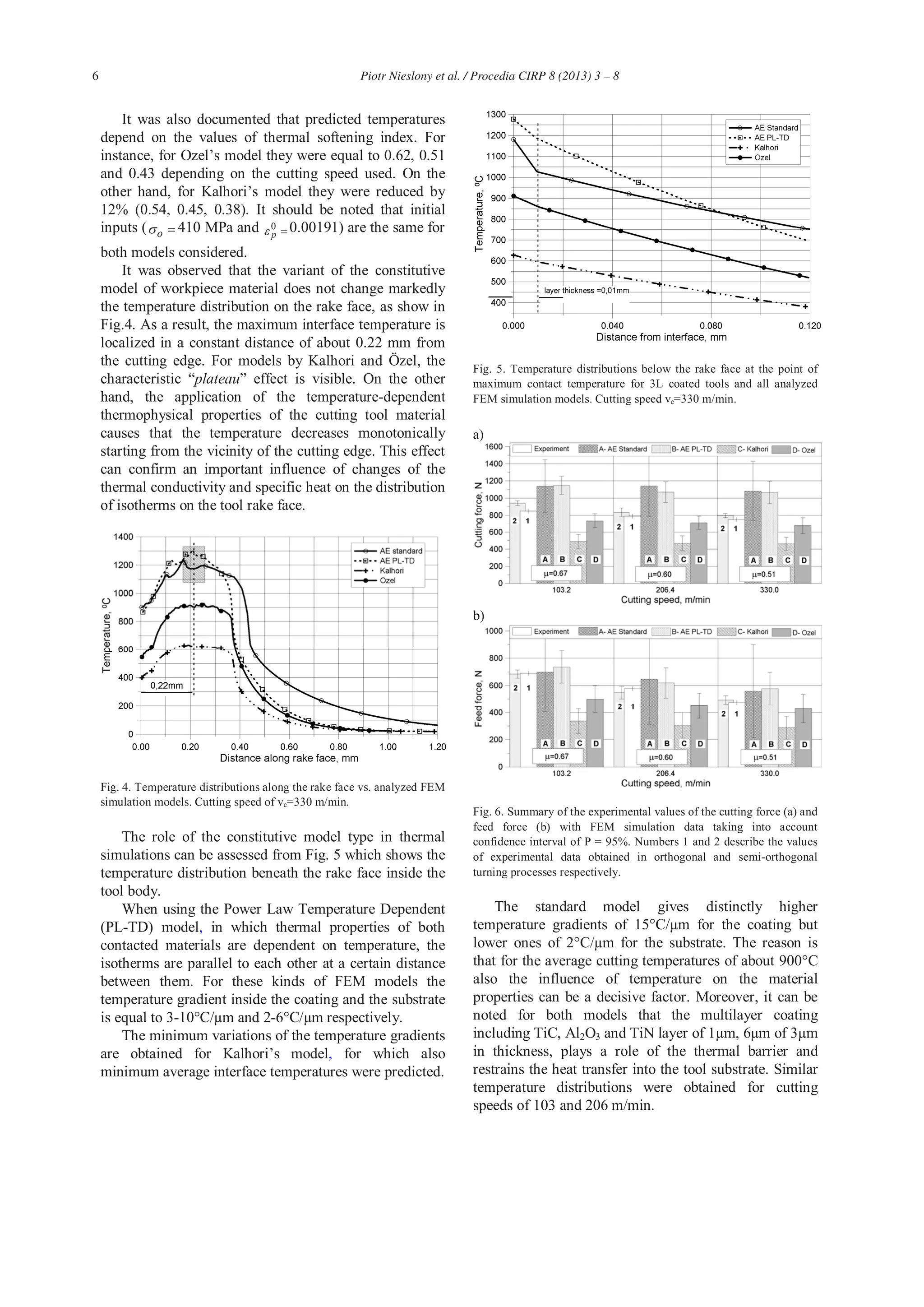
It was observed that the variant of the constitutive
model of workpiece material does not change markedly
the temperature distribution on the rake face, as show in
Fig.4. As a result, the maximum interface temperature is
localized in a constant distance of about 0.22 mm from
the cutting edge. For models by Kalhori and Özel, the
characteristic “plateau” effect is visible. On the other
hand, the application of the temperature-dependent
thermophysical properties of the cutting tool material
causes that the temperature decreases monotonically
starting from the vicinity of the cutting edge. This effect
can confirm an important influence of changes of the
thermal conductivity and specific heat on the distribution
of isotherms on the tool rake face.
Fig. 4. Temperature distributions along the rake face vs. analyzed FEM
simulation models. Cutting speed of vc=330 m/min.
The role of the constitutive model type in thermal
simulations can be assessed from Fig. 5 which shows the
temperature distribution beneath the rake face inside the
tool body.
When using the Power Law Temperature Dependent
(PL-TD) model, in which thermal properties of both
contacted materials are dependent on temperature, the
isotherms are parallel to each other at a certain distance
between them. For these kinds of FEM models the
temperature gradient inside the coating and the substrate
is equal to 3-10°C/μm and 2-6°C/μm respectively.
The minimum variations of the temperature gradients
are obtained for Kalhori’s model, for which also
minimum average interface temperatures were predicted.
Fig. 5. Temperature distributions below the rake face at the point of
maximum contact temperature for 3L coated tools and all analyzed
FEM simulation models. Cutting speed vc=330 m/min.
a)
b)
Fig. 6. Summary of the experimental values of the cutting force (a) and
feed force (b) with FEM simulation data taking into account
confidence interval of P = 95%. Numbers 1 and 2 describe the values
of experimental data obtained in orthogonal and semi-orthogonal
turning processes respectively.
The standard model gives distinctly higher
temperature gradients of 15°C/μm for the coating but
lower ones of 2°C/μm for the substrate. The reason is
that for the average cutting temperatures of about 900°C
also the influence of temperature on the material
properties can be a decisive factor. Moreover, it can be
noted for both models that the multilayer coating
including TiC, Al2O3 and TiN layer of 1μm, 6μm of 3μm
in thickness, plays a role of the thermal barrier and
restrains the heat transfer into the tool substrate. Similar
temperature distributions were obtained for cutting
speeds of 103 and 206 m/min.
7Piotr Nieslony et al. / Procedia CIRP 8 (2013) 3 – 8
The values of force components are compared in
terms of FEM model types in Fig. 6. It is reasoned that
this factor plays an important role in the simulation of
the decohesion of the workpiece material.
The observed differences relate not only to the values
of the cutting forces but also the courses of both
components Fc and Ff. In general, higher values of
cutting force were obtained for the standard FE model
which utilizes the input data from the AE database. The
minimum values of both components resulted from the
Kalhori’s model, as indicated by bar #C in Fig. 6. This
constitutive material model gives low stress values in the
entire range of strains and temperatures.
Good agreement was achieved when using Özel’s
model. In this case, the differences between
measurements and predictions do not exceed 10% for the
whole range of cutting speeds. On the other hand, it was
revealed that the feed force predictions are very sensitive
to the cutting speed. The prediction accuracy increases
from 30% to 10% when cutting speed increases.
It was observed that values of cutting forces
predicted by Ozel’s model are of 34% higher than those
predicted by Kalhori’s model. Moreover, for the cutting
temperature of 600°C the difference between predicted
values of the flow stress is about 48%. In turn, this fact
can be related to different thermal softening indexes
(0.43 and 0.70 respectively).
It should be noted that despite different measuring
devices and different machining conditions (free
orthogonal vs. non-free cutting) the measured values of
the cutting force Fc and feed force Ff differ slightly from
each other (Fig. 6 – bars # 1 and 2). The standard
deviations of the dynamic measuring signals are in the
range of ±50N and ±10N for piezoelectric and strain-
gauge dynamometers respectively. These data are very
important in terms of the acceptability and the accuracy
of FEM simulation and the constitutive models used.
It can be noted in Fig. 6 that simulation models result
in higher variations of the values of the cutting force.
For instance, for FEM simulations which utilize PL-TD
model, the standard deviation of the cutting force signal
is about ±100N regardless of the simulation variant used.
In contrast, the standard FEM model gives very high
scatters, especially for the feed force Ff (±300N). This
fact can be explained by the poor identification of the
thermal properties at high cutting temperature including
the occurrence distinct material plasticizing.
4. Summary
Based on the experimental results and FEM
predictions the conclusions are as follows:
Changes of the model parameters which control the
function pf influence the simulation results.
When keeping the same thermophysical properties
( , cp, ) in the material models, the predicted values
of cutting forces and the average cutting temperature
as well the distribution of isotherms on the rake face
differ substantially.
The best agreement between the measured and
simulated forces was achieved for the input data
given by Özel.
Better fitting of the measured temperatures to the
predicted values was found for the input data given
by Kalhori. The prediction accuracy increases from
86% to 98% for the highest cutting speed of
vc=330m/min.
The reason that these constitutive models cannot be
universal in terms of both mechanical and thermal
characteristics is the different approach to modeling
of the thermal softening effect.
Acknowledgements
The authors would like to acknowledge, that this
research has been carried out as part of a project funded
by the Polish National Centre for Research and
Development. Project No. PBS1-178595.
References
[1] Arrazola P.J. Özel T., 2010. Investigations on the Effects of
Friction Modeling in Finite Element Simulation of Machining,
Int. J Mechanical Sciences 52/1, p. 31.
[2] Attia M.H., Kops L., 2004. A New Approach to Cutting
Temperature Prediction Considering the Thermal Constriction
Phenomenon in Multi-layer Coated Tools, Annals of the CIRP
53/1, p. 47.
[3] Childs T.H.C., 2006. Numerical Experiments on the Influence
of Material and Other Variables on Plane Strain Continuous
Chip Formation in Metal Machining, Int. J Mechanical Sciences
48, p. 307.
[4] Childs T.H.C., Maekawa K., et al., 2000. Metal Cutting. Theory
and Applications, Arnold, London.
[5] Courbon C., Mabrouki T., Rech J., et al, 2011. New Thermal
Issues on the Modelling of Tool-Workpiece Interaction:
Application to Dry Cutting of AISI 1045 steel, Advanced
Materials Research 223, p. 286.
[6] Fang N., 2005. A New Quantitative Sensitivity Analysis of the
Flow Stress of 18 Engineering Materials in Machining, J. Eng.
Mater. Technol. 127, p. 192.
[7] Kalhori V., 2001. Modeling and Simulation of Mechanical
Cutting, Doctoral thesis, Lulea University of Technology.
[8] Klocke F., Krieg T., 1999. Coated Tools for Metal Cutting-
Features and Applications, Annals of the CIRP 48/2, p. 515.
[9] Maranhao C., Davim J. P., 2012. The role of flow stress and
friction coefficient in fem analysis of machining: a review,
Reviews on Advanced Materials Science 30, p. 184.
[10] Material Properties Database, 2013. MPDB, JAHM Software,
Inc.
[11] , 2011. FEM Modelling of Thermal Influences in
Turning for Defined Thermophysical Properties of Cutting Tool
Materials (in Polish), School of Metal Cutting SOS5, Opole,
Poland, p. 210.
8 Piotr Nieslony et al. / Procedia CIRP 8 (2013) 3 – 8
[12] Özel T., Karpat Y., 2007. Identification of Constitutive Material
Model Parameters for High-Strain Rate Metal Cutting
Conditions Using Evolutionary Computational Algorithms, Int.
J. Materials and Manufacturing Processes 22/5, p. 659.
[13] Özel T., Sima M., Srivastava A.K., 2010. Finite Element
Simulation of High Speed Machining Ti-6Al-4V Alloy using
Modified Material Models, NAMRI/SME 38, p. 49.
[14] Özel T., Sima M., Srivastava A.K., Kaftanoglu B., 2010.
Investigations on the Effects of Multi-Layered Coated Inserts in
Machining Ti-6Al-4V Alloy with Experiments and Finite
Element Simulations, Annals of the CIRP - Manufacturing
Technology 59/2, p. 77.
[15] Pujana J., Arrazola P.J., M’Saoubi R.M., et al., 2007. Analysis
of the Inverse Identification of Constitutive Equations applied in
Orthogonal Cutting Process, Int. J. Mach. Tools Manuf. 47,
p. 2153.
[16] Third Wave AdvantEdge User’s Manual, 2011, Version 5.8,
Minneapolis, USA.
[17] Umbrello D., M’Saoubi R., Outeiro J.C., 2007. The Influence of
Johnson–Cook Material Constants on Finite Element Simulation
of Machining of AISI 316L steel, Int. J. Mach. Tools Manuf. 47,
p. 462.

Fem based modelling of the influence of thermophysical properties

  • 1.
    Procedia CIRP 8(2013) 3 – 8 2212-8271 © 2013 The Authors. Published by Elsevier B.V. Selection and peer-review under responsibility of The International Scientific Committee of the “14th CIRP Conference on Modeling of Machining Operations” in the person of the Conference Chair Prof. Luca Settineri doi:10.1016/j.procir.2013.06.056 14th CIRP Conference on Modeling of Machining Operations (CIRP CMMO) FEM-Based Modelling of the Influence of Thermophysical Properties of Work and Cutting Tool Materials on the Process Performance Piotr Nieslonya *, Wit Grzesika , Piotr Laskowskib , Witold Habratc a Opole University of Technology, 76 Proszkowska str., 45-758 Opole, Poland b PZL WSK Rzeszów, 120 -078 Rzeszów, Poland c -959 Rzeszów, Poland * Corresponding author. Tel.: +49 77 449 8460; fax: +49 77 449 8460; .E-mail address: p.nieslony@po.opole.pl. Abstract The paper considers the problem of the influence of constitutive model parameters on the results of FEM-based modelling of the turning process under simple orthogonal arrangement. In these simulations C45 (AISI 1045) carbon steel and multilayer-coated carbide tool were used. The orthogonal cutting model was used with varying cutting speed of vc=100-330 m/min and constant feed rate f=0.16 mm/rev and depth of cut ap=2 mm. The simulations were based on the power constitutive law (PL) with a special consideration of the temperature-related thermal influences. Both sets of literature data, i.e. Ozel’s and Kalhori’s models and own data in the form of multi-regressive equations for the substrate and coating components were applied. The novelty of this study is that the sensitivity analysis concerns the material flow stress in the PL model. As outputs, the average interface temperature, the distribution of temperature on the rake face and within wedge body, as well as cutting forces were determined, compared and discussed. Quite satisfactory results with simulation errors lower than 15% were obtained. © 2013 The Authors. Published by Elsevier B.V. Selection and/or peer-review under responsibility of The International Scientific Committee of the 14th CIRP Conference on Modeling of Machining Operations" in the person of the Conference Chair Prof. Luca Settineri Keywords: FEM simulations; constitutive models; thermal softening index 1. Constitutive material models in FEM simulation Modelling of machining processes in terms of multi- criteria optimization is currently developed in order to support the implementation of new technological chains into the production. For this reason the FEM based simulation is a basic engineering tool in modern industry. Unfortunately, all popular FEM simulation methods, i.e. Lagrangian, Eulerian, ALE methods are not able to include into the cutting model all corresponding physical phenomena with acceptable engineering accuracy [4,8,14]. According to the current knowledge of metal cutting the threshold is the development of more accurate and complete constitutive material models which consider the appropriate mechanical thermophysical properties of both workpiece and tool materials [1,3,15,17]. The success in developing the constitutive models depends on solving three important problems: Definition of mechanical properties of the workpiece material under cutting conditions, Specification of the thermophysical properties of the workpiece and cutting tool materials including thin layered coatings [3,11], Quantification of friction in the cutting zone [5,12,17]. The sensitivity analysis of the flow stress of 18 different materials based on the J-C material model indicated that it is predominantly governed either by strain hardening or thermal softening [6]. In addition, FEM predictions are greatly influenced by the friction coefficient [9]. It should be underlined that the FEM is one of the leading machining problems and is very popular among metal cutting experts and scientists. Moreover, the FEM constitutive model should meet the HSC and HPC demands and can be validated for a wide range of machining parameters, especially the cutting speed Available online at www.sciencedirect.com © 2013 The Authors. Published by Elsevier B.V. Selection and peer-review under responsibility of The International Scientific Committee of the “14th CIRP Conference on Modeling of Machining Operations” in the person of the Conference Chair Prof. Luca Settineri
  • 2.
    4 Piotr Nieslonyet al. / Procedia CIRP 8 (2013) 3 – 8 [2,13]. In addition, it should cover a wide spectrum of cutting tool materials including multilayer coated and composite tools. Bearing in mind all these modeling aspects and barriers, in this study the focus is made on the influence of model parameters for prediction accuracy under orthogonal cutting conditions. The second important consideration is the influence of temperature on the strain-stress diagram. 2. Methodology of investigations In FEM simulations the modified Lagrangian equation was used to predict the thermal effects occurring during orthogonal cutting process of the C45 steel. The tool material was WC-6%Co sintered carbide coated with three-layer TiC/Al2O3/TiN (3L) coating. The investigation program includes the comparison between simulated and experimental results for two constitutive material models available in AdvantEdge commercial package [16], i.e. standard and PL-TD (Power Law – Temperature Dependent). In this study the PL-TD model considers two sets of model parameters of the machined C45 steel specified in Table 1. During experimental study the components of the resultant cutting force were measured under free and non free orthogonal cutting conditions. In the first case a strain–gauge dynamometer with a SNAP Master data acquisition system was applied. In addition, the forces in semi-orthogonal cutting were measured using Kistler 9257B piezoelectric dynamometer equipped with 5019B amplifier and NI 6062E, National Instruments, A/D multi-channel board. The visualization of the recorded force signals and its processing was performed using CutPro data acquisition system. Concerning the FEM modelling, both standard and PL- TD constitutive models are described by the same power model given by the following equation n p p opf T /1 0 1 (1) (1) where o is the initial yield stress, p is the plastic strain, 0 p is the reference plastic strain, 1/n is the strain hardening exponent and T is thermal softening index defined as a function of temperature according to (2). In equation (2) the c0 through c5 are coefficients for the polynomial fit, T is the temperature, Tcut is the linear cut off temperature, and Tmelt is the melting temperature. The equation (2a) is defined for T<Tcut, where equation (2b) for T Tcut. 5 5 4 4 3 3 2 210 TcTcTcTcTccT (2a) cutmelt cut cut TT TT TT 1 (2b) Using the PL-TD constitutive model, the user can define their own model parameters based on literature data or experimental results. In the case of cutting tool material, the FEM model is mainly related to the thermal interactions ignoring the thermal softening effect. In this paper these data were the same as in Ref. [11]. The analysis of the influence of thermophysical properties of the machined C45 steel on the changes of the characteristics of machining process was carried out for three groups of relevant data presented by Kalhori [7], Özel and Karpat [12], as well as the data available in AdvantEdge (AE) package [16]. The thermophysical properties of the machined C45 steel were quantified based on own investigations [11] and own database MPDB [10]. In particular, they include temperature- based thermal conductivity, specific heat and thermal expansion (linear expansion coefficient ), which were kept constant for all material models considered in this comparative study. All the above mentioned data are specified in Figs. 1 and 2. Fig. 1. Sample function determined by eq. (1) for a set of experimental data It should be noted in Fig. 1 that in Kalhori’s analysis the values of stress as a function of plastic strain are generally lower than those determined by Özel and Karpat [12]. Moreover, Kalhori [7] has considered the relationships for the wide range of temperature
  • 3.
    5Piotr Nieslony etal. / Procedia CIRP 8 (2013) 3 – 8 (20°C - 800°C). Table 1. Constitutive model parameters - equations (1) and (2) - calculated for the C45 carbon steel according to the data by Kalhori [7] and Ozel and Karpat [12] Parameters Kalhori Özel and Karpat c0 1,0018 1,0162 c1 -3,57 10-4 -7,60 10-5 c2 -1,39 10-6 -1,20 10-6 c3 5,95 10-10 8,00 10-10 o , Pa 401 106 0 p 0,00191 n 6,2 4,9 CTcut o , 800 625 cut 0,115 0,200 Error, % 11 7 In this case, plastic strain varied from 0 to 0.115. On the other hand, Özel and Karpat focused on the temperature range of 60°C-625°C and plastic strain of 0.05-0.2 respectively. Based on these data, parameters of the power constitutive model described by eq. (1) were computed and specified in Table 1. In this analysis, the values of the yield stress and the reference plastic strain were assumed to be constant and equal to o 410 MPa and 0 p 0.00191 respectively. As a result, the relative errors determined for data provided by Kalhori and Özel were about 11% and 7% respectively. Changes of the thermal softening index, describing by function T in eq. (1) are shown in Fig. 2. Fig. 2. Thermal softening of C45 steel calculated by eq. (2) for the data from Table 1 It is seen in Fig. 2 that values of this index vary in the range <1;0>, where value1 is related to the ambient of 20°C, and value 0 corresponds to the melting temperature. According to the computation algorithm of the AE program, the thermal softening function was assumed to be linear in the temperature range from that defined by own experiments up to the melting point. It can be pointed out that material plasticizing due to the thermal softening occurs faster when Kalhori’s model is used (20% and 40% at 400°C and 500°C respectively in relation to the Özel’s data). This means that for the same values of strain and yield stress, the calculated values of the stresses are lower than those determined by Özel’s model. In addition, this effect will be more pronounced by higher values of the strain-hardening exponent n. 3. Experimental results The analysis of the experimental results was performed in two stages. The first parts were focused on the variations of the cutting temperature resulting from variations of the thermophysical properties in the FEM model. In addition, the second part concerns the assessment of the influences of the mechanical properties. In this case, the main problems considered are changes of the cutting forces and the distributions of the reduced stresses on the tool rake face. The average values of the cutting temperature determined by FEM simulations for four variants of the material models are presented in Fig. 3. First finding is that the predicted cutting temperatures based on the data collected in AE database were distinctly higher that those measured. This specifically concerns the AE PL- TD model in which the thermophysical properties of the tool material depend on the temperature [11]. In this case the workpiece material model is the same as the AE Standard model. It is reasoned that experimental results coincide well with simulated results using input data by Kalhori [7], taking into consideration relatively large variations of the experimental results. Fig. 3. Comparison of the measured temperature with FEM simulation data. Confidence interval P = 95%.
  • 4.
    6 Piotr Nieslonyet al. / Procedia CIRP 8 (2013) 3 – 8 It was also documented that predicted temperatures depend on the values of thermal softening index. For instance, for Ozel’s model they were equal to 0.62, 0.51 and 0.43 depending on the cutting speed used. On the other hand, for Kalhori’s model they were reduced by 12% (0.54, 0.45, 0.38). It should be noted that initial inputs ( o 410 MPa and 0 p 0.00191) are the same for both models considered. It was observed that the variant of the constitutive model of workpiece material does not change markedly the temperature distribution on the rake face, as show in Fig.4. As a result, the maximum interface temperature is localized in a constant distance of about 0.22 mm from the cutting edge. For models by Kalhori and Özel, the characteristic “plateau” effect is visible. On the other hand, the application of the temperature-dependent thermophysical properties of the cutting tool material causes that the temperature decreases monotonically starting from the vicinity of the cutting edge. This effect can confirm an important influence of changes of the thermal conductivity and specific heat on the distribution of isotherms on the tool rake face. Fig. 4. Temperature distributions along the rake face vs. analyzed FEM simulation models. Cutting speed of vc=330 m/min. The role of the constitutive model type in thermal simulations can be assessed from Fig. 5 which shows the temperature distribution beneath the rake face inside the tool body. When using the Power Law Temperature Dependent (PL-TD) model, in which thermal properties of both contacted materials are dependent on temperature, the isotherms are parallel to each other at a certain distance between them. For these kinds of FEM models the temperature gradient inside the coating and the substrate is equal to 3-10°C/μm and 2-6°C/μm respectively. The minimum variations of the temperature gradients are obtained for Kalhori’s model, for which also minimum average interface temperatures were predicted. Fig. 5. Temperature distributions below the rake face at the point of maximum contact temperature for 3L coated tools and all analyzed FEM simulation models. Cutting speed vc=330 m/min. a) b) Fig. 6. Summary of the experimental values of the cutting force (a) and feed force (b) with FEM simulation data taking into account confidence interval of P = 95%. Numbers 1 and 2 describe the values of experimental data obtained in orthogonal and semi-orthogonal turning processes respectively. The standard model gives distinctly higher temperature gradients of 15°C/μm for the coating but lower ones of 2°C/μm for the substrate. The reason is that for the average cutting temperatures of about 900°C also the influence of temperature on the material properties can be a decisive factor. Moreover, it can be noted for both models that the multilayer coating including TiC, Al2O3 and TiN layer of 1μm, 6μm of 3μm in thickness, plays a role of the thermal barrier and restrains the heat transfer into the tool substrate. Similar temperature distributions were obtained for cutting speeds of 103 and 206 m/min.
  • 5.
    7Piotr Nieslony etal. / Procedia CIRP 8 (2013) 3 – 8 The values of force components are compared in terms of FEM model types in Fig. 6. It is reasoned that this factor plays an important role in the simulation of the decohesion of the workpiece material. The observed differences relate not only to the values of the cutting forces but also the courses of both components Fc and Ff. In general, higher values of cutting force were obtained for the standard FE model which utilizes the input data from the AE database. The minimum values of both components resulted from the Kalhori’s model, as indicated by bar #C in Fig. 6. This constitutive material model gives low stress values in the entire range of strains and temperatures. Good agreement was achieved when using Özel’s model. In this case, the differences between measurements and predictions do not exceed 10% for the whole range of cutting speeds. On the other hand, it was revealed that the feed force predictions are very sensitive to the cutting speed. The prediction accuracy increases from 30% to 10% when cutting speed increases. It was observed that values of cutting forces predicted by Ozel’s model are of 34% higher than those predicted by Kalhori’s model. Moreover, for the cutting temperature of 600°C the difference between predicted values of the flow stress is about 48%. In turn, this fact can be related to different thermal softening indexes (0.43 and 0.70 respectively). It should be noted that despite different measuring devices and different machining conditions (free orthogonal vs. non-free cutting) the measured values of the cutting force Fc and feed force Ff differ slightly from each other (Fig. 6 – bars # 1 and 2). The standard deviations of the dynamic measuring signals are in the range of ±50N and ±10N for piezoelectric and strain- gauge dynamometers respectively. These data are very important in terms of the acceptability and the accuracy of FEM simulation and the constitutive models used. It can be noted in Fig. 6 that simulation models result in higher variations of the values of the cutting force. For instance, for FEM simulations which utilize PL-TD model, the standard deviation of the cutting force signal is about ±100N regardless of the simulation variant used. In contrast, the standard FEM model gives very high scatters, especially for the feed force Ff (±300N). This fact can be explained by the poor identification of the thermal properties at high cutting temperature including the occurrence distinct material plasticizing. 4. Summary Based on the experimental results and FEM predictions the conclusions are as follows: Changes of the model parameters which control the function pf influence the simulation results. When keeping the same thermophysical properties ( , cp, ) in the material models, the predicted values of cutting forces and the average cutting temperature as well the distribution of isotherms on the rake face differ substantially. The best agreement between the measured and simulated forces was achieved for the input data given by Özel. Better fitting of the measured temperatures to the predicted values was found for the input data given by Kalhori. The prediction accuracy increases from 86% to 98% for the highest cutting speed of vc=330m/min. The reason that these constitutive models cannot be universal in terms of both mechanical and thermal characteristics is the different approach to modeling of the thermal softening effect. Acknowledgements The authors would like to acknowledge, that this research has been carried out as part of a project funded by the Polish National Centre for Research and Development. Project No. PBS1-178595. References [1] Arrazola P.J. Özel T., 2010. Investigations on the Effects of Friction Modeling in Finite Element Simulation of Machining, Int. J Mechanical Sciences 52/1, p. 31. [2] Attia M.H., Kops L., 2004. A New Approach to Cutting Temperature Prediction Considering the Thermal Constriction Phenomenon in Multi-layer Coated Tools, Annals of the CIRP 53/1, p. 47. [3] Childs T.H.C., 2006. Numerical Experiments on the Influence of Material and Other Variables on Plane Strain Continuous Chip Formation in Metal Machining, Int. J Mechanical Sciences 48, p. 307. [4] Childs T.H.C., Maekawa K., et al., 2000. Metal Cutting. Theory and Applications, Arnold, London. [5] Courbon C., Mabrouki T., Rech J., et al, 2011. New Thermal Issues on the Modelling of Tool-Workpiece Interaction: Application to Dry Cutting of AISI 1045 steel, Advanced Materials Research 223, p. 286. [6] Fang N., 2005. A New Quantitative Sensitivity Analysis of the Flow Stress of 18 Engineering Materials in Machining, J. Eng. Mater. Technol. 127, p. 192. [7] Kalhori V., 2001. Modeling and Simulation of Mechanical Cutting, Doctoral thesis, Lulea University of Technology. [8] Klocke F., Krieg T., 1999. Coated Tools for Metal Cutting- Features and Applications, Annals of the CIRP 48/2, p. 515. [9] Maranhao C., Davim J. P., 2012. The role of flow stress and friction coefficient in fem analysis of machining: a review, Reviews on Advanced Materials Science 30, p. 184. [10] Material Properties Database, 2013. MPDB, JAHM Software, Inc. [11] , 2011. FEM Modelling of Thermal Influences in Turning for Defined Thermophysical Properties of Cutting Tool Materials (in Polish), School of Metal Cutting SOS5, Opole, Poland, p. 210.
  • 6.
    8 Piotr Nieslonyet al. / Procedia CIRP 8 (2013) 3 – 8 [12] Özel T., Karpat Y., 2007. Identification of Constitutive Material Model Parameters for High-Strain Rate Metal Cutting Conditions Using Evolutionary Computational Algorithms, Int. J. Materials and Manufacturing Processes 22/5, p. 659. [13] Özel T., Sima M., Srivastava A.K., 2010. Finite Element Simulation of High Speed Machining Ti-6Al-4V Alloy using Modified Material Models, NAMRI/SME 38, p. 49. [14] Özel T., Sima M., Srivastava A.K., Kaftanoglu B., 2010. Investigations on the Effects of Multi-Layered Coated Inserts in Machining Ti-6Al-4V Alloy with Experiments and Finite Element Simulations, Annals of the CIRP - Manufacturing Technology 59/2, p. 77. [15] Pujana J., Arrazola P.J., M’Saoubi R.M., et al., 2007. Analysis of the Inverse Identification of Constitutive Equations applied in Orthogonal Cutting Process, Int. J. Mach. Tools Manuf. 47, p. 2153. [16] Third Wave AdvantEdge User’s Manual, 2011, Version 5.8, Minneapolis, USA. [17] Umbrello D., M’Saoubi R., Outeiro J.C., 2007. The Influence of Johnson–Cook Material Constants on Finite Element Simulation of Machining of AISI 316L steel, Int. J. Mach. Tools Manuf. 47, p. 462.